Incremental and Parallel Computation of
Structural Graph Summaries
for Evolving Graphs
Till Blume1
, David Richerby2
, and Ansgar Scherp3
CIKM 2020, Virtual Event
1
Kiel University, Germany
2
University of Essex, United Kingdom
3
Ulm University, Germany
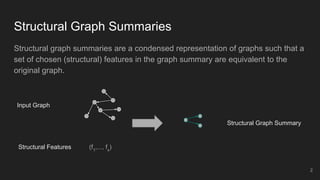
Structural Graph Summaries
Structural graph summaries are a condensed representation of graphs such that a
set of chosen (structural) features in the graph summary are equivalent to the
original graph.
Structural Features (f1
,..., fx
)
Input Graph
Structural Graph Summary
2
G2
G1
G2
G1 vs1
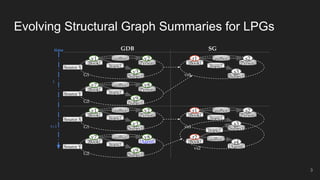
Evolving Structural Graph Summaries for LPGs
SGGDB
{Person}
v2
{Book}
v1
{Subject}
v3
{author}
{topic}Source X
{Person}
v8
{Book}
v7
{Subject}
v9
{author}
{topic}Source Y
{Person}
s2
{Book}
r1
{Subject}
s3
{author}
{topic}
{Person}
v2
{Book}
v1
{Subject}
v3
{author}
{topic}Source X
{Agent}
v8
{Book}
v7
{Subject}
v9
{author}
{topic}
{Person}
s2
{Book}
r1 {author}
{topic}
vs1
time
t
t+1 {Subject}
s3
{Book}
r2
{Agent}
s4
{topic}
{author}
vs2Source Y
3
Problem Definition
● there are various different structural features that can be used to summarize
● when the input graph changes, it is often prohibitively expensive to recompute
the structural graph summary from scratch
● existing incremental algorithms are often not designed for evolving graphs or
require an explicit change log
4
Contribution
1. generic, parallel algorithm to incrementally compute and update structural
graph summaries and as well as a generic data structure following our formal
language
2. theoretical complexity analysis: all graph summaries defined in the formal
language can be updated in O(∆·dk
), with ∆ changes the input graph, d is the
maximum degree of the input graph, and k is the maximum distance in the
subgraphs considered for the equivalence
3. empirical analyses on benchmark and real-world datasets: our
incremental algorithm outperforms a batch computation even with about 50%
of the graph changed
5
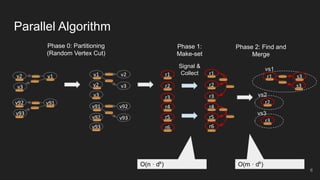
Parallel Algorithm
Phase 2: Find and
Merge
Phase 1:
Make-set
v1
v3
Signal &
Collectv2
v91
v93
v92
v1
v3
v2
v3
Phase 0: Partitioning
(Random Vertex Cut)
v2
v91
v93
v92
v93v92
r1
r2
r3
r4
r5
r6
r1
r2
r3
r4
r6
r5
r1 s3
r2
vs1
vs2
r3
vs3
s3
O(n · dk
) O(m · dk
)
6
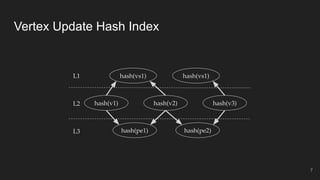
Vertex Update Hash Index
hash(v1)
hash(vs1)
hash(pe1)
hash(v2) hash(v3)
hash(vs1)
hash(pe2)
L1
L2
L3
7
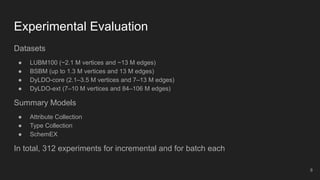
Experimental Evaluation
Datasets
● LUBM100 (~2.1 M vertices and ~13 M edges)
● BSBM (up to 1.3 M vertices and 13 M edges)
● DyLDO-core (2.1–3.5 M vertices and 7–13 M edges)
● DyLDO-ext (7–10 M vertices and 84–106 M edges)
Summary Models
● Attribute Collection
● Type Collection
● SchemEX
In total, 312 experiments for incremental and for batch each
8
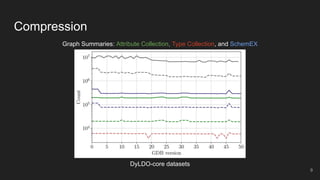
Compression
DyLDO-core datasets
9
Graph Summaries: Attribute Collection, Type Collection, and SchemEX
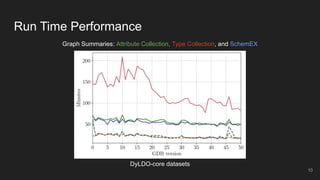
Run Time Performance
Graph Summaries: Attribute Collection, Type Collection, and SchemEX
DyLDO-core datasets
10
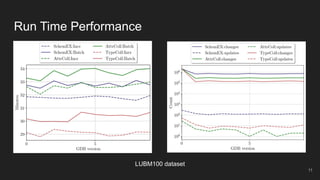
Run Time Performance
LUBM100 dataset
11
Conclusion
1. generic, parallel algorithm to incrementally compute and update structural graph
summaries and as well as a generic data structure following our formal language
2. theoretical complexity analysis: all graph summaries defined in the formal
language can be updated in O(∆·dk
), with ∆ changes the input graph, d is the
maximum degree of the input graph, and k is the maximum distance in the
subgraphs considered for the equivalence
3. empirical analyses on benchmark and real-world datasets: our incremental
algorithm outperforms a batch computation even with about 50% of the graph
changed
Source Code and all resources available on GitHub:
https://github.com/t-blume/fluid-spark 12

Incremental and parallel computation of structural graph summaries for evolving graphs

  • 1.
    Incremental and ParallelComputation of Structural Graph Summaries for Evolving Graphs Till Blume1 , David Richerby2 , and Ansgar Scherp3 CIKM 2020, Virtual Event 1 Kiel University, Germany 2 University of Essex, United Kingdom 3 Ulm University, Germany
  • 2.
    Structural Graph Summaries Structuralgraph summaries are a condensed representation of graphs such that a set of chosen (structural) features in the graph summary are equivalent to the original graph. Structural Features (f1 ,..., fx ) Input Graph Structural Graph Summary 2
  • 3.
    G2 G1 G2 G1 vs1 Evolving StructuralGraph Summaries for LPGs SGGDB {Person} v2 {Book} v1 {Subject} v3 {author} {topic}Source X {Person} v8 {Book} v7 {Subject} v9 {author} {topic}Source Y {Person} s2 {Book} r1 {Subject} s3 {author} {topic} {Person} v2 {Book} v1 {Subject} v3 {author} {topic}Source X {Agent} v8 {Book} v7 {Subject} v9 {author} {topic} {Person} s2 {Book} r1 {author} {topic} vs1 time t t+1 {Subject} s3 {Book} r2 {Agent} s4 {topic} {author} vs2Source Y 3
  • 4.
    Problem Definition ● thereare various different structural features that can be used to summarize ● when the input graph changes, it is often prohibitively expensive to recompute the structural graph summary from scratch ● existing incremental algorithms are often not designed for evolving graphs or require an explicit change log 4
  • 5.
    Contribution 1. generic, parallelalgorithm to incrementally compute and update structural graph summaries and as well as a generic data structure following our formal language 2. theoretical complexity analysis: all graph summaries defined in the formal language can be updated in O(∆·dk ), with ∆ changes the input graph, d is the maximum degree of the input graph, and k is the maximum distance in the subgraphs considered for the equivalence 3. empirical analyses on benchmark and real-world datasets: our incremental algorithm outperforms a batch computation even with about 50% of the graph changed 5
  • 6.
    Parallel Algorithm Phase 2:Find and Merge Phase 1: Make-set v1 v3 Signal & Collectv2 v91 v93 v92 v1 v3 v2 v3 Phase 0: Partitioning (Random Vertex Cut) v2 v91 v93 v92 v93v92 r1 r2 r3 r4 r5 r6 r1 r2 r3 r4 r6 r5 r1 s3 r2 vs1 vs2 r3 vs3 s3 O(n · dk ) O(m · dk ) 6
  • 7.
    Vertex Update HashIndex hash(v1) hash(vs1) hash(pe1) hash(v2) hash(v3) hash(vs1) hash(pe2) L1 L2 L3 7
  • 8.
    Experimental Evaluation Datasets ● LUBM100(~2.1 M vertices and ~13 M edges) ● BSBM (up to 1.3 M vertices and 13 M edges) ● DyLDO-core (2.1–3.5 M vertices and 7–13 M edges) ● DyLDO-ext (7–10 M vertices and 84–106 M edges) Summary Models ● Attribute Collection ● Type Collection ● SchemEX In total, 312 experiments for incremental and for batch each 8
  • 9.
    Compression DyLDO-core datasets 9 Graph Summaries:Attribute Collection, Type Collection, and SchemEX
  • 10.
    Run Time Performance GraphSummaries: Attribute Collection, Type Collection, and SchemEX DyLDO-core datasets 10
  • 11.
  • 12.
    Conclusion 1. generic, parallelalgorithm to incrementally compute and update structural graph summaries and as well as a generic data structure following our formal language 2. theoretical complexity analysis: all graph summaries defined in the formal language can be updated in O(∆·dk ), with ∆ changes the input graph, d is the maximum degree of the input graph, and k is the maximum distance in the subgraphs considered for the equivalence 3. empirical analyses on benchmark and real-world datasets: our incremental algorithm outperforms a batch computation even with about 50% of the graph changed Source Code and all resources available on GitHub: https://github.com/t-blume/fluid-spark 12