THE FEUDAL SYSTEM EUROPE BETWEEN THE 11TH AND THE 13TH CENTURY   Bilingual project-IES Fco. Rodríguez Marín-Osuna (Seville-Spain)-2010/11 Comenius assistant: Francesco Scudellari PLEASE  NOTE: At the bottom of every slide there will be a section called  VOCABULARY.  Please write down the Vocabulary section’s words, along with their Spanish translation, in your notebook.
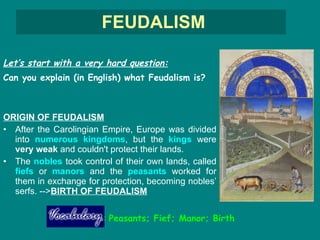
FEUDALISM Let’s start with a very hard question: Can you explain (in English) what Feudalism is? ORIGIN OF FEUDALISM After the Carolingian Empire, Europe was divided into  numerous kingdoms , but the  kings  were  very weak  and couldn't protect their lands.  The  nobles  took control of their own lands, called  fiefs   or  manors  and the  peasants  worked for them in exchange for protection, becoming nobles’ serfs. --> BIRTH OF FEUDALISM :  Peasants; Fief; Manor; Birth
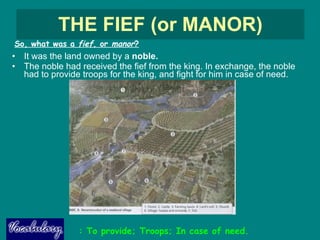
THE FIEF (or MANOR) It was the land owned by a  noble. The noble had received the fief from the king. In exchange, the noble had to provide troops for the king, and fight for him in case of need. So, what was a  fief , or  manor ? : To provide; Troops; In case of need.
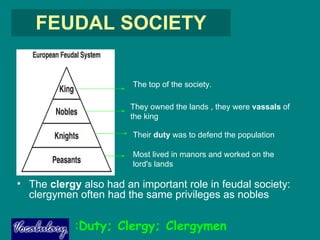
FEUDAL SOCIETY : Duty; Clergy; Clergymen The  clergy  also had an important role in feudal society: clergymen often had the same privileges as nobles The top of the society.  Their  duty  was to defend the population They owned the lands , they were  vassals  of the king Most lived in manors and worked on the lord's lands
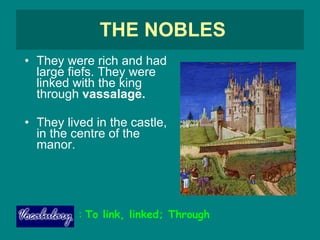
THE NOBLES They were rich and had large fiefs. They were linked with the king through  vassalage. They lived in the castle, in the centre of the manor.  :  To link, linked; Through
THE  KNIGHTS They were Nobles of lower rank, they only had their horses and weapons. They were linked to a most powerful noble through vassalage.  Their main activity was war, because they had to defend their lord or king. In order to be constantly ready for war, they trained in tournaments.  The Knights’ weapons were lances,  shields and maces. :  Rank; Main; In order to; To train; Weapon; Shield
THE CLERGY The  Pope  in Rome was the head of the church . Below him there were: Secular clergy : the leaders were the  bishops , they controlled the diocese divided into  parishes  where the  priest  worked.  -  Regular   clergy : it was led by an  abbot.  Below him were the superiors who managed monasteries and convents, where  friars, monks  and  nuns  lived.  : Church; Clergy; Bishop; Parish; Priest; To lead – led – led ; Abbot; To manage Friar; Monk; Nun
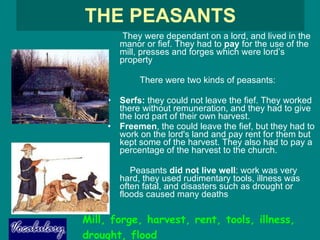
THE PEASANTS They were dependant on a lord, and lived in the manor or fief. They had to  pay  for the use of the mill, presses and forges which were lord’s property There were two kinds of peasants: Serfs:  they could not leave the fief. They worked there without remuneration, and they had to give the lord part of their own harvest. Freemen , the could leave the fief, but they had to work on the lord's land and pay rent for them but kept some of the harvest. They also had to pay a percentage of the harvest to the church. Peasants  did not live well : work was very hard, they used rudimentary tools, illness was often fatal, and disasters such as drought or floods caused many deaths Mill, forge, harvest, rent, tools, illness,  drought, flood

Unit 4.feudal europe

  • 1.
    THE FEUDAL SYSTEMEUROPE BETWEEN THE 11TH AND THE 13TH CENTURY Bilingual project-IES Fco. Rodríguez Marín-Osuna (Seville-Spain)-2010/11 Comenius assistant: Francesco Scudellari PLEASE NOTE: At the bottom of every slide there will be a section called VOCABULARY. Please write down the Vocabulary section’s words, along with their Spanish translation, in your notebook.
  • 2.
    FEUDALISM Let’s startwith a very hard question: Can you explain (in English) what Feudalism is? ORIGIN OF FEUDALISM After the Carolingian Empire, Europe was divided into numerous kingdoms , but the kings were very weak and couldn't protect their lands. The nobles took control of their own lands, called fiefs or manors and the peasants worked for them in exchange for protection, becoming nobles’ serfs. --> BIRTH OF FEUDALISM : Peasants; Fief; Manor; Birth
  • 3.
    THE FIEF (orMANOR) It was the land owned by a noble. The noble had received the fief from the king. In exchange, the noble had to provide troops for the king, and fight for him in case of need. So, what was a fief , or manor ? : To provide; Troops; In case of need.
  • 4.
    FEUDAL SOCIETY :Duty; Clergy; Clergymen The clergy also had an important role in feudal society: clergymen often had the same privileges as nobles The top of the society. Their duty was to defend the population They owned the lands , they were vassals of the king Most lived in manors and worked on the lord's lands
  • 5.
    THE NOBLES Theywere rich and had large fiefs. They were linked with the king through vassalage. They lived in the castle, in the centre of the manor. : To link, linked; Through
  • 6.
    THE KNIGHTSThey were Nobles of lower rank, they only had their horses and weapons. They were linked to a most powerful noble through vassalage. Their main activity was war, because they had to defend their lord or king. In order to be constantly ready for war, they trained in tournaments. The Knights’ weapons were lances, shields and maces. : Rank; Main; In order to; To train; Weapon; Shield
  • 7.
    THE CLERGY The Pope in Rome was the head of the church . Below him there were: Secular clergy : the leaders were the bishops , they controlled the diocese divided into parishes where the priest worked. - Regular clergy : it was led by an abbot. Below him were the superiors who managed monasteries and convents, where friars, monks and nuns lived. : Church; Clergy; Bishop; Parish; Priest; To lead – led – led ; Abbot; To manage Friar; Monk; Nun
  • 8.
    THE PEASANTS Theywere dependant on a lord, and lived in the manor or fief. They had to pay for the use of the mill, presses and forges which were lord’s property There were two kinds of peasants: Serfs: they could not leave the fief. They worked there without remuneration, and they had to give the lord part of their own harvest. Freemen , the could leave the fief, but they had to work on the lord's land and pay rent for them but kept some of the harvest. They also had to pay a percentage of the harvest to the church. Peasants did not live well : work was very hard, they used rudimentary tools, illness was often fatal, and disasters such as drought or floods caused many deaths Mill, forge, harvest, rent, tools, illness, drought, flood