United States   of America
Population and area ·  It is located in the Western Hemisphere on the continent of North America. · With 9.83 millions of km² and more than 310 million inhabitants. · It is the third or the fourth largest country by total area and by people.  · The nation's capital, Washington D.C, is located on the mid-Atlantic coast. · It has 50 states.
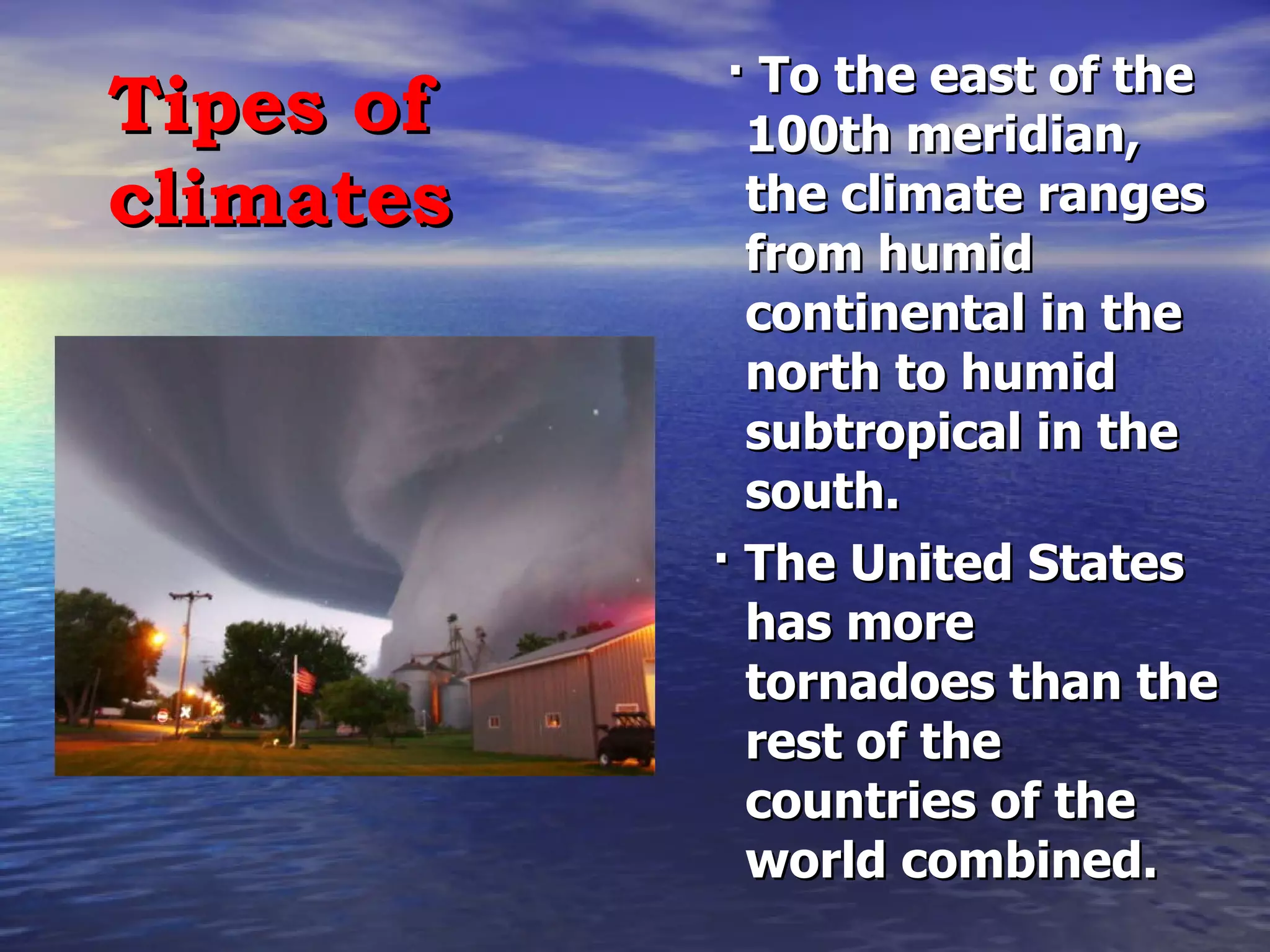
· To the east of the 100th meridian, the climate ranges from humid continental in the north to humid subtropical in the south. ·  The United States has more tornadoes than the rest of the countries of the world combined. Tipes of climates
· · The Ohioan climate is continental, and therefore usually mild, with a cool and sometimes rainy spring, and warm summers with some humidity. Autumn tends to be cool, while winters are cold with snowfall.  · The southern part of the state is the warmest, with the least frost, while the eastern highland areas tend to be colder, especially in winter.
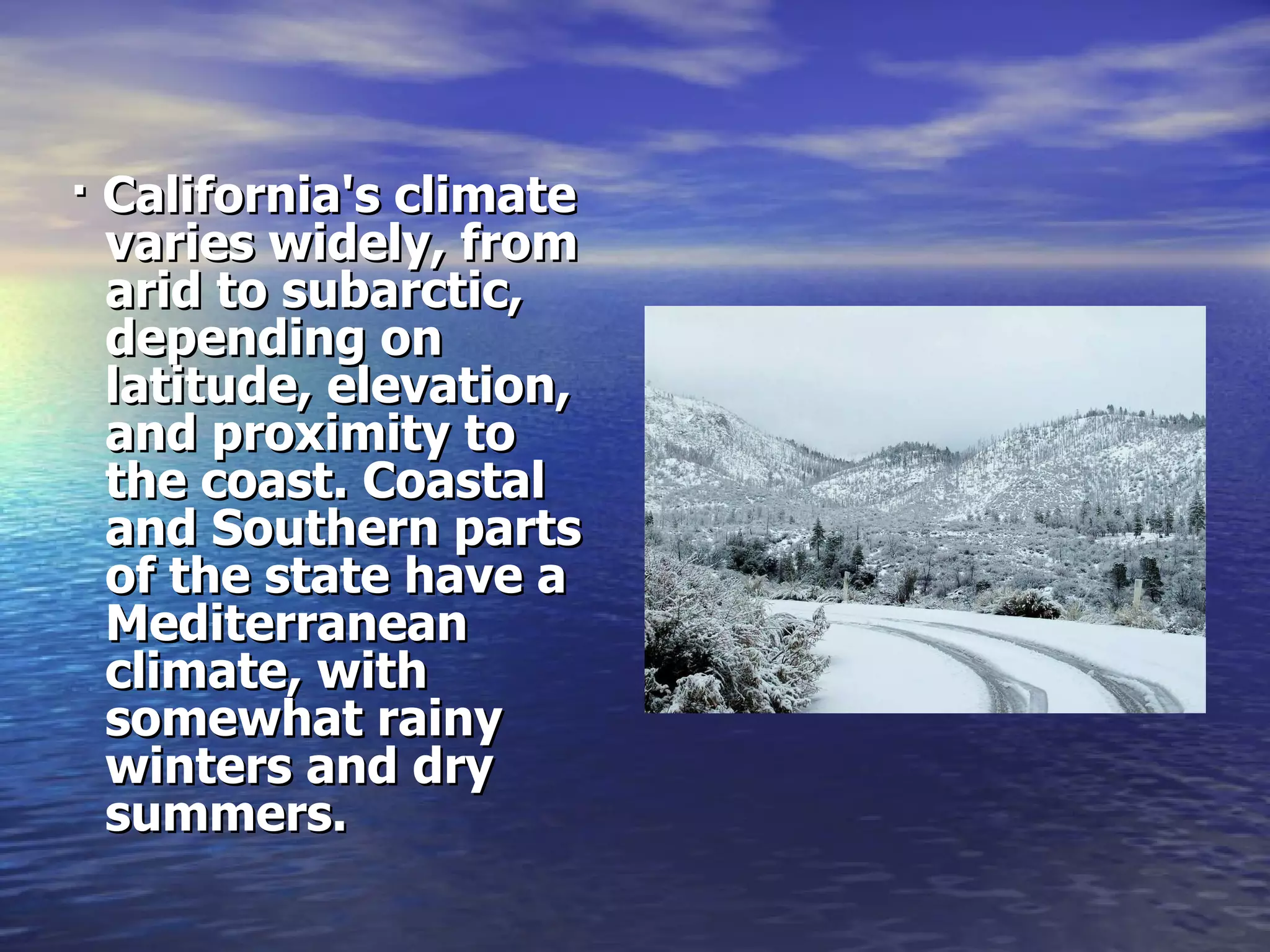
· California's climate varies widely, from arid to subarctic, depending on latitude, elevation, and proximity to the coast. Coastal and Southern parts of the state have a Mediterranean climate, with somewhat rainy winters and dry summers.
Made by: - Marina Vázquez Vázquez - María Villar Espada - Beatriz Mendoza de Puelles

United states

  • 1.
    United States of America
  • 2.
    Population and area· It is located in the Western Hemisphere on the continent of North America. · With 9.83 millions of km² and more than 310 million inhabitants. · It is the third or the fourth largest country by total area and by people. · The nation's capital, Washington D.C, is located on the mid-Atlantic coast. · It has 50 states.
  • 3.
    · To theeast of the 100th meridian, the climate ranges from humid continental in the north to humid subtropical in the south. · The United States has more tornadoes than the rest of the countries of the world combined. Tipes of climates
  • 4.
    · · TheOhioan climate is continental, and therefore usually mild, with a cool and sometimes rainy spring, and warm summers with some humidity. Autumn tends to be cool, while winters are cold with snowfall. · The southern part of the state is the warmest, with the least frost, while the eastern highland areas tend to be colder, especially in winter.
  • 5.
    · California's climatevaries widely, from arid to subarctic, depending on latitude, elevation, and proximity to the coast. Coastal and Southern parts of the state have a Mediterranean climate, with somewhat rainy winters and dry summers.
  • 6.
    Made by: -Marina Vázquez Vázquez - María Villar Espada - Beatriz Mendoza de Puelles