THE KOREAN WAR
Section 1, Lesson 2
Objectives

  • Explain how Mao Zedong and the communists
    gained power in China.

  • Describe the causes and progress of the war
    in Korea.

  • Identify the long-term effects of the Korean
    War.
Terms and People

• Mao Zedong − communist leader in China
• 38th parallel − dividing line between North Korea and
  South Korea
• Douglas MacArthur − World War II hero who
  commanded American troops in South Korea
• limited war − war fought to achieve only specific goals
• SEATO − Southeast Asia Treaty Organization; defensive
  alliance aimed at preventing the spread of communism in
  Southeast Asia
Witness History: They Won’t Escape this
Time
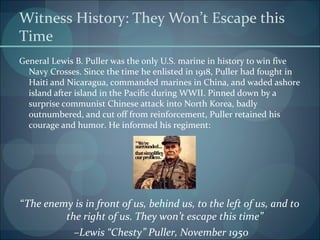
General Lewis B. Puller was the only U.S. marine in history to win five
  Navy Crosses. Since the time he enlisted in 1918, Puller had fought in
  Haiti and Nicaragua, commanded marines in China, and waded ashore
  island after island in the Pacific during WWII. Pinned down by a
  surprise communist Chinese attack into North Korea, badly
  outnumbered, and cut off from reinforcement, Puller retained his
  courage and humor. He informed his regiment:


“The enemy is in front of us, behind us, to the left of us, and to
         the right of us. They won’t escape this time”
           –Lewis “Chesty” Puller, November 1950
How did President Truman use the
power of the presidency to limit the
spread of communism in East Asia?


In the early 1950s, Cold War tensions
erupted in East Asia, where communist and
non-communist forces struggled for control
of Korea.
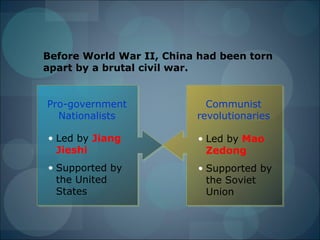
Before World War II, China had been torn
apart by a brutal civil war.


Pro-government              Communist
  Nationalists            revolutionaries

• Led by Jiang            • Led by Mao
  Jieshi                    Zedong
• Supported by            • Supported by
  the United                the Soviet
  States                    Union
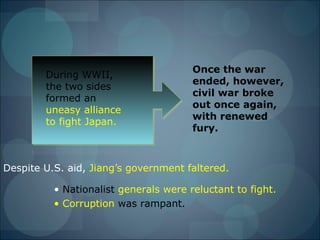
Once the war
        During WWII,
                                       ended, however,
        the two sides
                                       civil war broke
        formed an
                                       out once again,
        uneasy alliance
                                       with renewed
        to fight Japan.
                                       fury.


Despite U.S. aid, Jiang’s government faltered.

          • Nationalist generals were reluctant to fight.
          • Corruption was rampant.
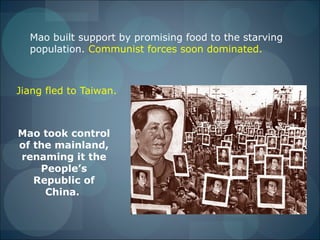
Mao built support by promising food to the starving
  population. Communist forces soon dominated.


Jiang fled to Taiwan.


Mao took control
of the mainland,
renaming it the
    People’s
   Republic of
     China.
Communism in China
Mao’s victory deeply shocked Americans.


Communists seemed to be winning everywhere,
extending their reach throughout the world.


 Communist regimes now controlled:

      • one fourth of the world’s landmass

      • one third of the world’s population
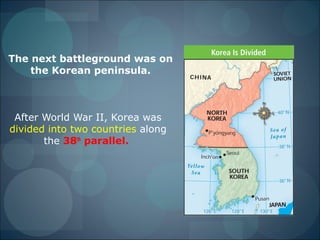
The next battleground was on
    the Korean peninsula.


 After World War II, Korea was
divided into two countries along
       the 38th parallel.
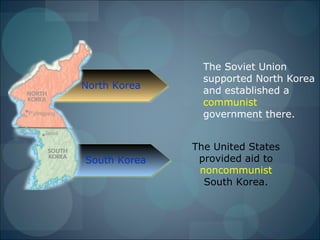
The Soviet Union
                supported North Korea
North Korea
                and established a
                communist
                government there.


              The United States
South Korea    provided aid to
               noncommunist
                South Korea.
Start of the Korean War
The crisis began in June, 1950.


                                  Communist
 North Korean troops,             forces
 armed with Soviet                advanced far
 equipment, crossed               into the South,
 the 38th parallel and            taking over
 attacked South Korea.            much of the
                                  peninsula.
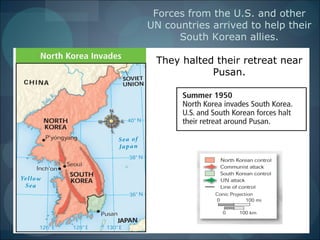
Forces from the U.S. and other
UN countries arrived to help their
      South Korean allies.

 They halted their retreat near
            Pusan.
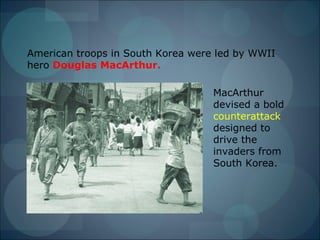
American troops in South Korea were led by WWII
hero Douglas MacArthur.

                                   MacArthur
                                   devised a bold
                                   counterattack
                                   designed to
                                   drive the
                                   invaders from
                                   South Korea.
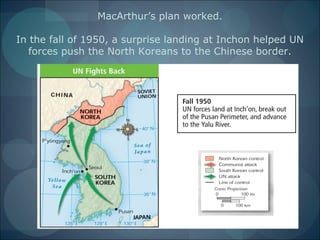
MacArthur’s plan worked.

In the fall of 1950, a surprise landing at Inchon helped UN
   forces push the North Koreans to the Chinese border.
The situation worsened when China
entered the war, sending 300,000 troops
across the border into North Korea.


      • The Chinese attacked U.S. and
        South Korean positions.

      • Badly outnumbered, UN troops
        were forced to retreat.
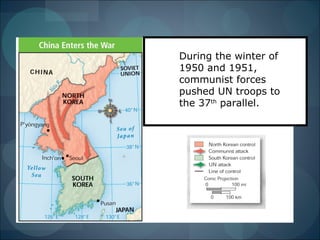
During the winter of
1950 and 1951,
communist forces
pushed UN troops to
the 37th parallel.
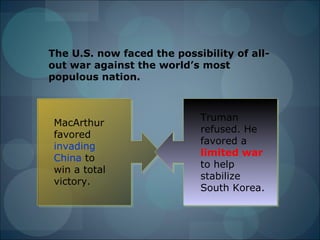
The U.S. now faced the possibility of all-
out war against the world’s most
populous nation.


                            Truman
 MacArthur
                            refused. He
 favored
                            favored a
 invading
                            limited war
 China to
                            to help
 win a total
                            stabilize
 victory.
                            South Korea.
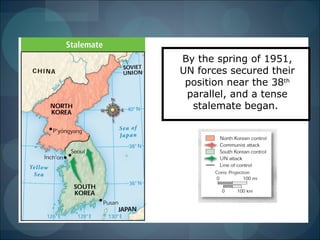
By the spring of 1951,
UN forces secured their
 position near the 38th
 parallel, and a tense
  stalemate began.
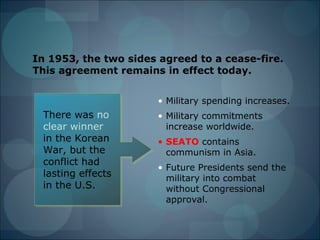
In 1953, the two sides agreed to a cease-fire.
This agreement remains in effect today.


                      • Military spending increases.
 There was no         • Military commitments
 clear winner           increase worldwide.
 in the Korean        • SEATO contains
 War, but the           communism in Asia.
 conflict had
                      • Future Presidents send the
 lasting effects        military into combat
 in the U.S.            without Congressional
                        approval.
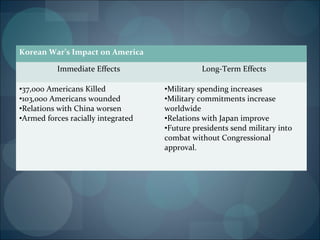
Korean War’s Impact on America

           Immediate Effects                  Long-Term Effects

•37,ooo Americans Killed            •Military spending increases
•103,000 Americans wounded          •Military commitments increase
•Relations with China worsen        worldwide
•Armed forces racially integrated   •Relations with Japan improve
                                    •Future presidents send military into
                                    combat without Congressional
                                    approval.

Unit 5 lesson 2 the korean war-1

  • 1.
  • 2.
    Objectives •Explain how Mao Zedong and the communists gained power in China. • Describe the causes and progress of the war in Korea. • Identify the long-term effects of the Korean War.
  • 3.
    Terms and People •Mao Zedong − communist leader in China • 38th parallel − dividing line between North Korea and South Korea • Douglas MacArthur − World War II hero who commanded American troops in South Korea • limited war − war fought to achieve only specific goals • SEATO − Southeast Asia Treaty Organization; defensive alliance aimed at preventing the spread of communism in Southeast Asia
  • 4.
    Witness History: TheyWon’t Escape this Time General Lewis B. Puller was the only U.S. marine in history to win five Navy Crosses. Since the time he enlisted in 1918, Puller had fought in Haiti and Nicaragua, commanded marines in China, and waded ashore island after island in the Pacific during WWII. Pinned down by a surprise communist Chinese attack into North Korea, badly outnumbered, and cut off from reinforcement, Puller retained his courage and humor. He informed his regiment: “The enemy is in front of us, behind us, to the left of us, and to the right of us. They won’t escape this time” –Lewis “Chesty” Puller, November 1950
  • 5.
    How did PresidentTruman use the power of the presidency to limit the spread of communism in East Asia? In the early 1950s, Cold War tensions erupted in East Asia, where communist and non-communist forces struggled for control of Korea.
  • 6.
    Before World WarII, China had been torn apart by a brutal civil war. Pro-government Communist Nationalists revolutionaries • Led by Jiang • Led by Mao Jieshi Zedong • Supported by • Supported by the United the Soviet States Union
  • 7.
    Once the war During WWII, ended, however, the two sides civil war broke formed an out once again, uneasy alliance with renewed to fight Japan. fury. Despite U.S. aid, Jiang’s government faltered. • Nationalist generals were reluctant to fight. • Corruption was rampant.
  • 8.
    Mao built supportby promising food to the starving population. Communist forces soon dominated. Jiang fled to Taiwan. Mao took control of the mainland, renaming it the People’s Republic of China.
  • 9.
  • 10.
    Mao’s victory deeplyshocked Americans. Communists seemed to be winning everywhere, extending their reach throughout the world. Communist regimes now controlled: • one fourth of the world’s landmass • one third of the world’s population
  • 11.
    The next battlegroundwas on the Korean peninsula. After World War II, Korea was divided into two countries along the 38th parallel.
  • 12.
    The Soviet Union supported North Korea North Korea and established a communist government there. The United States South Korea provided aid to noncommunist South Korea.
  • 13.
    Start of theKorean War
  • 14.
    The crisis beganin June, 1950. Communist North Korean troops, forces armed with Soviet advanced far equipment, crossed into the South, the 38th parallel and taking over attacked South Korea. much of the peninsula.
  • 15.
    Forces from theU.S. and other UN countries arrived to help their South Korean allies. They halted their retreat near Pusan.
  • 16.
    American troops inSouth Korea were led by WWII hero Douglas MacArthur. MacArthur devised a bold counterattack designed to drive the invaders from South Korea.
  • 17.
    MacArthur’s plan worked. Inthe fall of 1950, a surprise landing at Inchon helped UN forces push the North Koreans to the Chinese border.
  • 18.
    The situation worsenedwhen China entered the war, sending 300,000 troops across the border into North Korea. • The Chinese attacked U.S. and South Korean positions. • Badly outnumbered, UN troops were forced to retreat.
  • 19.
    During the winterof 1950 and 1951, communist forces pushed UN troops to the 37th parallel.
  • 20.
    The U.S. nowfaced the possibility of all- out war against the world’s most populous nation. Truman MacArthur refused. He favored favored a invading limited war China to to help win a total stabilize victory. South Korea.
  • 21.
    By the springof 1951, UN forces secured their position near the 38th parallel, and a tense stalemate began.
  • 22.
    In 1953, thetwo sides agreed to a cease-fire. This agreement remains in effect today. • Military spending increases. There was no • Military commitments clear winner increase worldwide. in the Korean • SEATO contains War, but the communism in Asia. conflict had • Future Presidents send the lasting effects military into combat in the U.S. without Congressional approval.
  • 23.
    Korean War’s Impacton America Immediate Effects Long-Term Effects •37,ooo Americans Killed •Military spending increases •103,000 Americans wounded •Military commitments increase •Relations with China worsen worldwide •Armed forces racially integrated •Relations with Japan improve •Future presidents send military into combat without Congressional approval.