Big Ideas
Trade, War, and Migration As the Cold War began,
the United States struggled to oppose Communist
aggression in Europe and Asia through political,
economic, and military measures.
Content Vocabulary
• containment
• limited war
Academic Vocabulary
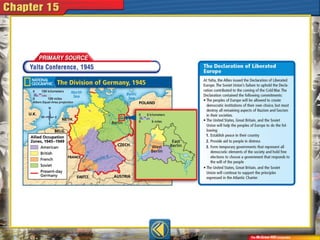
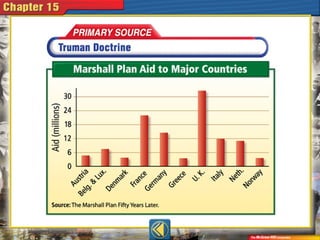
• insecurity
• initially
People and Events to Identify
• George Kennan
• Long Telegram
• Marshall Plan
• NATO
• SEATO
A. A
B. B
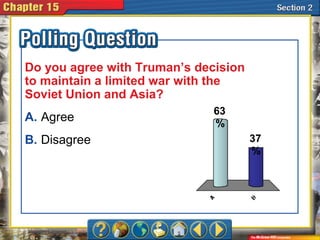
Do you agree with Truman’s decision
to maintain a limited war with the
Soviet Union and Asia?
A. Agree
B. Disagree
A B
37
%
63
%
Containing Communism
The Truman Doctrine offered aid to any
nation resisting communism; the
Marshall Plan aided European
countries in rebuilding.
• Increasingly exasperated by the Soviet’s
refusal to cooperate, officials at the State
Department asked the American Embassy in
Moscow to explain Soviet behavior.
− Diplomat George Kennan responded with
what became known as the Long Telegram.
− Kennan proposed “a long term, patient but
firm and vigilant containment of Russian
expansive tendencies”—the basic policy
followed by the United States throughout the
Cold War.
Containing Communism (cont.)
• After World War II, instead of withdrawing as
promised, the Soviet troops remained in
northern Iran.
Containing Communism (cont.)
− Stalin then began demanding access to
Iran’s oil supplies; he also helped local
Communists establish a separate
government in northern Iran.
− The secretary of state sent Stalin a strong
message demanding that they withdraw from
northern Iran.
− Coupled with the threat of the USS Missouri
sailing into the eastern Mediterranean, Stalin
withdrew.
• In August 1946 Stalin demanded joint control of
the Dardanelles with Turkey.
• After Britain informed the United States that
they could no longer afford to help Greece,
Truman gave a speech to Congress outlining a
policy that became known as the
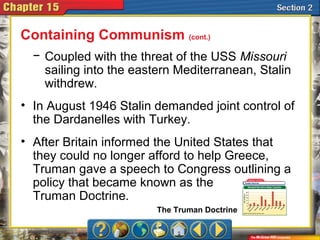
Truman Doctrine.
Containing Communism (cont.)
The Truman Doctrine
• In June 1947 Secretary of State George
Marshall proposed the European Recovery
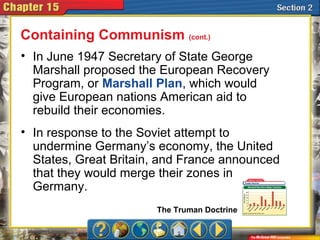
Program, or Marshall Plan, which would
give European nations American aid to
rebuild their economies.
• In response to the Soviet attempt to
undermine Germany’s economy, the United
States, Great Britain, and France announced
that they would merge their zones in
Germany.
Containing Communism (cont.)
The Truman Doctrine
• The new nation was called the Federal
Republic of Germany—or West Germany.
• The Soviet zone eventually became the
German Democratic Republic—or East
Germany.
• The Soviets then cut all road and rail traffic to
West Berlin, hoping to force the United States
to either reconsider its decision or abandon
West Berlin.
Containing Communism (cont.)
− Truman ordered the air force to fly
supplies into Berlin instead—known as the
Berlin airlift.
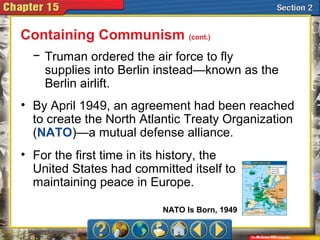
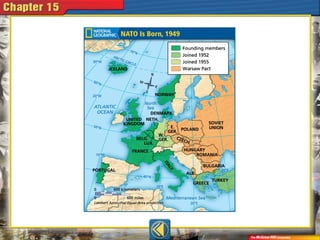
• By April 1949, an agreement had been reached
to create the North Atlantic Treaty Organization
(NATO)—a mutual defense alliance.
• For the first time in its history, the
United States had committed itself to
maintaining peace in Europe.
Containing Communism (cont.)
NATO Is Born, 1949
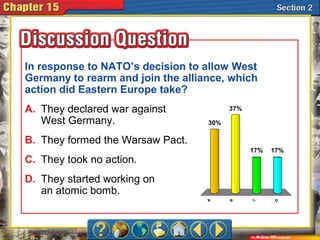
A. A
B. B
C. C
D. DA B C D
30%
17%17%
37%
In response to NATO’s decision to allow West
Germany to rearm and join the alliance, which
action did Eastern Europe take?
A. They declared war against
West Germany.
B. They formed the Warsaw Pact.
C. They took no action.
D. They started working on
an atomic bomb.
The Korean War
Attempts to keep South Korea free
from communism led the United States
to military intervention.
• After World War II, Communist forces led by
Mao Zedong and the Nationalist government
led by Chiang Kai-shek started fighting again.
− The United States sent the Nationalist
government $2 billion in aid beginning in the
mid-1940s, but they squandered the money
through poor military planning and
corruption.
− The victorious Communists established the
People’s Republic of China in October 1949.
The Korean War (cont.)
• In September 1949 the Soviet Union
announced that it had successfully tested the
first atomic weapon.
• Then, in the early 1950s, the People’s
Republic of China and the Soviet Union
signed a treaty of friendship and alliance.
The Korean War (cont.)
• At the end of World War II, General Douglas
MacArthur had taken charge of occupied
Japan.
The Korean War (cont.)
− Once the United States lost China as its
chief ally in Asia, it adopted policies to
encourage the rapid recovery of Japan’s
industrial economy.
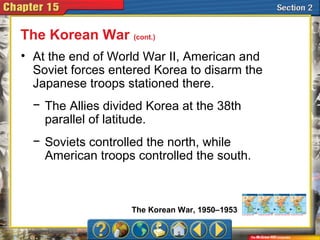
• At the end of World War II, American and
Soviet forces entered Korea to disarm the
Japanese troops stationed there.
The Korean War (cont.)
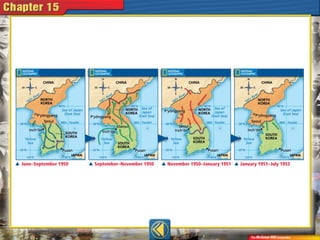
− The Allies divided Korea at the 38th
parallel of latitude.
− Soviets controlled the north, while
American troops controlled the south.
The Korean War, 1950–1953
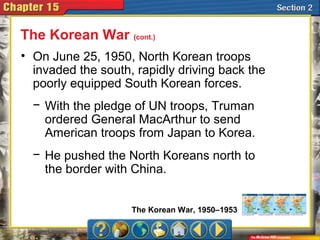
• On June 25, 1950, North Korean troops
invaded the south, rapidly driving back the
poorly equipped South Korean forces.
The Korean War (cont.)
− With the pledge of UN troops, Truman
ordered General MacArthur to send
American troops from Japan to Korea.
− He pushed the North Koreans north to
the border with China.
The Korean War, 1950–1953
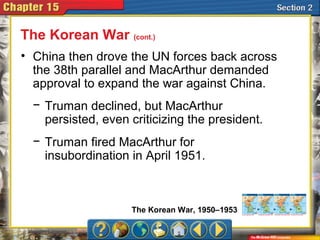
• China then drove the UN forces back across
the 38th parallel and MacArthur demanded
approval to expand the war against China.
The Korean War (cont.)
− Truman declined, but MacArthur
persisted, even criticizing the president.
− Truman fired MacArthur for
insubordination in April 1951.
The Korean War, 1950–1953
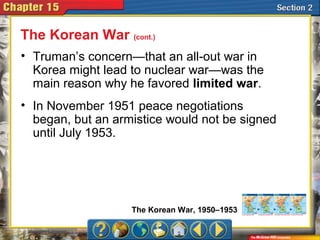
• Truman’s concern—that an all-out war in
Korea might lead to nuclear war—was the
main reason why he favored limited war.
The Korean War (cont.)
The Korean War, 1950–1953
• In November 1951 peace negotiations
began, but an armistice would not be signed
until July 1953.
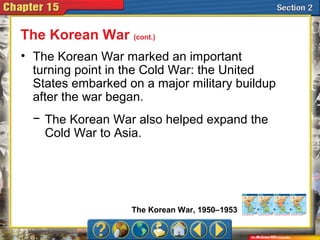
• The Korean War marked an important
turning point in the Cold War: the United
States embarked on a major military buildup
after the war began.
The Korean War (cont.)
− The Korean War also helped expand the
Cold War to Asia.
The Korean War, 1950–1953
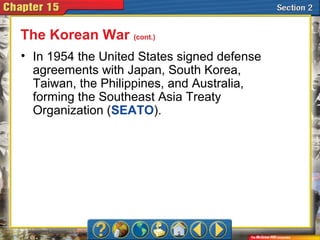
• In 1954 the United States signed defense
agreements with Japan, South Korea,
Taiwan, the Philippines, and Australia,
forming the Southeast Asia Treaty
Organization (SEATO).
The Korean War (cont.)
A. A
B. B
C. C
D. DA B C D
23%
33%
23%
20%
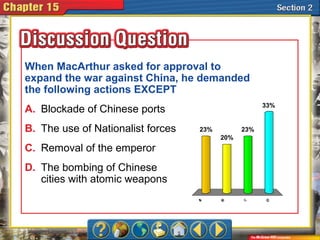
When MacArthur asked for approval to
expand the war against China, he demanded
the following actions EXCEPT
A. Blockade of Chinese ports
B. The use of Nationalist forces
C. Removal of the emperor
D. The bombing of Chinese
cities with atomic weapons
satellite nations
nations politically and economically
dominated or controlled by another,
more powerful country
Iron Curtain
the political and military barrier that
isolated Soviet-controlled countries of
Eastern Europe after World War II
liberate
to set free
equipment
the articles or physical resources
prepared or furnished for a specific
task
containment
the policy or process of preventing
the expansion of a hostile power
limited war
a war fought with limited commitment
of resources to achieve a limited
objective, such as containing
communism
insecurity
the state of not being confident or
sure
initial
of or relating to the beginning
subversion
a systematic attempt to overthrow a
government by using persons working
secretly from within
loyalty review program
a policy established by President
Truman that authorized the screening
of all federal employees to determine
their loyalty to the American
government
perjury
lying when one has sworn under oath
to tell the truth
censure
to express a formal disapproval of an
action
fallout
radioactive particles dispersed by a
nuclear explosion
manipulate
to operate or arrange manually to
achieve a desired effect
convince
to bring to belief, consent, or a course
of action
massive retaliation
a policy of threatening a massive
response, including the use of nuclear
weapons, against a Communist state
trying to seize a peaceful state by
force
brinkmanship
the willingness to go to the brink of
war to force an opponent to back
down
covert
not openly shown or engaged in
developing nation
a nation whose economy is primarily
agricultural
military-industrial complex
an informal relationship that some
people believe exists between the
military and the defense industry to
promote greater military spending and
influence government policy
imply
to express indirectly
response
something said or done as a reaction
Click the Forward button to go to the next slide.
Click the Previous button to return to the previous slide.
Click the Home button to return to the Chapter Menu.
Click the Transparency button from the Chapter Menu, Chapter Introduction, or
Visual Summary slides to access the transparencies that are relevant to this
chapter. From within a section, click on this button to access the relevant Daily
Focus Skills Transparency.
Click the Return button in a feature to return to the main presentation.
Click the History Online button to access online textbook features.
Click the Reference Atlas button to access the Interactive Reference Atlas.
Click the Exit button or press the Escape key [Esc] to end the chapter slide show.
Click the Help button to access this screen.
Links to Presentation Plus! features such as Maps in Motion, Graphs in Motion,
Charts in Motion, Concepts in Motion, and figures from your textbook are located at
the bottom of relevant screens.
To use this Presentation Plus! product:
This slide is intentionally blank.

15 2

  • 1.
    Big Ideas Trade, War,and Migration As the Cold War began, the United States struggled to oppose Communist aggression in Europe and Asia through political, economic, and military measures.
  • 2.
    Content Vocabulary • containment •limited war Academic Vocabulary • insecurity • initially
  • 3.
    People and Eventsto Identify • George Kennan • Long Telegram • Marshall Plan • NATO • SEATO
  • 4.
    A. A B. B Doyou agree with Truman’s decision to maintain a limited war with the Soviet Union and Asia? A. Agree B. Disagree A B 37 % 63 %
  • 5.
    Containing Communism The TrumanDoctrine offered aid to any nation resisting communism; the Marshall Plan aided European countries in rebuilding.
  • 6.
    • Increasingly exasperatedby the Soviet’s refusal to cooperate, officials at the State Department asked the American Embassy in Moscow to explain Soviet behavior. − Diplomat George Kennan responded with what became known as the Long Telegram. − Kennan proposed “a long term, patient but firm and vigilant containment of Russian expansive tendencies”—the basic policy followed by the United States throughout the Cold War. Containing Communism (cont.)
  • 7.
    • After WorldWar II, instead of withdrawing as promised, the Soviet troops remained in northern Iran. Containing Communism (cont.) − Stalin then began demanding access to Iran’s oil supplies; he also helped local Communists establish a separate government in northern Iran. − The secretary of state sent Stalin a strong message demanding that they withdraw from northern Iran.
  • 8.
    − Coupled withthe threat of the USS Missouri sailing into the eastern Mediterranean, Stalin withdrew. • In August 1946 Stalin demanded joint control of the Dardanelles with Turkey. • After Britain informed the United States that they could no longer afford to help Greece, Truman gave a speech to Congress outlining a policy that became known as the Truman Doctrine. Containing Communism (cont.) The Truman Doctrine
  • 9.
    • In June1947 Secretary of State George Marshall proposed the European Recovery Program, or Marshall Plan, which would give European nations American aid to rebuild their economies. • In response to the Soviet attempt to undermine Germany’s economy, the United States, Great Britain, and France announced that they would merge their zones in Germany. Containing Communism (cont.) The Truman Doctrine
  • 10.
    • The newnation was called the Federal Republic of Germany—or West Germany. • The Soviet zone eventually became the German Democratic Republic—or East Germany. • The Soviets then cut all road and rail traffic to West Berlin, hoping to force the United States to either reconsider its decision or abandon West Berlin. Containing Communism (cont.)
  • 11.
    − Truman orderedthe air force to fly supplies into Berlin instead—known as the Berlin airlift. • By April 1949, an agreement had been reached to create the North Atlantic Treaty Organization (NATO)—a mutual defense alliance. • For the first time in its history, the United States had committed itself to maintaining peace in Europe. Containing Communism (cont.) NATO Is Born, 1949
  • 12.
    A. A B. B C.C D. DA B C D 30% 17%17% 37% In response to NATO’s decision to allow West Germany to rearm and join the alliance, which action did Eastern Europe take? A. They declared war against West Germany. B. They formed the Warsaw Pact. C. They took no action. D. They started working on an atomic bomb.
  • 13.
    The Korean War Attemptsto keep South Korea free from communism led the United States to military intervention.
  • 14.
    • After WorldWar II, Communist forces led by Mao Zedong and the Nationalist government led by Chiang Kai-shek started fighting again. − The United States sent the Nationalist government $2 billion in aid beginning in the mid-1940s, but they squandered the money through poor military planning and corruption. − The victorious Communists established the People’s Republic of China in October 1949. The Korean War (cont.)
  • 15.
    • In September1949 the Soviet Union announced that it had successfully tested the first atomic weapon. • Then, in the early 1950s, the People’s Republic of China and the Soviet Union signed a treaty of friendship and alliance. The Korean War (cont.)
  • 16.
    • At theend of World War II, General Douglas MacArthur had taken charge of occupied Japan. The Korean War (cont.) − Once the United States lost China as its chief ally in Asia, it adopted policies to encourage the rapid recovery of Japan’s industrial economy.
  • 17.
    • At theend of World War II, American and Soviet forces entered Korea to disarm the Japanese troops stationed there. The Korean War (cont.) − The Allies divided Korea at the 38th parallel of latitude. − Soviets controlled the north, while American troops controlled the south. The Korean War, 1950–1953
  • 18.
    • On June25, 1950, North Korean troops invaded the south, rapidly driving back the poorly equipped South Korean forces. The Korean War (cont.) − With the pledge of UN troops, Truman ordered General MacArthur to send American troops from Japan to Korea. − He pushed the North Koreans north to the border with China. The Korean War, 1950–1953
  • 19.
    • China thendrove the UN forces back across the 38th parallel and MacArthur demanded approval to expand the war against China. The Korean War (cont.) − Truman declined, but MacArthur persisted, even criticizing the president. − Truman fired MacArthur for insubordination in April 1951. The Korean War, 1950–1953
  • 20.
    • Truman’s concern—thatan all-out war in Korea might lead to nuclear war—was the main reason why he favored limited war. The Korean War (cont.) The Korean War, 1950–1953 • In November 1951 peace negotiations began, but an armistice would not be signed until July 1953.
  • 21.
    • The KoreanWar marked an important turning point in the Cold War: the United States embarked on a major military buildup after the war began. The Korean War (cont.) − The Korean War also helped expand the Cold War to Asia. The Korean War, 1950–1953
  • 22.
    • In 1954the United States signed defense agreements with Japan, South Korea, Taiwan, the Philippines, and Australia, forming the Southeast Asia Treaty Organization (SEATO). The Korean War (cont.)
  • 23.
    A. A B. B C.C D. DA B C D 23% 33% 23% 20% When MacArthur asked for approval to expand the war against China, he demanded the following actions EXCEPT A. Blockade of Chinese ports B. The use of Nationalist forces C. Removal of the emperor D. The bombing of Chinese cities with atomic weapons
  • 30.
    satellite nations nations politicallyand economically dominated or controlled by another, more powerful country
  • 31.
    Iron Curtain the politicaland military barrier that isolated Soviet-controlled countries of Eastern Europe after World War II
  • 32.
  • 33.
    equipment the articles orphysical resources prepared or furnished for a specific task
  • 34.
    containment the policy orprocess of preventing the expansion of a hostile power
  • 35.
    limited war a warfought with limited commitment of resources to achieve a limited objective, such as containing communism
  • 36.
    insecurity the state ofnot being confident or sure
  • 37.
    initial of or relatingto the beginning
  • 38.
    subversion a systematic attemptto overthrow a government by using persons working secretly from within
  • 39.
    loyalty review program apolicy established by President Truman that authorized the screening of all federal employees to determine their loyalty to the American government
  • 40.
    perjury lying when onehas sworn under oath to tell the truth
  • 41.
    censure to express aformal disapproval of an action
  • 42.
  • 43.
    manipulate to operate orarrange manually to achieve a desired effect
  • 44.
    convince to bring tobelief, consent, or a course of action
  • 45.
    massive retaliation a policyof threatening a massive response, including the use of nuclear weapons, against a Communist state trying to seize a peaceful state by force
  • 46.
    brinkmanship the willingness togo to the brink of war to force an opponent to back down
  • 47.
  • 48.
    developing nation a nationwhose economy is primarily agricultural
  • 49.
    military-industrial complex an informalrelationship that some people believe exists between the military and the defense industry to promote greater military spending and influence government policy
  • 50.
  • 51.
    response something said ordone as a reaction
  • 52.
    Click the Forwardbutton to go to the next slide. Click the Previous button to return to the previous slide. Click the Home button to return to the Chapter Menu. Click the Transparency button from the Chapter Menu, Chapter Introduction, or Visual Summary slides to access the transparencies that are relevant to this chapter. From within a section, click on this button to access the relevant Daily Focus Skills Transparency. Click the Return button in a feature to return to the main presentation. Click the History Online button to access online textbook features. Click the Reference Atlas button to access the Interactive Reference Atlas. Click the Exit button or press the Escape key [Esc] to end the chapter slide show. Click the Help button to access this screen. Links to Presentation Plus! features such as Maps in Motion, Graphs in Motion, Charts in Motion, Concepts in Motion, and figures from your textbook are located at the bottom of relevant screens. To use this Presentation Plus! product:
  • 53.
    This slide isintentionally blank.