TEST 25 MATERIAL THE COLD WAR (1945-1952)
 
SECTION 1: THE START OF THE  COLD WAR
EAST-WEST SUSPICIONS Truman’s policy was exemplified by a sign he kept on his desk, “The buck stops here.”  He showed quick, effective, yet restrained action.
During the first months of his administration, most of his attention was devoted to winning the war against Germany and Japan.
He supported the creation of the United Nations, but was much more suspicious of the Soviet Union than Roosevelt had been. After the war, the alliance between Great Britain, the U.S. and the Soviets unraveled.
Soviet expansion into Eastern Europe heightened American fears of  communism . Soviet leaders had promised free elections in Soviet occupied nations after the war, but did not deliver.
Elections were supervised by Soviet troops to influence the elections of communist sympathizers. Nations that were held under Soviet domination came to be known as  satellite   nations .
The Soviets removed whole factories, transportation equipment, and machinery from satellite nations.
They also forced the removal of leaders of satellite nations whose leaders were deemed disloyal, called  purges .
The leaders of W. Europe and the U.S. watched on with grave concern.  Former British Prime Minister Winston Churchill coined the phrase  “Iron Curtain”,  which would be used to describe Soviet policy in Europe from 1945-89.
THE STRENGTH OF COMMUNISM As the U.S. withdrew troops from Europe, the Soviets were the most powerful military force in Europe.
20 million Soviets suffered devastation of land, property and industry due to the German invasions.
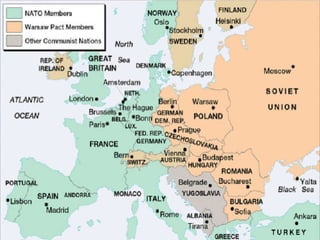
Because of their fear of future invasions, the Soviet Union wanted to create a  buffer zone , or safety zone, on its western border, and Soviet troops stationed there ensured that the nations of Eastern Europe would remain its allies.
 
As the Communists promised to solve the problems of society, they saw the world as divided between the forces of progress and the forces of oppression.
Soviet rhetoric incited revolts in impoverished nations.  Sometimes the Soviets organized groups of  guerrilla  forces – armed bands that were not part of a regular military unit – to start civil wars.
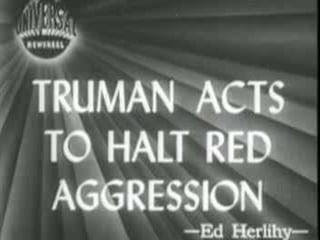
Truman responded with a policy of  containment  – preventing the further spread of communism.
He felt that the foreign policy of the Soviet leaders included conquering other nations, not just securing their own borders. Some believed the policy was too soft, and wanted a quick and decisive victory over the Soviets.
Newspaper columnist Walter Lippmann published his views on containment in a book called  The Cold War .  The title referred to a state of war that did not involve actual bloodshed, and would be used by everyone to describe the icy rivalry between the U.S. and the Soviet Union.
CPS questions  Section 1:  1-11
AID TO EUROPE The Cold War involved a constant state of military preparedness; it called for military support for countries believed to be in danger of communist takeovers.
The U.S. and Soviets each tried to “buy” allies with gifts ranging from food to steel mills.
In 1947, Great Britain informed the U.S. that they would withdraw soldiers from Greece and stop sending aid to Turkey.  It was feared that these countries could soon fall to the communists.
President Truman established a policy, to be known as the  Truman Doctrine , proposed that the U.S. provide military and economic aid to Greece and Turkey. It was immediately approved by Congress, and superseded the Monroe Doctrine.
 
Soon afterwards, a plan for aid to Europe was established. Truman realized the economic woes to France, Italy, and other W. European countries might lead to the election of communist governments, and that Europe’s poor economy would affect U.S. markets.
June 1947 – Secretary of State George C. Marshall proposed economic aid for all European nations, called the  Marshall Plan .  The Soviets and Eastern European countries turned down the offer.
Western Europe, on the other hand, welcomed the offer, and it was an enormous success.  More than $13 billion in loans and grants was administered.
 
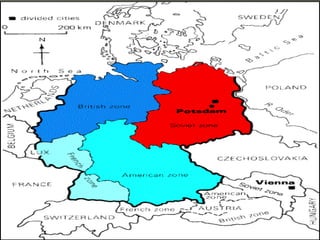
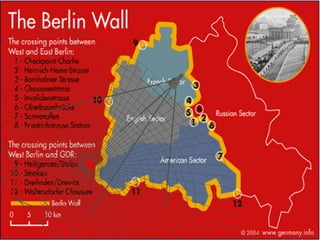
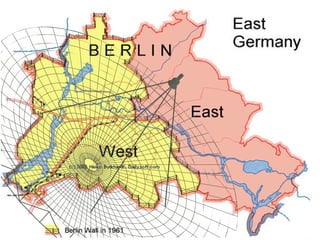
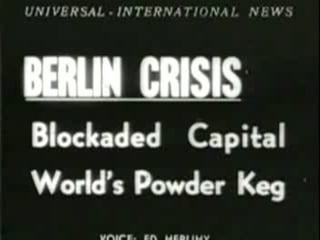
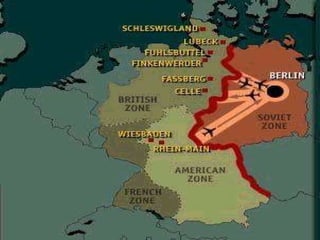
THE BERLIN AIRLIFT After the war, the Allies decided on a joint occupation of Germany, with each of the powers controlling a zone, or section, of Germany.
 
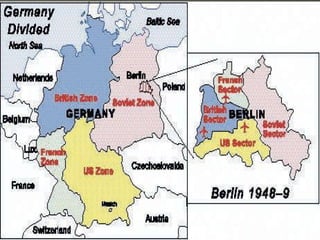
They also each controlled a section of the capital,  Berlin , in the Soviet-controlled zone.
 
After failing to reach agreement with the Soviets, the Western Powers joined their 3 sections in May 1948 to form an independent nation.
The Soviets responded by closing off all traffic from West Germany to Berlin, thinking it would force the West to back down from its control of West Berlin.
Instead, Truman saw this as a test of Western determination –  he ordered a massive airlift to supply Berlin’s 2 million people, sending food, medicine, clothing, even coal.
 
In May 1949, the Soviets finally lifted the blockade.


NORTH ATLANTIC TREATY ORGANIZATION Fearing that rebuilding their economies without rebuilding their military strength might invite Soviet aggression, 5 Western European states formed an alliance in 1948.
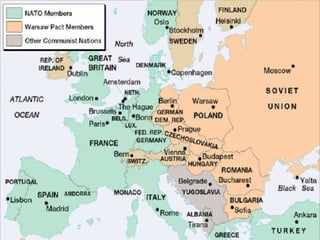
They invited the U.S., the world’s only atomic power, to join the alliance (NATO) in April 1949. NATO  stands for  North Atlantic Treaty Organization
NATO linked into a military alliance the U.S., Great Britain, Canada, Belgium, Italy, France, the Netherlands, Luxembourg, Iceland, Denmark, Norway, and Portugal.  Greece, Turkey, and West Germany joined later.
NATO was based on  collective security , an agreement by which “an armed attack against one or more of them in Europe or N. America shall be considered an attack on all of them.”
Gen. Dwight D. Eisenhower  was commander of the NATO forces. In Sept. 1949, the Soviets exploded their first atomic bomb, ending the U.S.’s nuclear monopoly.
In 1955, the Soviets and their satellites countered NATO by forming their own alliance – the  Warsaw Pact .
Within a few years, both the U.S. and Soviets would develop the  hydrogen bomb  – a new and more powerful weapon. The arms race was now underway.
 
CPS questions  Section 1:  12-21
SECTION 2: THE COLD WAR IN ASIA
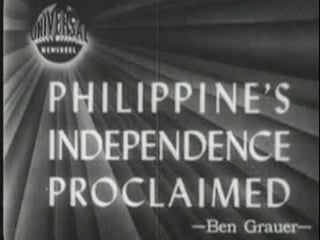
July 4, 1946:  The United States gave the Philippines its independence. Later, when communist-led guerrilla groups revolted against the government, the U.S. sent money and weapons to put down the rebellion.
 
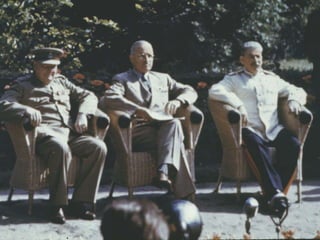
OCCUPATION OF JAPAN Before the end of the war, Allied leaders met at  Potsdam , near Berlin to discuss how they would deal with Germany and Japan after the war.
 
It was determined that American troops would occupy Japan until their goals had been accomplished.
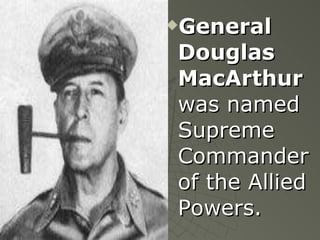
General Douglas MacArthur  was named Supreme Commander of the Allied Powers.
Under his leadership Japan’s military was dismantled, with its leaders tried, convicted of war crimes, and hanged. A new constitution provided for representative government and woman suffrage.
The emperor remained as a symbol of unity, but no longer was looked upon as a god. Instead of paying reparations, Japan received nearly $2 billion in aid to rebuild after the war.
In a treaty signed in 1951, the country gained back its independence, and eventually established itself as the leading economy of Asia.
COMMUNIST TRIUMPH IN CHINA Japan’s surrender left a divided nation…
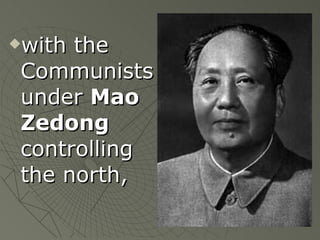
with the Communists under  Mao Zedong  controlling the north,
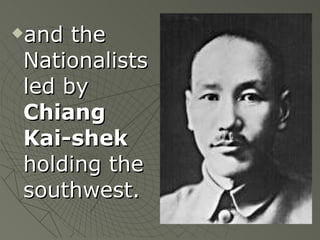
and the Nationalists led by  Chiang Kai-shek  holding the southwest.
Civil war had been going on since the 1930’s between these two groups.  During WWII, they stopped fighting one another and started fighting the Japanese.
During this time, Mao’s forces were able to extend their control over most of China.
In assessing the Communist threat, it was determined that it was more important to save W. Europe from Stalin than saving China from Mao.
The reason was that the Nationalist government had too many weaknesses to justify attempting to save.
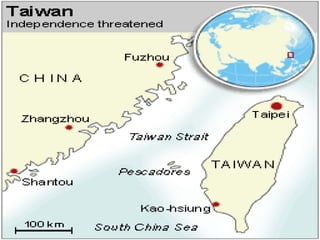
By the end of 1949, Mao’s forces forced Chiang’s army off the mainland to Taiwan and a few other small islands.
The U.S. regarded the nationalist government of  Taiwan  as the government of all of China and blocked attempts by Mao to gain a seat in the U.N.
 
Truman was criticized for allowing China to fall to the Communists, but he believed that Americans wouldn’t have supported him had he decided upon military intervention.
CPS questions  Section 2:  1-8
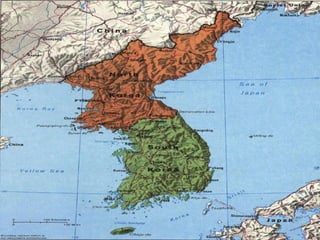
WAR IN KOREA Allied nations had promised Korea “independence” at the Cairo conference in 1943, but it did not occur, because the Soviet troops occupied Korea north of the 38th parallel, and aided by Korean Communists, set up a communist government.
 
 
Like other Soviet satellite nations, N. Korea sealed itself off from the rest of the world. In the south, the U.S. supported the government of Syngman Rhee, and in 1948 the UN recognized the S. Korean government as the government of all of Korea.
U.S. military and diplomatic experts advised that Korea should be viewed as outside the defense perimeter, the area that could be protected, because of the great costs of defending it.  U.S. troops withdrew most of its troops the next year.
On June 25, 1950, N. Korean troops invaded S. Korea.  Truman was not sure if N. Korea was acting alone or as the agent of the Soviet Union or China.
An emergency meeting of the UN was called and they voted unanimously to order N. Korea to withdraw its troops.  When they did not, on June 27, the UN voted to aid S. Korea.
Truman quickly appointed Gen. MacArthur to command all UN troops in Korea.  Truman deployed U.S. troops without asking Congress to declare war, acting as commander in chief under the UN charter.
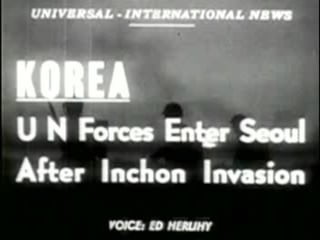
N. Korea had the early advantage, but Gen MacArthur and the UN troops regrouped and forced the N. Koreans northward. The UN asked MacArthur to liberate N. Korea and unite it with the South.
 
By November, 1950, UN troops were as far north as the Yalu River valley (separating N. Korea from China), when 200,000 Chinese troops crossed the border to aid the N. Koreans.  MacArthur and his troops were once again pushed back.
 
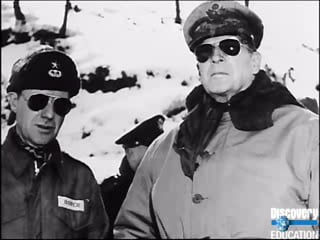
MacArthur then started disagreeing with Truman over the conduct of the war. MacArthur wanted to bomb China and help Chiang invade from Taiwan.  Truman, however, didn’t want to risk war with China.
 
In April, 1951, MacArthur’s criticism of the President in a letter was made public. This was a deliberate challenge to the power of the President over the military.  Truman felt he had no choice other than to remove MacArthur from command.
 
Hearings were held to determine the circumstances of MacArthur’s dismissal.  Two months of hearings dispelled much of the controversy, and Truman’s decision emerged as acceptable to the country.
Years of fighting produced a stalemate in Korea.  The war continued until 1953, when a cease-fire was declared. Korea was left a divided country, as it had been before the conflict started.
The U.S. lost 54,000 troops, but many neutral nations began to draw closer to the U.S., and noncommunist ones began to arm for their own defense.
 
CPS questions  Section 2:  9-14
SECTION 3: COLD WAR AMERICA
Fear that Americans had of a post-war depression proved to be unfounded – jobs actually increased.  Farm income was high because of the U.S. feeding millions of people overseas.
Instead of depression, consumer demand stimulated a sharp rise in prices, or  inflation . Defense spending had increased from $15 to $50 billion from 1949-1953, and the Marshall Plan restored markets in Europe for American goods.
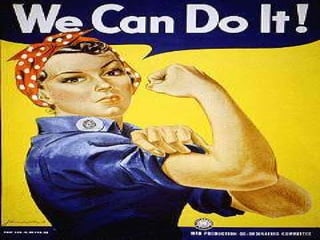
In many ways, the cold war economy of the ‘50’s resembled the wartime economy of the ‘40’s. Women were encouraged by the government to return to being homemakers, in order to help those returning from the war get jobs.
 
Even though the number of women workers dropped overall, the types of work that women performed changed dramatically, especially African-American women, who now had more jobs in factories rather than working on farms or as domestics.
GAINS FOR AFRICAN-AMERICANS Many African Americans made the transition from farming to manufacturing, from rural areas to cities, and from the South to other regions of the country.
The number of white-collar, skilled jobs tripled, from about 300,000 to 900,000.  Their average income nearly doubled during this time, also.
Changing social attitudes helped these changes- the horrifying racism of Nazis made some Americans more sensitive to racism in their own country. NAACP membership rose from 100,000 to 351,000 during this time.
Though there was progress, African Americans still were not treated equally- wages averaged 60% of that of white workers.  They were usually the “last hired and first fired” in jobs.  Patterns of segregation and discrimination were still evident, especially in the South.
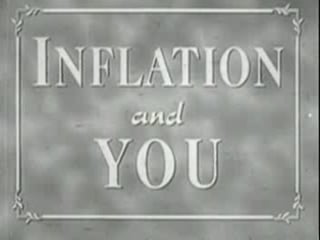
INFLATION IN THE POSTWAR YEARS The federal government ran a large deficit during WWII.  The national debt rose from $50 to $270 billion.
As inflation drove prices up, paychecks bought less than before.  Workers, demanding pay raises, often went on strike. In 1946 alone, there were nearly 5,000 strikes in which a record 4.6 million workers took part.
Truman even considered drafting striking railroad workers into the army before the strike ended.
 
TAFT-HARTLEY ACT A swing towards conservatism occurred with the passage of the Taft-Hartley Act, which passed over Truman’s veto in 1947.
This act was to keep unions from abusing their power:  It outlawed such business practices as:
the closed shop  – which forced businesses owner to hire only union members jurisdictional strikes  – which forced businesses to recognize one union instead of another, and featherbedding  – limiting workers’ output in order to create more jobs.
High union fees were lowered. Unions were forbidden to support political campaigns.
The measure was highly controversial - supporters claimed it held unions in check while those against it said that it erased many of the gains that unions had made since 1933.
CPS questions  Section 3:  1-10
ELECTION OF 1948 Democrats were divided on a number of issues.  Some Southern Democrats left to form the “Dixiecrat” party, and nominated S. Carolina’s Strom Thurmond for President.
Other Democrats supported former Vice-President Henry Wallace on the Progressive party ticket. The rest of the Democrats re-nominated Truman, just because they could convince Eisenhower to accept the nomination.
The Republicans united behind their candidate, NY  Gov. Thomas E. Dewey .  He was so confident he would win that he didn’t even campaign on major issues, just asked Americans to join him in building unity.
Truman ran an aggressive campaign, but didn’t receive any help in the Republican Congress in passing civil rights and other progressive legislation. He called them the “do nothing, good for nothing” Republican 80th Congress.
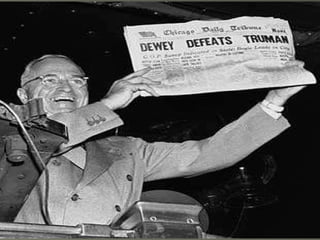
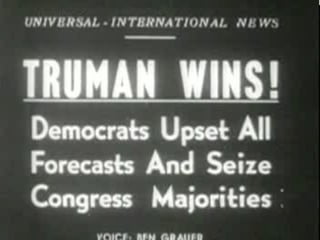
Despite pollsters predicting a Republican victory up until the day of the election, Truman won in his bid for re-election.
He won support from labor unions for his veto of the Taft-Hartley Act, from African-Americans for his civil rights proposals, and from farmers for his support of high farm price supports.
Not only did Truman defeat Dewey, but the Democrats regained their majority in Congress.
 
Truman called for a  Fair Deal , an extension of Roosevelt’s New Deal.  Many of his proposals, however, were blocked by Republicans and Southern Democrats, and the country slipped into a mild recession.
The Korean War helped with production of war goods at home, as well as fueling anti-communist sentiment at home.
 
FEAR OF COMMUNISTS The Cold War, Korean War and communist spy ring uncovered in Canada heightened fear of communism in the U.S. This explained America’s success in developing an atomic bomb so early.
It was suspected that communists were in the press, the government, universities, and the arts – all working to undermine American democracy.
It was determined that since the goal of the Communist party was to overthrow the U.S. government, its members were not protected by the First Amendment.
Many people were forced to take loyalty oaths before being hired for jobs. People confused criticism of American institutions for disloyalty.
Critics of Truman claimed that his advisers were Communists or communist tools, or  subversives  – individuals attempting to overthrow the government.
 
It was claimed by a magazine editor, Whittaker Chambers, and admitted communist spy, that he received secret documents from Alger Hiss, a high ranking State Dept. official.
Few people believed the story at first, but Richard Nixon – Rep., CA- pressed the case forward, and Chambers produced several rolls of microfilm he claimed to have received from Hiss.
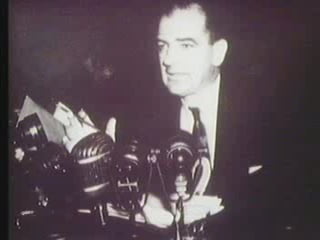
Though not convicted of spying, Hiss was found guilty of lying under oath. Sen. Joseph R. McCarthy  accused the Democrats of “twenty years of treason”.
 
Though McCarthy never produced any evidence to support his claims, he ruined the careers of many govt. officials.
The use of indiscriminate, unfounded political accusations to destroy or assassinate the character of one’s opponent became known as  McCarthyism .
McCarthyism inspired “witch hunts” on all levels, driving professors out of colleges, books from schools, broadcasters, writers, and actors barred from stage and films.
TRUMAN’S LEGACY In 1952, Truman decided to not run for re-election.  By the time he left office, he was unpopular in the eyes of most, and was accused of being soft on communism.
Instances of corruption were also discovered – some of his closest aids received valuable gifts in return for political favors, though he wasn’t personally involved.
The problems Truman faced were new and complex, but Truman was still effective as President. His reputation as a leader rose after he left the White House.
Most of the Fair Deal measures he called for eventually became law. His policy of “containment” was continued by other Presidents.
He set the U.S. on a course that included aid for those in need and an unwavering defense of democracy everywhere.
CPS questions  Section 3:  11-19
THIS CONCLUDES THE MATERIAL FOR TEST 25 TEST WILL BE TAKEN ON TUESDAY, 1/30/07

Test 25 slide_show

  • 1.
    TEST 25 MATERIALTHE COLD WAR (1945-1952)
  • 2.
  • 3.
    SECTION 1: THESTART OF THE COLD WAR
  • 4.
    EAST-WEST SUSPICIONS Truman’spolicy was exemplified by a sign he kept on his desk, “The buck stops here.” He showed quick, effective, yet restrained action.
  • 5.
    During the firstmonths of his administration, most of his attention was devoted to winning the war against Germany and Japan.
  • 6.
    He supported thecreation of the United Nations, but was much more suspicious of the Soviet Union than Roosevelt had been. After the war, the alliance between Great Britain, the U.S. and the Soviets unraveled.
  • 7.
    Soviet expansion intoEastern Europe heightened American fears of communism . Soviet leaders had promised free elections in Soviet occupied nations after the war, but did not deliver.
  • 8.
    Elections were supervisedby Soviet troops to influence the elections of communist sympathizers. Nations that were held under Soviet domination came to be known as satellite nations .
  • 9.
    The Soviets removedwhole factories, transportation equipment, and machinery from satellite nations.
  • 10.
    They also forcedthe removal of leaders of satellite nations whose leaders were deemed disloyal, called purges .
  • 11.
    The leaders ofW. Europe and the U.S. watched on with grave concern. Former British Prime Minister Winston Churchill coined the phrase “Iron Curtain”, which would be used to describe Soviet policy in Europe from 1945-89.
  • 12.
    THE STRENGTH OFCOMMUNISM As the U.S. withdrew troops from Europe, the Soviets were the most powerful military force in Europe.
  • 13.
    20 million Sovietssuffered devastation of land, property and industry due to the German invasions.
  • 14.
    Because of theirfear of future invasions, the Soviet Union wanted to create a buffer zone , or safety zone, on its western border, and Soviet troops stationed there ensured that the nations of Eastern Europe would remain its allies.
  • 15.
  • 16.
    As the Communistspromised to solve the problems of society, they saw the world as divided between the forces of progress and the forces of oppression.
  • 17.
    Soviet rhetoric incitedrevolts in impoverished nations. Sometimes the Soviets organized groups of guerrilla forces – armed bands that were not part of a regular military unit – to start civil wars.
  • 18.
    Truman responded witha policy of containment – preventing the further spread of communism.
  • 19.
    He felt thatthe foreign policy of the Soviet leaders included conquering other nations, not just securing their own borders. Some believed the policy was too soft, and wanted a quick and decisive victory over the Soviets.
  • 20.
    Newspaper columnist WalterLippmann published his views on containment in a book called The Cold War . The title referred to a state of war that did not involve actual bloodshed, and would be used by everyone to describe the icy rivalry between the U.S. and the Soviet Union.
  • 21.
    CPS questions Section 1: 1-11
  • 22.
    AID TO EUROPEThe Cold War involved a constant state of military preparedness; it called for military support for countries believed to be in danger of communist takeovers.
  • 23.
    The U.S. andSoviets each tried to “buy” allies with gifts ranging from food to steel mills.
  • 24.
    In 1947, GreatBritain informed the U.S. that they would withdraw soldiers from Greece and stop sending aid to Turkey. It was feared that these countries could soon fall to the communists.
  • 25.
    President Truman establisheda policy, to be known as the Truman Doctrine , proposed that the U.S. provide military and economic aid to Greece and Turkey. It was immediately approved by Congress, and superseded the Monroe Doctrine.
  • 26.
  • 27.
    Soon afterwards, aplan for aid to Europe was established. Truman realized the economic woes to France, Italy, and other W. European countries might lead to the election of communist governments, and that Europe’s poor economy would affect U.S. markets.
  • 28.
    June 1947 –Secretary of State George C. Marshall proposed economic aid for all European nations, called the Marshall Plan . The Soviets and Eastern European countries turned down the offer.
  • 29.
    Western Europe, onthe other hand, welcomed the offer, and it was an enormous success. More than $13 billion in loans and grants was administered.
  • 30.
  • 31.
    THE BERLIN AIRLIFTAfter the war, the Allies decided on a joint occupation of Germany, with each of the powers controlling a zone, or section, of Germany.
  • 32.
  • 33.
    They also eachcontrolled a section of the capital, Berlin , in the Soviet-controlled zone.
  • 34.
  • 35.
    After failing toreach agreement with the Soviets, the Western Powers joined their 3 sections in May 1948 to form an independent nation.
  • 36.
    The Soviets respondedby closing off all traffic from West Germany to Berlin, thinking it would force the West to back down from its control of West Berlin.
  • 37.
    Instead, Truman sawthis as a test of Western determination – he ordered a massive airlift to supply Berlin’s 2 million people, sending food, medicine, clothing, even coal.
  • 38.
  • 39.
    In May 1949,the Soviets finally lifted the blockade.
  • 40.
  • 41.
  • 42.
  • 43.
    NORTH ATLANTIC TREATYORGANIZATION Fearing that rebuilding their economies without rebuilding their military strength might invite Soviet aggression, 5 Western European states formed an alliance in 1948.
  • 44.
    They invited theU.S., the world’s only atomic power, to join the alliance (NATO) in April 1949. NATO stands for North Atlantic Treaty Organization
  • 45.
    NATO linked intoa military alliance the U.S., Great Britain, Canada, Belgium, Italy, France, the Netherlands, Luxembourg, Iceland, Denmark, Norway, and Portugal. Greece, Turkey, and West Germany joined later.
  • 46.
    NATO was basedon collective security , an agreement by which “an armed attack against one or more of them in Europe or N. America shall be considered an attack on all of them.”
  • 47.
    Gen. Dwight D.Eisenhower was commander of the NATO forces. In Sept. 1949, the Soviets exploded their first atomic bomb, ending the U.S.’s nuclear monopoly.
  • 48.
    In 1955, theSoviets and their satellites countered NATO by forming their own alliance – the Warsaw Pact .
  • 49.
    Within a fewyears, both the U.S. and Soviets would develop the hydrogen bomb – a new and more powerful weapon. The arms race was now underway.
  • 50.
  • 51.
    CPS questions Section 1: 12-21
  • 52.
    SECTION 2: THECOLD WAR IN ASIA
  • 53.
    July 4, 1946: The United States gave the Philippines its independence. Later, when communist-led guerrilla groups revolted against the government, the U.S. sent money and weapons to put down the rebellion.
  • 54.
  • 55.
    OCCUPATION OF JAPANBefore the end of the war, Allied leaders met at Potsdam , near Berlin to discuss how they would deal with Germany and Japan after the war.
  • 56.
  • 57.
    It was determinedthat American troops would occupy Japan until their goals had been accomplished.
  • 58.
    General Douglas MacArthur was named Supreme Commander of the Allied Powers.
  • 59.
    Under his leadershipJapan’s military was dismantled, with its leaders tried, convicted of war crimes, and hanged. A new constitution provided for representative government and woman suffrage.
  • 60.
    The emperor remainedas a symbol of unity, but no longer was looked upon as a god. Instead of paying reparations, Japan received nearly $2 billion in aid to rebuild after the war.
  • 61.
    In a treatysigned in 1951, the country gained back its independence, and eventually established itself as the leading economy of Asia.
  • 62.
    COMMUNIST TRIUMPH INCHINA Japan’s surrender left a divided nation…
  • 63.
    with the Communistsunder Mao Zedong controlling the north,
  • 64.
    and the Nationalistsled by Chiang Kai-shek holding the southwest.
  • 65.
    Civil war hadbeen going on since the 1930’s between these two groups. During WWII, they stopped fighting one another and started fighting the Japanese.
  • 66.
    During this time,Mao’s forces were able to extend their control over most of China.
  • 67.
    In assessing theCommunist threat, it was determined that it was more important to save W. Europe from Stalin than saving China from Mao.
  • 68.
    The reason wasthat the Nationalist government had too many weaknesses to justify attempting to save.
  • 69.
    By the endof 1949, Mao’s forces forced Chiang’s army off the mainland to Taiwan and a few other small islands.
  • 70.
    The U.S. regardedthe nationalist government of Taiwan as the government of all of China and blocked attempts by Mao to gain a seat in the U.N.
  • 71.
  • 72.
    Truman was criticizedfor allowing China to fall to the Communists, but he believed that Americans wouldn’t have supported him had he decided upon military intervention.
  • 73.
    CPS questions Section 2: 1-8
  • 74.
    WAR IN KOREAAllied nations had promised Korea “independence” at the Cairo conference in 1943, but it did not occur, because the Soviet troops occupied Korea north of the 38th parallel, and aided by Korean Communists, set up a communist government.
  • 75.
  • 76.
  • 77.
    Like other Sovietsatellite nations, N. Korea sealed itself off from the rest of the world. In the south, the U.S. supported the government of Syngman Rhee, and in 1948 the UN recognized the S. Korean government as the government of all of Korea.
  • 78.
    U.S. military anddiplomatic experts advised that Korea should be viewed as outside the defense perimeter, the area that could be protected, because of the great costs of defending it. U.S. troops withdrew most of its troops the next year.
  • 79.
    On June 25,1950, N. Korean troops invaded S. Korea. Truman was not sure if N. Korea was acting alone or as the agent of the Soviet Union or China.
  • 80.
    An emergency meetingof the UN was called and they voted unanimously to order N. Korea to withdraw its troops. When they did not, on June 27, the UN voted to aid S. Korea.
  • 81.
    Truman quickly appointedGen. MacArthur to command all UN troops in Korea. Truman deployed U.S. troops without asking Congress to declare war, acting as commander in chief under the UN charter.
  • 82.
    N. Korea hadthe early advantage, but Gen MacArthur and the UN troops regrouped and forced the N. Koreans northward. The UN asked MacArthur to liberate N. Korea and unite it with the South.
  • 83.
  • 84.
    By November, 1950,UN troops were as far north as the Yalu River valley (separating N. Korea from China), when 200,000 Chinese troops crossed the border to aid the N. Koreans. MacArthur and his troops were once again pushed back.
  • 85.
  • 86.
    MacArthur then starteddisagreeing with Truman over the conduct of the war. MacArthur wanted to bomb China and help Chiang invade from Taiwan. Truman, however, didn’t want to risk war with China.
  • 87.
  • 88.
    In April, 1951,MacArthur’s criticism of the President in a letter was made public. This was a deliberate challenge to the power of the President over the military. Truman felt he had no choice other than to remove MacArthur from command.
  • 89.
  • 90.
    Hearings were heldto determine the circumstances of MacArthur’s dismissal. Two months of hearings dispelled much of the controversy, and Truman’s decision emerged as acceptable to the country.
  • 91.
    Years of fightingproduced a stalemate in Korea. The war continued until 1953, when a cease-fire was declared. Korea was left a divided country, as it had been before the conflict started.
  • 92.
    The U.S. lost54,000 troops, but many neutral nations began to draw closer to the U.S., and noncommunist ones began to arm for their own defense.
  • 93.
  • 94.
    CPS questions Section 2: 9-14
  • 95.
    SECTION 3: COLDWAR AMERICA
  • 96.
    Fear that Americanshad of a post-war depression proved to be unfounded – jobs actually increased. Farm income was high because of the U.S. feeding millions of people overseas.
  • 97.
    Instead of depression,consumer demand stimulated a sharp rise in prices, or inflation . Defense spending had increased from $15 to $50 billion from 1949-1953, and the Marshall Plan restored markets in Europe for American goods.
  • 98.
    In many ways,the cold war economy of the ‘50’s resembled the wartime economy of the ‘40’s. Women were encouraged by the government to return to being homemakers, in order to help those returning from the war get jobs.
  • 99.
  • 100.
    Even though thenumber of women workers dropped overall, the types of work that women performed changed dramatically, especially African-American women, who now had more jobs in factories rather than working on farms or as domestics.
  • 101.
    GAINS FOR AFRICAN-AMERICANSMany African Americans made the transition from farming to manufacturing, from rural areas to cities, and from the South to other regions of the country.
  • 102.
    The number ofwhite-collar, skilled jobs tripled, from about 300,000 to 900,000. Their average income nearly doubled during this time, also.
  • 103.
    Changing social attitudeshelped these changes- the horrifying racism of Nazis made some Americans more sensitive to racism in their own country. NAACP membership rose from 100,000 to 351,000 during this time.
  • 104.
    Though there wasprogress, African Americans still were not treated equally- wages averaged 60% of that of white workers. They were usually the “last hired and first fired” in jobs. Patterns of segregation and discrimination were still evident, especially in the South.
  • 105.
    INFLATION IN THEPOSTWAR YEARS The federal government ran a large deficit during WWII. The national debt rose from $50 to $270 billion.
  • 106.
    As inflation droveprices up, paychecks bought less than before. Workers, demanding pay raises, often went on strike. In 1946 alone, there were nearly 5,000 strikes in which a record 4.6 million workers took part.
  • 107.
    Truman even considereddrafting striking railroad workers into the army before the strike ended.
  • 108.
  • 109.
    TAFT-HARTLEY ACT Aswing towards conservatism occurred with the passage of the Taft-Hartley Act, which passed over Truman’s veto in 1947.
  • 110.
    This act wasto keep unions from abusing their power: It outlawed such business practices as:
  • 111.
    the closed shop – which forced businesses owner to hire only union members jurisdictional strikes – which forced businesses to recognize one union instead of another, and featherbedding – limiting workers’ output in order to create more jobs.
  • 112.
    High union feeswere lowered. Unions were forbidden to support political campaigns.
  • 113.
    The measure washighly controversial - supporters claimed it held unions in check while those against it said that it erased many of the gains that unions had made since 1933.
  • 114.
    CPS questions Section 3: 1-10
  • 115.
    ELECTION OF 1948Democrats were divided on a number of issues. Some Southern Democrats left to form the “Dixiecrat” party, and nominated S. Carolina’s Strom Thurmond for President.
  • 116.
    Other Democrats supportedformer Vice-President Henry Wallace on the Progressive party ticket. The rest of the Democrats re-nominated Truman, just because they could convince Eisenhower to accept the nomination.
  • 117.
    The Republicans unitedbehind their candidate, NY Gov. Thomas E. Dewey . He was so confident he would win that he didn’t even campaign on major issues, just asked Americans to join him in building unity.
  • 118.
    Truman ran anaggressive campaign, but didn’t receive any help in the Republican Congress in passing civil rights and other progressive legislation. He called them the “do nothing, good for nothing” Republican 80th Congress.
  • 119.
    Despite pollsters predictinga Republican victory up until the day of the election, Truman won in his bid for re-election.
  • 120.
    He won supportfrom labor unions for his veto of the Taft-Hartley Act, from African-Americans for his civil rights proposals, and from farmers for his support of high farm price supports.
  • 121.
    Not only didTruman defeat Dewey, but the Democrats regained their majority in Congress.
  • 122.
  • 123.
    Truman called fora Fair Deal , an extension of Roosevelt’s New Deal. Many of his proposals, however, were blocked by Republicans and Southern Democrats, and the country slipped into a mild recession.
  • 124.
    The Korean Warhelped with production of war goods at home, as well as fueling anti-communist sentiment at home.
  • 125.
  • 126.
    FEAR OF COMMUNISTSThe Cold War, Korean War and communist spy ring uncovered in Canada heightened fear of communism in the U.S. This explained America’s success in developing an atomic bomb so early.
  • 127.
    It was suspectedthat communists were in the press, the government, universities, and the arts – all working to undermine American democracy.
  • 128.
    It was determinedthat since the goal of the Communist party was to overthrow the U.S. government, its members were not protected by the First Amendment.
  • 129.
    Many people wereforced to take loyalty oaths before being hired for jobs. People confused criticism of American institutions for disloyalty.
  • 130.
    Critics of Trumanclaimed that his advisers were Communists or communist tools, or subversives – individuals attempting to overthrow the government.
  • 131.
  • 132.
    It was claimedby a magazine editor, Whittaker Chambers, and admitted communist spy, that he received secret documents from Alger Hiss, a high ranking State Dept. official.
  • 133.
    Few people believedthe story at first, but Richard Nixon – Rep., CA- pressed the case forward, and Chambers produced several rolls of microfilm he claimed to have received from Hiss.
  • 134.
    Though not convictedof spying, Hiss was found guilty of lying under oath. Sen. Joseph R. McCarthy accused the Democrats of “twenty years of treason”.
  • 135.
  • 136.
    Though McCarthy neverproduced any evidence to support his claims, he ruined the careers of many govt. officials.
  • 137.
    The use ofindiscriminate, unfounded political accusations to destroy or assassinate the character of one’s opponent became known as McCarthyism .
  • 138.
    McCarthyism inspired “witchhunts” on all levels, driving professors out of colleges, books from schools, broadcasters, writers, and actors barred from stage and films.
  • 139.
    TRUMAN’S LEGACY In1952, Truman decided to not run for re-election. By the time he left office, he was unpopular in the eyes of most, and was accused of being soft on communism.
  • 140.
    Instances of corruptionwere also discovered – some of his closest aids received valuable gifts in return for political favors, though he wasn’t personally involved.
  • 141.
    The problems Trumanfaced were new and complex, but Truman was still effective as President. His reputation as a leader rose after he left the White House.
  • 142.
    Most of theFair Deal measures he called for eventually became law. His policy of “containment” was continued by other Presidents.
  • 143.
    He set theU.S. on a course that included aid for those in need and an unwavering defense of democracy everywhere.
  • 144.
    CPS questions Section 3: 11-19
  • 145.
    THIS CONCLUDES THEMATERIAL FOR TEST 25 TEST WILL BE TAKEN ON TUESDAY, 1/30/07