UNIT 5
ECOSYSTEMS
WATH IS AN ECOSYSTEM?
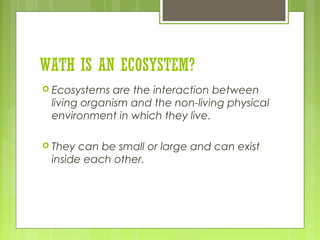
 Ecosystems are the interaction between
living organism and the non-living physical
environment in which they live.
 They can be small or large and can exist
inside each other.
WHAT MAKES UP AN ECOSYSTEM?
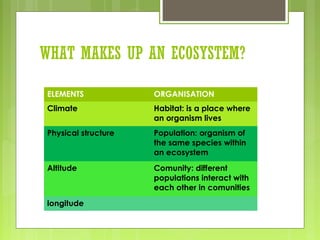
ELEMENTS ORGANISATION
Climate Habitat: is a place where
an organism lives
Physical structure Population: organism of
the same species within
an ecosystem
Altitude Comunity: different
populations interact with
each other in comunities
longitude
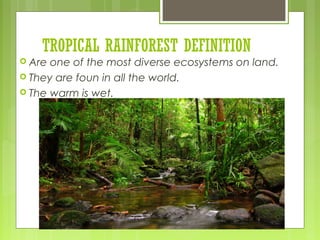
TROPICAL RAINFOREST DEFINITION
 Are one of the most diverse ecosystems on land.
 They are foun in all the world.
 The warm is wet.
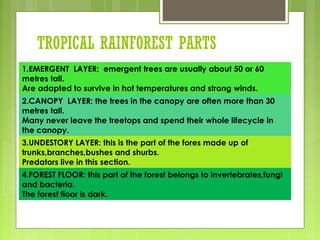
TROPICAL RAINFOREST PARTS
1.EMERGENT LAYER: emergent trees are usually about 50 or 60
metres tall.
Are adapted to survive in hot temperatures and strong winds.
2.CANOPY LAYER: the trees in the canopy are often more than 30
metres tall.
Many never leave the treetops and spend their whole lifecycle in
the canopy.
3.UNDESTORY LAYER: this is the part of the fores made up of
trunks,branches,bushes and shurbs.
Predators live in this section.
4.FOREST FLOOR: this part of the forest belongs to invertebrates,fungi
and bacteria.
The forest floor is dark.
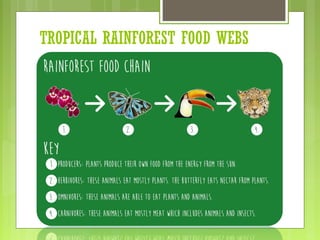
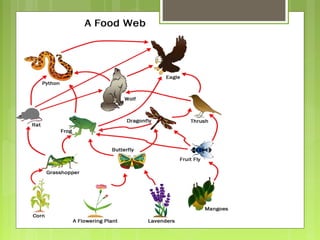
TROPICAL RAINFOREST FOOD WEBS
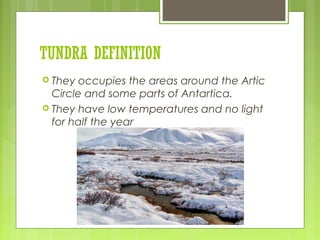
TUNDRA DEFINITION
 They occupies the areas around the Artic
Circle and some parts of Antartica.
 They have low temperatures and no light
for half the year
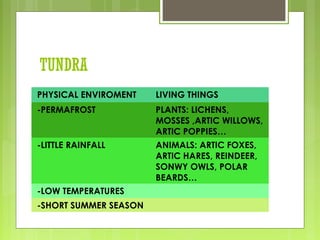
TUNDRA
PHYSICAL ENVIROMENT LIVING THINGS
-PERMAFROST PLANTS: LICHENS,
MOSSES ,ARTIC WILLOWS,
ARTIC POPPIES…
-LITTLE RAINFALL ANIMALS: ARTIC FOXES,
ARTIC HARES, REINDEER,
SONWY OWLS, POLAR
BEARDS…
-LOW TEMPERATURES
-SHORT SUMMER SEASON
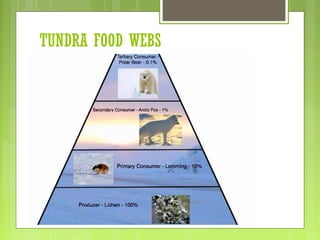
TUNDRA FOOD WEBS
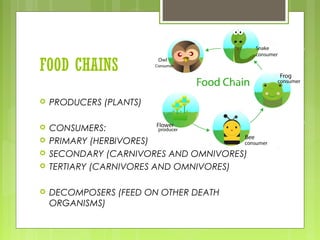
FOOD CHAINS
 PRODUCERS (PLANTS)
 CONSUMERS:
 PRIMARY (HERBIVORES)
 SECONDARY (CARNIVORES AND OMNIVORES)
 TERTIARY (CARNIVORES AND OMNIVORES)
 DECOMPOSERS (FEED ON OTHER DEATH
ORGANISMS)
FOOD WEBS
-THERE IS AN INTERDEPENDENCE OF SPECIES WICH LIVE OFF
EACH OTHER.
-THESE INTERDEPENDENCIES FORM FOOD WEBS.
-ARE MADE UP OF DIFFERENT FOOD CHAINS.
-PRODUCE ENERGY (BIOMASS).
FOOD FOR THE NEXT TROPHIC LEVEL
Unit 5 ecosystems Lucia y Nayara

Unit 5 ecosystems Lucia y Nayara

  • 1.
  • 2.
    WATH IS ANECOSYSTEM?  Ecosystems are the interaction between living organism and the non-living physical environment in which they live.  They can be small or large and can exist inside each other.
  • 3.
    WHAT MAKES UPAN ECOSYSTEM? ELEMENTS ORGANISATION Climate Habitat: is a place where an organism lives Physical structure Population: organism of the same species within an ecosystem Altitude Comunity: different populations interact with each other in comunities longitude
  • 4.
    TROPICAL RAINFOREST DEFINITION Are one of the most diverse ecosystems on land.  They are foun in all the world.  The warm is wet.
  • 5.
    TROPICAL RAINFOREST PARTS 1.EMERGENTLAYER: emergent trees are usually about 50 or 60 metres tall. Are adapted to survive in hot temperatures and strong winds. 2.CANOPY LAYER: the trees in the canopy are often more than 30 metres tall. Many never leave the treetops and spend their whole lifecycle in the canopy. 3.UNDESTORY LAYER: this is the part of the fores made up of trunks,branches,bushes and shurbs. Predators live in this section. 4.FOREST FLOOR: this part of the forest belongs to invertebrates,fungi and bacteria. The forest floor is dark.
  • 6.
  • 7.
    TUNDRA DEFINITION  Theyoccupies the areas around the Artic Circle and some parts of Antartica.  They have low temperatures and no light for half the year
  • 8.
    TUNDRA PHYSICAL ENVIROMENT LIVINGTHINGS -PERMAFROST PLANTS: LICHENS, MOSSES ,ARTIC WILLOWS, ARTIC POPPIES… -LITTLE RAINFALL ANIMALS: ARTIC FOXES, ARTIC HARES, REINDEER, SONWY OWLS, POLAR BEARDS… -LOW TEMPERATURES -SHORT SUMMER SEASON
  • 9.
  • 10.
    FOOD CHAINS  PRODUCERS(PLANTS)  CONSUMERS:  PRIMARY (HERBIVORES)  SECONDARY (CARNIVORES AND OMNIVORES)  TERTIARY (CARNIVORES AND OMNIVORES)  DECOMPOSERS (FEED ON OTHER DEATH ORGANISMS)
  • 11.
    FOOD WEBS -THERE ISAN INTERDEPENDENCE OF SPECIES WICH LIVE OFF EACH OTHER. -THESE INTERDEPENDENCIES FORM FOOD WEBS. -ARE MADE UP OF DIFFERENT FOOD CHAINS. -PRODUCE ENERGY (BIOMASS). FOOD FOR THE NEXT TROPHIC LEVEL