ATAL BIHARIVAJPAYEE UNIVERSITY KONI BILASPUR (CG)
DEPARTMENT OF COMPUTER SCIENCE AND APPLICATION
ACADEMIC SESSION – 2022 – 2023
TOPIC:- CONCURRECY CONTROLTECHNIQUE
GUIDED BY :-
MISS – ANKITA JAISWAL
SUBMITTED BY :-
PRAVIN BHARGAW
B.Sc. - 4rd sem.
Concurrency
Control
Techniques
Concurrency Control
Concurrency Control is the
management procedure that is
required for controlling and managing
the concurrent execution of database
operations and thus avoiding the
inconsistencies in the database.
Concurrent Execution
In a multi-user system, multiple users
can access and use the same database
at one time, which is known as the
concurrent execution of the database.
It means that the same database is
executed simultaneously .
Problems with Concurrent Execution
In a database transaction, the two main operations are READ and WRITE operations.
So, there is a need to manage these two operations in the concurrent execution if
these operations are not performed in an properly manner, so the data may become
inconsistent .There are some problems.
> Lost Update Problems (W - W Conflict).
> Dirty Read Problems (W-R Conflict).
> Unrepeatable Read Problem (W-R Conflict).
Lost Update Problems (W - W Conflict):-
The problem occurs when two
different database transactions
perform the read/write operations
on the same database items in an
interleaved manner (i.e., concurrent
execution) that makes the values of
the items incorrect hence making
the database inconsistent.
For example:
Consider the below
diagram where two
transactionsTX andTY, are
performed on the same
account A where the
balance of account A is
$300.
Dirty Read Problems (W-R Conflict)
The dirty read problem
occurs when one transaction
updates an item of the database,
and somehow the transaction fails,
and before the data gets rollback,
the updated database item is
accessed by another transaction.
There comes the Read-Write
Conflict between both transactions.
For example:
Consider two transactionsTX and
TY in the below diagram performing
read/write operations on account A
where the available balance in
account A is $300:
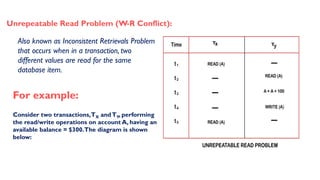
Unrepeatable Read Problem (W-R Conflict):
Also known as Inconsistent Retrievals Problem
that occurs when in a transaction, two
different values are read for the same
database item.
For example:
Consider two transactions,TX andTY, performing
the read/write operations on account A, having an
available balance = $300.The diagram is shown
below:
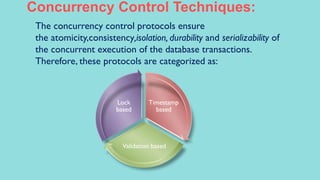
Concurrency Control Techniques:
The concurrency control protocols ensure
the atomicity,consistency,isolation, durability and serializability of
the concurrent execution of the database transactions.
Therefore, these protocols are categorized as:
Timestamp
based
Validation based
Lock
based
Lock-BasedTechnique:
In this type of
protocol, any
transaction cannot
read or write data
until it acquires an
appropriate lock on
it.There are two
types of lock:
* Shared lock:
 It is also known as a Read-only lock. In a shared lock, the data item can
only read by the transaction.
 It can be shared between the transactions because when the
transaction holds a lock, then it can't update the data on the data item.
* Exclusive lock:
 In the exclusive lock, the data item can be both reads as well as written
by the transaction.
 This lock is exclusive, and in this lock, multiple transactions do not
modify the same data simultaneously.
Lock Compatibility Matrix –
Request
Grant S
S X
X
Yes No
No No
There are
four types of
lock
techniques
available:
Simplistic
lock
Pre-
claiming
Lock
Strict
Two-
phase
locking
* Simplistic lock technique
 It is the simplest way of locking the data while transaction.
 Simplistic lock-based protocols allow all the transactions to
get the lock on the data before insert or delete or update on
it.
 It will unlock the data item after completing the transaction.
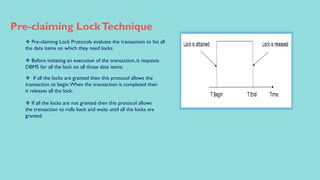
Pre-claiming LockTechnique
 Pre-claiming Lock Protocols evaluate the transaction to list all
the data items on which they need locks.
 Before initiating an execution of the transaction, it requests
DBMS for all the lock on all those data items.
 If all the locks are granted then this protocol allows the
transaction to begin.When the transaction is completed then
it releases all the lock.
 If all the locks are not granted then this protocol allows
the transaction to rolls back and waits until all the locks are
granted.
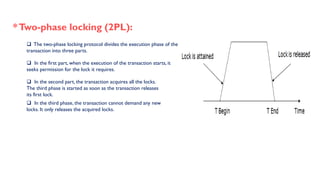
*Two-phase locking (2PL):
 The two-phase locking protocol divides the execution phase of the
transaction into three parts.
 In the first part, when the execution of the transaction starts, it
seeks permission for the lock it requires.
 In the second part, the transaction acquires all the locks.
The third phase is started as soon as the transaction releases
its first lock.
 In the third phase, the transaction cannot demand any new
locks. It only releases the acquired locks.
There are two phases
of 2PL:
Growing
phase
Shrinking
phase
Growing phase:
> In the growing phase, a new lock on the data item may
be acquired by the transaction, but none can be released.
Shrinking phase:
•> In the shrinking phase, existing lock held by the
transaction may be released, but no new locks can be
acquired.
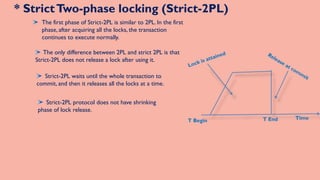
* StrictTwo-phase locking (Strict-2PL)
The first phase of Strict-2PL is similar to 2PL. In the first
phase, after acquiring all the locks, the transaction
continues to execute normally.
The only difference between 2PL and strict 2PL is that
Strict-2PL does not release a lock after using it.
Strict-2PL waits until the whole transaction to
commit, and then it releases all the locks at a time.
Strict-2PL protocol does not have shrinking
phase of lock release.
T Begin T End Time
TheTimestamp Ordering Protocol is used to order the transactions based on
their Timestamps.The order of transaction is nothing but the ascending order of the
transaction creation.
Timestamp Ordering Protocol:
The priority of the older transaction is higher that's why it executes first.To
determine the timestamp of the transaction, this protocol uses system time or logical
counter.
The timestamp ordering protocol also maintains the timestamp of last read and
write operation on a data.
BasicTimestamp ordering protocol works:
1. In this condition, whenever a transactionTi issues a Read (X) operation:
 If TS(Ti) < W_TS(X) then the operation is rejected.
 If TS(Ti) => W_TS(X) then the operation is executed.
100
Tj
R(a)
W(a)
Ti
200
 There would be occur the Dirty read problem.
100
Tj
R(a)
W(a)
Ti
200
2. In this condition, whenever a transactionTi issues a Write(X) operation:
 If TS(Ti) < R_TS(X) then the operation is rejected .There would be occur Dirty
read problem.
 IfTS(Ti) < W_TS(X) then the operation is rejected andTi is rolled back .
There would be create the Lost update problem due to W-Wconflict.
100
Tj
W(a)
R(a)
Ti
200
100
Tj
W(a)
W(a)
Ti
200
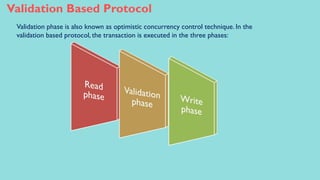
Validation Based Protocol
Validation phase is also known as optimistic concurrency control technique. In the
validation based protocol, the transaction is executed in the three phases:
* Read phase:
 In this phase, the transaction T is read and executed.
 It is used to read the value of various data items and stores them
in temporary local variables.
 It can perform all the write operations on temporary variables
without an update to the actual database.
* Validation phase:
 n this phase, the temporary variable value will be validated against
the actual data to see if it violates the serializability.
* Write phase:
If the validation of the transaction is
validated, then the temporary results are
written to the database or system
otherwise the transaction is rolled back.
Here each phase has the different timestamps:
Finish(Ti)
Valida
tion
(Ti)
Start(
Ti)
Start(Ti):
o It contains the time whenTi started its execution.
Validation phase:
o It contains the time whenTi finishes its read phase and starts its
validation phase.
Finish(Ti):
o It contains the time whenTi finishes its write phase.
DBMS Presentation.pptx

DBMS Presentation.pptx

  • 1.
    ATAL BIHARIVAJPAYEE UNIVERSITYKONI BILASPUR (CG) DEPARTMENT OF COMPUTER SCIENCE AND APPLICATION ACADEMIC SESSION – 2022 – 2023 TOPIC:- CONCURRECY CONTROLTECHNIQUE GUIDED BY :- MISS – ANKITA JAISWAL SUBMITTED BY :- PRAVIN BHARGAW B.Sc. - 4rd sem.
  • 2.
  • 3.
    Concurrency Control Concurrency Controlis the management procedure that is required for controlling and managing the concurrent execution of database operations and thus avoiding the inconsistencies in the database.
  • 4.
    Concurrent Execution In amulti-user system, multiple users can access and use the same database at one time, which is known as the concurrent execution of the database. It means that the same database is executed simultaneously .
  • 5.
    Problems with ConcurrentExecution In a database transaction, the two main operations are READ and WRITE operations. So, there is a need to manage these two operations in the concurrent execution if these operations are not performed in an properly manner, so the data may become inconsistent .There are some problems. > Lost Update Problems (W - W Conflict). > Dirty Read Problems (W-R Conflict). > Unrepeatable Read Problem (W-R Conflict).
  • 6.
    Lost Update Problems(W - W Conflict):- The problem occurs when two different database transactions perform the read/write operations on the same database items in an interleaved manner (i.e., concurrent execution) that makes the values of the items incorrect hence making the database inconsistent.
  • 7.
    For example: Consider thebelow diagram where two transactionsTX andTY, are performed on the same account A where the balance of account A is $300.
  • 8.
    Dirty Read Problems(W-R Conflict) The dirty read problem occurs when one transaction updates an item of the database, and somehow the transaction fails, and before the data gets rollback, the updated database item is accessed by another transaction. There comes the Read-Write Conflict between both transactions.
  • 9.
    For example: Consider twotransactionsTX and TY in the below diagram performing read/write operations on account A where the available balance in account A is $300:
  • 10.
    Unrepeatable Read Problem(W-R Conflict): Also known as Inconsistent Retrievals Problem that occurs when in a transaction, two different values are read for the same database item. For example: Consider two transactions,TX andTY, performing the read/write operations on account A, having an available balance = $300.The diagram is shown below:
  • 11.
    Concurrency Control Techniques: Theconcurrency control protocols ensure the atomicity,consistency,isolation, durability and serializability of the concurrent execution of the database transactions. Therefore, these protocols are categorized as: Timestamp based Validation based Lock based
  • 12.
    Lock-BasedTechnique: In this typeof protocol, any transaction cannot read or write data until it acquires an appropriate lock on it.There are two types of lock:
  • 13.
    * Shared lock: It is also known as a Read-only lock. In a shared lock, the data item can only read by the transaction.  It can be shared between the transactions because when the transaction holds a lock, then it can't update the data on the data item. * Exclusive lock:  In the exclusive lock, the data item can be both reads as well as written by the transaction.  This lock is exclusive, and in this lock, multiple transactions do not modify the same data simultaneously.
  • 14.
    Lock Compatibility Matrix– Request Grant S S X X Yes No No No
  • 15.
    There are four typesof lock techniques available: Simplistic lock Pre- claiming Lock Strict Two- phase locking
  • 16.
    * Simplistic locktechnique  It is the simplest way of locking the data while transaction.  Simplistic lock-based protocols allow all the transactions to get the lock on the data before insert or delete or update on it.  It will unlock the data item after completing the transaction.
  • 17.
    Pre-claiming LockTechnique  Pre-claimingLock Protocols evaluate the transaction to list all the data items on which they need locks.  Before initiating an execution of the transaction, it requests DBMS for all the lock on all those data items.  If all the locks are granted then this protocol allows the transaction to begin.When the transaction is completed then it releases all the lock.  If all the locks are not granted then this protocol allows the transaction to rolls back and waits until all the locks are granted.
  • 18.
    *Two-phase locking (2PL): The two-phase locking protocol divides the execution phase of the transaction into three parts.  In the first part, when the execution of the transaction starts, it seeks permission for the lock it requires.  In the second part, the transaction acquires all the locks. The third phase is started as soon as the transaction releases its first lock.  In the third phase, the transaction cannot demand any new locks. It only releases the acquired locks.
  • 19.
    There are twophases of 2PL: Growing phase Shrinking phase
  • 20.
    Growing phase: > Inthe growing phase, a new lock on the data item may be acquired by the transaction, but none can be released. Shrinking phase: •> In the shrinking phase, existing lock held by the transaction may be released, but no new locks can be acquired.
  • 21.
    * StrictTwo-phase locking(Strict-2PL) The first phase of Strict-2PL is similar to 2PL. In the first phase, after acquiring all the locks, the transaction continues to execute normally. The only difference between 2PL and strict 2PL is that Strict-2PL does not release a lock after using it. Strict-2PL waits until the whole transaction to commit, and then it releases all the locks at a time. Strict-2PL protocol does not have shrinking phase of lock release. T Begin T End Time
  • 22.
    TheTimestamp Ordering Protocolis used to order the transactions based on their Timestamps.The order of transaction is nothing but the ascending order of the transaction creation. Timestamp Ordering Protocol: The priority of the older transaction is higher that's why it executes first.To determine the timestamp of the transaction, this protocol uses system time or logical counter. The timestamp ordering protocol also maintains the timestamp of last read and write operation on a data.
  • 23.
    BasicTimestamp ordering protocolworks: 1. In this condition, whenever a transactionTi issues a Read (X) operation:  If TS(Ti) < W_TS(X) then the operation is rejected.  If TS(Ti) => W_TS(X) then the operation is executed. 100 Tj R(a) W(a) Ti 200  There would be occur the Dirty read problem. 100 Tj R(a) W(a) Ti 200
  • 24.
    2. In thiscondition, whenever a transactionTi issues a Write(X) operation:  If TS(Ti) < R_TS(X) then the operation is rejected .There would be occur Dirty read problem.  IfTS(Ti) < W_TS(X) then the operation is rejected andTi is rolled back . There would be create the Lost update problem due to W-Wconflict. 100 Tj W(a) R(a) Ti 200 100 Tj W(a) W(a) Ti 200
  • 25.
    Validation Based Protocol Validationphase is also known as optimistic concurrency control technique. In the validation based protocol, the transaction is executed in the three phases:
  • 26.
    * Read phase: In this phase, the transaction T is read and executed.  It is used to read the value of various data items and stores them in temporary local variables.  It can perform all the write operations on temporary variables without an update to the actual database. * Validation phase:  n this phase, the temporary variable value will be validated against the actual data to see if it violates the serializability.
  • 27.
    * Write phase: Ifthe validation of the transaction is validated, then the temporary results are written to the database or system otherwise the transaction is rolled back.
  • 28.
    Here each phasehas the different timestamps: Finish(Ti) Valida tion (Ti) Start( Ti)
  • 29.
    Start(Ti): o It containsthe time whenTi started its execution. Validation phase: o It contains the time whenTi finishes its read phase and starts its validation phase. Finish(Ti): o It contains the time whenTi finishes its write phase.