

 Because failures occurs, transaction are broken up 
into states to handle various situation. 
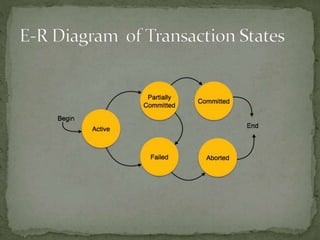
 Active, the initial state; the transaction stays in 
this state until while it is still executing. 
 A transition is terminated only if it has either been 
committed or aborted.
 The DBMS needs to write out enough information to 
disk so that, in case of a failure, the system could re-create 
the updates performed by the transaction once 
the system is brought back up. After it has written out 
all the necessary information, it is committed.
 Committed- after successful completion. 
 Once committed, the transaction can no longer be 
undone by aborting it. 
 Its effect could be undone only by a compensating 
transaction.
 Aborted, after the transaction has been rolled 
back the the database has been restored to its state 
prior to the start of the transaction. 
 The DBMS could either kill the transaction or 
restart the transaction. 
 A transaction may only be restarted as a result of 
some hardware or software error, and a restarted 
transaction is considered a new transaction.
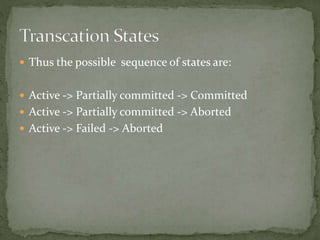
 Thus the possible sequence of states are: 
 Active -> Partially committed -> Committed 
 Active -> Partially committed -> Aborted 
 Active -> Failed -> Aborted
Ravi Ranjan MCA- I Iyr

Transaction states PPT

  • 2.
     Because failuresoccurs, transaction are broken up into states to handle various situation.  Active, the initial state; the transaction stays in this state until while it is still executing.  A transition is terminated only if it has either been committed or aborted.
  • 3.
     The DBMSneeds to write out enough information to disk so that, in case of a failure, the system could re-create the updates performed by the transaction once the system is brought back up. After it has written out all the necessary information, it is committed.
  • 4.
     Committed- aftersuccessful completion.  Once committed, the transaction can no longer be undone by aborting it.  Its effect could be undone only by a compensating transaction.
  • 5.
     Aborted, afterthe transaction has been rolled back the the database has been restored to its state prior to the start of the transaction.  The DBMS could either kill the transaction or restart the transaction.  A transaction may only be restarted as a result of some hardware or software error, and a restarted transaction is considered a new transaction.
  • 6.
     Thus thepossible sequence of states are:  Active -> Partially committed -> Committed  Active -> Partially committed -> Aborted  Active -> Failed -> Aborted
  • 8.