ACUTE, SUBACUTE,CHRONIC
TOXICITY
BY
Mayuri Chavan
Assistant Professor
INTRODUCTION OF TOXICOLOGY
• Toxicology is the scientific study of adverse/toxic/lethal effects of the
chemicals that occur in living organisms.
• It involves observing and reporting symptoms, mechanisms, detection
and treatments of toxic substances, in particular relation to the
poisoning of humans.
• TOXICITY
• Any toxic (adverse) effect that a chemical or physical agent might
produce within a living organism.
Organisation for Economic Co-operation
and Development (OECD)
•The OECD/OCDE is an intergovernmental/international
economic organisation with 37 member countries, founded in
1961 to stimulate the economic progress and world trade and
they work to build better policies for better lives
•The mission of OECD is to promote policies that will improve
the economic and social well-being of people around the
world.
•Headquarter: Paris, France
•Secretory General (2020): José Ángel Gurría
•India is one of the many non-member economies with which the
OECD has working relationships in addition to its member countries.
The OECD has been co-operating with India since 1995.
•OECD also provide the guidelines for testing of chemicals for
assessing the potential effects of chemicals on human health and the
environment.
“OECD provides guidelines for Toxicity Studies”
•These guidelines are Internationally accepted as standard methods
for safety testing.
•The Guidelines are used by professionals in industries, academic
reserch and government involved in the testing and assessment of
chemicals (industrial chemicals, pesticides, personal care products,
drugs, etc.).
• The OECD Guidelines for the Testing of Chemicals are split
into five sections:
• Section 1: Physical Chemical Properties Section 2:
Effects on Biotic Systems
• Section 3: Environmental Fate and Behaviour
• Section 4: Health Effects
• Section 5: Other Test
Acute, Sub-Acute and Chronic Toxicity As per
OECD Guidelines
• Acute Toxicity refers those adverse effects occurring following oral or
dermal administration of a single dose of a substance, or multiple doses
given within 24 hours, or an inhalation exposure of 4 hours.
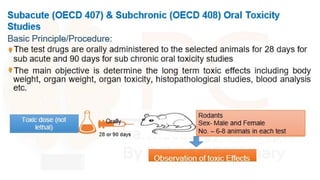
• Subacute Toxicity (repeat dose toxicity) focuses on adverse effects
occurring after administration of a single dose or multiple doses of a test
sample per day given during a period of from 14 to 28 days.
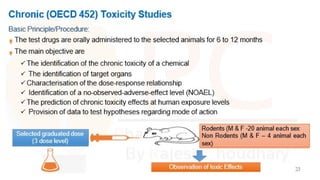
• Chronic toxicity defined as adverse effects occurring after the repeated
or continuous administration of a test sample for more than 3 months.
• Sub-Chronic: It can be defined as exposure to a chemical for 1 to 3
months.
OECD Guidelines
OECD Guidelines for Acute Toxicity Study
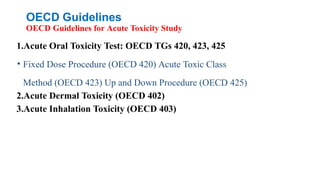
1.Acute Oral Toxicity Test: OECD TGs 420, 423, 425
• Fixed Dose Procedure (OECD 420) Acute Toxic Class
Method (OECD 423) Up and Down Procedure (OECD 425)
2.Acute Dermal Toxicity (OECD 402)
3.Acute Inhalation Toxicity (OECD 403)
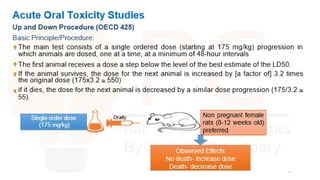
Acute Oral Toxicity Studies
•Toxicological Studies on Rodents (Female Rats preffered) after single oral
dose or dose within 24 hours and observation period 14 days.
•The main objective is determining the LD50 value of the test substances.
•The method provides information on the hazardous properties and allows
the substance to be ranked and classified according to the Globally
Harmonised System (GHS) for the classification of chemicals which cause
acute toxicity
•OECD Guidelines for Acute oral Toxicity Studies
• Fixed Dose Procedure (OECD 420; Adopted 17 Dec. 2001)
• Acute Toxic Class Method (OECD 423; Adopted 17 Dec. 2001)
• Up and Down Procedure (OECD 425; Adopted 17 Dec. 2001)
Acute Oral Toxicity Studies
Fixed Dose Procedure (OECD 420)
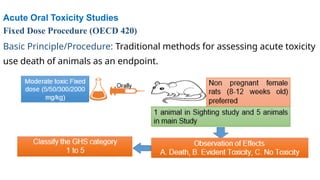
Basic Principle/Procedure: Traditional methods for assessing acute toxicity
use death of animals as an endpoint.
Principles of Test
• Test Substance are administered by oral route to the group of animals in
stepwise procedure using the fixed doses of 5, 50, 300 and 2000 mg/kg
(exceptionally an additional fixed dose of 5000 mg/kg may be considered)
• In Main study, The initial dose level is selected on the basis of a sighting
study as the dose (moderate toxic dose) expected to produce some signs
of toxicity without causing severe toxic effects or mortality. Clinical signs
and conditions associated with pain, suffering, and impending death
• Further groups of animals may be dosed at higher or lower fixed doses,
depending on the presence or absence of signs of toxicity or mortality.
• This procedure continues until the dose causing evident toxicity or no
more than one death is identified, or when no effects are seen at the
highest dose or when deaths occur at the lowest dose.
Acute Oral Toxicity Studies Acute Toxic Class Method (OECD 423)
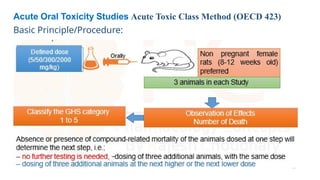
Basic Principle/Procedure:
Principle of ATC
• The substance is administered orally to a group of experimental animals at
one of the defined doses.
• The substance is tested using a stepwise procedure, each step using three
animals of a single sex (normally females).
• Absence or presence of compound-related mortality of the animals dosed
at one step will determine the next step, i.e.
➢no further testing is needed,
➢dosing of three additional animals, with the same dose,
➢dosing of three additional animals at the next higher or the next lower
dose level.
Unit 5 ACUTE, SUBACUTE,CHRONIC TOXICITY.pptx

Unit 5 ACUTE, SUBACUTE,CHRONIC TOXICITY.pptx

  • 1.
  • 2.
    INTRODUCTION OF TOXICOLOGY •Toxicology is the scientific study of adverse/toxic/lethal effects of the chemicals that occur in living organisms. • It involves observing and reporting symptoms, mechanisms, detection and treatments of toxic substances, in particular relation to the poisoning of humans. • TOXICITY • Any toxic (adverse) effect that a chemical or physical agent might produce within a living organism.
  • 3.
    Organisation for EconomicCo-operation and Development (OECD) •The OECD/OCDE is an intergovernmental/international economic organisation with 37 member countries, founded in 1961 to stimulate the economic progress and world trade and they work to build better policies for better lives •The mission of OECD is to promote policies that will improve the economic and social well-being of people around the world. •Headquarter: Paris, France •Secretory General (2020): José Ángel Gurría
  • 4.
    •India is oneof the many non-member economies with which the OECD has working relationships in addition to its member countries. The OECD has been co-operating with India since 1995. •OECD also provide the guidelines for testing of chemicals for assessing the potential effects of chemicals on human health and the environment. “OECD provides guidelines for Toxicity Studies” •These guidelines are Internationally accepted as standard methods for safety testing. •The Guidelines are used by professionals in industries, academic reserch and government involved in the testing and assessment of chemicals (industrial chemicals, pesticides, personal care products, drugs, etc.).
  • 5.
    • The OECDGuidelines for the Testing of Chemicals are split into five sections: • Section 1: Physical Chemical Properties Section 2: Effects on Biotic Systems • Section 3: Environmental Fate and Behaviour • Section 4: Health Effects • Section 5: Other Test
  • 6.
    Acute, Sub-Acute andChronic Toxicity As per OECD Guidelines • Acute Toxicity refers those adverse effects occurring following oral or dermal administration of a single dose of a substance, or multiple doses given within 24 hours, or an inhalation exposure of 4 hours. • Subacute Toxicity (repeat dose toxicity) focuses on adverse effects occurring after administration of a single dose or multiple doses of a test sample per day given during a period of from 14 to 28 days. • Chronic toxicity defined as adverse effects occurring after the repeated or continuous administration of a test sample for more than 3 months. • Sub-Chronic: It can be defined as exposure to a chemical for 1 to 3 months.
  • 7.
    OECD Guidelines OECD Guidelinesfor Acute Toxicity Study 1.Acute Oral Toxicity Test: OECD TGs 420, 423, 425 • Fixed Dose Procedure (OECD 420) Acute Toxic Class Method (OECD 423) Up and Down Procedure (OECD 425) 2.Acute Dermal Toxicity (OECD 402) 3.Acute Inhalation Toxicity (OECD 403)
  • 8.
    Acute Oral ToxicityStudies •Toxicological Studies on Rodents (Female Rats preffered) after single oral dose or dose within 24 hours and observation period 14 days. •The main objective is determining the LD50 value of the test substances. •The method provides information on the hazardous properties and allows the substance to be ranked and classified according to the Globally Harmonised System (GHS) for the classification of chemicals which cause acute toxicity •OECD Guidelines for Acute oral Toxicity Studies • Fixed Dose Procedure (OECD 420; Adopted 17 Dec. 2001) • Acute Toxic Class Method (OECD 423; Adopted 17 Dec. 2001) • Up and Down Procedure (OECD 425; Adopted 17 Dec. 2001)
  • 9.
    Acute Oral ToxicityStudies Fixed Dose Procedure (OECD 420) Basic Principle/Procedure: Traditional methods for assessing acute toxicity use death of animals as an endpoint.
  • 10.
    Principles of Test •Test Substance are administered by oral route to the group of animals in stepwise procedure using the fixed doses of 5, 50, 300 and 2000 mg/kg (exceptionally an additional fixed dose of 5000 mg/kg may be considered) • In Main study, The initial dose level is selected on the basis of a sighting study as the dose (moderate toxic dose) expected to produce some signs of toxicity without causing severe toxic effects or mortality. Clinical signs and conditions associated with pain, suffering, and impending death • Further groups of animals may be dosed at higher or lower fixed doses, depending on the presence or absence of signs of toxicity or mortality. • This procedure continues until the dose causing evident toxicity or no more than one death is identified, or when no effects are seen at the highest dose or when deaths occur at the lowest dose.
  • 11.
    Acute Oral ToxicityStudies Acute Toxic Class Method (OECD 423) Basic Principle/Procedure:
  • 12.
    Principle of ATC •The substance is administered orally to a group of experimental animals at one of the defined doses. • The substance is tested using a stepwise procedure, each step using three animals of a single sex (normally females). • Absence or presence of compound-related mortality of the animals dosed at one step will determine the next step, i.e. ➢no further testing is needed, ➢dosing of three additional animals, with the same dose, ➢dosing of three additional animals at the next higher or the next lower dose level.