
Top Pillars
Empowering tomorrow’s leaders
Proposal Writing
Mohammad Maani
Part of:
Community Capacity Building Program
What is the Proposal?
 A proposal is a request for financial assistance to
implement a project.
 A proposal is a plan or an idea, often a formal or
written one, which is suggested for people to think
about and decide upon.
 proposal is a document that offers a solution to a
problem or a course of action in response to a need.
 Funding is sought, in whole or in part, from
government funding agencies, charitable foundations,
businesses, individuals, and other sources.
 Consider it as MARKETING DOCUMENT
Type of Proposals
 Business Proposals
 Internal Proposal
 External Proposal: solicited and unsolicited
 Sales Proposal
 Grant Proposal
 Research Proposals
 This form requires the writer to describe the
intended research in full detail, including the
problem the research is addressing, why it's
important, what research has been conducted
before in this field, and how the student's project
will accomplish something unique.
What is the Grant?
 A grant is a way the government funds your ideas and
projects to provide public services and stimulate the
economy.
 Grants support critical recovery initiatives, innovative
research, and many other programs.
 “There is no grantsmanship that will turn a bad idea
into a good one, but there are many ways to disguise
a good idea.”
 Consider it as MARKETING DOCUMENT
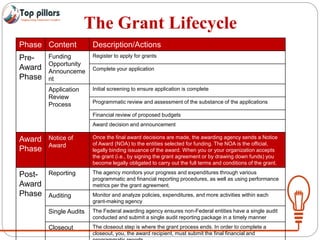
The Grant Lifecycle
Phase Content Description/Actions
Pre-
Award
Phase
Funding
Opportunity
Announceme
nt
Register to apply for grants
Complete your application
Application
Review
Process
Initial screening to ensure application is complete
Programmatic review and assessment of the substance of the applications
Financial review of proposed budgets
Award decision and announcement
Award
Phase
Notice of
Award
Once the final award decisions are made, the awarding agency sends a Notice
of Award (NOA) to the entities selected for funding. The NOA is the official,
legally binding issuance of the award. When you or your organization accepts
the grant (i.e., by signing the grant agreement or by drawing down funds) you
become legally obligated to carry out the full terms and conditions of the grant.
Post-
Award
Phase
Reporting The agency monitors your progress and expenditures through various
programmatic and financial reporting procedures, as well as using performance
metrics per the grant agreement.
Auditing Monitor and analyze policies, expenditures, and more activities within each
grant-making agency
Single Audits The Federal awarding agency ensures non-Federal entities have a single audit
conducted and submit a single audit reporting package in a timely manner
Closeout The closeout step is where the grant process ends. In order to complete a
closeout, you, the award recipient, must submit the final financial and
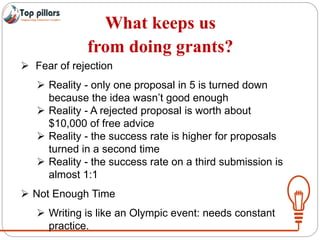
What keeps us
from doing grants?
 Fear of rejection
 Reality - only one proposal in 5 is turned down
because the idea wasn’t good enough
 Reality - A rejected proposal is worth about
$10,000 of free advice
 Reality - the success rate is higher for proposals
turned in a second time
 Reality - the success rate on a third submission is
almost 1:1
 Not Enough Time
 Writing is like an Olympic event: needs constant
practice.
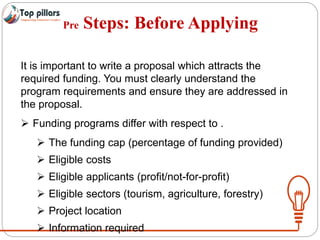
Pre Steps: Before Applying
It is important to write a proposal which attracts the
required funding. You must clearly understand the
program requirements and ensure they are addressed in
the proposal.
 Funding programs differ with respect to .
 The funding cap (percentage of funding provided)
 Eligible costs
 Eligible applicants (profit/not-for-profit)
 Eligible sectors (tourism, agriculture, forestry)
 Project location
 Information required
Pre Steps: Organizing Work
 Involve your team (one person shouldn't write a
proposal)
 Prepare all preliminary information
 Create a checklist
 Don't bother the funder too much during the
preparation process
 Think of the structure
Pre Steps: Start-up Work
 Identifying a project idea
 Looking for a potential funder
 Studying priorities, guidelines and application forms /
previously funded projects
 Establishing initial contact (organizations mission and
vision, strategy, structure, team)
 Creating partnerships (now or earlier)
Proposal Formatting
Formatting is concerned with the look, style, and layout
of the proposal. It is not merely aesthetics.
It is pleasing to the eye but also:
 Adds to the perception that the document is well
thought out.
 Enhances the credibility and professionalism of
your organization.
 Is easy to read and understand.
 Facilitates the understanding of the proposal
content.
 Makes it easy for the reader to find the information
they are looking for.
Proposal Formatting
 Cover/Title Page
 First thing the funder reads
 Must engage the reader so (s)he reads the rest of
the proposal
 Personal, to the point, concise
 It should include: date, project title, location, name
of organization; any required information (e.g.
proposal ref #).
 Footnoting & References
 Footnote the source of quotes, statistics, and
tables.
Proposal Formatting
 Table of Contents
 Make it easy for readers to find the information
they require.
 Each heading should be listed with its
corresponding page #.
 Keep it a reasonable length.
 Too may headings can make it unwieldy.
 Appendices
 Use appendices to avoid crowding the body of the
proposal and maintain the narrative flow.
 Typical appendices include: material lists,
Proposal Formatting
 Length
 The proposal should be focused and concise
 The length will usually depend on the number of
resources being requested
 Lay out
 The margins, spacing, fonts, headings, and
numbering should be consistent throughout the
document
 Writing
 Sentence structure, grammar, and spelling should
be checked.
Proposal Content
 Executive Summary / Abstract
 A concise summary of the key points. It should not
exceed two pages in length and single spaced.
 Should be able to stand alone
 it may be all the reviewers read
 Do not refer to proposal in the abstract
 Cover all key elements in order.
 Remember: this what reader first read and what
the writer lastly writs.
Proposal Content
 The Problem Statement
 Framing the Need:
 Don’t assume that no one else has ever
thought of your idea.
 The Problem Statement establishes a
framework for the project’s goals, objectives,
methods, and evaluation.
 Provide a thorough explanation of your need
 Test assumptions
 Anticipate questions of others
 Incorporate proposal guidelines
 Begin with a framing statement then provide
Proposal Content
 A Good Problem Statement Should:
 Show that you understand the problem.
 Demonstrate that this is an important problem to
solve, not only at domestic level, but regionally and
nationally as well.
 Clearly describe the aspects of the problem that
your project will address, and what gaps this will
fill.
 Describe the theoretical or conceptual basis for
your project and your knowledge of the issues
surrounding your proposed project.
 Include statistical data, if appropriate.
 Demonstrate that your approach is creative or
Proposal Content
 A Problem Statement Example
 The Idea: Children are exhibiting violent and
disruptive behavior.
 Clarifying the assumptions and Anticipating the
questions
 The harsh truth is that growing numbers of children
in America are exhibiting violent and disruptive
behavior or externalizing behavior (also referred to as
antisocial behavior, challenging behavior, defiance, noncompliance,
aggressive behavior, acting-out, etc.) beyond the occasional
minor incident typical of most children during the
normal course of development. Such behavior has
become one of the most pressing issues in
schools.
Proposal Content
 Goals and Objectives
 The goal of your project should be to solve the
problem described in the proposal problem
statement.
 Goals are general, long term broad desires (A
CONCISE STATEMENT OF THE WHOLE PURPOSE
OF THE PROJECT). The opening statement of
this section should begin with “the goal of this
project is to…”
 Objectives are specific, verifiable outcomes
which flow from goals. Objectives discuss who
is going to do what, when they will do it, and
how it will be measured.
Proposal Content
 Methodology: The “How”
 Plan of Action, Project Design, or Methodology
 Usually, this is the area allotted the most points.
 Often poorly written or missing altogether.
 2:5 proposals are turned down because the
methodology is unsound.
 Often the most detailed and lengthy section
 What specific activities will allow you to meet
your objectives. Task oriented, specific, detailed
 Essential that you demonstrate all the steps
necessary to complete project with each
flowing logically from the previous to the next.
Proposal Content
 Introduction to the organization or individual applying
 provide a description of past and present programs and
projects implemented by you/your organization, clearly
demonstrating your/your organization’s ability to carry out the
proposed program. The description should include
information on all previous grants received from the donor.
 Key Personnel
 This is where you demonstrate that you are the right person
to do this project. Do not simply say “See resume.”
 Convince the funding agency the you are capable of
accomplishing what you say you can accomplish.
 Highlight the expertise of all key personnel.
 If you don’t identify a person, summarize the job description
Proposal Content
 Program Activities
 Provide a description of the proposed program’s
activities and how they will help achieve the
objectives.
 Project Schedule
 It should clearly indicate when the project will start
and end.
 It will describe the sequence of project activities
and the duration of these activities.
Proposal Content
 Program Audiences
 Describe your key audiences for the project, both
primary and secondary. Primary audiences are
those who will participate directly in the program,
while secondary audiences are those who will be
reached by the project's primary audiences.
 Program Partners
 Good partnerships demonstrate community
support. They also provide access to people,
skills, funding, and in-kind contributions to help
with project planning and implementation.
 list the names and type of involvement of key
Proposal Content
 Media plan and visibility
 Provide a description of your program`s outreach
and media strategy. For example, with regard to
social media, you could include a specific number
of planned posts per platform and clear goals for
engagement, both per post and for the chosen
platform as a whole. For traditional media, you
could describe your plan to invite appropriate
media outlets to cover your programs.
 The media plan should illustrate how the
program`s activities, outcomes and
accomplishments will be made visible and create a
larger impact by reaching indirect audiences as
Proposal Content
 Economic and Social Benefits
 You will need to demonstrate how target groups
will benefit from your proposal. Often there are
direct and indirect beneficiaries. You should
distinguish between them and indicate how each
will benefit.
 Economic benefits include: Short-term project
employment, long-term employment, skill
development, and increased tax revenues.
 Social benefits are non-financial, positive
outcomes for target groups.
Proposal Content
 Monitoring & Evaluation
 Aspects of monitoring and evaluation:
 Project Monitoring: How project costs, quality, schedule,
and scope will be monitored, controlled, and corrected if
necessary.
 Best Practices: How you plan to capture and record what
you learn from your project so it can be applied in the
planning and execution of future projects.
 Accounting: The retention and recording of financial
information. Accounting is very important to funding
agencies. It must be transparent and accurate.
 Project Output: Determining the success of your project’s
end product. There should be emphasis on reporting the
effects of the project on the target group (beneficiaries)
Proposal Content
 A Good Evaluation Plan
 Covers both process and product.
 Tells who will perform the evaluation and how they
were chosen.
 Defines the criteria by which the program will be
evaluated.
 Evaluates the achievement of each objective.
 Describes data gathering methods.
 Explains assessment instruments, questionnaires,
and other materials.
 Describes data analysis procedures.
 Relates evaluation findings to plan for program
improvement.
 Describes evaluation reports to be produced.
Proposal Content
 Project Continuation
 Funding agencies want to have a lasting impact
and they want to know how that will happen.
 Include how you propose to continue the project
beyond the funding that you are requesting - May
include a ‘good faith” statement from the institution.
 Demonstrate Continuation with budget
construction.
 How will this project become part of an established
program?
 Will it generate fees to sustain it?
 Will it become part of the institutional budget?
Proposal Content
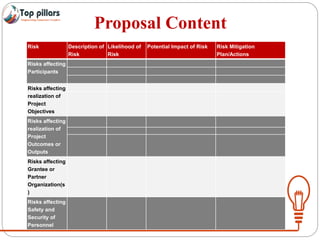
Risk Description of
Risk
Likelihood of
Risk
Potential Impact of Risk Risk Mitigation
Plan/Actions
Risks affecting
Participants
Risks affecting
realization of
Project
Objectives
Risks affecting
realization of
Project
Outcomes or
Outputs
Risks affecting
Grantee or
Partner
Organization(s
)
Risks affecting
Safety and
Security of
Personnel
.
Proposal Content
 Financial Proposal
 Direct Costs: Costs that can be identified
specifically with a particular sponsored project, an
instructional activity, or any other institutional
activity; or that can be directly assigned to such
activities relatively easily with a high degree of
accuracy.
 Indirect Costs: Costs that are incurred for common
or joint objectives, and, therefore, cannot be
identified readily and specifically with a particular
sponsored project, an instructional activity, or any
other institutional activity.
Proposal Content
 Financial Proposal
 How Do we Determine if a Cost is Allowable?
 Only required for federal, but most institutions
apply to all sponsored projects.
 REASONABLE: A prudent business person
would have purchased this item and paid this
price.
 ALLOCABLE: Assigned to the activity on a
reasonable basis.
 CONSISTENTLY TREATED: like costs must be
treated or costed the same in like
circumstances.
Proposal Content
 Categories of a Budget
 Salaries
 Fringe Benefits
 Travel
 Materials & Supplies
 Equipment
 Contractual
 Other
Proposal Content
 Appendix
 What additional information will be helpful to the
reader?.
 Vitae.
 Letters of Support/Commitment (Grants Office
will obtain any institutional letters).
 Sample questionnaires, syllabi.
 Some sponsors either do not allow appendix
material or do not require reviewers to read
anything that appears in an appendix.
 Don’t waste trees.
Special Challenges
 Applying to Multiple Funding Programs
While accessing funding from several sources, the
likelihood of omission increases when a proposal is
submitted to multiple funding partners.
 Don’t assume that because a proposal satisfies
one funding agency it will satisfy others.
 Do not overlook the requirements of programs
which will make smaller contributions.
 Read program criteria closely and reflect those
criteria throughout your proposal.
 Use the program application(s) as proposal
checklists to ensure all the required information
is included.
Special Challenges
 Terms of Reference
 Many projects require the retention of outside
expertise such as engineers, architects, and
consultants.
 You will need to specify what work you require
these professionals to carry out, how they will be
selected, and how you will control the work.
 Any funding proposal for a study or professional
services should contain a good draft terms of
reference.
TIPS
 Recycle your Rejected Proposal
 Success means having one in three grants
funded.
 A rejected proposal does not always mean the
idea was rejected.
 Obtain reviewer comments.
 Call the program officer.
 Rewrite, revise, resubmit.
 Remember
 Get and Read.
 Follow The Guidelines.
 Call The Program Officer.
Q&A
Top Pillars
Empowering tomorrow’s leaders
Top Pillars
Mohammad Maani
Empowering tomorrows leaders

Introduction to Effective Proposal Writing

  • 1.
    Top Pillars Empowering tomorrow’sleaders Proposal Writing Mohammad Maani Part of: Community Capacity Building Program
  • 2.
    What is theProposal?  A proposal is a request for financial assistance to implement a project.  A proposal is a plan or an idea, often a formal or written one, which is suggested for people to think about and decide upon.  proposal is a document that offers a solution to a problem or a course of action in response to a need.  Funding is sought, in whole or in part, from government funding agencies, charitable foundations, businesses, individuals, and other sources.  Consider it as MARKETING DOCUMENT
  • 3.
    Type of Proposals Business Proposals  Internal Proposal  External Proposal: solicited and unsolicited  Sales Proposal  Grant Proposal  Research Proposals  This form requires the writer to describe the intended research in full detail, including the problem the research is addressing, why it's important, what research has been conducted before in this field, and how the student's project will accomplish something unique.
  • 4.
    What is theGrant?  A grant is a way the government funds your ideas and projects to provide public services and stimulate the economy.  Grants support critical recovery initiatives, innovative research, and many other programs.  “There is no grantsmanship that will turn a bad idea into a good one, but there are many ways to disguise a good idea.”  Consider it as MARKETING DOCUMENT
  • 5.
    The Grant Lifecycle PhaseContent Description/Actions Pre- Award Phase Funding Opportunity Announceme nt Register to apply for grants Complete your application Application Review Process Initial screening to ensure application is complete Programmatic review and assessment of the substance of the applications Financial review of proposed budgets Award decision and announcement Award Phase Notice of Award Once the final award decisions are made, the awarding agency sends a Notice of Award (NOA) to the entities selected for funding. The NOA is the official, legally binding issuance of the award. When you or your organization accepts the grant (i.e., by signing the grant agreement or by drawing down funds) you become legally obligated to carry out the full terms and conditions of the grant. Post- Award Phase Reporting The agency monitors your progress and expenditures through various programmatic and financial reporting procedures, as well as using performance metrics per the grant agreement. Auditing Monitor and analyze policies, expenditures, and more activities within each grant-making agency Single Audits The Federal awarding agency ensures non-Federal entities have a single audit conducted and submit a single audit reporting package in a timely manner Closeout The closeout step is where the grant process ends. In order to complete a closeout, you, the award recipient, must submit the final financial and
  • 6.
    What keeps us fromdoing grants?  Fear of rejection  Reality - only one proposal in 5 is turned down because the idea wasn’t good enough  Reality - A rejected proposal is worth about $10,000 of free advice  Reality - the success rate is higher for proposals turned in a second time  Reality - the success rate on a third submission is almost 1:1  Not Enough Time  Writing is like an Olympic event: needs constant practice.
  • 7.
    Pre Steps: BeforeApplying It is important to write a proposal which attracts the required funding. You must clearly understand the program requirements and ensure they are addressed in the proposal.  Funding programs differ with respect to .  The funding cap (percentage of funding provided)  Eligible costs  Eligible applicants (profit/not-for-profit)  Eligible sectors (tourism, agriculture, forestry)  Project location  Information required
  • 8.
    Pre Steps: OrganizingWork  Involve your team (one person shouldn't write a proposal)  Prepare all preliminary information  Create a checklist  Don't bother the funder too much during the preparation process  Think of the structure
  • 9.
    Pre Steps: Start-upWork  Identifying a project idea  Looking for a potential funder  Studying priorities, guidelines and application forms / previously funded projects  Establishing initial contact (organizations mission and vision, strategy, structure, team)  Creating partnerships (now or earlier)
  • 10.
    Proposal Formatting Formatting isconcerned with the look, style, and layout of the proposal. It is not merely aesthetics. It is pleasing to the eye but also:  Adds to the perception that the document is well thought out.  Enhances the credibility and professionalism of your organization.  Is easy to read and understand.  Facilitates the understanding of the proposal content.  Makes it easy for the reader to find the information they are looking for.
  • 11.
    Proposal Formatting  Cover/TitlePage  First thing the funder reads  Must engage the reader so (s)he reads the rest of the proposal  Personal, to the point, concise  It should include: date, project title, location, name of organization; any required information (e.g. proposal ref #).  Footnoting & References  Footnote the source of quotes, statistics, and tables.
  • 12.
    Proposal Formatting  Tableof Contents  Make it easy for readers to find the information they require.  Each heading should be listed with its corresponding page #.  Keep it a reasonable length.  Too may headings can make it unwieldy.  Appendices  Use appendices to avoid crowding the body of the proposal and maintain the narrative flow.  Typical appendices include: material lists,
  • 13.
    Proposal Formatting  Length The proposal should be focused and concise  The length will usually depend on the number of resources being requested  Lay out  The margins, spacing, fonts, headings, and numbering should be consistent throughout the document  Writing  Sentence structure, grammar, and spelling should be checked.
  • 14.
    Proposal Content  ExecutiveSummary / Abstract  A concise summary of the key points. It should not exceed two pages in length and single spaced.  Should be able to stand alone  it may be all the reviewers read  Do not refer to proposal in the abstract  Cover all key elements in order.  Remember: this what reader first read and what the writer lastly writs.
  • 15.
    Proposal Content  TheProblem Statement  Framing the Need:  Don’t assume that no one else has ever thought of your idea.  The Problem Statement establishes a framework for the project’s goals, objectives, methods, and evaluation.  Provide a thorough explanation of your need  Test assumptions  Anticipate questions of others  Incorporate proposal guidelines  Begin with a framing statement then provide
  • 16.
    Proposal Content  AGood Problem Statement Should:  Show that you understand the problem.  Demonstrate that this is an important problem to solve, not only at domestic level, but regionally and nationally as well.  Clearly describe the aspects of the problem that your project will address, and what gaps this will fill.  Describe the theoretical or conceptual basis for your project and your knowledge of the issues surrounding your proposed project.  Include statistical data, if appropriate.  Demonstrate that your approach is creative or
  • 17.
    Proposal Content  AProblem Statement Example  The Idea: Children are exhibiting violent and disruptive behavior.  Clarifying the assumptions and Anticipating the questions  The harsh truth is that growing numbers of children in America are exhibiting violent and disruptive behavior or externalizing behavior (also referred to as antisocial behavior, challenging behavior, defiance, noncompliance, aggressive behavior, acting-out, etc.) beyond the occasional minor incident typical of most children during the normal course of development. Such behavior has become one of the most pressing issues in schools.
  • 18.
    Proposal Content  Goalsand Objectives  The goal of your project should be to solve the problem described in the proposal problem statement.  Goals are general, long term broad desires (A CONCISE STATEMENT OF THE WHOLE PURPOSE OF THE PROJECT). The opening statement of this section should begin with “the goal of this project is to…”  Objectives are specific, verifiable outcomes which flow from goals. Objectives discuss who is going to do what, when they will do it, and how it will be measured.
  • 19.
    Proposal Content  Methodology:The “How”  Plan of Action, Project Design, or Methodology  Usually, this is the area allotted the most points.  Often poorly written or missing altogether.  2:5 proposals are turned down because the methodology is unsound.  Often the most detailed and lengthy section  What specific activities will allow you to meet your objectives. Task oriented, specific, detailed  Essential that you demonstrate all the steps necessary to complete project with each flowing logically from the previous to the next.
  • 20.
    Proposal Content  Introductionto the organization or individual applying  provide a description of past and present programs and projects implemented by you/your organization, clearly demonstrating your/your organization’s ability to carry out the proposed program. The description should include information on all previous grants received from the donor.  Key Personnel  This is where you demonstrate that you are the right person to do this project. Do not simply say “See resume.”  Convince the funding agency the you are capable of accomplishing what you say you can accomplish.  Highlight the expertise of all key personnel.  If you don’t identify a person, summarize the job description
  • 21.
    Proposal Content  ProgramActivities  Provide a description of the proposed program’s activities and how they will help achieve the objectives.  Project Schedule  It should clearly indicate when the project will start and end.  It will describe the sequence of project activities and the duration of these activities.
  • 22.
    Proposal Content  ProgramAudiences  Describe your key audiences for the project, both primary and secondary. Primary audiences are those who will participate directly in the program, while secondary audiences are those who will be reached by the project's primary audiences.  Program Partners  Good partnerships demonstrate community support. They also provide access to people, skills, funding, and in-kind contributions to help with project planning and implementation.  list the names and type of involvement of key
  • 23.
    Proposal Content  Mediaplan and visibility  Provide a description of your program`s outreach and media strategy. For example, with regard to social media, you could include a specific number of planned posts per platform and clear goals for engagement, both per post and for the chosen platform as a whole. For traditional media, you could describe your plan to invite appropriate media outlets to cover your programs.  The media plan should illustrate how the program`s activities, outcomes and accomplishments will be made visible and create a larger impact by reaching indirect audiences as
  • 24.
    Proposal Content  Economicand Social Benefits  You will need to demonstrate how target groups will benefit from your proposal. Often there are direct and indirect beneficiaries. You should distinguish between them and indicate how each will benefit.  Economic benefits include: Short-term project employment, long-term employment, skill development, and increased tax revenues.  Social benefits are non-financial, positive outcomes for target groups.
  • 25.
    Proposal Content  Monitoring& Evaluation  Aspects of monitoring and evaluation:  Project Monitoring: How project costs, quality, schedule, and scope will be monitored, controlled, and corrected if necessary.  Best Practices: How you plan to capture and record what you learn from your project so it can be applied in the planning and execution of future projects.  Accounting: The retention and recording of financial information. Accounting is very important to funding agencies. It must be transparent and accurate.  Project Output: Determining the success of your project’s end product. There should be emphasis on reporting the effects of the project on the target group (beneficiaries)
  • 26.
    Proposal Content  AGood Evaluation Plan  Covers both process and product.  Tells who will perform the evaluation and how they were chosen.  Defines the criteria by which the program will be evaluated.  Evaluates the achievement of each objective.  Describes data gathering methods.  Explains assessment instruments, questionnaires, and other materials.  Describes data analysis procedures.  Relates evaluation findings to plan for program improvement.  Describes evaluation reports to be produced.
  • 27.
    Proposal Content  ProjectContinuation  Funding agencies want to have a lasting impact and they want to know how that will happen.  Include how you propose to continue the project beyond the funding that you are requesting - May include a ‘good faith” statement from the institution.  Demonstrate Continuation with budget construction.  How will this project become part of an established program?  Will it generate fees to sustain it?  Will it become part of the institutional budget?
  • 28.
    Proposal Content Risk Descriptionof Risk Likelihood of Risk Potential Impact of Risk Risk Mitigation Plan/Actions Risks affecting Participants Risks affecting realization of Project Objectives Risks affecting realization of Project Outcomes or Outputs Risks affecting Grantee or Partner Organization(s ) Risks affecting Safety and Security of Personnel .
  • 29.
    Proposal Content  FinancialProposal  Direct Costs: Costs that can be identified specifically with a particular sponsored project, an instructional activity, or any other institutional activity; or that can be directly assigned to such activities relatively easily with a high degree of accuracy.  Indirect Costs: Costs that are incurred for common or joint objectives, and, therefore, cannot be identified readily and specifically with a particular sponsored project, an instructional activity, or any other institutional activity.
  • 30.
    Proposal Content  FinancialProposal  How Do we Determine if a Cost is Allowable?  Only required for federal, but most institutions apply to all sponsored projects.  REASONABLE: A prudent business person would have purchased this item and paid this price.  ALLOCABLE: Assigned to the activity on a reasonable basis.  CONSISTENTLY TREATED: like costs must be treated or costed the same in like circumstances.
  • 31.
    Proposal Content  Categoriesof a Budget  Salaries  Fringe Benefits  Travel  Materials & Supplies  Equipment  Contractual  Other
  • 32.
    Proposal Content  Appendix What additional information will be helpful to the reader?.  Vitae.  Letters of Support/Commitment (Grants Office will obtain any institutional letters).  Sample questionnaires, syllabi.  Some sponsors either do not allow appendix material or do not require reviewers to read anything that appears in an appendix.  Don’t waste trees.
  • 33.
    Special Challenges  Applyingto Multiple Funding Programs While accessing funding from several sources, the likelihood of omission increases when a proposal is submitted to multiple funding partners.  Don’t assume that because a proposal satisfies one funding agency it will satisfy others.  Do not overlook the requirements of programs which will make smaller contributions.  Read program criteria closely and reflect those criteria throughout your proposal.  Use the program application(s) as proposal checklists to ensure all the required information is included.
  • 34.
    Special Challenges  Termsof Reference  Many projects require the retention of outside expertise such as engineers, architects, and consultants.  You will need to specify what work you require these professionals to carry out, how they will be selected, and how you will control the work.  Any funding proposal for a study or professional services should contain a good draft terms of reference.
  • 35.
    TIPS  Recycle yourRejected Proposal  Success means having one in three grants funded.  A rejected proposal does not always mean the idea was rejected.  Obtain reviewer comments.  Call the program officer.  Rewrite, revise, resubmit.  Remember  Get and Read.  Follow The Guidelines.  Follow The Guidelines.  Call The Program Officer.
  • 36.
  • 37.
    Top Pillars Empowering tomorrow’sleaders Top Pillars Mohammad Maani Empowering tomorrows leaders

Editor's Notes

  • #4 https://www.thoughtco.com/proposal-business-and-academic-writing-1691691
  • #6 https://www.grants.gov/learn-grants/grants-101.html