Grant Writing 102
              Hillel Bromberg

                May 30, 2012


A Service
   Of:                   Sponsored by:
INTEGRATED PLANNING
            Advising nonprofits in:        www.synthesispartnership.com
            • Strategy
            • Planning                                    (617) 969-1881
            • Organizational Development   info@synthesispartnership.com


A Service
   Of:                                            Sponsored by:
Affordable collaborative data
             management in the cloud.

A Service
   Of:                        Sponsored by:
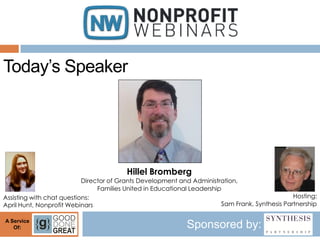
Today’s Speaker


                                         Hillel Bromberg
                           Director of Grants Development and Administration,
                                Families United in Educational Leadership
Assisting with chat questions:                                                                   Hosting:
April Hunt, Nonprofit Webinars                                           Sam Frank, Synthesis Partnership

A Service
   Of:                                                       Sponsored by:
Grant Writing 102

                  or
How to impress the pants off the funders


        Hillel Bromberg
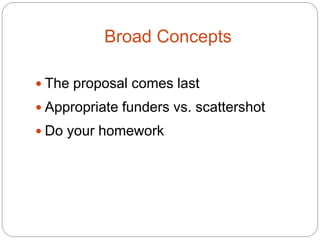
Broad Concepts

 The proposal comes last
 Appropriate funders vs. scattershot
 Do your homework
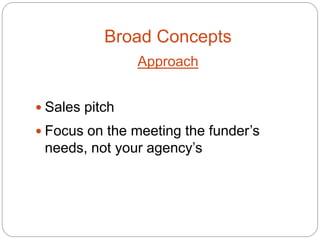
Broad Concepts
                Approach


 Sales pitch
 Focus on the meeting the funder’s
 needs, not your agency’s
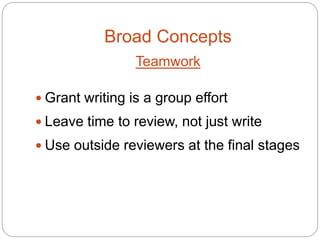
Broad Concepts
                 Teamwork

 Grant writing is a group effort
 Leave time to review, not just write
 Use outside reviewers at the final stages
Broad Concepts


DON’T SLIP THE DEADLINE!!
Broad Concepts
        Leverage your rejections

 Rejections are not the end of the
 process
 Request reviewers’ comments
 Read the winning application(s)
 Revise and reapply
Broad Concepts
               Writing Style

 Not academic, journalistic, etc.
 Short sentences
 Subheads
 Energetic, concise, direct writing
 Avoid jargon
 PROOFREAD! Have zero tolerance for
 errors in spelling, formatting, etc.
Parts of the proposal
                 Letter of Intent
 Your purpose is not to describe the workings of
 the program, but to get the reader to invite a
 proposal.

 Concise
 Compelling
 Clear


 Get the reader excited
Parts of the proposal
Part I – About the organization (message)

Build trust by describing:
 Your mission
 Whom you serve
 Track record of achievement
 List your programs
 Size of budget
 Location
 Who runs the organization
Parts of the proposal
 Part I – About the organization (content)

 History
 Goals & objectives (short & long term)
 Programs & services
 Organizational structure (board, staff,
 volunteers)
Parts of the proposal
       Part II – About the program/project
       Description of the program/project

 Don’t assume what the funder knows
 Describe your target audience (quantity,
  demographics, geography, etc.)
 What project planning have you already done?


       Use the “mind’s eye” test
Parts of the proposal
       Part II – About the program/project

Description of need (what is the issue you plan
   to address? What is your approach? What
 research supports your idea? How does your
     strategy differ from others in the field?)

 Why is this situation important?
 What research did you do?


                  Tell a story
Parts of the proposal
       Part II – About the program/project
 Specific activities (including information about
          service delivery and/or timeline)
 Your work plan – what are you doing about this
  problem?
 What are your outputs?
 How many units of service will you deliver over
  what time frame?
 Who is doing the work and what are their
  credentials?
 When and where will the work happen?
Parts of the proposal
       Part II – About the program/project
Objectives and goals for this request (how will
    this grant strengthen the organization,
 address the issues, make improvements, or
               achieve success?)

 Prime question: what will change about your
 world as a result of your program/project?
Parts of the proposal
       Part II – About the program/project

 Evaluation (what are the anticipated outcomes
  and how will you know if you are successful?)

 Key: be sure your evaluation plan is achievable
  given your resources.
 If the evaluation will cost money, put that cost into
  the project budget
Parts of the proposal
       Part II – About the program/project

                      Other
 aka, conclusion

 Summary of your appeal

 Mimic the funder’s words
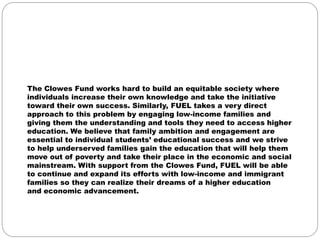
The Clowes Fund works hard to build an equitable society where
individuals increase their own knowledge and take the initiative
toward their own success. Similarly, FUEL takes a very direct
approach to this problem by engaging low-income families and
giving them the understanding and tools they need to access higher
education. We believe that family ambition and engagement are
essential to individual students’ educational success and we strive
to help underserved families gain the education that will help them
move out of poverty and take their place in the economic and social
mainstream. With support from the Clowes Fund, FUEL will be able
to continue and expand its efforts with low-income and immigrant
families so they can realize their dreams of a higher education
and economic advancement.
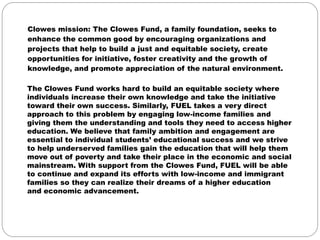
Clowes mission: The Clowes Fund, a family foundation, seeks to
enhance the common good by encouraging organizations and
projects that help to build a just and equitable society, create
opportunities for initiative, foster creativity and the growth of
knowledge, and promote appreciation of the natural environment.

The Clowes Fund works hard to build an equitable society where
individuals increase their own knowledge and take the initiative
toward their own success. Similarly, FUEL takes a very direct
approach to this problem by engaging low-income families and
giving them the understanding and tools they need to access higher
education. We believe that family ambition and engagement are
essential to individual students’ educational success and we strive
to help underserved families gain the education that will help them
move out of poverty and take their place in the economic and social
mainstream. With support from the Clowes Fund, FUEL will be able
to continue and expand its efforts with low-income and immigrant
families so they can realize their dreams of a higher education
and economic advancement.
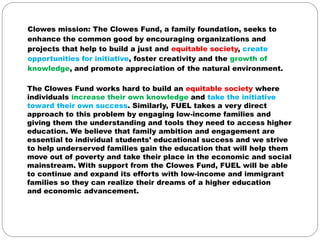
Clowes mission: The Clowes Fund, a family foundation, seeks to
enhance the common good by encouraging organizations and
projects that help to build a just and equitable society, create
opportunities for initiative, foster creativity and the growth of
knowledge, and promote appreciation of the natural environment.

The Clowes Fund works hard to build an equitable society where
individuals increase their own knowledge and take the initiative
toward their own success. Similarly, FUEL takes a very direct
approach to this problem by engaging low-income families and
giving them the understanding and tools they need to access higher
education. We believe that family ambition and engagement are
essential to individual students’ educational success and we strive
to help underserved families gain the education that will help them
move out of poverty and take their place in the economic and social
mainstream. With support from the Clowes Fund, FUEL will be able
to continue and expand its efforts with low-income and immigrant
families so they can realize their dreams of a higher education
and economic advancement.
Parts of the proposal
                Budget

Expenses divide into three sections:
 personnel expenses
 direct project expenses
 administrative or overhead expenses
Parts of the proposal
                  Budget
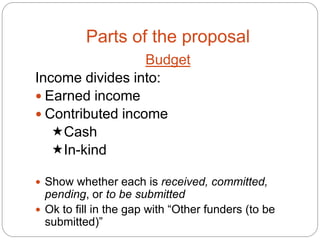
Income divides into:
 Earned income
 Contributed income
   Cash
   In-kind

 Show whether each is received, committed,
  pending, or to be submitted
 Ok to fill in the gap with “Other funders (to be
  submitted)”
Parts of the proposal
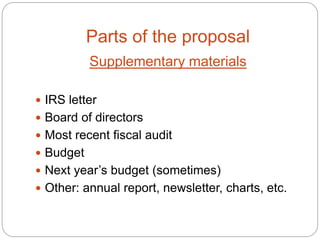
           Supplementary materials

 IRS letter
 Board of directors
 Most recent fiscal audit
 Budget
 Next year’s budget (sometimes)
 Other: annual report, newsletter, charts, etc.
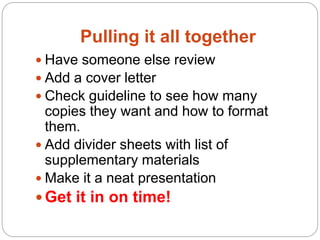
Pulling it all together
 Have someone else review
 Add a cover letter
 Check guideline to see how many
  copies they want and how to format
  them.
 Add divider sheets with list of
  supplementary materials
 Make it a neat presentation
 Get it in on time!
Grant Writing 102


Hillel Bromberg
wordwise@rcn.com
   781-258-0124
Find listings for our current season
          of webinars and register at:

            NonprofitWebinars.com


A Service
   Of:                     Sponsored by:

Grant Writing 102

  • 1.
    Grant Writing 102 Hillel Bromberg May 30, 2012 A Service Of: Sponsored by:
  • 2.
    INTEGRATED PLANNING Advising nonprofits in: www.synthesispartnership.com • Strategy • Planning (617) 969-1881 • Organizational Development info@synthesispartnership.com A Service Of: Sponsored by:
  • 3.
    Affordable collaborative data management in the cloud. A Service Of: Sponsored by:
  • 4.
    Today’s Speaker Hillel Bromberg Director of Grants Development and Administration, Families United in Educational Leadership Assisting with chat questions: Hosting: April Hunt, Nonprofit Webinars Sam Frank, Synthesis Partnership A Service Of: Sponsored by:
  • 5.
    Grant Writing 102 or How to impress the pants off the funders Hillel Bromberg
  • 6.
    Broad Concepts  Theproposal comes last  Appropriate funders vs. scattershot  Do your homework
  • 7.
    Broad Concepts Approach  Sales pitch  Focus on the meeting the funder’s needs, not your agency’s
  • 8.
    Broad Concepts Teamwork  Grant writing is a group effort  Leave time to review, not just write  Use outside reviewers at the final stages
  • 9.
  • 10.
    Broad Concepts Leverage your rejections  Rejections are not the end of the process  Request reviewers’ comments  Read the winning application(s)  Revise and reapply
  • 11.
    Broad Concepts Writing Style  Not academic, journalistic, etc.  Short sentences  Subheads  Energetic, concise, direct writing  Avoid jargon  PROOFREAD! Have zero tolerance for errors in spelling, formatting, etc.
  • 12.
    Parts of theproposal Letter of Intent  Your purpose is not to describe the workings of the program, but to get the reader to invite a proposal.  Concise  Compelling  Clear  Get the reader excited
  • 13.
    Parts of theproposal Part I – About the organization (message) Build trust by describing:  Your mission  Whom you serve  Track record of achievement  List your programs  Size of budget  Location  Who runs the organization
  • 14.
    Parts of theproposal Part I – About the organization (content)  History  Goals & objectives (short & long term)  Programs & services  Organizational structure (board, staff, volunteers)
  • 15.
    Parts of theproposal Part II – About the program/project Description of the program/project  Don’t assume what the funder knows  Describe your target audience (quantity, demographics, geography, etc.)  What project planning have you already done? Use the “mind’s eye” test
  • 16.
    Parts of theproposal Part II – About the program/project Description of need (what is the issue you plan to address? What is your approach? What research supports your idea? How does your strategy differ from others in the field?)  Why is this situation important?  What research did you do? Tell a story
  • 17.
    Parts of theproposal Part II – About the program/project Specific activities (including information about service delivery and/or timeline)  Your work plan – what are you doing about this problem?  What are your outputs?  How many units of service will you deliver over what time frame?  Who is doing the work and what are their credentials?  When and where will the work happen?
  • 18.
    Parts of theproposal Part II – About the program/project Objectives and goals for this request (how will this grant strengthen the organization, address the issues, make improvements, or achieve success?)  Prime question: what will change about your world as a result of your program/project?
  • 19.
    Parts of theproposal Part II – About the program/project Evaluation (what are the anticipated outcomes and how will you know if you are successful?)  Key: be sure your evaluation plan is achievable given your resources.  If the evaluation will cost money, put that cost into the project budget
  • 20.
    Parts of theproposal Part II – About the program/project Other  aka, conclusion  Summary of your appeal  Mimic the funder’s words
  • 21.
    The Clowes Fundworks hard to build an equitable society where individuals increase their own knowledge and take the initiative toward their own success. Similarly, FUEL takes a very direct approach to this problem by engaging low-income families and giving them the understanding and tools they need to access higher education. We believe that family ambition and engagement are essential to individual students’ educational success and we strive to help underserved families gain the education that will help them move out of poverty and take their place in the economic and social mainstream. With support from the Clowes Fund, FUEL will be able to continue and expand its efforts with low-income and immigrant families so they can realize their dreams of a higher education and economic advancement.
  • 22.
    Clowes mission: TheClowes Fund, a family foundation, seeks to enhance the common good by encouraging organizations and projects that help to build a just and equitable society, create opportunities for initiative, foster creativity and the growth of knowledge, and promote appreciation of the natural environment. The Clowes Fund works hard to build an equitable society where individuals increase their own knowledge and take the initiative toward their own success. Similarly, FUEL takes a very direct approach to this problem by engaging low-income families and giving them the understanding and tools they need to access higher education. We believe that family ambition and engagement are essential to individual students’ educational success and we strive to help underserved families gain the education that will help them move out of poverty and take their place in the economic and social mainstream. With support from the Clowes Fund, FUEL will be able to continue and expand its efforts with low-income and immigrant families so they can realize their dreams of a higher education and economic advancement.
  • 23.
    Clowes mission: TheClowes Fund, a family foundation, seeks to enhance the common good by encouraging organizations and projects that help to build a just and equitable society, create opportunities for initiative, foster creativity and the growth of knowledge, and promote appreciation of the natural environment. The Clowes Fund works hard to build an equitable society where individuals increase their own knowledge and take the initiative toward their own success. Similarly, FUEL takes a very direct approach to this problem by engaging low-income families and giving them the understanding and tools they need to access higher education. We believe that family ambition and engagement are essential to individual students’ educational success and we strive to help underserved families gain the education that will help them move out of poverty and take their place in the economic and social mainstream. With support from the Clowes Fund, FUEL will be able to continue and expand its efforts with low-income and immigrant families so they can realize their dreams of a higher education and economic advancement.
  • 24.
    Parts of theproposal Budget Expenses divide into three sections:  personnel expenses  direct project expenses  administrative or overhead expenses
  • 25.
    Parts of theproposal Budget Income divides into:  Earned income  Contributed income Cash In-kind  Show whether each is received, committed, pending, or to be submitted  Ok to fill in the gap with “Other funders (to be submitted)”
  • 26.
    Parts of theproposal Supplementary materials  IRS letter  Board of directors  Most recent fiscal audit  Budget  Next year’s budget (sometimes)  Other: annual report, newsletter, charts, etc.
  • 27.
    Pulling it alltogether  Have someone else review  Add a cover letter  Check guideline to see how many copies they want and how to format them.  Add divider sheets with list of supplementary materials  Make it a neat presentation  Get it in on time!
  • 28.
    Grant Writing 102 HillelBromberg wordwise@rcn.com 781-258-0124
  • 29.
    Find listings forour current season of webinars and register at: NonprofitWebinars.com A Service Of: Sponsored by: