Designing Classes

1.   Designing classes
2.   Designing protocols and class visibility
3.   The UML object Constraint language
4.   Designing methods
Introduction
• Designer has to know
  – Specification of the class
  – interaction of that class with other classes
Object oriented design philosophy
• Designing class with reusability in mind ->
  more gain in productivity and reduce the time
  for developing new application
UML Object Constraint Language(OCL)
•   The rules and semantics of UML are expressed using OCL
•   OCL
     – Specification language
     – Uses simple logic to specify the properties of the system
•   UML modeling constructs requires expression. some example as follow
     – Item.selector
         • Item -> object
         • Selector -> attribute
         • Ex : kathir.regno
     – Item.selextor[qualifier-value]
         • Qualifier is uesd to select related values
         • Ex:
               – Kathir.phone[2]
     – Set->select ( Boolean expression)
         • Company.employee->salary>20000
Designing classes : process
• Apply design axioms to design calsses , their
  atribute, methods and association , structures,
  amd protocols
  – Refine and complete the static uml class diagrams by
    adding details to that design
     • Refine attribute
     • Design methods and protocols
         – Uses uml activity diagram to represent algorithm
     • Refine the association bw classes
     • Refine class hierarchy and design with inheritance
  – Iterate and refine
Class visibility: desiging well defined
    public , private and protected
                 protocols
• 2 problems in designing methods or attributes
  of class
  – Protocol or interface to the class operation and
    its visibility
  – How it is implemented
• Protocol layers
  – Private protocol
  – Protected protocol
  – Public protocol
Internal layer
• Defines the implementation of the object
• Apply axioms and corollaries ( corollary 1) to
  decide what to private
• Private protocol
   – Includes messages that should not be sent from other
     objects
   – Accessible to only operations of that class
• Protected protocol
   – Methods and attributes can be used by class itself or
     its subclass
External layer
• Design the functionality of the object
• Public protocol
  – Defined to pass message bw associated classes
  – Interpretation and implementation of each
    message is up to the individual classes
Encapsulation leakage

• lack of well designed protocol leads to this
  problem
• Encapsulation leakage occurs when details
  about classes internal implementation are
  disclosed through the interface
Refining attribute
• Attribute
   – Represents the state of the object
• Analysis phase -> name of the attribute is sufficient
• Design phase         -> detailed information must
  be added
• Attribute types
   – Single valued attribute
      • Ex: dob of the student
   – Multiplicity or multivalue attribute
      • Subjects handled by the staff
   – Reference to another object or instance connection
      • Person hold the account
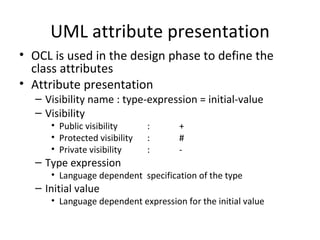
UML attribute presentation
• OCL is used in the design phase to define the
  class attributes
• Attribute presentation
  – Visibility name : type-expression = initial-value
  – Visibility
     • Public visibility      :     +
     • Protected visibility   :     #
     • Private visibility     :     -
  – Type expression
     • Language dependent specification of the type
  – Initial value
     • Language dependent expression for the initial value
Designing methods and protocols
• Specifying the algorithm for methods
  – By using formal structure (ex uml activity diag) with
    OCL
• Types of methods
  –   Constructor
  –   Destructor
  –   Conversion method
  –   Copy method
  –   Attribute set
  –   Attribute get
  –   IO methods
  –   Domain specific
Design issues : avoiding pitfalls
• Better to have Large set of simple classes than
  few large , complex classes
  – Initially class might be too big
  – Apply design axioms and corollary
     • to reduce the size
     • Improve reusability
UML Operation presentation
• Visibility name: (Parameter list ) : return-type-expression
   – Visibility
       • Public visibility           :          +
       • Protected visibility        :          #
       • Private visibility          :          -
   – Name
       • Name of the operation
   – Parameter list
       • List of parameters each specified by
           – Name : type expression = default value
   – Return type expression
   – Ex:
       • + withdraw(amount:type):
Packaging and managing classes

Unit 4 designing classes

  • 1.
    Designing Classes 1. Designing classes 2. Designing protocols and class visibility 3. The UML object Constraint language 4. Designing methods
  • 2.
    Introduction • Designer hasto know – Specification of the class – interaction of that class with other classes
  • 3.
    Object oriented designphilosophy • Designing class with reusability in mind -> more gain in productivity and reduce the time for developing new application
  • 4.
    UML Object ConstraintLanguage(OCL) • The rules and semantics of UML are expressed using OCL • OCL – Specification language – Uses simple logic to specify the properties of the system • UML modeling constructs requires expression. some example as follow – Item.selector • Item -> object • Selector -> attribute • Ex : kathir.regno – Item.selextor[qualifier-value] • Qualifier is uesd to select related values • Ex: – Kathir.phone[2] – Set->select ( Boolean expression) • Company.employee->salary>20000
  • 5.
    Designing classes :process • Apply design axioms to design calsses , their atribute, methods and association , structures, amd protocols – Refine and complete the static uml class diagrams by adding details to that design • Refine attribute • Design methods and protocols – Uses uml activity diagram to represent algorithm • Refine the association bw classes • Refine class hierarchy and design with inheritance – Iterate and refine
  • 6.
    Class visibility: desigingwell defined public , private and protected protocols • 2 problems in designing methods or attributes of class – Protocol or interface to the class operation and its visibility – How it is implemented • Protocol layers – Private protocol – Protected protocol – Public protocol
  • 7.
    Internal layer • Definesthe implementation of the object • Apply axioms and corollaries ( corollary 1) to decide what to private • Private protocol – Includes messages that should not be sent from other objects – Accessible to only operations of that class • Protected protocol – Methods and attributes can be used by class itself or its subclass
  • 8.
    External layer • Designthe functionality of the object • Public protocol – Defined to pass message bw associated classes – Interpretation and implementation of each message is up to the individual classes
  • 9.
    Encapsulation leakage • lackof well designed protocol leads to this problem • Encapsulation leakage occurs when details about classes internal implementation are disclosed through the interface
  • 10.
    Refining attribute • Attribute – Represents the state of the object • Analysis phase -> name of the attribute is sufficient • Design phase -> detailed information must be added • Attribute types – Single valued attribute • Ex: dob of the student – Multiplicity or multivalue attribute • Subjects handled by the staff – Reference to another object or instance connection • Person hold the account
  • 11.
    UML attribute presentation •OCL is used in the design phase to define the class attributes • Attribute presentation – Visibility name : type-expression = initial-value – Visibility • Public visibility : + • Protected visibility : # • Private visibility : - – Type expression • Language dependent specification of the type – Initial value • Language dependent expression for the initial value
  • 12.
    Designing methods andprotocols • Specifying the algorithm for methods – By using formal structure (ex uml activity diag) with OCL • Types of methods – Constructor – Destructor – Conversion method – Copy method – Attribute set – Attribute get – IO methods – Domain specific
  • 13.
    Design issues :avoiding pitfalls • Better to have Large set of simple classes than few large , complex classes – Initially class might be too big – Apply design axioms and corollary • to reduce the size • Improve reusability
  • 14.
    UML Operation presentation •Visibility name: (Parameter list ) : return-type-expression – Visibility • Public visibility : + • Protected visibility : # • Private visibility : - – Name • Name of the operation – Parameter list • List of parameters each specified by – Name : type expression = default value – Return type expression – Ex: • + withdraw(amount:type):
  • 15.