©Ian Sommerville 1995 Software Engineering, 5th edition. Chapter 14 Slide 1
Object-oriented Design
Designing systems using self-
contained objects and object
classes
©Ian Sommerville 1995 Software Engineering, 5th edition. Chapter 14 Slide 2
Objectives
To explain how a software design may be
represented as a set of interacting objects
To illustrate, with a simple example, the object-
oriented design process
To introduce various models which describe an
object-oriented design
To explain how objects may be represented as
concurrent processes
©Ian Sommerville 1995 Software Engineering, 5th edition. Chapter 14 Slide 3
Topics covered
Objects, object classes and inheritance
Object identification
An object-oriented design example
Concurrent objects
©Ian Sommerville 1995 Software Engineering, 5th edition. Chapter 14 Slide 4
Characteristics of OOD
Objects are abstractions of real-world or system
entities and manage themselves
Objects are independent and encapsulate state and
representation information.
System functionality is expressed in terms of
object services
Shared data areas are eliminated. Objects
communicate by message passing
Objects may be distributed and may execute
sequentially or in parallel
©Ian Sommerville 1995 Software Engineering, 5th edition. Chapter 14 Slide 5
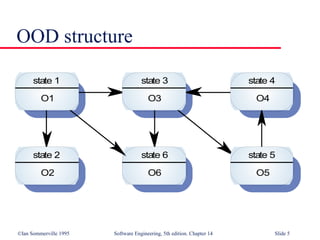
OOD structure
state 3
O3
state 4
O4
state 1
O1
state 6
O6
state 5
O5
state 2
O2
©Ian Sommerville 1995 Software Engineering, 5th edition. Chapter 14 Slide 6
Advantages of OOD
Easier maintenance. Objects may be
understood as stand-alone entities
Objects are appropriate reusable components
For some systems, there may be an obvious
mapping from real world entities to system
objects
©Ian Sommerville 1995 Software Engineering, 5th edition. Chapter 14 Slide 7
Object-oriented development
Object-oriented analysis, design and
programming are related but distinct
OOA is concerned with developing an object
model of the application domain
OOD is concerned with developing an object-
oriented system model to implement
requirements
OOP is concerned with realising an OOD using
an OO programming language such as C++
©Ian Sommerville 1995 Software Engineering, 5th edition. Chapter 14 Slide 8
Object-oriented design methods
Some methods which were originally based on
functions (such as the Yourdon method) have
been adapted to object-oriented design. Other
methods such as the Booch method have been
developed specifically for OOD
HOOD is an object-oriented design method
developed to support Ada programming.
JSD has an object-oriented flavour but does not
conceal entity state information.
©Ian Sommerville 1995 Software Engineering, 5th edition. Chapter 14 Slide 9
OO Design method commonality
The identification of objects, their attributes and
services
The organisation of objects into an aggregation
hierarchy
The construction of dynamic object-use
descriptions which show how services are used
The specification of object interfaces
©Ian Sommerville 1995 Software Engineering, 5th edition. Chapter 14 Slide 10
Objects, classes and inheritance
Objects are entities in a software system which
represent instances of real-world and system
entities
Object classes are templates for objects. They
may be used to create objects
Object classes may inherit attributes and services
from other object classes
©Ian Sommerville 1995 Software Engineering, 5th edition. Chapter 14 Slide 11
Objects
An object is an entity which has a state and a defined set of
operations which operate on that state. The state is represented as a
set of object attributes. The operations associated with the object
provide services to other objects (clients) which request these
services when some computation is required. Objects are created
according to some object class definition. An object class definition
serves as a template for objects. It includes declarations of all the
attributes and services which should be associated with an object of
that class.
©Ian Sommerville 1995 Software Engineering, 5th edition. Chapter 14 Slide 12
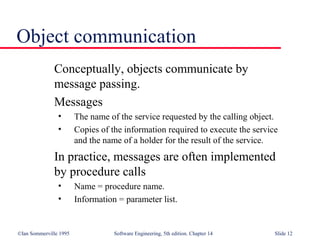
Object communication
Conceptually, objects communicate by
message passing.
Messages
• The name of the service requested by the calling object.
• Copies of the information required to execute the service
and the name of a holder for the result of the service.
In practice, messages are often implemented
by procedure calls
• Name = procedure name.
• Information = parameter list.
©Ian Sommerville 1995 Software Engineering, 5th edition. Chapter 14 Slide 13
A mail message object class
Replace with portrait slide
©Ian Sommerville 1995 Software Engineering, 5th edition. Chapter 14 Slide 14
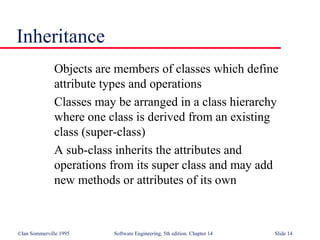
Inheritance
Objects are members of classes which define
attribute types and operations
Classes may be arranged in a class hierarchy
where one class is derived from an existing
class (super-class)
A sub-class inherits the attributes and
operations from its super class and may add
new methods or attributes of its own
©Ian Sommerville 1995 Software Engineering, 5th edition. Chapter 14 Slide 15
A class or type hierarchy
Replace with portrait slide
©Ian Sommerville 1995 Software Engineering, 5th edition. Chapter 14 Slide 16
Multiple inheritance
Replace with portrait slide
©Ian Sommerville 1995 Software Engineering, 5th edition. Chapter 14 Slide 17
Advantages of inheritance
It is an abstraction mechanism which may be
used to classify entities
It is a reuse mechanism at both the design and the
programming level
The inheritance graph is a source of
organisational knowledge about domains and
systems
©Ian Sommerville 1995 Software Engineering, 5th edition. Chapter 14 Slide 18
Inheritance and OOD
There are differing views as to whether
inheritance is fundamental to OOD.
• View 1. Identifying the inheritance hierarchy or network is a
fundamental part of object-oriented design. Obviously this can
only be implemented using an OOPL.
• View 2. Inheritance is a useful implementation concept which
allows reuse of attribute and operation definitions. Identifying
an inheritance hierarchy at the design stage places unnecessary
restrictions on the implementation.
©Ian Sommerville 1995 Software Engineering, 5th edition. Chapter 14 Slide 19
Object identification
Identifying objects is the most difficult part of
object oriented design.
There is no 'magic formula' for object
identification. It relies on the skill, experience
and domain knowledge of system designers.
Object identification is an iterative process. You
are unlikely to get it right first time
©Ian Sommerville 1995 Software Engineering, 5th edition. Chapter 14 Slide 20
Approaches to identification
Use a grammatical approach based on a natural
language description of the system (used in Hood
method)
Base the identification on tangible things in the
application domain
Use a behavioural approach and identify objects
based on what participates in what behaviour
Use a scenario-based analysis. Used in the
ObjectOry method
©Ian Sommerville 1995 Software Engineering, 5th edition. Chapter 14 Slide 21
Objects and operations
Nouns in the description give pointers to objects
in the system
Verbs give pointers to operations associated with
objects
Approach assumes that the designer has a
common sense knowledge of the application
domain as not all objects and services are likely
to be mentioned in the description
©Ian Sommerville 1995 Software Engineering, 5th edition. Chapter 14 Slide 22
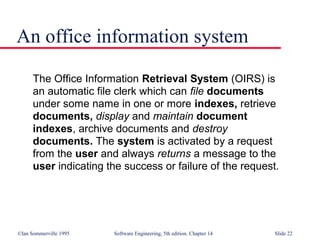
An office information system
The Office Information Retrieval System (OIRS) is
an automatic file clerk which can file documents
under some name in one or more indexes, retrieve
documents, display and maintain document
indexes, archive documents and destroy
documents. The system is activated by a request
from the user and always returns a message to the
user indicating the success or failure of the request.
©Ian Sommerville 1995 Software Engineering, 5th edition. Chapter 14 Slide 23
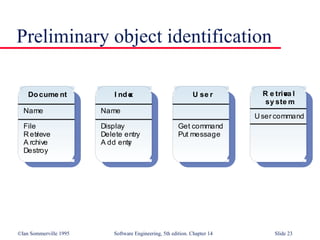
Preliminary object identification
File
Retrieve
A rchive
Destroy
Docume nt
Name
Display
Delete entry
A dd entry
I ndex
Name
Get command
Put message
U se r R e trieva l
sy ste m
User command
©Ian Sommerville 1995 Software Engineering, 5th edition. Chapter 14 Slide 24
Object interface design
Concerned with specifying the detail of the object
interfaces. This means defining attribute types
and the signatures and semantics of object
operations
Representation information should be avoided
Precise specification is essential so a
programming language description should be
used
©Ian Sommerville 1995 Software Engineering, 5th edition. Chapter 14 Slide 25
Concurrent objects
The nature of objects as self-contained entities
make them suitable for concurrent
implementation
The message-passing model of object
communication can be implemented directly if
objects are running on separate processors in a
distributed system
©Ian Sommerville 1995 Software Engineering, 5th edition. Chapter 14 Slide 26
Active and passive objects
Passive objects.
• The object is implemented as a parallel process (server)
with entry points corresponding to object operations. If no
calls are made to it, the object suspends itself
Active objects
• Objects are implemented as parallel processes and the
internal object state may be changed by the object itself and
not simply by external calls
©Ian Sommerville 1995 Software Engineering, 5th edition. Chapter 14 Slide 27
OOD is design with information hiding.
Representations may be changed without
extensive system modifications
An object has a private state with associated
constructor and access operations. Objects
provide services (operations) to other objects.
Object identification is a difficult process.
Identifying nouns and verbs in a natural
language description can be a useful starting
point for object identification.
Key points
©Ian Sommerville 1995 Software Engineering, 5th edition. Chapter 14 Slide 28
Key points
Object interfaces must be precisely defined. A
programming language such as Ada or C++ may
be used for this
Useful documentation of an OOD include object
hierarchy charts and object interaction
diagrams
Objects may be implemented as either
sequential or concurrent entities. Concurrent
objects may be active or passive

Object Oriented Design Concept

  • 1.
    ©Ian Sommerville 1995Software Engineering, 5th edition. Chapter 14 Slide 1 Object-oriented Design Designing systems using self- contained objects and object classes
  • 2.
    ©Ian Sommerville 1995Software Engineering, 5th edition. Chapter 14 Slide 2 Objectives To explain how a software design may be represented as a set of interacting objects To illustrate, with a simple example, the object- oriented design process To introduce various models which describe an object-oriented design To explain how objects may be represented as concurrent processes
  • 3.
    ©Ian Sommerville 1995Software Engineering, 5th edition. Chapter 14 Slide 3 Topics covered Objects, object classes and inheritance Object identification An object-oriented design example Concurrent objects
  • 4.
    ©Ian Sommerville 1995Software Engineering, 5th edition. Chapter 14 Slide 4 Characteristics of OOD Objects are abstractions of real-world or system entities and manage themselves Objects are independent and encapsulate state and representation information. System functionality is expressed in terms of object services Shared data areas are eliminated. Objects communicate by message passing Objects may be distributed and may execute sequentially or in parallel
  • 5.
    ©Ian Sommerville 1995Software Engineering, 5th edition. Chapter 14 Slide 5 OOD structure state 3 O3 state 4 O4 state 1 O1 state 6 O6 state 5 O5 state 2 O2
  • 6.
    ©Ian Sommerville 1995Software Engineering, 5th edition. Chapter 14 Slide 6 Advantages of OOD Easier maintenance. Objects may be understood as stand-alone entities Objects are appropriate reusable components For some systems, there may be an obvious mapping from real world entities to system objects
  • 7.
    ©Ian Sommerville 1995Software Engineering, 5th edition. Chapter 14 Slide 7 Object-oriented development Object-oriented analysis, design and programming are related but distinct OOA is concerned with developing an object model of the application domain OOD is concerned with developing an object- oriented system model to implement requirements OOP is concerned with realising an OOD using an OO programming language such as C++
  • 8.
    ©Ian Sommerville 1995Software Engineering, 5th edition. Chapter 14 Slide 8 Object-oriented design methods Some methods which were originally based on functions (such as the Yourdon method) have been adapted to object-oriented design. Other methods such as the Booch method have been developed specifically for OOD HOOD is an object-oriented design method developed to support Ada programming. JSD has an object-oriented flavour but does not conceal entity state information.
  • 9.
    ©Ian Sommerville 1995Software Engineering, 5th edition. Chapter 14 Slide 9 OO Design method commonality The identification of objects, their attributes and services The organisation of objects into an aggregation hierarchy The construction of dynamic object-use descriptions which show how services are used The specification of object interfaces
  • 10.
    ©Ian Sommerville 1995Software Engineering, 5th edition. Chapter 14 Slide 10 Objects, classes and inheritance Objects are entities in a software system which represent instances of real-world and system entities Object classes are templates for objects. They may be used to create objects Object classes may inherit attributes and services from other object classes
  • 11.
    ©Ian Sommerville 1995Software Engineering, 5th edition. Chapter 14 Slide 11 Objects An object is an entity which has a state and a defined set of operations which operate on that state. The state is represented as a set of object attributes. The operations associated with the object provide services to other objects (clients) which request these services when some computation is required. Objects are created according to some object class definition. An object class definition serves as a template for objects. It includes declarations of all the attributes and services which should be associated with an object of that class.
  • 12.
    ©Ian Sommerville 1995Software Engineering, 5th edition. Chapter 14 Slide 12 Object communication Conceptually, objects communicate by message passing. Messages • The name of the service requested by the calling object. • Copies of the information required to execute the service and the name of a holder for the result of the service. In practice, messages are often implemented by procedure calls • Name = procedure name. • Information = parameter list.
  • 13.
    ©Ian Sommerville 1995Software Engineering, 5th edition. Chapter 14 Slide 13 A mail message object class Replace with portrait slide
  • 14.
    ©Ian Sommerville 1995Software Engineering, 5th edition. Chapter 14 Slide 14 Inheritance Objects are members of classes which define attribute types and operations Classes may be arranged in a class hierarchy where one class is derived from an existing class (super-class) A sub-class inherits the attributes and operations from its super class and may add new methods or attributes of its own
  • 15.
    ©Ian Sommerville 1995Software Engineering, 5th edition. Chapter 14 Slide 15 A class or type hierarchy Replace with portrait slide
  • 16.
    ©Ian Sommerville 1995Software Engineering, 5th edition. Chapter 14 Slide 16 Multiple inheritance Replace with portrait slide
  • 17.
    ©Ian Sommerville 1995Software Engineering, 5th edition. Chapter 14 Slide 17 Advantages of inheritance It is an abstraction mechanism which may be used to classify entities It is a reuse mechanism at both the design and the programming level The inheritance graph is a source of organisational knowledge about domains and systems
  • 18.
    ©Ian Sommerville 1995Software Engineering, 5th edition. Chapter 14 Slide 18 Inheritance and OOD There are differing views as to whether inheritance is fundamental to OOD. • View 1. Identifying the inheritance hierarchy or network is a fundamental part of object-oriented design. Obviously this can only be implemented using an OOPL. • View 2. Inheritance is a useful implementation concept which allows reuse of attribute and operation definitions. Identifying an inheritance hierarchy at the design stage places unnecessary restrictions on the implementation.
  • 19.
    ©Ian Sommerville 1995Software Engineering, 5th edition. Chapter 14 Slide 19 Object identification Identifying objects is the most difficult part of object oriented design. There is no 'magic formula' for object identification. It relies on the skill, experience and domain knowledge of system designers. Object identification is an iterative process. You are unlikely to get it right first time
  • 20.
    ©Ian Sommerville 1995Software Engineering, 5th edition. Chapter 14 Slide 20 Approaches to identification Use a grammatical approach based on a natural language description of the system (used in Hood method) Base the identification on tangible things in the application domain Use a behavioural approach and identify objects based on what participates in what behaviour Use a scenario-based analysis. Used in the ObjectOry method
  • 21.
    ©Ian Sommerville 1995Software Engineering, 5th edition. Chapter 14 Slide 21 Objects and operations Nouns in the description give pointers to objects in the system Verbs give pointers to operations associated with objects Approach assumes that the designer has a common sense knowledge of the application domain as not all objects and services are likely to be mentioned in the description
  • 22.
    ©Ian Sommerville 1995Software Engineering, 5th edition. Chapter 14 Slide 22 An office information system The Office Information Retrieval System (OIRS) is an automatic file clerk which can file documents under some name in one or more indexes, retrieve documents, display and maintain document indexes, archive documents and destroy documents. The system is activated by a request from the user and always returns a message to the user indicating the success or failure of the request.
  • 23.
    ©Ian Sommerville 1995Software Engineering, 5th edition. Chapter 14 Slide 23 Preliminary object identification File Retrieve A rchive Destroy Docume nt Name Display Delete entry A dd entry I ndex Name Get command Put message U se r R e trieva l sy ste m User command
  • 24.
    ©Ian Sommerville 1995Software Engineering, 5th edition. Chapter 14 Slide 24 Object interface design Concerned with specifying the detail of the object interfaces. This means defining attribute types and the signatures and semantics of object operations Representation information should be avoided Precise specification is essential so a programming language description should be used
  • 25.
    ©Ian Sommerville 1995Software Engineering, 5th edition. Chapter 14 Slide 25 Concurrent objects The nature of objects as self-contained entities make them suitable for concurrent implementation The message-passing model of object communication can be implemented directly if objects are running on separate processors in a distributed system
  • 26.
    ©Ian Sommerville 1995Software Engineering, 5th edition. Chapter 14 Slide 26 Active and passive objects Passive objects. • The object is implemented as a parallel process (server) with entry points corresponding to object operations. If no calls are made to it, the object suspends itself Active objects • Objects are implemented as parallel processes and the internal object state may be changed by the object itself and not simply by external calls
  • 27.
    ©Ian Sommerville 1995Software Engineering, 5th edition. Chapter 14 Slide 27 OOD is design with information hiding. Representations may be changed without extensive system modifications An object has a private state with associated constructor and access operations. Objects provide services (operations) to other objects. Object identification is a difficult process. Identifying nouns and verbs in a natural language description can be a useful starting point for object identification. Key points
  • 28.
    ©Ian Sommerville 1995Software Engineering, 5th edition. Chapter 14 Slide 28 Key points Object interfaces must be precisely defined. A programming language such as Ada or C++ may be used for this Useful documentation of an OOD include object hierarchy charts and object interaction diagrams Objects may be implemented as either sequential or concurrent entities. Concurrent objects may be active or passive