1
Introduction to Unified
Modeling Language
By,
D. B. Naga Muruga,
Dept of Mechanical Engineering,
Sriram Engineering College
2
UML for OOAD
2.1 What is UML?
2.2 Classes in UML
2.3 Relations in UML
2.4 Static and Dynamic Design with UML
3
2.1 UML Background
"The Unified Modelling Language (UML) is a graphical
language for visualizing, specifying, constructing, and
documenting the artifacts of a software-intensive system.
The UML offers a standard way to write a systems blueprints,
including conceptual things like business processes
and system functions as well as concrete things such as
programming language statements, database schemas, and
reusable software components."
Grady Booch, Ivar Jacobsen, Jim Rumbaugh
Rational Software
[OMG Unified Modelling Language Specification, Version 1.3, March 2000]
4
2.1 Brief UML History
 Around 1980
 first OO modelling languages
 other techniques, e.g. SA/SD
 Around 1990
 "OO method wars"
 many modelling languages
 End of 90's
 UML appears as combination of best practices
5
2.1 Why UML?
 Physicists know formal graphical modelling
 Mathematics to describe nature
 Feynman graphs to calculate particle reaction rates
 We need a common language
 discuss software systems at a black- (white-) board
 document software systems
 UML is an important part of that language
 UML provides the "words and grammar"
6
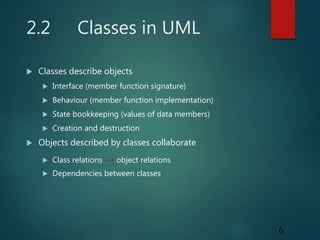
2.2 Classes in UML
 Classes describe objects
 Interface (member function signature)
 Behaviour (member function implementation)
 State bookkeeping (values of data members)
 Creation and destruction
 Objects described by classes collaborate
 Class relations → object relations
 Dependencies between classes
7
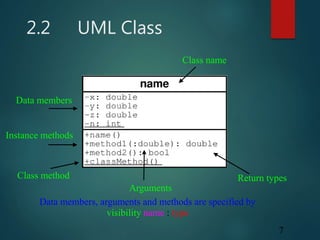
2.2 UML Class
Class name
Data members
Instance methods
Arguments
Return types
Data members, arguments and methods are specified by
visibility name : type
Class method
8
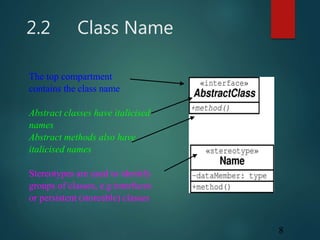
2.2 Class Name
The top compartment
contains the class name
Abstract classes have italicised
names
Abstract methods also have
italicised names
Stereotypes are used to identify
groups of classes, e.g interfaces
or persistent (storeable) classes
9
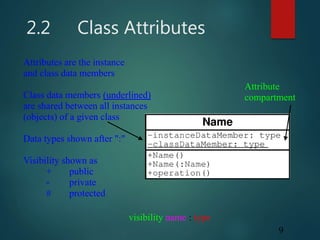
2.2 Class Attributes
Attributes are the instance
and class data members
Class data members (underlined)
are shared between all instances
(objects) of a given class
Data types shown after ":"
Visibility shown as
+ public
- private
# protected
Attribute
compartment
visibility name : type
10
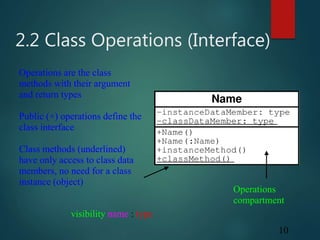
2.2 Class Operations (Interface)
Operations are the class
methods with their argument
and return types
Public (+) operations define the
class interface
Class methods (underlined)
have only access to class data
members, no need for a class
instance (object)
Operations
compartment
visibility name : type
11
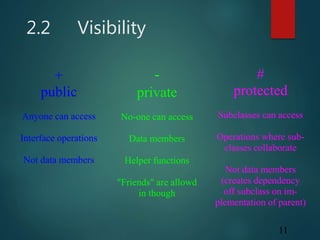
2.2 Visibility
+
public
Anyone can access
Interface operations
Not data members
-
private
No-one can access
Data members
Helper functions
"Friends" are allowd
in though
#
protected
Subclasses can access
Operations where sub-
classes collaborate
Not data members
(creates dependency
off subclass on im-
plementation of parent)
12
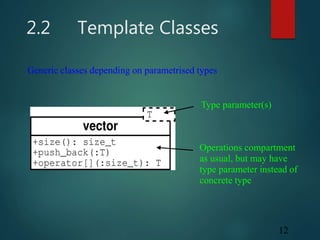
2.2 Template Classes
Generic classes depending on parametrised types
Type parameter(s)
Operations compartment
as usual, but may have
type parameter instead of
concrete type
13
2.3 Relations
 Association
 Aggregation
 Composition
 Parametric and Friendship
 Inheritance
14
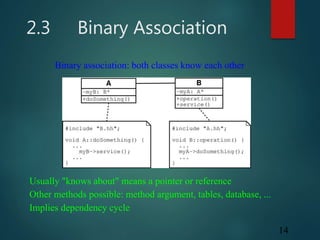
2.3 Binary Association
Binary association: both classes know each other
Usually "knows about" means a pointer or reference
Other methods possible: method argument, tables, database, ...
Implies dependency cycle
15
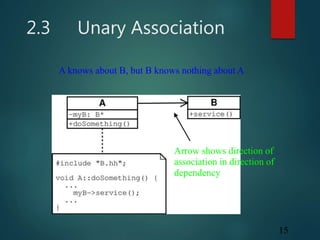
2.3 Unary Association
A knows about B, but B knows nothing about A
Arrow shows direction of
association in direction of
dependency
16
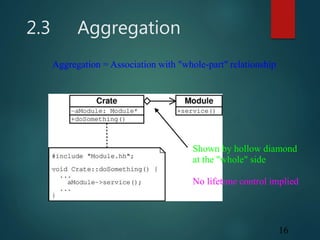
2.3 Aggregation
Aggregation = Association with "whole-part" relationship
Shown by hollow diamond
at the "whole" side
No lifetime control implied
17
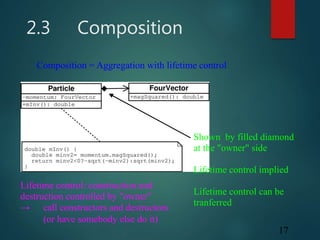
2.3 Composition
Composition = Aggregation with lifetime control
Shown by filled diamond
at the "owner" side
Lifetime control implied
Lifetime control can be
tranferred
Lifetime control: construction and
destruction controlled by "owner"
→ call constructors and destructors
(or have somebody else do it)
18
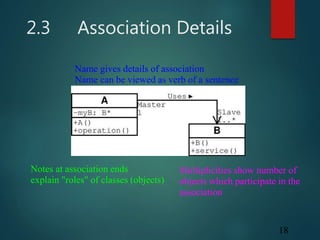
2.3 Association Details
Name gives details of association
Name can be viewed as verb of a sentence
Notes at association ends
explain "roles" of classes (objects)
Multiplicities show number of
objects which participate in the
association
19
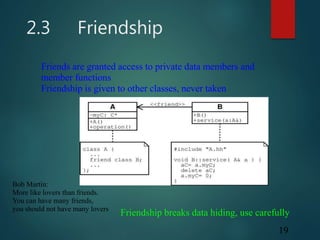
2.3 Friendship
Friends are granted access to private data members and
member functions
Friendship is given to other classes, never taken
Bob Martin:
More like lovers than friends.
You can have many friends,
you should not have many lovers
Friendship breaks data hiding, use carefully
20
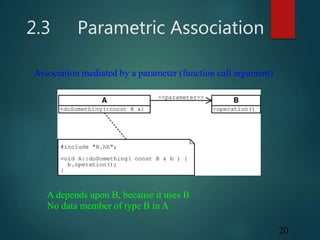
2.3 Parametric Association
Association mediated by a parameter (function call argument)
A depends upon B, because it uses B
No data member of type B in A
21
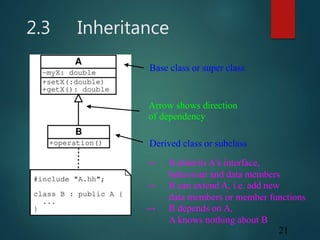
2.3 Inheritance
Base class or super class
Derived class or subclass
Arrow shows direction
of dependency
→ B inherits A's interface,
behaviour and data members
→ B can extend A, i.e. add new
data members or member functions
→ B depends on A,
A knows nothing about B
22
2.3 Associations Summary
 Can express different kinds of associations between
classes/objects with UML
 Association, aggregation, composition, inheritance
 Friendship, parametric association
 Can go from simple sketches to more detailed design by adding
adornments
 Name, roles, multiplicities
 lifetime control
23
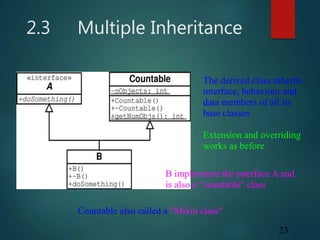
2.3 Multiple Inheritance
The derived class inherits
interface, behaviour and
data members of all its
base classes
Extension and overriding
works as before
B implements the interface A and
is also a "countable" class
Countable also called a "Mixin class"
24
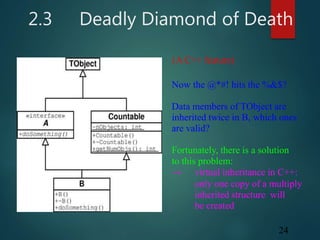
2.3 Deadly Diamond of Death
Now the @*#! hits the %&$?
Data members of TObject are
inherited twice in B, which ones
are valid?
Fortunately, there is a solution
to this problem:
→ virtual inheritance in C++:
only one copy of a multiply
inherited structure will
be created
(A C++ feature)
25
2.4 Static and Dynamic Design
 Static design describes code structure and object relations
 Class relations
 Objects at a given time
 Dynamic design shows communication between objects
 Similarity to class relations
 can follow sequences of events
26
2.4 Class Diagram
 Show static relations between classes
 we have seen them already
 interfaces, data members
 associations
 Subdivide into diagrams for specific purpose
 showing all classes usually too much
 ok to show only relevant class members
 set of all diagrams should describe system
27
2.4 Object Diagram
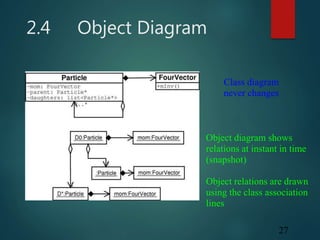
Object diagram shows
relations at instant in time
(snapshot)
Object relations are drawn
using the class association
lines
Class diagram
never changes
28
2.4 Sequence Diagram
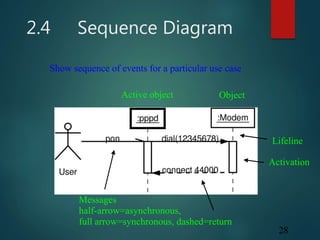
Show sequence of events for a particular use case
Object
Lifeline
Activation
Messages
half-arrow=asynchronous,
full arrow=synchronous, dashed=return
Active object
29
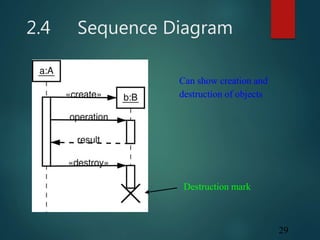
2.4 Sequence Diagram
Can show creation and
destruction of objects
Destruction mark
30
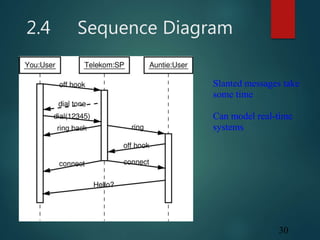
2.4 Sequence Diagram
Slanted messages take
some time
Can model real-time
systems
31
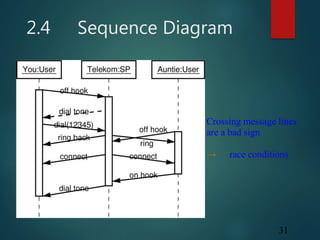
2.4 Sequence Diagram
Crossing message lines
are a bad sign
→ race conditions
32
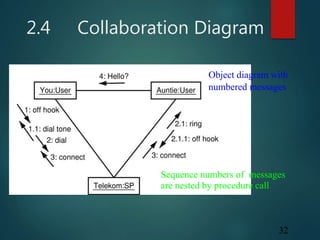
2.4 Collaboration Diagram
Object diagram with
numbered messages
Sequence numbers of messages
are nested by procedure call
33
2.4 Static and Dynamic Design
Summary
 Class diagrams → object diagrams
 classes → objects; associations → links
 Dynamic models show how system works
 Sequence and collaboration diagram
 There are tools for this process
 UML syntax and consistency checks
 Rough sketches by hand or with simple tools
 aid in design discussions
34
Some Comments
 Design-heavy development processes
 several 10% of person-power/time spent on design with formal UML
from requirements
 start coding when the design is consistent
 large software houses may work this way
 Lighter processes
 a few % of person-power/time spent with UML
 UML as a discussion and documentation aid
 probably more adequate in HEP
35
36

Basics of uml

  • 1.
    1 Introduction to Unified ModelingLanguage By, D. B. Naga Muruga, Dept of Mechanical Engineering, Sriram Engineering College
  • 2.
    2 UML for OOAD 2.1What is UML? 2.2 Classes in UML 2.3 Relations in UML 2.4 Static and Dynamic Design with UML
  • 3.
    3 2.1 UML Background "TheUnified Modelling Language (UML) is a graphical language for visualizing, specifying, constructing, and documenting the artifacts of a software-intensive system. The UML offers a standard way to write a systems blueprints, including conceptual things like business processes and system functions as well as concrete things such as programming language statements, database schemas, and reusable software components." Grady Booch, Ivar Jacobsen, Jim Rumbaugh Rational Software [OMG Unified Modelling Language Specification, Version 1.3, March 2000]
  • 4.
    4 2.1 Brief UMLHistory  Around 1980  first OO modelling languages  other techniques, e.g. SA/SD  Around 1990  "OO method wars"  many modelling languages  End of 90's  UML appears as combination of best practices
  • 5.
    5 2.1 Why UML? Physicists know formal graphical modelling  Mathematics to describe nature  Feynman graphs to calculate particle reaction rates  We need a common language  discuss software systems at a black- (white-) board  document software systems  UML is an important part of that language  UML provides the "words and grammar"
  • 6.
    6 2.2 Classes inUML  Classes describe objects  Interface (member function signature)  Behaviour (member function implementation)  State bookkeeping (values of data members)  Creation and destruction  Objects described by classes collaborate  Class relations → object relations  Dependencies between classes
  • 7.
    7 2.2 UML Class Classname Data members Instance methods Arguments Return types Data members, arguments and methods are specified by visibility name : type Class method
  • 8.
    8 2.2 Class Name Thetop compartment contains the class name Abstract classes have italicised names Abstract methods also have italicised names Stereotypes are used to identify groups of classes, e.g interfaces or persistent (storeable) classes
  • 9.
    9 2.2 Class Attributes Attributesare the instance and class data members Class data members (underlined) are shared between all instances (objects) of a given class Data types shown after ":" Visibility shown as + public - private # protected Attribute compartment visibility name : type
  • 10.
    10 2.2 Class Operations(Interface) Operations are the class methods with their argument and return types Public (+) operations define the class interface Class methods (underlined) have only access to class data members, no need for a class instance (object) Operations compartment visibility name : type
  • 11.
    11 2.2 Visibility + public Anyone canaccess Interface operations Not data members - private No-one can access Data members Helper functions "Friends" are allowd in though # protected Subclasses can access Operations where sub- classes collaborate Not data members (creates dependency off subclass on im- plementation of parent)
  • 12.
    12 2.2 Template Classes Genericclasses depending on parametrised types Type parameter(s) Operations compartment as usual, but may have type parameter instead of concrete type
  • 13.
    13 2.3 Relations  Association Aggregation  Composition  Parametric and Friendship  Inheritance
  • 14.
    14 2.3 Binary Association Binaryassociation: both classes know each other Usually "knows about" means a pointer or reference Other methods possible: method argument, tables, database, ... Implies dependency cycle
  • 15.
    15 2.3 Unary Association Aknows about B, but B knows nothing about A Arrow shows direction of association in direction of dependency
  • 16.
    16 2.3 Aggregation Aggregation =Association with "whole-part" relationship Shown by hollow diamond at the "whole" side No lifetime control implied
  • 17.
    17 2.3 Composition Composition =Aggregation with lifetime control Shown by filled diamond at the "owner" side Lifetime control implied Lifetime control can be tranferred Lifetime control: construction and destruction controlled by "owner" → call constructors and destructors (or have somebody else do it)
  • 18.
    18 2.3 Association Details Namegives details of association Name can be viewed as verb of a sentence Notes at association ends explain "roles" of classes (objects) Multiplicities show number of objects which participate in the association
  • 19.
    19 2.3 Friendship Friends aregranted access to private data members and member functions Friendship is given to other classes, never taken Bob Martin: More like lovers than friends. You can have many friends, you should not have many lovers Friendship breaks data hiding, use carefully
  • 20.
    20 2.3 Parametric Association Associationmediated by a parameter (function call argument) A depends upon B, because it uses B No data member of type B in A
  • 21.
    21 2.3 Inheritance Base classor super class Derived class or subclass Arrow shows direction of dependency → B inherits A's interface, behaviour and data members → B can extend A, i.e. add new data members or member functions → B depends on A, A knows nothing about B
  • 22.
    22 2.3 Associations Summary Can express different kinds of associations between classes/objects with UML  Association, aggregation, composition, inheritance  Friendship, parametric association  Can go from simple sketches to more detailed design by adding adornments  Name, roles, multiplicities  lifetime control
  • 23.
    23 2.3 Multiple Inheritance Thederived class inherits interface, behaviour and data members of all its base classes Extension and overriding works as before B implements the interface A and is also a "countable" class Countable also called a "Mixin class"
  • 24.
    24 2.3 Deadly Diamondof Death Now the @*#! hits the %&$? Data members of TObject are inherited twice in B, which ones are valid? Fortunately, there is a solution to this problem: → virtual inheritance in C++: only one copy of a multiply inherited structure will be created (A C++ feature)
  • 25.
    25 2.4 Static andDynamic Design  Static design describes code structure and object relations  Class relations  Objects at a given time  Dynamic design shows communication between objects  Similarity to class relations  can follow sequences of events
  • 26.
    26 2.4 Class Diagram Show static relations between classes  we have seen them already  interfaces, data members  associations  Subdivide into diagrams for specific purpose  showing all classes usually too much  ok to show only relevant class members  set of all diagrams should describe system
  • 27.
    27 2.4 Object Diagram Objectdiagram shows relations at instant in time (snapshot) Object relations are drawn using the class association lines Class diagram never changes
  • 28.
    28 2.4 Sequence Diagram Showsequence of events for a particular use case Object Lifeline Activation Messages half-arrow=asynchronous, full arrow=synchronous, dashed=return Active object
  • 29.
    29 2.4 Sequence Diagram Canshow creation and destruction of objects Destruction mark
  • 30.
    30 2.4 Sequence Diagram Slantedmessages take some time Can model real-time systems
  • 31.
    31 2.4 Sequence Diagram Crossingmessage lines are a bad sign → race conditions
  • 32.
    32 2.4 Collaboration Diagram Objectdiagram with numbered messages Sequence numbers of messages are nested by procedure call
  • 33.
    33 2.4 Static andDynamic Design Summary  Class diagrams → object diagrams  classes → objects; associations → links  Dynamic models show how system works  Sequence and collaboration diagram  There are tools for this process  UML syntax and consistency checks  Rough sketches by hand or with simple tools  aid in design discussions
  • 34.
    34 Some Comments  Design-heavydevelopment processes  several 10% of person-power/time spent on design with formal UML from requirements  start coding when the design is consistent  large software houses may work this way  Lighter processes  a few % of person-power/time spent with UML  UML as a discussion and documentation aid  probably more adequate in HEP
  • 35.
  • 36.