PHARMACEUTICAL MICROBIOLOGY
SEM-III
MS. PAYAL PILAJI
(PHARMACEUTICAL CHEMISTRY)
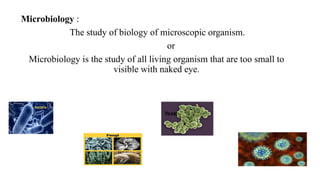
Microbiology :
The study of biology of microscopic organism.
or
Microbiology is the study of all living organism that are too small to
visible with naked eye.
Yeast
 Most microorganisms are unicellular, but this is not universal, since some
multicellular organisms are microscopic.
 Most importantly, these organisms are vital to humans and the environment, as
they participate in the Earth’s element cycles, such as the carbon cycle and the
nitrogen cycle.
 Microorganisms live in all parts of the biosphere:
o water o in the atmosphere
o soil o deep inside the rocks
o hot springs
o on the ocean floor, within the Earth’s crust
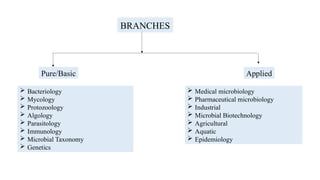
BRANCHES
Pure/Basic Applied
 Bacteriology
 Mycology
 Protozoology
 Algology
 Parasitology
 Immunology
 Microbial Taxonomy
 Genetics
 Medical microbiology
 Pharmaceutical microbiology
 Industrial
 Microbial Biotechnology
 Agricultural
 Aquatic
 Epidemiology
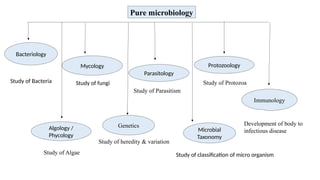
Pure microbiology
Bacteriology
Study of Bacteria
Mycology
Study of fungi
Protozoology
Algology /
Phycology
Parasitology
Study of Protozoa
Study of Algae
Study of Parasitism
Immunology
Development of body to
infectious disease
Genetics
Study of heredity & variation
Microbial
Taxonomy
Study of classification of micro organism
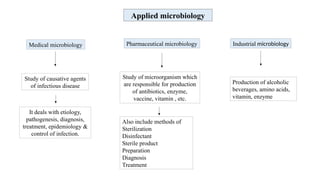
Applied microbiology
Medical microbiology
Study of causative agents
of infectious disease
It deals with etiology,
pathogenesis, diagnosis,
treatment, epidemiology &
control of infection.
Pharmaceutical microbiology
Study of microorganism which
are responsible for production
of antibiotics, enzyme,
vaccine, vitamin , etc.
Also include methods of
Sterilization
Disinfectant
Sterile product
Preparation
Diagnosis
Treatment
Industrial microbiology
Production of alcoholic
beverages, amino acids,
vitamin, enzyme
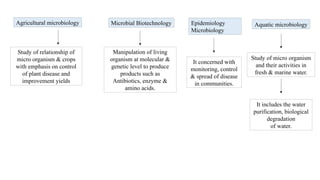
Agricultural microbiology
Study of relationship of
micro organism & crops
with emphasis on control
of plant disease and
improvement yields
Microbial Biotechnology
Manipulation of living
organism at molecular &
genetic level to produce
products such as
Antibiotics, enzyme &
amino acids.
Aquatic microbiology
Study of micro organism
and their activities in
fresh & marine water.
It includes the water
purification, biological
degradation
of water.
Epidemiology
Microbiology
It concerned with
monitoring, control
& spread of disease
in communities.
 Scientific evidence suggests that life began on Earth some 3.5 billion
years ago.
 Since then, life has evolved into a wide variety of forms, which
biologists have classified into a hierarchy of taxa.
 Some of the oldest cells on Earth are single-cell
 Early history of microbiology :
Historians are unsure who made the first observations of microorganisms.
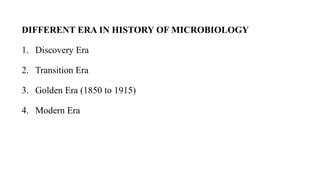
DIFFERENT ERA IN HISTORY OF MICROBIOLOGY
1. Discovery Era
2. Transition Era
3. Golden Era (1850 to 1915)
4. Modern Era
DISCOVERY ERA
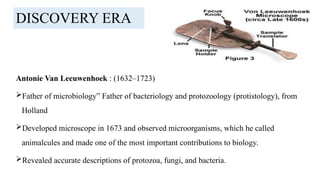
Antonie Van Leeuwenhoek : (1632–1723)
Father of microbiology” Father of bacteriology and protozoology (protistology), from
Holland
Developed microscope in 1673 and observed microorganisms, which he called
animalcules and made one of the most important contributions to biology.
Revealed accurate descriptions of protozoa, fungi, and bacteria.
TRANSITION ERA
 Francesco Redi:
who showed that fly maggots do not arise from decaying meat (as others believed) if
the meat is covered to prevent the entry of flies.
 John Needham:
He proposed that tiny organism arises spontaneously on the mutton gravy.
He covered the flasks with cork as done by Redi, still the microbes appeared on mutton
gravy.
 Lazzaro Spallanzani :
Disputed the theory by showing that boiled broth would not give rise to microscopic
forms of life.
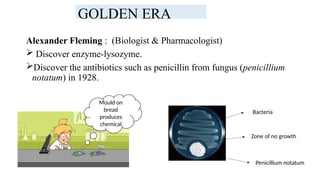
Alexander Fleming : (Biologist & Pharmacologist)
 Discover enzyme-lysozyme.
Discover the antibiotics such as penicillin from fungus (penicillium
notatum) in 1928.
Mould on
bread
produces
chemical
Bacteria
Zone of no growth
Penicillium notatum
GOLDEN ERA
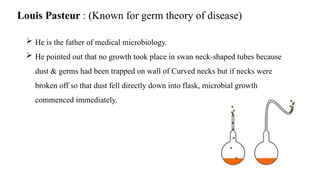
Louis Pasteur : (Known for germ theory of disease)
 He is the father of medical microbiology.
 He pointed out that no growth took place in swan neck-shaped tubes because
dust & germs had been trapped on wall of Curved necks but if necks were
broken off so that dust fell directly down into flask, microbial growth
commenced immediately.
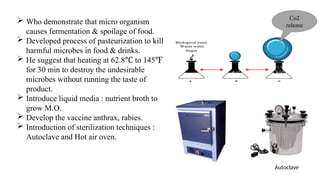
 Who demonstrate that micro organism
causes fermentation & spoilage of food.
 Developed process of pasteurization to kill
harmful microbes in food & drinks.
 He suggest that heating at 62.8 to 145
℃ ℉
for 30 min to destroy the undesirable
microbes without running the taste of
product.
 Introduce liquid media : nutrient broth to
grow M.O.
 Develop the vaccine anthrax, rabies.
 Introduction of sterilization techniques :
Autoclave and Hot air oven.
Co2
release
Autoclave
Edward Jenner :
 Discover safe & effective vaccine against smallpox.
 He discovered the technique of vaccination.
Robert Koch :
Father of practical microbiology.
Discovered rod shaped bacteria smear.
Introduce staining technique.
Discover tubercular bacilli – mycobacterium tuberculosis.
Discover vibrio cholera.
Developed pure culture technique.
John Tyndall:
 He discovered highly resistant bacterial structure later known as endospore.
 Prolonged boiling or intermittent heating was necessary to kill these spores, to
make the infusion completely sterilized, a process known as Tyndallisation.
Richard Petri:
 He developed the Petri dish, container used for solid culture media.
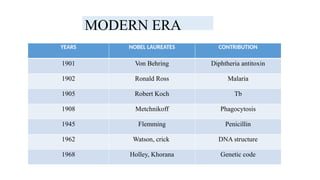
YEARS NOBEL LAUREATES CONTRIBUTION
1901 Von Behring Diphtheria antitoxin
1902 Ronald Ross Malaria
1905 Robert Koch Tb
1908 Metchnikoff Phagocytosis
1945 Flemming Penicillin
1962 Watson, crick DNA structure
1968 Holley, Khorana Genetic code
MODERN ERA
Applications and scope of pharmaceutical microbiology
• Production of antibiotics :
Pharmaceutical or industrial microbiology concerns with isolation of antibiotics
producing micro-organism from natural microorganism by process of
fermentation.
Penicillin – penicillium notatum
Streptomycin – Streptomyces griseus
Tetracycline – Streptomyces aureofaciens
Chloramphenicol – Streptomyces venezuelae
• Production of enzymes, vaccines, biosurfactants, alcoholic &
other pharmaceutical product :
Many microbial cells convert raw material into valuable organic comp such
as butanol, ethanol, acetone etc.
Microbial cells also produce intracellular & extracellular enzymes are
important for pharmaceutical fermentation process.
Biosurfactants have lots of application in agriculture, food industries, paper
& metal industries, leather paper.
Different types of biosurfactants are synthesized by number of
microorganism such as Bacillum species, Acinetobacter species,
Pseudomonas Species, etc.
• Molecular biology Microbial genetics and Genetic engineering
 Study of genetic information and how it regulated the development and function
of cells and organisms.
 New genes can be inserted into plants and animals.
 Genetic engineering: microbes used to make hormones (insulin, human growth
hormone), vaccine, antibiotics, and interferon and many other useful products for
human being.
 Development of new efficient microbial strains to synthesize useful products.
• Diagnosis of diseases and treatment :
Different tests are used to detect infectious disease.
Ex- ELISA test, Widal test
• Treatment of industrial waste material :
 Many microbial species are used for decomposition of such
waste material and organic compound e.g. actinomycetes,
fungi, protozoa etc.
 Cyanide is produced on industrial scale for use in metal
extraction, electroplating and steel industry which is
degraded by Streptomyces lavendulae.
• Plant growth promotion :
Many microbial cells present in soil play important role in
soil fertility, herbicidal resistance, insect resistance, change
in protein/oil content and enhanced quality of plant product.
Ex- Rhizobium species, Pseudomonas species, Acetobacter
species.
Rhizosperic bacteria may release various plant growth
promoting substances as secondary metabolism.
• Sterile product preparation :
 Pharmaceutical microbiology plays major role in preparation of sterile
product.
• Sterilization :
Moist heat sterilization, dry heat sterilization, membrane filtration, gaseous & chemical
sterilization methods are used for killing microorganism.
Methods of sterilization depend upon properties of product & general type of microbes present
in products.
Moist heat sterilization (autoclave) – Bacillus Stearothermophilus.
Dry heat sterilization (Hot Air Oven) – Bacillus Subtilis.
Membrane filtration – Pseudomonas diminuta.
Radiation sterilization – Bacillus pumilis.
• Testing of pharmaceuticals :
Raw material and finished product
Test for detection of E. coli, Salmonella, Pseudomonas
aeruginosa, Staphylococcus aureus in pharmaceutical raw material &
finisher product are described in IP, USP, BP, EP.
Water is always tested for total microbial count & presence of E.coli.
Bacterial Endotoxins Test (BET) used as quality control test for
parenteral & medical devices, LAL test, Gel-clot test for detection of
endotoxins.
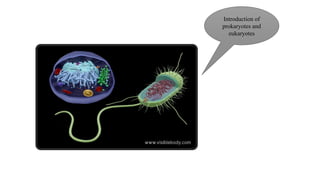
Introduction of
prokaryotes and
eukaryotes
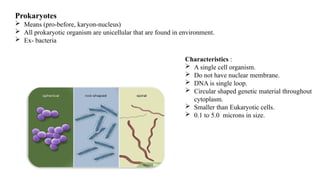
Prokaryotes
 Means (pro-before, karyon-nucleus)
 All prokaryotic organism are unicellular that are found in environment.
 Ex- bacteria
Characteristics :
 A single cell organism.
 Do not have nuclear membrane.
 DNA is single loop.
 Circular shaped genetic material throughout
cytoplasm.
 Smaller than Eukaryotic cells.
 0.1 to 5.0 microns in size.
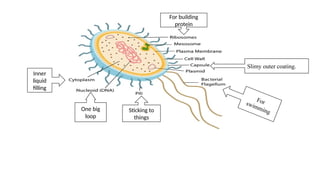
One big
loop
Slimy outer coating.
For
swimming
For building
protein
Sticking to
things
Inner
liquid
filling
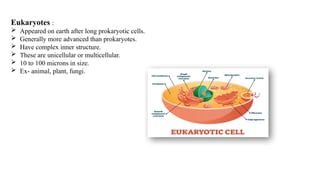
Eukaryotes :
 Appeared on earth after long prokaryotic cells.
 Generally more advanced than prokaryotes.
 Have complex inner structure.
 These are unicellular or multicellular.
 10 to 100 microns in size.
 Ex- animal, plant, fungi.
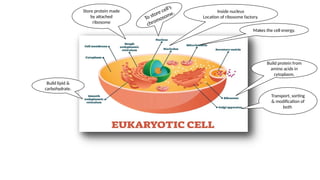
Inside nucleus
Location of ribosome factory.
Makes the cell energy.
Build protein from
amino acids in
cytoplasm.
To store cell’s
chromosome.
Store protein made
by attached
ribosome
Build lipid &
carbohydrate.
Transport, sorting
& modification of
both
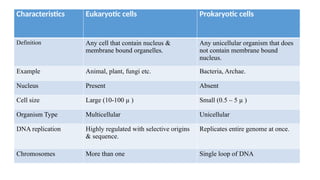
Characteristics Eukaryotic cells Prokaryotic cells
Definition Any cell that contain nucleus &
membrane bound organelles.
Any unicellular organism that does
not contain membrane bound
nucleus.
Example Animal, plant, fungi etc. Bacteria, Archae.
Nucleus Present Absent
Cell size Large (10-100 µ ) Small (0.5 – 5 µ )
Organism Type Multicellular Unicellular
DNA replication Highly regulated with selective origins
& sequence.
Replicates entire genome at once.
Chromosomes More than one Single loop of DNA
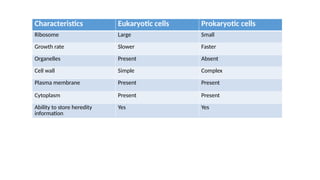
Characteristics Eukaryotic cells Prokaryotic cells
Ribosome Large Small
Growth rate Slower Faster
Organelles Present Absent
Cell wall Simple Complex
Plasma membrane Present Present
Cytoplasm Present Present
Ability to store heredity
information
Yes Yes
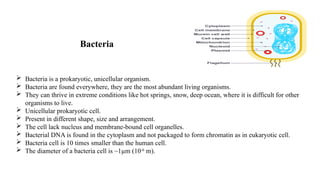
 Bacteria is a prokaryotic, unicellular organism.
 Bacteria are found everywhere, they are the most abundant living organisms.
 They can thrive in extreme conditions like hot springs, snow, deep ocean, where it is difficult for other
organisms to live.
 Unicellular prokaryotic cell.
 Present in different shape, size and arrangement.
 The cell lack nucleus and membrane-bound cell organelles.
 Bacterial DNA is found in the cytoplasm and not packaged to form chromatin as in eukaryotic cell.
 Bacteria cell is 10 times smaller than the human cell.
 The diameter of a bacteria cell is ~1µm (10-6
m).
Bacteria
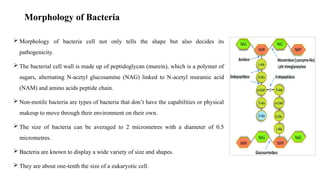
Morphology of Bacteria
 Morphology of bacteria cell not only tells the shape but also decides its
pathogenicity.
 The bacterial cell wall is made up of peptidoglycan (murein), which is a polymer of
sugars, alternating N-acetyl glucosamine (NAG) linked to N-acetyl muramic acid
(NAM) and amino acids peptide chain.
 Non-motile bacteria are types of bacteria that don’t have the capabilities or physical
makeup to move through their environment on their own.
 The size of bacteria can be averaged to 2 micrometres with a diameter of 0.5
micrometres.
 Bacteria are known to display a wide variety of size and shapes.
 They are about one-tenth the size of a eukaryotic cell.
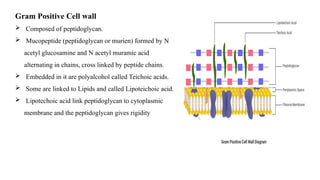
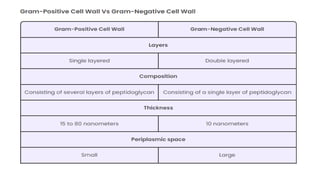
Gram Positive Cell wall
 Composed of peptidoglycan.
 Mucopeptide (peptidoglycan or murien) formed by N
acetyl glucosamine and N acetyl muramic acid
alternating in chains, cross linked by peptide chains.
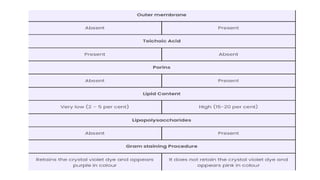
 Embedded in it are polyalcohol called Teichoic acids.
 Some are linked to Lipids and called Lipoteichoic acid.
 Lipotechoic acid link peptidoglycan to cytoplasmic
membrane and the peptidoglycan gives rigidity
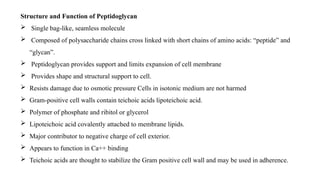
Structure and Function of Peptidoglycan
 Single bag-like, seamless molecule
 Composed of polysaccharide chains cross linked with short chains of amino acids: “peptide” and
“glycan”.
 Peptidoglycan provides support and limits expansion of cell membrane
 Provides shape and structural support to cell.
 Resists damage due to osmotic pressure Cells in isotonic medium are not harmed
 Gram-positive cell walls contain teichoic acids lipoteichoic acid.
 Polymer of phosphate and ribitol or glycerol
 Lipoteichoic acid covalently attached to membrane lipids.
 Major contributor to negative charge of cell exterior.
 Appears to function in Ca++ binding
 Teichoic acids are thought to stabilize the Gram positive cell wall and may be used in adherence.
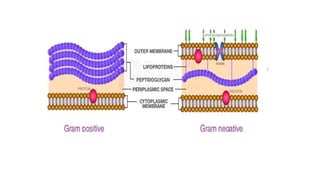
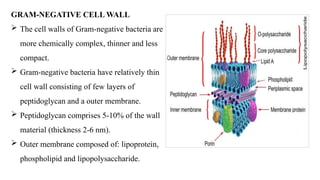
GRAM-NEGATIVE CELL WALL
 The cell walls of Gram-negative bacteria are
more chemically complex, thinner and less
compact.
 Gram-negative bacteria have relatively thin
cell wall consisting of few layers of
peptidoglycan and a outer membrane.
 Peptidoglycan comprises 5-10% of the wall
material (thickness 2-6 nm).
 Outer membrane composed of: lipoprotein,
phospholipid and lipopolysaccharide.
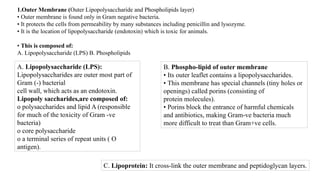
1.Outer Membrane (Outer Lipopolysaccharide and Phospholipids layer)
• Outer membrane is found only in Gram negative bacteria.
• It protects the cells from permeability by many substances including penicillin and lysozyme.
• It is the location of lipopolysaccharide (endotoxin) which is toxic for animals.
• This is composed of:
A. Lipopolysaccharide (LPS) B. Phospholipids
B. Phospho-lipid of outer membrane
• Its outer leaflet contains a lipopolysaccharides.
• This membrane has special channels (tiny holes or
openings) called porins (consisting of
protein molecules).
• Porins block the entrance of harmful chemicals
and antibiotics, making Gram-ve bacteria much
more difficult to treat than Gram+ve cells.
A. Lipopolysaccharide (LPS):
Lipopolysaccharides are outer most part of
Gram (-) bacterial
cell wall, which acts as an endotoxin.
Lipopoly saccharides,are composed of:
o polysaccharides and lipid A (responsible
for much of the toxicity of Gram -ve
bacteria)
o core polysaccharide
o a terminal series of repeat units ( O
antigen).
C. Lipoprotein: It cross-link the outer membrane and peptidoglycan layers.
 2. PEPTIDOGLYCAN LAYER (Thin inner layer):
 Peptidoglycan makes up only 5 – 20% of the cell wall and is not the outermost layer, but lies
between the plasma membrane and an outer membrane.
Primary function of the bacterial cell wall:
 To prevent the cell from expanding and eventually rupture or osmotic lysis of the cell
protoplast.
 It is very rigid and gives shape to the cell.
 They may cause symptoms of disease in animals.
 They are the site of action of some of our most important antibiotics
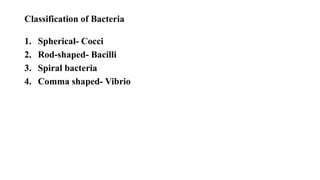
Classification of Bacteria
1. Spherical- Cocci
2. Rod-shaped- Bacilli
3. Spiral bacteria
4. Comma shaped- Vibrio
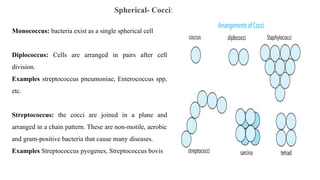
Spherical- Cocci:
Monococcus: bacteria exist as a single spherical cell
Diplococcus: Cells are arranged in pairs after cell
division.
Examples streptococcus pneumoniae, Enterococcus spp,
etc.
Streptococcus: the cocci are joined in a plane and
arranged in a chain pattern. These are non-motile, aerobic
and gram-positive bacteria that cause many diseases.
Examples Streptococcus pyogenes, Streptococcus bovis
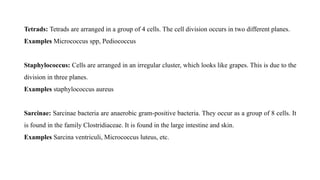
Tetrads: Tetrads are arranged in a group of 4 cells. The cell division occurs in two different planes.
Examples Micrococcus spp, Pediococcus
Staphylococcus: Cells are arranged in an irregular cluster, which looks like grapes. This is due to the
division in three planes.
Examples staphylococcus aureus
Sarcinae: Sarcinae bacteria are anaerobic gram-positive bacteria. They occur as a group of 8 cells. It
is found in the family Clostridiaceae. It is found in the large intestine and skin.
Examples Sarcina ventriculi, Micrococcus luteus, etc.
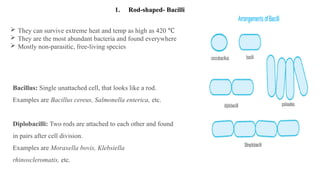
 They can survive extreme heat and temp as high as 420 ℃
 They are the most abundant bacteria and found everywhere
 Mostly non-parasitic, free-living species
Bacillus: Single unattached cell, that looks like a rod.
Examples are Bacillus cereus, Salmonella enterica, etc.
Diplobacilli: Two rods are attached to each other and found
in pairs after cell division.
Examples are Moraxella bovis, Klebsiella
rhinoscleromatis, etc.
1. Rod-shaped- Bacilli
Streptobacilli: Due to cell division in one plane, bacilli are arranged in a chain. Genus
Streptobacillus contains gram-negative, aerobic or facultative anaerobic bacteria.
Examples are Streptobacillus felis, etc.
Coccobacilli: These are short compared to other bacilli and oval in shape, they appear
like a coccus.
Examples are Chlamydia trachomatis, Haemophilus influenzae
Palisades: The bacilli after cell division bend and therefore arranged in a palisade, fence-
like structure.
Example: Corynebacterium diptheria
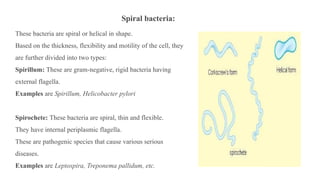
Spiral bacteria:
These bacteria are spiral or helical in shape.
Based on the thickness, flexibility and motility of the cell, they
are further divided into two types:
Spirillum: These are gram-negative, rigid bacteria having
external flagella.
Examples are Spirillum, Helicobacter pylori
Spirochete: These bacteria are spiral, thin and flexible.
They have internal periplasmic flagella.
These are pathogenic species that cause various serious
diseases.
Examples are Leptospira, Treponema pallidum, etc.
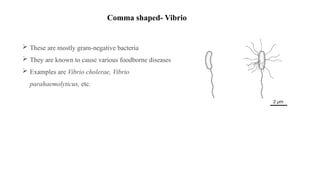
 These are mostly gram-negative bacteria
 They are known to cause various foodborne diseases
 Examples are Vibrio cholerae, Vibrio
parahaemolyticus, etc.
Comma shaped- Vibrio
 Bacteria may require adequate nutrition, optimum pH, temperature and oxygen for
multiplication and growth.
 Some species require only minimal nutrients in their environment, whereas others have
complex nutritional requirements.
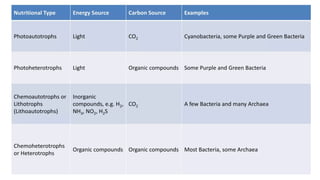
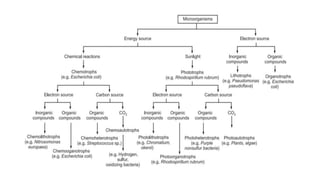
 Bacteria can be classified depending on nutritional requirements i.e. sources of energy,
electron, carbon etc.
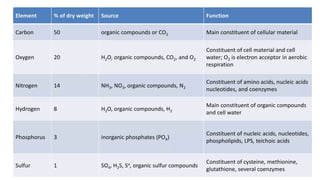
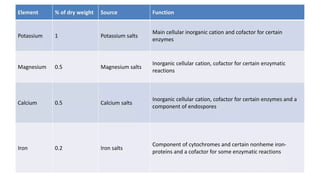
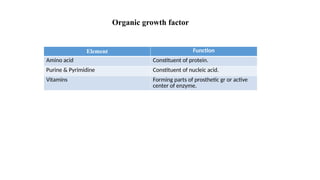
Nutritional requirement
Element Function
Amino acid Constituent of protein.
Purine & Pyrimidine Constituent of nucleic acid.
Vitamins Forming parts of prosthetic gr or active
center of enzyme.
Organic growth factor
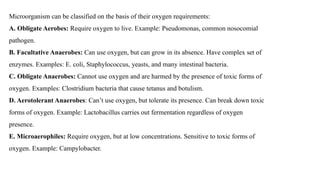
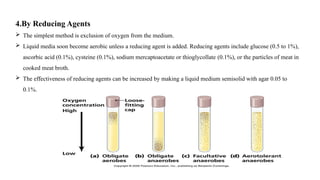
Microorganism can be classified on the basis of their oxygen requirements:
A. Obligate Aerobes: Require oxygen to live. Example: Pseudomonas, common nosocomial
pathogen.
B. Facultative Anaerobes: Can use oxygen, but can grow in its absence. Have complex set of
enzymes. Examples: E. coli, Staphylococcus, yeasts, and many intestinal bacteria.
C. Obligate Anaerobes: Cannot use oxygen and are harmed by the presence of toxic forms of
oxygen. Examples: Clostridium bacteria that cause tetanus and botulism.
D. Aerotolerant Anaerobes: Can’t use oxygen, but tolerate its presence. Can break down toxic
forms of oxygen. Example: Lactobacillus carries out fermentation regardless of oxygen
presence.
E. Microaerophiles: Require oxygen, but at low concentrations. Sensitive to toxic forms of
oxygen. Example: Campylobacter.
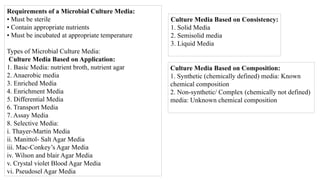
Requirements of a Microbial Culture Media:
• Must be sterile
• Contain appropriate nutrients
• Must be incubated at appropriate temperature
Types of Microbial Culture Media:
Culture Media Based on Application:
1. Basic Media: nutrient broth, nutrient agar
2. Anaerobic media
3. Enriched Media
4. Enrichment Media
5. Differential Media
6. Transport Media
7. Assay Media
8. Selective Media:
i. Thayer-Martin Media
ii. Manittol- Salt Agar Media
iii. Mac-Conkey’s Agar Media
iv. Wilson and blair Agar Media
v. Crystal violet Blood Agar Media
vi. Pseudosel Agar Media
Culture Media Based on Consistency:
1. Solid Media
2. Semisolid media
3. Liquid Media
Culture Media Based on Composition:
1. Synthetic (chemically defined) media: Known
chemical composition
2. Non-synthetic/ Complex (chemically not defined)
media: Unknown chemical composition
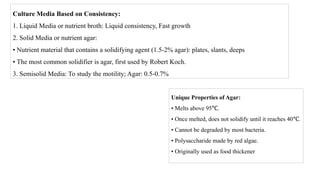
Culture Media Based on Consistency:
1. Liquid Media or nutrient broth: Liquid consistency, Fast growth
2. Solid Media or nutrient agar:
• Nutrient material that contains a solidifying agent (1.5-2% agar): plates, slants, deeps
• The most common solidifier is agar, first used by Robert Koch.
3. Semisolid Media: To study the motility; Agar: 0.5-0.7%
Unique Properties of Agar:
• Melts above 95 .
℃
• Once melted, does not solidify until it reaches 40 .
℃
• Cannot be degraded by most bacteria.
• Polysaccharide made by red algae.
• Originally used as food thickener
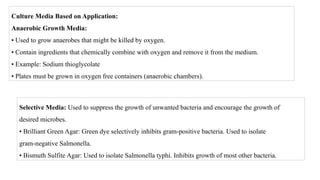
Culture Media Based on Application:
Anaerobic Growth Media:
• Used to grow anaerobes that might be killed by oxygen.
• Contain ingredients that chemically combine with oxygen and remove it from the medium.
• Example: Sodium thioglycolate
• Plates must be grown in oxygen free containers (anaerobic chambers).
Selective Media: Used to suppress the growth of unwanted bacteria and encourage the growth of
desired microbes.
• Brilliant Green Agar: Green dye selectively inhibits gram-positive bacteria. Used to isolate
gram-negative Salmonella.
• Bismuth Sulfite Agar: Used to isolate Salmonella typhi. Inhibits growth of most other bacteria.
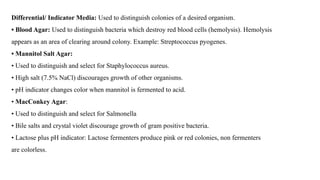
Differential/ Indicator Media: Used to distinguish colonies of a desired organism.
• Blood Agar: Used to distinguish bacteria which destroy red blood cells (hemolysis). Hemolysis
appears as an area of clearing around colony. Example: Streptococcus pyogenes.
• Mannitol Salt Agar:
• Used to distinguish and select for Staphylococcus aureus.
• High salt (7.5% NaCl) discourages growth of other organisms.
• pH indicator changes color when mannitol is fermented to acid.
• MacConkey Agar:
• Used to distinguish and select for Salmonella
• Bile salts and crystal violet discourage growth of gram positive bacteria.
• Lactose plus pH indicator: Lactose fermenters produce pink or red colonies, non fermenters
are colorless.
PHYSICAL PARAMETERS FOR GROWTH
Growth and Multiplication of Bacteria
• Refers to an increase in cell number, not in cell size.
• Bacteria divide by binary fission and cell divides to form two daughter cells.
• Growth in numbers can be studied by bacterial counts that of total and viable counts.
• The total count gives the number of cells either living or not and the viable count measures the number of
living cells that are capable of multiplication.
Many factors affect the generation time and growth of the organism, which are:
1. Nutrition
2. Temperature
3. Oxygen
4. Carbon dioxide
5. Light
6. pH
7. Moisture
8. Salt concentration
Nutrition:
• For growth and multiplication of bacteria, the minimum nutritional requirement is water, a
source of carbon, nitrogen and some inorganic salts.
• Bacteria can be classified nutritionally, based on their energy requirement and on their ability to
Synthesis essential metabolites.
• Bacteria which derive their energy from sunlight- phototrophs.
• Bacteria which obtain energy from chemical reactions- chemotrophs.
• Bacteria which can synthesise all their organic compounds- autotrophs
• Bacteria which are unable to synthesise their own metabolites- heterotrophs.
Oxygen:
Depending on the influence of oxygen on growth and viability, bacteria are divided into aerobes
and anaerobes.
Temperature
• Bacteria vary in their requirement of temperature for
growth.
• The temperature at which growth occurs best is
known as the optimum temperature.
• Mesophilic bacteria - grow best at temperatures of
25-40°C.
• Psychrophilic bacteria - grow best at temperatures
below 20°C.
• Thermophiles - grow best at high temperatures, 55-
80°C.
• The lowest temperature that kills a bacterium under
standard conditions in a given time is
known as thermal death point.
pH :
• Bacteria are sensitive to variations in pH.
• Majority of pathogenic bacteria grow best at
neutral or slightly alkaline pH.
• Acidophiles:
“Acid loving” - Grow at very low pH (0.1 to 5.4).
• Neutrophiles:
Grow at pH 5.4 to 8.5.
• Alkaliphiles:
“Alkali loving”- Grow at alkaline or high pH (7 to
12 or higher), for Vibrio cholerae optimal pH 9.
Salt concentration/ Osmotic Effect
• Bacteria are more tolerant to osmotic variation than most other cells due to the mechanical strength of
their cell wall. Sudden exposure to hypertonic solutions may cause osmotic withdrawal of water and
shrinkage of protoplasm called plasmolysis.
• Halophiles: Require moderate to large salt concentrations. Ocean water contains 3.5% salt.
• Extreme or Obligate Halophiles: Require very high salt concentrations (20 to 30%).
• Facultative Halophiles: Do not require high salt concentrations for growth, but tolerate 2% salt or more.
Hypertonic Solutions: High osmotic pressure removes water from cell, causing shrinkage of cell
membrane (plasmolysis).
Used to control spoilage and microbial growth (Sugar in jelly and Salt on meat)
Hypotonic Solutions: Low osmotic pressure causes water to enter the cell. In most cases cell wall
prevents excessive entry of water.
Microbe may lyse or burst if cell wall is weak.
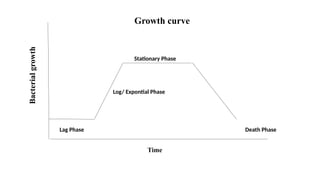
Lag Phase
Stationary Phase
Death Phase
Log/ Expontial Phase
Growth curve
Time
Bacterial
growth
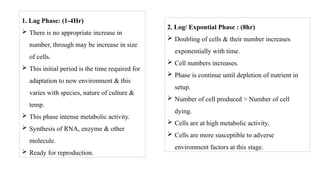
1. Lag Phase: (1-4Hr)
 There is no appropriate increase in
number, through may be increase in size
of cells.
 This initial period is the time required for
adaptation to new environment & this
varies with species, nature of culture &
temp.
 This phase intense metabolic activity.
 Synthesis of RNA, enzyme & other
molecule.
 Ready for reproduction.
2. Log/ Expontial Phase : (8hr)
 Doubling of cells & their number increases
exponentially with time.
 Cell numbers increases.
 Phase is continue until depletion of nutrient in
setup.
 Number of cell produced > Number of cell
dying.
 Cells are at high metabolic activity.
 Cells are more susceptible to adverse
environment factors at this stage.
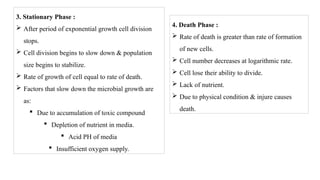
3. Stationary Phase :
 After period of exponential growth cell division
stops.
 Cell division begins to slow down & population
size begins to stabilize.
 Rate of growth of cell equal to rate of death.
 Factors that slow down the microbial growth are
as:
 Due to accumulation of toxic compound
 Depletion of nutrient in media.
 Acid PH of media
 Insufficient oxygen supply.
4. Death Phase :
 Rate of death is greater than rate of formation
of new cells.
 Cell number decreases at logarithmic rate.
 Cell lose their ability to divide.
 Lack of nutrient.
 Due to physical condition & injure causes
death.
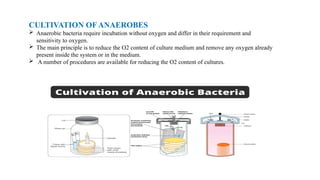
CULTIVATION OF ANAEROBES
 Anaerobic bacteria require incubation without oxygen and differ in their requirement and
sensitivity to oxygen.
 The main principle is to reduce the O2 content of culture medium and remove any oxygen already
present inside the system or in the medium.
 A number of procedures are available for reducing the O2 content of cultures.
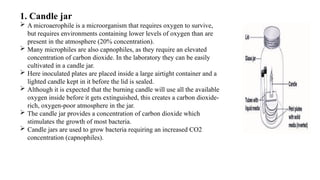
1. Candle jar
 A microaerophile is a microorganism that requires oxygen to survive,
but requires environments containing lower levels of oxygen than are
present in the atmosphere (20% concentration).
 Many microphiles are also capnophiles, as they require an elevated
concentration of carbon dioxide. In the laboratory they can be easily
cultivated in a candle jar.
 Here inoculated plates are placed inside a large airtight container and a
lighted candle kept in it before the lid is sealed.
 Although it is expected that the burning candle will use all the available
oxygen inside before it gets extinguished, this creates a carbon dioxide-
rich, oxygen-poor atmosphere in the jar.
 The candle jar provides a concentration of carbon dioxide which
stimulates the growth of most bacteria.
 Candle jars are used to grow bacteria requiring an increased CO2
concentration (capnophiles).
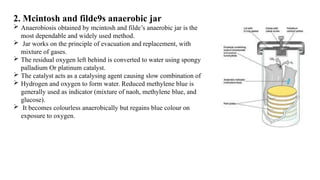
2. Mcintosh and filde9s anaerobic jar
 Anaerobiosis obtained by mcintosh and filde’s anaerobic jar is the
most dependable and widely used method.
 Jar works on the principle of evacuation and replacement, with
mixture of gases.
 The residual oxygen left behind is converted to water using spongy
palladium Or platinum catalyst.
 The catalyst acts as a catalysing agent causing slow combination of
 Hydrogen and oxygen to form water. Reduced methylene blue is
generally used as indicator (mixture of naoh, methylene blue, and
glucose).
 It becomes colourless anaerobically but regains blue colour on
exposure to oxygen.
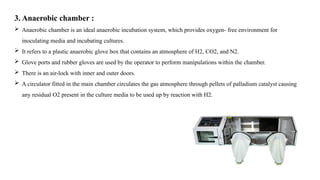
3. Anaerobic chamber :
 Anaerobic chamber is an ideal anaerobic incubation system, which provides oxygen- free environment for
inoculating media and incubating cultures.
 It refers to a plastic anaerobic glove box that contains an atmosphere of H2, CO2, and N2.
 Glove ports and rubber gloves are used by the operator to perform manipulations within the chamber.
 There is an air-lock with inner and outer doors.
 A circulator fitted in the main chamber circulates the gas atmosphere through pellets of palladium catalyst causing
any residual O2 present in the culture media to be used up by reaction with H2.
4.By Reducing Agents
 The simplest method is exclusion of oxygen from the medium.
 Liquid media soon become aerobic unless a reducing agent is added. Reducing agents include glucose (0.5 to 1%),
ascorbic acid (0.1%), cysteine (0.1%), sodium mercaptoacetate or thioglycollate (0.1%), or the particles of meat in
cooked meat broth.
 The effectiveness of reducing agents can be increased by making a liquid medium semisolid with agar 0.05 to
0.1%.
QUANTITATIVE MEASUREMENT OF BACTERIAL
GROWTH
The term growth indicates the magnitude of total population.
Microbial growth measurement s essential for:
 Determine growth and reproduction rate
 Determining the suitability of water, milk and food for consumption
 Counting microflora of soil
 Monitoring fermentation process
 Checking suitability of raw material for preparing pharmaceutical products
 Checking microbial titre in commercial products (bio-fertilizers, vaccines, probiotic tablets etc
Methods
Total cell counts/direct method include:
 Direct microscopic examination/ breed method
 Electronic cell counters/ coulter method
 Measurement of the turbidity of a suspension
 Determination of the weight of a dry culture (biomass assessment),
 Adenosine triphosphate (ATP) measurements
Viable counting/indirect method techniques include:
 Plate count method (spread plate and pour plate)
 Membrane filtration.
Total cell counts
Direct microscopic method :
 A measured volume of a bacterial suspension is placed within a defined area on a microscope slide.
 A 0.01-ml sample is spread over a marked square centimeter of slide The smear is then fixed by
heating, stained, examined under oil immersion lens, and the cells are counted
 Customarily, cells in a few microscopic fields are counted because it is not possible to scan the
entire area of smear.
 The counting of total number of cells is determined by calculating the total number of microscopic
fields per one square cm. area of the smear.
Application
This method also determines relative effectiveness of antibiotics against pathogenic bacteria
Disadvantages
Does not determine the number of viable cells
The total number of cells can be counted with the help of following calculations:
(a) Area of microscopic field = πr2
Where, r = (oil immersion lens) = 0.08 mm.
Therefore,
Area of the microscopic field under the oil immersion lens= πr2
= 3.14 x (0.08 mm)2
= 0.02 sq. mm.
(b) Area of the smear one sq. cm. = 100 sq. mm.
Then, the no. of microscopic fields = 100 / 0.02= 5000
(c) No. of cells 1 sq. cm. (or per 0.01 ml microbial cell suspension) = Average no. of
microbes per microscopic field x 5000
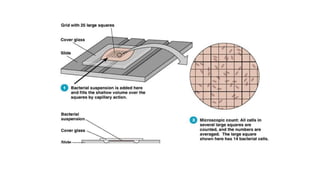
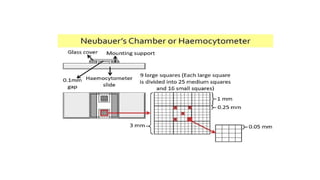
Counting chamber method
 A specially designed slide called a Petroff-Hausser cell counter or Neubauer chamber is used.
 The counting grids, when the chamber is covered with a glass coverslip, hold a known volume of culture.
 Calculated taking the count of number of bacteria per unit area of grid
 By counting the number of cells within a proportion of the grid, and multiplying it by a conversion factor
(depending on chamber volume and sample dilution used) the number of cells per millilitre can be
determined.
Advantages
 rapid
 inexpensive
Disadvantages
 Motile bacteria are difficult to count by this method
 Unable to distinguish living from dead cells
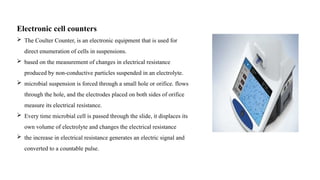
Electronic cell counters
 The Coulter Counter, is an electronic equipment that is used for
direct enumeration of cells in suspensions.
 based on the measurement of changes in electrical resistance
produced by non-conductive particles suspended in an electrolyte.
 microbial suspension is forced through a small hole or orifice. flows
through the hole, and the electrodes placed on both sides of orifice
measure its electrical resistance.
 Every time microbial cell is passed through the slide, it displaces its
own volume of electrolyte and changes the electrical resistance
 the increase in electrical resistance generates an electric signal and
converted to a countable pulse.
Advantages
can count thousands of cells in few seconds
useful for large quantity
quick and easy to use
Disadvantages
Suspension must be free of foreign particles
Cannot distinguish between live and dead cells
Dry weight estimation
 This method determines the weight of total cells, both living and dead.
 It involves separating the biomass from a known volume of a homogeneous cell suspension.
 usually achieved by filtration under vacuum, through a preweighed membrane filter.
 The filter with collected cells is washed and dried.
 Results are normally expressed as milligrams of cells per millilitre of culture.
 Advantages
 Only way to determine growth of filamentous bacteria
 Simple method
Disadvantages
 non-cellular materials above the size of the filter pores is also collected that lead to errors.
 Cannot distinguish between live and dead cells
 large volume of sample required to obtain sufficient biomass for accurate weighing
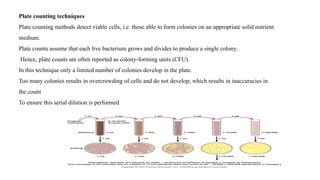
Plate counting techniques
Plate counting methods detect viable cells, i.e. those able to form colonies on an appropriate solid nutrient
medium.
Plate counts assume that each live bacterium grows and divides to produce a single colony.
Hence, plate counts are often reported as colony-forming units (CFU).
In this technique only a limited number of colonies develop in the plate.
Too many colonies results in overcrowding of cells and do not develop; which results in inaccuracies in
the count
To ensure this serial dilution is performed
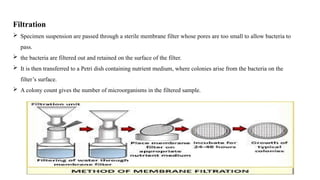
Filtration
 Specimen suspension are passed through a sterile membrane filter whose pores are too small to allow bacteria to
pass.
 the bacteria are filtered out and retained on the surface of the filter.
 It is then transferred to a Petri dish containing nutrient medium, where colonies arise from the bacteria on the
filter’s surface.
 A colony count gives the number of microorganisms in the filtered sample.

Pharmaceutical Microbiology (sem-3) unit 1.pptx

  • 1.
    PHARMACEUTICAL MICROBIOLOGY SEM-III MS. PAYALPILAJI (PHARMACEUTICAL CHEMISTRY)
  • 3.
    Microbiology : The studyof biology of microscopic organism. or Microbiology is the study of all living organism that are too small to visible with naked eye. Yeast
  • 4.
     Most microorganismsare unicellular, but this is not universal, since some multicellular organisms are microscopic.  Most importantly, these organisms are vital to humans and the environment, as they participate in the Earth’s element cycles, such as the carbon cycle and the nitrogen cycle.  Microorganisms live in all parts of the biosphere: o water o in the atmosphere o soil o deep inside the rocks o hot springs o on the ocean floor, within the Earth’s crust
  • 5.
    BRANCHES Pure/Basic Applied  Bacteriology Mycology  Protozoology  Algology  Parasitology  Immunology  Microbial Taxonomy  Genetics  Medical microbiology  Pharmaceutical microbiology  Industrial  Microbial Biotechnology  Agricultural  Aquatic  Epidemiology
  • 6.
    Pure microbiology Bacteriology Study ofBacteria Mycology Study of fungi Protozoology Algology / Phycology Parasitology Study of Protozoa Study of Algae Study of Parasitism Immunology Development of body to infectious disease Genetics Study of heredity & variation Microbial Taxonomy Study of classification of micro organism
  • 7.
    Applied microbiology Medical microbiology Studyof causative agents of infectious disease It deals with etiology, pathogenesis, diagnosis, treatment, epidemiology & control of infection. Pharmaceutical microbiology Study of microorganism which are responsible for production of antibiotics, enzyme, vaccine, vitamin , etc. Also include methods of Sterilization Disinfectant Sterile product Preparation Diagnosis Treatment Industrial microbiology Production of alcoholic beverages, amino acids, vitamin, enzyme
  • 8.
    Agricultural microbiology Study ofrelationship of micro organism & crops with emphasis on control of plant disease and improvement yields Microbial Biotechnology Manipulation of living organism at molecular & genetic level to produce products such as Antibiotics, enzyme & amino acids. Aquatic microbiology Study of micro organism and their activities in fresh & marine water. It includes the water purification, biological degradation of water. Epidemiology Microbiology It concerned with monitoring, control & spread of disease in communities.
  • 10.
     Scientific evidencesuggests that life began on Earth some 3.5 billion years ago.  Since then, life has evolved into a wide variety of forms, which biologists have classified into a hierarchy of taxa.  Some of the oldest cells on Earth are single-cell  Early history of microbiology : Historians are unsure who made the first observations of microorganisms.
  • 11.
    DIFFERENT ERA INHISTORY OF MICROBIOLOGY 1. Discovery Era 2. Transition Era 3. Golden Era (1850 to 1915) 4. Modern Era
  • 12.
    DISCOVERY ERA Antonie VanLeeuwenhoek : (1632–1723) Father of microbiology” Father of bacteriology and protozoology (protistology), from Holland Developed microscope in 1673 and observed microorganisms, which he called animalcules and made one of the most important contributions to biology. Revealed accurate descriptions of protozoa, fungi, and bacteria.
  • 13.
    TRANSITION ERA  FrancescoRedi: who showed that fly maggots do not arise from decaying meat (as others believed) if the meat is covered to prevent the entry of flies.  John Needham: He proposed that tiny organism arises spontaneously on the mutton gravy. He covered the flasks with cork as done by Redi, still the microbes appeared on mutton gravy.  Lazzaro Spallanzani : Disputed the theory by showing that boiled broth would not give rise to microscopic forms of life.
  • 14.
    Alexander Fleming :(Biologist & Pharmacologist)  Discover enzyme-lysozyme. Discover the antibiotics such as penicillin from fungus (penicillium notatum) in 1928. Mould on bread produces chemical Bacteria Zone of no growth Penicillium notatum GOLDEN ERA
  • 15.
    Louis Pasteur :(Known for germ theory of disease)  He is the father of medical microbiology.  He pointed out that no growth took place in swan neck-shaped tubes because dust & germs had been trapped on wall of Curved necks but if necks were broken off so that dust fell directly down into flask, microbial growth commenced immediately.
  • 16.
     Who demonstratethat micro organism causes fermentation & spoilage of food.  Developed process of pasteurization to kill harmful microbes in food & drinks.  He suggest that heating at 62.8 to 145 ℃ ℉ for 30 min to destroy the undesirable microbes without running the taste of product.  Introduce liquid media : nutrient broth to grow M.O.  Develop the vaccine anthrax, rabies.  Introduction of sterilization techniques : Autoclave and Hot air oven. Co2 release Autoclave
  • 17.
    Edward Jenner : Discover safe & effective vaccine against smallpox.  He discovered the technique of vaccination. Robert Koch : Father of practical microbiology. Discovered rod shaped bacteria smear. Introduce staining technique. Discover tubercular bacilli – mycobacterium tuberculosis. Discover vibrio cholera. Developed pure culture technique.
  • 18.
    John Tyndall:  Hediscovered highly resistant bacterial structure later known as endospore.  Prolonged boiling or intermittent heating was necessary to kill these spores, to make the infusion completely sterilized, a process known as Tyndallisation. Richard Petri:  He developed the Petri dish, container used for solid culture media.
  • 19.
    YEARS NOBEL LAUREATESCONTRIBUTION 1901 Von Behring Diphtheria antitoxin 1902 Ronald Ross Malaria 1905 Robert Koch Tb 1908 Metchnikoff Phagocytosis 1945 Flemming Penicillin 1962 Watson, crick DNA structure 1968 Holley, Khorana Genetic code MODERN ERA
  • 20.
    Applications and scopeof pharmaceutical microbiology • Production of antibiotics : Pharmaceutical or industrial microbiology concerns with isolation of antibiotics producing micro-organism from natural microorganism by process of fermentation. Penicillin – penicillium notatum Streptomycin – Streptomyces griseus Tetracycline – Streptomyces aureofaciens Chloramphenicol – Streptomyces venezuelae
  • 21.
    • Production ofenzymes, vaccines, biosurfactants, alcoholic & other pharmaceutical product : Many microbial cells convert raw material into valuable organic comp such as butanol, ethanol, acetone etc. Microbial cells also produce intracellular & extracellular enzymes are important for pharmaceutical fermentation process. Biosurfactants have lots of application in agriculture, food industries, paper & metal industries, leather paper. Different types of biosurfactants are synthesized by number of microorganism such as Bacillum species, Acinetobacter species, Pseudomonas Species, etc.
  • 22.
    • Molecular biologyMicrobial genetics and Genetic engineering  Study of genetic information and how it regulated the development and function of cells and organisms.  New genes can be inserted into plants and animals.  Genetic engineering: microbes used to make hormones (insulin, human growth hormone), vaccine, antibiotics, and interferon and many other useful products for human being.  Development of new efficient microbial strains to synthesize useful products.
  • 23.
    • Diagnosis ofdiseases and treatment : Different tests are used to detect infectious disease. Ex- ELISA test, Widal test • Treatment of industrial waste material :  Many microbial species are used for decomposition of such waste material and organic compound e.g. actinomycetes, fungi, protozoa etc.  Cyanide is produced on industrial scale for use in metal extraction, electroplating and steel industry which is degraded by Streptomyces lavendulae.
  • 24.
    • Plant growthpromotion : Many microbial cells present in soil play important role in soil fertility, herbicidal resistance, insect resistance, change in protein/oil content and enhanced quality of plant product. Ex- Rhizobium species, Pseudomonas species, Acetobacter species. Rhizosperic bacteria may release various plant growth promoting substances as secondary metabolism. • Sterile product preparation :  Pharmaceutical microbiology plays major role in preparation of sterile product.
  • 25.
    • Sterilization : Moistheat sterilization, dry heat sterilization, membrane filtration, gaseous & chemical sterilization methods are used for killing microorganism. Methods of sterilization depend upon properties of product & general type of microbes present in products. Moist heat sterilization (autoclave) – Bacillus Stearothermophilus. Dry heat sterilization (Hot Air Oven) – Bacillus Subtilis. Membrane filtration – Pseudomonas diminuta. Radiation sterilization – Bacillus pumilis.
  • 26.
    • Testing ofpharmaceuticals : Raw material and finished product Test for detection of E. coli, Salmonella, Pseudomonas aeruginosa, Staphylococcus aureus in pharmaceutical raw material & finisher product are described in IP, USP, BP, EP. Water is always tested for total microbial count & presence of E.coli. Bacterial Endotoxins Test (BET) used as quality control test for parenteral & medical devices, LAL test, Gel-clot test for detection of endotoxins.
  • 27.
  • 28.
    Prokaryotes  Means (pro-before,karyon-nucleus)  All prokaryotic organism are unicellular that are found in environment.  Ex- bacteria Characteristics :  A single cell organism.  Do not have nuclear membrane.  DNA is single loop.  Circular shaped genetic material throughout cytoplasm.  Smaller than Eukaryotic cells.  0.1 to 5.0 microns in size.
  • 29.
    One big loop Slimy outercoating. For swimming For building protein Sticking to things Inner liquid filling
  • 30.
    Eukaryotes :  Appearedon earth after long prokaryotic cells.  Generally more advanced than prokaryotes.  Have complex inner structure.  These are unicellular or multicellular.  10 to 100 microns in size.  Ex- animal, plant, fungi.
  • 31.
    Inside nucleus Location ofribosome factory. Makes the cell energy. Build protein from amino acids in cytoplasm. To store cell’s chromosome. Store protein made by attached ribosome Build lipid & carbohydrate. Transport, sorting & modification of both
  • 32.
    Characteristics Eukaryotic cellsProkaryotic cells Definition Any cell that contain nucleus & membrane bound organelles. Any unicellular organism that does not contain membrane bound nucleus. Example Animal, plant, fungi etc. Bacteria, Archae. Nucleus Present Absent Cell size Large (10-100 µ ) Small (0.5 – 5 µ ) Organism Type Multicellular Unicellular DNA replication Highly regulated with selective origins & sequence. Replicates entire genome at once. Chromosomes More than one Single loop of DNA
  • 33.
    Characteristics Eukaryotic cellsProkaryotic cells Ribosome Large Small Growth rate Slower Faster Organelles Present Absent Cell wall Simple Complex Plasma membrane Present Present Cytoplasm Present Present Ability to store heredity information Yes Yes
  • 34.
     Bacteria isa prokaryotic, unicellular organism.  Bacteria are found everywhere, they are the most abundant living organisms.  They can thrive in extreme conditions like hot springs, snow, deep ocean, where it is difficult for other organisms to live.  Unicellular prokaryotic cell.  Present in different shape, size and arrangement.  The cell lack nucleus and membrane-bound cell organelles.  Bacterial DNA is found in the cytoplasm and not packaged to form chromatin as in eukaryotic cell.  Bacteria cell is 10 times smaller than the human cell.  The diameter of a bacteria cell is ~1µm (10-6 m). Bacteria
  • 35.
    Morphology of Bacteria Morphology of bacteria cell not only tells the shape but also decides its pathogenicity.  The bacterial cell wall is made up of peptidoglycan (murein), which is a polymer of sugars, alternating N-acetyl glucosamine (NAG) linked to N-acetyl muramic acid (NAM) and amino acids peptide chain.  Non-motile bacteria are types of bacteria that don’t have the capabilities or physical makeup to move through their environment on their own.  The size of bacteria can be averaged to 2 micrometres with a diameter of 0.5 micrometres.  Bacteria are known to display a wide variety of size and shapes.  They are about one-tenth the size of a eukaryotic cell.
  • 36.
    Gram Positive Cellwall  Composed of peptidoglycan.  Mucopeptide (peptidoglycan or murien) formed by N acetyl glucosamine and N acetyl muramic acid alternating in chains, cross linked by peptide chains.  Embedded in it are polyalcohol called Teichoic acids.  Some are linked to Lipids and called Lipoteichoic acid.  Lipotechoic acid link peptidoglycan to cytoplasmic membrane and the peptidoglycan gives rigidity
  • 37.
    Structure and Functionof Peptidoglycan  Single bag-like, seamless molecule  Composed of polysaccharide chains cross linked with short chains of amino acids: “peptide” and “glycan”.  Peptidoglycan provides support and limits expansion of cell membrane  Provides shape and structural support to cell.  Resists damage due to osmotic pressure Cells in isotonic medium are not harmed  Gram-positive cell walls contain teichoic acids lipoteichoic acid.  Polymer of phosphate and ribitol or glycerol  Lipoteichoic acid covalently attached to membrane lipids.  Major contributor to negative charge of cell exterior.  Appears to function in Ca++ binding  Teichoic acids are thought to stabilize the Gram positive cell wall and may be used in adherence.
  • 38.
    GRAM-NEGATIVE CELL WALL The cell walls of Gram-negative bacteria are more chemically complex, thinner and less compact.  Gram-negative bacteria have relatively thin cell wall consisting of few layers of peptidoglycan and a outer membrane.  Peptidoglycan comprises 5-10% of the wall material (thickness 2-6 nm).  Outer membrane composed of: lipoprotein, phospholipid and lipopolysaccharide.
  • 39.
    1.Outer Membrane (OuterLipopolysaccharide and Phospholipids layer) • Outer membrane is found only in Gram negative bacteria. • It protects the cells from permeability by many substances including penicillin and lysozyme. • It is the location of lipopolysaccharide (endotoxin) which is toxic for animals. • This is composed of: A. Lipopolysaccharide (LPS) B. Phospholipids B. Phospho-lipid of outer membrane • Its outer leaflet contains a lipopolysaccharides. • This membrane has special channels (tiny holes or openings) called porins (consisting of protein molecules). • Porins block the entrance of harmful chemicals and antibiotics, making Gram-ve bacteria much more difficult to treat than Gram+ve cells. A. Lipopolysaccharide (LPS): Lipopolysaccharides are outer most part of Gram (-) bacterial cell wall, which acts as an endotoxin. Lipopoly saccharides,are composed of: o polysaccharides and lipid A (responsible for much of the toxicity of Gram -ve bacteria) o core polysaccharide o a terminal series of repeat units ( O antigen). C. Lipoprotein: It cross-link the outer membrane and peptidoglycan layers.
  • 40.
     2. PEPTIDOGLYCANLAYER (Thin inner layer):  Peptidoglycan makes up only 5 – 20% of the cell wall and is not the outermost layer, but lies between the plasma membrane and an outer membrane. Primary function of the bacterial cell wall:  To prevent the cell from expanding and eventually rupture or osmotic lysis of the cell protoplast.  It is very rigid and gives shape to the cell.  They may cause symptoms of disease in animals.  They are the site of action of some of our most important antibiotics
  • 44.
    Classification of Bacteria 1.Spherical- Cocci 2. Rod-shaped- Bacilli 3. Spiral bacteria 4. Comma shaped- Vibrio
  • 45.
    Spherical- Cocci: Monococcus: bacteriaexist as a single spherical cell Diplococcus: Cells are arranged in pairs after cell division. Examples streptococcus pneumoniae, Enterococcus spp, etc. Streptococcus: the cocci are joined in a plane and arranged in a chain pattern. These are non-motile, aerobic and gram-positive bacteria that cause many diseases. Examples Streptococcus pyogenes, Streptococcus bovis
  • 46.
    Tetrads: Tetrads arearranged in a group of 4 cells. The cell division occurs in two different planes. Examples Micrococcus spp, Pediococcus Staphylococcus: Cells are arranged in an irregular cluster, which looks like grapes. This is due to the division in three planes. Examples staphylococcus aureus Sarcinae: Sarcinae bacteria are anaerobic gram-positive bacteria. They occur as a group of 8 cells. It is found in the family Clostridiaceae. It is found in the large intestine and skin. Examples Sarcina ventriculi, Micrococcus luteus, etc.
  • 47.
     They cansurvive extreme heat and temp as high as 420 ℃  They are the most abundant bacteria and found everywhere  Mostly non-parasitic, free-living species Bacillus: Single unattached cell, that looks like a rod. Examples are Bacillus cereus, Salmonella enterica, etc. Diplobacilli: Two rods are attached to each other and found in pairs after cell division. Examples are Moraxella bovis, Klebsiella rhinoscleromatis, etc. 1. Rod-shaped- Bacilli
  • 48.
    Streptobacilli: Due tocell division in one plane, bacilli are arranged in a chain. Genus Streptobacillus contains gram-negative, aerobic or facultative anaerobic bacteria. Examples are Streptobacillus felis, etc. Coccobacilli: These are short compared to other bacilli and oval in shape, they appear like a coccus. Examples are Chlamydia trachomatis, Haemophilus influenzae Palisades: The bacilli after cell division bend and therefore arranged in a palisade, fence- like structure. Example: Corynebacterium diptheria
  • 49.
    Spiral bacteria: These bacteriaare spiral or helical in shape. Based on the thickness, flexibility and motility of the cell, they are further divided into two types: Spirillum: These are gram-negative, rigid bacteria having external flagella. Examples are Spirillum, Helicobacter pylori Spirochete: These bacteria are spiral, thin and flexible. They have internal periplasmic flagella. These are pathogenic species that cause various serious diseases. Examples are Leptospira, Treponema pallidum, etc.
  • 50.
     These aremostly gram-negative bacteria  They are known to cause various foodborne diseases  Examples are Vibrio cholerae, Vibrio parahaemolyticus, etc. Comma shaped- Vibrio
  • 51.
     Bacteria mayrequire adequate nutrition, optimum pH, temperature and oxygen for multiplication and growth.  Some species require only minimal nutrients in their environment, whereas others have complex nutritional requirements.  Bacteria can be classified depending on nutritional requirements i.e. sources of energy, electron, carbon etc. Nutritional requirement
  • 55.
    Element Function Amino acidConstituent of protein. Purine & Pyrimidine Constituent of nucleic acid. Vitamins Forming parts of prosthetic gr or active center of enzyme. Organic growth factor
  • 57.
    Microorganism can beclassified on the basis of their oxygen requirements: A. Obligate Aerobes: Require oxygen to live. Example: Pseudomonas, common nosocomial pathogen. B. Facultative Anaerobes: Can use oxygen, but can grow in its absence. Have complex set of enzymes. Examples: E. coli, Staphylococcus, yeasts, and many intestinal bacteria. C. Obligate Anaerobes: Cannot use oxygen and are harmed by the presence of toxic forms of oxygen. Examples: Clostridium bacteria that cause tetanus and botulism. D. Aerotolerant Anaerobes: Can’t use oxygen, but tolerate its presence. Can break down toxic forms of oxygen. Example: Lactobacillus carries out fermentation regardless of oxygen presence. E. Microaerophiles: Require oxygen, but at low concentrations. Sensitive to toxic forms of oxygen. Example: Campylobacter.
  • 58.
    Requirements of aMicrobial Culture Media: • Must be sterile • Contain appropriate nutrients • Must be incubated at appropriate temperature Types of Microbial Culture Media: Culture Media Based on Application: 1. Basic Media: nutrient broth, nutrient agar 2. Anaerobic media 3. Enriched Media 4. Enrichment Media 5. Differential Media 6. Transport Media 7. Assay Media 8. Selective Media: i. Thayer-Martin Media ii. Manittol- Salt Agar Media iii. Mac-Conkey’s Agar Media iv. Wilson and blair Agar Media v. Crystal violet Blood Agar Media vi. Pseudosel Agar Media Culture Media Based on Consistency: 1. Solid Media 2. Semisolid media 3. Liquid Media Culture Media Based on Composition: 1. Synthetic (chemically defined) media: Known chemical composition 2. Non-synthetic/ Complex (chemically not defined) media: Unknown chemical composition
  • 59.
    Culture Media Basedon Consistency: 1. Liquid Media or nutrient broth: Liquid consistency, Fast growth 2. Solid Media or nutrient agar: • Nutrient material that contains a solidifying agent (1.5-2% agar): plates, slants, deeps • The most common solidifier is agar, first used by Robert Koch. 3. Semisolid Media: To study the motility; Agar: 0.5-0.7% Unique Properties of Agar: • Melts above 95 . ℃ • Once melted, does not solidify until it reaches 40 . ℃ • Cannot be degraded by most bacteria. • Polysaccharide made by red algae. • Originally used as food thickener
  • 60.
    Culture Media Basedon Application: Anaerobic Growth Media: • Used to grow anaerobes that might be killed by oxygen. • Contain ingredients that chemically combine with oxygen and remove it from the medium. • Example: Sodium thioglycolate • Plates must be grown in oxygen free containers (anaerobic chambers). Selective Media: Used to suppress the growth of unwanted bacteria and encourage the growth of desired microbes. • Brilliant Green Agar: Green dye selectively inhibits gram-positive bacteria. Used to isolate gram-negative Salmonella. • Bismuth Sulfite Agar: Used to isolate Salmonella typhi. Inhibits growth of most other bacteria.
  • 61.
    Differential/ Indicator Media:Used to distinguish colonies of a desired organism. • Blood Agar: Used to distinguish bacteria which destroy red blood cells (hemolysis). Hemolysis appears as an area of clearing around colony. Example: Streptococcus pyogenes. • Mannitol Salt Agar: • Used to distinguish and select for Staphylococcus aureus. • High salt (7.5% NaCl) discourages growth of other organisms. • pH indicator changes color when mannitol is fermented to acid. • MacConkey Agar: • Used to distinguish and select for Salmonella • Bile salts and crystal violet discourage growth of gram positive bacteria. • Lactose plus pH indicator: Lactose fermenters produce pink or red colonies, non fermenters are colorless.
  • 62.
    PHYSICAL PARAMETERS FORGROWTH Growth and Multiplication of Bacteria • Refers to an increase in cell number, not in cell size. • Bacteria divide by binary fission and cell divides to form two daughter cells. • Growth in numbers can be studied by bacterial counts that of total and viable counts. • The total count gives the number of cells either living or not and the viable count measures the number of living cells that are capable of multiplication. Many factors affect the generation time and growth of the organism, which are: 1. Nutrition 2. Temperature 3. Oxygen 4. Carbon dioxide 5. Light 6. pH 7. Moisture 8. Salt concentration
  • 63.
    Nutrition: • For growthand multiplication of bacteria, the minimum nutritional requirement is water, a source of carbon, nitrogen and some inorganic salts. • Bacteria can be classified nutritionally, based on their energy requirement and on their ability to Synthesis essential metabolites. • Bacteria which derive their energy from sunlight- phototrophs. • Bacteria which obtain energy from chemical reactions- chemotrophs. • Bacteria which can synthesise all their organic compounds- autotrophs • Bacteria which are unable to synthesise their own metabolites- heterotrophs. Oxygen: Depending on the influence of oxygen on growth and viability, bacteria are divided into aerobes and anaerobes.
  • 64.
    Temperature • Bacteria varyin their requirement of temperature for growth. • The temperature at which growth occurs best is known as the optimum temperature. • Mesophilic bacteria - grow best at temperatures of 25-40°C. • Psychrophilic bacteria - grow best at temperatures below 20°C. • Thermophiles - grow best at high temperatures, 55- 80°C. • The lowest temperature that kills a bacterium under standard conditions in a given time is known as thermal death point. pH : • Bacteria are sensitive to variations in pH. • Majority of pathogenic bacteria grow best at neutral or slightly alkaline pH. • Acidophiles: “Acid loving” - Grow at very low pH (0.1 to 5.4). • Neutrophiles: Grow at pH 5.4 to 8.5. • Alkaliphiles: “Alkali loving”- Grow at alkaline or high pH (7 to 12 or higher), for Vibrio cholerae optimal pH 9.
  • 65.
    Salt concentration/ OsmoticEffect • Bacteria are more tolerant to osmotic variation than most other cells due to the mechanical strength of their cell wall. Sudden exposure to hypertonic solutions may cause osmotic withdrawal of water and shrinkage of protoplasm called plasmolysis. • Halophiles: Require moderate to large salt concentrations. Ocean water contains 3.5% salt. • Extreme or Obligate Halophiles: Require very high salt concentrations (20 to 30%). • Facultative Halophiles: Do not require high salt concentrations for growth, but tolerate 2% salt or more. Hypertonic Solutions: High osmotic pressure removes water from cell, causing shrinkage of cell membrane (plasmolysis). Used to control spoilage and microbial growth (Sugar in jelly and Salt on meat) Hypotonic Solutions: Low osmotic pressure causes water to enter the cell. In most cases cell wall prevents excessive entry of water. Microbe may lyse or burst if cell wall is weak.
  • 66.
    Lag Phase Stationary Phase DeathPhase Log/ Expontial Phase Growth curve Time Bacterial growth
  • 67.
    1. Lag Phase:(1-4Hr)  There is no appropriate increase in number, through may be increase in size of cells.  This initial period is the time required for adaptation to new environment & this varies with species, nature of culture & temp.  This phase intense metabolic activity.  Synthesis of RNA, enzyme & other molecule.  Ready for reproduction. 2. Log/ Expontial Phase : (8hr)  Doubling of cells & their number increases exponentially with time.  Cell numbers increases.  Phase is continue until depletion of nutrient in setup.  Number of cell produced > Number of cell dying.  Cells are at high metabolic activity.  Cells are more susceptible to adverse environment factors at this stage.
  • 68.
    3. Stationary Phase:  After period of exponential growth cell division stops.  Cell division begins to slow down & population size begins to stabilize.  Rate of growth of cell equal to rate of death.  Factors that slow down the microbial growth are as:  Due to accumulation of toxic compound  Depletion of nutrient in media.  Acid PH of media  Insufficient oxygen supply. 4. Death Phase :  Rate of death is greater than rate of formation of new cells.  Cell number decreases at logarithmic rate.  Cell lose their ability to divide.  Lack of nutrient.  Due to physical condition & injure causes death.
  • 69.
    CULTIVATION OF ANAEROBES Anaerobic bacteria require incubation without oxygen and differ in their requirement and sensitivity to oxygen.  The main principle is to reduce the O2 content of culture medium and remove any oxygen already present inside the system or in the medium.  A number of procedures are available for reducing the O2 content of cultures.
  • 70.
    1. Candle jar A microaerophile is a microorganism that requires oxygen to survive, but requires environments containing lower levels of oxygen than are present in the atmosphere (20% concentration).  Many microphiles are also capnophiles, as they require an elevated concentration of carbon dioxide. In the laboratory they can be easily cultivated in a candle jar.  Here inoculated plates are placed inside a large airtight container and a lighted candle kept in it before the lid is sealed.  Although it is expected that the burning candle will use all the available oxygen inside before it gets extinguished, this creates a carbon dioxide- rich, oxygen-poor atmosphere in the jar.  The candle jar provides a concentration of carbon dioxide which stimulates the growth of most bacteria.  Candle jars are used to grow bacteria requiring an increased CO2 concentration (capnophiles).
  • 71.
    2. Mcintosh andfilde9s anaerobic jar  Anaerobiosis obtained by mcintosh and filde’s anaerobic jar is the most dependable and widely used method.  Jar works on the principle of evacuation and replacement, with mixture of gases.  The residual oxygen left behind is converted to water using spongy palladium Or platinum catalyst.  The catalyst acts as a catalysing agent causing slow combination of  Hydrogen and oxygen to form water. Reduced methylene blue is generally used as indicator (mixture of naoh, methylene blue, and glucose).  It becomes colourless anaerobically but regains blue colour on exposure to oxygen.
  • 72.
    3. Anaerobic chamber:  Anaerobic chamber is an ideal anaerobic incubation system, which provides oxygen- free environment for inoculating media and incubating cultures.  It refers to a plastic anaerobic glove box that contains an atmosphere of H2, CO2, and N2.  Glove ports and rubber gloves are used by the operator to perform manipulations within the chamber.  There is an air-lock with inner and outer doors.  A circulator fitted in the main chamber circulates the gas atmosphere through pellets of palladium catalyst causing any residual O2 present in the culture media to be used up by reaction with H2.
  • 73.
    4.By Reducing Agents The simplest method is exclusion of oxygen from the medium.  Liquid media soon become aerobic unless a reducing agent is added. Reducing agents include glucose (0.5 to 1%), ascorbic acid (0.1%), cysteine (0.1%), sodium mercaptoacetate or thioglycollate (0.1%), or the particles of meat in cooked meat broth.  The effectiveness of reducing agents can be increased by making a liquid medium semisolid with agar 0.05 to 0.1%.
  • 74.
    QUANTITATIVE MEASUREMENT OFBACTERIAL GROWTH The term growth indicates the magnitude of total population. Microbial growth measurement s essential for:  Determine growth and reproduction rate  Determining the suitability of water, milk and food for consumption  Counting microflora of soil  Monitoring fermentation process  Checking suitability of raw material for preparing pharmaceutical products  Checking microbial titre in commercial products (bio-fertilizers, vaccines, probiotic tablets etc
  • 75.
    Methods Total cell counts/directmethod include:  Direct microscopic examination/ breed method  Electronic cell counters/ coulter method  Measurement of the turbidity of a suspension  Determination of the weight of a dry culture (biomass assessment),  Adenosine triphosphate (ATP) measurements Viable counting/indirect method techniques include:  Plate count method (spread plate and pour plate)  Membrane filtration.
  • 76.
    Total cell counts Directmicroscopic method :  A measured volume of a bacterial suspension is placed within a defined area on a microscope slide.  A 0.01-ml sample is spread over a marked square centimeter of slide The smear is then fixed by heating, stained, examined under oil immersion lens, and the cells are counted  Customarily, cells in a few microscopic fields are counted because it is not possible to scan the entire area of smear.  The counting of total number of cells is determined by calculating the total number of microscopic fields per one square cm. area of the smear. Application This method also determines relative effectiveness of antibiotics against pathogenic bacteria Disadvantages Does not determine the number of viable cells
  • 77.
    The total numberof cells can be counted with the help of following calculations: (a) Area of microscopic field = πr2 Where, r = (oil immersion lens) = 0.08 mm. Therefore, Area of the microscopic field under the oil immersion lens= πr2 = 3.14 x (0.08 mm)2 = 0.02 sq. mm. (b) Area of the smear one sq. cm. = 100 sq. mm. Then, the no. of microscopic fields = 100 / 0.02= 5000 (c) No. of cells 1 sq. cm. (or per 0.01 ml microbial cell suspension) = Average no. of microbes per microscopic field x 5000
  • 79.
    Counting chamber method A specially designed slide called a Petroff-Hausser cell counter or Neubauer chamber is used.  The counting grids, when the chamber is covered with a glass coverslip, hold a known volume of culture.  Calculated taking the count of number of bacteria per unit area of grid  By counting the number of cells within a proportion of the grid, and multiplying it by a conversion factor (depending on chamber volume and sample dilution used) the number of cells per millilitre can be determined. Advantages  rapid  inexpensive Disadvantages  Motile bacteria are difficult to count by this method  Unable to distinguish living from dead cells
  • 81.
    Electronic cell counters The Coulter Counter, is an electronic equipment that is used for direct enumeration of cells in suspensions.  based on the measurement of changes in electrical resistance produced by non-conductive particles suspended in an electrolyte.  microbial suspension is forced through a small hole or orifice. flows through the hole, and the electrodes placed on both sides of orifice measure its electrical resistance.  Every time microbial cell is passed through the slide, it displaces its own volume of electrolyte and changes the electrical resistance  the increase in electrical resistance generates an electric signal and converted to a countable pulse.
  • 82.
    Advantages can count thousandsof cells in few seconds useful for large quantity quick and easy to use Disadvantages Suspension must be free of foreign particles Cannot distinguish between live and dead cells
  • 83.
    Dry weight estimation This method determines the weight of total cells, both living and dead.  It involves separating the biomass from a known volume of a homogeneous cell suspension.  usually achieved by filtration under vacuum, through a preweighed membrane filter.  The filter with collected cells is washed and dried.  Results are normally expressed as milligrams of cells per millilitre of culture.  Advantages  Only way to determine growth of filamentous bacteria  Simple method Disadvantages  non-cellular materials above the size of the filter pores is also collected that lead to errors.  Cannot distinguish between live and dead cells  large volume of sample required to obtain sufficient biomass for accurate weighing
  • 84.
    Plate counting techniques Platecounting methods detect viable cells, i.e. those able to form colonies on an appropriate solid nutrient medium. Plate counts assume that each live bacterium grows and divides to produce a single colony. Hence, plate counts are often reported as colony-forming units (CFU). In this technique only a limited number of colonies develop in the plate. Too many colonies results in overcrowding of cells and do not develop; which results in inaccuracies in the count To ensure this serial dilution is performed
  • 85.
    Filtration  Specimen suspensionare passed through a sterile membrane filter whose pores are too small to allow bacteria to pass.  the bacteria are filtered out and retained on the surface of the filter.  It is then transferred to a Petri dish containing nutrient medium, where colonies arise from the bacteria on the filter’s surface.  A colony count gives the number of microorganisms in the filtered sample.