UNIT 4.
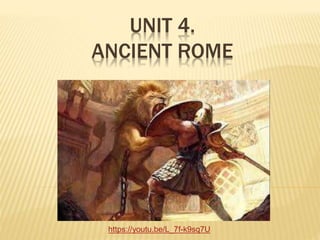
ANCIENT ROME
https://youtu.be/L_7f-k9sq7U
THE ORIGINS OF ROME
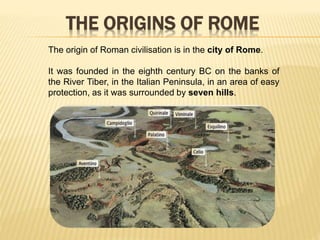
The origin of Roman civilisation is in the city of Rome.
It was founded in the eighth century BC on the banks of
the River Tiber, in the Italian Peninsula, in an area of easy
protection, as it was surrounded by seven hills.
The territory in which it settled was
called Latium, which was inhabited
by the Latins.
Before its foundation, the Italian
Peninsula was populated by Latins
(in the centre), the Greeks (in the
south) and the Etruscans (in the
north).
The Etruscans, in the 6th century BC,
conquered and gained control of
Latium.
THE ORIGINS OF ROME
THE LEGEND OF ROMULUS AND REMUS
 According to legend, Rome was founded in
Palatine Hill by Romulus in 753 BC.
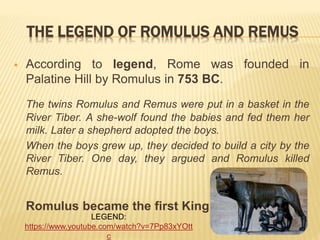
The twins Romulus and Remus were put in a basket in the
River Tiber. A she-wolf found the babies and fed them her
milk. Later a shepherd adopted the boys.
When the boys grew up, they decided to build a city by the
River Tiber. One day, they argued and Romulus killed
Remus.
Romulus became the first King!
LEGEND:
https://www.youtube.com/watch?v=7Pp83xYOtt
c
SYSTEMS OF GOVERNMENT
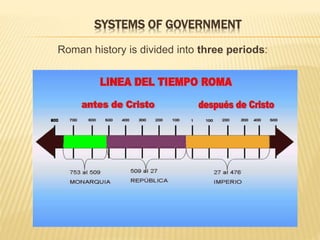
Roman history is divided into three periods:
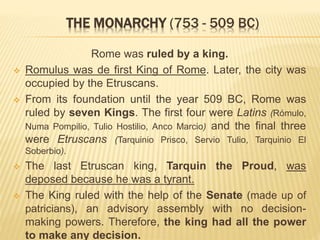
THE MONARCHY (753 - 509 BC)
Rome was ruled by a king.
 Romulus was de first King of Rome. Later, the city was
occupied by the Etruscans.
 From its foundation until the year 509 BC, Rome was
ruled by seven Kings. The first four were Latins (Rómulo,
Numa Pompilio, Tulio Hostilio, Anco Marcio) and the final three
were Etruscans (Tarquinio Prisco, Servio Tulio, Tarquinio El
Soberbio).
 The last Etruscan king, Tarquin the Proud, was
deposed because he was a tyrant.
 The King ruled with the help of the Senate (made up of
patricians), an advisory assembly with no decision-
making powers. Therefore, the king had all the power
to make any decision.
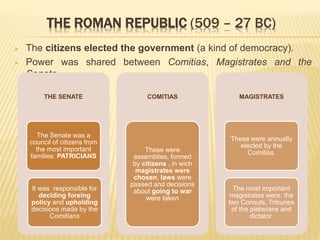
 The citizens elected the government (a kind of democracy).
 Power was shared between Comitias, Magistrates and the
Senate.
THE SENATE
The Senate was a
council of citizens from
the most important
families: PATRICIANS
It was responsible for
deciding foreing
policy and upholding
decisions made by the
Comitians
COMITIAS
These were
assemblies, formed
by citizens , in wich
magistrates were
chosen, laws were
passed and decisions
about going to war
were taken
MAGISTRATES
These were annually
elected by the
Comitias.
The most important
magistrates were: the
two Consuls, Tribunes
of the plebeians and
dictator.
THE ROMAN REPUBLIC (509 – 27 BC)
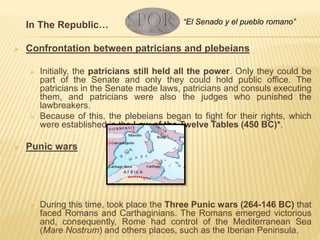
In The Republic…
 Confrontation between patricians and plebeians
 Initially, the patricians still held all the power. Only they could be
part of the Senate and only they could hold public office. The
patricians in the Senate made laws, patricians and consuls executing
them, and patricians were also the judges who punished the
lawbreakers.
 Because of this, the plebeians began to fight for their rights, which
were established in the Law of the Twelve Tables (450 BC)*.
 Punic wars
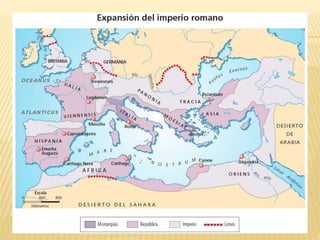
 During this time, took place the Three Punic wars (264-146 BC) that
faced Romans and Carthaginians. The Romans emerged victorious
and, consequently, Rome had control of the Mediterranean Sea
(Mare Nostrum) and others places, such as the Iberian Peninsula.
“El Senado y el pueblo romano”
INVESTIGATION ACTIVITY:
LAW OF THE TWELVE TABLES
 Read the information you have on the
following link:
 http://www.derechoromano.es/2015/06/ley-xii-
tablas.html
 Write a short description about Law of the
Twelve Tables and three of the laws these
tables contained.
THE REPUBLIC ENDED…
 …When some magistrates and generals (with
so much power), took control of the government
of Rome, formed Triumvirates:
 First triumvirate: Julius Caesar, Pompey and
Crassus.
 In 48 BC, Caesar was proclaimed perpetual dictator, with
all the power. However, The senators were afraid that
Caesar wanted to be king, so they murdered him in 44 BC.
 Second triumvirate: Marco Antonio, Lepidus and
Octavian.
 Octavian took all the power and the Senate gave him all
the maximum power (27 BC).
THE ROMAN EMPIRE (27 BC – 476 AD)
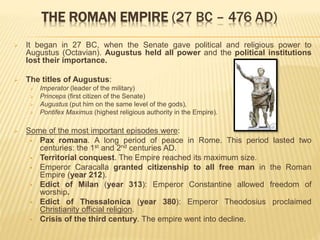
 It began in 27 BC, when the Senate gave political and religious power to
Augustus (Octavian). Augustus held all power and the political institutions
lost their importance.
 The titles of Augustus:
 Imperator (leader of the military)
 Princeps (first citizen of the Senate)
 Augustus (put him on the same level of the gods),
 Pontifex Maximus (highest religious authority in the Empire).
 Some of the most important episodes were:
 Pax romana. A long period of peace in Rome. This period lasted two
centuries: the 1st and 2nd centuries AD.
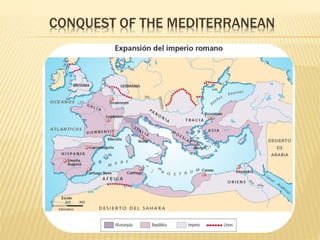
 Territorial conquest. The Empire reached its maximum size.
 Emperor Caracalla granted citizenship to all free man in the Roman
Empire (year 212).
 Edict of Milan (year 313): Emperor Constantine allowed freedom of
worship.
 Edict of Thessalonica (year 380): Emperor Theodosius proclaimed
Christianity official religion.
 Crisis of the third century. The empire went into decline.
CONQUEST OF THE MEDITERRANEAN
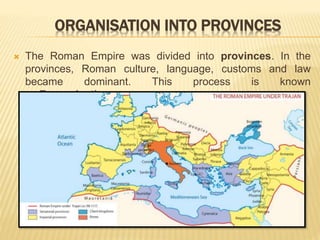
ORGANISATION INTO PROVINCES
 The Roman Empire was divided into provinces. In the
provinces, Roman culture, language, customs and law
became dominant. This process is known
as Romanisation.
CRISIS AND FALL OF THE EMPIRE
Starting in the 3rd century. WHY?
 Political instability: increased military power, attack of the
barbarians, political corruption…
 Economic instability: shortage of slaves, drop in production, trade
weakened…
 Social instability: social unrest.
 Division of the Empire by Theodosius (395 BC). Emperor
Theodosius divided the Empire into two parts:
1. The Western Roman
Empire, with Rome as
capital.
2. The Eastern Roman Empire,
with its capital in
Constantinople
 In 476 AD , the Germanic people (Odoacer)
deposed the last Emperor (Romulus
Augustus) of the Western Roman Empire.
 It was the ended of the Roman Empire.
 AND ALSO THE END OF ANCIENT
HISTORY!!!!!! AND THE START OF THE
MIDDLE AGES!!!!
FALL OF THE EMPIRE
ANCIENT ROME: https://www.youtube.com/watch?v=L_7f-k9sq7U
THE END
THANKS YOU FOR YOUR
ATTENTION

Unit 4. Ancient Rome

  • 1.
  • 2.
    THE ORIGINS OFROME The origin of Roman civilisation is in the city of Rome. It was founded in the eighth century BC on the banks of the River Tiber, in the Italian Peninsula, in an area of easy protection, as it was surrounded by seven hills.
  • 3.
    The territory inwhich it settled was called Latium, which was inhabited by the Latins. Before its foundation, the Italian Peninsula was populated by Latins (in the centre), the Greeks (in the south) and the Etruscans (in the north). The Etruscans, in the 6th century BC, conquered and gained control of Latium. THE ORIGINS OF ROME
  • 4.
    THE LEGEND OFROMULUS AND REMUS  According to legend, Rome was founded in Palatine Hill by Romulus in 753 BC. The twins Romulus and Remus were put in a basket in the River Tiber. A she-wolf found the babies and fed them her milk. Later a shepherd adopted the boys. When the boys grew up, they decided to build a city by the River Tiber. One day, they argued and Romulus killed Remus. Romulus became the first King! LEGEND: https://www.youtube.com/watch?v=7Pp83xYOtt c
  • 5.
    SYSTEMS OF GOVERNMENT Romanhistory is divided into three periods:
  • 6.
    THE MONARCHY (753- 509 BC) Rome was ruled by a king.  Romulus was de first King of Rome. Later, the city was occupied by the Etruscans.  From its foundation until the year 509 BC, Rome was ruled by seven Kings. The first four were Latins (Rómulo, Numa Pompilio, Tulio Hostilio, Anco Marcio) and the final three were Etruscans (Tarquinio Prisco, Servio Tulio, Tarquinio El Soberbio).  The last Etruscan king, Tarquin the Proud, was deposed because he was a tyrant.  The King ruled with the help of the Senate (made up of patricians), an advisory assembly with no decision- making powers. Therefore, the king had all the power to make any decision.
  • 7.
     The citizenselected the government (a kind of democracy).  Power was shared between Comitias, Magistrates and the Senate. THE SENATE The Senate was a council of citizens from the most important families: PATRICIANS It was responsible for deciding foreing policy and upholding decisions made by the Comitians COMITIAS These were assemblies, formed by citizens , in wich magistrates were chosen, laws were passed and decisions about going to war were taken MAGISTRATES These were annually elected by the Comitias. The most important magistrates were: the two Consuls, Tribunes of the plebeians and dictator. THE ROMAN REPUBLIC (509 – 27 BC)
  • 8.
    In The Republic… Confrontation between patricians and plebeians  Initially, the patricians still held all the power. Only they could be part of the Senate and only they could hold public office. The patricians in the Senate made laws, patricians and consuls executing them, and patricians were also the judges who punished the lawbreakers.  Because of this, the plebeians began to fight for their rights, which were established in the Law of the Twelve Tables (450 BC)*.  Punic wars  During this time, took place the Three Punic wars (264-146 BC) that faced Romans and Carthaginians. The Romans emerged victorious and, consequently, Rome had control of the Mediterranean Sea (Mare Nostrum) and others places, such as the Iberian Peninsula. “El Senado y el pueblo romano”
  • 9.
    INVESTIGATION ACTIVITY: LAW OFTHE TWELVE TABLES  Read the information you have on the following link:  http://www.derechoromano.es/2015/06/ley-xii- tablas.html  Write a short description about Law of the Twelve Tables and three of the laws these tables contained.
  • 10.
    THE REPUBLIC ENDED… …When some magistrates and generals (with so much power), took control of the government of Rome, formed Triumvirates:  First triumvirate: Julius Caesar, Pompey and Crassus.  In 48 BC, Caesar was proclaimed perpetual dictator, with all the power. However, The senators were afraid that Caesar wanted to be king, so they murdered him in 44 BC.  Second triumvirate: Marco Antonio, Lepidus and Octavian.  Octavian took all the power and the Senate gave him all the maximum power (27 BC).
  • 12.
    THE ROMAN EMPIRE(27 BC – 476 AD)  It began in 27 BC, when the Senate gave political and religious power to Augustus (Octavian). Augustus held all power and the political institutions lost their importance.  The titles of Augustus:  Imperator (leader of the military)  Princeps (first citizen of the Senate)  Augustus (put him on the same level of the gods),  Pontifex Maximus (highest religious authority in the Empire).  Some of the most important episodes were:  Pax romana. A long period of peace in Rome. This period lasted two centuries: the 1st and 2nd centuries AD.  Territorial conquest. The Empire reached its maximum size.  Emperor Caracalla granted citizenship to all free man in the Roman Empire (year 212).  Edict of Milan (year 313): Emperor Constantine allowed freedom of worship.  Edict of Thessalonica (year 380): Emperor Theodosius proclaimed Christianity official religion.  Crisis of the third century. The empire went into decline.
  • 13.
    CONQUEST OF THEMEDITERRANEAN
  • 14.
    ORGANISATION INTO PROVINCES The Roman Empire was divided into provinces. In the provinces, Roman culture, language, customs and law became dominant. This process is known as Romanisation.
  • 15.
    CRISIS AND FALLOF THE EMPIRE Starting in the 3rd century. WHY?  Political instability: increased military power, attack of the barbarians, political corruption…  Economic instability: shortage of slaves, drop in production, trade weakened…  Social instability: social unrest.  Division of the Empire by Theodosius (395 BC). Emperor Theodosius divided the Empire into two parts: 1. The Western Roman Empire, with Rome as capital. 2. The Eastern Roman Empire, with its capital in Constantinople
  • 16.
     In 476AD , the Germanic people (Odoacer) deposed the last Emperor (Romulus Augustus) of the Western Roman Empire.  It was the ended of the Roman Empire.  AND ALSO THE END OF ANCIENT HISTORY!!!!!! AND THE START OF THE MIDDLE AGES!!!! FALL OF THE EMPIRE ANCIENT ROME: https://www.youtube.com/watch?v=L_7f-k9sq7U
  • 17.
    THE END THANKS YOUFOR YOUR ATTENTION