

Concept of Social Processes
Ashok Pandey
Faculty member, PU
17/30/2019 Ashok Pandey
Concept of Social Processes
• Meaning, definition, characteristics, agent/agencies and stage of socialization.
• Meaning, definition, characteristics, factors favoring assimilation
• Introduction and characteristics of social conflict
• Introduction, definition, characteristics, types and basic function of social institution like
marriage, family, kinship system
• Religious, political economical and social institutions and their contribution on health
development
• Social change and cultural change
o Introduction, definition, characteristics of social change and cultural change
o Factors of socio-cultural change
o Process or mechanism of socio-cultural change
o Consequences of social and cultural change
27/30/2019 Ashok Pandey
Socialization
Definition:
‘Complex process of interaction through which the
individual learns the habits, beliefs, skills and standards of
judgment that are necessary for his effective participation in
social groups and communities’ – Lundberg
‘The process of educating the individual into the social and
cultural world, making him a particular member in society
and its various groups by inducting him a particular member
in society and its various groups by inducting him to accept
the norms and values of the society.’- Kimball Young
37/30/2019 Ashok Pandey
Aims of socialization
•To become social and cultural being
•To maintain social order by following social norms,
standards
•To lead qualitative, meaningful life
•To learn and fulfill social roles
•For existence of specified pattern of behaviour
•To shape total personality of the individual
47/30/2019 Ashok Pandey
Characteristics of socialization
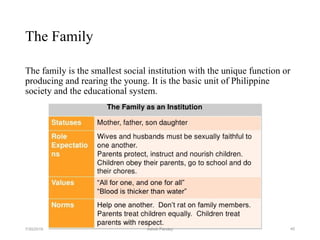
•Continuous process
•Tool for transmission of culture
•Learning process
•Establishes limits on the individual through social
interaction
57/30/2019 Ashok Pandey
Methods of socialization
• Guidance
• Teaching
• Imitation
• Use of visual aids
• Atmosphere
• Practices
• Others
67/30/2019 Ashok Pandey
Importance
• Socialization prepares the child to lead approved way of social life,
at the same time the individuality also develops.
• Through socialization, the individual learns the values, ideas, aims,
objectives of life and the means of attaining them.
• Socialization makes the individual to become socially disciplined
and helps him to live according to the social expectations.
• It reduces the social distance between different caste, class, religion
and disorganization.
• It brings people together, guides them the ways to solve social
problems.
• It also transmits the culture from one generation to another
generation.
• Thus socialization is a social learning.
77/30/2019 Ashok Pandey
Agents of Socialization
• Our society relies on four major agents of socialization
Family
School
Peers
Media
87/30/2019 Ashok Pandey
Family
•The family is the earliest agent of socialization.
•It grabs the child at birth, when the child is most
helpless and dependent, and doesn't let go for a
whole lifetime.
•The things makes socialization in the family so
important and influential are:
• Foundation for all civilized behavior
• Language abilities (learning to talk)
• Body control (e.g., toilet training)
• Emotional control (e.g., "don't hit your sister")
• Rules of public conduct (e.g., "don't throw food")
97/30/2019 Ashok Pandey
• Lifetime impacts affecting the person's self-esteem, emotional
health, identity, and personality.
• Origin point of gender roles (masculine and feminine
behavior; fundamental division of the social world into men
and women).
• The power of the family is strongest during infancy and
toddler years.
• After that the media, then peers, and finally school
challenges its exclusive access to the child.
• By later childhood the family's power as a socialization
agent has weakened considerably.
• In the adolescent years that power is further weakened by
peer group influences and the predominance of the media in
teenage stage.
• Overall there has been an historical trend of the family's
power as an agent of socialization being steadily eroded by
the media, peer groups and schooling.
107/30/2019 Ashok Pandey
School
Socialization takes three forms in school
a.Official curriculum
b.Social curriculum
c.Hidden curriculum
117/30/2019 Ashok Pandey
Peer Groups
• Peers are people of roughly the same age (same stage of
development and maturity), similar social identity, and close social
proximity.
• Typically, children encounter peer group influence around age three
or so.
• Usually these are neighbors and family members.
• With peers, the child begins to broaden his or her circle of influence
to people outside of the immediate family.
127/30/2019 Ashok Pandey
Mass Media
It includes:
• Television
• Radio
• Movies
• Music
• Books, magazines, etc.
• Internet
137/30/2019 Ashok Pandey
Sigmund Freud and His Concept of the Human
Mind
•Sigmund Freud was an Austrian Psychiatrist and the
founder of Psychoanalysis. Much of the works of Freud
centre around the ‘Human Mind’ rather than the process
of socialisation.
•Though Freud has not established any theory concerning
socialisation as such his ideas have contributed much
towards the clarification of that process. This can be
ascertained by an understanding of his analysis of the
human mind.
147/30/2019 Ashok Pandey
Freud has divided human mind into three compartments.
ID
Id is present in the deepest level of the unconscious ,
Id is completely selfish, concerned with immediate gratification of
instinctual needs, the biological drives, like hunger, sex.
Ego
Ego is functionally the executive of personality.
The Ego acts as a mediator or balancer between the demands of id
and superego.
Ego is based on the Reality Principal.
Superego
Superego is developed over a period of time. Superego is the
internalized representative of values and morals of society as taught
to the child by the parents and other such as teachers.
157/30/2019 Ashok Pandey
Stages of socialization
• Socialization is a gradual continuous process of social
learning, where the newborn child throughout life processes
acquiring the social values, standards, norms to lead
productive social life.
• It proceeds from simplicity to complexity.
167/30/2019 Ashok Pandey
•The various stages of socialization are as
follows:
Oral stage ( birth to one year)
Anal stage (ages one to three)
The Oedipal stage (ages 4 -12)
The adolescence stage (13 – 19 years)
Young adulthood (ages 19 – 29 )
The early middle years (ages 30 – 49)
The late middle years (ages 50 – 65)
The older years (about age 65 on)
177/30/2019 Ashok Pandey
Oral stage ( birth to one year)
•At first the infant faces crisis, he must breath, he
must exert himself to be fed, and face other
discomforts, so he cries a good deal.
•The essential goal of the first stage of socialization
is to establish oral dependency. In this stage, the
infant is not involved in the family as a whole.
•In this stage the child can’t distinguish between his
own role and that of the mother.
•Some control over hunger drive has been established
and the infant is sensitized to the diffusely erotic
pleasure of bodily contact with mother.
187/30/2019 Ashok Pandey
Anal stage (ages one to three)
• It is the 2nd
stage.
• It normally starts after the completion of oral stage i.e. after
completion of one year up to the third year.
• Here, ‘toilet training’ , keeping the cloths clean and also learns that
he is getting care and love and hence, he learns to return the sense
of love.
• Therefore, in this stage also, the role of the child taker, i.e. the
mother’s role is very crucial and vital.
• In this stage, the child is enabled to discriminate between correct
and incorrect, first by teaching how to behave, what to do etc. and
secondly by rewarding for correct deeds and punishing for
incorrect tasks.
197/30/2019 Ashok Pandey
The Oedipal stage (ages 4 -12)
•This is the 3rd
stage.
•This starts usually from the fourth year up to the
puberty i.e. up to the age of 12 or 13 years. It is in this
stage that the child becomes the member of the family
as a whole.
•According to Sigmund Freud, at this stage the boy
develops the ‘Oedipus complex’ i.e. the feeling of
jealousy towards father and love towards mother.
•Similarly, the girl develops the ‘Electra complex’ i.e.
the feeling of jealousy towards the mother and love
towards the father.
•According to Freud, the feelings are mainly sexual.
207/30/2019 Ashok Pandey
The adolescence stage (13 – 19 years)
• Adolescent stage is the fourth stage starting with the period
of adolescence.
• Due to the physiological and the psychological changes that
take place within the individual, this stage has great
importance.
• There is seen various conflict or strain between parents and
their adolescent children. Especially sexual thought, desire,
activity and curiosity leads to the various ways for offspring
and makes difficult for parents to control them.
• During this period, the boys and girls try to become out of
control or free but they can’t be totally far from their parents
because of their dependency to them.
217/30/2019 Ashok Pandey
Young adulthood (ages 19 – 29 )
• Somewhere during this period of extended youth, young adults
gradually ease into adult responsibilities.
• They finish school, take a full-time job, engage in courtship, get
married and go into debt.
227/30/2019 Ashok Pandey
The early middle years (ages 30 – 49)
•During the early middle years, most people are much
surer of themselves and of their goals in life.
•As with any point in the life course, however, the self
can receive serve jolts (to give somebody a sudden
shock, especially so that they start to take action or deal
with a situation) – in this case from such circumstances
as divorce or being fired.
•People are very active during this period, and they go
for settled life.
237/30/2019 Ashok Pandey
The later middle years (ages 50 – 65)
•During this period people attempt to evaluate the part and
come to terms with what lies ahead.
•They compare what they have accomplished with how far
they had hoped to go.
•Life during this stage isn’t always stressful. Many people
find late middle age to be the most comfortable period of
their lives.
•They enjoy job security and a standard of living higher
than even before; they have a bigger house, newer cars etc.
247/30/2019 Ashok Pandey
The older years (about age 65 on)
• For those in good health, being over 65 is often experienced as
old age but as an extension of the middle years.
• So there is no precise beginning point to this last stage. For
some, the 75th
birthday may mask entry into this period of life.
• People who continue to work or to be active in other rewarding
social activities are unlikely to see themselves as old.
• But for most, this stage is marked by growing frailty (weakness
and poor health) and illness, for all who reach this stage by
death. For some, the physical decline is slow, and may make a
century of their life-time span.
257/30/2019 Ashok Pandey
Meaning, definition, characteristics, factors
favoring assimilation
267/30/2019 Ashok Pandey
Meaning
Assimilation is the process whereby persons and
groups acquire the culture of other group in which
they come to live, by adopting its attitudes and
values, its patterns of thinking and behaving-in short,
its way of life.
277/30/2019 Ashok Pandey
Definition
Assimilation is a process of interpenetration and fusion in
which persons and groups acquire the memories, sentiments,
attitudes of other persons or groups and by sharing their
experiences and history are incorporated with them in a
cultural life. -Park and Burgess
Assimilation is a process whereby altitudes of many persons
are united, and thus develop into a united group -Bogarclus
Assimilation is the “social process whereby individuals or
groups come to share the same sentiments and goals.” –
Biesaru
“Assimilation is the process whereby individuals or groups
once dissimilar become similar, and identified in their interest
and outlook.” -Nimkoft
287/30/2019 Ashok Pandey
Types of Assimilation
1. In broad sense migration of refugees from one
country to another or people from rural to urban
areas is included in the category of assimilation in
its broadest sense.
2. In local sense, assimilation is that which takes
place within the family or group like new married
couple adopts the some culture and assimilate one
another.
297/30/2019 Ashok Pandey
Characteristics
Assimilation is not confined to single field only
fusion of two distinct cultural groups.
Assimilation is a slow and gradual process
Fusion of personalities and groups
Assimilation is an unconscious process
unconscious manner individuals and groups discard their original
cultural heritage and substitute it with the new one.
Assimilation is a two-way process
Assimilation involves the principle of give and take. It is
normally preceded by another process called ‘acculturation’
307/30/2019 Ashok Pandey
Factors favoring assimilation
(1) Toleration
(2) Intimate social relationships
(3) Amalgamation or intermarriage
(4) Cultural similarity
(5) Education
(6) Equal social and economic opportunity
317/30/2019 Ashok Pandey
Introduction and characteristics of social
conflict
• Social conflict is always present in social life.
• It is a fundamental feature of human society.
• It does not occur because people are unreasonable or
uncooperative or because they are unwilling to live properly
and decently with others.
327/30/2019 Ashok Pandey
Park and Burgess (1921), likewise, treat conflict as a distinct
form of competition. They wrote: ‘Both are forms of
interaction but competition is a struggle between individuals
or groups of individuals who are not necessarily in contact and
communication while conflict is a contest in which contact is
an indispensable condition.’
According to Max Weber (1968), ‘a social relationship will be
referred to as conflict in so far as action within it is oriented
intentional to carrying out the actor’s own will against the
resistance of the other party or parties’. Thus, the social
interaction of conflict is defined by the desire of each
participant to impose his will upon the other’s resistance.
337/30/2019 Ashok Pandey
This response can be in the form of:
(1) fight,
(2) flee,
(3) simply freeze, or
(4) turning sideways into the conflict.
347/30/2019 Ashok Pandey
Characteristics:
1. It is a universal process found in every society.
2. It is the result of deliberate and conscious efforts of
individuals or the groups.
3. The nature of the conflict is personal and direct. In conflict
the incumbents or participants know each other personally.
4. It is basically an individual’s process. Its aim is not directly
connected with the achievement of the goal or an objective but
is rather directed to dominate others or to eliminate the
opponent.
5. Conflict is of brief duration, temporary and intermittent in
character. But, once begun, the conflict process is hard to stop.
It tends to grow more and more bitter as it proceeds. Being
temporary, it gives way to some form of accommodation.
357/30/2019 Ashok Pandey
6. It is a process loaded with impulsiveness of human emotions and
violent passions. It gains force and then bursts open. Unlike fighting of
animals, generally in human groups, the spontaneous fighting is
inhibited. It is often avoided through the process of accommodation
and assimilation.
7. It may be latent or overt. In the latent form, it may exist in the form
of tension, dissatisfaction, contravention and rivalry. It becomes overt
when an issue is declared and a hostile action is taken.
8. It is mostly violent but it may take the form of negotiations, party
politics, disputes or rivalry.
9. It is cumulative; each act of aggression usually promotes a more
aggressive rebuttal. Thus, termination of conflict is not easy.
10. It tends to be more intense when individuals and groups who have
close relationships with one another are involved.
11. Groups previously in conflict may co-operate to achieve a goal
considered important enough for them to unite despite their differences.
367/30/2019 Ashok Pandey
Social institution
• Introduction, definition, characteristics, types and basic function of social
institution like marriage, family, kinship system
• Religious, political economical and social institutions and their
contribution on health development
• A social institution consists of a group of people who have come together
for a common purpose. These institutions are a part of the social order of
society and they govern behavior and expectations of individuals.
• Is a group of social positions, connected by social relations, performing a
social role.
• Any institution in a society that works to socialize the group of people in
it.
377/30/2019 Ashok Pandey
Characteristics of an Institution
• Institutions are purposive.
• Relatively permanent in content.
• Institutions are structured.
• Institutions are a unified structure.
• Institutions are necessarily value-laden.
387/30/2019 Ashok Pandey
Major Social Institutions
•The Family
•Education
•Religion
•Economic Institutions
•Political
•Government as a Social Institution
397/30/2019 Ashok Pandey
The Family
The family is the smallest social institution with the unique function or
producing and rearing the young. It is the basic unit of Philippine
society and the educational system.
407/30/2019 Ashok Pandey
Functions of the Family
• Reproduction of the race and rearing the young
• Cultural transmission or enculturation
• Socialization of the child
• Providing affection and a sense of security
• Providing the environment for personality development and the
growth of self concept
• Providing social status
417/30/2019 Ashok Pandey
Kinds of Family
According to structure
a. Conjugal or Nuclear Family- the primary or
elementary family consisting of husband, wife and
children.
b. Consanguine or Extended Family- consist of
married couple, their parents, siblings, grandparents,
uncles, aunt s, and cousins.
427/30/2019 Ashok Pandey
According to term of marriage
Polyandry -one woman is married to two or more men at the
same time.
Polygamy -one man is married to two or more women at the
same time.
Cenogamy - two or more men mate with two or more women
in group marriage.
437/30/2019 Ashok Pandey
According to descent
Patrilocal- when the newly married couple lives with the
parents of the husband.
Matrilocal- when the newly married couple lives with the
parents of the wife.
Neolocal - when the newly married pair maintains a separate
household and live by themselves.
447/30/2019 Ashok Pandey
According to authority
Partriarchal - when the father is considered the head and
plays a dominant role.
Matriarchal - when the mother or female is the head and
makes the major decisions.
Equalitarian - when both father and mother share in making
decisions and are equal in authority.
457/30/2019 Ashok Pandey
Religious institutions and their
contribution on health development
• is a system of beliefs and rituals that serves to bind people
together through shared worship, thereby creating a social
group.
• set of beliefs and practices that pertain to a sacred or
supernatural realm that guides human behavior and gives
meaning to life among a community of believers.
467/30/2019 Ashok Pandey
Groups of people that have similar beliefs in
the existence of God or gods.
• Hindu organizations
• Bible Societies
• Buddhist organizations
• Churches
• Church of All Worlds
• Jewish organizations
• Mission organizations
• Monasteries
• Mosques
• World Pantheist Movement
477/30/2019 Ashok Pandey
Functions of Religion
1. Serves as a means of social control.
2. Exerts a great influence upon personality development.
3. Allays fear of unknown.
4. Explains events or situations which are beyond comprehension of
man.
5. Gives man comfort, strength and hope in times of crisis and despair.
6. It preserves and transmit knowledge, skills, spiritual, and cultural
values and practices.
7. It serves as an instrument of change.
8. Promotes closeness, love, cooperation, friendliness and helpfulness.
9. Alleviates sufferings from major calamities.
10. It provides hope for a blissful life
487/30/2019 Ashok Pandey
Political institutions
These social institutions influence the process of government, such as
political parties. Examples are:
•Authoritarianism
•Conservative
•Democracy
•Democratic Party
•Independent Party
•Libertarian Party
•Liberal
•Lobbyists
•Monarchy
•Republican Party
497/30/2019 Ashok Pandey
Economical
Microeconomics
•Concerned with the specific economic units of parts that makes an
economic system and the relationship between those parts.
•Emphasis is placed on understanding the behavior of individual firms,
industries, households, and ways in which such entities interact.
(Spencer, 1980; Javier,2002)
Macroeconomics
Concerned with the economy as a whole, or large segments of it.
It focuses on such problems as the role of unemployment, the changing
level of prices, the nation’s total output of goods and services, and the
ways in which government raises and spends money.
507/30/2019 Ashok Pandey
Social change and cultural change
o Introduction, definition, characteristics of social
change and cultural change
o Factors of socio-cultural change
o Process or mechanism of socio-cultural change
o Consequences of social and cultural change
517/30/2019 Ashok Pandey
Social change
• Social change means that large number of persons is engaging
in activities that differ from those which they or their
immediate forefathers engaged in same time before.
• Society is composed of a vast and complex network of
patterned human relationships in which all men participate.
527/30/2019 Ashok Pandey
Definitions:
•Social change is a term used to describe variation or
modification of any aspect of social processes, social
pattern, social interactions or social organizations.- Jones
•M. P. Jenson states “Social change may be defined as
modification in ways of doing and thinking of people”.
•According to Gillin and Gillin, “Social changes are
variation from the accepted modes of life, whether due to
alteration in geographical conditions and whether
brought about by diffusion or inventions within the
group.”
537/30/2019 Ashok Pandey
Characteristics or nature of social change
•Social change is community change
•Social change is universal phenomena
•Prediction of social change is not possible
•Social change is continuous
•Social change shows chain reaction sequence
•Social change is a complex phenomena
•Social change is both planned and unplanned or spontaneous
•Social change is the results from the interaction of a number of factors
•Speed of social change is not uniform
547/30/2019 Ashok Pandey
Cultural change
Cultural change is modification or variation in totality of
pattern of behaviour, beliefs, norms, values etc. cultural change
is the change of perceiving learning and experiences.
557/30/2019 Ashok Pandey
Characteristics of cultural change
Regular process
Mainly cultural change is affected by diffusion, adaptation,
developmental activities and acculturation(when the whole system
of life in a culture begins to change under the influence of any
other culture, it is the process of acculturation ).
Change in fooding and dressing
Language is chief vehicle of culture
Culture is transmitted
567/30/2019 Ashok Pandey
Causes of social/cultural change
Conflict
 No society is free from conflicts. Any attempts to resolve the conflict would lead to some kind of change or the
other.
Social problems
 Problems such as unemployment, poverty etc. involve a good deal of social conflict, in the course of which
social change occurs.
 If they are to be solved or reduced, the existing social order will have to be changed to some extent.
•Some other causes are:
 discovery,
 westernization,
 industrialization,
 acculturation,
 urbanization.
577/30/2019 Ashok Pandey
Kinds of socio-cultural change
•Social change means change in social structure,
changes in social value, institutional change,
changes in the distribution of possessions and
rewards, changes in personnel, changes in the
abilities or attitudes of personal and other changes.
587/30/2019 Ashok Pandey
Process or mechanism of socio-cultural
change
Diffusion:
Diffusion is the movement of things and ideas from one culture to
another.
When diffusion occurs, the form of a trait may move from one society
to another but not its original cultural meaning.
For instance, when McDonald's first brought their American style
hamburgers to Moscow and Beijing, they were accepted as luxury
foods for special occasions because they were relatively expensive and
exotic.
In America, of course, they have a very different meaning--they are
ordinary every day fast food items.
597/30/2019 Ashok Pandey
Acculturation:
Acculturation is what happens to an entire culture when alien traits
diffuse in on a large scale and substantially replace traditional cultural
patterns.
After several centuries of relentless pressure from European Americans
to adopt their ways, Native American cultures have been largely
acculturated. As a result, the vast majority of American Indians now
speak English instead of their ancestral language, wear European style
clothes, go to school to learn about the world from a European
perspective, and see themselves as being a part of the broader
American society.
As Native American societies continue to acculturate, most are
experiencing a corresponding loss of their traditional cultures despite
efforts of preservationists in their communities.
607/30/2019 Ashok Pandey
Transculturation:
Transculturation is what happens to an individual when he or she
moves to another society and adopts its culture.
Immigrants who successfully learn the language and accept as their
own the cultural patterns of their adopted country have transculturated.
In contrast, people who live as socially isolated expatriates in a foreign
land for years without desiring or expecting to become assimilated
click this icon to hear the preceding term pronounced participants in the
host culture are not transculturating.
617/30/2019 Ashok Pandey
Consequences of social and cultural change
Definition: A social problem is any deviant behaviour in a
disapproved direction of such a degree that it exceeds the
tolerance limit of the community.”-Lundberg
•Every social problem implies three things.
Something should be done to change the situation
The existing social order has to be changed to solve the
problem
The situation regarded a problem is undesirable but is not
inevitable.
627/30/2019 Ashok Pandey
Classification of social problem
Economic problems- poverty, unemployment.
Biological problems- physical diseases and defects.
Psychological problems- suicide, alcoholism etc.
Cultural problems- divorce, crime, juvenile delinquency,
homeless and widow etc.
637/30/2019 Ashok Pandey
647/30/2019 Ashok Pandey

Unit 3 concept of social processes

  • 1.
    Concept of SocialProcesses Ashok Pandey Faculty member, PU 17/30/2019 Ashok Pandey
  • 2.
    Concept of SocialProcesses • Meaning, definition, characteristics, agent/agencies and stage of socialization. • Meaning, definition, characteristics, factors favoring assimilation • Introduction and characteristics of social conflict • Introduction, definition, characteristics, types and basic function of social institution like marriage, family, kinship system • Religious, political economical and social institutions and their contribution on health development • Social change and cultural change o Introduction, definition, characteristics of social change and cultural change o Factors of socio-cultural change o Process or mechanism of socio-cultural change o Consequences of social and cultural change 27/30/2019 Ashok Pandey
  • 3.
    Socialization Definition: ‘Complex process ofinteraction through which the individual learns the habits, beliefs, skills and standards of judgment that are necessary for his effective participation in social groups and communities’ – Lundberg ‘The process of educating the individual into the social and cultural world, making him a particular member in society and its various groups by inducting him a particular member in society and its various groups by inducting him to accept the norms and values of the society.’- Kimball Young 37/30/2019 Ashok Pandey
  • 4.
    Aims of socialization •Tobecome social and cultural being •To maintain social order by following social norms, standards •To lead qualitative, meaningful life •To learn and fulfill social roles •For existence of specified pattern of behaviour •To shape total personality of the individual 47/30/2019 Ashok Pandey
  • 5.
    Characteristics of socialization •Continuousprocess •Tool for transmission of culture •Learning process •Establishes limits on the individual through social interaction 57/30/2019 Ashok Pandey
  • 6.
    Methods of socialization •Guidance • Teaching • Imitation • Use of visual aids • Atmosphere • Practices • Others 67/30/2019 Ashok Pandey
  • 7.
    Importance • Socialization preparesthe child to lead approved way of social life, at the same time the individuality also develops. • Through socialization, the individual learns the values, ideas, aims, objectives of life and the means of attaining them. • Socialization makes the individual to become socially disciplined and helps him to live according to the social expectations. • It reduces the social distance between different caste, class, religion and disorganization. • It brings people together, guides them the ways to solve social problems. • It also transmits the culture from one generation to another generation. • Thus socialization is a social learning. 77/30/2019 Ashok Pandey
  • 8.
    Agents of Socialization •Our society relies on four major agents of socialization Family School Peers Media 87/30/2019 Ashok Pandey
  • 9.
    Family •The family isthe earliest agent of socialization. •It grabs the child at birth, when the child is most helpless and dependent, and doesn't let go for a whole lifetime. •The things makes socialization in the family so important and influential are: • Foundation for all civilized behavior • Language abilities (learning to talk) • Body control (e.g., toilet training) • Emotional control (e.g., "don't hit your sister") • Rules of public conduct (e.g., "don't throw food") 97/30/2019 Ashok Pandey
  • 10.
    • Lifetime impactsaffecting the person's self-esteem, emotional health, identity, and personality. • Origin point of gender roles (masculine and feminine behavior; fundamental division of the social world into men and women). • The power of the family is strongest during infancy and toddler years. • After that the media, then peers, and finally school challenges its exclusive access to the child. • By later childhood the family's power as a socialization agent has weakened considerably. • In the adolescent years that power is further weakened by peer group influences and the predominance of the media in teenage stage. • Overall there has been an historical trend of the family's power as an agent of socialization being steadily eroded by the media, peer groups and schooling. 107/30/2019 Ashok Pandey
  • 11.
    School Socialization takes threeforms in school a.Official curriculum b.Social curriculum c.Hidden curriculum 117/30/2019 Ashok Pandey
  • 12.
    Peer Groups • Peersare people of roughly the same age (same stage of development and maturity), similar social identity, and close social proximity. • Typically, children encounter peer group influence around age three or so. • Usually these are neighbors and family members. • With peers, the child begins to broaden his or her circle of influence to people outside of the immediate family. 127/30/2019 Ashok Pandey
  • 13.
    Mass Media It includes: •Television • Radio • Movies • Music • Books, magazines, etc. • Internet 137/30/2019 Ashok Pandey
  • 14.
    Sigmund Freud andHis Concept of the Human Mind •Sigmund Freud was an Austrian Psychiatrist and the founder of Psychoanalysis. Much of the works of Freud centre around the ‘Human Mind’ rather than the process of socialisation. •Though Freud has not established any theory concerning socialisation as such his ideas have contributed much towards the clarification of that process. This can be ascertained by an understanding of his analysis of the human mind. 147/30/2019 Ashok Pandey
  • 15.
    Freud has dividedhuman mind into three compartments. ID Id is present in the deepest level of the unconscious , Id is completely selfish, concerned with immediate gratification of instinctual needs, the biological drives, like hunger, sex. Ego Ego is functionally the executive of personality. The Ego acts as a mediator or balancer between the demands of id and superego. Ego is based on the Reality Principal. Superego Superego is developed over a period of time. Superego is the internalized representative of values and morals of society as taught to the child by the parents and other such as teachers. 157/30/2019 Ashok Pandey
  • 16.
    Stages of socialization •Socialization is a gradual continuous process of social learning, where the newborn child throughout life processes acquiring the social values, standards, norms to lead productive social life. • It proceeds from simplicity to complexity. 167/30/2019 Ashok Pandey
  • 17.
    •The various stagesof socialization are as follows: Oral stage ( birth to one year) Anal stage (ages one to three) The Oedipal stage (ages 4 -12) The adolescence stage (13 – 19 years) Young adulthood (ages 19 – 29 ) The early middle years (ages 30 – 49) The late middle years (ages 50 – 65) The older years (about age 65 on) 177/30/2019 Ashok Pandey
  • 18.
    Oral stage (birth to one year) •At first the infant faces crisis, he must breath, he must exert himself to be fed, and face other discomforts, so he cries a good deal. •The essential goal of the first stage of socialization is to establish oral dependency. In this stage, the infant is not involved in the family as a whole. •In this stage the child can’t distinguish between his own role and that of the mother. •Some control over hunger drive has been established and the infant is sensitized to the diffusely erotic pleasure of bodily contact with mother. 187/30/2019 Ashok Pandey
  • 19.
    Anal stage (agesone to three) • It is the 2nd stage. • It normally starts after the completion of oral stage i.e. after completion of one year up to the third year. • Here, ‘toilet training’ , keeping the cloths clean and also learns that he is getting care and love and hence, he learns to return the sense of love. • Therefore, in this stage also, the role of the child taker, i.e. the mother’s role is very crucial and vital. • In this stage, the child is enabled to discriminate between correct and incorrect, first by teaching how to behave, what to do etc. and secondly by rewarding for correct deeds and punishing for incorrect tasks. 197/30/2019 Ashok Pandey
  • 20.
    The Oedipal stage(ages 4 -12) •This is the 3rd stage. •This starts usually from the fourth year up to the puberty i.e. up to the age of 12 or 13 years. It is in this stage that the child becomes the member of the family as a whole. •According to Sigmund Freud, at this stage the boy develops the ‘Oedipus complex’ i.e. the feeling of jealousy towards father and love towards mother. •Similarly, the girl develops the ‘Electra complex’ i.e. the feeling of jealousy towards the mother and love towards the father. •According to Freud, the feelings are mainly sexual. 207/30/2019 Ashok Pandey
  • 21.
    The adolescence stage(13 – 19 years) • Adolescent stage is the fourth stage starting with the period of adolescence. • Due to the physiological and the psychological changes that take place within the individual, this stage has great importance. • There is seen various conflict or strain between parents and their adolescent children. Especially sexual thought, desire, activity and curiosity leads to the various ways for offspring and makes difficult for parents to control them. • During this period, the boys and girls try to become out of control or free but they can’t be totally far from their parents because of their dependency to them. 217/30/2019 Ashok Pandey
  • 22.
    Young adulthood (ages19 – 29 ) • Somewhere during this period of extended youth, young adults gradually ease into adult responsibilities. • They finish school, take a full-time job, engage in courtship, get married and go into debt. 227/30/2019 Ashok Pandey
  • 23.
    The early middleyears (ages 30 – 49) •During the early middle years, most people are much surer of themselves and of their goals in life. •As with any point in the life course, however, the self can receive serve jolts (to give somebody a sudden shock, especially so that they start to take action or deal with a situation) – in this case from such circumstances as divorce or being fired. •People are very active during this period, and they go for settled life. 237/30/2019 Ashok Pandey
  • 24.
    The later middleyears (ages 50 – 65) •During this period people attempt to evaluate the part and come to terms with what lies ahead. •They compare what they have accomplished with how far they had hoped to go. •Life during this stage isn’t always stressful. Many people find late middle age to be the most comfortable period of their lives. •They enjoy job security and a standard of living higher than even before; they have a bigger house, newer cars etc. 247/30/2019 Ashok Pandey
  • 25.
    The older years(about age 65 on) • For those in good health, being over 65 is often experienced as old age but as an extension of the middle years. • So there is no precise beginning point to this last stage. For some, the 75th birthday may mask entry into this period of life. • People who continue to work or to be active in other rewarding social activities are unlikely to see themselves as old. • But for most, this stage is marked by growing frailty (weakness and poor health) and illness, for all who reach this stage by death. For some, the physical decline is slow, and may make a century of their life-time span. 257/30/2019 Ashok Pandey
  • 26.
    Meaning, definition, characteristics,factors favoring assimilation 267/30/2019 Ashok Pandey
  • 27.
    Meaning Assimilation is theprocess whereby persons and groups acquire the culture of other group in which they come to live, by adopting its attitudes and values, its patterns of thinking and behaving-in short, its way of life. 277/30/2019 Ashok Pandey
  • 28.
    Definition Assimilation is aprocess of interpenetration and fusion in which persons and groups acquire the memories, sentiments, attitudes of other persons or groups and by sharing their experiences and history are incorporated with them in a cultural life. -Park and Burgess Assimilation is a process whereby altitudes of many persons are united, and thus develop into a united group -Bogarclus Assimilation is the “social process whereby individuals or groups come to share the same sentiments and goals.” – Biesaru “Assimilation is the process whereby individuals or groups once dissimilar become similar, and identified in their interest and outlook.” -Nimkoft 287/30/2019 Ashok Pandey
  • 29.
    Types of Assimilation 1.In broad sense migration of refugees from one country to another or people from rural to urban areas is included in the category of assimilation in its broadest sense. 2. In local sense, assimilation is that which takes place within the family or group like new married couple adopts the some culture and assimilate one another. 297/30/2019 Ashok Pandey
  • 30.
    Characteristics Assimilation is notconfined to single field only fusion of two distinct cultural groups. Assimilation is a slow and gradual process Fusion of personalities and groups Assimilation is an unconscious process unconscious manner individuals and groups discard their original cultural heritage and substitute it with the new one. Assimilation is a two-way process Assimilation involves the principle of give and take. It is normally preceded by another process called ‘acculturation’ 307/30/2019 Ashok Pandey
  • 31.
    Factors favoring assimilation (1)Toleration (2) Intimate social relationships (3) Amalgamation or intermarriage (4) Cultural similarity (5) Education (6) Equal social and economic opportunity 317/30/2019 Ashok Pandey
  • 32.
    Introduction and characteristicsof social conflict • Social conflict is always present in social life. • It is a fundamental feature of human society. • It does not occur because people are unreasonable or uncooperative or because they are unwilling to live properly and decently with others. 327/30/2019 Ashok Pandey
  • 33.
    Park and Burgess(1921), likewise, treat conflict as a distinct form of competition. They wrote: ‘Both are forms of interaction but competition is a struggle between individuals or groups of individuals who are not necessarily in contact and communication while conflict is a contest in which contact is an indispensable condition.’ According to Max Weber (1968), ‘a social relationship will be referred to as conflict in so far as action within it is oriented intentional to carrying out the actor’s own will against the resistance of the other party or parties’. Thus, the social interaction of conflict is defined by the desire of each participant to impose his will upon the other’s resistance. 337/30/2019 Ashok Pandey
  • 34.
    This response canbe in the form of: (1) fight, (2) flee, (3) simply freeze, or (4) turning sideways into the conflict. 347/30/2019 Ashok Pandey
  • 35.
    Characteristics: 1. It isa universal process found in every society. 2. It is the result of deliberate and conscious efforts of individuals or the groups. 3. The nature of the conflict is personal and direct. In conflict the incumbents or participants know each other personally. 4. It is basically an individual’s process. Its aim is not directly connected with the achievement of the goal or an objective but is rather directed to dominate others or to eliminate the opponent. 5. Conflict is of brief duration, temporary and intermittent in character. But, once begun, the conflict process is hard to stop. It tends to grow more and more bitter as it proceeds. Being temporary, it gives way to some form of accommodation. 357/30/2019 Ashok Pandey
  • 36.
    6. It isa process loaded with impulsiveness of human emotions and violent passions. It gains force and then bursts open. Unlike fighting of animals, generally in human groups, the spontaneous fighting is inhibited. It is often avoided through the process of accommodation and assimilation. 7. It may be latent or overt. In the latent form, it may exist in the form of tension, dissatisfaction, contravention and rivalry. It becomes overt when an issue is declared and a hostile action is taken. 8. It is mostly violent but it may take the form of negotiations, party politics, disputes or rivalry. 9. It is cumulative; each act of aggression usually promotes a more aggressive rebuttal. Thus, termination of conflict is not easy. 10. It tends to be more intense when individuals and groups who have close relationships with one another are involved. 11. Groups previously in conflict may co-operate to achieve a goal considered important enough for them to unite despite their differences. 367/30/2019 Ashok Pandey
  • 37.
    Social institution • Introduction,definition, characteristics, types and basic function of social institution like marriage, family, kinship system • Religious, political economical and social institutions and their contribution on health development • A social institution consists of a group of people who have come together for a common purpose. These institutions are a part of the social order of society and they govern behavior and expectations of individuals. • Is a group of social positions, connected by social relations, performing a social role. • Any institution in a society that works to socialize the group of people in it. 377/30/2019 Ashok Pandey
  • 38.
    Characteristics of anInstitution • Institutions are purposive. • Relatively permanent in content. • Institutions are structured. • Institutions are a unified structure. • Institutions are necessarily value-laden. 387/30/2019 Ashok Pandey
  • 39.
    Major Social Institutions •TheFamily •Education •Religion •Economic Institutions •Political •Government as a Social Institution 397/30/2019 Ashok Pandey
  • 40.
    The Family The familyis the smallest social institution with the unique function or producing and rearing the young. It is the basic unit of Philippine society and the educational system. 407/30/2019 Ashok Pandey
  • 41.
    Functions of theFamily • Reproduction of the race and rearing the young • Cultural transmission or enculturation • Socialization of the child • Providing affection and a sense of security • Providing the environment for personality development and the growth of self concept • Providing social status 417/30/2019 Ashok Pandey
  • 42.
    Kinds of Family Accordingto structure a. Conjugal or Nuclear Family- the primary or elementary family consisting of husband, wife and children. b. Consanguine or Extended Family- consist of married couple, their parents, siblings, grandparents, uncles, aunt s, and cousins. 427/30/2019 Ashok Pandey
  • 43.
    According to termof marriage Polyandry -one woman is married to two or more men at the same time. Polygamy -one man is married to two or more women at the same time. Cenogamy - two or more men mate with two or more women in group marriage. 437/30/2019 Ashok Pandey
  • 44.
    According to descent Patrilocal-when the newly married couple lives with the parents of the husband. Matrilocal- when the newly married couple lives with the parents of the wife. Neolocal - when the newly married pair maintains a separate household and live by themselves. 447/30/2019 Ashok Pandey
  • 45.
    According to authority Partriarchal- when the father is considered the head and plays a dominant role. Matriarchal - when the mother or female is the head and makes the major decisions. Equalitarian - when both father and mother share in making decisions and are equal in authority. 457/30/2019 Ashok Pandey
  • 46.
    Religious institutions andtheir contribution on health development • is a system of beliefs and rituals that serves to bind people together through shared worship, thereby creating a social group. • set of beliefs and practices that pertain to a sacred or supernatural realm that guides human behavior and gives meaning to life among a community of believers. 467/30/2019 Ashok Pandey
  • 47.
    Groups of peoplethat have similar beliefs in the existence of God or gods. • Hindu organizations • Bible Societies • Buddhist organizations • Churches • Church of All Worlds • Jewish organizations • Mission organizations • Monasteries • Mosques • World Pantheist Movement 477/30/2019 Ashok Pandey
  • 48.
    Functions of Religion 1.Serves as a means of social control. 2. Exerts a great influence upon personality development. 3. Allays fear of unknown. 4. Explains events or situations which are beyond comprehension of man. 5. Gives man comfort, strength and hope in times of crisis and despair. 6. It preserves and transmit knowledge, skills, spiritual, and cultural values and practices. 7. It serves as an instrument of change. 8. Promotes closeness, love, cooperation, friendliness and helpfulness. 9. Alleviates sufferings from major calamities. 10. It provides hope for a blissful life 487/30/2019 Ashok Pandey
  • 49.
    Political institutions These socialinstitutions influence the process of government, such as political parties. Examples are: •Authoritarianism •Conservative •Democracy •Democratic Party •Independent Party •Libertarian Party •Liberal •Lobbyists •Monarchy •Republican Party 497/30/2019 Ashok Pandey
  • 50.
    Economical Microeconomics •Concerned with thespecific economic units of parts that makes an economic system and the relationship between those parts. •Emphasis is placed on understanding the behavior of individual firms, industries, households, and ways in which such entities interact. (Spencer, 1980; Javier,2002) Macroeconomics Concerned with the economy as a whole, or large segments of it. It focuses on such problems as the role of unemployment, the changing level of prices, the nation’s total output of goods and services, and the ways in which government raises and spends money. 507/30/2019 Ashok Pandey
  • 51.
    Social change andcultural change o Introduction, definition, characteristics of social change and cultural change o Factors of socio-cultural change o Process or mechanism of socio-cultural change o Consequences of social and cultural change 517/30/2019 Ashok Pandey
  • 52.
    Social change • Socialchange means that large number of persons is engaging in activities that differ from those which they or their immediate forefathers engaged in same time before. • Society is composed of a vast and complex network of patterned human relationships in which all men participate. 527/30/2019 Ashok Pandey
  • 53.
    Definitions: •Social change isa term used to describe variation or modification of any aspect of social processes, social pattern, social interactions or social organizations.- Jones •M. P. Jenson states “Social change may be defined as modification in ways of doing and thinking of people”. •According to Gillin and Gillin, “Social changes are variation from the accepted modes of life, whether due to alteration in geographical conditions and whether brought about by diffusion or inventions within the group.” 537/30/2019 Ashok Pandey
  • 54.
    Characteristics or natureof social change •Social change is community change •Social change is universal phenomena •Prediction of social change is not possible •Social change is continuous •Social change shows chain reaction sequence •Social change is a complex phenomena •Social change is both planned and unplanned or spontaneous •Social change is the results from the interaction of a number of factors •Speed of social change is not uniform 547/30/2019 Ashok Pandey
  • 55.
    Cultural change Cultural changeis modification or variation in totality of pattern of behaviour, beliefs, norms, values etc. cultural change is the change of perceiving learning and experiences. 557/30/2019 Ashok Pandey
  • 56.
    Characteristics of culturalchange Regular process Mainly cultural change is affected by diffusion, adaptation, developmental activities and acculturation(when the whole system of life in a culture begins to change under the influence of any other culture, it is the process of acculturation ). Change in fooding and dressing Language is chief vehicle of culture Culture is transmitted 567/30/2019 Ashok Pandey
  • 57.
    Causes of social/culturalchange Conflict  No society is free from conflicts. Any attempts to resolve the conflict would lead to some kind of change or the other. Social problems  Problems such as unemployment, poverty etc. involve a good deal of social conflict, in the course of which social change occurs.  If they are to be solved or reduced, the existing social order will have to be changed to some extent. •Some other causes are:  discovery,  westernization,  industrialization,  acculturation,  urbanization. 577/30/2019 Ashok Pandey
  • 58.
    Kinds of socio-culturalchange •Social change means change in social structure, changes in social value, institutional change, changes in the distribution of possessions and rewards, changes in personnel, changes in the abilities or attitudes of personal and other changes. 587/30/2019 Ashok Pandey
  • 59.
    Process or mechanismof socio-cultural change Diffusion: Diffusion is the movement of things and ideas from one culture to another. When diffusion occurs, the form of a trait may move from one society to another but not its original cultural meaning. For instance, when McDonald's first brought their American style hamburgers to Moscow and Beijing, they were accepted as luxury foods for special occasions because they were relatively expensive and exotic. In America, of course, they have a very different meaning--they are ordinary every day fast food items. 597/30/2019 Ashok Pandey
  • 60.
    Acculturation: Acculturation is whathappens to an entire culture when alien traits diffuse in on a large scale and substantially replace traditional cultural patterns. After several centuries of relentless pressure from European Americans to adopt their ways, Native American cultures have been largely acculturated. As a result, the vast majority of American Indians now speak English instead of their ancestral language, wear European style clothes, go to school to learn about the world from a European perspective, and see themselves as being a part of the broader American society. As Native American societies continue to acculturate, most are experiencing a corresponding loss of their traditional cultures despite efforts of preservationists in their communities. 607/30/2019 Ashok Pandey
  • 61.
    Transculturation: Transculturation is whathappens to an individual when he or she moves to another society and adopts its culture. Immigrants who successfully learn the language and accept as their own the cultural patterns of their adopted country have transculturated. In contrast, people who live as socially isolated expatriates in a foreign land for years without desiring or expecting to become assimilated click this icon to hear the preceding term pronounced participants in the host culture are not transculturating. 617/30/2019 Ashok Pandey
  • 62.
    Consequences of socialand cultural change Definition: A social problem is any deviant behaviour in a disapproved direction of such a degree that it exceeds the tolerance limit of the community.”-Lundberg •Every social problem implies three things. Something should be done to change the situation The existing social order has to be changed to solve the problem The situation regarded a problem is undesirable but is not inevitable. 627/30/2019 Ashok Pandey
  • 63.
    Classification of socialproblem Economic problems- poverty, unemployment. Biological problems- physical diseases and defects. Psychological problems- suicide, alcoholism etc. Cultural problems- divorce, crime, juvenile delinquency, homeless and widow etc. 637/30/2019 Ashok Pandey
  • 64.