MANJIT DAS
M.A./M.Sc 2nd SEMESTER
CENTRE FOR STUDIES IN GEOGRAPHY
PRESENTED BY-
INTRODUCTION
 It is a process socio cultural transformation.
 It is the process of change and involving values, norms,
institution and structure.
 Political dimensions of modernization involves creation of a
modern nation or state.
 Cultural modernization involves adherence to nationalistic
ideology, belief in equality, freedom and humanism, a rational
and scientific outlook.
 Economic modernization involves industrialization
accompanied with monetization of economy, increasing division
of labor, use of management techniques and improved
technology and the expansion of service sector.
 Social modernization involves universalistic values,
achievement motivation, increasing literacy and urbanization
and the decline of traditional authority.
OBJECTIVES
Our present study depicts the picture of transformation
of rural areas due to the impact of modernization. Our present
objective are as follows
 To know the better condition of rural life
 Influence of modernization in rural areas for development
and its effect on day to day life
To show the socio- cultural development with the
modernization
METHODOLOGY
For the present study data were collected from
primary sources i.e. directly from individuals and also
from secondary sources such as journals, research paper,
census of India (1991, 2001 & 2011) , internet etc
1
• Development of Science and Technology
2
• Development of Economic activity
3
• Successful Working of Democratic Institutions
3 MAJOR FACTORS OF MODERNIZATION
Faces of
modernization
Economic
Political
Cultural
a) Development in technology
b) Specialization in economic role
c) Scope for saving and investment
d) Expansion of market
a) Decline of traditional rulers
b) Formulation of ideology for the rulers to handle the power
c) Decentralization of power among the members of society
a) Growing differentiation among the major elements of culture
like religion, philosophy and science.
b) Spread of literacy and secular education
c) Expansion of media communication
d) Development of new cultural element
MODERNIZATION IN ASSAM
 Introduction of new institution like banking, mass media,
communication etc.
 Introduction of new value system such as equality, justice,
individualism, secularism etc.
 Acceptance of scientific innovation.
 Increase in the standard of living.
 Restructuring of political system i.e. introduction of
democracy
 Introduction of structural changes in social institution like
marriage, family, caste etc.
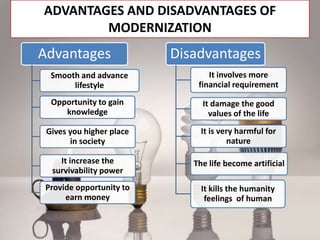
ADVANTAGES AND DISADVANTAGES OF
MODERNIZATION
Advantages
Smooth and advance
lifestyle
Opportunity to gain
knowledge
Gives you higher place
in society
It increase the
survivability power
Provide opportunity to
earn money
Disadvantages
It involves more
financial requirement
It damage the good
values of the life
It is very harmful for
nature
The life become artificial
It kills the humanity
feelings of human
IMPACT OF MODERNIZATION IN RURAL ASSAM
Percentage of Medical Institution
1991 2011
Primary Health centre 2.5 16.89
Sub-Centre 4.12 79.89
Source:- Census of India (1991 & 2011)
0
10
20
30
40
50
60
70
80
90
Primary Health Centre Sub Centre
Percentage Percentage of Medical Institution
1991
2011
Fig 1 :- Shows percentage of Medical Institution
Year Birth Rate Death Rate Infant
Mortality Rate
1971 39.3 18.7 144
2001 27.9 9.9 77
2011 24.0 8.4 58
Source:- Census of India
0
20
40
60
80
100
120
140
160
1971 2001 2011
Year
Birth Rate
Death Rate
Infant Moratlity Rate
Fig 2 :-Showing Birth rate, Death rate, & Infant mortality rate (19971,2001&2011)
Number Of Villages With Electricity
Year 2010-11 2011-12 2012-13 2013-14
No. of
villages
20465 22294 22520 22587
19000
20000
21000
22000
23000
2010-2011 2011-2012 2012-2013 2013-2014
No.ofvillages
Source:- Economic Survey of Assam (Assam power distribution company ltd.)
Fig 3 :- Showing increasing the number of villages with electricity.
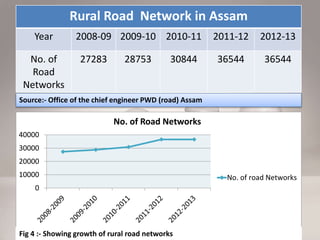
Rural Road Network in Assam
Year 2008-09 2009-10 2010-11 2011-12 2012-13
No. of
Road
Networks
27283 28753 30844 36544 36544
0
10000
20000
30000
40000
No. of Road Networks
No. of road Networks
Source:- Office of the chief engineer PWD (road) Assam
Fig 4 :- Showing growth of rural road networks
Rural Telephone Connection
year 2009-10 2010-11
No. of Connection 481092 594291
0
200000
400000
600000
800000
No. of Telephone Connection
2009-2010
2010-2011
Source:- Annual report 2009-10, 2010-11 of Dept. of telecommunication govt. of
Assam
Fig 5 :- Increasing the number of rural telecom connection
Village Public Telephone Connection
Year 2009-10 2010-11 2011-12 2012-13 2013-14
No. of
Connection
23992 24196 24415 24688 24692
23500
24000
24500
25000
2009-2010 2010-2011 2011-2012 2012-2013 2013-2014
Series 1
Series 1
Source:- Annual report 2009-10, 2010-11 of Dept. of telecommunication govt. of
Assam
Fig 6 :- Increasing the number of rural public telephone connection, 2009 to 2014
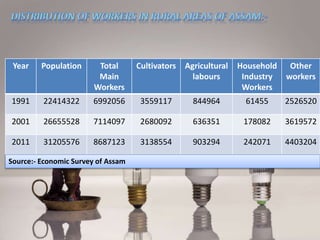
Year Population Total
Main
Workers
Cultivators Agricultural
labours
Household
Industry
Workers
Other
workers
1991 22414322 6992056 3559117 844964 61455 2526520
2001 26655528 7114097 2680092 636351 178082 3619572
2011 31205576 8687123 3138554 903294 242071 4403204
Source:- Economic Survey of Assam
51%
12%1%
36%
1991
Cultivator Agricultural Labour
Household Industry Workers Other Workers
Fig 6 :- Percentage of rural workers in Assam 1991
38%
9%
2%
51%
2001
Cultivators Agricultural Labours
Household Industry Workers Other Workers
.Percentage of rural workers in Assam 2001
36%
10%
3%
51%
2011
Cultivators Agricutural labour
Household Industry Workers Other Workers
Fig 8:- Percentage of rural workers in Assam 2011
PERCEPTION OF RESPONDENCE REGARDING MORDINIZATION
Agree Disagree
F % F %
I like modernization 37 92.5 3 7.5
I think that modernization has change
the way of the life of people
36 90 4 10
I think modernization has change the
traditional dressing of people
38 95 2 5
Modernization has impact on my family 35 87.5 5 12.5
Modernization has impact on religious
system
30 75 10 25
I think cultural values are hurdles in
modernization
36 90 4 10
RESULT
 In the first query, 92.5% agreed with statement, only 7.5%were
not favor modernization; they argued that they love their culture.
 The next statement again 90% of people agreed
 In the 3rd query, a huge proportion i.e. 95% agreed, only 5%
disagreed, they stated that they wear only traditional dress.
 Family is consider a basic unit of the society, in the 4th query
majority of them 87.5% agreed while a minute 12.5% disagree
 When we asked 5th query which was about their religion majority
of them agreed i.e. 75% but 1/4th i.e. 25% disagree the statement.
From this statement we understand that people are very sensitive
about their religion.
 The last and important statement i.e. cultural values are obstacle
on the path of modernization or not, a huge proportion of people
i.e. 90% of them agree the statement only 10% of them disagree.
Suggestion
Yes we need modernization, and it is important for
country like India and specially state like Assam. But due to the
effect of modernization, people in rural areas tend to motivate
by the secondary and tertiary sector of earnings. Which seems to
have catastrophic impact upon rural agricultural livelihood,
which is the backbone of Assemese society. This seems to make
the state more dependent on other states for their food supply.
From the view of our study the followings should be the aim
of modernization on our state:-
• To increase the level of “production output” in agricultural
sector through the effect of the modern equipments
technology and products like hybrid seeds etc.
• To motivate society for modern type of agriculture
• To give implementation to our traditional & cultural arts-
crafts by modernization effect
Conclusion
We can conclude from the above results that the society
is going under transition and is becoming modernized because
the normative structure, cultural traits, value system, dress
patterns, and family system have all been strongly affected and
altered due to the modern world. The technological
advancement has fed people with new culture traits, diffusing
alien features into the societies. Traditional and cultural traits
are considered a sign of recognition and identity of any nation
and this very core has been permanently replaced by the
western world. So there is a dire need to save and preserve our
cultural identity. The researchers and social scientists should
play their role in this concern to save their identity.
Thank
you

Modernization

  • 1.
    MANJIT DAS M.A./M.Sc 2ndSEMESTER CENTRE FOR STUDIES IN GEOGRAPHY PRESENTED BY-
  • 2.
    INTRODUCTION  It isa process socio cultural transformation.  It is the process of change and involving values, norms, institution and structure.  Political dimensions of modernization involves creation of a modern nation or state.  Cultural modernization involves adherence to nationalistic ideology, belief in equality, freedom and humanism, a rational and scientific outlook.  Economic modernization involves industrialization accompanied with monetization of economy, increasing division of labor, use of management techniques and improved technology and the expansion of service sector.  Social modernization involves universalistic values, achievement motivation, increasing literacy and urbanization and the decline of traditional authority.
  • 3.
    OBJECTIVES Our present studydepicts the picture of transformation of rural areas due to the impact of modernization. Our present objective are as follows  To know the better condition of rural life  Influence of modernization in rural areas for development and its effect on day to day life To show the socio- cultural development with the modernization
  • 4.
    METHODOLOGY For the presentstudy data were collected from primary sources i.e. directly from individuals and also from secondary sources such as journals, research paper, census of India (1991, 2001 & 2011) , internet etc
  • 5.
    1 • Development ofScience and Technology 2 • Development of Economic activity 3 • Successful Working of Democratic Institutions 3 MAJOR FACTORS OF MODERNIZATION
  • 6.
  • 7.
    a) Development intechnology b) Specialization in economic role c) Scope for saving and investment d) Expansion of market
  • 8.
    a) Decline oftraditional rulers b) Formulation of ideology for the rulers to handle the power c) Decentralization of power among the members of society
  • 9.
    a) Growing differentiationamong the major elements of culture like religion, philosophy and science. b) Spread of literacy and secular education c) Expansion of media communication d) Development of new cultural element
  • 10.
    MODERNIZATION IN ASSAM Introduction of new institution like banking, mass media, communication etc.  Introduction of new value system such as equality, justice, individualism, secularism etc.  Acceptance of scientific innovation.  Increase in the standard of living.  Restructuring of political system i.e. introduction of democracy  Introduction of structural changes in social institution like marriage, family, caste etc.
  • 11.
    ADVANTAGES AND DISADVANTAGESOF MODERNIZATION Advantages Smooth and advance lifestyle Opportunity to gain knowledge Gives you higher place in society It increase the survivability power Provide opportunity to earn money Disadvantages It involves more financial requirement It damage the good values of the life It is very harmful for nature The life become artificial It kills the humanity feelings of human
  • 12.
    IMPACT OF MODERNIZATIONIN RURAL ASSAM Percentage of Medical Institution 1991 2011 Primary Health centre 2.5 16.89 Sub-Centre 4.12 79.89 Source:- Census of India (1991 & 2011)
  • 13.
    0 10 20 30 40 50 60 70 80 90 Primary Health CentreSub Centre Percentage Percentage of Medical Institution 1991 2011 Fig 1 :- Shows percentage of Medical Institution
  • 14.
    Year Birth RateDeath Rate Infant Mortality Rate 1971 39.3 18.7 144 2001 27.9 9.9 77 2011 24.0 8.4 58 Source:- Census of India
  • 15.
    0 20 40 60 80 100 120 140 160 1971 2001 2011 Year BirthRate Death Rate Infant Moratlity Rate Fig 2 :-Showing Birth rate, Death rate, & Infant mortality rate (19971,2001&2011)
  • 16.
    Number Of VillagesWith Electricity Year 2010-11 2011-12 2012-13 2013-14 No. of villages 20465 22294 22520 22587 19000 20000 21000 22000 23000 2010-2011 2011-2012 2012-2013 2013-2014 No.ofvillages Source:- Economic Survey of Assam (Assam power distribution company ltd.) Fig 3 :- Showing increasing the number of villages with electricity.
  • 17.
    Rural Road Networkin Assam Year 2008-09 2009-10 2010-11 2011-12 2012-13 No. of Road Networks 27283 28753 30844 36544 36544 0 10000 20000 30000 40000 No. of Road Networks No. of road Networks Source:- Office of the chief engineer PWD (road) Assam Fig 4 :- Showing growth of rural road networks
  • 18.
    Rural Telephone Connection year2009-10 2010-11 No. of Connection 481092 594291 0 200000 400000 600000 800000 No. of Telephone Connection 2009-2010 2010-2011 Source:- Annual report 2009-10, 2010-11 of Dept. of telecommunication govt. of Assam Fig 5 :- Increasing the number of rural telecom connection
  • 19.
    Village Public TelephoneConnection Year 2009-10 2010-11 2011-12 2012-13 2013-14 No. of Connection 23992 24196 24415 24688 24692 23500 24000 24500 25000 2009-2010 2010-2011 2011-2012 2012-2013 2013-2014 Series 1 Series 1 Source:- Annual report 2009-10, 2010-11 of Dept. of telecommunication govt. of Assam Fig 6 :- Increasing the number of rural public telephone connection, 2009 to 2014
  • 20.
    Year Population Total Main Workers CultivatorsAgricultural labours Household Industry Workers Other workers 1991 22414322 6992056 3559117 844964 61455 2526520 2001 26655528 7114097 2680092 636351 178082 3619572 2011 31205576 8687123 3138554 903294 242071 4403204 Source:- Economic Survey of Assam
  • 21.
    51% 12%1% 36% 1991 Cultivator Agricultural Labour HouseholdIndustry Workers Other Workers Fig 6 :- Percentage of rural workers in Assam 1991
  • 22.
    38% 9% 2% 51% 2001 Cultivators Agricultural Labours HouseholdIndustry Workers Other Workers .Percentage of rural workers in Assam 2001
  • 23.
    36% 10% 3% 51% 2011 Cultivators Agricutural labour HouseholdIndustry Workers Other Workers Fig 8:- Percentage of rural workers in Assam 2011
  • 24.
    PERCEPTION OF RESPONDENCEREGARDING MORDINIZATION Agree Disagree F % F % I like modernization 37 92.5 3 7.5 I think that modernization has change the way of the life of people 36 90 4 10 I think modernization has change the traditional dressing of people 38 95 2 5 Modernization has impact on my family 35 87.5 5 12.5 Modernization has impact on religious system 30 75 10 25 I think cultural values are hurdles in modernization 36 90 4 10
  • 25.
    RESULT  In thefirst query, 92.5% agreed with statement, only 7.5%were not favor modernization; they argued that they love their culture.  The next statement again 90% of people agreed  In the 3rd query, a huge proportion i.e. 95% agreed, only 5% disagreed, they stated that they wear only traditional dress.  Family is consider a basic unit of the society, in the 4th query majority of them 87.5% agreed while a minute 12.5% disagree  When we asked 5th query which was about their religion majority of them agreed i.e. 75% but 1/4th i.e. 25% disagree the statement. From this statement we understand that people are very sensitive about their religion.  The last and important statement i.e. cultural values are obstacle on the path of modernization or not, a huge proportion of people i.e. 90% of them agree the statement only 10% of them disagree.
  • 26.
    Suggestion Yes we needmodernization, and it is important for country like India and specially state like Assam. But due to the effect of modernization, people in rural areas tend to motivate by the secondary and tertiary sector of earnings. Which seems to have catastrophic impact upon rural agricultural livelihood, which is the backbone of Assemese society. This seems to make the state more dependent on other states for their food supply.
  • 27.
    From the viewof our study the followings should be the aim of modernization on our state:- • To increase the level of “production output” in agricultural sector through the effect of the modern equipments technology and products like hybrid seeds etc. • To motivate society for modern type of agriculture • To give implementation to our traditional & cultural arts- crafts by modernization effect
  • 28.
    Conclusion We can concludefrom the above results that the society is going under transition and is becoming modernized because the normative structure, cultural traits, value system, dress patterns, and family system have all been strongly affected and altered due to the modern world. The technological advancement has fed people with new culture traits, diffusing alien features into the societies. Traditional and cultural traits are considered a sign of recognition and identity of any nation and this very core has been permanently replaced by the western world. So there is a dire need to save and preserve our cultural identity. The researchers and social scientists should play their role in this concern to save their identity.
  • 30.