Communication
Learning objectives
 What is communication?
 Why is it important?
 Internal & External communication
 The advantages & disadvantages of different
methods of communication
 Selecting the correct method of communication
 The direction of communication
 Formal & Informal communication
 Barriers to communication
 Reducing barriers to communication
 ICT and communication
Communication in the Workplace
What is Communication?
The process of sending and receiving
information
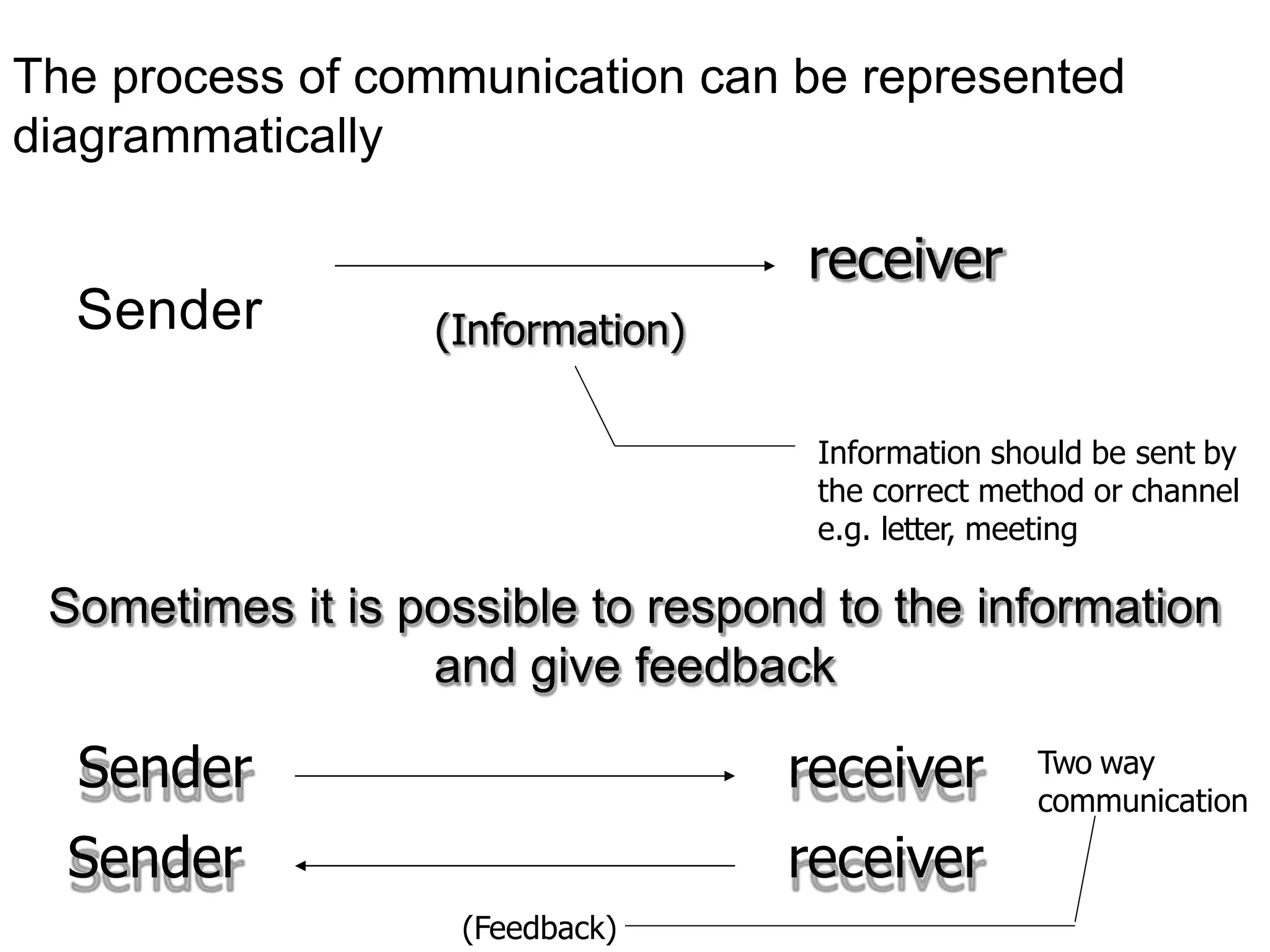
The process of communication can be represented
diagrammatically
Sender
receiver
(Information)
Information should be sent by
the correct method or channel
e.g. letter, meeting
Sometimes it is possible to respond to the information
and give feedback
receiver
receiver
Sender
Sender
(Feedback)
Two way
communication
Why is communication important for
businesses?
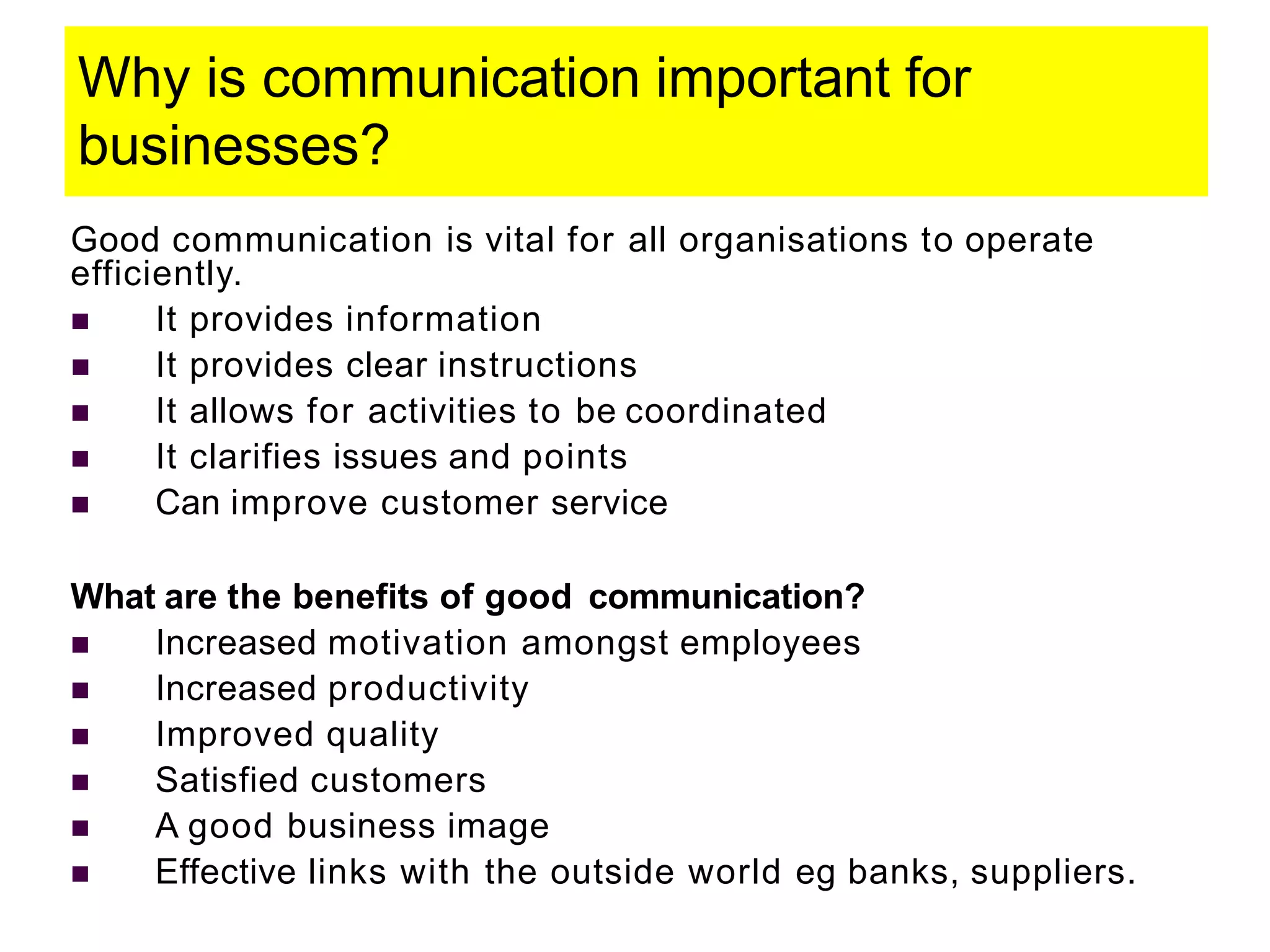
Good communication is vital for all organisations to operate
efficiently.
 It provides information
 It provides clear instructions
 It allows for activities to be coordinated
 It clarifies issues and points
 Can improve customer service
What are the benefits of good communication?
 Increased motivation amongst employees
 Increased productivity
 Improved quality
 Satisfied customers
 A good business image
 Effective links with the outside world eg banks, suppliers.
Fork Handles - Watch the video clip. Is there effective
communication in the shop? How does this effect the
business, customer and staff?
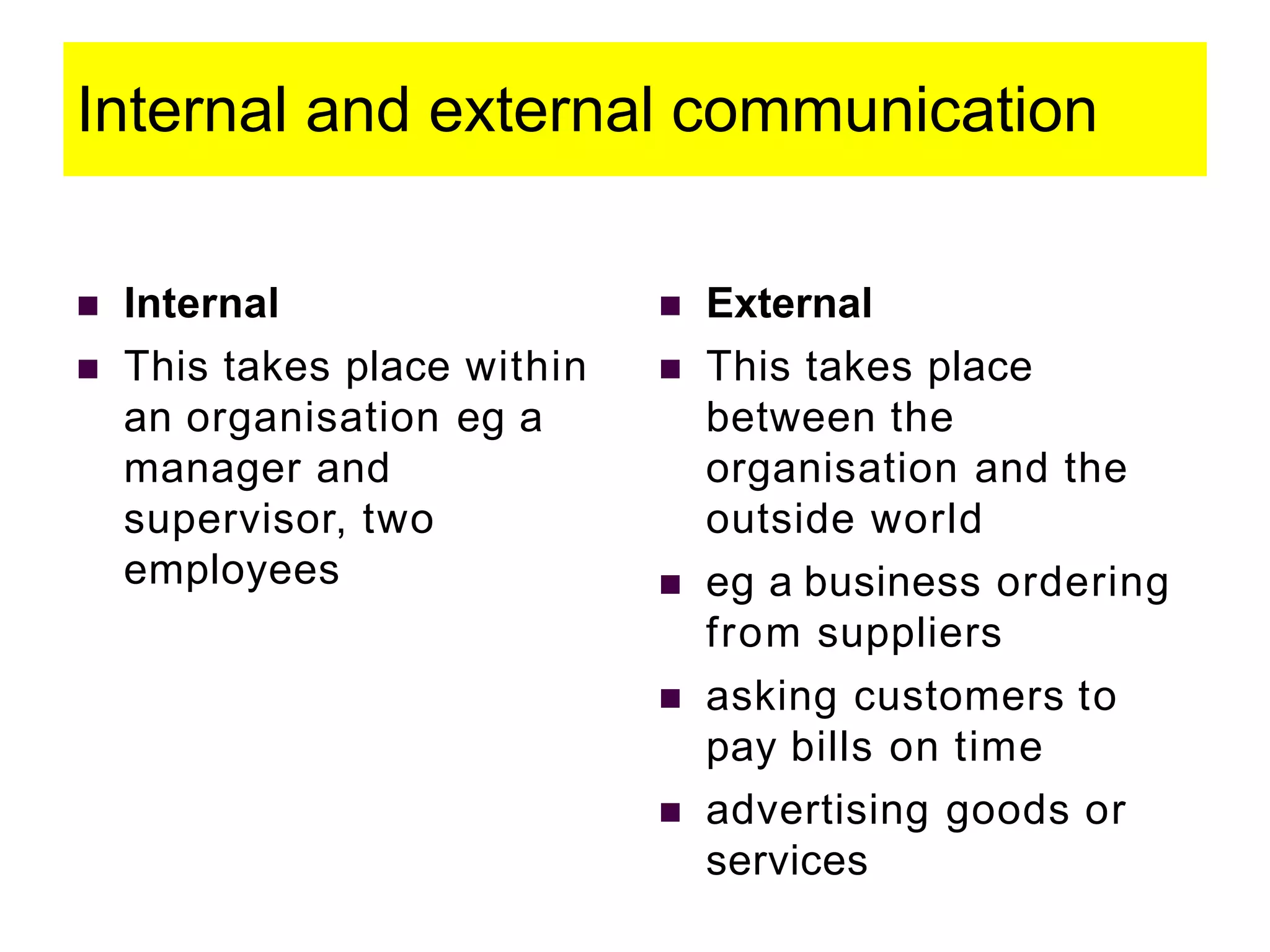
Internal and external communication
 Internal
 This takes place within
an organisation eg a
manager and
supervisor, two
employees
 External
 This takes place
between the
organisation and the
outside world
 eg a business ordering
from suppliers
 asking customers to
pay bills on time
 advertising goods or
services
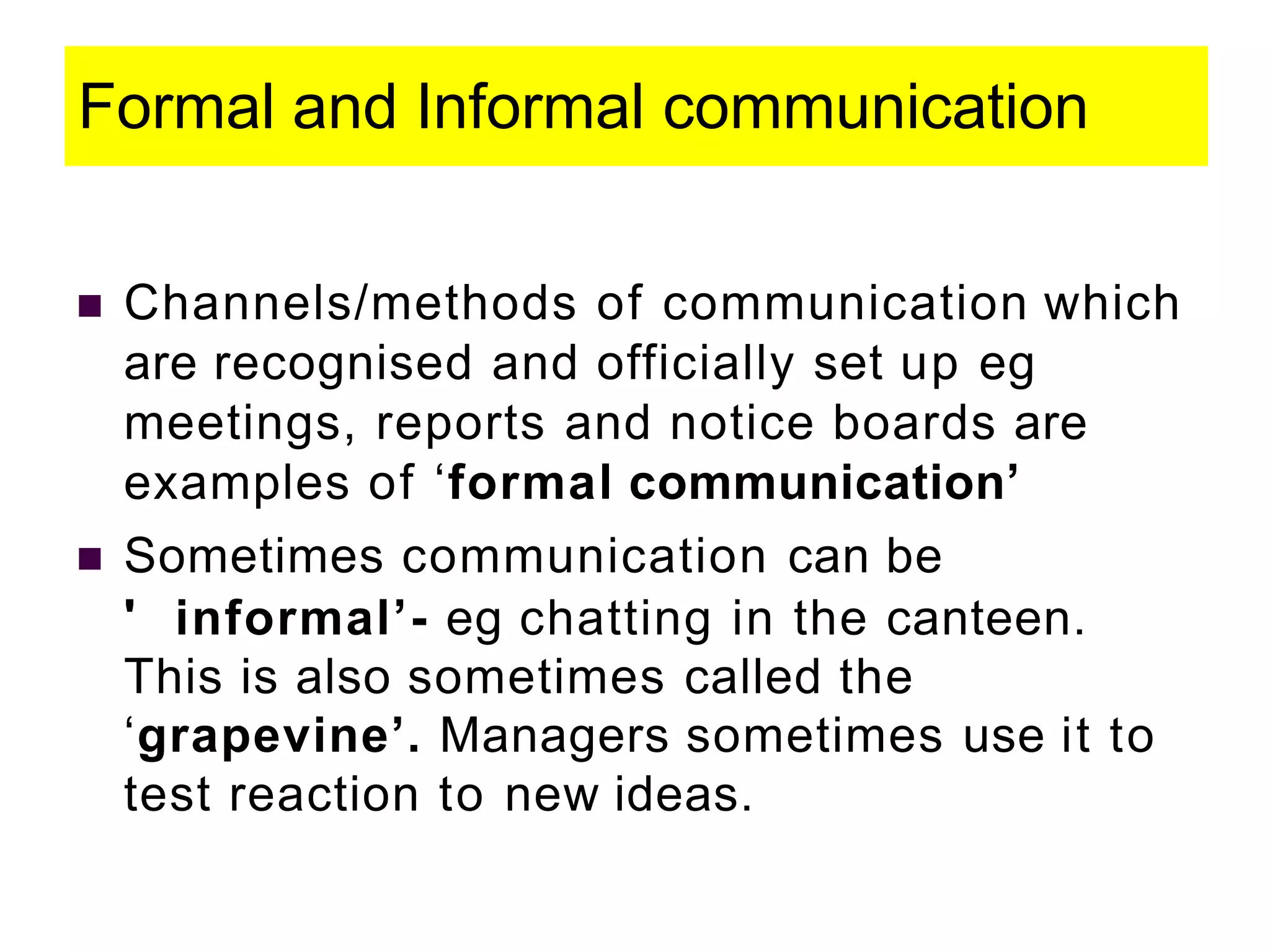
Formal and Informal communication
 Channels/methods of communication which
are recognised and officially set up eg
meetings, reports and notice boards are
examples of ‘formal communication’
 Sometimes communication can be
' informal’- eg chatting in the canteen.
This is also sometimes called the
‘grapevine’. Managers sometimes use it to
test reaction to new ideas.
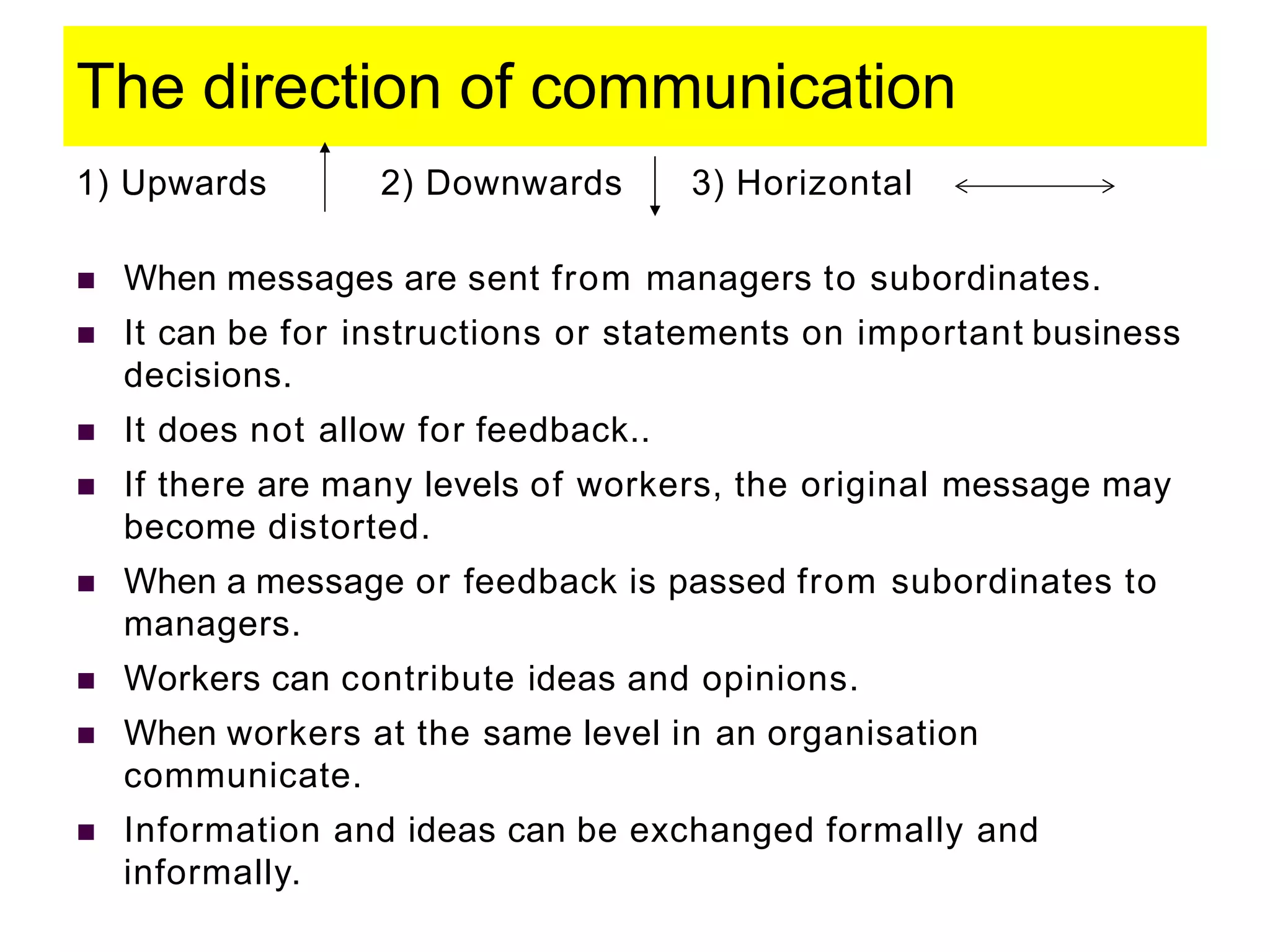
The direction of communication
1) Upwards 2) Downwards 3) Horizontal
 When messages are sent from managers to subordinates.
 It can be for instructions or statements on important business
decisions.
 It does not allow for feedback..
 If there are many levels of workers, the original message may
become distorted.
 When a message or feedback is passed from subordinates to
managers.
 Workers can contribute ideas and opinions.
 When workers at the same level in an organisation
communicate.
 Information and ideas can be exchanged formally and
informally.
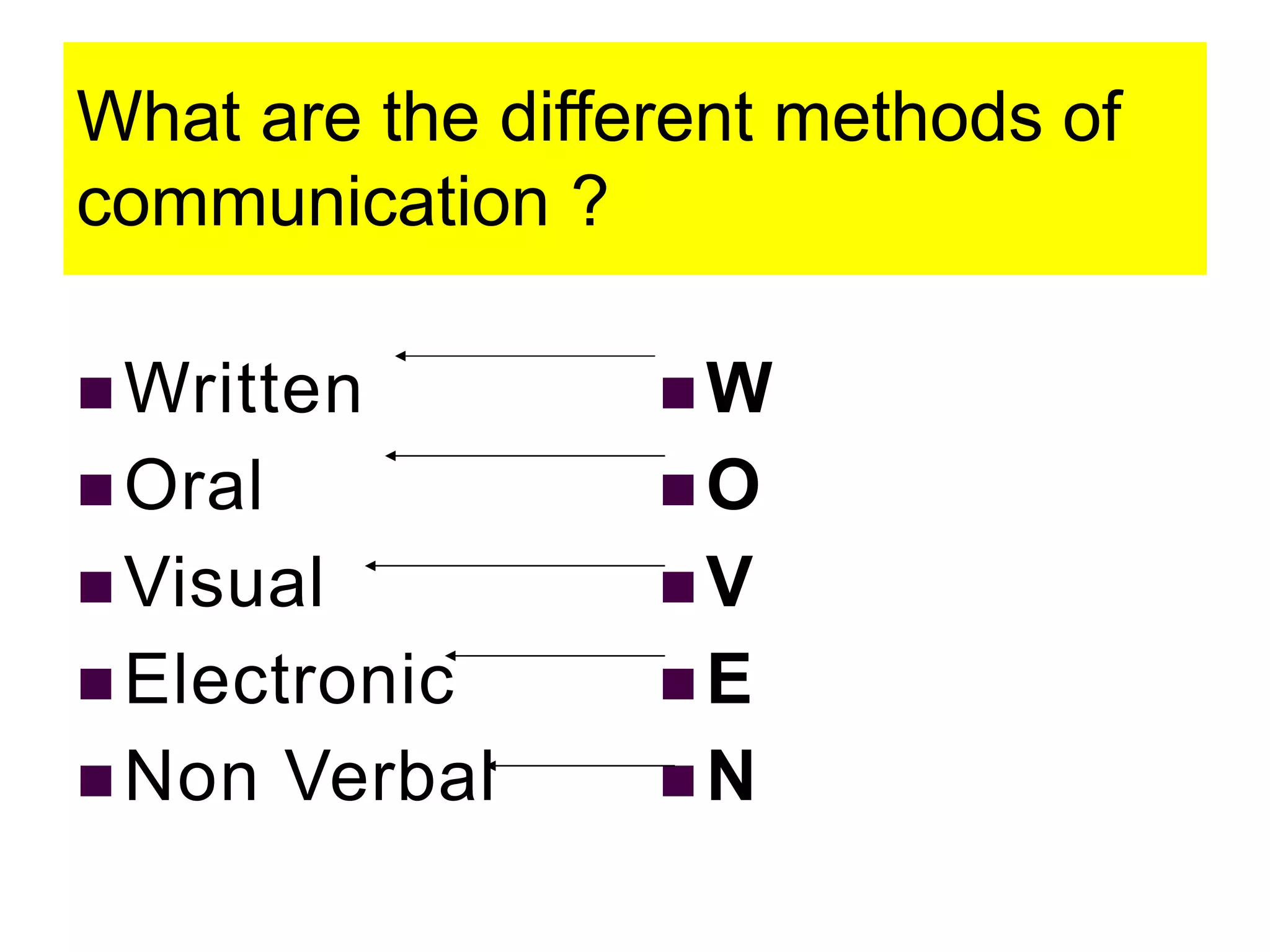
What are the different methods of
communication ?
 Written
 Oral
 Visual
 Electronic
 Non Verbal
 W
 O
 V
 E
 N
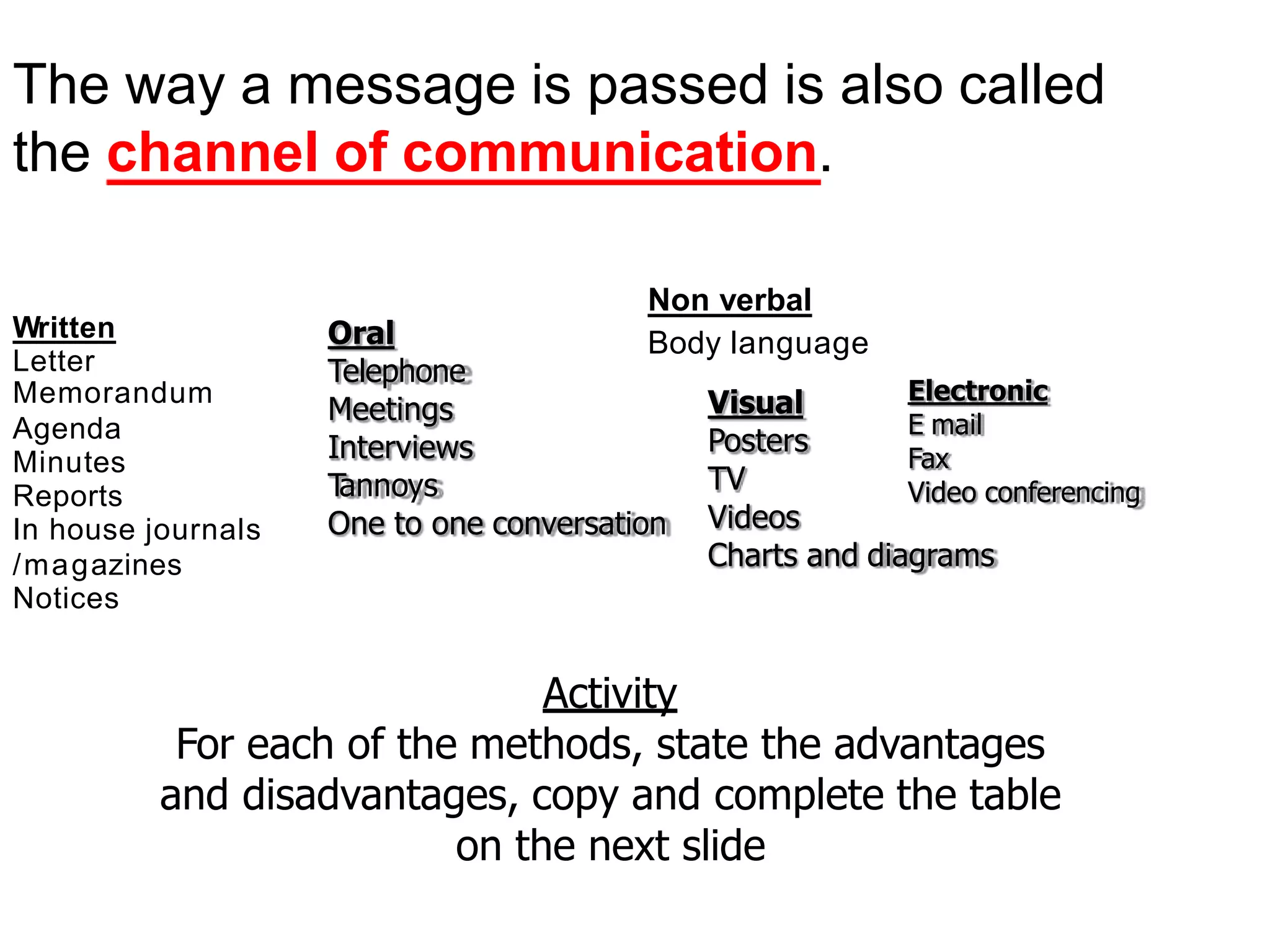
The way a message is passed is also called
the channel of communication.
Written
Letter
Memorandum
Agenda
Minutes
Reports
In house journals
/magazines
Notices
Oral
Telephone
Meetings
Interviews
Tannoys
One to one conversation
Non verbal
Body language
Visual
Posters
TV
Videos
Charts and diagrams
Electronic
E mail
Fax
Video conferencing
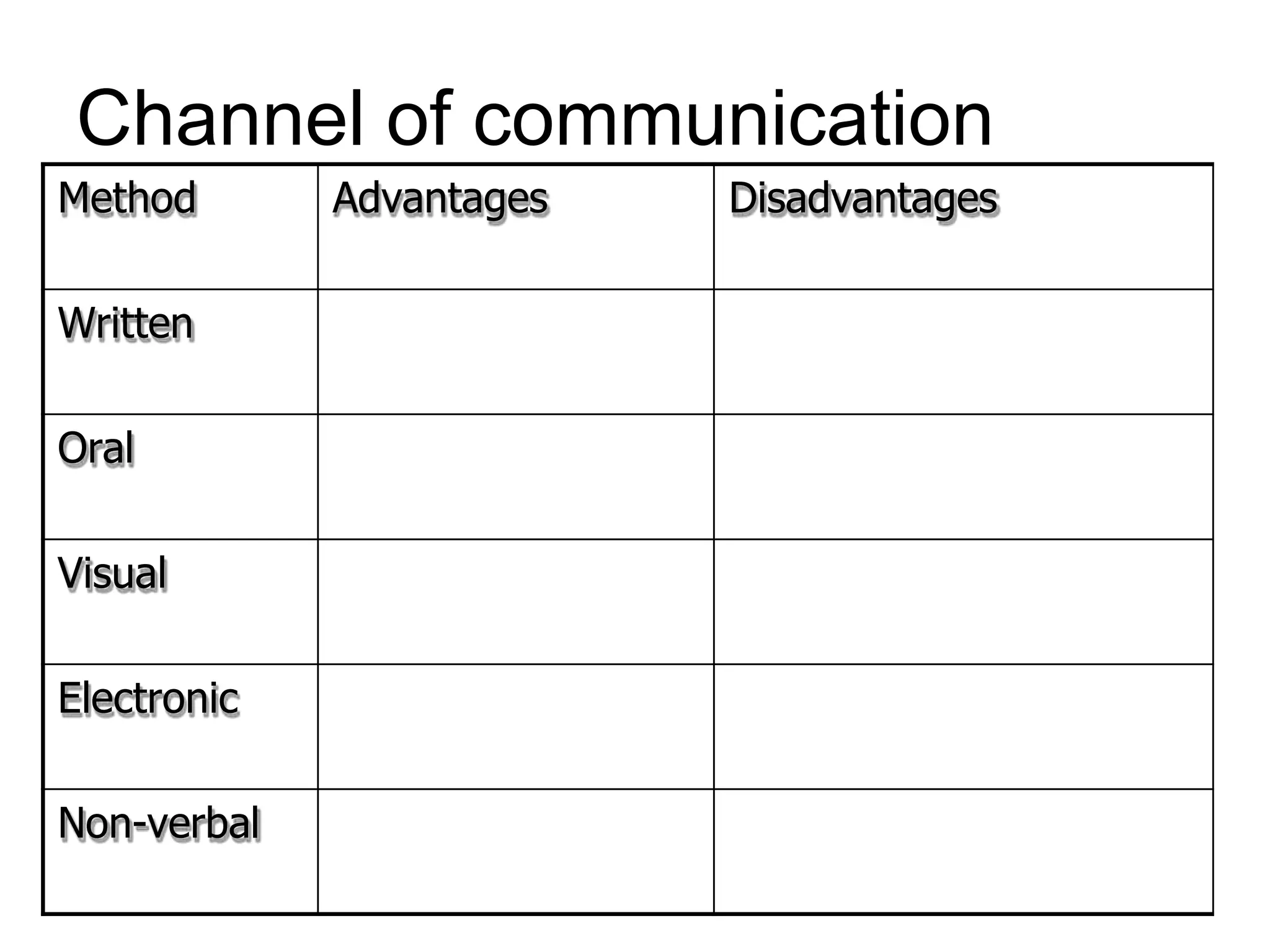
Activity
For each of the methods, state the advantages
and disadvantages, copy and complete the table
on the next slide
Channel of communication
Method Advantages Disadvantages
Written
Oral
Visual
Electronic
Non-verbal
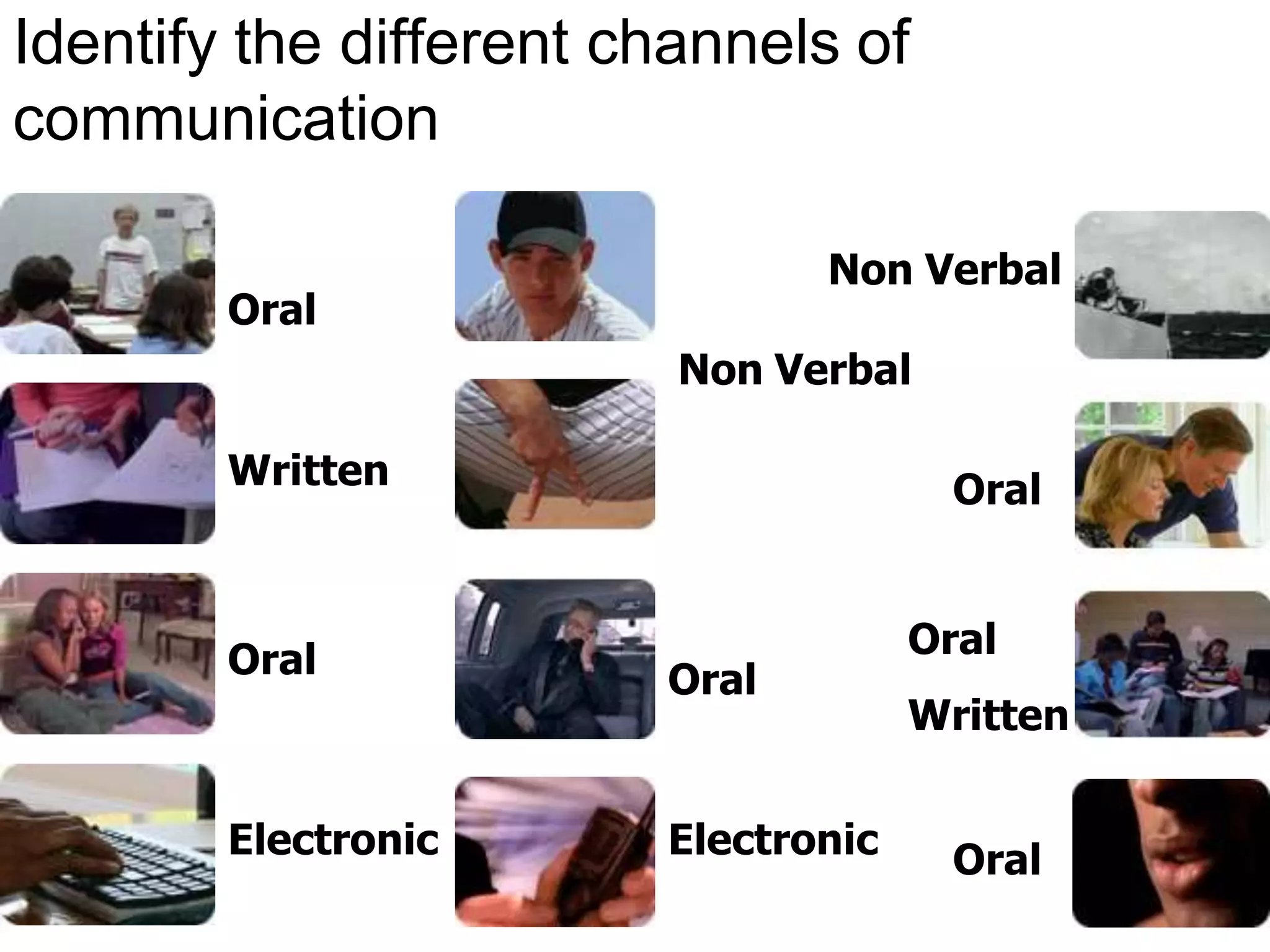
Identify the different channels of
communication
Non Verbal
Oral
Written
Oral
Electronic
Oral
Electronic
Oral
Written
Oral
Oral
Non Verbal
Which methods of communication should
be used in the following situations? Why?
 Reply to a customer complaint
 Tell a subordinate their performance was
poor
 Finding out why a delivery from supplier
due today had not yet arrived
 Telling staff in your department about
major changes to the procedures for
applying for courses and claiming travelling
expenses where the mileage had been
reduced.
What are Barriers to Communication?
List as many as you can think of.
 Unclear messages sent
 Use of jargon e.g. C U L8R
 Wrong choice of medium
 Style used
 Clear concise and to the point
 Correct person for the message
 Language used is too difficult
 Not speaking clearly
 Long message- lose interest
 Wrong channel used
 Message becomes distorted
 No feedback
 Distance
 Breakdown of medium eg postal strike, computer crashes
ICT and communication
The use technology has meant that
businesses:
 Have access to more information than
before eg Internet
 Are more efficient eg email
 Can use data in different ways
 Can present data in many forms
 More people are able to work from
home
Questions
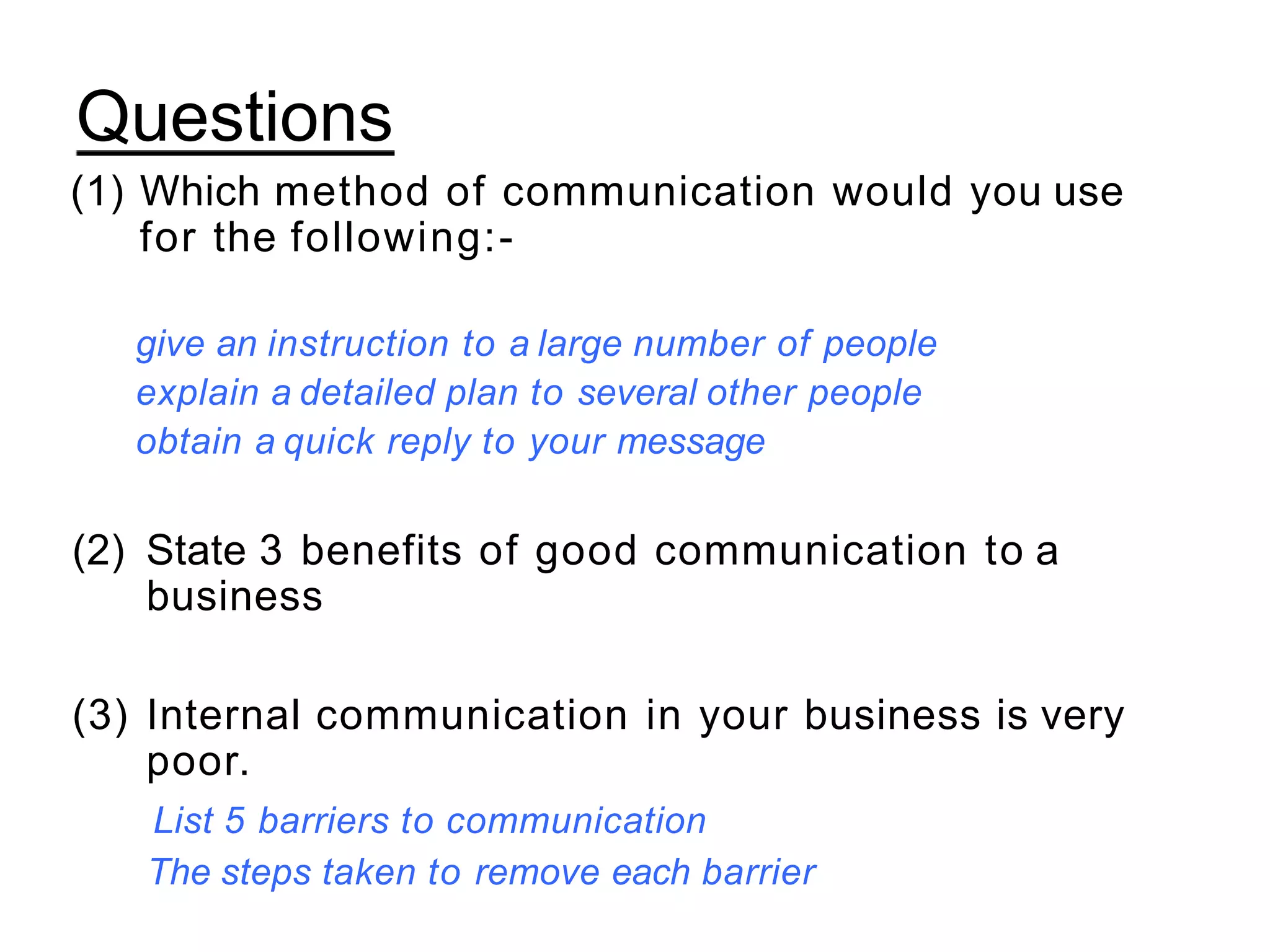
(1) Which method of communication would you use
for the following:-
give an instruction to a large number of people
explain a detailed plan to several other people
obtain a quick reply to your message
(2) State 3 benefits of good communication to a
business
(3) Internal communication in your business is very
poor.
List 5 barriers to communication
The steps taken to remove each barrier
Questions
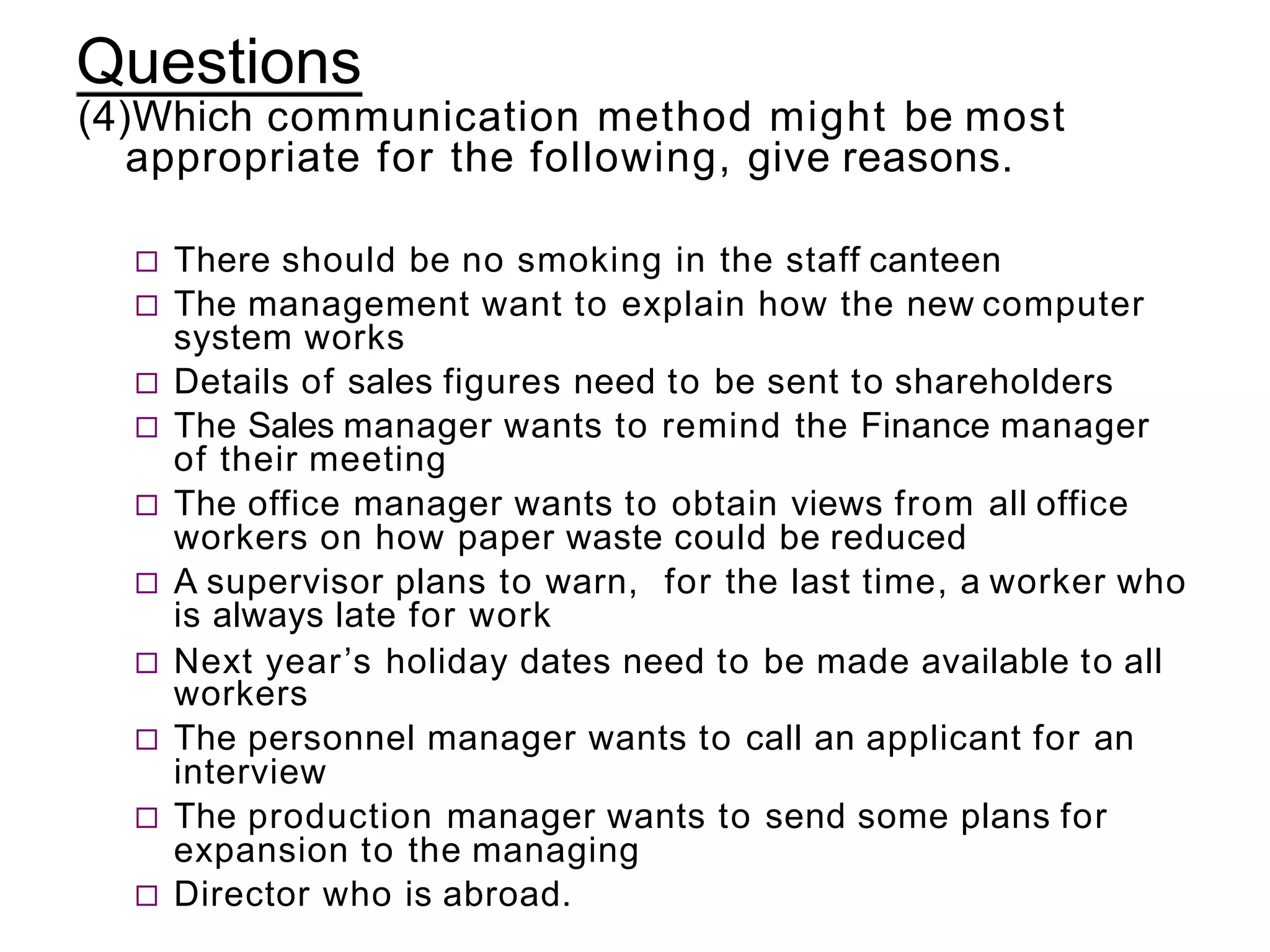
(4)Which communication method might be most
appropriate for the following, give reasons.
 There should be no smoking in the staff canteen
 The management want to explain how the new computer
system works
 Details of sales figures need to be sent to shareholders
 The Sales manager wants to remind the Finance manager
of their meeting
 The office manager wants to obtain views from all office
workers on how paper waste could be reduced
 A supervisor plans to warn, for the last time, a worker who
is always late for work
 Next year’s holiday dates need to be made available to all
workers
 The personnel manager wants to call an applicant for an
interview
 The production manager wants to send some plans for
expansion to the managing
 Director who is abroad.
Build a Better Answer
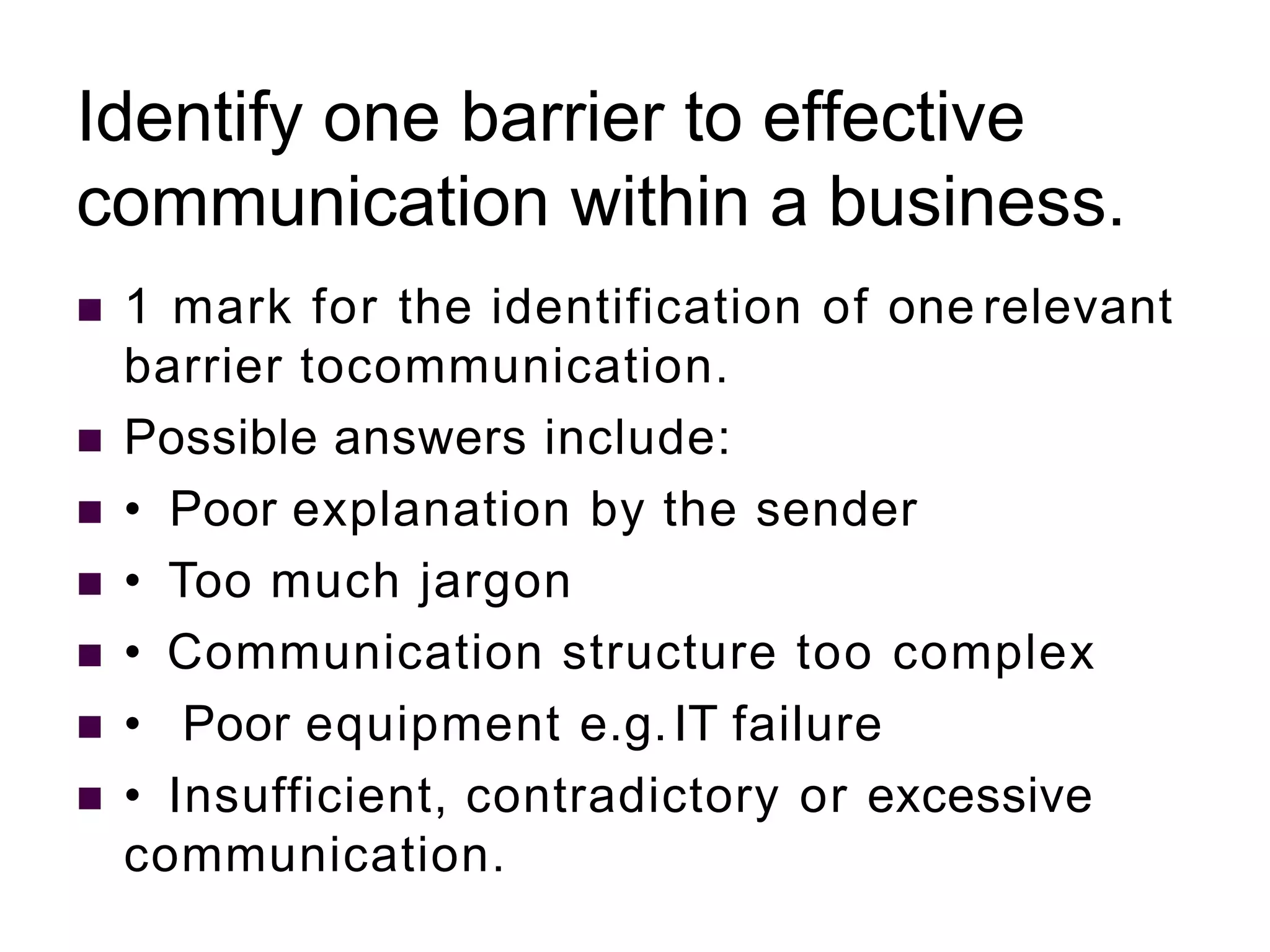
Identify one barrier to effective
communication within a business.
 1 mark for the identification of one relevant
barrier tocommunication.
 Possible answers include:
 • Poor explanation by the sender
 • Too much jargon
 • Communication structure too complex
 • Poor equipment e.g.IT failure
 • Insufficient, contradictory or excessive
communication.
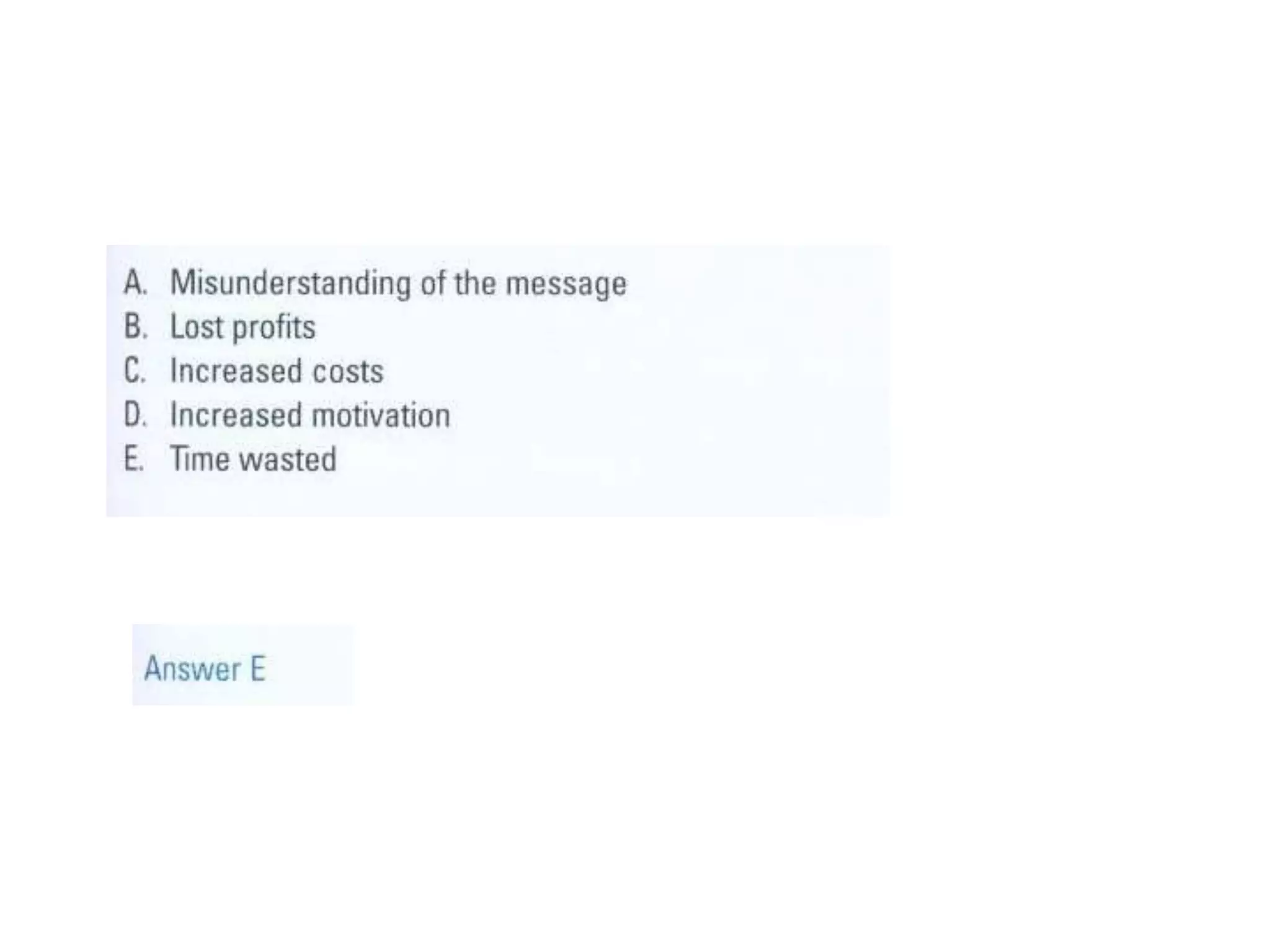
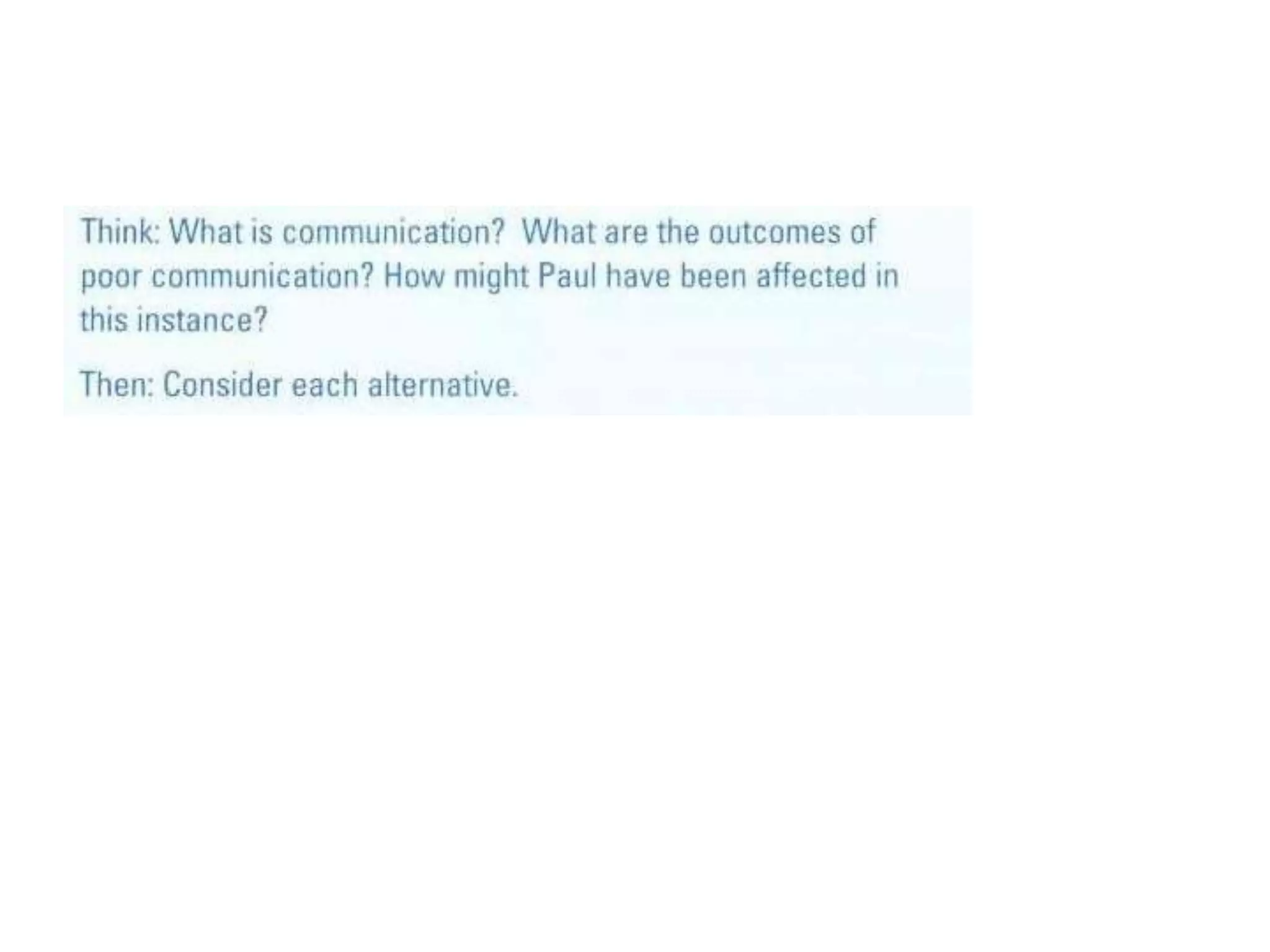
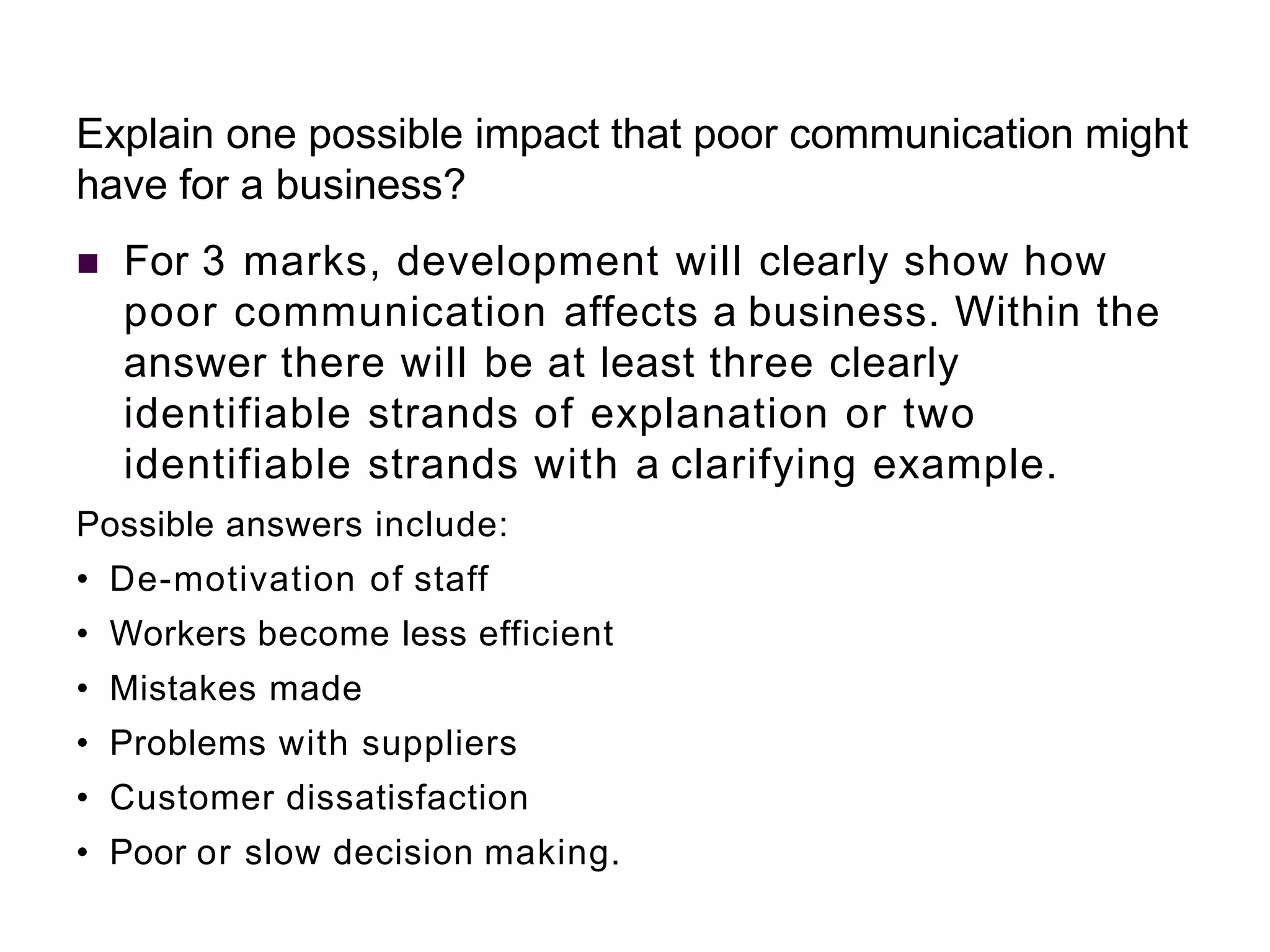
Explain one possible impact that poor communication might
have for a business?
 For 3 marks, development will clearly show how
poor communication affects a business. Within the
answer there will be at least three clearly
identifiable strands of explanation or two
identifiable strands with a clarifying example.
Possible answers include:
• De-motivation of staff
• Workers become less efficient
• Mistakes made
• Problems with suppliers
• Customer dissatisfaction
• Poor or slow decision making.

Unit 2.4: Internal and External Communication

  • 1.
  • 2.
    Learning objectives  Whatis communication?  Why is it important?  Internal & External communication  The advantages & disadvantages of different methods of communication  Selecting the correct method of communication  The direction of communication  Formal & Informal communication  Barriers to communication  Reducing barriers to communication  ICT and communication
  • 3.
    Communication in theWorkplace What is Communication? The process of sending and receiving information
  • 4.
    The process ofcommunication can be represented diagrammatically Sender receiver (Information) Information should be sent by the correct method or channel e.g. letter, meeting Sometimes it is possible to respond to the information and give feedback receiver receiver Sender Sender (Feedback) Two way communication
  • 5.
    Why is communicationimportant for businesses? Good communication is vital for all organisations to operate efficiently.  It provides information  It provides clear instructions  It allows for activities to be coordinated  It clarifies issues and points  Can improve customer service What are the benefits of good communication?  Increased motivation amongst employees  Increased productivity  Improved quality  Satisfied customers  A good business image  Effective links with the outside world eg banks, suppliers.
  • 6.
    Fork Handles -Watch the video clip. Is there effective communication in the shop? How does this effect the business, customer and staff?
  • 7.
    Internal and externalcommunication  Internal  This takes place within an organisation eg a manager and supervisor, two employees  External  This takes place between the organisation and the outside world  eg a business ordering from suppliers  asking customers to pay bills on time  advertising goods or services
  • 8.
    Formal and Informalcommunication  Channels/methods of communication which are recognised and officially set up eg meetings, reports and notice boards are examples of ‘formal communication’  Sometimes communication can be ' informal’- eg chatting in the canteen. This is also sometimes called the ‘grapevine’. Managers sometimes use it to test reaction to new ideas.
  • 9.
    The direction ofcommunication 1) Upwards 2) Downwards 3) Horizontal  When messages are sent from managers to subordinates.  It can be for instructions or statements on important business decisions.  It does not allow for feedback..  If there are many levels of workers, the original message may become distorted.  When a message or feedback is passed from subordinates to managers.  Workers can contribute ideas and opinions.  When workers at the same level in an organisation communicate.  Information and ideas can be exchanged formally and informally.
  • 10.
    What are thedifferent methods of communication ?  Written  Oral  Visual  Electronic  Non Verbal  W  O  V  E  N
  • 11.
    The way amessage is passed is also called the channel of communication. Written Letter Memorandum Agenda Minutes Reports In house journals /magazines Notices Oral Telephone Meetings Interviews Tannoys One to one conversation Non verbal Body language Visual Posters TV Videos Charts and diagrams Electronic E mail Fax Video conferencing Activity For each of the methods, state the advantages and disadvantages, copy and complete the table on the next slide
  • 12.
    Channel of communication MethodAdvantages Disadvantages Written Oral Visual Electronic Non-verbal
  • 13.
    Identify the differentchannels of communication Non Verbal Oral Written Oral Electronic Oral Electronic Oral Written Oral Oral Non Verbal
  • 14.
    Which methods ofcommunication should be used in the following situations? Why?  Reply to a customer complaint  Tell a subordinate their performance was poor  Finding out why a delivery from supplier due today had not yet arrived  Telling staff in your department about major changes to the procedures for applying for courses and claiming travelling expenses where the mileage had been reduced.
  • 15.
    What are Barriersto Communication? List as many as you can think of.  Unclear messages sent  Use of jargon e.g. C U L8R  Wrong choice of medium  Style used  Clear concise and to the point  Correct person for the message  Language used is too difficult  Not speaking clearly  Long message- lose interest  Wrong channel used  Message becomes distorted  No feedback  Distance  Breakdown of medium eg postal strike, computer crashes
  • 16.
    ICT and communication Theuse technology has meant that businesses:  Have access to more information than before eg Internet  Are more efficient eg email  Can use data in different ways  Can present data in many forms  More people are able to work from home
  • 17.
    Questions (1) Which methodof communication would you use for the following:- give an instruction to a large number of people explain a detailed plan to several other people obtain a quick reply to your message (2) State 3 benefits of good communication to a business (3) Internal communication in your business is very poor. List 5 barriers to communication The steps taken to remove each barrier
  • 18.
    Questions (4)Which communication methodmight be most appropriate for the following, give reasons.  There should be no smoking in the staff canteen  The management want to explain how the new computer system works  Details of sales figures need to be sent to shareholders  The Sales manager wants to remind the Finance manager of their meeting  The office manager wants to obtain views from all office workers on how paper waste could be reduced  A supervisor plans to warn, for the last time, a worker who is always late for work  Next year’s holiday dates need to be made available to all workers  The personnel manager wants to call an applicant for an interview  The production manager wants to send some plans for expansion to the managing  Director who is abroad.
  • 19.
  • 23.
    Identify one barrierto effective communication within a business.  1 mark for the identification of one relevant barrier tocommunication.  Possible answers include:  • Poor explanation by the sender  • Too much jargon  • Communication structure too complex  • Poor equipment e.g.IT failure  • Insufficient, contradictory or excessive communication.
  • 24.
    Explain one possibleimpact that poor communication might have for a business?  For 3 marks, development will clearly show how poor communication affects a business. Within the answer there will be at least three clearly identifiable strands of explanation or two identifiable strands with a clarifying example. Possible answers include: • De-motivation of staff • Workers become less efficient • Mistakes made • Problems with suppliers • Customer dissatisfaction • Poor or slow decision making.