The factors affecting the O3
layer
 There are two
major factors that
has tremendous
negative effects on
the O3 layer
 I. CFCs
 II. NOx
I. CFC’s and ozone depletion
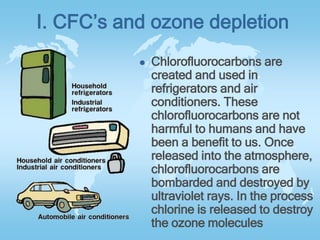
 Chlorofluorocarbons are
created and used in
refrigerators and air
conditioners. These
chlorofluorocarbons are not
harmful to humans and have
been a benefit to us. Once
released into the atmosphere,
chlorofluorocarbons are
bombarded and destroyed by
ultraviolet rays. In the process
chlorine is released to destroy
the ozone molecules
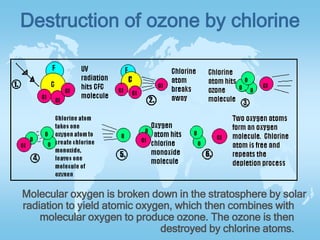
Destruction of ozone by chlorine
Molecular oxygen is broken down in the stratosphere by solar
radiation to yield atomic oxygen, which then combines with
molecular oxygen to produce ozone. The ozone is then
destroyed by chlorine atoms.
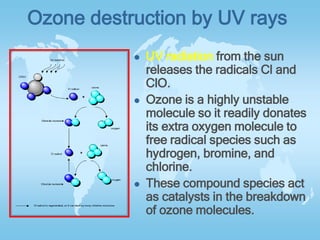
Ozone destruction by UV rays
 UV radiation from the sun
releases the radicals Cl and
ClO.
 Ozone is a highly unstable
molecule so it readily donates
its extra oxygen molecule to
free radical species such as
hydrogen, bromine, and
chlorine.
 These compound species act
as catalysts in the breakdown
of ozone molecules.
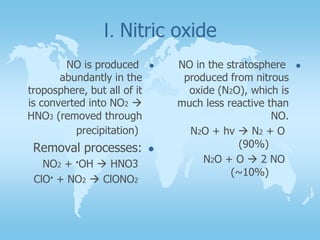
I. Nitric oxide
NO is produced
abundantly in the
troposphere, but all of it
is converted into NO2 
HNO3 (removed through
precipitation)
Removal processes:
NO2 + .OH  HNO3
ClO. + NO2  ClONO2
NO in the stratosphere
produced from nitrous
oxide (N2O), which is
much less reactive than
NO.
N2O + hv  N2 + O
(90%)
N2O + O  2 NO
(~10%)
The two-sided effect of NOx
NOx provides a
catalytic chain
mechanism for O3
destruction.
NOx inhibit the NOx
and ClOx cycles for
O3 destruction by
removing radical
species in the two
cycles.
The relative magnitude of
the two effects is altitude
dependent.
–>25 km, the net effect
is to destruct O3.
–(NOx accounts for
>50% of total ozone
destruction in the
middle and upper
troposphere.)
–In the lower
stratosphere, the net
effect is to protect O3
from destruction.
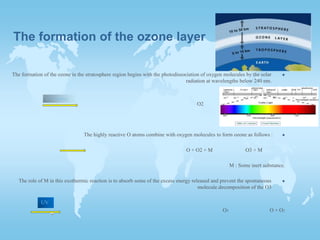
The formation of the ozone layer
The formation of the ozone in the stratosphere region begins with the photodissociation of oxygen molecules by the solar
radiation at wavelengths below 240 nm.
O2 O + O
The highly reactive O atoms combine with oxygen molecules to form ozone as follows :
O3 + MO + O2 + M
M : Some inert substance.
The role of M in this exothermic reaction is to absorb some of the excess energy released and prevent the spontaneous
decomposition of the O3.molecule
O3 O + O2
UV < 240nm
UV

The factors affecting the o3 layer

  • 1.
    The factors affectingthe O3 layer  There are two major factors that has tremendous negative effects on the O3 layer  I. CFCs  II. NOx
  • 2.
    I. CFC’s andozone depletion  Chlorofluorocarbons are created and used in refrigerators and air conditioners. These chlorofluorocarbons are not harmful to humans and have been a benefit to us. Once released into the atmosphere, chlorofluorocarbons are bombarded and destroyed by ultraviolet rays. In the process chlorine is released to destroy the ozone molecules
  • 3.
    Destruction of ozoneby chlorine Molecular oxygen is broken down in the stratosphere by solar radiation to yield atomic oxygen, which then combines with molecular oxygen to produce ozone. The ozone is then destroyed by chlorine atoms.
  • 4.
    Ozone destruction byUV rays  UV radiation from the sun releases the radicals Cl and ClO.  Ozone is a highly unstable molecule so it readily donates its extra oxygen molecule to free radical species such as hydrogen, bromine, and chlorine.  These compound species act as catalysts in the breakdown of ozone molecules.
  • 5.
    I. Nitric oxide NOis produced abundantly in the troposphere, but all of it is converted into NO2  HNO3 (removed through precipitation) Removal processes: NO2 + .OH  HNO3 ClO. + NO2  ClONO2 NO in the stratosphere produced from nitrous oxide (N2O), which is much less reactive than NO. N2O + hv  N2 + O (90%) N2O + O  2 NO (~10%)
  • 6.
    The two-sided effectof NOx NOx provides a catalytic chain mechanism for O3 destruction. NOx inhibit the NOx and ClOx cycles for O3 destruction by removing radical species in the two cycles. The relative magnitude of the two effects is altitude dependent. –>25 km, the net effect is to destruct O3. –(NOx accounts for >50% of total ozone destruction in the middle and upper troposphere.) –In the lower stratosphere, the net effect is to protect O3 from destruction.
  • 7.
    The formation ofthe ozone layer The formation of the ozone in the stratosphere region begins with the photodissociation of oxygen molecules by the solar radiation at wavelengths below 240 nm. O2 O + O The highly reactive O atoms combine with oxygen molecules to form ozone as follows : O3 + MO + O2 + M M : Some inert substance. The role of M in this exothermic reaction is to absorb some of the excess energy released and prevent the spontaneous decomposition of the O3.molecule O3 O + O2 UV < 240nm UV