Unit – I
Introduction to Derivatives
Done by
K.Arjun Goud
Derivatives
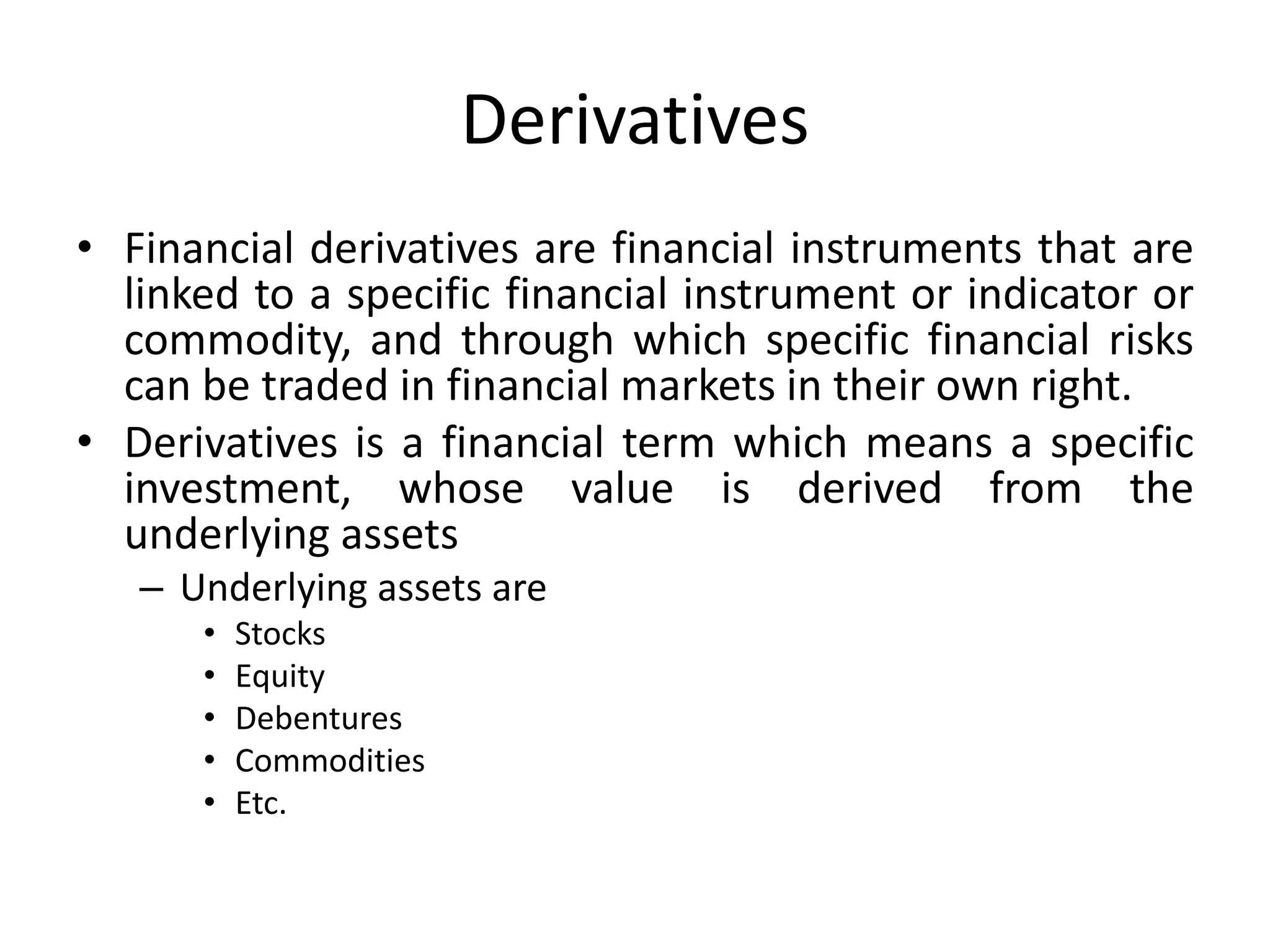
• Financial derivatives are financial instruments that are
linked to a specific financial instrument or indicator or
commodity, and through which specific financial risks
can be traded in financial markets in their own right.
• Derivatives is a financial term which means a specific
investment, whose value is derived from the
underlying assets
– Underlying assets are
• Stocks
• Equity
• Debentures
• Commodities
• Etc.
Evolution of Derivatives
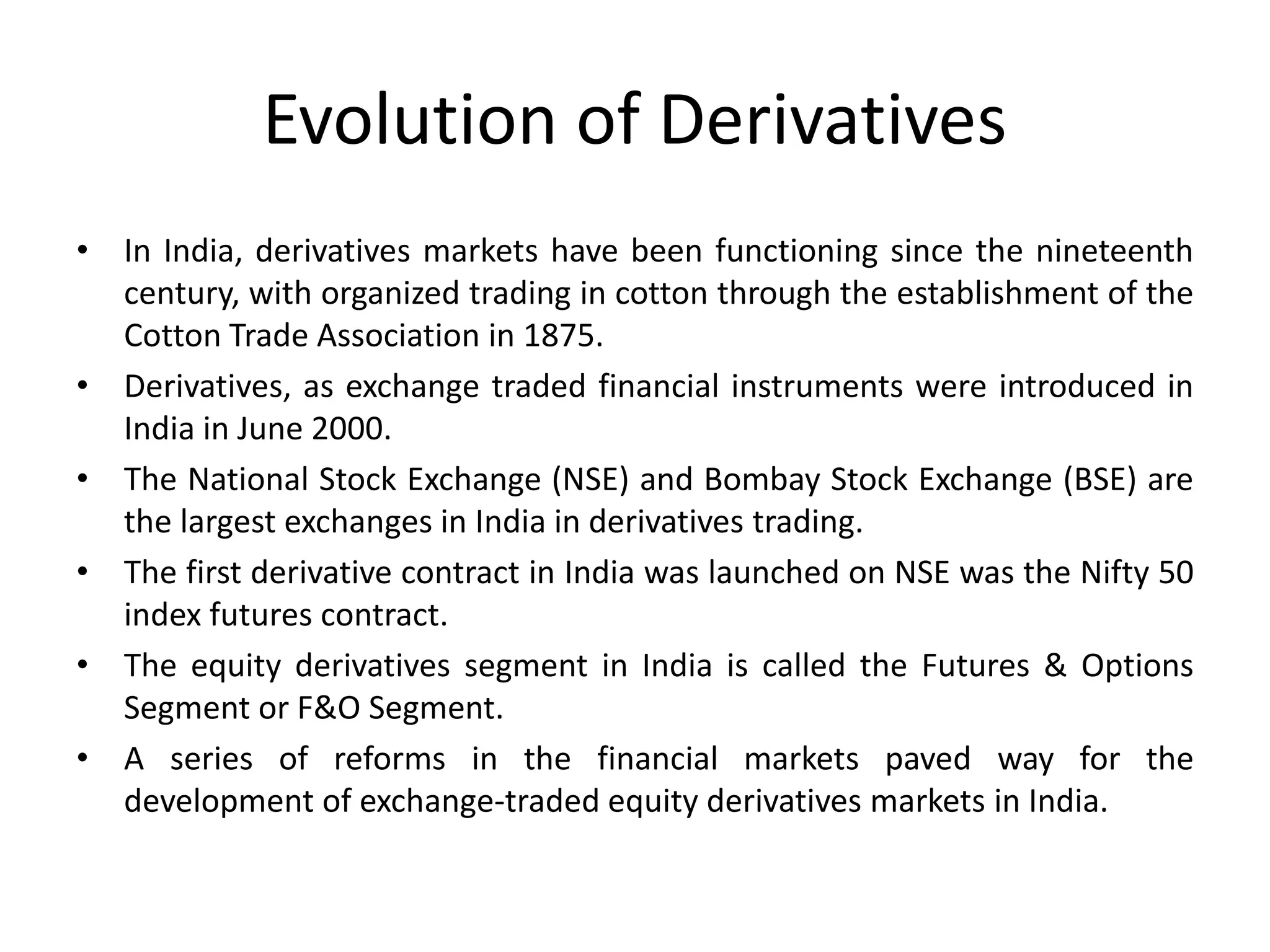
• In India, derivatives markets have been functioning since the nineteenth
century, with organized trading in cotton through the establishment of the
Cotton Trade Association in 1875.
• Derivatives, as exchange traded financial instruments were introduced in
India in June 2000.
• The National Stock Exchange (NSE) and Bombay Stock Exchange (BSE) are
the largest exchanges in India in derivatives trading.
• The first derivative contract in India was launched on NSE was the Nifty 50
index futures contract.
• The equity derivatives segment in India is called the Futures & Options
Segment or F&O Segment.
• A series of reforms in the financial markets paved way for the
development of exchange-traded equity derivatives markets in India.
Contdd…
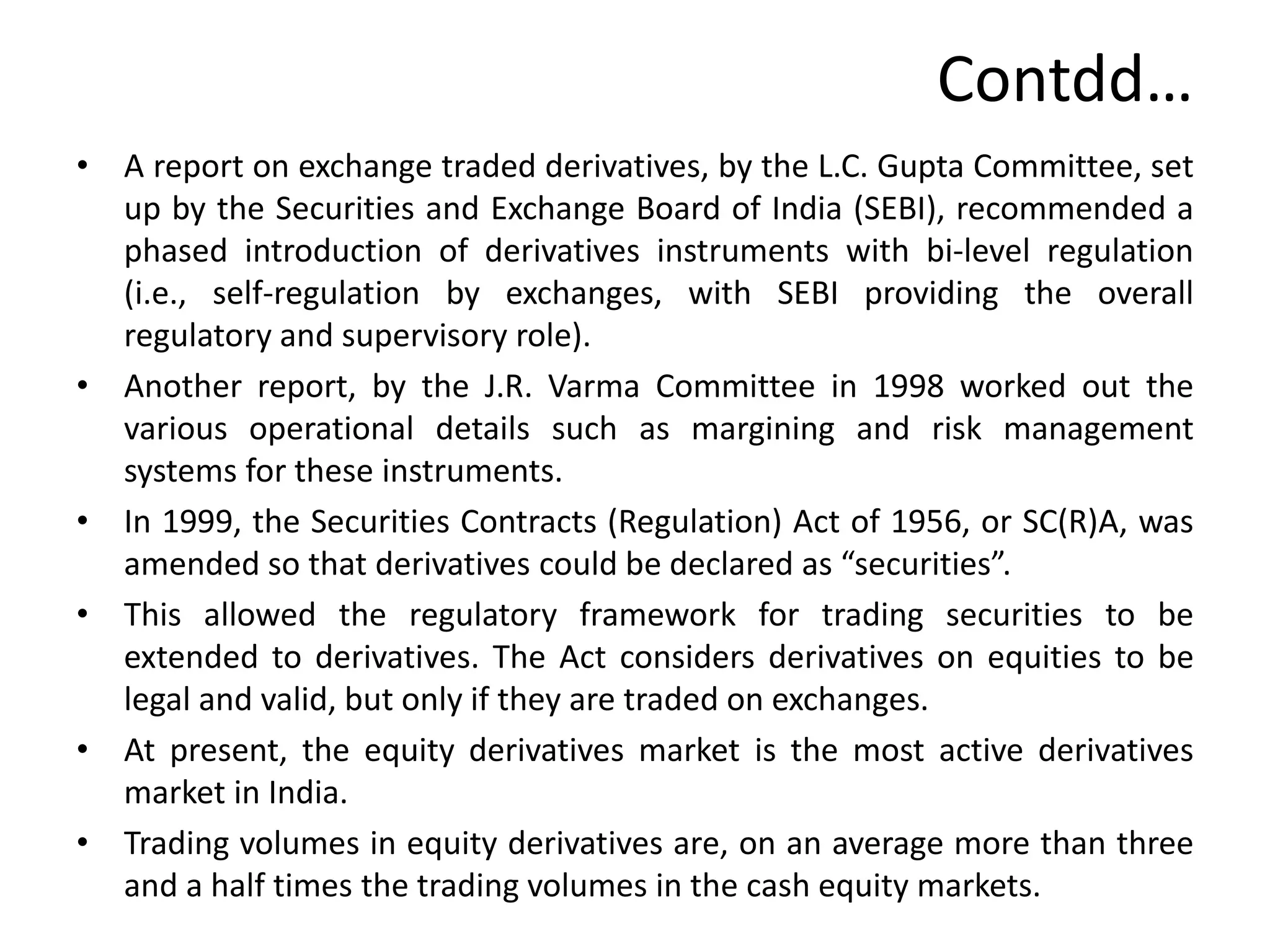
• A report on exchange traded derivatives, by the L.C. Gupta Committee, set
up by the Securities and Exchange Board of India (SEBI), recommended a
phased introduction of derivatives instruments with bi-level regulation
(i.e., self-regulation by exchanges, with SEBI providing the overall
regulatory and supervisory role).
• Another report, by the J.R. Varma Committee in 1998 worked out the
various operational details such as margining and risk management
systems for these instruments.
• In 1999, the Securities Contracts (Regulation) Act of 1956, or SC(R)A, was
amended so that derivatives could be declared as “securities”.
• This allowed the regulatory framework for trading securities to be
extended to derivatives. The Act considers derivatives on equities to be
legal and valid, but only if they are traded on exchanges.
• At present, the equity derivatives market is the most active derivatives
market in India.
• Trading volumes in equity derivatives are, on an average more than three
and a half times the trading volumes in the cash equity markets.
Features of Derivatives
• Value of a financial derivative is derived from
some other asset.
• Derivatives are used for transferring risk from
risk adverse investors to risk bearing investors.
• Financial derivatives provide commitments to
prices or rates for the future dates or given
protection against adverse movements of
prices or exchange rates and thereby reduce
the magnitude of financial risk
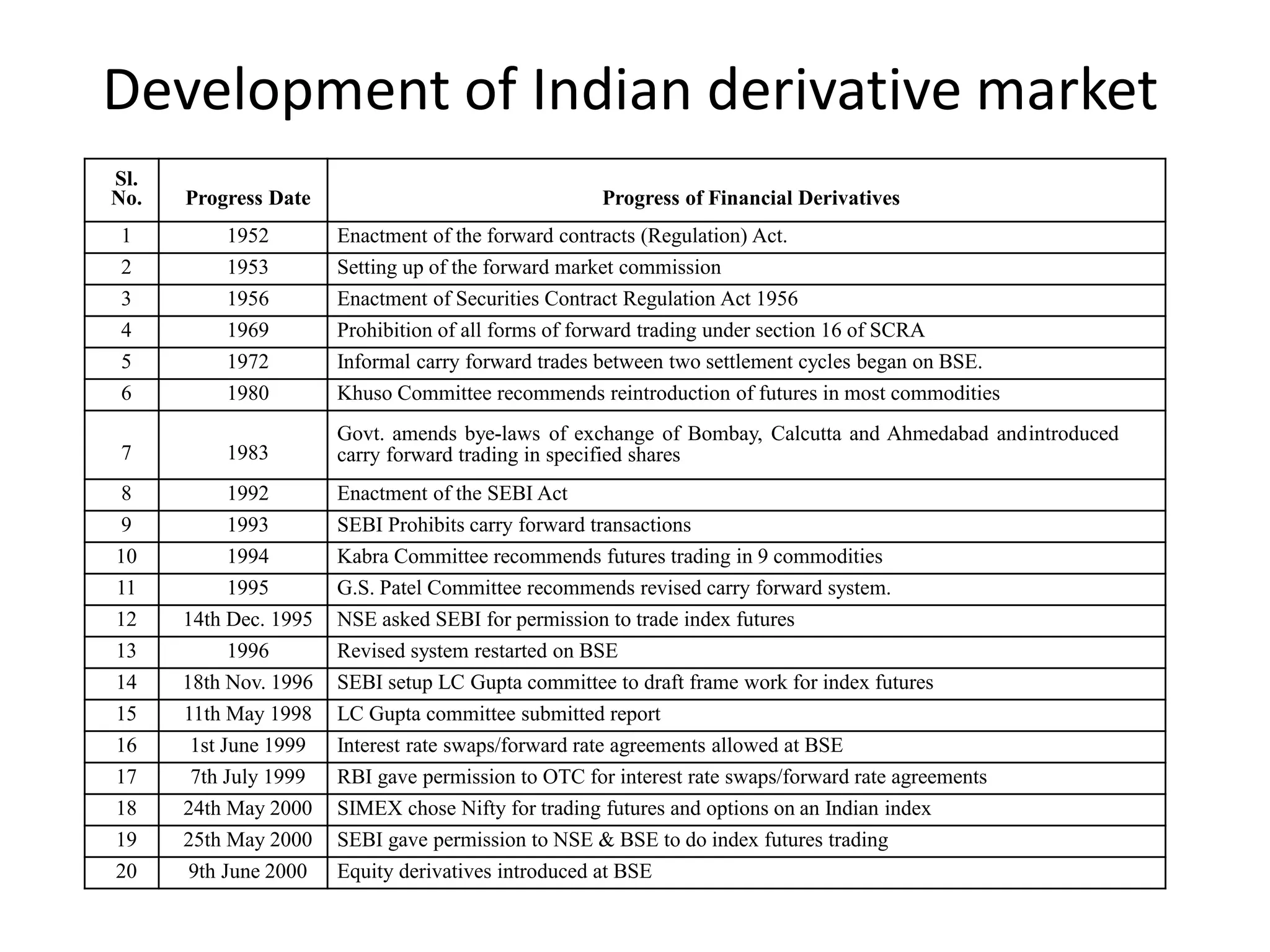
Development of Indian derivative market
Sl.
No. Progress Date Progress of Financial Derivatives
1 1952 Enactment of the forward contracts (Regulation) Act.
2 1953 Setting up of the forward market commission
3 1956 Enactment of Securities Contract Regulation Act 1956
4 1969 Prohibition of all forms of forward trading under section 16 of SCRA
5 1972 Informal carry forward trades between two settlement cycles began on BSE.
6 1980 Khuso Committee recommends reintroduction of futures in most commodities
7 1983
Govt. amends bye-laws of exchange of Bombay, Calcutta and Ahmedabad andintroduced
carry forward trading in specified shares
8 1992 Enactment of the SEBI Act
9 1993 SEBI Prohibits carry forward transactions
10 1994 Kabra Committee recommends futures trading in 9 commodities
11 1995 G.S. Patel Committee recommends revised carry forward system.
12 14th Dec. 1995 NSE asked SEBI for permission to trade index futures
13 1996 Revised system restarted on BSE
14 18th Nov. 1996 SEBI setup LC Gupta committee to draft frame work for index futures
15 11th May 1998 LC Gupta committee submitted report
16 1st June 1999 Interest rate swaps/forward rate agreements allowed at BSE
17 7th July 1999 RBI gave permission to OTC for interest rate swaps/forward rate agreements
18 24th May 2000 SIMEX chose Nifty for trading futures and options on an Indian index
19 25th May 2000 SEBI gave permission to NSE & BSE to do index futures trading
20 9th June 2000 Equity derivatives introduced at BSE
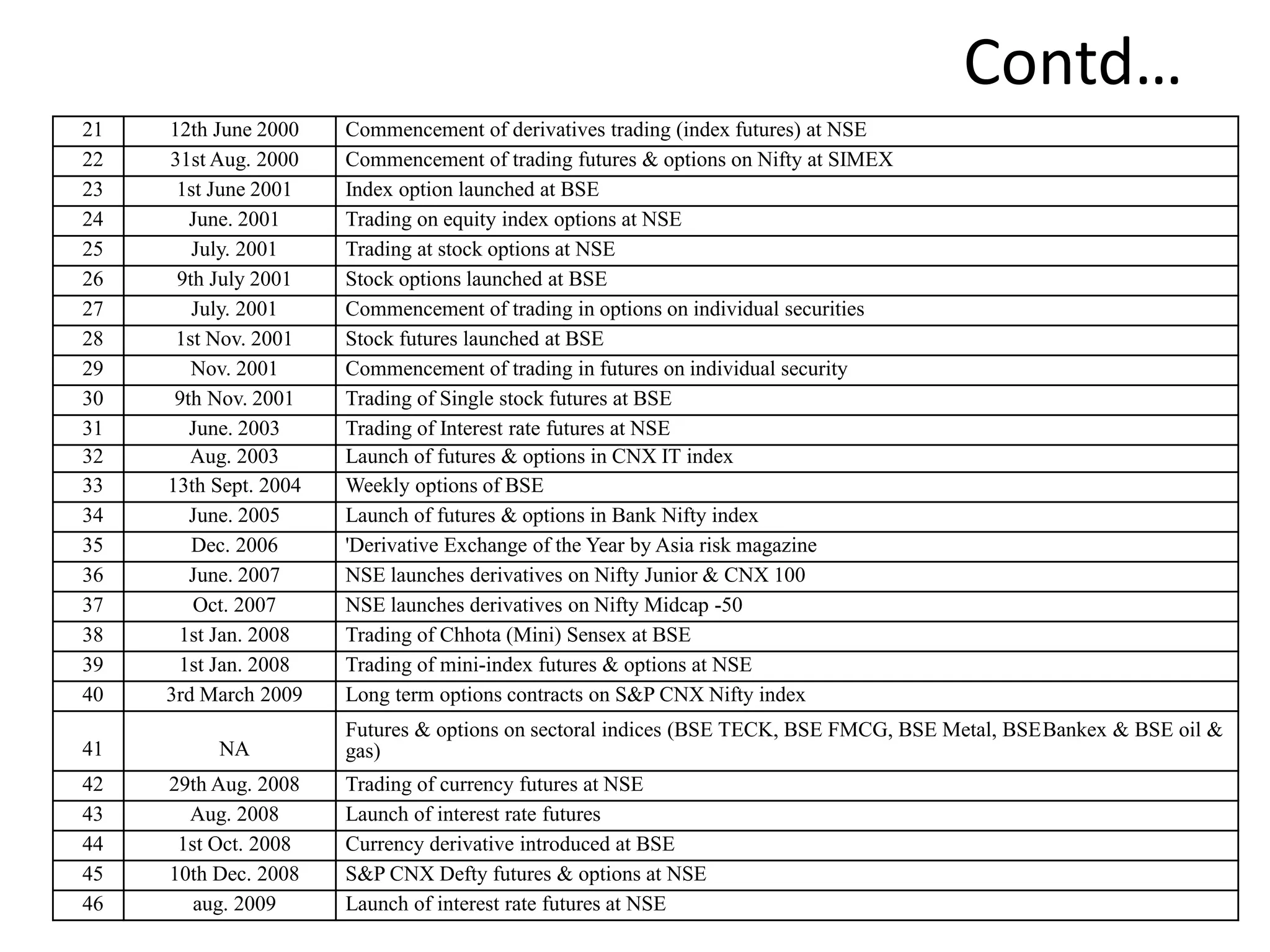
Contd…
21 12th June 2000 Commencement of derivatives trading (index futures) at NSE
22 31st Aug. 2000 Commencement of trading futures & options on Nifty at SIMEX
23 1st June 2001 Index option launched at BSE
24 June. 2001 Trading on equity index options at NSE
25 July. 2001 Trading at stock options at NSE
26 9th July 2001 Stock options launched at BSE
27 July. 2001 Commencement of trading in options on individual securities
28 1st Nov. 2001 Stock futures launched at BSE
29 Nov. 2001 Commencement of trading in futures on individual security
30 9th Nov. 2001 Trading of Single stock futures at BSE
31 June. 2003 Trading of Interest rate futures at NSE
32 Aug. 2003 Launch of futures & options in CNX IT index
33 13th Sept. 2004 Weekly options of BSE
34 June. 2005 Launch of futures & options in Bank Nifty index
35 Dec. 2006 'Derivative Exchange of the Year by Asia risk magazine
36 June. 2007 NSE launches derivatives on Nifty Junior & CNX 100
37 Oct. 2007 NSE launches derivatives on Nifty Midcap -50
38 1st Jan. 2008 Trading of Chhota (Mini) Sensex at BSE
39 1st Jan. 2008 Trading of mini-index futures & options at NSE
40 3rd March 2009 Long term options contracts on S&P CNX Nifty index
41 NA
Futures & options on sectoral indices (BSE TECK, BSE FMCG, BSE Metal, BSEBankex & BSE oil &
gas)
42 29th Aug. 2008 Trading of currency futures at NSE
43 Aug. 2008 Launch of interest rate futures
44 1st Oct. 2008 Currency derivative introduced at BSE
45 10th Dec. 2008 S&P CNX Defty futures & options at NSE
46 aug. 2009 Launch of interest rate futures at NSE
Factors contributing to the growth and
development of derivative market in India
• 1. Price volatility
• 2. Globalization
• 3. Technological innovations
• 4. Introduction of ICT
• 5. Concept of risk hedging and mitigating
• 6. Applications of financial theories
• 7. As an avenue of speculation
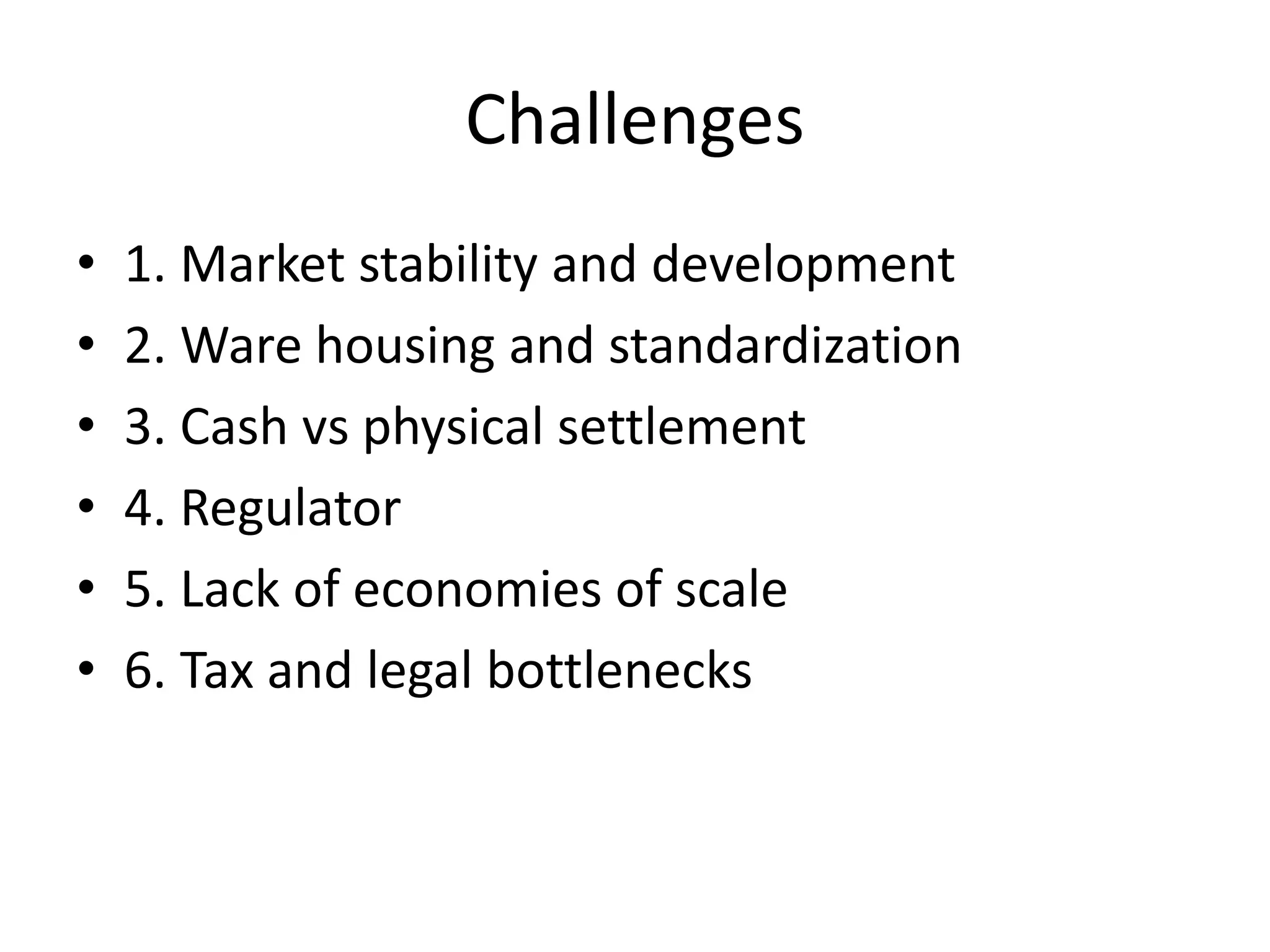
Challenges
• 1. Market stability and development
• 2. Ware housing and standardization
• 3. Cash vs physical settlement
• 4. Regulator
• 5. Lack of economies of scale
• 6. Tax and legal bottlenecks
Players in Derivatives
• Speculator
• Arbitrageurs
• Hedger
• Margin Trader
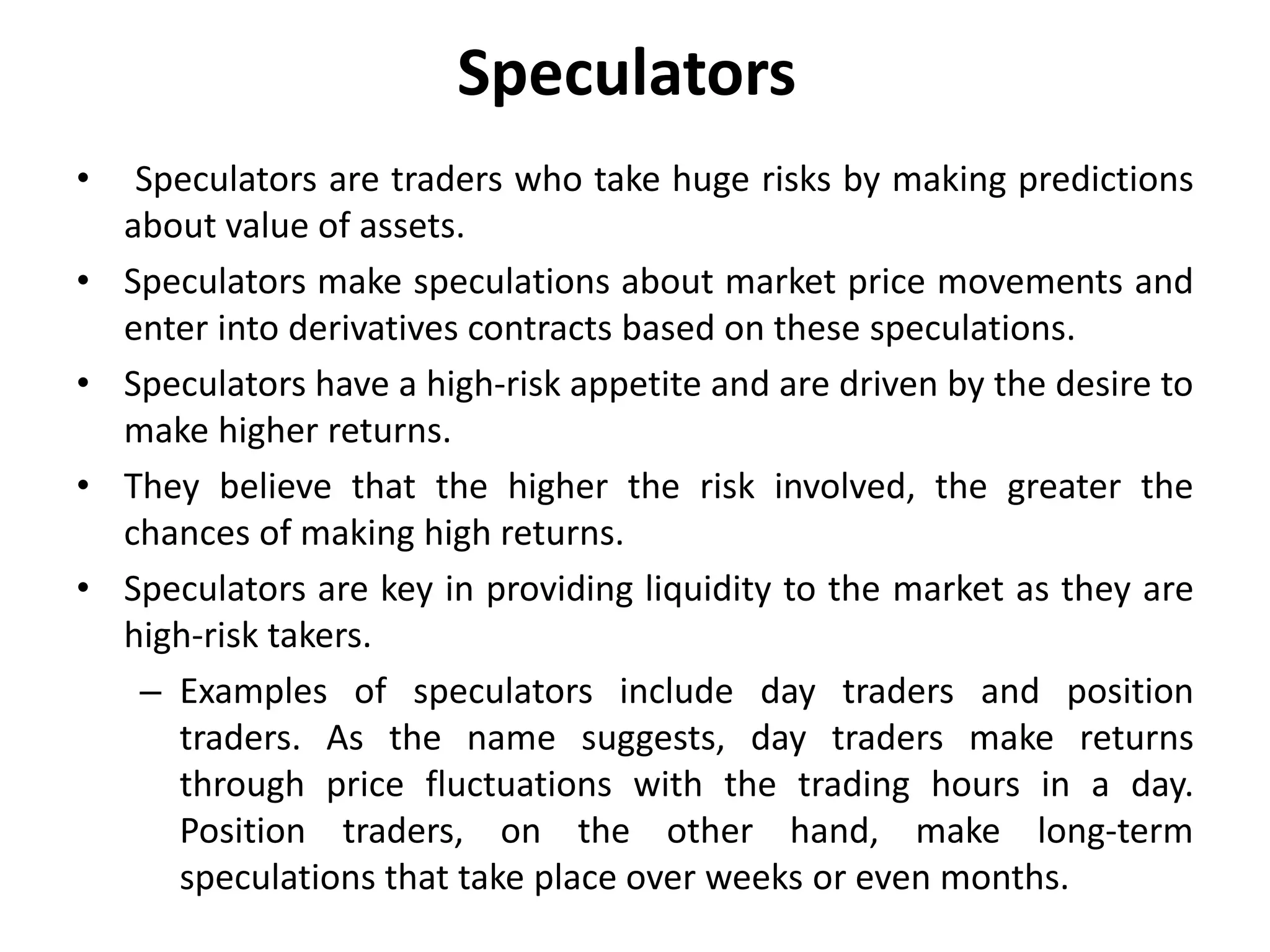
Speculators
• Speculators are traders who take huge risks by making predictions
about value of assets.
• Speculators make speculations about market price movements and
enter into derivatives contracts based on these speculations.
• Speculators have a high-risk appetite and are driven by the desire to
make higher returns.
• They believe that the higher the risk involved, the greater the
chances of making high returns.
• Speculators are key in providing liquidity to the market as they are
high-risk takers.
– Examples of speculators include day traders and position
traders. As the name suggests, day traders make returns
through price fluctuations with the trading hours in a day.
Position traders, on the other hand, make long-term
speculations that take place over weeks or even months.
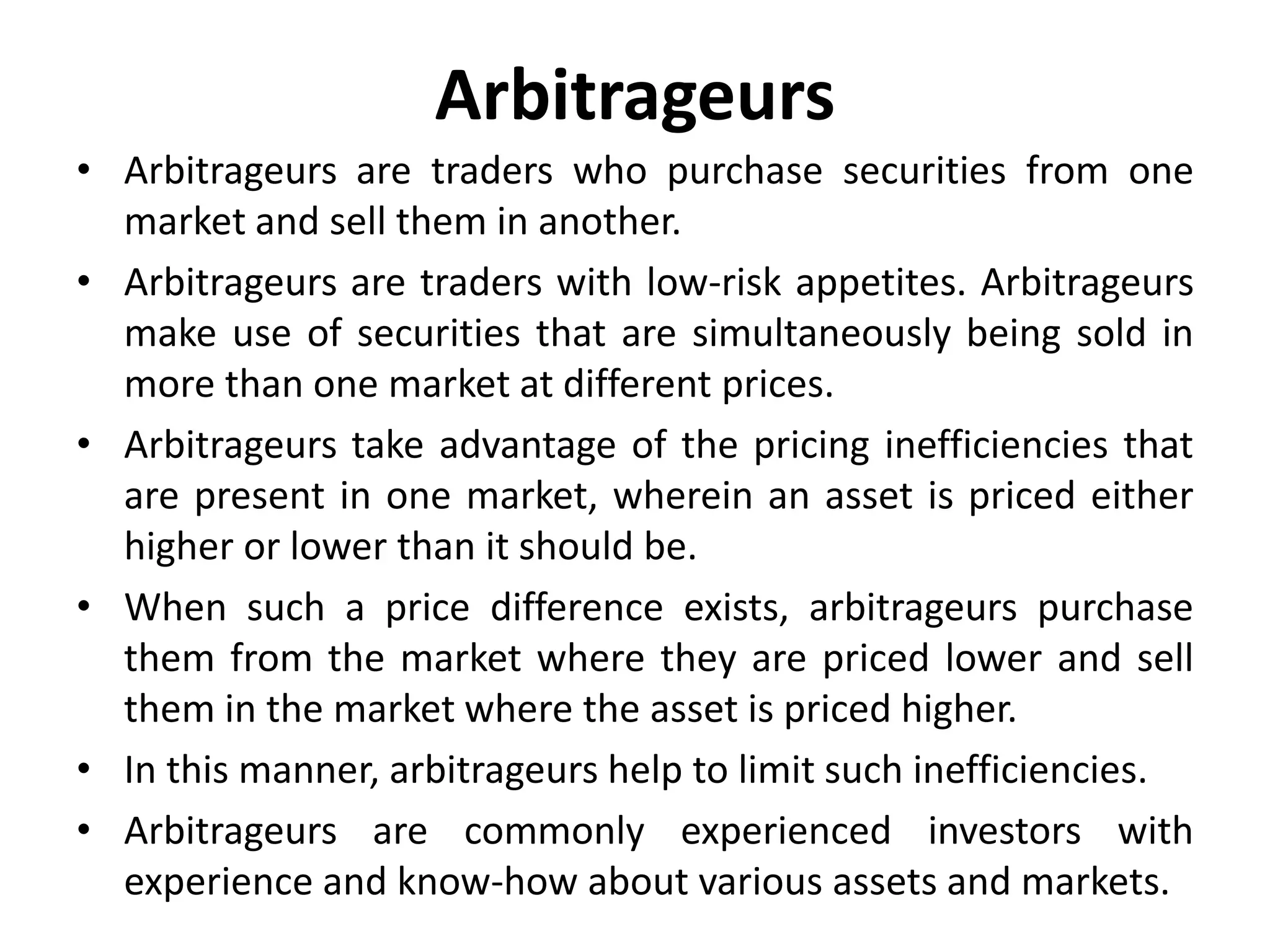
Arbitrageurs
• Arbitrageurs are traders who purchase securities from one
market and sell them in another.
• Arbitrageurs are traders with low-risk appetites. Arbitrageurs
make use of securities that are simultaneously being sold in
more than one market at different prices.
• Arbitrageurs take advantage of the pricing inefficiencies that
are present in one market, wherein an asset is priced either
higher or lower than it should be.
• When such a price difference exists, arbitrageurs purchase
them from the market where they are priced lower and sell
them in the market where the asset is priced higher.
• In this manner, arbitrageurs help to limit such inefficiencies.
• Arbitrageurs are commonly experienced investors with
experience and know-how about various assets and markets.
Hedgers
• Hedgers are traders who invest in the derivatives market to mitigate
risk.
• Hedgers are risk-averse investors who use derivative instruments to
reduce the losses that market volatility entails.
• Hedging helps to counterbalance the risks involved in investing in
assets such as stocks, bonds, commodities, or currencies.
• Through hedging, the investors protect their assets by entering into
an exact opposite trade in the derivative market.
• In this manner, the hedger transfers the risk to other market
participants who are risk-seekers and hedge against losses.
• The risk-seekers, in turn, are those investors and traders willing to
take on the risk.
• Hedgers commonly include producers, farmers, and wholesalers
who face losses if their commodities’ prices fall.
Margin Traders
• Margin traders are speculators who aim to make quick profits
through the derivatives market.
• Margin traders use leveraging to make purchases that are beyond
the means of their current financial status.
• Their trading technique is known as margin trading.
• Margin trading refers to the trading technique where the investors
only pay a fraction of the total amount payable initially.
• A small fraction of the total amount payable is as a deposit, known
as the margin balance. Using margin trading, investors can make
more significant trades than what their financial capacity can afford.
• Margin trading is a technique that is distinctive to the derivatives
market.
– Examples of margin traders include day traders and position
traders.
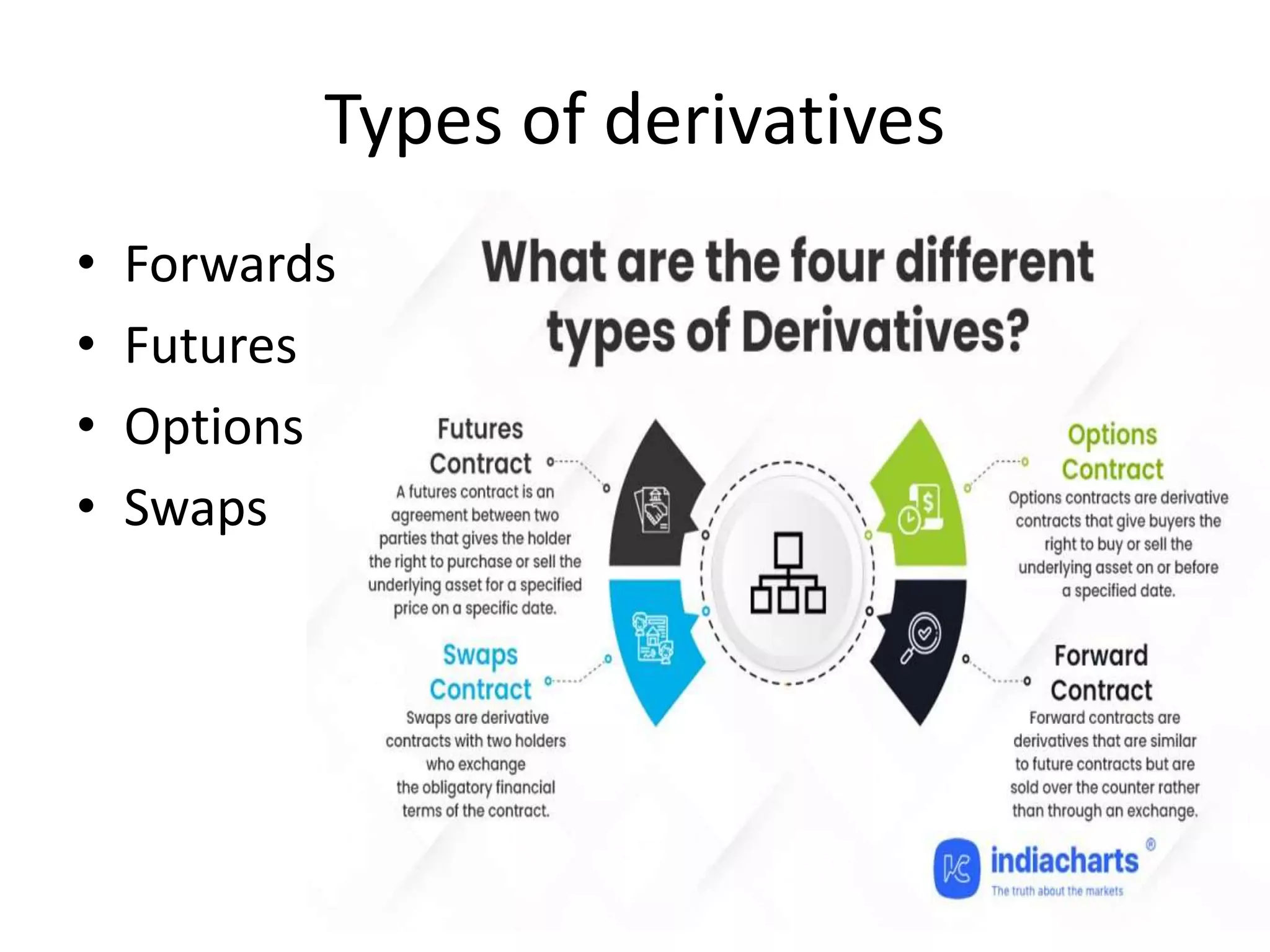
Types of derivatives
• Forwards
• Futures
• Options
• Swaps
Forwards
• Forward contracts are derivatives that are similar to future contracts but are sold over the
counter rather than through an exchange.
• Forward contracts are customized agreements whose terms are made to cater to the needs
of the buyers and sellers.
• Since they are sold over the counter, they encompass more risk to both the involved
parties.
• Forward contracts do not fall under the jurisdiction of regulatory authorities such as the
SEBI in India and the SEC in the United States, thereby making them riskier than futures
contracts.
• Forwards contracts involve counterparty risks when one party cannot fulfill their
obligations as deemed by the contract.
• Forward contracts, like futures contracts, help hedge as well as speculate.
• Forward contracts shield holders from incurring huge losses apart from offering the two
parties the means to customize the contract according to their specific needs.
• Since futures contracts are exchange based, they cannot be altered to suit the needs of the
two parties.
• In situations where there’s a need to customize the derivatives contract, the forward
contract works better.
• Forward contracts are traded on all major stock exchanges, including the Indian stock
exchange.
Example
• a company can purchase a forward contract for oil
for Rs 3800 a barrel with an expiry date of November
23, 2020, from an oil seller. This contract ensures
that regardless of the price fluctuations, the
company can buy oil for Rs 3800 a barrel on the set
date. However, since the contract is not exchange-
based, there is a slight chance that the seller will not
stick to the terms of the contract.
Futures
• Futures contract is an agreement between two parties that gives the
holder the right to purchase or sell the underlying asset for a specified
price on a specific date.
• Futures contracts are obligatory, and therefore binding on the two parties.
• Futures contracts are standardized derivative contracts that trade on
exchanges.
• Traders use futures contracts to hedge against risks due to price
fluctuations in the underlying assets.
• Futures contracts promise the holder a predetermined buying or selling
price, which remains unaltered irrespective of the market volatility, and
therefore shields them from risk.
• Futures contracts are traded in all major stock markets, including the
Indian Stock Markets like the Bombay Stock Exchange and the National
Stock Exchange of India.
• The Securities and Exchange Board of India (SEBI) regulates all the futures
contracts in India.
Example
• Futures contracts are based on any type of asset or
commodity, including agricultural goods, energy-based
commodities, stocks, bonds, etc.
• For example, an agricultural future contract is based on an
agricultural commodity such as wheat or cotton. A bakery
owner buys a futures contract for wheat, for 100 kg at Rs
40,000, with an expiry date of December 23, 2022. The bakery
owner makes this purchase because he fears the wheat price
will increase. By purchasing this futures contract, he is assured
100 kg at Rs 40,000 irrespective of the price changes.
Options
• Options contracts are derivative contracts that give buyers the right
to buy or sell the underlying asset on or before a specified date.
• Options contracts, however, are not obligatory wherein the buyer is
bound to fulfill the terms of the contract.
• Like futures contracts, options contracts also form an agreement
between two parties.
• The only difference between a futures contract and an options
contract is that the holders of options contracts are not under any
obligation to buy or sell the asset as deemed by the contract.
• Options contracts only provide their holders with the opportunity
to buy or sell an asset at a specific price, should they so desire.
• Option contracts protect traders from risks while allowing them to
avoid falling through with the contract if the contract terms do not
seem attractive later.
• Options help traders to hedge against market price fluctuations.
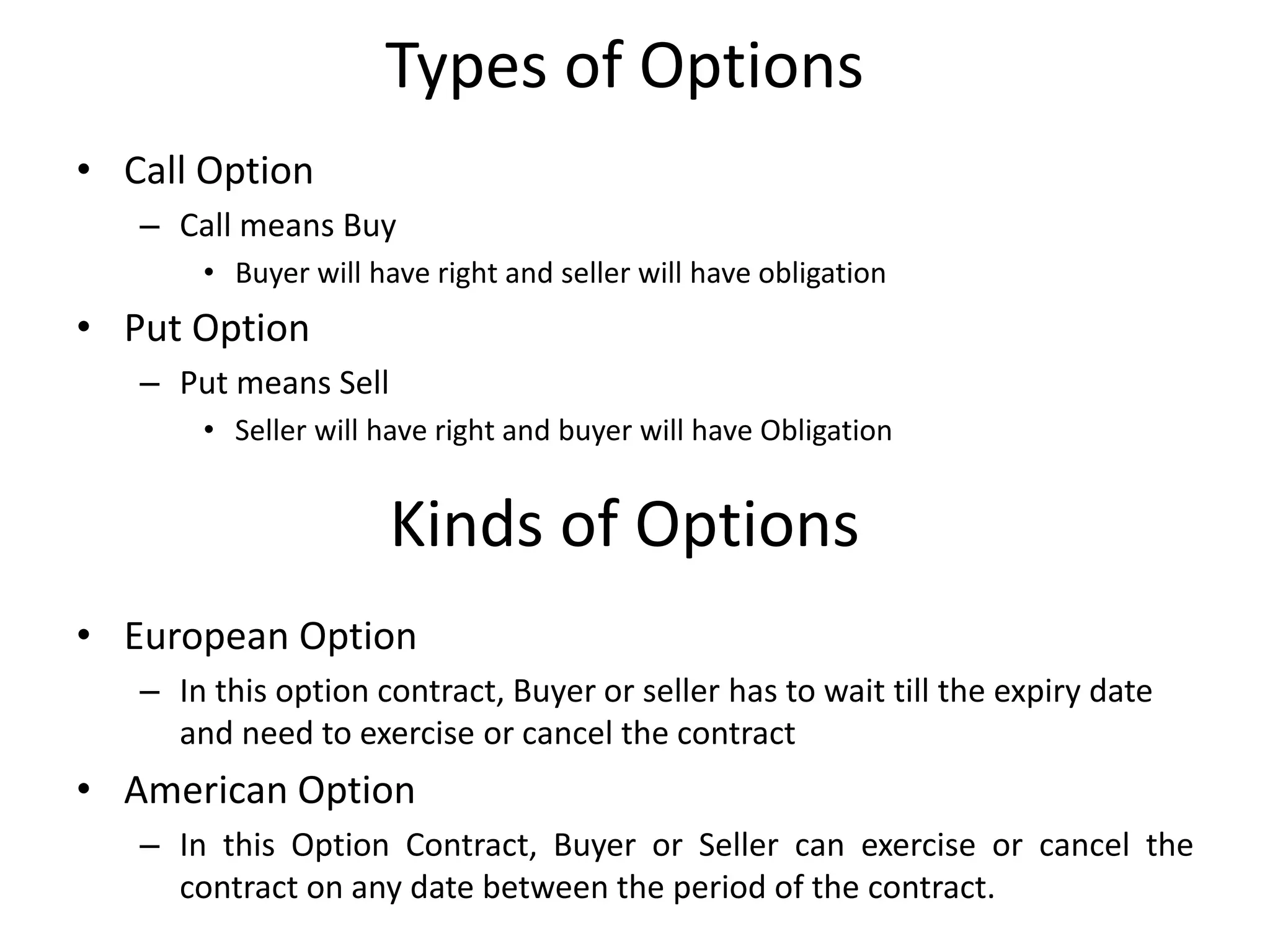
Types of Options
• Call Option
– Call means Buy
• Buyer will have right and seller will have obligation
• Put Option
– Put means Sell
• Seller will have right and buyer will have Obligation
Kinds of Options
• European Option
– In this option contract, Buyer or seller has to wait till the expiry date
and need to exercise or cancel the contract
• American Option
– In this Option Contract, Buyer or Seller can exercise or cancel the
contract on any date between the period of the contract.
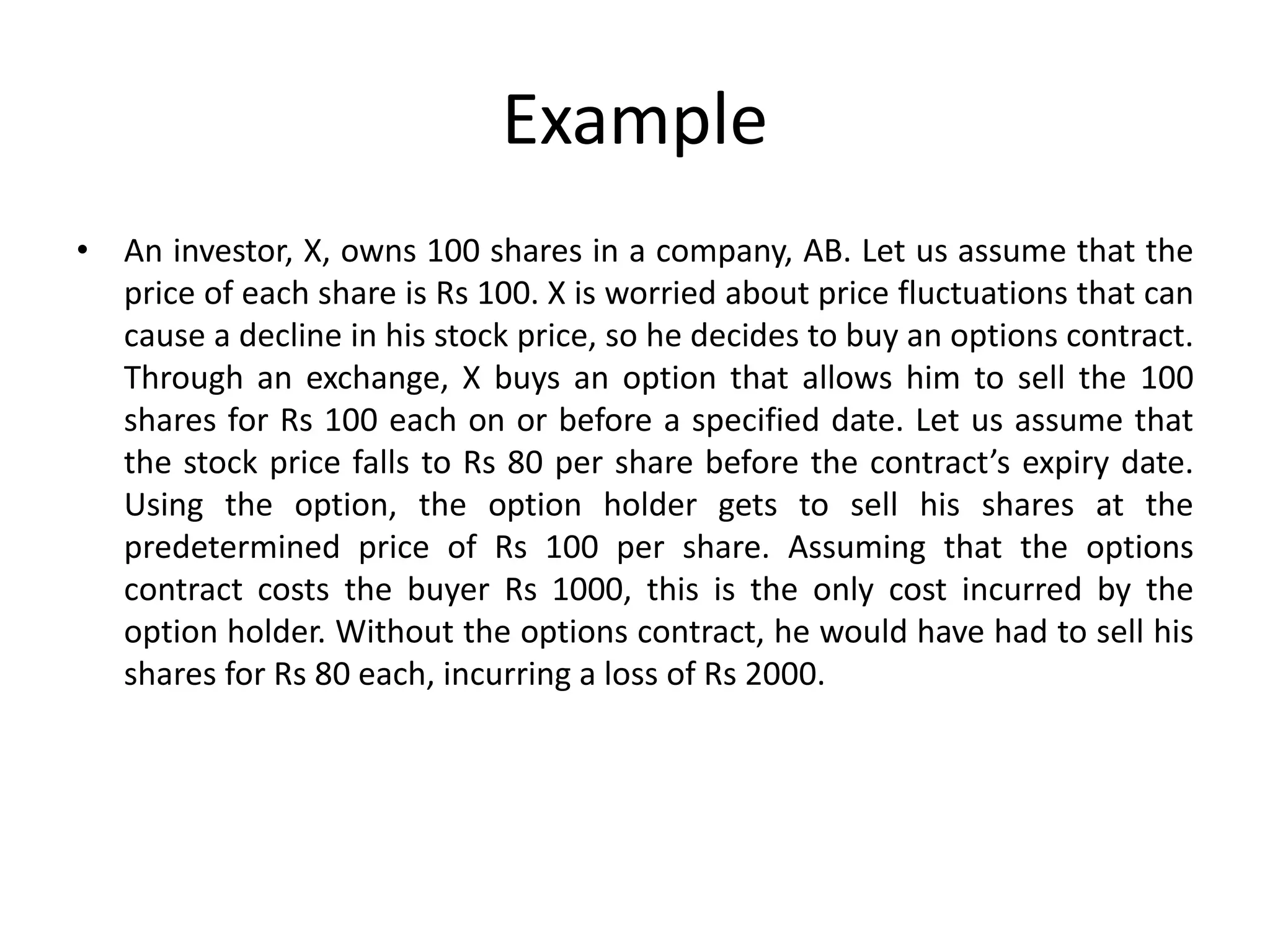
Example
• An investor, X, owns 100 shares in a company, AB. Let us assume that the
price of each share is Rs 100. X is worried about price fluctuations that can
cause a decline in his stock price, so he decides to buy an options contract.
Through an exchange, X buys an option that allows him to sell the 100
shares for Rs 100 each on or before a specified date. Let us assume that
the stock price falls to Rs 80 per share before the contract’s expiry date.
Using the option, the option holder gets to sell his shares at the
predetermined price of Rs 100 per share. Assuming that the options
contract costs the buyer Rs 1000, this is the only cost incurred by the
option holder. Without the options contract, he would have had to sell his
shares for Rs 80 each, incurring a loss of Rs 2000.
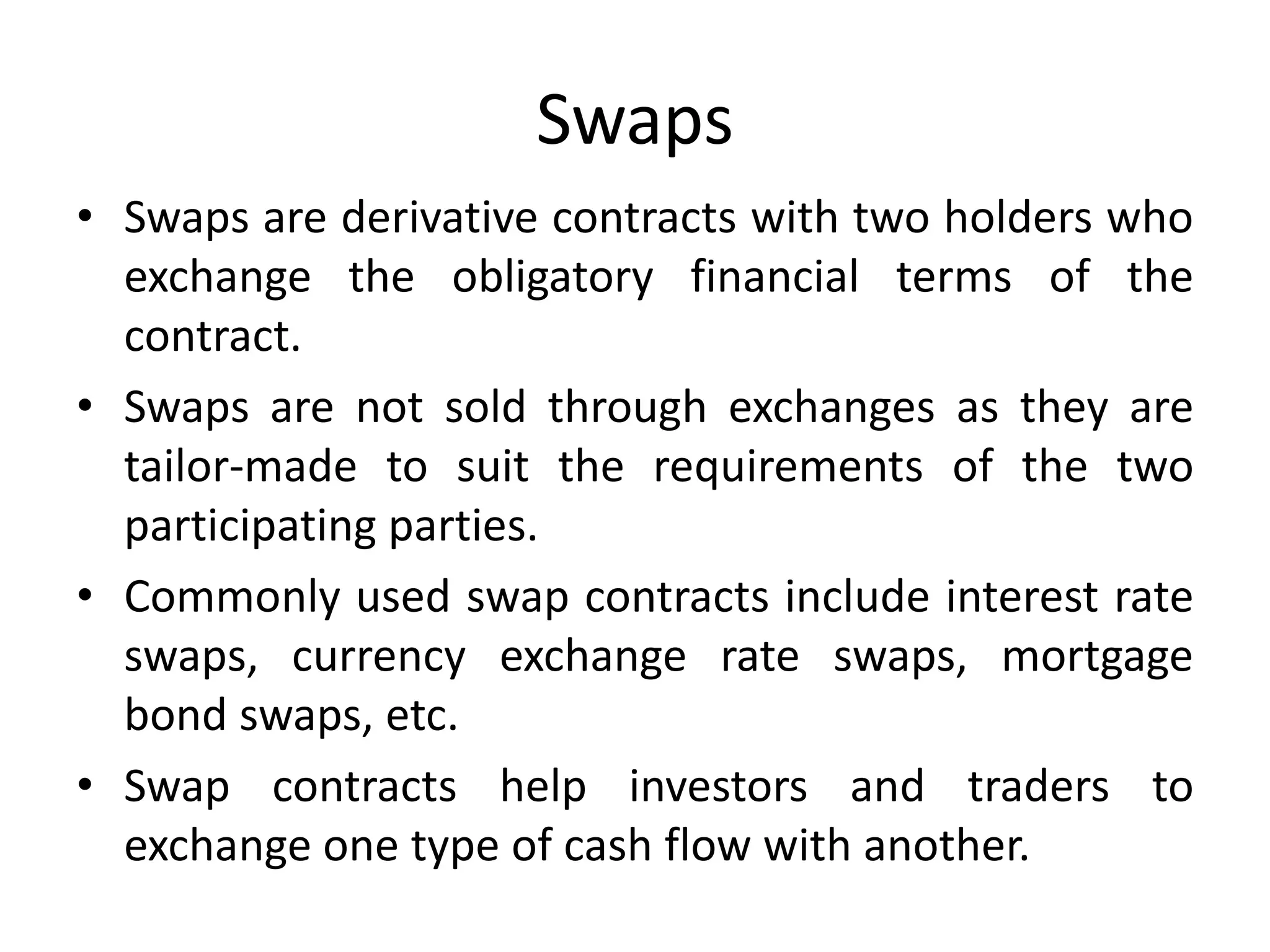
Swaps
• Swaps are derivative contracts with two holders who
exchange the obligatory financial terms of the
contract.
• Swaps are not sold through exchanges as they are
tailor-made to suit the requirements of the two
participating parties.
• Commonly used swap contracts include interest rate
swaps, currency exchange rate swaps, mortgage
bond swaps, etc.
• Swap contracts help investors and traders to
exchange one type of cash flow with another.
Types of Swaps
• Interest Rate Swaps
• Currency Swaps
Example
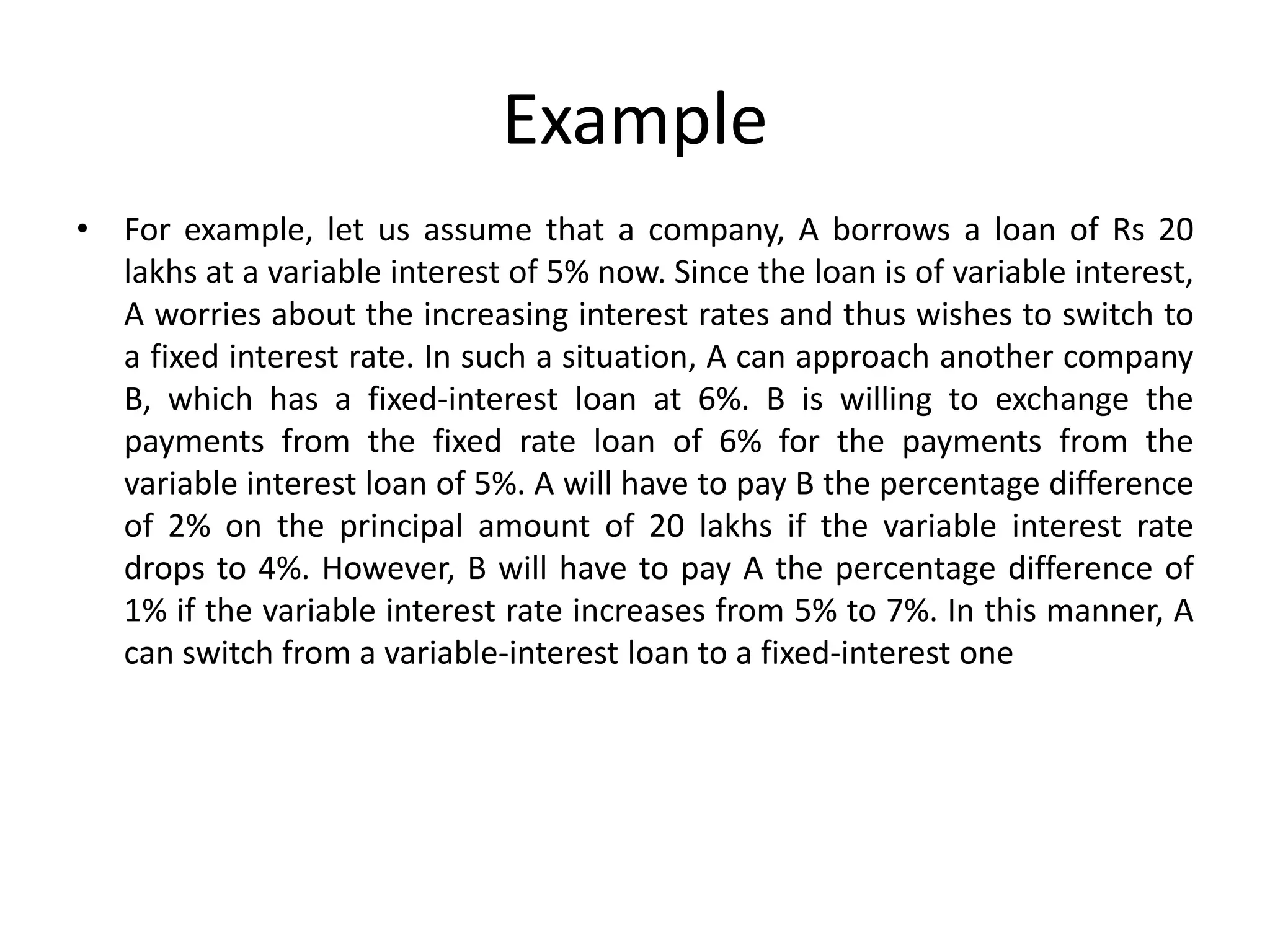
• For example, let us assume that a company, A borrows a loan of Rs 20
lakhs at a variable interest of 5% now. Since the loan is of variable interest,
A worries about the increasing interest rates and thus wishes to switch to
a fixed interest rate. In such a situation, A can approach another company
B, which has a fixed-interest loan at 6%. B is willing to exchange the
payments from the fixed rate loan of 6% for the payments from the
variable interest loan of 5%. A will have to pay B the percentage difference
of 2% on the principal amount of 20 lakhs if the variable interest rate
drops to 4%. However, B will have to pay A the percentage difference of
1% if the variable interest rate increases from 5% to 7%. In this manner, A
can switch from a variable-interest loan to a fixed-interest one
Uses of Derivatives
• Risk management
• Hedging
• Arbitrage Between Markets
• Speculation
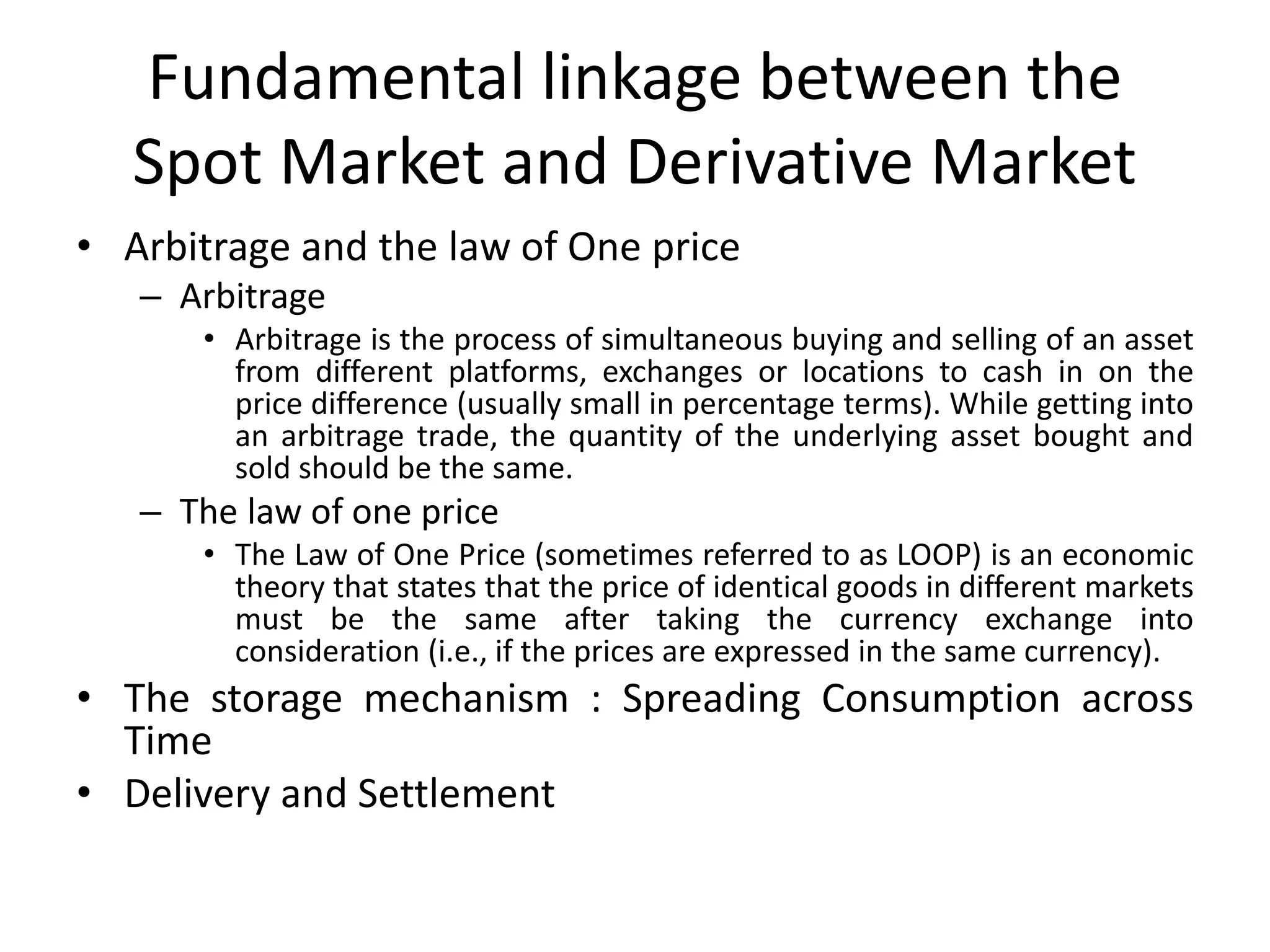
Fundamental linkage between the
Spot Market and Derivative Market
• Arbitrage and the law of One price
– Arbitrage
• Arbitrage is the process of simultaneous buying and selling of an asset
from different platforms, exchanges or locations to cash in on the
price difference (usually small in percentage terms). While getting into
an arbitrage trade, the quantity of the underlying asset bought and
sold should be the same.
– The law of one price
• The Law of One Price (sometimes referred to as LOOP) is an economic
theory that states that the price of identical goods in different markets
must be the same after taking the currency exchange into
consideration (i.e., if the prices are expressed in the same currency).
• The storage mechanism : Spreading Consumption across
Time
• Delivery and Settlement
Role of Derivative markets
• Price Discovery of the Underlying Asset
• Techniques of Risk management
• Operational Advantage
• Market Efficiency
Importance of Derivatives
• Risk Sharing
• Implementation of Asset Allocation Decisions
• Information gathering
• Price Discovery and Liquidity
Uses / Advantages of Derivatives
• Low Transaction costs
• Used in Risk management
• Market Efficiency
• Determines the Price of an underlying Asset
• Risk is transferable
Misuses / Disadvantages
• Involves High Risk
• Counterparty Risk
• Speculative in Nature

Unit - I Introduction to Derivatives.ppt

  • 1.
    Unit – I Introductionto Derivatives Done by K.Arjun Goud
  • 2.
    Derivatives • Financial derivativesare financial instruments that are linked to a specific financial instrument or indicator or commodity, and through which specific financial risks can be traded in financial markets in their own right. • Derivatives is a financial term which means a specific investment, whose value is derived from the underlying assets – Underlying assets are • Stocks • Equity • Debentures • Commodities • Etc.
  • 3.
    Evolution of Derivatives •In India, derivatives markets have been functioning since the nineteenth century, with organized trading in cotton through the establishment of the Cotton Trade Association in 1875. • Derivatives, as exchange traded financial instruments were introduced in India in June 2000. • The National Stock Exchange (NSE) and Bombay Stock Exchange (BSE) are the largest exchanges in India in derivatives trading. • The first derivative contract in India was launched on NSE was the Nifty 50 index futures contract. • The equity derivatives segment in India is called the Futures & Options Segment or F&O Segment. • A series of reforms in the financial markets paved way for the development of exchange-traded equity derivatives markets in India.
  • 4.
    Contdd… • A reporton exchange traded derivatives, by the L.C. Gupta Committee, set up by the Securities and Exchange Board of India (SEBI), recommended a phased introduction of derivatives instruments with bi-level regulation (i.e., self-regulation by exchanges, with SEBI providing the overall regulatory and supervisory role). • Another report, by the J.R. Varma Committee in 1998 worked out the various operational details such as margining and risk management systems for these instruments. • In 1999, the Securities Contracts (Regulation) Act of 1956, or SC(R)A, was amended so that derivatives could be declared as “securities”. • This allowed the regulatory framework for trading securities to be extended to derivatives. The Act considers derivatives on equities to be legal and valid, but only if they are traded on exchanges. • At present, the equity derivatives market is the most active derivatives market in India. • Trading volumes in equity derivatives are, on an average more than three and a half times the trading volumes in the cash equity markets.
  • 5.
    Features of Derivatives •Value of a financial derivative is derived from some other asset. • Derivatives are used for transferring risk from risk adverse investors to risk bearing investors. • Financial derivatives provide commitments to prices or rates for the future dates or given protection against adverse movements of prices or exchange rates and thereby reduce the magnitude of financial risk
  • 6.
    Development of Indianderivative market Sl. No. Progress Date Progress of Financial Derivatives 1 1952 Enactment of the forward contracts (Regulation) Act. 2 1953 Setting up of the forward market commission 3 1956 Enactment of Securities Contract Regulation Act 1956 4 1969 Prohibition of all forms of forward trading under section 16 of SCRA 5 1972 Informal carry forward trades between two settlement cycles began on BSE. 6 1980 Khuso Committee recommends reintroduction of futures in most commodities 7 1983 Govt. amends bye-laws of exchange of Bombay, Calcutta and Ahmedabad andintroduced carry forward trading in specified shares 8 1992 Enactment of the SEBI Act 9 1993 SEBI Prohibits carry forward transactions 10 1994 Kabra Committee recommends futures trading in 9 commodities 11 1995 G.S. Patel Committee recommends revised carry forward system. 12 14th Dec. 1995 NSE asked SEBI for permission to trade index futures 13 1996 Revised system restarted on BSE 14 18th Nov. 1996 SEBI setup LC Gupta committee to draft frame work for index futures 15 11th May 1998 LC Gupta committee submitted report 16 1st June 1999 Interest rate swaps/forward rate agreements allowed at BSE 17 7th July 1999 RBI gave permission to OTC for interest rate swaps/forward rate agreements 18 24th May 2000 SIMEX chose Nifty for trading futures and options on an Indian index 19 25th May 2000 SEBI gave permission to NSE & BSE to do index futures trading 20 9th June 2000 Equity derivatives introduced at BSE
  • 7.
    Contd… 21 12th June2000 Commencement of derivatives trading (index futures) at NSE 22 31st Aug. 2000 Commencement of trading futures & options on Nifty at SIMEX 23 1st June 2001 Index option launched at BSE 24 June. 2001 Trading on equity index options at NSE 25 July. 2001 Trading at stock options at NSE 26 9th July 2001 Stock options launched at BSE 27 July. 2001 Commencement of trading in options on individual securities 28 1st Nov. 2001 Stock futures launched at BSE 29 Nov. 2001 Commencement of trading in futures on individual security 30 9th Nov. 2001 Trading of Single stock futures at BSE 31 June. 2003 Trading of Interest rate futures at NSE 32 Aug. 2003 Launch of futures & options in CNX IT index 33 13th Sept. 2004 Weekly options of BSE 34 June. 2005 Launch of futures & options in Bank Nifty index 35 Dec. 2006 'Derivative Exchange of the Year by Asia risk magazine 36 June. 2007 NSE launches derivatives on Nifty Junior & CNX 100 37 Oct. 2007 NSE launches derivatives on Nifty Midcap -50 38 1st Jan. 2008 Trading of Chhota (Mini) Sensex at BSE 39 1st Jan. 2008 Trading of mini-index futures & options at NSE 40 3rd March 2009 Long term options contracts on S&P CNX Nifty index 41 NA Futures & options on sectoral indices (BSE TECK, BSE FMCG, BSE Metal, BSEBankex & BSE oil & gas) 42 29th Aug. 2008 Trading of currency futures at NSE 43 Aug. 2008 Launch of interest rate futures 44 1st Oct. 2008 Currency derivative introduced at BSE 45 10th Dec. 2008 S&P CNX Defty futures & options at NSE 46 aug. 2009 Launch of interest rate futures at NSE
  • 8.
    Factors contributing tothe growth and development of derivative market in India • 1. Price volatility • 2. Globalization • 3. Technological innovations • 4. Introduction of ICT • 5. Concept of risk hedging and mitigating • 6. Applications of financial theories • 7. As an avenue of speculation
  • 9.
    Challenges • 1. Marketstability and development • 2. Ware housing and standardization • 3. Cash vs physical settlement • 4. Regulator • 5. Lack of economies of scale • 6. Tax and legal bottlenecks
  • 10.
    Players in Derivatives •Speculator • Arbitrageurs • Hedger • Margin Trader
  • 11.
    Speculators • Speculators aretraders who take huge risks by making predictions about value of assets. • Speculators make speculations about market price movements and enter into derivatives contracts based on these speculations. • Speculators have a high-risk appetite and are driven by the desire to make higher returns. • They believe that the higher the risk involved, the greater the chances of making high returns. • Speculators are key in providing liquidity to the market as they are high-risk takers. – Examples of speculators include day traders and position traders. As the name suggests, day traders make returns through price fluctuations with the trading hours in a day. Position traders, on the other hand, make long-term speculations that take place over weeks or even months.
  • 12.
    Arbitrageurs • Arbitrageurs aretraders who purchase securities from one market and sell them in another. • Arbitrageurs are traders with low-risk appetites. Arbitrageurs make use of securities that are simultaneously being sold in more than one market at different prices. • Arbitrageurs take advantage of the pricing inefficiencies that are present in one market, wherein an asset is priced either higher or lower than it should be. • When such a price difference exists, arbitrageurs purchase them from the market where they are priced lower and sell them in the market where the asset is priced higher. • In this manner, arbitrageurs help to limit such inefficiencies. • Arbitrageurs are commonly experienced investors with experience and know-how about various assets and markets.
  • 13.
    Hedgers • Hedgers aretraders who invest in the derivatives market to mitigate risk. • Hedgers are risk-averse investors who use derivative instruments to reduce the losses that market volatility entails. • Hedging helps to counterbalance the risks involved in investing in assets such as stocks, bonds, commodities, or currencies. • Through hedging, the investors protect their assets by entering into an exact opposite trade in the derivative market. • In this manner, the hedger transfers the risk to other market participants who are risk-seekers and hedge against losses. • The risk-seekers, in turn, are those investors and traders willing to take on the risk. • Hedgers commonly include producers, farmers, and wholesalers who face losses if their commodities’ prices fall.
  • 14.
    Margin Traders • Margintraders are speculators who aim to make quick profits through the derivatives market. • Margin traders use leveraging to make purchases that are beyond the means of their current financial status. • Their trading technique is known as margin trading. • Margin trading refers to the trading technique where the investors only pay a fraction of the total amount payable initially. • A small fraction of the total amount payable is as a deposit, known as the margin balance. Using margin trading, investors can make more significant trades than what their financial capacity can afford. • Margin trading is a technique that is distinctive to the derivatives market. – Examples of margin traders include day traders and position traders.
  • 15.
    Types of derivatives •Forwards • Futures • Options • Swaps
  • 16.
    Forwards • Forward contractsare derivatives that are similar to future contracts but are sold over the counter rather than through an exchange. • Forward contracts are customized agreements whose terms are made to cater to the needs of the buyers and sellers. • Since they are sold over the counter, they encompass more risk to both the involved parties. • Forward contracts do not fall under the jurisdiction of regulatory authorities such as the SEBI in India and the SEC in the United States, thereby making them riskier than futures contracts. • Forwards contracts involve counterparty risks when one party cannot fulfill their obligations as deemed by the contract. • Forward contracts, like futures contracts, help hedge as well as speculate. • Forward contracts shield holders from incurring huge losses apart from offering the two parties the means to customize the contract according to their specific needs. • Since futures contracts are exchange based, they cannot be altered to suit the needs of the two parties. • In situations where there’s a need to customize the derivatives contract, the forward contract works better. • Forward contracts are traded on all major stock exchanges, including the Indian stock exchange.
  • 17.
    Example • a companycan purchase a forward contract for oil for Rs 3800 a barrel with an expiry date of November 23, 2020, from an oil seller. This contract ensures that regardless of the price fluctuations, the company can buy oil for Rs 3800 a barrel on the set date. However, since the contract is not exchange- based, there is a slight chance that the seller will not stick to the terms of the contract.
  • 18.
    Futures • Futures contractis an agreement between two parties that gives the holder the right to purchase or sell the underlying asset for a specified price on a specific date. • Futures contracts are obligatory, and therefore binding on the two parties. • Futures contracts are standardized derivative contracts that trade on exchanges. • Traders use futures contracts to hedge against risks due to price fluctuations in the underlying assets. • Futures contracts promise the holder a predetermined buying or selling price, which remains unaltered irrespective of the market volatility, and therefore shields them from risk. • Futures contracts are traded in all major stock markets, including the Indian Stock Markets like the Bombay Stock Exchange and the National Stock Exchange of India. • The Securities and Exchange Board of India (SEBI) regulates all the futures contracts in India.
  • 19.
    Example • Futures contractsare based on any type of asset or commodity, including agricultural goods, energy-based commodities, stocks, bonds, etc. • For example, an agricultural future contract is based on an agricultural commodity such as wheat or cotton. A bakery owner buys a futures contract for wheat, for 100 kg at Rs 40,000, with an expiry date of December 23, 2022. The bakery owner makes this purchase because he fears the wheat price will increase. By purchasing this futures contract, he is assured 100 kg at Rs 40,000 irrespective of the price changes.
  • 20.
    Options • Options contractsare derivative contracts that give buyers the right to buy or sell the underlying asset on or before a specified date. • Options contracts, however, are not obligatory wherein the buyer is bound to fulfill the terms of the contract. • Like futures contracts, options contracts also form an agreement between two parties. • The only difference between a futures contract and an options contract is that the holders of options contracts are not under any obligation to buy or sell the asset as deemed by the contract. • Options contracts only provide their holders with the opportunity to buy or sell an asset at a specific price, should they so desire. • Option contracts protect traders from risks while allowing them to avoid falling through with the contract if the contract terms do not seem attractive later. • Options help traders to hedge against market price fluctuations.
  • 21.
    Types of Options •Call Option – Call means Buy • Buyer will have right and seller will have obligation • Put Option – Put means Sell • Seller will have right and buyer will have Obligation Kinds of Options • European Option – In this option contract, Buyer or seller has to wait till the expiry date and need to exercise or cancel the contract • American Option – In this Option Contract, Buyer or Seller can exercise or cancel the contract on any date between the period of the contract.
  • 22.
    Example • An investor,X, owns 100 shares in a company, AB. Let us assume that the price of each share is Rs 100. X is worried about price fluctuations that can cause a decline in his stock price, so he decides to buy an options contract. Through an exchange, X buys an option that allows him to sell the 100 shares for Rs 100 each on or before a specified date. Let us assume that the stock price falls to Rs 80 per share before the contract’s expiry date. Using the option, the option holder gets to sell his shares at the predetermined price of Rs 100 per share. Assuming that the options contract costs the buyer Rs 1000, this is the only cost incurred by the option holder. Without the options contract, he would have had to sell his shares for Rs 80 each, incurring a loss of Rs 2000.
  • 23.
    Swaps • Swaps arederivative contracts with two holders who exchange the obligatory financial terms of the contract. • Swaps are not sold through exchanges as they are tailor-made to suit the requirements of the two participating parties. • Commonly used swap contracts include interest rate swaps, currency exchange rate swaps, mortgage bond swaps, etc. • Swap contracts help investors and traders to exchange one type of cash flow with another.
  • 24.
    Types of Swaps •Interest Rate Swaps • Currency Swaps
  • 25.
    Example • For example,let us assume that a company, A borrows a loan of Rs 20 lakhs at a variable interest of 5% now. Since the loan is of variable interest, A worries about the increasing interest rates and thus wishes to switch to a fixed interest rate. In such a situation, A can approach another company B, which has a fixed-interest loan at 6%. B is willing to exchange the payments from the fixed rate loan of 6% for the payments from the variable interest loan of 5%. A will have to pay B the percentage difference of 2% on the principal amount of 20 lakhs if the variable interest rate drops to 4%. However, B will have to pay A the percentage difference of 1% if the variable interest rate increases from 5% to 7%. In this manner, A can switch from a variable-interest loan to a fixed-interest one
  • 26.
    Uses of Derivatives •Risk management • Hedging • Arbitrage Between Markets • Speculation
  • 27.
    Fundamental linkage betweenthe Spot Market and Derivative Market • Arbitrage and the law of One price – Arbitrage • Arbitrage is the process of simultaneous buying and selling of an asset from different platforms, exchanges or locations to cash in on the price difference (usually small in percentage terms). While getting into an arbitrage trade, the quantity of the underlying asset bought and sold should be the same. – The law of one price • The Law of One Price (sometimes referred to as LOOP) is an economic theory that states that the price of identical goods in different markets must be the same after taking the currency exchange into consideration (i.e., if the prices are expressed in the same currency). • The storage mechanism : Spreading Consumption across Time • Delivery and Settlement
  • 28.
    Role of Derivativemarkets • Price Discovery of the Underlying Asset • Techniques of Risk management • Operational Advantage • Market Efficiency
  • 29.
    Importance of Derivatives •Risk Sharing • Implementation of Asset Allocation Decisions • Information gathering • Price Discovery and Liquidity
  • 30.
    Uses / Advantagesof Derivatives • Low Transaction costs • Used in Risk management • Market Efficiency • Determines the Price of an underlying Asset • Risk is transferable
  • 31.
    Misuses / Disadvantages •Involves High Risk • Counterparty Risk • Speculative in Nature