Patient Education
CHAPTER 6
Learning
Objectives
Define patient education
Understand the concept, purposes &
importance of patient education
Explain the process of patient education
Describe the role of nurse in patient
education
Explain how to integrate patient teaching in
Nursing Process
CHAPTER
OUTLINE
 Introduction
 Patient Education
and Health Education
 Concept and
importance
 Patient education
process
 Role of nurse in patient
education
 Integrating patient
education in nursing
process
INTRODUCTION
Patient education starts with disease oriented
patient education (DOPE) to prevention oriented
patient education (POPE) and ultimately health
oriented patient education (HOPE). —
Grueninger, 1995
ASPECTS OF
NURSING
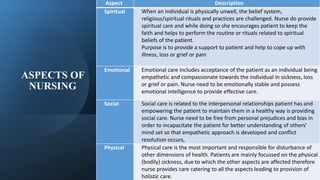
Aspect Description
Spiritual When an individual is physically unwell, the belief system,
religious/spiritual rituals and practices are challenged. Nurse do provide
spiritual care and while doing so she encourages patient to keep the
faith and helps to perform the routine or rituals related to spiritual
beliefs of the patient.
Purpose is to provide a support to patient and help to cope up with
illness, loss or grief or pain
Emotional Emotional care includes acceptance of the patient as an individual being
empathetic and compassionate towards the individual in sickness, loss
or grief or pain. Nurse need to be emotionally stable and possess
emotional intelligence to provide effective care.
Social Social care is related to the interpersonal relationships patient has and
empowering the patient to maintain them in a healthy way is providing
social care. Nurse need to be free from personal prejudices and bias in
order to incapacitate the patient for better understanding of others’
mind set so that empathetic approach is developed and conflict
resolution occurs,
Physical Physical care is the most important and responsible for disturbance of
other dimensions of health. Patients are mainly focussed on the physical
(bodily) sickness, due to which the other aspects are affected therefore
nurse provides care catering to all the aspects leading to provision of
holistic care.
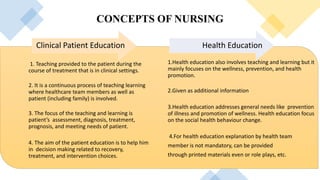
CONCEPTS OF NURSING
1. Teaching provided to the patient during the
course of treatment that is in clinical settings.
2. It is a continuous process of teaching learning
where healthcare team members as well as
patient (including family) is involved.
3. The focus of the teaching and learning is
patient’s assessment, diagnosis, treatment,
prognosis, and meeting needs of patient.
4. The aim of the patient education is to help him
in decision making related to recovery,
treatment, and intervention choices.
1.Health education also involves teaching and learning but it
mainly focuses on the wellness, prevention, and health
promotion.
2.Given as additional information
3.Health education addresses general needs like prevention
of illness and promotion of wellness. Health education focus
on the social health behaviour change.
4.For health education explanation by health team
member is not mandatory, can be provided
through printed materials even or role plays, etc.
Clinical Patient Education Health Education
CONCEPT AND IMPORTANCE OF
PATIENT EDUCATION
Patient education has always been considered to be
competent nursing care. Role of nurse as educator
has evolved with nursing profession.
CONCEPT AND IMPORTANCE OF
PATIENT EDUCATION
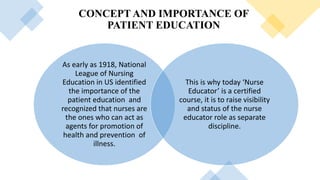
As early as 1918, National
League of Nursing
Education in US identified
the importance of the
patient education and
recognized that nurses are
the ones who can act as
agents for promotion of
health and prevention of
illness.
This is why today ‘Nurse
Educator’ is a certified
course, it is to raise visibility
and status of the nurse
educator role as separate
discipline.
PURPOSES OF PATIENT
EDUCATION
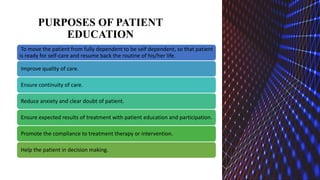
To move the patient from fully dependent to be self dependent, so that patient
is ready for self-care and resume back the routine of his/her life.
Improve quality of care.
Ensure continuity of care.
Reduce anxiety and clear doubt of patient.
Ensure expected results of treatment with patient education and participation.
Promote the compliance to treatment therapy or intervention.
Help the patient in decision making.
PATIENT EDUCATION PROCESS
It is a systematic sequential planned course of
action which consist of two major components
teaching and learning leading to best decision
making. The participants in this process are health
team members and the patient. Nurse mainly has
the responsibility for imparting patient education
and with patient.
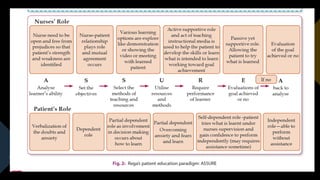
EXPANDED ROLES OF NURSES
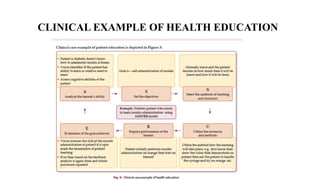
CLINICAL EXAMPLE OF HEALTH EDUCATION
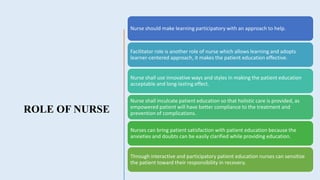
ROLE OF NURSE
Nurse should make learning participatory with an approach to help.
Facilitator role is another role of nurse which allows learning and adopts
learner-centered approach, it makes the patient education effective.
Nurse shall use innovative ways and styles in making the patient education
acceptable and long-lasting effect.
Nurse shall inculcate patient education so that holistic care is provided, as
empowered patient will have better compliance to the treatment and
prevention of complications.
Nurses can bring patient satisfaction with patient education because the
anxieties and doubts can be easily clarified while providing education.
Through interactive and participatory patient education nurses can sensitize
the patient toward their responsibility in recovery.
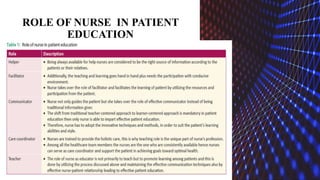
ROLE OF NURSE IN PATIENT
EDUCATION
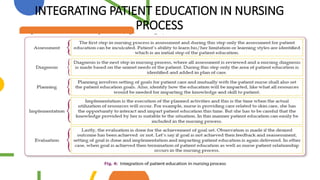
INTEGRATING PATIENT EDUCATION IN NURSING
PROCESS
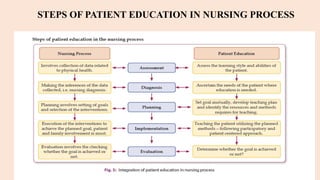
STEPS OF PATIENT EDUCATION IN NURSING PROCESS
SUMMARY
• This chapter dealt with patient
education concept, its importance,
purposes, process and how it can be
integrated in the nursing process.
• Patient education is a process of
assisting the patients to learn health-
related activities or knowledge, which
is helpful for them in gaining self-
dependence in everyday life.
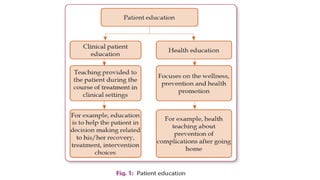
• Patient education has two parts—
clinical patient education and health
education.
SUMMARY
• Patient education is imparted
based on the cooperative
communication, where the
discussion of various options is
done and talks are aimed for
seeking solution or decision
making.
• Open communication during the
patient education helps to have
better therapeutic relationship and
provides self-dependence to the
patient.
“Textbook of Foundation of
Nursing" by Jyoti Kathwal

CHP 6 Patient teaching.pptx

  • 1.
  • 2.
    Learning Objectives Define patient education Understandthe concept, purposes & importance of patient education Explain the process of patient education Describe the role of nurse in patient education Explain how to integrate patient teaching in Nursing Process
  • 3.
    CHAPTER OUTLINE  Introduction  PatientEducation and Health Education  Concept and importance  Patient education process  Role of nurse in patient education  Integrating patient education in nursing process
  • 4.
    INTRODUCTION Patient education startswith disease oriented patient education (DOPE) to prevention oriented patient education (POPE) and ultimately health oriented patient education (HOPE). — Grueninger, 1995
  • 5.
    ASPECTS OF NURSING Aspect Description SpiritualWhen an individual is physically unwell, the belief system, religious/spiritual rituals and practices are challenged. Nurse do provide spiritual care and while doing so she encourages patient to keep the faith and helps to perform the routine or rituals related to spiritual beliefs of the patient. Purpose is to provide a support to patient and help to cope up with illness, loss or grief or pain Emotional Emotional care includes acceptance of the patient as an individual being empathetic and compassionate towards the individual in sickness, loss or grief or pain. Nurse need to be emotionally stable and possess emotional intelligence to provide effective care. Social Social care is related to the interpersonal relationships patient has and empowering the patient to maintain them in a healthy way is providing social care. Nurse need to be free from personal prejudices and bias in order to incapacitate the patient for better understanding of others’ mind set so that empathetic approach is developed and conflict resolution occurs, Physical Physical care is the most important and responsible for disturbance of other dimensions of health. Patients are mainly focussed on the physical (bodily) sickness, due to which the other aspects are affected therefore nurse provides care catering to all the aspects leading to provision of holistic care.
  • 6.
    CONCEPTS OF NURSING 1.Teaching provided to the patient during the course of treatment that is in clinical settings. 2. It is a continuous process of teaching learning where healthcare team members as well as patient (including family) is involved. 3. The focus of the teaching and learning is patient’s assessment, diagnosis, treatment, prognosis, and meeting needs of patient. 4. The aim of the patient education is to help him in decision making related to recovery, treatment, and intervention choices. 1.Health education also involves teaching and learning but it mainly focuses on the wellness, prevention, and health promotion. 2.Given as additional information 3.Health education addresses general needs like prevention of illness and promotion of wellness. Health education focus on the social health behaviour change. 4.For health education explanation by health team member is not mandatory, can be provided through printed materials even or role plays, etc. Clinical Patient Education Health Education
  • 8.
    CONCEPT AND IMPORTANCEOF PATIENT EDUCATION Patient education has always been considered to be competent nursing care. Role of nurse as educator has evolved with nursing profession.
  • 9.
    CONCEPT AND IMPORTANCEOF PATIENT EDUCATION As early as 1918, National League of Nursing Education in US identified the importance of the patient education and recognized that nurses are the ones who can act as agents for promotion of health and prevention of illness. This is why today ‘Nurse Educator’ is a certified course, it is to raise visibility and status of the nurse educator role as separate discipline.
  • 10.
    PURPOSES OF PATIENT EDUCATION Tomove the patient from fully dependent to be self dependent, so that patient is ready for self-care and resume back the routine of his/her life. Improve quality of care. Ensure continuity of care. Reduce anxiety and clear doubt of patient. Ensure expected results of treatment with patient education and participation. Promote the compliance to treatment therapy or intervention. Help the patient in decision making.
  • 11.
    PATIENT EDUCATION PROCESS Itis a systematic sequential planned course of action which consist of two major components teaching and learning leading to best decision making. The participants in this process are health team members and the patient. Nurse mainly has the responsibility for imparting patient education and with patient.
  • 13.
  • 14.
    CLINICAL EXAMPLE OFHEALTH EDUCATION
  • 15.
    ROLE OF NURSE Nurseshould make learning participatory with an approach to help. Facilitator role is another role of nurse which allows learning and adopts learner-centered approach, it makes the patient education effective. Nurse shall use innovative ways and styles in making the patient education acceptable and long-lasting effect. Nurse shall inculcate patient education so that holistic care is provided, as empowered patient will have better compliance to the treatment and prevention of complications. Nurses can bring patient satisfaction with patient education because the anxieties and doubts can be easily clarified while providing education. Through interactive and participatory patient education nurses can sensitize the patient toward their responsibility in recovery.
  • 16.
    ROLE OF NURSEIN PATIENT EDUCATION
  • 17.
  • 18.
    STEPS OF PATIENTEDUCATION IN NURSING PROCESS
  • 19.
    SUMMARY • This chapterdealt with patient education concept, its importance, purposes, process and how it can be integrated in the nursing process. • Patient education is a process of assisting the patients to learn health- related activities or knowledge, which is helpful for them in gaining self- dependence in everyday life. • Patient education has two parts— clinical patient education and health education.
  • 20.
    SUMMARY • Patient educationis imparted based on the cooperative communication, where the discussion of various options is done and talks are aimed for seeking solution or decision making. • Open communication during the patient education helps to have better therapeutic relationship and provides self-dependence to the patient.
  • 21.
    “Textbook of Foundationof Nursing" by Jyoti Kathwal