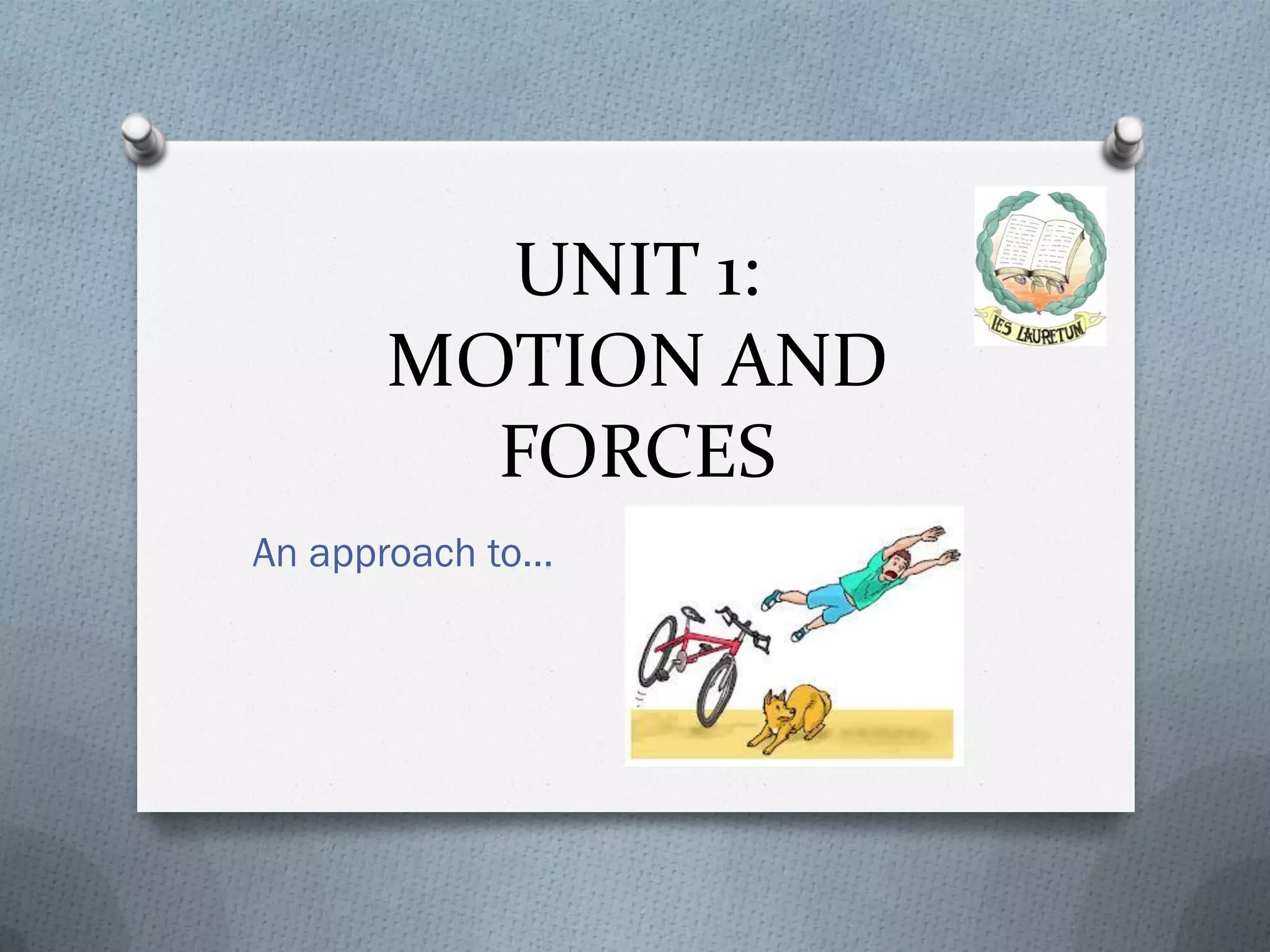
UNIT 1:
MOTION AND
FORCES
An approach to…
VOCABULARY
O Motion
O Rest
O Position (P)
O Frame of reference (SR)
O Vector
O Arrow
O Path
O Distance (∆s)
O Inicial
O Final
O Displacement (∆r)
O Length
O Position-time graph
O Speed-time graph
O To equal
O To increase
O Value
O Linearly
O To speed up
O To slow down
O To curve upward
O To curve downward
O Round-about
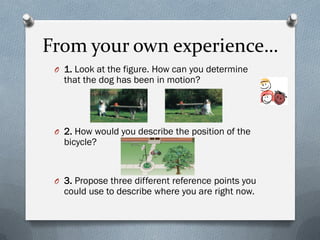
From your own experience…
O 1. Look at the figure. How can you determine
that the dog has been in motion?
O 2. How would you describe the position of the
bicycle?
O 3. Propose three different reference points you
could use to describe where you are right now.
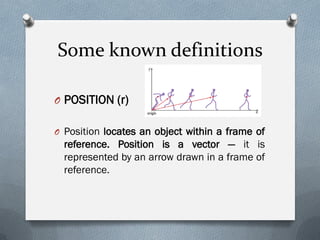
Some known definitions
O POSITION (r)
O Position locates an object within a frame of
reference. Position is a vector — it is
represented by an arrow drawn in a frame of
reference.
Some known definitions
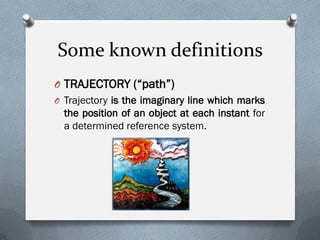
O TRAJECTORY (“path”)
O Trajectory is the imaginary line which marks
the position of an object at each instant for
a determined reference system.
Some known definitions
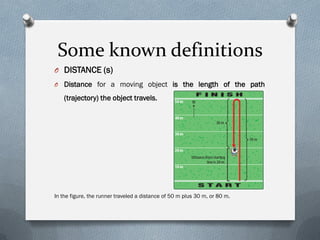
O DISTANCE (s)
O Distance for a moving object is the length of the path
(trajectory) the object travels.
In the figure, the runner traveled a distance of 50 m plus 30 m, or 80 m.
Some known definitions
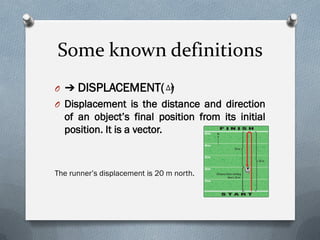
O ➔ DISPLACEMENT( )
O Displacement is the distance and direction
of an object’s final position from its initial
position. It is a vector.
The runner’s displacement is 20 m north.
∆𝑟
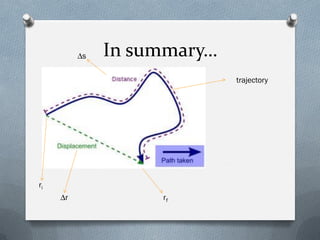
In summary…
∆r rf
ri
trajectory
∆s
Speed
speed
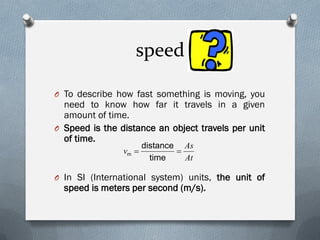
O To describe how fast something is moving, you
need to know how far it travels in a given
amount of time.
O Speed is the distance an object travels per unit
of time.
O In SI (International system) units, the unit of
speed is meters per second (m/s).
At
As
v 
time
distance
m
An ex. of speed
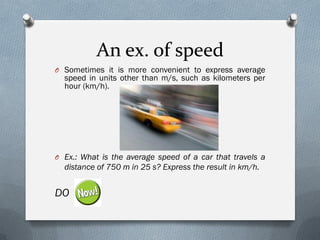
O Sometimes it is more convenient to express average
speed in units other than m/s, such as kilometers per
hour (km/h).
O Ex.: What is the average speed of a car that travels a
distance of 750 m in 25 s? Express the result in km/h.
DO
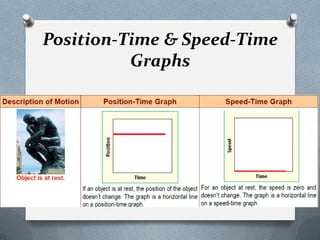
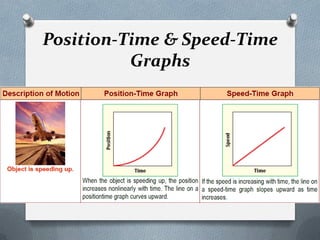
Position-Time & Speed-Time
Graphs
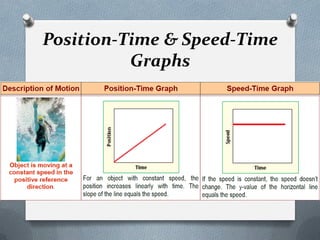
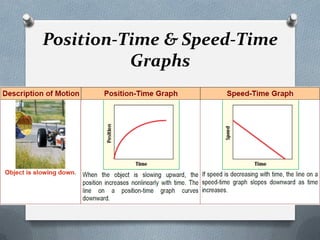
Position-Time & Speed-Time
Graphs
Position-Time & Speed-Time
Graphs
Position-Time & Speed-Time
Graphs
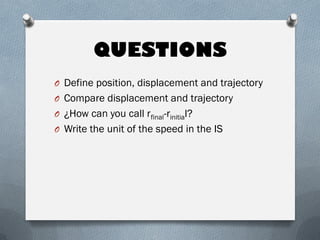
QUESTIONS
O Define position, displacement and trajectory
O Compare displacement and trajectory
O ¿How can you call rfinal-rinitial?
O Write the unit of the speed in the IS

Unit 1. motion and forces

  • 1.
  • 2.
    VOCABULARY O Motion O Rest OPosition (P) O Frame of reference (SR) O Vector O Arrow O Path O Distance (∆s) O Inicial O Final O Displacement (∆r) O Length O Position-time graph O Speed-time graph O To equal O To increase O Value O Linearly O To speed up O To slow down O To curve upward O To curve downward O Round-about
  • 3.
    From your ownexperience… O 1. Look at the figure. How can you determine that the dog has been in motion? O 2. How would you describe the position of the bicycle? O 3. Propose three different reference points you could use to describe where you are right now.
  • 4.
    Some known definitions OPOSITION (r) O Position locates an object within a frame of reference. Position is a vector — it is represented by an arrow drawn in a frame of reference.
  • 5.
    Some known definitions OTRAJECTORY (“path”) O Trajectory is the imaginary line which marks the position of an object at each instant for a determined reference system.
  • 6.
    Some known definitions ODISTANCE (s) O Distance for a moving object is the length of the path (trajectory) the object travels. In the figure, the runner traveled a distance of 50 m plus 30 m, or 80 m.
  • 7.
    Some known definitions O➔ DISPLACEMENT( ) O Displacement is the distance and direction of an object’s final position from its initial position. It is a vector. The runner’s displacement is 20 m north. ∆𝑟
  • 8.
  • 9.
  • 10.
    speed O To describehow fast something is moving, you need to know how far it travels in a given amount of time. O Speed is the distance an object travels per unit of time. O In SI (International system) units, the unit of speed is meters per second (m/s). At As v  time distance m
  • 11.
    An ex. ofspeed O Sometimes it is more convenient to express average speed in units other than m/s, such as kilometers per hour (km/h). O Ex.: What is the average speed of a car that travels a distance of 750 m in 25 s? Express the result in km/h. DO
  • 12.
  • 13.
  • 14.
  • 15.
  • 16.
    QUESTIONS O Define position,displacement and trajectory O Compare displacement and trajectory O ¿How can you call rfinal-rinitial? O Write the unit of the speed in the IS