COMMUNICATION
Q1: How important is COMMUNICATION to you?
(Write your answers in the chat box)
➢Communication has evolved from Latin language.
➢Communis (n) means common, commonality, sharing
➢Communicare (v) means make something common
➢Some scholars relate the term communication with an English word
“community.”
➢Communication is the foundation of a community.
(1) imparting or exchanging of information, ideas or feelings
(2) a document or message imparting news, views, information, etc.
(3) the study of ways in which human beings
communicate, speak, including gestures,
telecommunications systems, publishing, broadcast
media, etc.
Characteristics of Communication:
1. It involves a minimum of 2 persons.
2. It is basically a 2-way process.
3. The forms of communication are (1) orders (2) reports (3) instructions (4)
queries
4. It is influences by the mode of thinking of both the sender and receiver.
5. The main objectives of communication are to (1) build interpersonal
relationships and (2) enhance human behavior.
6. Communication is a circular process that starts and ends with the sender.
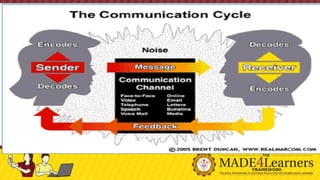
COMMUNICATION process involves the following important factors:
(1) Sender – initiator of the message
(2) Message
may be sent by computer, telephone, letter, memo,
report, announcement, picture, spoken word
(3) Encoding
I. converting the idea into words or gestures
that will convey meaning
(4) Channel – mode message flows
• Computer
• Telephone
• Cellphone
• Television
• Letters
• memorandum
(5) Receiver decodes message.
translating the message from its symbol forming a
meaning
successful communication takes place only when a
receiver understands the meaning intended by
the sender
6. Decoding – comprehending the message
(7) FEEDBACK travels to sender.
the verbal and nonverbal responses of the
receiver create feedback
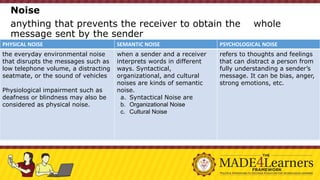
Noise
anything that prevents the receiver to obtain the whole
message sent by the sender
PHYSICAL NOISE SEMANTIC NOISE PSYCHOLOGICAL NOISE
the everyday environmental noise
that disrupts the messages such as
low telephone volume, a distracting
seatmate, or the sound of vehicles
Physiological impairment such as
deafness or blindness may also be
considered as physical noise.
when a sender and a receiver
interprets words in different
ways. Syntactical,
organizational, and cultural
noises are kinds of semantic
noise.
a. Syntactical Noise are
b. Organizational Noise
c. Cultural Noise
refers to thoughts and feelings
that can distract a person from
fully understanding a sender’s
message. It can be bias, anger,
strong emotions, etc.
COMMUNICATION TYPES
• the ways by which communication can be expressed
1. Verbal
• Intrapersonal
• Interpersonal
• Oral communication
• Public Communication
2. Nonverbal – passive form of communication
• Kinesics – body movements
• Paralanguage -- voice
• Haptics --- touch
3. Written – act of transferring and exchanging information through
letters, symbols and words
4. Visual Communication – the act of transmitting
information using visual elements
Examples:
Drawings, signs, typography, colors, shapes, graphic
designs, illustrations, animations
Q2: Which mode of communication are you often
exposed to in your workplace/organization? What do
you think are the skills needed to communicate
properly using that mode?
➢Human communication is the process of making sense out of the
world and sharing that sense with others by creating meaning
through the use of verbal and nonverbal messages.
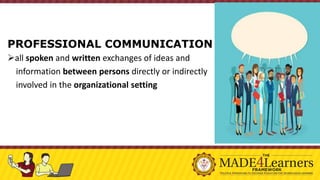
PROFESSIONAL COMMUNICATION
➢all spoken and written exchanges of ideas and
information between persons directly or indirectly
involved in the organizational setting
PROFESSIONAL ORGANIZATION
➢a stable system of individuals who work
together to achieve, through the hierarchy
of ranks and division of labor, common goals
CASE ANALYSIS
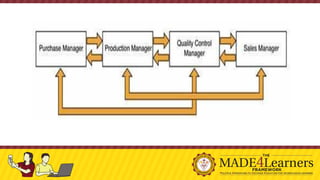
Communication Flow
COMMUNICATION NETWORKS
➢are linked communication channels or paths through which
communication flows from one person to another in the
organization
➢signify the existence of specific patterns by which messages
are communicated between three or more individuals (Neher
1997)
Two fundamental components by which communication flow:
1. FORMAL CHANNEL
➢officially sanctioned channels for flow of communication
➢function through rules, regulations and are directly connected to the
organizational structure defined by the organization
The organization's designated structure indicates two major directions of
communication flow, they include:
1.1 Vertical Communication
➢is the flow of information both up and down the chain of command
➢involves an exchange of messages between two or more levels in the
organizational hierarchy
Two categories in vertical communication:
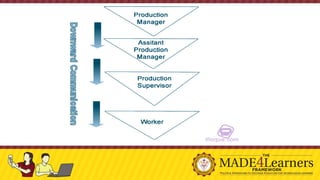
1.1.1 Downward communication
➢Communication flows from a higher level to one or more lower levels
➢may be in the form of staff meeting, company policy statement, company
newsletters, informational memos, face-to-face contact and speeches.
Most downward communication involves information like:
➢Job instruction or specific jobs
➢Relations between tasks
➢Goals/objectives
➢Directions, decisions
➢Procedures and practices to be adopted
➢Performance feedback
➢Encouragement/appreciations
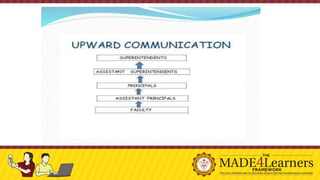
1.1.2 Upward Communication
➢communication flows from a lower level to higher levels in the organization
➢consists of messages sent up the lines from subordinates to managers
➢ provides feedback for upper management regarding policies and practices,
which allows for wider participation in decision-making
Most upward communication consists in the following topical points:
➢Progress reports or information
➢Problem resolutions
➢New developments
➢Suggestions for improvements
➢Complaints/problems
➢Appeal (Requests)
➢Exit interviews
1.2 Horizontal or Lateral Communication
➢occurs in an organization between employees at the same hierarchical level
➢appears to be more prevalent across the lower levels of the organization,
where it tends to focus on problem-solving, information sharing and conflict
resolution
➢used to improve understanding, coordinate efforts for achieving organization
objectives.
Formal communication channels are like highlighted roads on a road map.
They specify organizational members who are responsible for tasks and
communicating information to levels above and below them and back and
forth to adjacent units.
2. INFORMAL CHANNEL
➢are communication routes that are not prespecified by the organization but
that develop through interpersonal relationships in the organization
➢ helps to convey unofficial or informal information (for example, conversations
among personnel and year-end functions); information may be work related,
social or personal.
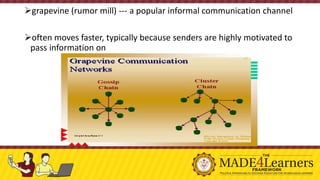
➢grapevine (rumor mill) --- a popular informal communication channel
➢often moves faster, typically because senders are highly motivated to
pass information on
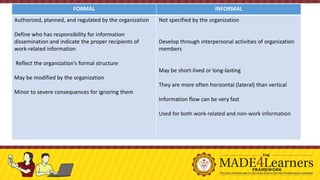
FORMAL INFORMAL
Authorized, planned, and regulated by the organization
Define who has responsibility for information
dissemination and indicate the proper recipients of
work-related information
Reflect the organization’s formal structure
May be modified by the organization
Minor to severe consequences for ignoring them
Not specified by the organization
Develop through interpersonal activities of organization
members
May be short-lived or long-lasting
They are more often horizontal (lateral) than vertical
Information flow can be very fast
Used for both work-related and non-work information
Q3: How important is professional communication to you
as a member of an organization?
(Write your answers in the chat box)
UNITY PROFESSIONALISM PRODUCTIVITY PEACE & HARMONY
Enrichment links
https://www.youtube.com/watch?v=GY3ADgnWLos

Unit 1 Introduction to Communication.pdf

  • 1.
  • 2.
    Q1: How importantis COMMUNICATION to you? (Write your answers in the chat box)
  • 3.
    ➢Communication has evolvedfrom Latin language. ➢Communis (n) means common, commonality, sharing ➢Communicare (v) means make something common
  • 4.
    ➢Some scholars relatethe term communication with an English word “community.” ➢Communication is the foundation of a community.
  • 5.
    (1) imparting orexchanging of information, ideas or feelings (2) a document or message imparting news, views, information, etc.
  • 6.
    (3) the studyof ways in which human beings communicate, speak, including gestures, telecommunications systems, publishing, broadcast media, etc.
  • 7.
    Characteristics of Communication: 1.It involves a minimum of 2 persons. 2. It is basically a 2-way process. 3. The forms of communication are (1) orders (2) reports (3) instructions (4) queries 4. It is influences by the mode of thinking of both the sender and receiver. 5. The main objectives of communication are to (1) build interpersonal relationships and (2) enhance human behavior. 6. Communication is a circular process that starts and ends with the sender.
  • 8.
    COMMUNICATION process involvesthe following important factors: (1) Sender – initiator of the message
  • 9.
    (2) Message may besent by computer, telephone, letter, memo, report, announcement, picture, spoken word
  • 10.
    (3) Encoding I. convertingthe idea into words or gestures that will convey meaning
  • 11.
    (4) Channel –mode message flows • Computer • Telephone • Cellphone • Television • Letters • memorandum
  • 12.
    (5) Receiver decodesmessage. translating the message from its symbol forming a meaning successful communication takes place only when a receiver understands the meaning intended by the sender
  • 13.
    6. Decoding –comprehending the message
  • 14.
    (7) FEEDBACK travelsto sender. the verbal and nonverbal responses of the receiver create feedback
  • 16.
    Noise anything that preventsthe receiver to obtain the whole message sent by the sender PHYSICAL NOISE SEMANTIC NOISE PSYCHOLOGICAL NOISE the everyday environmental noise that disrupts the messages such as low telephone volume, a distracting seatmate, or the sound of vehicles Physiological impairment such as deafness or blindness may also be considered as physical noise. when a sender and a receiver interprets words in different ways. Syntactical, organizational, and cultural noises are kinds of semantic noise. a. Syntactical Noise are b. Organizational Noise c. Cultural Noise refers to thoughts and feelings that can distract a person from fully understanding a sender’s message. It can be bias, anger, strong emotions, etc.
  • 17.
    COMMUNICATION TYPES • theways by which communication can be expressed 1. Verbal • Intrapersonal • Interpersonal • Oral communication • Public Communication
  • 18.
    2. Nonverbal –passive form of communication • Kinesics – body movements • Paralanguage -- voice • Haptics --- touch 3. Written – act of transferring and exchanging information through letters, symbols and words
  • 19.
    4. Visual Communication– the act of transmitting information using visual elements Examples: Drawings, signs, typography, colors, shapes, graphic designs, illustrations, animations
  • 20.
    Q2: Which modeof communication are you often exposed to in your workplace/organization? What do you think are the skills needed to communicate properly using that mode?
  • 21.
    ➢Human communication isthe process of making sense out of the world and sharing that sense with others by creating meaning through the use of verbal and nonverbal messages.
  • 22.
    PROFESSIONAL COMMUNICATION ➢all spokenand written exchanges of ideas and information between persons directly or indirectly involved in the organizational setting
  • 23.
    PROFESSIONAL ORGANIZATION ➢a stablesystem of individuals who work together to achieve, through the hierarchy of ranks and division of labor, common goals
  • 24.
  • 25.
    COMMUNICATION NETWORKS ➢are linkedcommunication channels or paths through which communication flows from one person to another in the organization ➢signify the existence of specific patterns by which messages are communicated between three or more individuals (Neher 1997)
  • 26.
    Two fundamental componentsby which communication flow: 1. FORMAL CHANNEL ➢officially sanctioned channels for flow of communication ➢function through rules, regulations and are directly connected to the organizational structure defined by the organization
  • 27.
    The organization's designatedstructure indicates two major directions of communication flow, they include: 1.1 Vertical Communication ➢is the flow of information both up and down the chain of command ➢involves an exchange of messages between two or more levels in the organizational hierarchy
  • 28.
    Two categories invertical communication: 1.1.1 Downward communication ➢Communication flows from a higher level to one or more lower levels ➢may be in the form of staff meeting, company policy statement, company newsletters, informational memos, face-to-face contact and speeches.
  • 29.
    Most downward communicationinvolves information like: ➢Job instruction or specific jobs ➢Relations between tasks ➢Goals/objectives ➢Directions, decisions ➢Procedures and practices to be adopted ➢Performance feedback ➢Encouragement/appreciations
  • 31.
    1.1.2 Upward Communication ➢communicationflows from a lower level to higher levels in the organization ➢consists of messages sent up the lines from subordinates to managers ➢ provides feedback for upper management regarding policies and practices, which allows for wider participation in decision-making
  • 32.
    Most upward communicationconsists in the following topical points: ➢Progress reports or information ➢Problem resolutions ➢New developments ➢Suggestions for improvements ➢Complaints/problems ➢Appeal (Requests) ➢Exit interviews
  • 34.
    1.2 Horizontal orLateral Communication ➢occurs in an organization between employees at the same hierarchical level ➢appears to be more prevalent across the lower levels of the organization, where it tends to focus on problem-solving, information sharing and conflict resolution ➢used to improve understanding, coordinate efforts for achieving organization objectives.
  • 36.
    Formal communication channelsare like highlighted roads on a road map. They specify organizational members who are responsible for tasks and communicating information to levels above and below them and back and forth to adjacent units.
  • 37.
    2. INFORMAL CHANNEL ➢arecommunication routes that are not prespecified by the organization but that develop through interpersonal relationships in the organization ➢ helps to convey unofficial or informal information (for example, conversations among personnel and year-end functions); information may be work related, social or personal.
  • 38.
    ➢grapevine (rumor mill)--- a popular informal communication channel ➢often moves faster, typically because senders are highly motivated to pass information on
  • 39.
    FORMAL INFORMAL Authorized, planned,and regulated by the organization Define who has responsibility for information dissemination and indicate the proper recipients of work-related information Reflect the organization’s formal structure May be modified by the organization Minor to severe consequences for ignoring them Not specified by the organization Develop through interpersonal activities of organization members May be short-lived or long-lasting They are more often horizontal (lateral) than vertical Information flow can be very fast Used for both work-related and non-work information
  • 40.
    Q3: How importantis professional communication to you as a member of an organization? (Write your answers in the chat box)
  • 41.
  • 44.