Atty. Juvi H. Gayatao, MPSA
(Anti-Graft and Corrupt Practices Act)
August 17, 1960
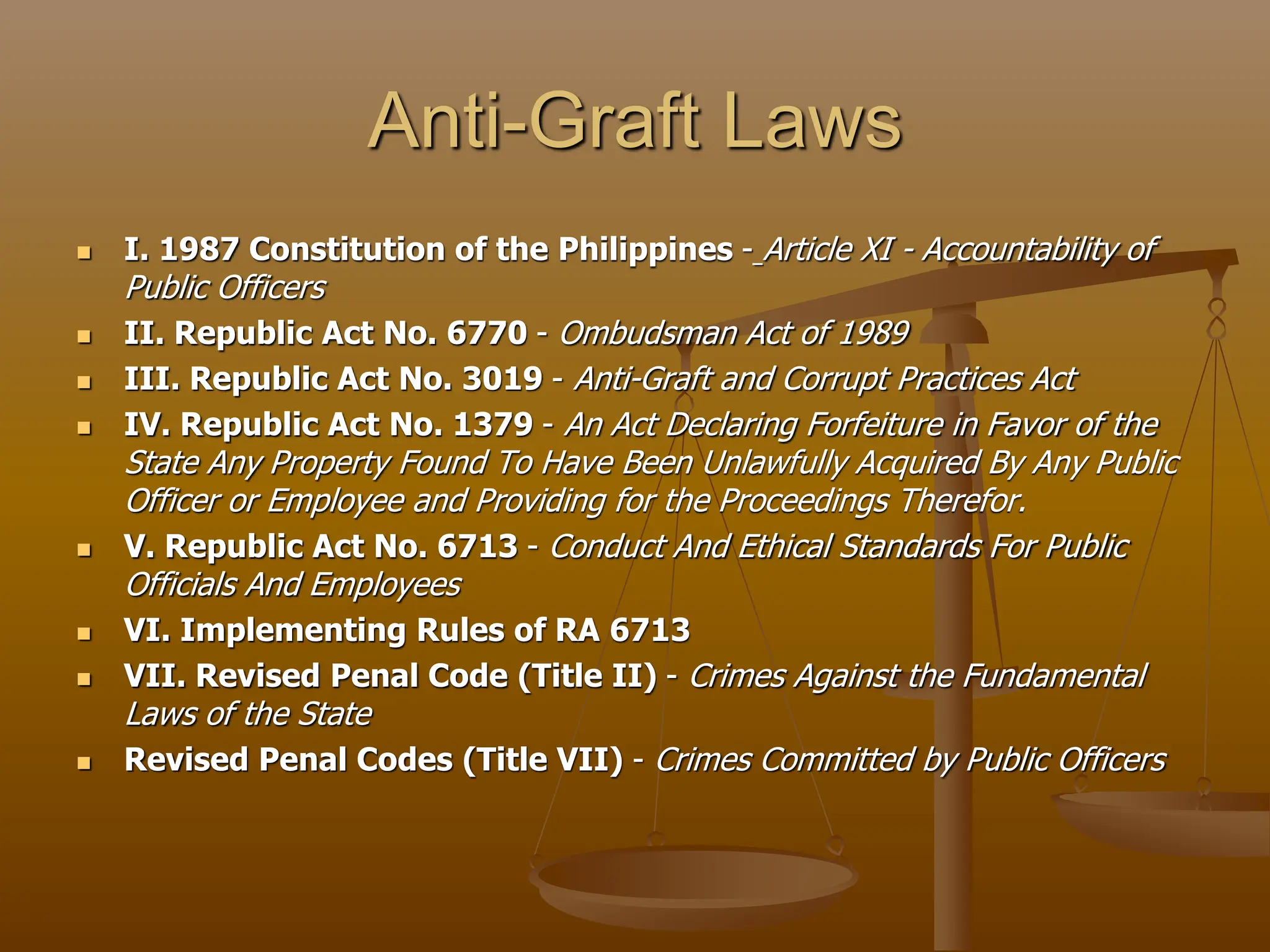
Anti-Graft Laws
 I. 1987 Constitution of the Philippines - Article XI - Accountability of
Public Officers
 II. Republic Act No. 6770 - Ombudsman Act of 1989
 III. Republic Act No. 3019 - Anti-Graft and Corrupt Practices Act
 IV. Republic Act No. 1379 - An Act Declaring Forfeiture in Favor of the
State Any Property Found To Have Been Unlawfully Acquired By Any Public
Officer or Employee and Providing for the Proceedings Therefor.
 V. Republic Act No. 6713 - Conduct And Ethical Standards For Public
Officials And Employees
 VI. Implementing Rules of RA 6713
 VII. Revised Penal Code (Title II) - Crimes Against the Fundamental
Laws of the State
 Revised Penal Codes (Title VII) - Crimes Committed by Public Officers
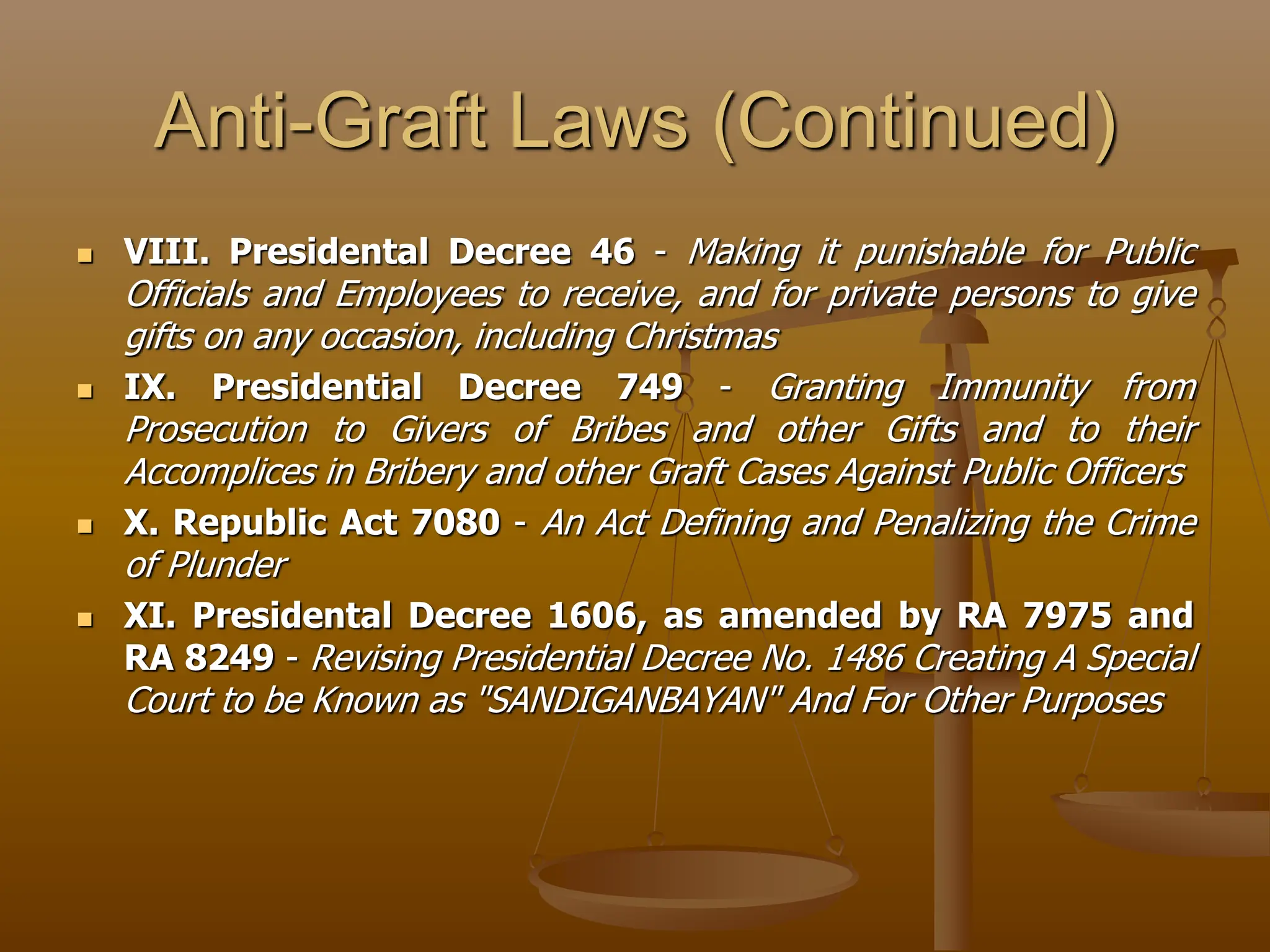
Anti-Graft Laws (Continued)
 VIII. Presidental Decree 46 - Making it punishable for Public
Officials and Employees to receive, and for private persons to give
gifts on any occasion, including Christmas
 IX. Presidential Decree 749 - Granting Immunity from
Prosecution to Givers of Bribes and other Gifts and to their
Accomplices in Bribery and other Graft Cases Against Public Officers
 X. Republic Act 7080 - An Act Defining and Penalizing the Crime
of Plunder
 XI. Presidental Decree 1606, as amended by RA 7975 and
RA 8249 - Revising Presidential Decree No. 1486 Creating A Special
Court to be Known as "SANDIGANBAYAN" And For Other Purposes
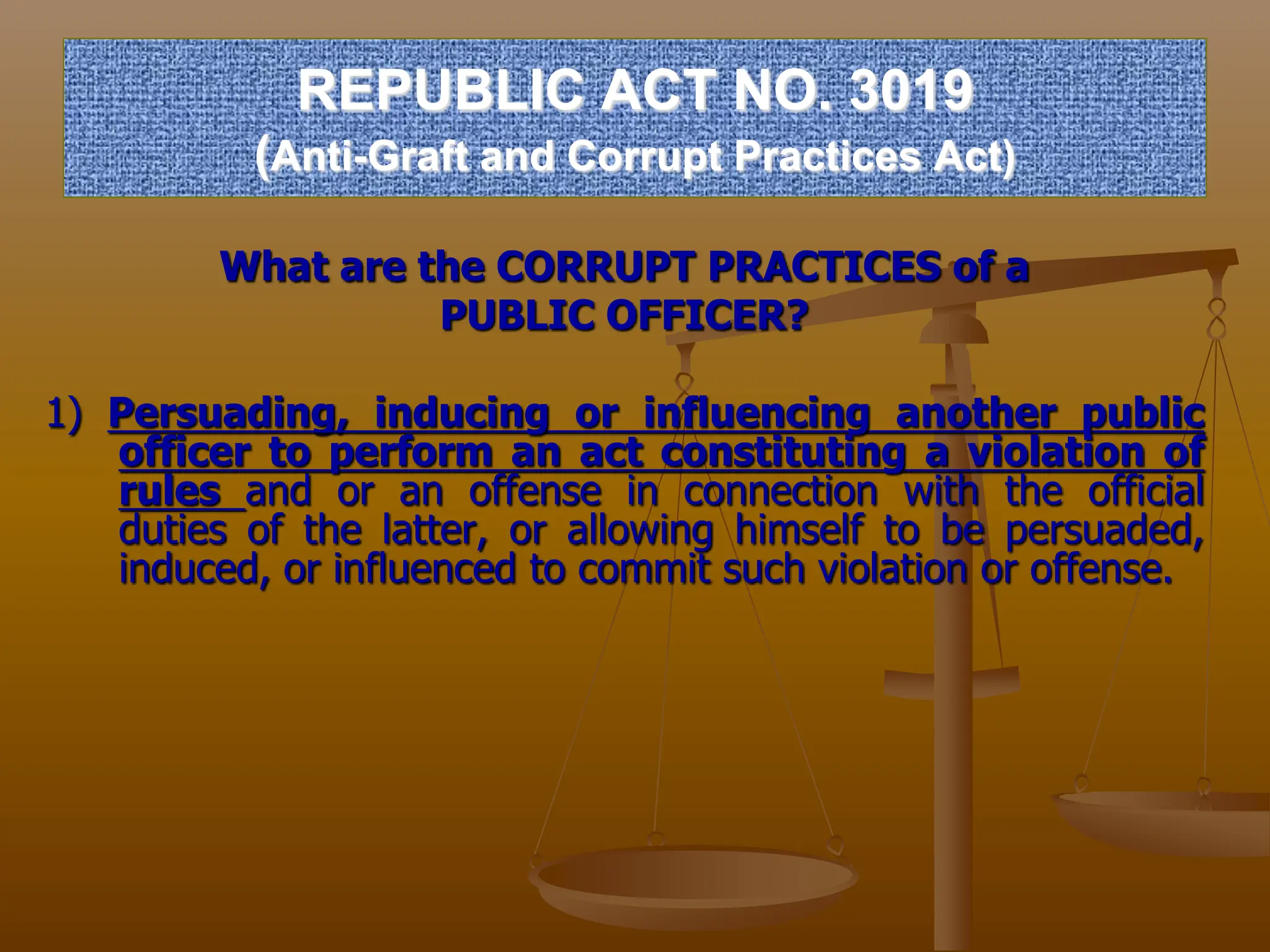
REPUBLIC ACT NO. 3019
(Anti-Graft and Corrupt Practices Act)
What are the CORRUPT PRACTICES of a
PUBLIC OFFICER?
1) Persuading, inducing or influencing another public
officer to perform an act constituting a violation of
rules and or an offense in connection with the official
duties of the latter, or allowing himself to be persuaded,
induced, or influenced to commit such violation or offense.
CORRUPT PRACTICES
of a PUBLIC OFFICER
2) Directly or indirectly requesting or
receiving any gift, present, share,
percentage, or benefit for himself or
for any other person, in connection with
any contract or transaction between the
Government and another party, wherein
the public officer in his official capacity
has to intervene under the law.
CORRUPT PRACTICES
of a PUBLIC OFFICER
 3) Directly or indirectly requesting or
receiving any gift, present or other
pecuniary or material benefit, for himself
or for another, from any person for whom
the public officer, in any manner or
capacity, in consideration for the help
given or to be given (Bribery).
CORRUPT PRACTICES
of a PUBLIC OFFICER
 4) Accepting or having any member of
his family accept employment in a
private enterprise which has pending
official business with him, during the
pendency thereof or within one year after
its termination.
CORRUPT PRACTICES
of a PUBLIC OFFICER
 5) Causing any undue injury to any
party, including the Government, or
giving any private party any unwarranted
benefits, advantage or preference in the
discharge of his official, functions through
manifest partiality, evident bad faith or
gross inexcusable negligence
CORRUPT PRACTICES
of a PUBLIC OFFICER
 6) Failure to Act Within a Reasonable
Period of Time.
 7) Entering into Contracts Grossly
Disadvantageous to the Government.
CORRUPT PRACTICES
of a PUBLIC OFFICER
 8) Directly or indirectly having financial or
pecuniary interest in any business,
contract or transaction in connection with
his official capacity, or in which he is
prohibited by the Constitution or by any
law from having any interest (Conflict of
Interest).
CORRUPT PRACTICES
of a PUBLIC OFFICER
 9) Having a material interest in any
transaction or act requiring the approval of
a board, panel or group of which he is a
member.
CORRUPT PRACTICES
of a PUBLIC OFFICER
 10) Knowingly approving or granting any
license, permit, privilege or benefit in favor
of any person not qualified for or not
legally entitled to such license, permit,
privilege or advantage.
CORRUPT PRACTICES
of a PUBLIC OFFICER

11) Divulging valuable information of a
confidential character, acquired by his
office or by him on account of his official
position to unauthorized persons, or
releasing such information in advance of
its authorized release date.
QUESTION: Is the receiving of a CHRISTMAS or
BIRTHDAY GIFT by a public officer
considered a corrupt practice?
ANSWER: NO if the gift was –
(a) unsolicited (given by the giver voluntarily and
not demanded by the public officer), and
(b) of small or insignificant value, and
(C) was given as a mere token of gratitude or
friendship according to local customs or usage.
PROHIBED ACTS under RA 3019:
1) Using or taking advantage of family or close personal relation
with a public official to capitalize or exploit, request or receive
any present, gift or material or pecuniary advantage from
another person having some business, transaction, application,
request or contract with the Government, in which such public
official has to intervene or in charged.
FAMILY RELATION includes the SPOUSE or RELATIVES by
consanguinity or affinity in the 3rd CIVIL DEGREE.
CLOSE PERSONAL RELATION includes close personal relationship,
social and fraternal connections, and professional employment all giving
rise to intimacy which assures free access to such public officer.
2) Inducing or causing any public official to commit any of the
CORRUPT PRACTICES.
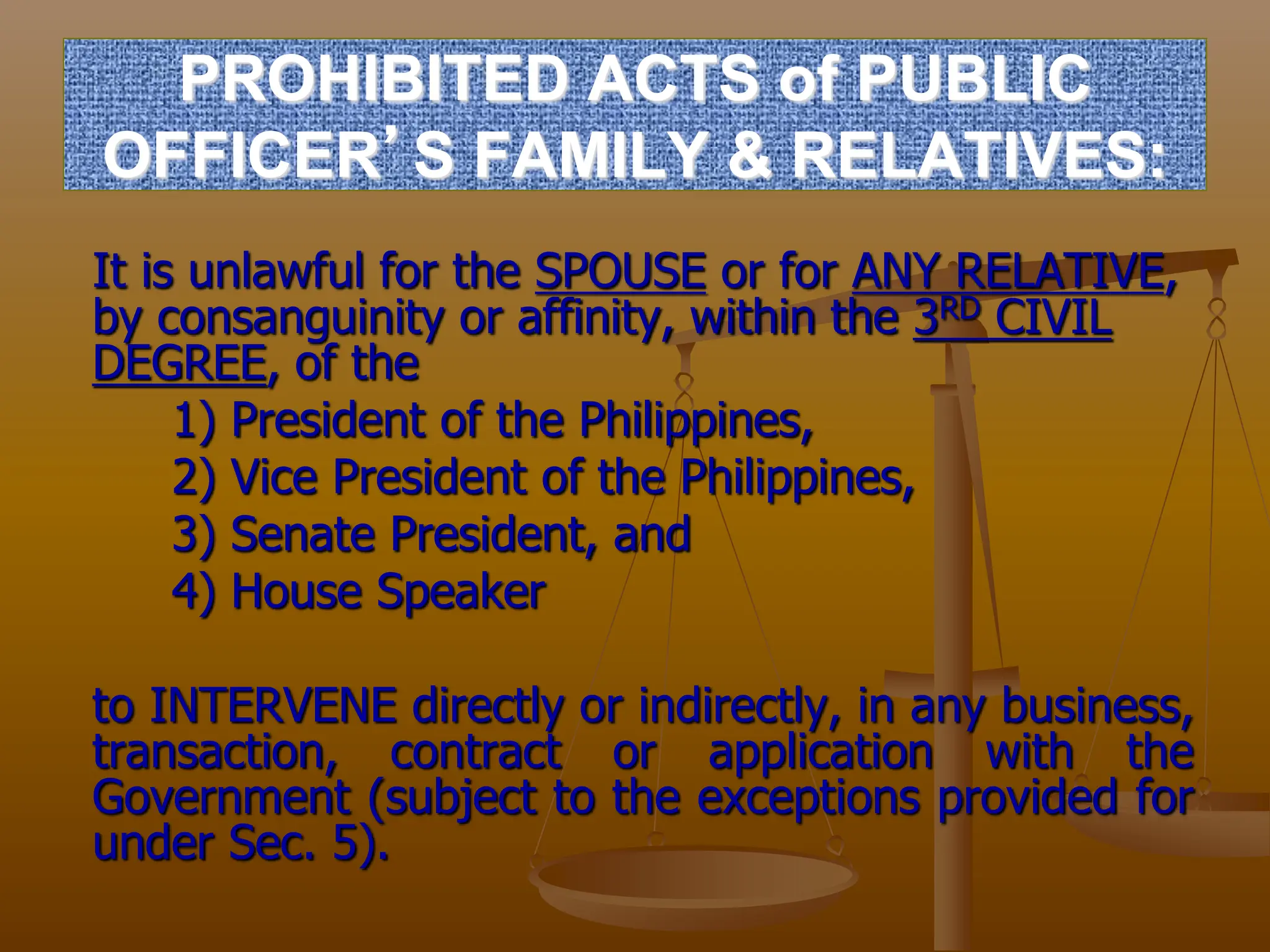
PROHIBITED ACTS of PUBLIC
OFFICER’S FAMILY & RELATIVES:
It is unlawful for the SPOUSE or for ANY RELATIVE,
by consanguinity or affinity, within the 3RD CIVIL
DEGREE, of the
1) President of the Philippines,
2) Vice President of the Philippines,
3) Senate President, and
4) House Speaker
to INTERVENE directly or indirectly, in any business,
transaction, contract or application with the
Government (subject to the exceptions provided for
under Sec. 5).
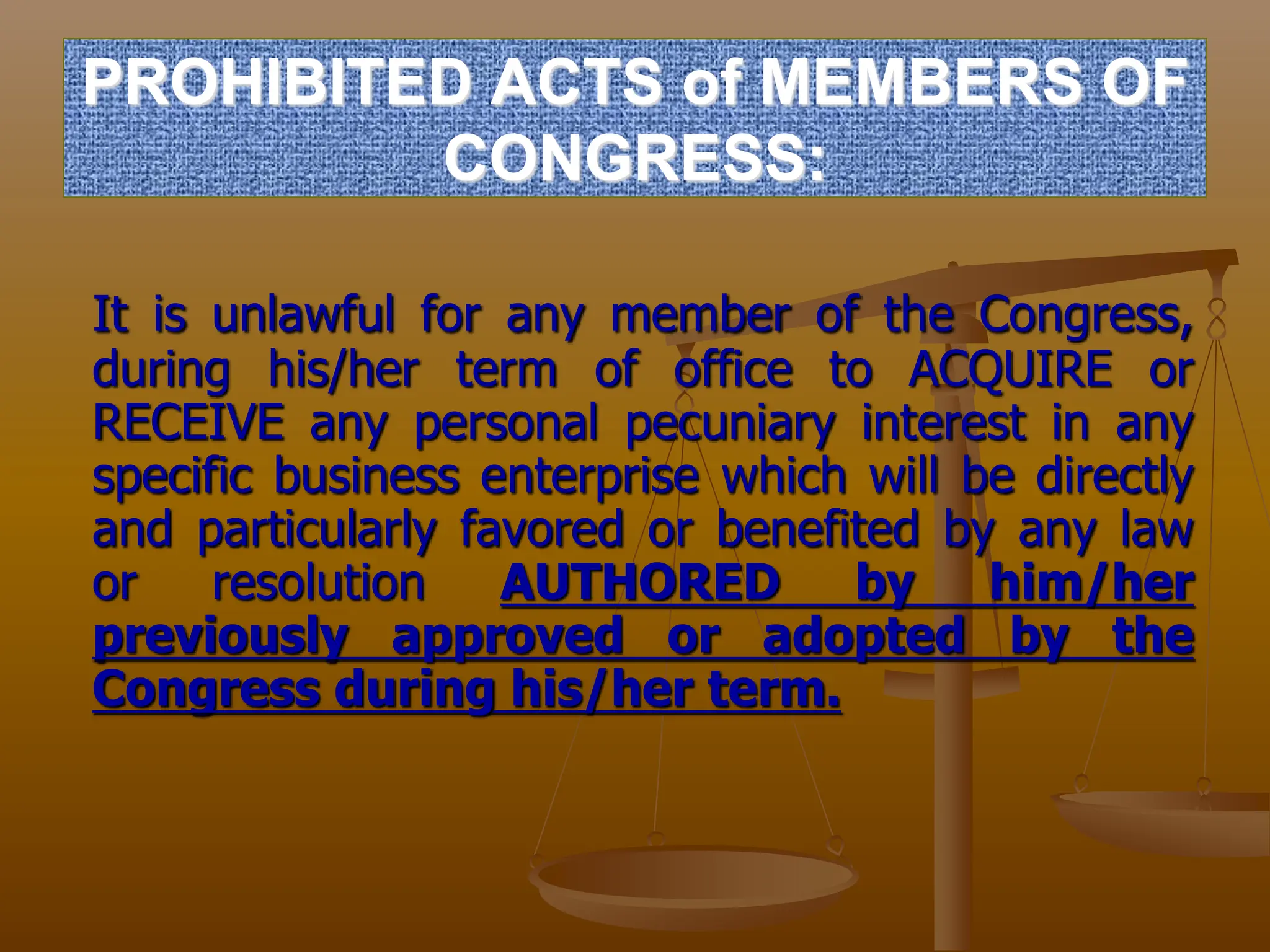
PROHIBITED ACTS of MEMBERS OF
CONGRESS:
It is unlawful for any member of the Congress,
during his/her term of office to ACQUIRE or
RECEIVE any personal pecuniary interest in any
specific business enterprise which will be directly
and particularly favored or benefited by any law
or resolution AUTHORED by him/her
previously approved or adopted by the
Congress during his/her term.
Statement of Assets and Liabilities
Every public officer MUST file-
WHAT?
A detailed and sworn statement of assets and liabilities, amounts and
sources of his/her income, amounts of his/her personal and family
expenses, and the amount of income taxes paid.
WHEN?
1) within 30 days after assuming office,
2) on or before April 15 of every year,
3) upon the expiration of his/her term of office, or
4) upon his/her resignation or separation from office.
(REPUBLIC ACT No. 6713 “AN ACT ESTABLISHING A CODE OF CONDUCT
AND ETHICAL STANDARDS FOR PUBLIC OFFICIALS AND EMPLOYEES…”)
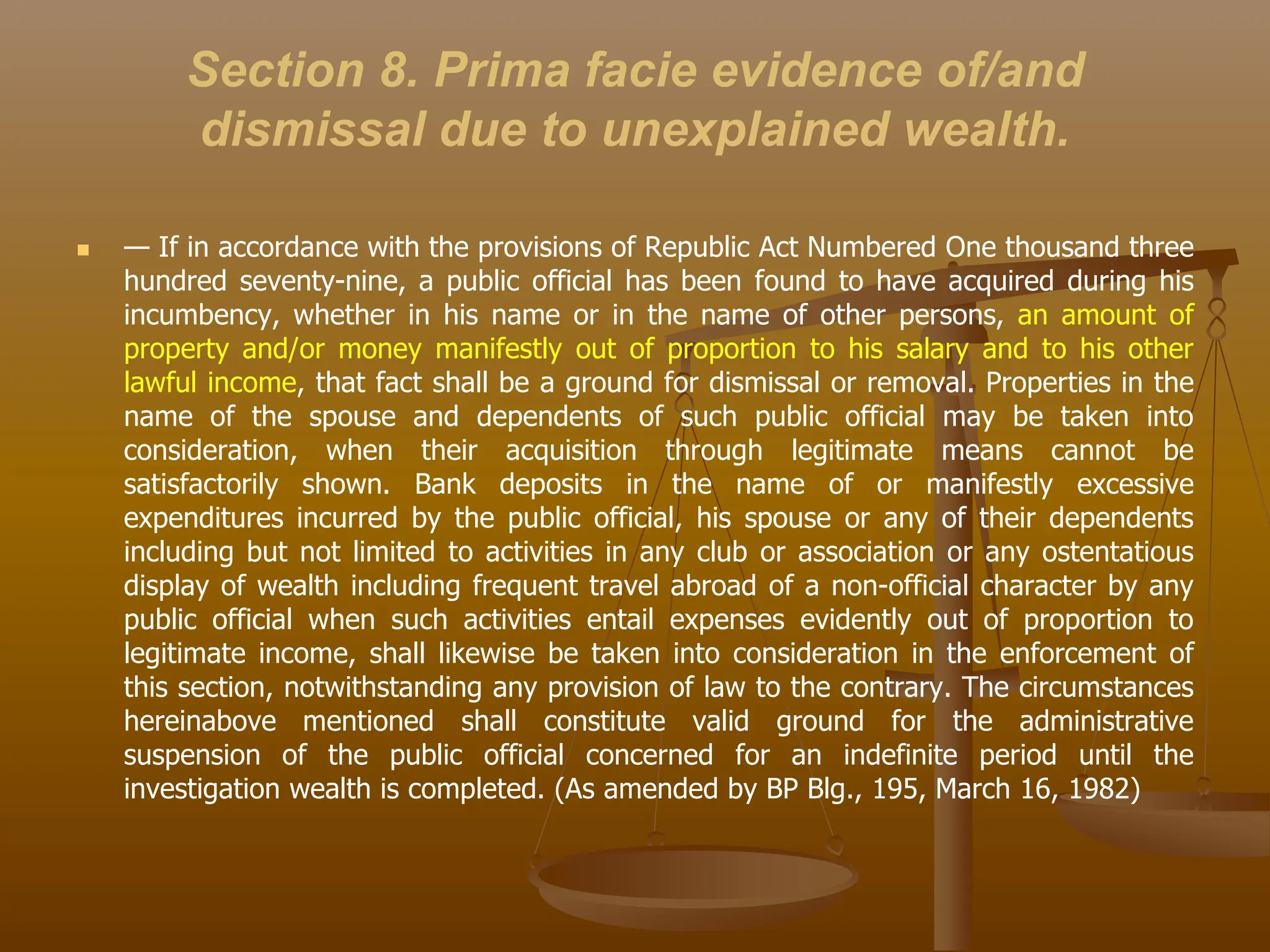
Section 8. Prima facie evidence of/and
dismissal due to unexplained wealth.
 — If in accordance with the provisions of Republic Act Numbered One thousand three
hundred seventy-nine, a public official has been found to have acquired during his
incumbency, whether in his name or in the name of other persons, an amount of
property and/or money manifestly out of proportion to his salary and to his other
lawful income, that fact shall be a ground for dismissal or removal. Properties in the
name of the spouse and dependents of such public official may be taken into
consideration, when their acquisition through legitimate means cannot be
satisfactorily shown. Bank deposits in the name of or manifestly excessive
expenditures incurred by the public official, his spouse or any of their dependents
including but not limited to activities in any club or association or any ostentatious
display of wealth including frequent travel abroad of a non-official character by any
public official when such activities entail expenses evidently out of proportion to
legitimate income, shall likewise be taken into consideration in the enforcement of
this section, notwithstanding any provision of law to the contrary. The circumstances
hereinabove mentioned shall constitute valid ground for the administrative
suspension of the public official concerned for an indefinite period until the
investigation wealth is completed. (As amended by BP Blg., 195, March 16, 1982)
What COURT has the JURISDICTION try
complaints for violations of RA 3019?
SANDIGANBAYAN
has the original jurisdiction to
hear and decide complaints for
Graft and Corruption for public
officers (SG 27 or higher)
Prescriptive Period
 20 years (RA 10910)
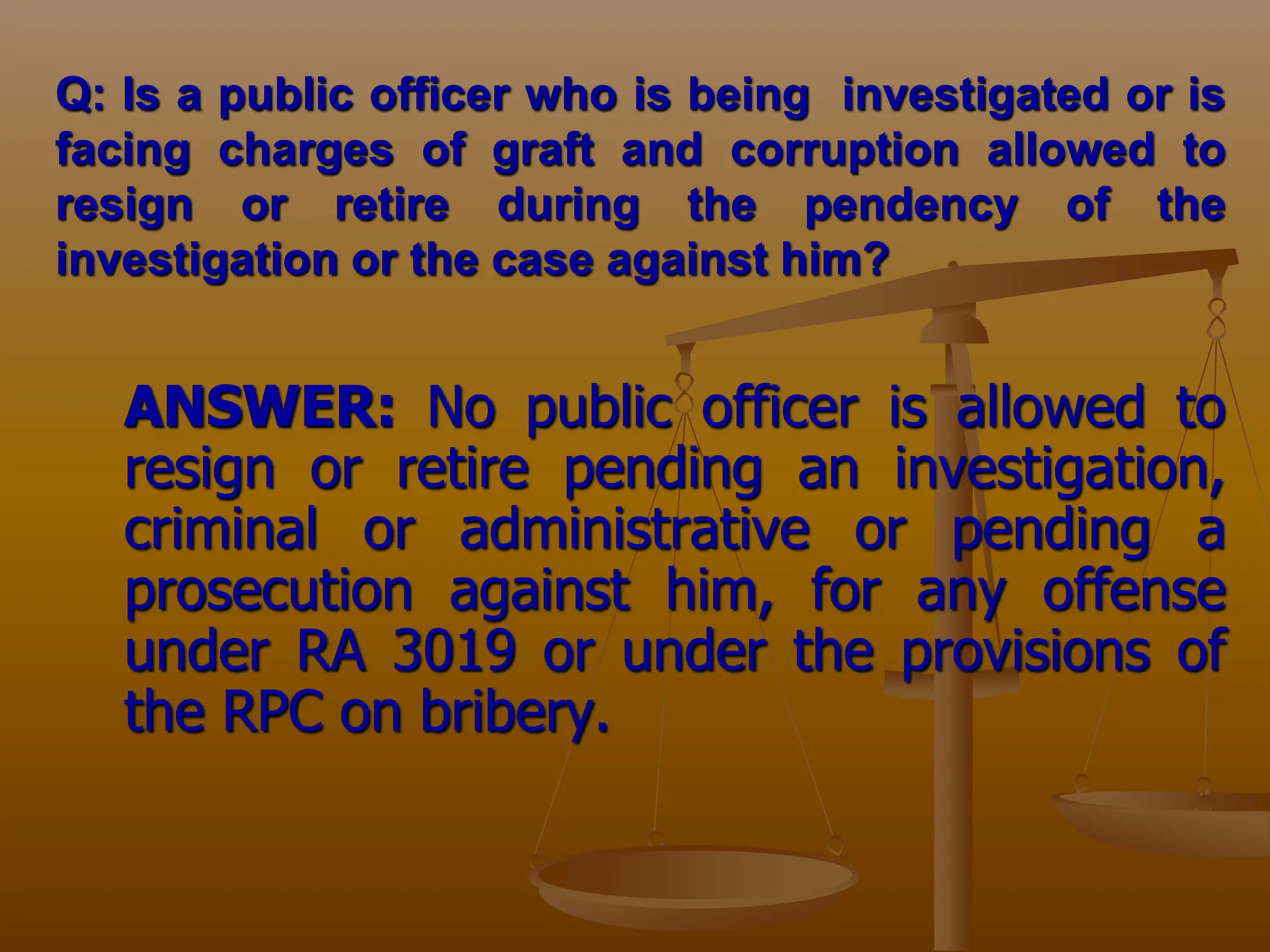
Q: Is a public officer who is being investigated or is
facing charges of graft and corruption allowed to
resign or retire during the pendency of the
investigation or the case against him?
ANSWER: No public officer is allowed to
resign or retire pending an investigation,
criminal or administrative or pending a
prosecution against him, for any offense
under RA 3019 or under the provisions of
the RPC on bribery.
Q: What should be done to the public officer
accused of violation of R.A. No. 3019 during the
pendency of the investigation or during the trial of
his case?
ANSWER: The public officer who is under
investigation or is being tried for graft and
corruption should be SUSPENDED FROM
OFFICE pending the investigation or trial
of his case.
Q: Is a public officer who was found guilty of the
charges entitled to his retirement or gratuity benefits?
ANSWER: No. Should the public officer be
convicted by final judgment, he loses all
retirement or gratuity benefits under the
law.
Q: What about if the public officer has already
received his retirement or gratuity benefits and he
was CONVICTED of the charges?
ANSWER: The convicted (found guilty of
the charges) public officer must return or
restitute the amount received as
retirement or gratuity benefit to the
Government.
Q: What about if the public officer was found
INNOCENT of the charges against him?
ANSWER: If the public officer is acquitted,
he is entitled to-
1) REINSTATEMENT to his position, and
2) Payment of BACKWAGES and
BENEFITS which he failed to receive
during his suspension.
Distinguish…
 Anti-Graft and Corrupt Practices Act with
Anti-Plunder Act
 Anti-Graft and Corrupt Practices Act with
Direct/Indirect Bribery

RA 3019 anti graft and corrupt practices act

  • 1.
    Atty. Juvi H.Gayatao, MPSA (Anti-Graft and Corrupt Practices Act) August 17, 1960
  • 2.
    Anti-Graft Laws  I.1987 Constitution of the Philippines - Article XI - Accountability of Public Officers  II. Republic Act No. 6770 - Ombudsman Act of 1989  III. Republic Act No. 3019 - Anti-Graft and Corrupt Practices Act  IV. Republic Act No. 1379 - An Act Declaring Forfeiture in Favor of the State Any Property Found To Have Been Unlawfully Acquired By Any Public Officer or Employee and Providing for the Proceedings Therefor.  V. Republic Act No. 6713 - Conduct And Ethical Standards For Public Officials And Employees  VI. Implementing Rules of RA 6713  VII. Revised Penal Code (Title II) - Crimes Against the Fundamental Laws of the State  Revised Penal Codes (Title VII) - Crimes Committed by Public Officers
  • 3.
    Anti-Graft Laws (Continued) VIII. Presidental Decree 46 - Making it punishable for Public Officials and Employees to receive, and for private persons to give gifts on any occasion, including Christmas  IX. Presidential Decree 749 - Granting Immunity from Prosecution to Givers of Bribes and other Gifts and to their Accomplices in Bribery and other Graft Cases Against Public Officers  X. Republic Act 7080 - An Act Defining and Penalizing the Crime of Plunder  XI. Presidental Decree 1606, as amended by RA 7975 and RA 8249 - Revising Presidential Decree No. 1486 Creating A Special Court to be Known as "SANDIGANBAYAN" And For Other Purposes
  • 4.
    REPUBLIC ACT NO.3019 (Anti-Graft and Corrupt Practices Act) What are the CORRUPT PRACTICES of a PUBLIC OFFICER? 1) Persuading, inducing or influencing another public officer to perform an act constituting a violation of rules and or an offense in connection with the official duties of the latter, or allowing himself to be persuaded, induced, or influenced to commit such violation or offense.
  • 5.
    CORRUPT PRACTICES of aPUBLIC OFFICER 2) Directly or indirectly requesting or receiving any gift, present, share, percentage, or benefit for himself or for any other person, in connection with any contract or transaction between the Government and another party, wherein the public officer in his official capacity has to intervene under the law.
  • 6.
    CORRUPT PRACTICES of aPUBLIC OFFICER  3) Directly or indirectly requesting or receiving any gift, present or other pecuniary or material benefit, for himself or for another, from any person for whom the public officer, in any manner or capacity, in consideration for the help given or to be given (Bribery).
  • 7.
    CORRUPT PRACTICES of aPUBLIC OFFICER  4) Accepting or having any member of his family accept employment in a private enterprise which has pending official business with him, during the pendency thereof or within one year after its termination.
  • 8.
    CORRUPT PRACTICES of aPUBLIC OFFICER  5) Causing any undue injury to any party, including the Government, or giving any private party any unwarranted benefits, advantage or preference in the discharge of his official, functions through manifest partiality, evident bad faith or gross inexcusable negligence
  • 9.
    CORRUPT PRACTICES of aPUBLIC OFFICER  6) Failure to Act Within a Reasonable Period of Time.  7) Entering into Contracts Grossly Disadvantageous to the Government.
  • 10.
    CORRUPT PRACTICES of aPUBLIC OFFICER  8) Directly or indirectly having financial or pecuniary interest in any business, contract or transaction in connection with his official capacity, or in which he is prohibited by the Constitution or by any law from having any interest (Conflict of Interest).
  • 11.
    CORRUPT PRACTICES of aPUBLIC OFFICER  9) Having a material interest in any transaction or act requiring the approval of a board, panel or group of which he is a member.
  • 12.
    CORRUPT PRACTICES of aPUBLIC OFFICER  10) Knowingly approving or granting any license, permit, privilege or benefit in favor of any person not qualified for or not legally entitled to such license, permit, privilege or advantage.
  • 13.
    CORRUPT PRACTICES of aPUBLIC OFFICER  11) Divulging valuable information of a confidential character, acquired by his office or by him on account of his official position to unauthorized persons, or releasing such information in advance of its authorized release date.
  • 14.
    QUESTION: Is thereceiving of a CHRISTMAS or BIRTHDAY GIFT by a public officer considered a corrupt practice? ANSWER: NO if the gift was – (a) unsolicited (given by the giver voluntarily and not demanded by the public officer), and (b) of small or insignificant value, and (C) was given as a mere token of gratitude or friendship according to local customs or usage.
  • 15.
    PROHIBED ACTS underRA 3019: 1) Using or taking advantage of family or close personal relation with a public official to capitalize or exploit, request or receive any present, gift or material or pecuniary advantage from another person having some business, transaction, application, request or contract with the Government, in which such public official has to intervene or in charged. FAMILY RELATION includes the SPOUSE or RELATIVES by consanguinity or affinity in the 3rd CIVIL DEGREE. CLOSE PERSONAL RELATION includes close personal relationship, social and fraternal connections, and professional employment all giving rise to intimacy which assures free access to such public officer. 2) Inducing or causing any public official to commit any of the CORRUPT PRACTICES.
  • 16.
    PROHIBITED ACTS ofPUBLIC OFFICER’S FAMILY & RELATIVES: It is unlawful for the SPOUSE or for ANY RELATIVE, by consanguinity or affinity, within the 3RD CIVIL DEGREE, of the 1) President of the Philippines, 2) Vice President of the Philippines, 3) Senate President, and 4) House Speaker to INTERVENE directly or indirectly, in any business, transaction, contract or application with the Government (subject to the exceptions provided for under Sec. 5).
  • 17.
    PROHIBITED ACTS ofMEMBERS OF CONGRESS: It is unlawful for any member of the Congress, during his/her term of office to ACQUIRE or RECEIVE any personal pecuniary interest in any specific business enterprise which will be directly and particularly favored or benefited by any law or resolution AUTHORED by him/her previously approved or adopted by the Congress during his/her term.
  • 18.
    Statement of Assetsand Liabilities Every public officer MUST file- WHAT? A detailed and sworn statement of assets and liabilities, amounts and sources of his/her income, amounts of his/her personal and family expenses, and the amount of income taxes paid. WHEN? 1) within 30 days after assuming office, 2) on or before April 15 of every year, 3) upon the expiration of his/her term of office, or 4) upon his/her resignation or separation from office. (REPUBLIC ACT No. 6713 “AN ACT ESTABLISHING A CODE OF CONDUCT AND ETHICAL STANDARDS FOR PUBLIC OFFICIALS AND EMPLOYEES…”)
  • 19.
    Section 8. Primafacie evidence of/and dismissal due to unexplained wealth.  — If in accordance with the provisions of Republic Act Numbered One thousand three hundred seventy-nine, a public official has been found to have acquired during his incumbency, whether in his name or in the name of other persons, an amount of property and/or money manifestly out of proportion to his salary and to his other lawful income, that fact shall be a ground for dismissal or removal. Properties in the name of the spouse and dependents of such public official may be taken into consideration, when their acquisition through legitimate means cannot be satisfactorily shown. Bank deposits in the name of or manifestly excessive expenditures incurred by the public official, his spouse or any of their dependents including but not limited to activities in any club or association or any ostentatious display of wealth including frequent travel abroad of a non-official character by any public official when such activities entail expenses evidently out of proportion to legitimate income, shall likewise be taken into consideration in the enforcement of this section, notwithstanding any provision of law to the contrary. The circumstances hereinabove mentioned shall constitute valid ground for the administrative suspension of the public official concerned for an indefinite period until the investigation wealth is completed. (As amended by BP Blg., 195, March 16, 1982)
  • 20.
    What COURT hasthe JURISDICTION try complaints for violations of RA 3019? SANDIGANBAYAN has the original jurisdiction to hear and decide complaints for Graft and Corruption for public officers (SG 27 or higher)
  • 21.
  • 22.
    Q: Is apublic officer who is being investigated or is facing charges of graft and corruption allowed to resign or retire during the pendency of the investigation or the case against him? ANSWER: No public officer is allowed to resign or retire pending an investigation, criminal or administrative or pending a prosecution against him, for any offense under RA 3019 or under the provisions of the RPC on bribery.
  • 23.
    Q: What shouldbe done to the public officer accused of violation of R.A. No. 3019 during the pendency of the investigation or during the trial of his case? ANSWER: The public officer who is under investigation or is being tried for graft and corruption should be SUSPENDED FROM OFFICE pending the investigation or trial of his case.
  • 24.
    Q: Is apublic officer who was found guilty of the charges entitled to his retirement or gratuity benefits? ANSWER: No. Should the public officer be convicted by final judgment, he loses all retirement or gratuity benefits under the law.
  • 25.
    Q: What aboutif the public officer has already received his retirement or gratuity benefits and he was CONVICTED of the charges? ANSWER: The convicted (found guilty of the charges) public officer must return or restitute the amount received as retirement or gratuity benefit to the Government.
  • 26.
    Q: What aboutif the public officer was found INNOCENT of the charges against him? ANSWER: If the public officer is acquitted, he is entitled to- 1) REINSTATEMENT to his position, and 2) Payment of BACKWAGES and BENEFITS which he failed to receive during his suspension.
  • 27.
    Distinguish…  Anti-Graft andCorrupt Practices Act with Anti-Plunder Act  Anti-Graft and Corrupt Practices Act with Direct/Indirect Bribery