Chapter TwoChapter Two
Stage Versus ScreenStage Versus Screen
Audience: No Cell Phones, Please!Audience: No Cell Phones, Please!
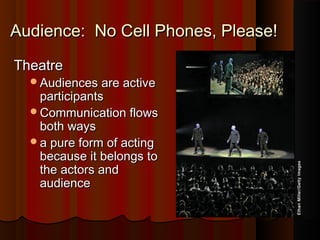
TheatreTheatre
Audiences are activeAudiences are active
participantsparticipants
Communication flowsCommunication flows
both waysboth ways
a pure form of actinga pure form of acting
because it belongs tobecause it belongs to
the actors andthe actors and
audienceaudience
EthanMiller/GettyImages
Audience: No Cell Phones, Please!Audience: No Cell Phones, Please!
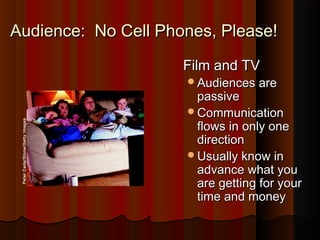
Film and TVFilm and TV
Audiences areAudiences are
passivepassive
CommunicationCommunication
flows in only oneflows in only one
directiondirection
Usually know inUsually know in
advance what youadvance what you
are getting for yourare getting for your
time and moneytime and money
PeterCade/Stone/GettyImages
Acting: I’m Ready for My Close-upActing: I’m Ready for My Close-up
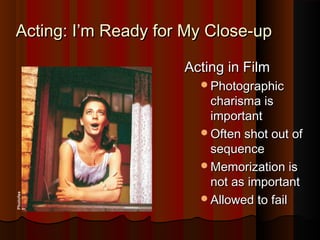
Acting in FilmActing in Film
PhotographicPhotographic
charisma ischarisma is
importantimportant
Often shot out ofOften shot out of
sequencesequence
Memorization isMemorization is
not as importantnot as important
Allowed to failAllowed to fail
Photofes
t
Acting: I’m Ready for My Close-upActing: I’m Ready for My Close-up
““We’re tightrope walkers. When you walk theWe’re tightrope walkers. When you walk the
wire in a movie, the wire is painted on thewire in a movie, the wire is painted on the
floor, but when you walk it on the stage, it’s afloor, but when you walk it on the stage, it’s a
hundred feet high without a net.”hundred feet high without a net.”
Al Pacino, ActorAl Pacino, Actor
“…“…acting for film is like a musician playing inacting for film is like a musician playing in
a recording studio and acting in the theatre isa recording studio and acting in the theatre is
like playing live in concert…”like playing live in concert…”
Willem Dafoe, ActorWillem Dafoe, Actor
Acting: I’m Ready for My Close-upActing: I’m Ready for My Close-up
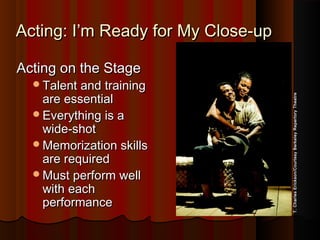
Acting on the StageActing on the Stage
Talent and trainingTalent and training
are essentialare essential
Everything is aEverything is a
wide-shotwide-shot
Memorization skillsMemorization skills
are requiredare required
Must perform wellMust perform well
with eachwith each
performanceperformance
T.CharlesErickson/CourtesyBerkeleyRepertoryTheatre
Directing: Direct and IndirectDirecting: Direct and Indirect
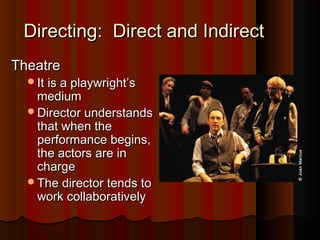
TheatreTheatre
It is a playwright’sIt is a playwright’s
mediummedium
Director understandsDirector understands
that when thethat when the
performance begins,performance begins,
the actors are inthe actors are in
chargecharge
The director tends toThe director tends to
work collaborativelywork collaboratively
©JoanMarcus
Directing: Direct and IndirectDirecting: Direct and Indirect
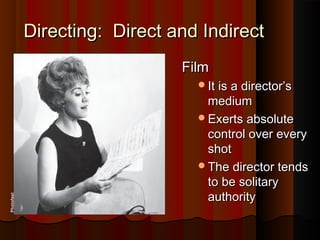
FilmFilm
It is a director’sIt is a director’s
mediummedium
Exerts absoluteExerts absolute
control over everycontrol over every
shotshot
The director tendsThe director tends
to be solitaryto be solitary
authorityauthority
Photofest
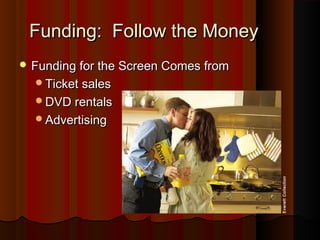
Funding: Follow the MoneyFunding: Follow the Money
 Funding for the Screen Comes fromFunding for the Screen Comes from
Ticket salesTicket sales
DVD rentalsDVD rentals
AdvertisingAdvertising
EverettCollection
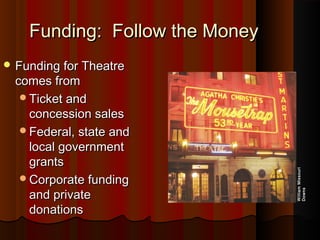
Funding: Follow the MoneyFunding: Follow the Money
 Funding for TheatreFunding for Theatre
comes fromcomes from
Ticket andTicket and
concession salesconcession sales
Federal, state andFederal, state and
local governmentlocal government
grantsgrants
Corporate fundingCorporate funding
and privateand private
donationsdonations
WilliamMissouri
Downs
Control: Who Pulls the Strings?Control: Who Pulls the Strings?
Screen entertainment tends to put theScreen entertainment tends to put the
values of the audience foremostvalues of the audience foremost
Theatre tends to value the voice of theTheatre tends to value the voice of the
artistartist
Bourgeois theatre and independentBourgeois theatre and independent
filmmaking will often combine bothfilmmaking will often combine both
considerationsconsiderations
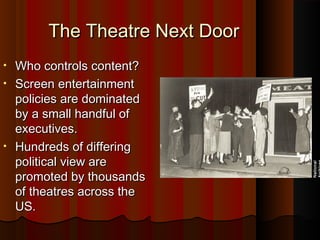
The Theatre Next DoorThe Theatre Next Door
• Who controls content?Who controls content?
• Screen entertainmentScreen entertainment
policies are dominatedpolicies are dominated
by a small handful ofby a small handful of
executives.executives.
• Hundreds of differingHundreds of differing
political view arepolitical view are
promoted by thousandspromoted by thousands
of theatres across theof theatres across the
US.US.
National
Ownership: Copyrights and CashOwnership: Copyrights and Cash
 Copyright – a legal guarantee granted by theCopyright – a legal guarantee granted by the
government to creative artists that allows them togovernment to creative artists that allows them to
maintain control and profit from their workmaintain control and profit from their work
 Royalty payment – fee paid to playwrights for theRoyalty payment – fee paid to playwrights for the
rights to produce their playrights to produce their play
 Public domain – once a playwright has been deadPublic domain – once a playwright has been dead
for 70 years, his or her plays become publicfor 70 years, his or her plays become public
propertyproperty
 Writers for hire – writers in screen entertainmentWriters for hire – writers in screen entertainment
who forfeit their rights to the works they author for awho forfeit their rights to the works they author for a
film or television programfilm or television program
Curtain CallCurtain Call
Screen entertainment tends to view theirScreen entertainment tends to view their
audiences as consumers and what theyaudiences as consumers and what they
do as a productdo as a product
Theatre tends to view their audiences asTheatre tends to view their audiences as
equal participants in the theatreequal participants in the theatre
experience and what they do as artisticexperience and what they do as artistic
productionproduction

Chapter 2: Stage vs Screen

  • 1.
    Chapter TwoChapter Two StageVersus ScreenStage Versus Screen
  • 2.
    Audience: No CellPhones, Please!Audience: No Cell Phones, Please! TheatreTheatre Audiences are activeAudiences are active participantsparticipants Communication flowsCommunication flows both waysboth ways a pure form of actinga pure form of acting because it belongs tobecause it belongs to the actors andthe actors and audienceaudience EthanMiller/GettyImages
  • 3.
    Audience: No CellPhones, Please!Audience: No Cell Phones, Please! Film and TVFilm and TV Audiences areAudiences are passivepassive CommunicationCommunication flows in only oneflows in only one directiondirection Usually know inUsually know in advance what youadvance what you are getting for yourare getting for your time and moneytime and money PeterCade/Stone/GettyImages
  • 4.
    Acting: I’m Readyfor My Close-upActing: I’m Ready for My Close-up Acting in FilmActing in Film PhotographicPhotographic charisma ischarisma is importantimportant Often shot out ofOften shot out of sequencesequence Memorization isMemorization is not as importantnot as important Allowed to failAllowed to fail Photofes t
  • 5.
    Acting: I’m Readyfor My Close-upActing: I’m Ready for My Close-up ““We’re tightrope walkers. When you walk theWe’re tightrope walkers. When you walk the wire in a movie, the wire is painted on thewire in a movie, the wire is painted on the floor, but when you walk it on the stage, it’s afloor, but when you walk it on the stage, it’s a hundred feet high without a net.”hundred feet high without a net.” Al Pacino, ActorAl Pacino, Actor “…“…acting for film is like a musician playing inacting for film is like a musician playing in a recording studio and acting in the theatre isa recording studio and acting in the theatre is like playing live in concert…”like playing live in concert…” Willem Dafoe, ActorWillem Dafoe, Actor
  • 6.
    Acting: I’m Readyfor My Close-upActing: I’m Ready for My Close-up Acting on the StageActing on the Stage Talent and trainingTalent and training are essentialare essential Everything is aEverything is a wide-shotwide-shot Memorization skillsMemorization skills are requiredare required Must perform wellMust perform well with eachwith each performanceperformance T.CharlesErickson/CourtesyBerkeleyRepertoryTheatre
  • 7.
    Directing: Direct andIndirectDirecting: Direct and Indirect TheatreTheatre It is a playwright’sIt is a playwright’s mediummedium Director understandsDirector understands that when thethat when the performance begins,performance begins, the actors are inthe actors are in chargecharge The director tends toThe director tends to work collaborativelywork collaboratively ©JoanMarcus
  • 8.
    Directing: Direct andIndirectDirecting: Direct and Indirect FilmFilm It is a director’sIt is a director’s mediummedium Exerts absoluteExerts absolute control over everycontrol over every shotshot The director tendsThe director tends to be solitaryto be solitary authorityauthority Photofest
  • 9.
    Funding: Follow theMoneyFunding: Follow the Money  Funding for the Screen Comes fromFunding for the Screen Comes from Ticket salesTicket sales DVD rentalsDVD rentals AdvertisingAdvertising EverettCollection
  • 10.
    Funding: Follow theMoneyFunding: Follow the Money  Funding for TheatreFunding for Theatre comes fromcomes from Ticket andTicket and concession salesconcession sales Federal, state andFederal, state and local governmentlocal government grantsgrants Corporate fundingCorporate funding and privateand private donationsdonations WilliamMissouri Downs
  • 11.
    Control: Who Pullsthe Strings?Control: Who Pulls the Strings? Screen entertainment tends to put theScreen entertainment tends to put the values of the audience foremostvalues of the audience foremost Theatre tends to value the voice of theTheatre tends to value the voice of the artistartist Bourgeois theatre and independentBourgeois theatre and independent filmmaking will often combine bothfilmmaking will often combine both considerationsconsiderations
  • 12.
    The Theatre NextDoorThe Theatre Next Door • Who controls content?Who controls content? • Screen entertainmentScreen entertainment policies are dominatedpolicies are dominated by a small handful ofby a small handful of executives.executives. • Hundreds of differingHundreds of differing political view arepolitical view are promoted by thousandspromoted by thousands of theatres across theof theatres across the US.US. National
  • 13.
    Ownership: Copyrights andCashOwnership: Copyrights and Cash  Copyright – a legal guarantee granted by theCopyright – a legal guarantee granted by the government to creative artists that allows them togovernment to creative artists that allows them to maintain control and profit from their workmaintain control and profit from their work  Royalty payment – fee paid to playwrights for theRoyalty payment – fee paid to playwrights for the rights to produce their playrights to produce their play  Public domain – once a playwright has been deadPublic domain – once a playwright has been dead for 70 years, his or her plays become publicfor 70 years, his or her plays become public propertyproperty  Writers for hire – writers in screen entertainmentWriters for hire – writers in screen entertainment who forfeit their rights to the works they author for awho forfeit their rights to the works they author for a film or television programfilm or television program
  • 14.
    Curtain CallCurtain Call Screenentertainment tends to view theirScreen entertainment tends to view their audiences as consumers and what theyaudiences as consumers and what they do as a productdo as a product Theatre tends to view their audiences asTheatre tends to view their audiences as equal participants in the theatreequal participants in the theatre experience and what they do as artisticexperience and what they do as artistic productionproduction