Studying Drama
Drama asa Form of Literature:
Drama is a dynamic and engaging form of literature that revolves around the performance of a story
through the interactions of characters, often on a stage. It is a medium that combines various
elements to convey a narrative, emotions, and ideas to an audience.
Meaning of Drama:
Drama is a literary genre that presents a story or narrative through the spoken dialogue and actions of
characters. It is designed for performance and often requires actors, a setting, and an audience.
Drama can explore a wide range of themes, emotions, and conflicts, making it a versatile form of
artistic expression.
Conventions in Drama:
The role of conventions in drama is significant, as they serve as established practices and expectations
that shape the way dramatic works are created and understood. Conventions in drama provide a
framework for both the creators and the audience, allowing for effective communication and the
conveyance of meaning.
Here are some key roles that conventions play in drama:
1. Communication: Conventions in drama act as a common language between the playwright, director,
actors, and the audience. They help convey specific information, such as the characters' emotions,
relationships, and intentions, through established symbols, gestures, and dialogue patterns.
2. Establishing Expectations: Conventions create a set of expectations for the audience. For example, in
a tragedy, the audience expects a downfall of the main character, while in a comedy, they anticipate
humor and a happy resolution. These expectations guide the audience's emotional responses.
3. Genre Conventions: Different genres of drama have their own conventions that help define and
distinguish them. For instance, in a Shakespearean tragedy, the convention of soliloquy, where
characters speak their inner thoughts aloud, is common. In a farce, physical humor and mistaken
identities are typical conventions.
4. Symbolism: Conventions often employ symbols to convey deeper meanings. For example, a character
wearing dark clothing or entering a scene in a certain way can symbolize their villainous nature. These
symbols provide subtext and layers of meaning for the audience to interpret.
5. Structural Conventions: Dramatic works often follow specific structures or conventions, such as the
three-act structure. These structural conventions help in organizing the plot, creating rising tension,
and delivering a satisfying resolution.
6. Historical and Cultural Context: Conventions can be influenced by the time and culture in which a
drama is written or performed. For example, the conventions of ancient Greek drama differ from
those of modern theater, reflecting the values and norms of their respective eras.
7. Reinforcing Themes: Conventions are used to reinforce the central themes of a dramatic work. For
instance, recurring motifs, character archetypes, or specific types of conflict can be employed to
emphasize the play's underlying message.
8. Artistic Innovation: While conventions provide a foundation for drama, they can also be challenged
and subverted by playwrights, directors, and actors to create innovative and thought-provoking
works. Breaking or reinterpreting conventions can lead to fresh perspectives and artistic exploration.
Basic Elements of Drama:
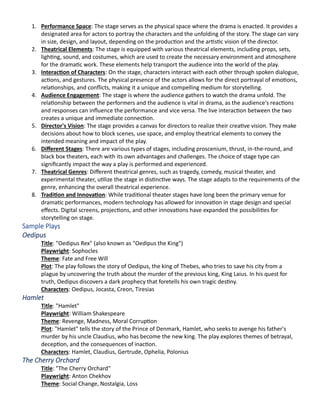
1. Characters: Characters are the central figures in a dramatic work. They have distinct personalities,
motivations, and conflicts, and their interactions drive the plot forward.
2.
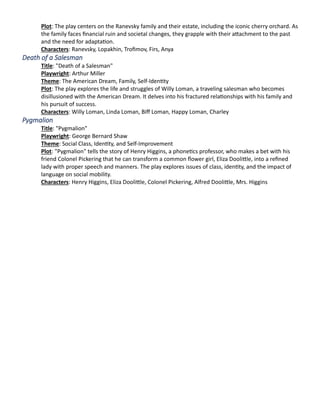
2. Plot: Theplot of a drama is the sequence of events that make up the story. It typically includes an
introduction, rising action, climax, falling action, and resolution. The plot structure is essential for
building tension and engaging the audience.
3. Dialogue: Dialogue is the primary means of communication in a drama. It is the spoken exchanges
between characters that reveal their thoughts, emotions, and motivations. Well-crafted dialogue is
crucial for character development and conveying the play's themes.
4. Setting: The setting provides the physical and temporal context for the drama. It includes details about
the location, time period, and atmosphere, which contribute to the play's mood and meaning.
5. Conflict: Conflict is at the heart of most dramas. It is the source of tension and drama, whether it be
internal conflicts within characters or external conflicts between characters. Resolving these conflicts is
often a central theme of the work.
6. Theme: Themes in drama are the broader ideas or messages that the play conveys. They can explore a
wide range of human experiences, such as love, power, betrayal, justice, and more. Themes provide
depth and resonance to the story.
7. Stage Directions: Stage directions are instructions within the script that guide actors and directors on
how to perform and stage the play. They include details about movement, gestures, and the physical
arrangement of the actors on the stage.
8. Audience: Unlike other forms of literature, drama is meant to be performed in front of an audience. The
audience's reaction and engagement are integral to the success of the dramatic work.
Drama and the stage
Drama and the stage are intimately connected, as the stage is the primary platform where dramatic
works come to life through performance. Here's a closer look at the relationship between drama and the
stage:
3.
1. Performance Space:The stage serves as the physical space where the drama is enacted. It provides a
designated area for actors to portray the characters and the unfolding of the story. The stage can vary
in size, design, and layout, depending on the production and the artistic vision of the director.
2. Theatrical Elements: The stage is equipped with various theatrical elements, including props, sets,
lighting, sound, and costumes, which are used to create the necessary environment and atmosphere
for the dramatic work. These elements help transport the audience into the world of the play.
3. Interaction of Characters: On the stage, characters interact with each other through spoken dialogue,
actions, and gestures. The physical presence of the actors allows for the direct portrayal of emotions,
relationships, and conflicts, making it a unique and compelling medium for storytelling.
4. Audience Engagement: The stage is where the audience gathers to watch the drama unfold. The
relationship between the performers and the audience is vital in drama, as the audience's reactions
and responses can influence the performance and vice versa. The live interaction between the two
creates a unique and immediate connection.
5. Director's Vision: The stage provides a canvas for directors to realize their creative vision. They make
decisions about how to block scenes, use space, and employ theatrical elements to convey the
intended meaning and impact of the play.
6. Different Stages: There are various types of stages, including proscenium, thrust, in-the-round, and
black box theaters, each with its own advantages and challenges. The choice of stage type can
significantly impact the way a play is performed and experienced.
7. Theatrical Genres: Different theatrical genres, such as tragedy, comedy, musical theater, and
experimental theater, utilize the stage in distinctive ways. The stage adapts to the requirements of the
genre, enhancing the overall theatrical experience.
8. Tradition and Innovation: While traditional theater stages have long been the primary venue for
dramatic performances, modern technology has allowed for innovation in stage design and special
effects. Digital screens, projections, and other innovations have expanded the possibilities for
storytelling on stage.
Sample Plays
Oedipus
Title: "Oedipus Rex" (also known as "Oedipus the King")
Playwright: Sophocles
Theme: Fate and Free Will
Plot: The play follows the story of Oedipus, the king of Thebes, who tries to save his city from a
plague by uncovering the truth about the murder of the previous king, King Laius. In his quest for
truth, Oedipus discovers a dark prophecy that foretells his own tragic destiny.
Characters: Oedipus, Jocasta, Creon, Tiresias
Hamlet
Title: "Hamlet"
Playwright: William Shakespeare
Theme: Revenge, Madness, Moral Corruption
Plot: "Hamlet" tells the story of the Prince of Denmark, Hamlet, who seeks to avenge his father's
murder by his uncle Claudius, who has become the new king. The play explores themes of betrayal,
deception, and the consequences of inaction.
Characters: Hamlet, Claudius, Gertrude, Ophelia, Polonius
The Cherry Orchard
Title: "The Cherry Orchard"
Playwright: Anton Chekhov
Theme: Social Change, Nostalgia, Loss
4.
Plot: The playcenters on the Ranevsky family and their estate, including the iconic cherry orchard. As
the family faces financial ruin and societal changes, they grapple with their attachment to the past
and the need for adaptation.
Characters: Ranevsky, Lopakhin, Trofimov, Firs, Anya
Death of a Salesman
Title: "Death of a Salesman"
Playwright: Arthur Miller
Theme: The American Dream, Family, Self-Identity
Plot: The play explores the life and struggles of Willy Loman, a traveling salesman who becomes
disillusioned with the American Dream. It delves into his fractured relationships with his family and
his pursuit of success.
Characters: Willy Loman, Linda Loman, Biff Loman, Happy Loman, Charley
Pygmalion
Title: "Pygmalion"
Playwright: George Bernard Shaw
Theme: Social Class, Identity, and Self-Improvement
Plot: "Pygmalion" tells the story of Henry Higgins, a phonetics professor, who makes a bet with his
friend Colonel Pickering that he can transform a common flower girl, Eliza Doolittle, into a refined
lady with proper speech and manners. The play explores issues of class, identity, and the impact of
language on social mobility.
Characters: Henry Higgins, Eliza Doolittle, Colonel Pickering, Alfred Doolittle, Mrs. Higgins