Theatrical Productio
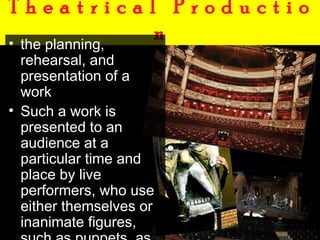
• the planning,
                n
  rehearsal, and
  presentation of a
  work
• Such a work is
  presented to an
  audience at a
  particular time and
  place by live
  performers, who use
  either themselves or
  inanimate figures,
Dramatic Productions
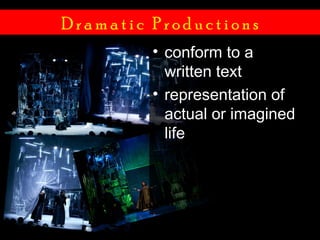
         • conform to a
           written text
         • representation of
           actual or imagined
           life
Nondramatic Productions
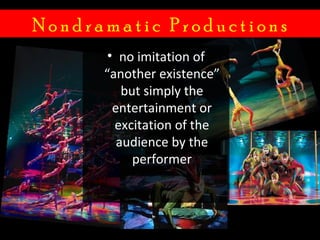
       • no imitation of
      “another existence”
          but simply the
        entertainment or
        excitation of the
         audience by the
            performer
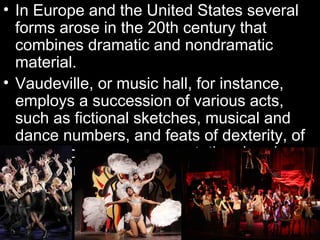
• In Europe and the United States several
  forms arose in the 20th century that
  combines dramatic and nondramatic
  material.
• Vaudeville, or music hall, for instance,
  employs a succession of various acts,
  such as fictional sketches, musical and
  dance numbers, and feats of dexterity, of
  which some are representational and
  others are not.
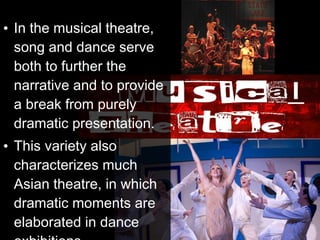
• In the musical theatre,
  song and dance serve
  both to further the
  narrative and to provide
  a break from purely
  dramatic presentation.
• This variety also
  characterizes much
  Asian theatre, in which
  dramatic moments are
  elaborated in dance
Theatre Rol
    es
Major Roles in a Theatrical
       Production
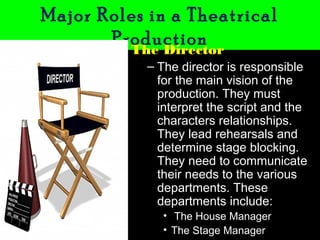
         The Director
            – The director is responsible
              for the main vision of the
              production. They must
              interpret the script and the
              characters relationships.
              They lead rehearsals and
              determine stage blocking.
              They need to communicate
              their needs to the various
              departments. These
              departments include:
              • The House Manager
              • The Stage Manager
The Producer
 – The Producer funds the production and
   designates a Director. For our purpose the
   Producer is usually the school or drama club.
The Assistant Director
  – The Assistant Director
    provides support to the
    Director and the specifics of
    the role would be
    determined between the
    two. Depending upon the
    nature of the production,
    this role might focus more
    on actors or on supporting
    the technical departments.
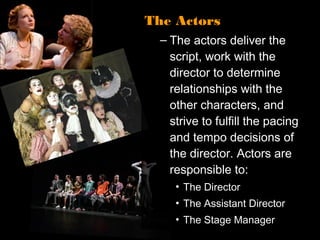
The Actors
  – The actors deliver the
    script, work with the
    director to determine
    relationships with the
    other characters, and
    strive to fulfill the pacing
    and tempo decisions of
    the director. Actors are
    responsible to:
     • The Director
     • The Assistant Director
     • The Stage Manager
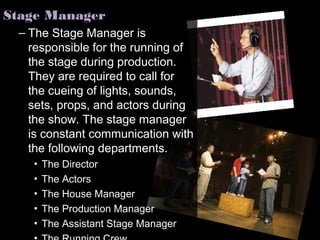
Stage Manager
 – The Stage Manager is
   responsible for the running of
   the stage during production.
   They are required to call for
   the cueing of lights, sounds,
   sets, props, and actors during
   the show. The stage manager
   is constant communication with
   the following departments.
   •   The Director
   •   The Actors
   •   The House Manager
   •   The Production Manager
   •   The Assistant Stage Manager
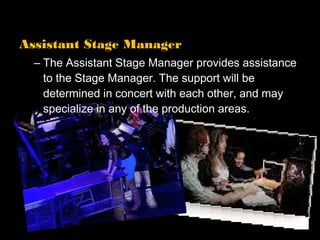
Assistant Stage Manager
  – The Assistant Stage Manager provides assistance
    to the Stage Manager. The support will be
    determined in concert with each other, and may
    specialize in any of the production areas.
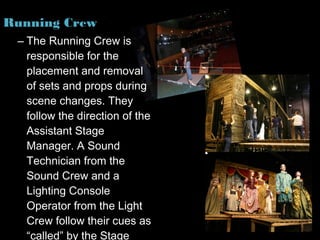
Running Crew
 – The Running Crew is
   responsible for the
   placement and removal
   of sets and props during
   scene changes. They
   follow the direction of the
   Assistant Stage
   Manager. A Sound
   Technician from the
   Sound Crew and a
   Lighting Console
   Operator from the Light
   Crew follow their cues as
   “called” by the Stage
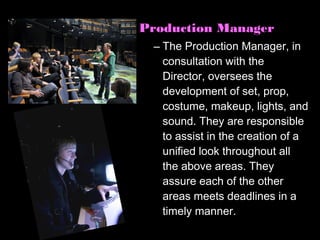
Production Manager
 – The Production Manager, in
   consultation with the
   Director, oversees the
   development of set, prop,
   costume, makeup, lights, and
   sound. They are responsible
   to assist in the creation of a
   unified look throughout all
   the above areas. They
   assure each of the other
   areas meets deadlines in a
   timely manner.
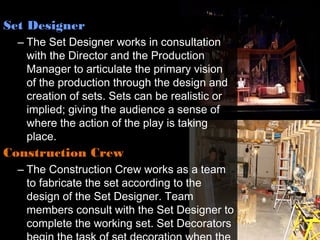
Set Designer
  – The Set Designer works in consultation
    with the Director and the Production
    Manager to articulate the primary vision
    of the production through the design and
    creation of sets. Sets can be realistic or
    implied; giving the audience a sense of
    where the action of the play is taking
    place.
Construction Crew
  – The Construction Crew works as a team
    to fabricate the set according to the
    design of the Set Designer. Team
    members consult with the Set Designer to
    complete the working set. Set Decorators
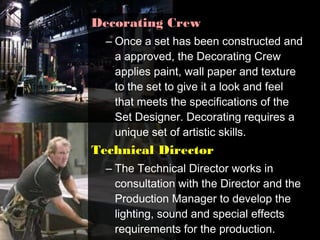
Decorating Crew
  – Once a set has been constructed and
    a approved, the Decorating Crew
    applies paint, wall paper and texture
    to the set to give it a look and feel
    that meets the specifications of the
    Set Designer. Decorating requires a
    unique set of artistic skills.
Technical Director
  – The Technical Director works in
    consultation with the Director and the
    Production Manager to develop the
    lighting, sound and special effects
    requirements for the production.
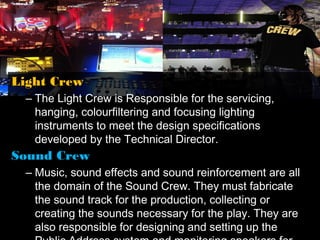
Light Crew
  – The Light Crew is Responsible for the servicing,
    hanging, colourfiltering and focusing lighting
    instruments to meet the design specifications
    developed by the Technical Director.
Sound Crew
  – Music, sound effects and sound reinforcement are all
    the domain of the Sound Crew. They must fabricate
    the sound track for the production, collecting or
    creating the sounds necessary for the play. They are
    also responsible for designing and setting up the
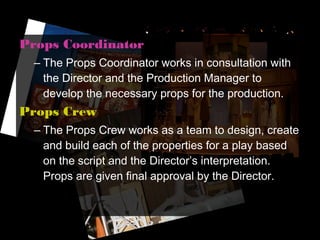
Props Coordinator
  – The Props Coordinator works in consultation with
    the Director and the Production Manager to
    develop the necessary props for the production.
Props Crew
  – The Props Crew works as a team to design, create
    and build each of the properties for a play based
    on the script and the Director’s interpretation.
    Props are given final approval by the Director.
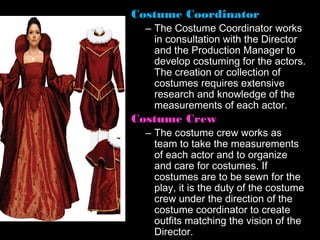
Costume Coordinator
  – The Costume Coordinator works
    in consultation with the Director
    and the Production Manager to
    develop costuming for the actors.
    The creation or collection of
    costumes requires extensive
    research and knowledge of the
    measurements of each actor.
Costume Crew
  – The costume crew works as
    team to take the measurements
    of each actor and to organize
    and care for costumes. If
    costumes are to be sewn for the
    play, it is the duty of the costume
    crew under the direction of the
    costume coordinator to create
    outfits matching the vision of the
    Director.
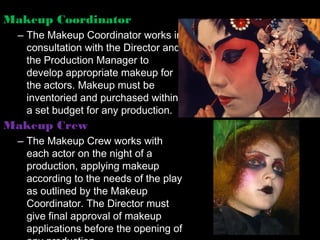
Makeup Coordinator
  – The Makeup Coordinator works in
    consultation with the Director and
    the Production Manager to
    develop appropriate makeup for
    the actors. Makeup must be
    inventoried and purchased within
    a set budget for any production.
Makeup Crew
  – The Makeup Crew works with
    each actor on the night of a
    production, applying makeup
    according to the needs of the play
    as outlined by the Makeup
    Coordinator. The Director must
    give final approval of makeup
    applications before the opening of
House Manager
  – The House Manager is responsible for
    the audience side of the curtain. They
    are responsible for the arrival, seating,
    and dispersal of audience.
Publicity
  – The Publicity Coordinator is responsible
    for advertising and promotion of the
    production.
Box Office
  – The Box Office is responsible for the sale of tickets
    and in coordination with the House Manager the
    organization of seating.
House Staff
  – The House Staff are responsible for the seating of
    the audience, program dispersal, and the general
    order and cleanliness of the seating area.
Stage production

Stage production

  • 2.
    Theatrical Productio • theplanning, n rehearsal, and presentation of a work • Such a work is presented to an audience at a particular time and place by live performers, who use either themselves or inanimate figures,
  • 3.
    Dramatic Productions • conform to a written text • representation of actual or imagined life
  • 4.
    Nondramatic Productions • no imitation of “another existence” but simply the entertainment or excitation of the audience by the performer
  • 5.
    • In Europeand the United States several forms arose in the 20th century that combines dramatic and nondramatic material. • Vaudeville, or music hall, for instance, employs a succession of various acts, such as fictional sketches, musical and dance numbers, and feats of dexterity, of which some are representational and others are not.
  • 6.
    • In the musicaltheatre, song and dance serve both to further the narrative and to provide a break from purely dramatic presentation. • This variety also characterizes much Asian theatre, in which dramatic moments are elaborated in dance
  • 7.
  • 8.
    Major Roles ina Theatrical Production The Director – The director is responsible for the main vision of the production. They must interpret the script and the characters relationships. They lead rehearsals and determine stage blocking. They need to communicate their needs to the various departments. These departments include: • The House Manager • The Stage Manager
  • 9.
    The Producer –The Producer funds the production and designates a Director. For our purpose the Producer is usually the school or drama club.
  • 10.
    The Assistant Director – The Assistant Director provides support to the Director and the specifics of the role would be determined between the two. Depending upon the nature of the production, this role might focus more on actors or on supporting the technical departments.
  • 11.
    The Actors – The actors deliver the script, work with the director to determine relationships with the other characters, and strive to fulfill the pacing and tempo decisions of the director. Actors are responsible to: • The Director • The Assistant Director • The Stage Manager
  • 12.
    Stage Manager –The Stage Manager is responsible for the running of the stage during production. They are required to call for the cueing of lights, sounds, sets, props, and actors during the show. The stage manager is constant communication with the following departments. • The Director • The Actors • The House Manager • The Production Manager • The Assistant Stage Manager
  • 13.
    Assistant Stage Manager – The Assistant Stage Manager provides assistance to the Stage Manager. The support will be determined in concert with each other, and may specialize in any of the production areas.
  • 14.
    Running Crew –The Running Crew is responsible for the placement and removal of sets and props during scene changes. They follow the direction of the Assistant Stage Manager. A Sound Technician from the Sound Crew and a Lighting Console Operator from the Light Crew follow their cues as “called” by the Stage
  • 15.
    Production Manager –The Production Manager, in consultation with the Director, oversees the development of set, prop, costume, makeup, lights, and sound. They are responsible to assist in the creation of a unified look throughout all the above areas. They assure each of the other areas meets deadlines in a timely manner.
  • 16.
    Set Designer – The Set Designer works in consultation with the Director and the Production Manager to articulate the primary vision of the production through the design and creation of sets. Sets can be realistic or implied; giving the audience a sense of where the action of the play is taking place. Construction Crew – The Construction Crew works as a team to fabricate the set according to the design of the Set Designer. Team members consult with the Set Designer to complete the working set. Set Decorators
  • 17.
    Decorating Crew – Once a set has been constructed and a approved, the Decorating Crew applies paint, wall paper and texture to the set to give it a look and feel that meets the specifications of the Set Designer. Decorating requires a unique set of artistic skills. Technical Director – The Technical Director works in consultation with the Director and the Production Manager to develop the lighting, sound and special effects requirements for the production.
  • 18.
    Light Crew – The Light Crew is Responsible for the servicing, hanging, colourfiltering and focusing lighting instruments to meet the design specifications developed by the Technical Director. Sound Crew – Music, sound effects and sound reinforcement are all the domain of the Sound Crew. They must fabricate the sound track for the production, collecting or creating the sounds necessary for the play. They are also responsible for designing and setting up the
  • 19.
    Props Coordinator – The Props Coordinator works in consultation with the Director and the Production Manager to develop the necessary props for the production. Props Crew – The Props Crew works as a team to design, create and build each of the properties for a play based on the script and the Director’s interpretation. Props are given final approval by the Director.
  • 20.
    Costume Coordinator – The Costume Coordinator works in consultation with the Director and the Production Manager to develop costuming for the actors. The creation or collection of costumes requires extensive research and knowledge of the measurements of each actor. Costume Crew – The costume crew works as team to take the measurements of each actor and to organize and care for costumes. If costumes are to be sewn for the play, it is the duty of the costume crew under the direction of the costume coordinator to create outfits matching the vision of the Director.
  • 21.
    Makeup Coordinator – The Makeup Coordinator works in consultation with the Director and the Production Manager to develop appropriate makeup for the actors. Makeup must be inventoried and purchased within a set budget for any production. Makeup Crew – The Makeup Crew works with each actor on the night of a production, applying makeup according to the needs of the play as outlined by the Makeup Coordinator. The Director must give final approval of makeup applications before the opening of
  • 22.
    House Manager – The House Manager is responsible for the audience side of the curtain. They are responsible for the arrival, seating, and dispersal of audience. Publicity – The Publicity Coordinator is responsible for advertising and promotion of the production.
  • 23.
    Box Office – The Box Office is responsible for the sale of tickets and in coordination with the House Manager the organization of seating. House Staff – The House Staff are responsible for the seating of the audience, program dispersal, and the general order and cleanliness of the seating area.