• A fundamental pedagogy of working practically in
Drama is the constant reflective and creative
dialogue.
• Verbal feedback and actions are world class
basics followed by a practical response through
dedicated improvement and reflection time.
•
• Asking questions invigorates thinking and
encourages students to communicate and
express ideas so that students are able to see the
out workings of their decision making, they are
able to think, to question and make connections:
•
• "Reflection and action upon the world in order
to transform it" Paulo Freire.
Home learning task
• Your task is to create a
poster in your Drama
books which includes the
main points about
PHYSICAL THEATRE,
including images and
information about key
practitioners.
• You will find the
information using this and
other presentations via
the department blog
• http://soadrama.blogspot
.co.uk
• You can find additional
resources such as images
of physical theatre work
online.
• The work is due by____
Devising
Stimulus 1 – CROSS THE SPACE
• In two large teams.
• Your aim is to get two members of your group
across the space without them touching the
floor at any point.
• When in contact with them, the other
members of the group cannot move their feet.
• SAFETY – no standing on peoples backs. Be
conscious of risk.
• COMPETITION – This is a race!
Devising
Explore and Experiment
• Using the same teams
• Imagine the ‘crosser’ is feeling a particular emotion,
such as love, or fear, happiness or anger.
• Adapt your movements speed and position so that the
sequence becomes more dramatic with this emotion as
the intention that you wish to communicate to the
audience.
• Adapt further by giving the crosser a prop, such as a
letter they have discovered, which is the source of their
emotion.
• Now it is no longer a race.
Devising
Review and Respond
• What changes were required, observed
or experienced, when the emotion was
introduced?
• Did the team supporting the crosser
remain neutral in their emotions or did
they act in the same way?
• If so what effect did that have on the
audience?
• Was there any sound? If so how did that
add to the experience for the audience?
• If not, what sounds could have been
made?
• A fundamental pedagogy of
working practically in Drama is
the constant reflective and
creative dialogue. Verbal
feedback and actions are world
class basics followed by a
practical response through
dedicated improvement and
reflection time. Asking questions
invigorates thinking and
encourages students to
communicate and express ideas
so that students are able to see
the out workings of their decision
making, they are able to think, to
question and make connections:
•
• "Reflection and action upon the
world in order to transform it"
Paulo Freire.
Devising
Style – Physical Theatre
Physical Theatre uses movement
to convey meaning.
1. Physical Theatre is a style which
uses choreographed movement
and dance to tell a story on
stage. These movements can be
combined with traditional
dialogue, or used on their own.
2. To allow the audience to
concentrate on the movement,
physical theatre productions
often use minimal props and
scenery. In some cases, the
actors’ bodes are even used as
objects on stage.
3. In this way, physical theatre builds
on the ideas of Brecht and Artaud
– there’s nothing realistic about
this sort of movement.
4. This style allows physical theatre
companies to communicate
emotions to the audience that
would be difficult to get across
using only words.
Frantic Assembly
• Frantic Assembly is a theatre company that uses a
technique called contact improvisation – a way of
improvising that requires the performers to use
physical contact with others as the starting point
for their own movements. The Curious Incident of
the Dog in the Night-Time is about an autistic boy
who struggles to express himself. Frantic Assembly
used physical theatre to give the audience an
insight into his thoughts. For example, unnatural
movements and chaotic scenes featuring lots of
performers highlighted the boy’s struggle to
understand the world around him.
Devising
Style – Physical Theatre Practitioners
Steven Berkoff
Devising
Style – Physical Theatre Practitioners
• British theatre practitioner Steven Berkoff
(born 1937) is known for his experimental
style. His plays often use physical theatre
techniques like mime, exaggerated
movements and improvisation – he
believes that actors’ bodies should convey
the story rather than relying on sets.
• LINK – we will explore Berkoff in more
detail in forthcoming Drama lessons
Devising
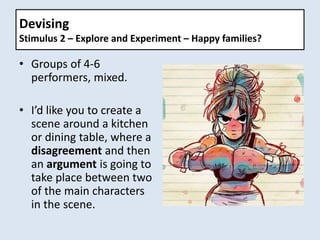
Stimulus 2 – Explore and Experiment – Happy families?
• Groups of 4-6
performers, mixed.
• I’d like you to create a
scene around a kitchen
or dining table, where a
disagreement and then
an argument is going to
take place between two
of the main characters
in the scene.
Devising
Develop and Dramatise
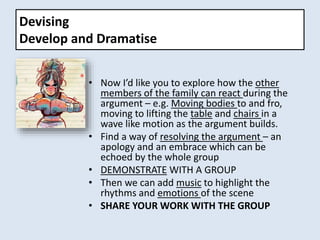
• Now I’d like you to explore how the other
members of the family can react during the
argument – e.g. Moving bodies to and fro,
moving to lifting the table and chairs in a
wave like motion as the argument builds.
• Find a way of resolving the argument – an
apology and an embrace which can be
echoed by the whole group
• DEMONSTRATE WITH A GROUP
• Then we can add music to highlight the
rhythms and emotions of the scene
• SHARE YOUR WORK WITH THE GROUP
Devising
Professional practice – Gecko Theatre
• Watch the following clip
of Gecko Theatre’s
• ‘A life in a day’ and study
the various techniques
that they use in the piece.
• Geck's YouTube channel
• Scott Graham from
Frantic Assembly explains
what Physical Theatre is
• How have they used key
techniques such as
movement, unison,
canon?
• How is it engaging you as
an audience?
• What do you notice about
their use of language in
the piece?
• How is music used, and to
what effect?
Devising – Review and Respond
Let’s take a moment to consider some of the key words of Physical Theatre
and ask questions or make statements about our work.
Unison
At the same time
Together
Slow motion Exaggerated
Exaggerate
Control
Controlled
Movement
Moving
Emphasise
Emphasis
Emphasised
Emotion
Emotions
Emotional
Contrast
Contrasting
Contrasted with..
Symbolise
Symbolised
Symbolising
Pace/Tempo
Faster/Slower
Climax
Ant-climax
Rhythm
Rhythmic

L1 Devising - Physical Theatre skills workshop 1

  • 1.
    • A fundamentalpedagogy of working practically in Drama is the constant reflective and creative dialogue. • Verbal feedback and actions are world class basics followed by a practical response through dedicated improvement and reflection time. • • Asking questions invigorates thinking and encourages students to communicate and express ideas so that students are able to see the out workings of their decision making, they are able to think, to question and make connections: • • "Reflection and action upon the world in order to transform it" Paulo Freire.
  • 2.
    Home learning task •Your task is to create a poster in your Drama books which includes the main points about PHYSICAL THEATRE, including images and information about key practitioners. • You will find the information using this and other presentations via the department blog • http://soadrama.blogspot .co.uk • You can find additional resources such as images of physical theatre work online. • The work is due by____
  • 3.
    Devising Stimulus 1 –CROSS THE SPACE • In two large teams. • Your aim is to get two members of your group across the space without them touching the floor at any point. • When in contact with them, the other members of the group cannot move their feet. • SAFETY – no standing on peoples backs. Be conscious of risk. • COMPETITION – This is a race!
  • 4.
    Devising Explore and Experiment •Using the same teams • Imagine the ‘crosser’ is feeling a particular emotion, such as love, or fear, happiness or anger. • Adapt your movements speed and position so that the sequence becomes more dramatic with this emotion as the intention that you wish to communicate to the audience. • Adapt further by giving the crosser a prop, such as a letter they have discovered, which is the source of their emotion. • Now it is no longer a race.
  • 5.
    Devising Review and Respond •What changes were required, observed or experienced, when the emotion was introduced? • Did the team supporting the crosser remain neutral in their emotions or did they act in the same way? • If so what effect did that have on the audience? • Was there any sound? If so how did that add to the experience for the audience? • If not, what sounds could have been made? • A fundamental pedagogy of working practically in Drama is the constant reflective and creative dialogue. Verbal feedback and actions are world class basics followed by a practical response through dedicated improvement and reflection time. Asking questions invigorates thinking and encourages students to communicate and express ideas so that students are able to see the out workings of their decision making, they are able to think, to question and make connections: • • "Reflection and action upon the world in order to transform it" Paulo Freire.
  • 6.
    Devising Style – PhysicalTheatre Physical Theatre uses movement to convey meaning. 1. Physical Theatre is a style which uses choreographed movement and dance to tell a story on stage. These movements can be combined with traditional dialogue, or used on their own. 2. To allow the audience to concentrate on the movement, physical theatre productions often use minimal props and scenery. In some cases, the actors’ bodes are even used as objects on stage. 3. In this way, physical theatre builds on the ideas of Brecht and Artaud – there’s nothing realistic about this sort of movement. 4. This style allows physical theatre companies to communicate emotions to the audience that would be difficult to get across using only words.
  • 7.
    Frantic Assembly • FranticAssembly is a theatre company that uses a technique called contact improvisation – a way of improvising that requires the performers to use physical contact with others as the starting point for their own movements. The Curious Incident of the Dog in the Night-Time is about an autistic boy who struggles to express himself. Frantic Assembly used physical theatre to give the audience an insight into his thoughts. For example, unnatural movements and chaotic scenes featuring lots of performers highlighted the boy’s struggle to understand the world around him. Devising Style – Physical Theatre Practitioners
  • 8.
    Steven Berkoff Devising Style –Physical Theatre Practitioners • British theatre practitioner Steven Berkoff (born 1937) is known for his experimental style. His plays often use physical theatre techniques like mime, exaggerated movements and improvisation – he believes that actors’ bodies should convey the story rather than relying on sets. • LINK – we will explore Berkoff in more detail in forthcoming Drama lessons
  • 9.
    Devising Stimulus 2 –Explore and Experiment – Happy families? • Groups of 4-6 performers, mixed. • I’d like you to create a scene around a kitchen or dining table, where a disagreement and then an argument is going to take place between two of the main characters in the scene.
  • 10.
    Devising Develop and Dramatise •Now I’d like you to explore how the other members of the family can react during the argument – e.g. Moving bodies to and fro, moving to lifting the table and chairs in a wave like motion as the argument builds. • Find a way of resolving the argument – an apology and an embrace which can be echoed by the whole group • DEMONSTRATE WITH A GROUP • Then we can add music to highlight the rhythms and emotions of the scene • SHARE YOUR WORK WITH THE GROUP
  • 11.
    Devising Professional practice –Gecko Theatre • Watch the following clip of Gecko Theatre’s • ‘A life in a day’ and study the various techniques that they use in the piece. • Geck's YouTube channel • Scott Graham from Frantic Assembly explains what Physical Theatre is • How have they used key techniques such as movement, unison, canon? • How is it engaging you as an audience? • What do you notice about their use of language in the piece? • How is music used, and to what effect?
  • 12.
    Devising – Reviewand Respond Let’s take a moment to consider some of the key words of Physical Theatre and ask questions or make statements about our work. Unison At the same time Together Slow motion Exaggerated Exaggerate Control Controlled Movement Moving Emphasise Emphasis Emphasised Emotion Emotions Emotional Contrast Contrasting Contrasted with.. Symbolise Symbolised Symbolising Pace/Tempo Faster/Slower Climax Ant-climax Rhythm Rhythmic