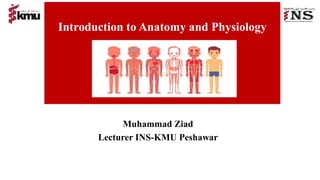
Introduction to Anatomy and Physiology
Muhammad Ziad
Lecturer INS-KMU Peshawar
Objectives:
By the end of the session students will be able to:
• Define the term A&P
• Understand the relationship between A&P
• Discuss level of organization of the body
• Identify anatomical position
• Describe the various body planes.
• Briefly discuss the body cavities. And list the organs lying within each cavity
• Identify abdominal pelvic region & quadrant
• Identify the organs present in Nine (9) abdomino-pelvic regions.
• Briefly discuss the importance of abdomino-pelvic quadrants and regions.
Anatomy Definition
• Anatomy – study of body structure and the relationship among them . e.g.
organ shape, size and weight etc
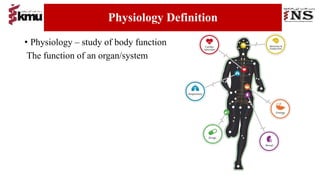
Physiology Definition
• Physiology – study of body function
The function of an organ/system
Basic Terminologies
 Cytology – study of structure and
function of cells
 Histology – microscopic study of cells
and tissue
 Osteology – study of structure and
function of bones
Basic Terminologies
 Myology – study of structure and function of
muscles
 Arthrology – study of structure and function of
joints
 Angiology – study of structure and function of
blood vessels and lymph system
• Neurology – study of nervous system
Directional terms
• Superior – the upper part of a
structure e.g. the heart is superior
to the liver.
• Inferior - the lower part of a
structure e.g.
the stomach is inferior to the lung.
Directional terms (cont)
• Anterior – at the front of the body
e.g. the sternum(breastbone)is
anterior to the heart.
• Posterior – at the back of the
body e.g. the esophagus is
posterior to the trachea.
Directional terms (cont)
• Medial – nearer to the midline e.g.
the ulna is medial to the radius.
• Lateral – farther to the midline
e.g. the lungs are lateral to the
heart.
• Intermediate – between two
structure e.g. the transverse colon
is intermediate between the
ascending and descending colons.
Directional terms (cont)
• Ipsilateral – on the same side of the body as another structure e.g. the gall bladder
and ascending colon are ipsilateral.
• Contralateral – on the opposite side of the body from another structure e.g. the
ascending and descending colons are contra lateral.
• Proximal – nearer to attachments of a limb to the trunk e.g. humerus is proximal to
the radius.
• Distal – farther from the attachment of a limb to the trunk e.g. phalanges are distal
to the carpals.
Directional terms (cont)
 Left Right
 Superior Inferior
 Anterior Posterior
 Ventral Dorsal
 Proximal Distal
 Medial Lateral
 Superficial Deep
 Adduct Abduct
 Cranial Caudal
Relationship between A&P
• Structures and functions are so closely related.
• The structure of a part of the body allows performance of
certain functions.
• e.g. the bone of the skull join tightly to form a rigid case that
protect the brain.
• The lining of the urinary bladder is much thicker to prevent
the escape of urine in to the pelvic cavity.
Organization of the body
Organization of the body (cont)
• Chemical
• Cellular
• Tissue
• Organs
• System Level
• Organismic Level
Anatomical position
• Any region or part of the
human body assume that
it is in specific stance called
the anatomical position.
• In the anatomical position
body is upright.
• Stand erect. Head level
and the eyes facing directly
forward
• Feet are flat on the floor.
• Arms are at the sides with the
• palms turned forward.
Anatomical position (cont)
 Sagittal plane – is a vertical plane. Divides the body into right and left
sides.
 Midsagittal plane- (equal right and left)
 Parasagittal plane- ( unequal right and left)
 Transverse (Horizontal) or cross sectional plane - Divides the body into
superior and inferior portions.
 Frontal (Coronal) plane - Divides the body into anterior or ventral and
posterior or dorsal portions.
Body Planes and sections
• Imaginary flat
surface that pass
through the body
parts.
Body cavities
• Body cavities are spaces within the body that help, separate, and
support internal organ.
• Bones, muscles, ligaments, and other structures separate the
various body cavities from one another
Body cavities (cont)
• Cranial cavity: formed by cranial bones and contains brain.
• Vertebral cavity: formed by vertebral column and contains spinal cord
and the beginning of spinal nerves.
• Thoracic/ chest cavity: contains pleural and pericardial cavities and
mediastinum.
1. Pleural cavity: each surrounds a lung, the serous membrane of the
pleural cavities in the pleura.
Body cavities (cont)
2. Pericardial cavity: surrounds the heart, the serious membrane of the
pericardial cavity in the pericardium.
3. Mediastinum: central portion of thoracic cavity between the lungs. It
contains heart, thymus, esophagus, trachea, and several large blood
vessels.
Body cavities (cont)
• Abdominopelvic cavity: Subdivided into abdominal and pelvic
cavities.
• Abdominal cavity: contains stomach, spleen, liver, gallbladder,
small and most of the large intestine.
• Pelvic cavity: contains urinary bladder, portions of large
intestine and internal organ of reproduction.
Abdominal pelvic region & quadrant
• To describe the location
of the many abdominal
and Pelvic organs more
easily two methods are
Used for dividing the
Abdominopelvic cavity
Into smaller area.
Abdominal pelvic region & quadrant
• First method two horizontal and two vertical lines.
• Partition this cavity into nine abdoninopelvic region.
• The top horizontal line, is drawn just inferior to the rib cage, across the
inferior portion of the stomach.
• The bottom horizontal line is drawn just inferior to the tops of the hip
bone.
Abdominal pelvic region & quadrant
• Two vertical lines,the left and right midclavicular lines,are
drawn throygh the mid portions of the clavicles(collar
bones),just medial to the nipple.
• The four lines divide the abdominopelvic cavity into a larger
middle section and smaller left and right sections.
Abdominal pelvic region & quadrant
• The name of the nine regions are:
1. Right hypochondriac
2. Epigestric region
3. Left hypochondric region
4. Right lumber region
5. Umblical region
6. Left lumber region
Abdominal pelvic region & quadrant
7. Right inguinal / iliac region
8. Hypogestric / pubic region
9. Left inguinal / iliac region
Abdominal pelvic region & quadrant
• The second method is
Similar and divides the
abdominopelvic cavity
Into quadrant.
• Quad =one-fourth
Abdominal pelvic region & quadrant
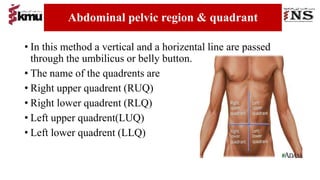
• In this method a vertical and a horizental line are passed
through the umbilicus or belly button.
• The name of the quadrents are
• Right upper quadrent (RUQ)
• Right lower quadrent (RLQ)
• Left upper quadrent(LUQ)
• Left lower quadrent (LLQ)
Abdominal pelvic region & quadrant
• The nine – region division is more widely used for anatomical
studies.
• The quadrents are more commonly used for describing the site
of abdominopelvic pain,tumor,or other abnormality.
Body Systems
References:
• Waugh, A., & Grant, A. (2018). Ross & Wilson Anatomy and Physiology
in health and illness. Elsevier.

Unit 1 A&P.ppt

  • 1.
    Introduction to Anatomyand Physiology Muhammad Ziad Lecturer INS-KMU Peshawar
  • 2.
    Objectives: By the endof the session students will be able to: • Define the term A&P • Understand the relationship between A&P • Discuss level of organization of the body • Identify anatomical position • Describe the various body planes. • Briefly discuss the body cavities. And list the organs lying within each cavity • Identify abdominal pelvic region & quadrant • Identify the organs present in Nine (9) abdomino-pelvic regions. • Briefly discuss the importance of abdomino-pelvic quadrants and regions.
  • 3.
    Anatomy Definition • Anatomy– study of body structure and the relationship among them . e.g. organ shape, size and weight etc
  • 4.
    Physiology Definition • Physiology– study of body function The function of an organ/system
  • 5.
    Basic Terminologies  Cytology– study of structure and function of cells  Histology – microscopic study of cells and tissue  Osteology – study of structure and function of bones
  • 6.
    Basic Terminologies  Myology– study of structure and function of muscles  Arthrology – study of structure and function of joints  Angiology – study of structure and function of blood vessels and lymph system • Neurology – study of nervous system
  • 7.
    Directional terms • Superior– the upper part of a structure e.g. the heart is superior to the liver. • Inferior - the lower part of a structure e.g. the stomach is inferior to the lung.
  • 8.
    Directional terms (cont) •Anterior – at the front of the body e.g. the sternum(breastbone)is anterior to the heart. • Posterior – at the back of the body e.g. the esophagus is posterior to the trachea.
  • 9.
    Directional terms (cont) •Medial – nearer to the midline e.g. the ulna is medial to the radius. • Lateral – farther to the midline e.g. the lungs are lateral to the heart. • Intermediate – between two structure e.g. the transverse colon is intermediate between the ascending and descending colons.
  • 10.
    Directional terms (cont) •Ipsilateral – on the same side of the body as another structure e.g. the gall bladder and ascending colon are ipsilateral. • Contralateral – on the opposite side of the body from another structure e.g. the ascending and descending colons are contra lateral. • Proximal – nearer to attachments of a limb to the trunk e.g. humerus is proximal to the radius. • Distal – farther from the attachment of a limb to the trunk e.g. phalanges are distal to the carpals.
  • 11.
    Directional terms (cont) Left Right  Superior Inferior  Anterior Posterior  Ventral Dorsal  Proximal Distal  Medial Lateral  Superficial Deep  Adduct Abduct  Cranial Caudal
  • 12.
    Relationship between A&P •Structures and functions are so closely related. • The structure of a part of the body allows performance of certain functions. • e.g. the bone of the skull join tightly to form a rigid case that protect the brain. • The lining of the urinary bladder is much thicker to prevent the escape of urine in to the pelvic cavity.
  • 13.
  • 14.
    Organization of thebody (cont) • Chemical • Cellular • Tissue • Organs • System Level • Organismic Level
  • 15.
    Anatomical position • Anyregion or part of the human body assume that it is in specific stance called the anatomical position. • In the anatomical position body is upright. • Stand erect. Head level and the eyes facing directly forward • Feet are flat on the floor. • Arms are at the sides with the • palms turned forward.
  • 16.
    Anatomical position (cont) Sagittal plane – is a vertical plane. Divides the body into right and left sides.  Midsagittal plane- (equal right and left)  Parasagittal plane- ( unequal right and left)  Transverse (Horizontal) or cross sectional plane - Divides the body into superior and inferior portions.  Frontal (Coronal) plane - Divides the body into anterior or ventral and posterior or dorsal portions.
  • 17.
    Body Planes andsections • Imaginary flat surface that pass through the body parts.
  • 18.
    Body cavities • Bodycavities are spaces within the body that help, separate, and support internal organ. • Bones, muscles, ligaments, and other structures separate the various body cavities from one another
  • 19.
  • 20.
    Body cavities (cont) •Cranial cavity: formed by cranial bones and contains brain. • Vertebral cavity: formed by vertebral column and contains spinal cord and the beginning of spinal nerves. • Thoracic/ chest cavity: contains pleural and pericardial cavities and mediastinum. 1. Pleural cavity: each surrounds a lung, the serous membrane of the pleural cavities in the pleura.
  • 21.
    Body cavities (cont) 2.Pericardial cavity: surrounds the heart, the serious membrane of the pericardial cavity in the pericardium. 3. Mediastinum: central portion of thoracic cavity between the lungs. It contains heart, thymus, esophagus, trachea, and several large blood vessels.
  • 22.
    Body cavities (cont) •Abdominopelvic cavity: Subdivided into abdominal and pelvic cavities. • Abdominal cavity: contains stomach, spleen, liver, gallbladder, small and most of the large intestine. • Pelvic cavity: contains urinary bladder, portions of large intestine and internal organ of reproduction.
  • 23.
    Abdominal pelvic region& quadrant • To describe the location of the many abdominal and Pelvic organs more easily two methods are Used for dividing the Abdominopelvic cavity Into smaller area.
  • 24.
    Abdominal pelvic region& quadrant • First method two horizontal and two vertical lines. • Partition this cavity into nine abdoninopelvic region. • The top horizontal line, is drawn just inferior to the rib cage, across the inferior portion of the stomach. • The bottom horizontal line is drawn just inferior to the tops of the hip bone.
  • 25.
    Abdominal pelvic region& quadrant • Two vertical lines,the left and right midclavicular lines,are drawn throygh the mid portions of the clavicles(collar bones),just medial to the nipple. • The four lines divide the abdominopelvic cavity into a larger middle section and smaller left and right sections.
  • 26.
    Abdominal pelvic region& quadrant • The name of the nine regions are: 1. Right hypochondriac 2. Epigestric region 3. Left hypochondric region 4. Right lumber region 5. Umblical region 6. Left lumber region
  • 27.
    Abdominal pelvic region& quadrant 7. Right inguinal / iliac region 8. Hypogestric / pubic region 9. Left inguinal / iliac region
  • 28.
    Abdominal pelvic region& quadrant • The second method is Similar and divides the abdominopelvic cavity Into quadrant. • Quad =one-fourth
  • 29.
    Abdominal pelvic region& quadrant • In this method a vertical and a horizental line are passed through the umbilicus or belly button. • The name of the quadrents are • Right upper quadrent (RUQ) • Right lower quadrent (RLQ) • Left upper quadrent(LUQ) • Left lower quadrent (LLQ)
  • 30.
    Abdominal pelvic region& quadrant • The nine – region division is more widely used for anatomical studies. • The quadrents are more commonly used for describing the site of abdominopelvic pain,tumor,or other abnormality.
  • 31.
  • 33.
    References: • Waugh, A.,& Grant, A. (2018). Ross & Wilson Anatomy and Physiology in health and illness. Elsevier.

Editor's Notes