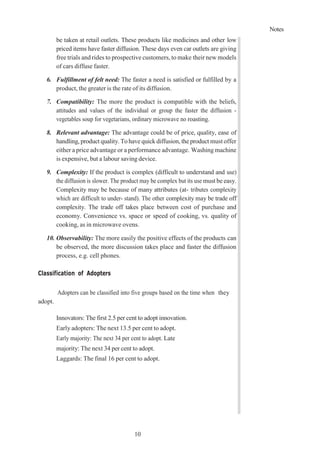
Consumer Behaviou
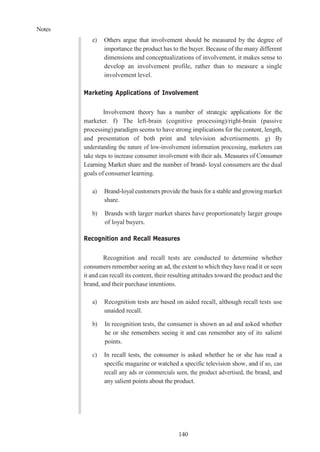
Notes
1
Consumer Behaviour
Objectives
➢ To understand the conceptual foundations of consumer buying
behavior
➢ To create awareness of the theories of motivation and perception as applied
in consumer behavior, and
➢ To acquaint with the communication and consumer decision
making
Unit - I
Consumer Behaviour and Marketing Action - An overview - Consumer
involvement - Decision-making processes - Purchase Behaviour and Marketing
Implications - Consumer Behaviour Models
Unit – II
Environmental influences on Consumer Behaviour - Cultural
influences - Social class - Reference groups and family influences - Opinion
leadership and the diffusion of innovations - Marketing implications of the
above influences.
Unit – III
Consumer buying behaviour - Marketing implications - Consumer
perceptions – Learning and attitudes - Motivation and personality –
Psychographics - Values and Lifestyles, Click-o-graphic.
Notes
2
Unit – IV
Strategic marketing applications - Market segmentation strategies
- Positioning strategies for existing and new products, Re-positioning,
Perceptual Mapping - Marketing communication - Store choice and shopping
behaviour - In-Store stimuli, store image and loyalty - Consumerism -
Consumer rights and Marketers’ responsibilities.
Unit - V
The Global Consumer Behaviour and Online buying behaviour
- Consumer buying habits and perceptions of emerging non-store choices -
Research and applications of consumer responses to direct marketing
approaches - Issues of privacy and ethics.
References
Bennet and Kassarjian, CONSUMER BEHA VIOUR, Prentice Hall of
India, New Delhi
Michael R. Solomon, CONSUMER BEHAVIOUR, PHI Learning Private
Limited, New Delhi, 2011
Ramanuj Majumdar, CONSUMER BEHAVIOUR, Prentice Hall of India,
New Delhi, 2011
Loudon and Della Bitta, CONSUMER BEHAVIOUR: CONCEPTS AND
APPLICATIONS, Tata McGraw Hill. New Delhi,2007
Berkman & Gilson, CONSUMER BEHA VIOUR:CONCEPTS AND
STRATEGIES, Kent Publishing Company.
EfraimTurban,JaeLce,DavidKing,&I-I.MichaelChung:ELECTRONIC
COMMCRCE: Managerial Perspective, Pearson Education Inc., 2000.
Notes
3
UNIT – I
Learning Objectives
After studying this chapter, you will be able to:
➢ Familiarize with the terms ‘Consumer’, ‘Customer’, ‘Industrial buyer’
➢ Understand the need of consumer behavioral study, differences
between organizational buying behavior and consumer buying
behavior
➢ Analyze the nature and model of Consumer Involvement
➢ Understand consumer and Industrial decision making process and
decision rules
➢ Appreciate marketing implications of Consumer Behavior
➢ Appreciate the study of Consumer Behavior Modeling
Unit Structure
Lesson 1.1 - Consumer Behavior and Marketing Action Lesson
1.2 - Consumer Involvement
Lesson 1.3 - Consumer Decision Making Process
Lesson 1.4 - Consumer Behavior and Marketing Implications
Lesson 1.5 - Consumer Behavior Models
Notes
4
Lesson 1.1 - Consumer Behavior and Marketing Action
Introduction
Consumer behavior is comparatively a new field of study which
evolved just after the Second World War. The seller’s market has disappeared
and buyers market has come up. This has led to paradigm shift of the manufacturer’s
attention from product to consumer and specially focused on the consumer
behavior. The evaluation of marketing concept from mere selling concept to
consumer-oriented marketing has resulted in buyer behavior becoming an
independent discipline. The growth of consumerism and consumer legislation
emphasizes the importance that is given to the consumer. Consumer behavior is a
study of how individuals make decision to spend their available resources (time,
money and effort) or consumption related aspects (What they buy? When they
buy?, How they buy? etc.).
The heterogeneity among people makes understanding consumer
behavior a challenging task to marketers. Hence marketers felt the need to
obtain an in-depth knowledge of consumers buying behavior. Finally this
knowledge acted as an imperative tool in the hands of marketers to forecast the
future buying behavior of customers and devise four marketing strategies in order to
create long term customer relationship.
Consumer Behavior: Definition
It is broadly the study of individuals, or organizations and the
processes consumers use to search, select, use and dispose of products,
services, experience, or ideas to satisfy needs and study of its impact on the
consumer and society.
Customers versus Consumers
The term ‘customer’ is specific in terms of brand, company, or shop. It refers
to person who customarily or regularly purchases particular brand, purchases
particular company’s product, or purchases from particular
Notes
5
shop. Thus a person who shops at Bata Stores or who uses Raymond’s
clothing is a customer of these firms. Whereas the ‘consumer’ is a person who
generally engages in the activities - search, select, use and dispose of products,
services, experience, or ideas.
Need for Study of Consumer Behavior
The study of consumer behavior helps everybody as all are consumers.
It is essential for marketers to understand consumers to survive and succeed in this
competitive marketing environment. The following reasons highlight the
importance of studying consumer behavior as a discipline.
Importance in Day to Day Life
The purpose of studying a discipline is to help oneself to better
appreciate its contributions. The reason to study consumer behavior is because
of the role it plays in the lives of humans. Most of the free time is spent in the
market place, shopping or engaging in other activities. The extra time is usually
passed in knowing and thinking about products and services, discussing with
friends about them, and watching advertisements related to them. The usage of them
significantly reveals our life styles. All these reasons suggest the need for study.
However, the purpose may be to attend immediate and tangible reasons.
Pertinence to Decision Making
Consumer behavior is said to be an applied discipline as some
decisions are significantly affected by their behavior or expected actions. The two
perspectives that seek application of its knowledge are micro and societal
perspectives.
The micro perspectives involve understanding consumer for the
purpose of helping a firm or organization to achieve its objectives. The people
involved in this field try to understand consumers in order to be more effective
at their tasks.
Whereas the societal or macro perspective applies knowledge of
consumers to aggregate- level faced by mass or society as a whole. The
behavior of consumer has significant influence on the quality and level of the
standard of living.
Notes
6
Organizational Buyer versus Individual Buyer
The obvious difference between industrial or institutional markets and
consumer markets is that, instead of purchases being made for individual
consumption industrial markets are made for business use. There are several
factors that differentiate consumer markets and their buying behavior from
organizational market and their buying behavior. The key factors of
differentiation are:
1. Market Structure and Demand
2. Buyer Characteristics
3. Decision Process and Buying Patterns
1. Market Structure and Demand The distinguishing factors of market
structure and demand are as follows:
➢ In organizations, buyers are more geographically concentrated than
consumer markets.
➢ Organizational buyers are fewer in number but they are bulk buyers
compared to individual buyers.
➢ Organizational buyer markets are either vertical or horizontal. In vertical
structures they cater only one or two industries, whereas in horizontal
structure the buyer base is too broad.
➢ Organizational demand is derived from consumer demand. The nature
of the demand is fluctuating and inelastic.
2. Buyer Characteristics The distinguishing factors of buyer
characteristics are as follows:
➢ Many individuals or group involvement is seen in decision making
process.
➢ Organizational buyers are quite knowledgeable and professional.
➢ The buying motive is mostly rational than individual buyer.
Notes
7
3. Decision Process and Buying Patterns The major differences are as
follows:
➢ In organizational buying lot of formalities like proposals, quotations,
procedures are to be followed unlike consumer buying.
➢ Decision process is much complex with high financial risk, technical
aspects, multiple influencing factors etc.
➢ Organizational buying requires more extensive negotiation over
larger time period than consumer buying.
****
Notes
8
Lesson 1.2 - Consumer Involvement
Some consumers are characterized as being more involved in products
and shopping than others. A consumer who is highly involved with a product
would be interested in knowing a lot about it before purchasing. Hence he
reads brochures thoroughly, compares brands and models available at
different outlets, asks questions, and looks for recommendations. Thus
consumer involvement can be defined as heightened state of awareness that
motivates consumers to seek out, attend to, and think about product information
prior to purchase.
Causes of Consumer Involvement
The factors that influences consumer involvement include personal, product
and situational.
Personal Factors
Self-concept, needs, and values are the three personal factors that
influence the extent of consumer involvement in a product or service. The more
product image, the value symbolism inherent in it and the needs it serves are
fitting together with the consumer self- image, values and needs, the more
likely the consumer is to feel involved in it. Celebrities for example share a
certain self-image, certain values, and certain needs. They tend to use products
and services that reflect their life style. They get highly involved in purchasing
prestigious products like designer wear, imported cars, health care products etc.
Product Factors
➢ The consumer involvement grows as the level of perceived risk in the
purchase of a good or service increases. It is likely that consumers will feel
more involved in the purchase of their house than in the purchase of
tooth paste, because it is a much riskier purchase.
Notes
9
➢ Product differentiation affects involvement. The involvement
increases as the number of alternatives that they have to choose from,
increases.
➢ The pleasure one gets by using a product or service can also influence
involvement. Some products are a greater source of pleasure to the
consumer than others. Tea and coffee have a high level of hedonic
(pleasure) value compared to, say household cleaners. Hence the
involvement is high.
➢ Involvement increases when a product gains public attention. Any
product that is socially visible or that is consumed in public, demands
high involvement. For example, involvement in the purchase of car is
more than the purchase of household items.
Situational Factors
➢ The situation in which the product is bought or used can generate
emotional involvement. The reason for purchase or purchase occasion
affects involvement. For example, buying a pair of socks for oneself is
far less involved than buying a gift for a close friend.
➢ Social pressure can significantly increase involvement. One is likely to be
more self conscious about the products and brands one looks at when
shopping with friends than when shopping alone.
➢ The need to make a fast decision also influences involvement. A
consumer who needs a new refrigerator and sees a ‘one- day- only sale’
at an appliances retailer does not have the time to shop around and compare
different brands and prices. The eminence of the decision heightens
involvement.
➢ The involvement is high when the decision is irrevocable, for example
when the retailer does not accept return or exchange on the sale items.
Thus involvement may be from outside the individual, as with
situational involvement or from with in the individual as with enduring
involvement. It can be induced by a host of personal-product-and situation related
factors, many of which can be controlled by the marketer. It affects the ways in which
consumers see, process, and send information to others.
Notes
10
Types of Involvement
The two types of involvement are:
A) Situation
B) Enduring
Situational Involvement
`Situational involvement is temporary and refers to emotional feelings
of a consumer, experiences in a particular situation when one thinks of a
specific product.
Enduring Involvement
Enduring involvement is persistent over time and refers to feelings
experienced toward a product category across different situations. For example,
holiday- makers renting a resort for their trip are highly involved in their choice, but
their involvement is temporary. Whereas involvement of a person whose hobby
is bike racing endures overtime and affects his responses in any situation
related to pre-purchase, purchase and post- purchase of sport bikes. It is
observed that involvement is triggered by special situation in the case of
holiday makers, but in the second case, it comes from, and is a part of the
consumer.
The contrast between situational and enduring involvement is
important. When marketers measure involvement they examine the extent to
which it can be induced by the product or selling situation. After noticing the type of
involvement they are facing, marketers work to control products or selling
situations.
Effects of Consumer Involvement
Involvement with the product makes consumers process the product-
related information more readily. This information is processed thoroughly;
hence, it is retained for a longtime. Because of this the consumers become
emotionally high and tend to engage in extended problem solving and word-
of-mouth communications. These result into three categories: search for
information, processing information, and
Notes
11
information transmission.
Customers who are highly involved tend to search for information and
shop around more when compared with low involvement customers. For
example, the customer who is highly involved with cars and thinks about
buying it is likely to gather information. He sees for alternative models to figure
the advantages and disadvantages of each. The more they are involved, the more they
learn about the alternatives with in that category. To gather the information they use
various sources. One such behavior is to shop around, where they visit various
outlets and talk to sales people. The customers of this kind should be encouraged
buy retailers to visit the outlets to know, and compare various models to meet
information needs.
Processing of Information
Processing of information means depth of comprehension, extent of
cognitive elaboration, and the extent of emotional arousal of information as
discussed below.
Depth of Comprehension
Highly involved customers tend to process product information at
deeper levels of understanding than the ones with low involvement. For
example educated parents in urban areas are highly involved in baby food
purchase decisions than rural uneducated parents. They also retain this
information for long time. In this case marketers need to provide information
cues to help the consumers to retrieve information from memory. But when
thetarget is lowinvolvement consumers,marketers should make the necessary
information as accessible as possible at the time of selection and buying of the
product.
Extent of Cognitive Elaboration
Highly involved customers think more about product choices than
consumers with low involvement. Their deep understanding involves support
arguments and / or counter arguments. That is, highly involved consumers tend
to generate cognitive responses either in support of the product information or
against the information provided by the marketers.
Notes
12
If we talk of the previous example, marketing baby food products, the
product all though effective may have significant side effects like obesity.
Educated parents are likely to give this the great deal of thought before giving it
to their children. To ensure that the parents generate positive thoughts, the
marketers have to mention a quality argument that the product benefits outweigh
its negative effects. If the arguments are less informed and not persuasive, it is
likely to produce negative thoughts resulting in an unfavorable attitude towards
the product.
Level of Emotional Arousal
Highly involved consumers are more emotional than less involved
consumers.
The highly involved consumers react more strongly to the product- related
information which may act for or against marketers. This is because the negative
interpretation is likely to be exaggerated more number of times causing the
customers to reject the product.
Information Transmission
Transmission of information is the extent to which greatly involved
customers send information about the product to others. This is done usually
through word-of-mouth communication. The researchers have shown that if
consumers are highly involved they talk about the product frequently than others.
Satisfied consumers are likely to speak favourable about the product, while unsatisfied
speak negatively. Therefore, marketers catering to highly involved consumers should
attempt to enhance consumer satisfaction and decrease dissatisfaction. For
example, customer happy with ONIDA television communicates the same to
others through word- of-mouth.
Models of Consumer Involvement
There are four prominent models of consumer behavior based on
involvement which help marketers in making strategic decision particularly in
marketing communication related strategies. The four models are as follows.
Notes
13
1. Low Involvement Learning Model
2. Learn-Feel-Do Hierarchy model
3. Level of Message Processing Model
4. Product versus Brand Involvement Model
1. Low Involvement Learning Model
Low Involvement products are those which are at low risk, perhaps by virtue of
being inexpensive, and repeatedly used by consumers. Marketers try to sell the
products without changing the attitudes of consumers. New product beliefs replace
old brand perceptions. Marketers achieve low– involvement learning through
proper positioning. For example, writing pen with the ‘uninterrupted flow’,
and tooth paste with ‘mouth wash’ positioning attracts new consumers.
2. Learn-Feel-Do Hierarchy Model
Buying decisions vary according to the way they are taken. Some
decisions are taken with lot of thinking others are taken with great feelings. Some are
made through force of habit and others are made consciously. The learn-feel-do
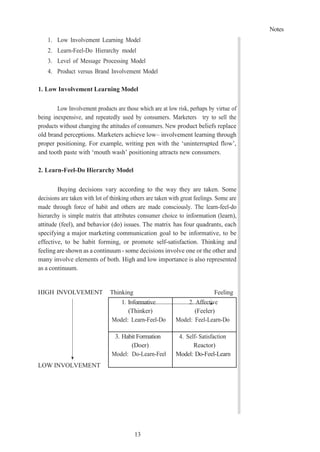
hierarchy is simple matrix that attributes consumer choice to information (learn),
attitude (feel), and behavior (do) issues. The matrix has four quadrants, each
specifying a major marketing communication goal to be informative, to be
effective, to be habit forming, or promote self-satisfaction. Thinking and
feeling are shown as a continuum - some decisions involve one or the other and
many involve elements of both. High and low importance is also represented
as a continuum.
HIGH INVOLVEMENT
LOW INVOLVEMENT
Thinking Feeling
1. Informative
(Thinker)
Model: Learn-Feel-Do
2. Affective
(Feeler)
Model: Feel-Learn-Do
3. Habit Formation
(Doer)
Model: Do-Learn-Feel
4. Self- Satisfaction
Reactor)
Model: Do-Feel-Learn
Notes
14
(I) High Involvement / High Thinking
Purchases in first quadrant require more information, both because of the
importance of the product to the consumer and thinking issues related to the
purchases. Major purchases such as cars, houses and other expensive and
infrequently buying items come under this category. The strategy model is learn-
feel-do. Marketers have to furnish full information to get consumer acceptance of
the product.
(ii) High Involvement / High Feeling
The purchase decisions in second quadrant involve less of information
than feeling. Typical purchases tied to self-esteem- jewelry, apparel, cosmetics
and accessories come under this category. The strategy model is feel-learn-do. To
encourage purchases marketers must approach customers with emotion and
appeal.
(iii) Low Involvement / Low Feeling
The purchases in this quadrant are motivated primarily by the need to satisfy
personal tastes, many of which are influenced by self-image. Products like news
paper, soft drinks, Liquor etc., fall under this category. Group influences often lead
to the purchase of these items. The strategy model is do-feel-learn. It helps
marketers to promote products through reference groups and other social
factors.
(iv) Low Involvement / Low Thinking
It involves less in thinking and more of habitual buying. Products like
stationery, groceries, food etc., fall under this category. Over a period of time any
product can fall in this segment. The role of information is to differentiate any
‘point of difference’ from competitors. Brand loyalty may result simply from
the habit. The strategy model is do-learn-feel. It suggests thatmarketers induce
trial through various sales promotion techniques.
3. Level of Message Processing Model
Consumer attention to advertisements or any other marketing
communication depends on four levels of consumer involvement: Pre-
attention, focal attention, comprehension and elaboration. Each calls
Notes
15
for different level of message processing. Pre-attention demands only limited
message processing - the consumer only identifies the product. Focal attention
involves basic information as product name or usefulness. In comprehension
level, the message is analyzed and the content of the message is integrated with
other information, through elaboration, which helps to build attitude towards the
product. It is suggested that marketers make advertisements which can induce
elaboration.
4. Product versus Brand Involvement Model
Sometimes consumer is involved with the product category but may
not be necessarily involved with the particular brand or vice versa. For example,
house wives know more about kitchen ware but may not know the details of
various brands. According to the consumer involvement in either product or
particular brand, consumer types can be divided into four categories as
described below.
(i) Brand Loyals: These consumers are highly involved with both the
product category and with particular brand. For example, cigarette smokers
and paper readers fall in this category.
(ii) Information Seekers: These buyers are involved more with product
category but may not have preferred brand. They are likely to see information
to decide a particular brand. For examples, air- conditioners and washing
machine buyers fall under this category.
(iii) Routine Brand Buyers: These consumers are not highly involved with
the product category but may be involved with the particular brand within
that category. They have low emotional attachment with the product
category and tied mainly with their brand. For example users of
particular brand of soap for years, regular visitors to particular
restaurant fall in this category.
(iv) Brand Switching: Consumers in this category have no emotional
attachment either with product category or any brand within it. They
typically respond to price. For example stationery items, fashion
products come under this category.
****
Notes
16
Lesson 1.3 - Consumer Decision Making Process
The most important environment in which firms operate is their
customer environment because the basic belief of marketing oriented
company – that the customer is the centre around which the business revolves.
Therefore, marketing people need to understand the processes that their
customers go through when making decision.
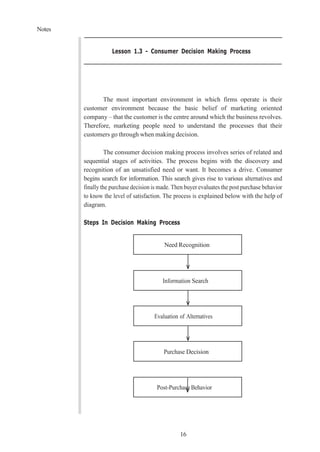
The consumer decision making process involves series of related and
sequential stages of activities. The process begins with the discovery and
recognition of an unsatisfied need or want. It becomes a drive. Consumer
begins search for information. This search gives rise to various alternatives and
finally the purchase decision is made. Then buyer evaluates the post purchase behavior
to know the level of satisfaction. The process is explained below with the help of
diagram.
Steps In Decision Making Process
Information Search
Evaluation of Alternatives
Purchase Decision
Need Recognition
Post-Purchase Behavior
Notes
17
1. Need Recognition
When a person has an unsatisfied need, the buying process begins to satisfy
the needs. The need may be activated by internal or external factors. The intensity of
the want will indicate the speed with which a person will move to fulfill the want.
On the basis of need and its urgency, the order of priority is decided. Marketers
should provide required information of selling points.
2. Information Search
Identified needs can be satisfied only when desired product is known
and also easily available. Different products are available in the market, but
consumer must know which product or brand gives him maximum
satisfaction. And the person has to search out for relevant information of the
product, brand or location. Consumers can use many sources e.g., neighbors,
friends and family. Marketers also provide relevant information through
advertisements, retailers, dealers, packaging and sales promotion, and
window displaying. Mass media like news papers, radio, and television provide
information. Nowadays internet has become an important and reliable source of
information. Marketers are expected to provide latest, reliable and adequate
information.
3. Evaluation of Alternatives
This is a critical stage in the process of buying. Following are
important elements in the process of alternatives evaluation
a. A product is viewed as a bundle of attributes. These attributes or features
are used for evaluating products or brands. For example, in washing machine
consumer considers price, capacity, technology, quality, model and size.
b. Factors like company, brand image, country, and distribution network
and after-sales service also become critical in evaluation.
c. Marketers should understand the importance of these factors with regards to
the consumers while manufacturing and marketing their products.
Notes
18
4. Purchase Decision
Outcome of the evaluation develops likes and dislikes about
alternative products or brands in consumers. This attitude towards the brand
influences a decision as to buy or not to buy. Thus the prospective buyer heads
towards final selection. In addition toall theabove factors, situational factors like
finance options, dealer terms, falling prices etc., are also considered.
5. Post- Purchase Behavior
Post-purchase behavior of consumer is more important as far as
marketer is concerned. Consumer gets brand preference only when that brand
lives up to his expectation. This brand preference naturally repeats sales of marketer.
A satisfied buyer is a silent advertisement. But, if the used brand does not yield
desired satisfaction, negative feeling will occur and that will lead to the
formation of negative attitude towards brand. This phenomenon is called
cognitive dissonance. Marketers try to use this phenomenon to attract users of other
brands to their brands. Different promotional-mix elements can help marketers
to retain his customers as well as to attract new customers.
Consumer Decision Rules
These are generally referred to as information processing strategies. These are
procedures that help consumers to evaluate various options and reduce the risk of
making complex decisions by providing the guidelines. Decision rules have
been broadly classified into two categories:
1. Compensatory Decision Rules: Consumers evaluate brand or model in
terms of each attribute and computes a weighted score for each brand.
The computed score reflects the brand’s relative merit as a potential
purchase choice. The assumption is that consumer will select the brand
that scores highest among alternative brands. The unique feature of this rule
is that it balances the positive evaluation of a brand on one attribute to
balance out a negative evaluation on some other attribute. For example,
positive attribute like high fuel efficiency is balanced with the negative
evaluation of high maintenance cost.
Notes
19
2. Non-compensatory Decision Rules: In contrast to the above rule non-
compensatory rules do not allow consumers to balance positive evaluation of
a brand on one attribute against negative evaluation on some other attribute.
There are three types of non-compensatory rules.
Conjunctive Decision Rule: In conjunctive decision rule the
consumer establishes a different, minimally acceptable level as a cut off point
for each attribute. In this the option is eliminated for further consideration if a
specific brand or model falls below the cutoff point on any attribute.
Disjunctive Rule: It is the ‘mirror image’ of conjunctive rule. Here the
consumer establishes a separate minimally acceptable cut off level for each
attribute. In this case if an option meets or exceeds the cut off established for
any one attribute, it is accepted.
Lexicographic Decision Rule: In this rule the consumer initially ranks
the attributes in terms of perceived relevance or importance. Later he compares
different alternatives in terms of the single attribute that is considered most
important. On this top ranked alternative, regardless of the score on any other
attribute,if one option scores sufficientlyhigh it is selected and the process ends.
Levels Of Consumer Decision Making
The consumer decision making process is complex with varying
degree. All purchase decisions do not require extensive effort. On continuum of effort
ranging from very high to very low, it can be distinguished into three specific
levels of consumer decision making:
1 Extensive Problem Solving (EPS)
2. Limited Problem Solving (LPS)
3. Routine Problem Solving (RPS)
1. Extensive Problem Solving (EPS): When consumers buy a new or
unfamiliar product it usually involves the need to obtain substantial
information and a long time to choose. They must form the concept
Notes
20
of a new product category and determine the criteria to be used in
choosing the product or brand.
2. Limited Problem Solving (LPS): Sometimes consumers are familiar
with both product category and various brands in that category, but they have
not fully established brand preferences. They search for additional
information which helps them to discriminate among various brands.
3. Routine Problem Solving (RPS): When consumers have already
purchased aproductorbrand,theyrequirelittleorno information to choose
the product. Consumers involve in habitual and automatic purchases.
****
Notes
21
Lesson1.4 - Consumer Behavior and Marketing Implications
The basic belief of marketing-oriented company is that the customer
is the hub around which the business revolves. Therefore, understanding what
makes people in general buy and what makes your customer in particular buy, is
a vital part of business success. Market itself means – customer, around whom all
marketing strategies are formulated and implemented. In order to meet
competition at the market place, the marketing managers are using various
methods to add value to the final product which will reach the hands of the
consumers. It means in ever changing marketing environment, there is a growing
concern or awareness among marketers to go for a careful study of the consumer
behavior around which all marketing activities are made. Following are the key
marketing implications of consumer behavior.
Consumer Behavior and Marketing Strategies
Understanding the consumer behavior is the basis for marketing
strategy formulation. Consumer’s reaction to strategy determines the
organization success or failure. In this competitive environment organizations
can survive only by offering more customer value - difference between all the
benefits derived from a total product and all the costs of acquiring those benefits
- than competitors. Providing superior customer value requires the organization
to do a better job of anticipating and reacting to the customer needs than the
competitor. Marketing strategy is basically the answer to the question: How will
company provide superior customer value to its target market? The answer to this
question requires formulation of marketing - mix – product, price, place and
promotion
- strategies. The right combination of these elements meets customer
expectation and provides customer value. For example, marketer of a bike
must know the customers performance expectations, desired service, price willing to
pay, information he seeks and after-sales service to provide superior customer
value.
Notes
22
Consumer Behavior and Market Segmentation
The most important marketing decision a firm makes is the selection of one
or more segments to focus their marketing effort. Marketers do not create segments
but they find it in the market place. Market segmentation is the study of market
place in order to discover viable group of consumers who are homogeneous in their
approach in selecting and using goods or services. Since market segment has
unique needs, a firm that develops a product focusing solely on the needs of that
segment will be able to meet the target group desire and provides more customer
value than competitor. For example, right segment for ‘Femina’ magazine is
educated urban women. The success of this magazine depends on their
understanding of the urban woman.
Consumer Behavior and Product Positioning
Product positioning is placing the product, service, company, or shop
in the mind of consumer or target group. Through positioning marketers seek
the right fit between a product and desired customer benefits. The right positioning
means understanding the consumer perception process in general and
perception of company’s product in particular. For example, Samsung brand is
perceived as premium brand by few customers and value-driven brand by others in
the market, but marketer must find out what makes their target market to perceive
differently and position it accordingly.
Consumer Behavior and Marketing Research
Studying consumer behavior enables marketing researchers to predict
how consumers will react to promotional messages and to understand why they make
the purchase decision they do. Marketers realized that if they know more about
the consumer decision making criteria, they can design marketing strategies and
promotional messages that will influence consumers more effectively. The
importance of consumer behavior made marketers to think of a separate branch in
marketing research - Consumer research, to deal exclusively for consumer related
issues. The current focus of consumer research is on study of underlying needs and
motives in taking purchase decisions, consumer learning process and attitude
formation process.
Notes
23
Consumer Behavior and Non-Profit and Societal Marketing
A sound knowledge of consumer behavior can help the organizations
that sell ideas and concepts of social relevance. Institutions that promote family
planning, AIDS free society, governmental agencies, religion orders and
universities also appeal to the public for their support in order to satisfy some
want or need in society. The knowledge about potential contributors, what
motivate their generosity, how these motives can be effectively appealed is useful for
the organizations involved in these activities.
Consumer Behavior and Governmental Decision Making
Two major areas where consumer behavior study helps government is in
policy making on various services, and in designing consumer protection
legislation. The knowledge of people’s attitudes, beliefs, perceptions and
habits provides adequate understanding of consumers.
****
Notes
24
Lesson 1.5 - Consumer Behavior Models
Economic or Marshallian Model
This theory was first advanced by the economists. They gave formal
explanation of buyer behavior. According to this theory the consumers are assumed
to be rational and conscious about economic calculations. They follow the law
of marginal utility. An individual buyer seeks to spend his money on such goods
which give maximum satisfaction (utility) according to his interests and at relative
cost. The buying behavior is determined by the income – its distribution and level
- affects the purchasing power. The economic factors which affect the buyer
behavior are:
1. Disposable Personal Income
The economists attempted to establish relationship between income
and spending. Disposable personal income represents potential purchasing
power that a buyer has. The change in income has direct relation on buying
habits. Personal consumption spendingtends to both rise and fall at a slower rate
than what disposable personal income does. Disposable of personal income
depend on various situations such as:
1. Size of family income
Size of family and size of family income affect the spending and saving
patterns. Usually large families spend more and small families spend less in
comparison.
2. Income Expectation
The income expected to be got in future has direct relation with the buying
behavior. The expectation of higher or lower income has a direct effect on
spending plans.
Notes
25
3. Tendency to Spend and to Save
This is related to the habit of buyers to spend or save out of the
disposable income. If the buyers give importance to the present needs, they dispose
off their income. And buyers spend less if they give importance to future needs.
4. Liquidity of Funds
The present buying plans are greatly influenced by liquidity of assets readily
convertible into cash. For example, readily marketable shares and bonds, bank
balances come into this category. However, this convertible assets influence
offer freedom to buyer, who actually buys with current income.
5. Consumer Credit
Facility of consumer credit system - hire purchase, installment
purchase etc., plays an important role in purchase decision. A buyer can
command more purchasing power. ‘Buy now and pay later’ plays its role
effectively in the rapid growth of market for car, scooter, washing machine, furniture,
television and so on.
The economic model of consumer behavior is uni-dimensional. It is
based on certain predictions of buying behavior. They are:
a. Lower the price of the product, higher the sales
b. Lower the size of the substitute product, lower the sale of the
product
c. Higher the real income, higher the sales of this product
d. Higher the promotional expenses, higher are the sales
However, ‘lower the price of a product, higher the sales’ may not hold
good as buyer may feel that the product is sub-standard one.
The behavioral researchers believe that this model ignores all the other
aspects such as perception, motivation, learning, attitude and
Notes
26
personality, and socio-cultural factors. Further, it is also observed that
consumer also gets influenced by other marketing variables such as products,
effective distribution network and marketing communication. Hence, it is felt
that the economic model is inadequate. It assumes that market is homogeneous
where markets are assumed to be heterogeneous.
Learning or Pavlovian Model
Psychology has contributed lot to the marketers to understand the buyers. It
explains how consumers learn about a product and the way they can recall from the
memory, and the development of buying habits. All theories of buyer’s
behavior have been primarily based on learning, viz., Stimulation-Response or
S-R model, this theory of learning is explained as a process of repetition,
motivation, conditioning and relationship. Repetition improves learning. For
example, when advertisements are repeated, people may be able to understand
further about the product. This is aimed at repeated advertisements for drawing
the attention and interest of the people. According to stimulus- response theory
learning involves the following steps.
a. Drive: It is a strong internal stimulus which impels action and when it
is directed towards a drive reducing object, it becomes a motive. A
drive thus motivates a person for action to satisfy the need. Drives may
be primary-thrust, hunger etc., and secondary - desire for money, pride
etc.
b. Cues: These are weak stimuli. They determine when the buyer will
respond.
c. Response: Response is the feedback reaction of the buyer. It is an
answer given to drive or cue. The individual has to choose some
specific response in order to fulfill the drive or the need which was acting
as a stimulus. For example, a hunger drive can be satisfied by visiting a
shop known through an advertisement and buying the readymade food
product. If that experience is satisfactory, this response of satisfaction is
strengthened.
Notes
27
Drives, Cues, and Responses
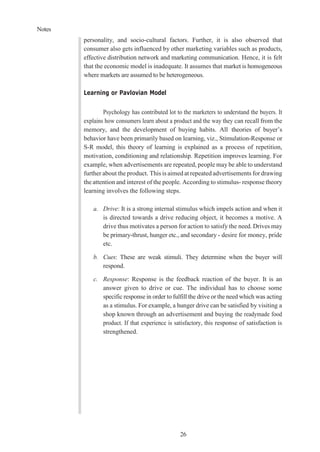
Thus this learning of links which mean stimulus, cue and response results
in habits. Along with this, attitudes and beliefs are also learnt. As it becomes a habit,
the decision process for the individual becomes routine affair. Thus, learning
model has the following prediction:
a. Learning refers to change in behavior brought about by practice or
experience. Everything one does or thinks is learnt.
b. Product features such as price, quality, service, brand, package etc., acts as
cues or hints influencing consumer behavior
c. Marketing communications such as advertising, sales promotion etc.,
also act as guides persuading buyer to purchase the product.
d. Response is decision to purchase.
Drive
An activated or Unsatisfied
enough to motivate
repeated purchase
error in
a stimulus response situation
These are stimuli, coming from the
marketing and social environment of
Notes
28
Psychoanalytical Model
Sigmund Freud developed this theory. According to him human
personality has three parts:
1. The Id, is the source of all mental energy that drives us to action
2. the super ego, the internal representation of what is social is
approved conscience
3. The Ego, the conscious director of id impulses for finding him
satisfaction in socially acceptable manner.
The buyer behavior depends upon the relative strength of the three
elements in the personal ability. Motivational research has been involved in
investigating motives of consumer behavior so as to develop suitable marketing
implications accordingly. This approach has been used to generate idea for
developing- design, features, advertising and other promotional techniques.
Sociological Model
According to this theory the individual decision and behavior are quite
often influenced by the family and the society. He gets influenced by it and in turn
also influences it in its path of development. He plays many roles as a part of
formal and informal associations or organizations i.e., as a family member,
employee of a firm, member of professional forum, and as an active member of an
informal cultural organization. Hence he is largely influenced by the group in which
he is a member. For example, the decision may be made by one, actual buying may
be done by another, and the product is used by yet another member of the family.
Here, a mother takes a decision to buy a tiny cycle for her child, the cycle is
purchased by the father and the user is the child.
Howard - Sheth Model
The Howard - Sheth model shows the processes and variables
influencing the buyer behavior before and during the purchase. It emphasizes
three key variables- perception, learning and attitude formation. It explains the
way consumers compare available products in order to choose the best which
fits their needs and desires. Consumers
Notes
29
learn by finding out the relevant information about products through two sources of
information:
a. Social sources
b. Commercial sources
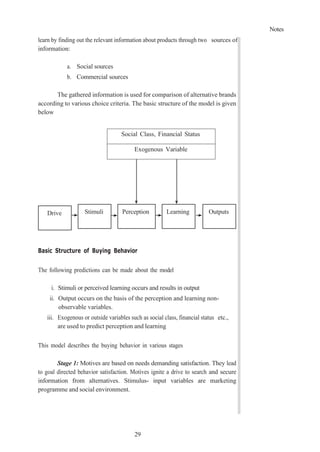
The gathered information is used for comparison of alternative brands
according to various choice criteria. The basic structure of the model is given
below
Social Class, Financial Status
Exogenous Variable
Basic Structure of Buying Behavior
The following predictions can be made about the model
i. Stimuli or perceived learning occurs and results in output
ii. Output occurs on the basis of the perception and learning non-
observable variables.
iii. Exogenous or outside variables such as social class, financial status etc.,
are used to predict perception and learning
This model describes the buying behavior in various stages
Stage 1: Motives are based on needs demanding satisfaction. They lead
to goal directed behavior satisfaction. Motives ignite a drive to search and secure
information from alternatives. Stimulus- input variables are marketing
programme and social environment.
Stimuli Outputs
Learning
Perception
Drive
Notes
30
Input or stimuli:
I. Product themselves in the market
II. Commercial information on them, say quality, price,
availability and distinctiveness
III. Product information obtained from friends, acquaintances and
reference groups.
Thus, a number of products or brands are perceived and considered by the
consumers mind. In this manner the resulting perception is selected.
Stage 2: While evaluating, many brands are eliminated or left out for
further consideration. Now, only few will receive further consideration. Each will
have plus / minus points. These choice considerations act as connecting links
between motives and selected brands choice consideration which provide a
structure to motives and the process of learning and experience. These
considerations develop as criteria/rule to decide on the goods that have the
prospects of yielding maximum satisfaction. The market must offer a good
marketing-mix that is used by the buyer to influence the choice criteria.
Stage3: The choice criteria gives rise to predisposition- the relative
preference in favour of particular brand. Sudden hindrances may sometimes stop the
process. This may be in form of price, inadequate supply of brand, external
variables such as financial status, time pressure etc. If they do not occur, the
preference results in a response output such as attention, comprehension, attitude,
buying intention and preferably actual purchase.
Stage 4: Feedback of purchase experience is sent to the buyer which shows
if the actual satisfaction was equal to the expected satisfaction. Satisfaction
leads to repurchase, and repeat orders indicate brand loyalty. The marketer is
interested in this outcome. Buying behavior is influenced by motives (rational /
emotional curiosity) attitudes, perception, social factors and personal factors.
31
Inhibitors
Set
Selective
Commercial
Social
Choice criteria
Brand in the
shop
Stimulus
variable
Predisposition
Alternatives
Policy
Personality
Social Class
Culture
Time Pressure
Satis-
Motives
Response
Output variable
Purchase
Intention
Attitude
Comprehension
of the brand
Attention
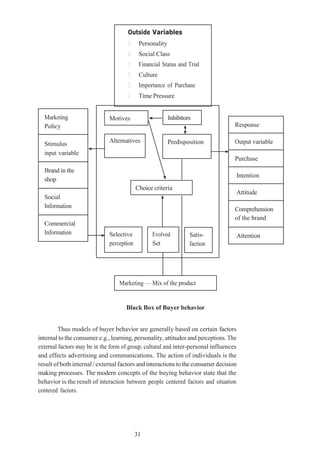
Black Box of Buyer behavior
Thus models of buyer behavior are generally based on certain factors
internal to the consumer e.g., learning, personality, attitudes and perceptions. The
external factors may be in the form of group, cultural and inter-personal influences
and effects advertising and communications. The action of individuals is the
result ofboth internal / external factors and interactions tothe consumerdecision
making processes. The modern concepts of the buying behavior state that the
behavior is the result of interaction between people centered factors and situation
centered factors.
32
Nicosia Model
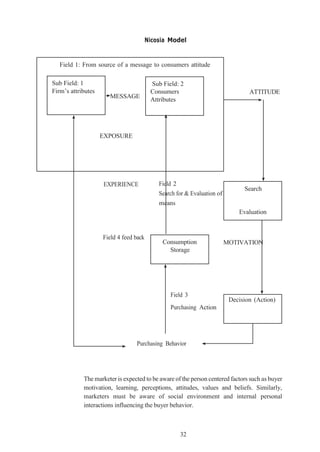
The marketer is expected to be aware of the person centered factors such as buyer
motivation, learning, perceptions, attitudes, values and beliefs. Similarly,
marketers must be aware of social environment and internal personal
interactions influencing the buyer behavior.
Field 1: From source of a message to consumers attitude
MESSAGE
ATTITUDE
EXPOSURE
2
of
means
Search
Evaluation
MOTIVATION
3
Decision (Action)
Action
Consumption
Storage
Sub Field: 2
Consumers
Attributes
Sub Field: 1
Firm’s attributes
Notes
33
Howard – Sheth Brand Buyer Behavior Model
Nicosia Model
The buyer behavior model is taken from the marketing mans point of view.
It is also called systems model as the human is analysed as a system, with stimuli as
the input to the system and the human behavior as an output of the system. Francesco
Nicosia, an expert in consumer motivation and behavior has developed this in
1966. He tried to explain buyer behavior by establishing a link between the
organization and its prospective consumer. Here the messages from the company
initially influence the predisposition of the consumer towards the product and
service. Based on the situation, the consumer will have a certain attitude towards
theproduct.Thismay result in a search for the product or an evaluation of the product
attributes by the consumer. If this step satisfies the consumer, it may result in
a positive response, with a decision to buy the product or else the reverse may
occur.
The Nicosia model divides the above activity explanation into four basic
areas:
Area 1: Field one has two sub areas-the consumer attributes and the
firms attributes. The advertising message from the company will reach the
consumers attributes. Certain attributes may develop sometimes depending upon the
way the message is received by the consumer. The newly developed attribute
becomes the input for area 2.
Area 2: This area is related to the search and evaluation undertaken by the
consumer of the advertised product and also to verify if other alternatives are
variable. If the above step motivates to buy the product / service, it becomes the
input for the third area.
Area 3: This area explains as how the consumer actually buys the
product.
Area 4: This is related to the uses of the purchase items. This can also
be used as an out put to receive feedback on sales results to the firm.
Notes
34
Summary
The heterogeneity among people across the world makes
understanding consumer buying behavior an intricate and challenging task.
Product motives and patronage motives play a crucial role in consumer
purchases. Like individuals organizations also make many buying decisions.
The major factors that distinguish it from consumer decision are Market
structure and Demand, Buyer characteristics, and Decision process and
buying patterns.
The degree of involvement has a lot of impact on search of
information, Information processing, and Transmission of information. The
various models of consumer involvement help marketers to study purchase behavior
across product segments.
Consumers usually go through five stages in arriving at a purchase decision.
In the first stage, the customer identifies an unsatisfied need. In the second
stage consumer collect information about the product and brands. In a third
stage, the consumer evaluates all the alternatives with the help of available
information. Later in stage four, the customer makes a purchase decision. And
finally in the fifth stage, consumer experiences post-purchase satisfaction or
dissatisfaction. Organizational buyer has different decision making criteria.
Decision making rules – Compensatory and Non compensatory – simplify the
complex nature of decision making to consumers.
Understanding consumer behavior is the basis of the formulation of marketing
strategies. Consumer behavior studies help in designing effective marketing
strategies like, Marketing-mix Strategy, Market Segmentation Strategy,
Product Positioning Strategy, and Marketing Research.
As consumer behavior is very complex to understand, consumer models aid
marketer to put their effort to understand in right direction. The models –
Economic, Learning, Psychoanalytic, Sociological, Howard-Sheth and
Nicosia enables marketers to understand and predict consumer behavior in the
market place.
Notes
35
Self Assessment Questions
1. Explain the nature of consumer behavior
2. Justify the statement, “The evaluation of marketing concept from mere
selling concept to Consumer-oriented marketing has resulted in buyer
behavior becoming an independent discipline.”
3. Compare and contrast the buying behavior of organization market and retail
consumers.
4. What is Consumer Involvement? Discuss the factors that affect the
Consumer Involvement.
5. How does processing of information affect consumer involvement?
6. Discuss various consumer involvement models and their suitability to
different organizations?
7. What essential elements are required to understand consumer
decision making?
8. How does decision making change because of change in purchase
involvement?
9. How can a consumer arrive at a decision? Explain various stages in it.
10. What is customer value and why is it important to marketers?
11. What are the four major marketing implications to understand
consumer Behavior?
12. List the inputs of various decisions making models and discuss their
limitations in the market place.
13. How do compensatory and non-compensatory decision rules vary?
14. Define extensive problem solving, limited problem solving and
routine problem solving. What are the differences among the three decision-
making approaches? What type of decision process would you expect most
consumers to follow in their first purchase of a new product or brand in
each of the following areas (a) Cosmetics
(b) Computer (c) Mobile (d) Edible oil (e) Air-conditioner. Explain your
answers.
Notes
36
Application Activities
1. Conduct a focus group interview to discover the buying motives
influencing the purchases of following products and brands
a) Vacuum cleaner
b) Purchases in Hyper-Markets
c) LG Refrigerator
d) Sun Umbrella
2. Interview 15 students on your campus and determine their internet shopping
behaviors. Divide them into appropriate groups such as heavy,
moderate, light, and non-shoppers and explain why each group behaves
as it does.
3. Develop a short questionnaire designs to measure the information search
consumers engage in prior to purchasing an expensive recreational or
entertainment item or service. Your questionnaire should include
measures of types of information sought, as well as sources that
provide this Information. Also include measures of the relevant
consumer characteristics that might influence information search, as
well as some measure of past experience with the products. Then
interview two recent purchasers of each product, using the
questionnaire you have developed. Analyze each consumers response
and classify each consumer in terms of information search. What are the
marketing implications of your results?
5. Develop a short questionnaire to elicit the evaluative criteria consumer
might use in selecting the following. Also have each respondent
indicate the relative importance he or she attaches to each of the
evaluative criteria. Then, working with several other students,
combined your information and develop a segmentation strategy based on
consumer evaluation criteria and its importance. Finally develop an
advertisement for the members of each market segment to indicate that
their needs would be served by your brand.
a) Shaving cream
b) Stationery
Notes
37
c) Santro Car
d) Panasonic Mobile
e) Whirlpool Refrigerator
f) Durian Furniture
Glossary
Attitude: A learned predisposition to behave in consistently favorable or
unfavorable manner with respect to given object.
Behavioral Learning Theories: Theories based on the premise that learning
takes place as the result of observable responses to external stimuli.
Brand Loyalty: Consumers consistent preference and / or purchase of the same
brand in a specific product or service category
Cognitive Learning: The acquisition of new knowledge about the world.
Compensatory Decision Rule: A type of decision rule in which consumer
evaluates each brand in terms of each relevant attribute and then selects the
brand with the highest weighted score
Conditioned Learning: According to Pavlovian theory conditioned learning
results when a stimulus paired with another stimulus that elicits a known response
serves to produce the same response by itself
Conditioned Stimuli: When new products bear a well known symbol on the
belief that it embodies the same attributes with the name it is associated with
Conjunctive Decision Rule: Non-compensatory decision rule in which
consumers establish a minimally acceptable cut off points for each attribute evaluated.
Brands that fall below the cutoff point on any one attribute are eliminated from
further consideration
Consumer Behavior: The behavior consumers display in searching for,
purchasing, using, evaluating and disposing of products, services, and ideas.
Consumer decision making: Cognitive and emotional aspects such as
impulse, family, friends, advertisers, role models, moods, and situations that
influence a purchase
Notes
38
Consumer Decision Rules: Procedures adopted by consumers to reduce the
complexity of making products and brand decisions
Consumer Research: Methodology used to study consumer behavior
Consumer Socialization: The process, started in childhood by which an
individual first learns the skills and attitudes relevant to consumer purchase
behavior
Cues: Stimuli that give direction to consumer motives (i.e., that suggest a
specific way to satisfy a salient motive
Customer Life Time Value: Profiles based on the collection and analysis of
internal secondary data.
Customer Retention: Providing value to customers continuously so that they
will stay with the company rather than switch to another firm
Customer Satisfaction: An individual’s perception of the performance of the
product or service in relation to his or her expectation
Customer Value: The ratio between the customers’s perceived benefits and
the resources used to obtain those benefits
Differentiated Marketing: Targeting a product or service to two or more
segments, using specifically tailored product, promotional appeal, price, and/or
method of distribution for each
Disjunctive Rule: A non-compensatory decision rule in which consumers
establish a minimally acceptable cut off point for each relevant product
attribute; any brand meeting or surpassing the cut off point for any one attribute
is considered an acceptable choice
Emotional Motives: The selection of goals according to personal or
subjective criteria (e, g., the desire for individuality, pride, fear etc)
Evoked Set: The specific brands consumer considers in making a purchase choice in
a particular product category
Extensive Problem Solving: Decision making efforts by consumers that have
no established criteria for evaluating a product category or specific brands in that
category or have not narrowed the brands to a manageable subset
Notes
39
Feed Back: The response given by a receiver to the sender of the message
Focus Group: A Qualitative research method in which about eight to ten
persons participate in an unstructured group interview focused on a product or
service concept
Freud Theory: A theory of personality and motivation developed by the
psychoanalyst Sigmund Freud
Information Processing: A cognitive theory of human learning patterned after
computer information processing that focuses on how information is stored in human
memory and how it is retrieved
Involvement Theory: A theory of consumer learning which postulates that
consumers engage in a range of information processing activity from extensive to
limited problem solving depending on the relevance of the purchase
Lexicographic Decision Rule: A non-compensatory decision rule in which
consumers first rank product attributes in terms of their importance then compare
brands in terms of the attribute considered most important. If one brand scores
higher than the other brands it is selected: if not the process is continued with
the second rank attribute, and so on
Non-compensatory Decision Rule: A type of consumer decision rule by
which positive evaluation of a brand attribute does not compensate for negative
evaluation of the same brand on some other attributes
Organizational Consumer: A business, government agency, or other
Institution that buys the goods, services, and/ or equipment necessary for the
organization to function
Purchase Behavior. Behavior that involves two types of purchases: trial
purchases and repeat purchase
Repeat Response Behavior: A habitual purchase response based on
predetermined criteria
Word-Of-Mouth: Informal conversations concerning products or services
****
40
41
Notes
UNIT – II
Learning Objectives
After studying this lesson, you should be able to:
➢ Define and identify the various influences on culture
➢ Know the Environmental variations and cultural values
➢ Explain the cross-cultural influences on consumer behavior
➢ Define Social Class and its impact on consumer decisions.
➢ Emphasize the role of reference groups in influencing consumer
behavior.
➢ Discuss Family life cycle and its implications on consumer behavior
➢ Define Family roles and consumption patterns
➢ Understand the concept of diffusion and adoption of new products/
innovation.
Lesson Structure
Lesson – 2.1: Cultural and Environmental Influences On Consumer
Behavior
Lesson – 2.2: Groups, Social Class and Reference Groups Lesson
– 2.3: Family Influences and Decision Making
Lesson – 2.4: Opinion Leadership and Diffusion Of Innovations
Notes
42
Lesson 2.1 - Cultural and Environmental Influences on
Consumer Behavior
Introduction
Everybody in this world is a consumer. Every day of our life we are
buying and consuming an incredible variety of goods and services. However,
we all have different tastes, likes and dislikes and adopt different behavior patterns
while making purchase decisions. Many factors affect how we, as individuals
and as societies, live, buy, and consume. External influences such as culture,
ethnicity, and social class influence how individual consumers buy and use
products, and help explain how groups of consumers behave. The study of
culture encompasses all aspects of a society such as its religion, knowledge,
language, laws, customs, traditions, music, art, technology, work patterns, products,
etc. Culture is an extremely critical and all pervasive influence in our life.
CULTURE - Meaning
For the purpose of studying consumer behavior, culture can be defined
as the sum total of learned beliefs, values and customs that serve to guide and
direct the consumer behavior of all members of that society. Howard and Sheth
have defined culture as “A selective, manmade way of responding to experience, a
set of behavioral pattern”. Thus, culture consists of traditional ideas and in particular
the values, which are attached to these ideas. It includes knowledge, belief, art, morale,
law, customs and all other habits acquired by man as a member of society. An accepted
concept about culture is that includes a set of learned beliefs, values, attitudes, habits
and forms of behavior that are shared by a society and are transmitted from
generation to generation within that society.
Culture is learned through the following three ways:
1. Formal learning: Parents and elders teach children the proper way to
behave. For instance, you have been taught that you need to study to be
successful and happy in life. This learning may influence your response both
as a student and individual towards education.
Notes
43
2. Informal learning: We learn by imitating the behavior of our parents,
friends, or by watching TV and film actors in action
3. Technical learning: Instructions are given about the specific method
by which certain things to done such as painting, dancing, singing etc.
Characteristics of Culture
➢ Culture is learned.
➢ Culture regulates society–norms, standards of behavior, rewards and
punishments.
➢ Culture makes life more efficient
➢ All members follow same norms.
➢ Culture is adaptive.
➢ Culture is environmental.
➢ Multiple cultures are nested hierarchically.
Culture also determines what is acceptable with product advertising. Culture
determines what people wear, eat, reside and travel. Cultural values in India
are good health, education, respect for age and seniority. But in our culture today,
time scarcity is a growing problem, which implies a change in meals. Some
changes in our culture:
1. Convenience: As more and more women are joining the work force there
is an increasing demand for products that help lighten and relieve the
daily household chores, and make life more convenient. This is reflected
in the soaring sale of washing machines, microwaves, pressure cookers,
mixer-grinders, food processors, frozen food etc.
2. Education: People in our society today wish to acquire relevant
education and skills that would help improve their career prospects. This is
evident from the fact that so many professional, career oriented
educational centers are coming up, and still they cannot seem to meet
the demand. As a specific instance count the number of institutions
offering courses and training in computers that has opened in your city.
3. Physical appearance: Today, physical fitness, good health and smart
appearance are on premium today. Slimming centers and
Notes
44
beauty parlours are mushrooming in all major cities of the country.
Cosmetics for both women and men are being sold in increasing
numbers. Even exclusive shops are retailing designer clothes.
4. Materialism: Thereis averydefiniteshift in thepeople’s cultural value
from spiritualism towards materialism. We are spending more money
than ever before on acquiring products such as air- conditioners, cars
CD players etc, which adds to our physical comfort as well as status.
Types of Culture
➢ National culture
➢ The culture prevalent in a nation, common to everyone
➢ Popular culture
➢ The culture of the masses with norms of mass appeal
➢ Subculture
➢ The culture of a group within the larger society
➢ Group identification based on nationality of origin, race,
region, age, religion, gender, etc.
➢ Corporate culture
➢ The company’s values, rituals, customs, myths and heroes
Hoffstede’s Five Dimensions of Culture
Culture has a profound impact on the way consumers perceive
themselves, products they buy and use, purchasing processes, and the
organisations from which they purchase. Marketers, however, are giving more
attention to understanding macro cultures and how they affect consumer
behavior. Hoffstede found five dimensions of culture that are common among
sixty six countries. These dimensions serve as a foundation for characterizing,
comparing and contrasting specific national cultures, and they are helpful in
identifying environmentally sensitive segments of the market.
1. Individualism versus collectivism (Pursuit of self or group interest)
Individualism describes the relationship between an individual and fellow
individuals, or the collectivity that prevails in society. Table
Notes
45
below depicts the attitudinal and behavioral differences associated with
individualism and collectivism.
2. Power distance ( Social inequality and submission to authority)
Power distance reflects the degree to which a society accepts
inequality in power at different levels in organisations and institutions.
It can affect preferences for centralization of authority, acceptance of
differential rewards, and the ways people of unequal status work together.
Individualism (E.g.,
United States, Australia,
Canada Etc)
Collectivism (E.g., Hong
Kong, Japan, India)
Self
construal
Defined by internal
attributes, personal traits
Defined by important others,
family and friends
Role of
others
Values
Self-evaluation e.g.,
standards of social
comparison, sources of
appraisal regarding self.
Emphasis on separateness,
individuality
Self-definition e.g.,
relationships with others
define self and affect personal
preferences. Emphasis on
connectedness, relationships
Motivational
drives
Behavior
Focus differentiation,
relatively greater need to
unique Reflective of
personal preferences and
needs
Focus on similarity, relatively
greater need to blend in
Influenced by preferences,
needs of close others
Individualism versus Collectivism
3. Uncertainty avoidance (Tolerance/avoidance of ambiguity)
Uncertainty avoidance concerns the different ways in which societies
react to the uncertainties and ambiguities inherent in life. Some societies need
well-defined rules or rituals to guide behavior, whereas others are tolerant
of deviant ideas and behavior.
4. Masculinity/femininity (Segregation of male and female roles in
society) This factor determines the extent to which societies hold
values traditionally regarded as predominantly masculine or feminine.
For instance, assertiveness, respect for achievement, and
Notes
46
the acquisition of money and material possessions are identified with
masculinity; and nurturing, concern for the environment and championing the
underdog are associated with a culture’s feminity.
5. Abstract versus associative thinking Creation of value in products
based on cause/effect logic or association among events without a logical
link
Cultural Influences
Culture is that complex whole which includes knowledge, belief, art,
law, morals, customs and any other capabilities and habits acquired by humans as
members of society. Culture influences the pattern of living, of consumption, of
decision-making by individuals. Culture is acquired and it can be acquired from
the family, from the region or from all that has been around us while we were
growing up and learning the ways of the world. Culture forms a boundary
within which an individual thinks and acts. When one thinks and acts beyond
these boundaries, he is adopting a cross-cultural behavior and there are cross-
cultural influences as well. The nature of cultural influences is such that we are
seldom aware of them. One feels, behaves, and thinks like the other members of
the same culture. It is all pervasive and is present everywhere. Material culture
influences technology and how it brings cultural changes like use of
telephones, mobile phones, clothing styles and fashions, gives the marketers a
chance to improve the product, packing, etc. to meet the needs of the customers.
Norms are the boundaries that culture sets on the behavior. Norms are
derived from cultural values, which are widely told beliefs that specify what is
desirable and what is not. Most individuals obey norms because it is natural to
obey them. Culture outlines many business norms, family norms, behavior
norms, etc. How we greet people, how close one should stand to others while
conducting business, the dress we wear and any other patterns of behavior.
Culture keeps changing slowly over time; and is not static. Changes take place
due to rapid technologies. In case of emergency, war, or natural calamities, marketers
and managers must understand the existing culture as well as the changing
culture and culture of the country where the goods are to be marketed. Major
companies have adapted themselves to international culture and are accepted
globally.
Notes
47
Coca Cola is sold all over the world. Procter & Gamble and other
companies give cross-cultural training to their employees. By making cross-
cultural mistakes, many companies have difficulty in pushing their products for
example, (i) Coca Cola had to withdraw its 2 liters’ bottle from Spain, because it did
not fit in the local refrigerator; (ii) Many countries are very traditional and do not
like women displayed on the products. This acts as a detriment to business in those
countries.
Variation in Cultural Values
There are three broad forms of cultural values as shown in the
following figure.
Values Orientation influencing Behavior
I. Other Oriented Values
This shows the relationship between individuals and the society. The
relationship influences marketing practices. If the society values collective
activity, decisions will be taken in a group. It gives rise to following questions
which affect consumer behavior.
Individual/ collective: Whether individual initiation has more value
than collective activity?
Romantic orientation: This depicts whether the communication is
more effective which emphasizes courtship or otherwise. In many countries a
romantic theme is more successful.
Adult/ child theme: Is family life concentrated round children or
adults? What role do children play in decision-making?
Notes
48
Masculine/ Feminine: Whether the society is male dominant or
women dominant or balanced.
Competitive/ Cooperation: Whether competition leads to success.
This is achieved by forming alliances with others.
Youth/ age: Are prestige roles assigned to younger or older members
of the society. American society is youth oriented and Korean is age oriented.
Decisions are taken by mature people in Korea.
II. Environment Oriented Values
Cleanliness: If a culture lays too much stress on cleanliness. There is scope
for the sale of beauty creams, soaps, deodorants, insecticides, washing powder,
vacuum cleaner, etc. In western countries, a lot of emphasis is placed on this
aspect and perfumes and deodorants are widely used.
Performance/ status: A status oriented society cares for higher
standards of living, and chooses quality goods and established brand names
and high prices items. This is true for the United States, Japan, Singapore,
Malaysia, Indonesia, Thailand and most Arabic countries.
In performance oriented societies, where rewards and prestige is based
on an individual’s performance, less importance is given to brand names.
Products whichfunction equallywell andmaynot bebigbrand names are used.
Germans do not give the same amount of emphasis to brand names. The
marketers adopt strategies accordingly.
Tradition/ change: Traditional oriented societies stick to the old
product and resist innovation or new techniques. In traditional societies, there is
less scope for new products, and old traditional products are in greaterdemand.
In somesocieties which areupwardlymobile,consumers are looking for modern
methods, new products, new models and new techniques.
Risk taking/ security: An individual who is in a secure position and
takes a risk can be either considered venturesome or foolhardy. This depends on
the culture of the society. For developing new entrepreneurs risk taking is a must.
It leads to new product development, new advertising themes and new channels of
distribution. Security oriented societies have little chances of development and
innovation.
Notes
49
Problem solving/fatalist: A society can be optimistic and have a
problem solving attitude or, be inactive and depend on fate. This has marketing
implications on the registering of complaints when consumers are dissatisfied
with the purchase of the products. Advertising plays an important part and
gives guidance to the consumer, and removes these doubts to a great extent.
Nature: There are differences in attitude over nature and its
preservation. Consumers stress on packing materials that are recyclable and
environment friendly. Some countries give great importance to stop
environmental pollution and to recycling of products.
Companies like P&G, Colgate-Palmolive captured a great extent of the
market by offering products which are less harmful to the environment. They also
use ingredients in the products which are not harmful in any way.
III. Self-Oriented Values
Active/passive: Whether a physically active approach to life is valued
more highly than a less active orientation. An active approach leads to taking action
all the time and not doing anything. In many countries, women are also taking an
active part in all activities. This makes the society a highly active one, where
everybody is involved in work.
Material/ non-material: In many societies money is given more
importance, and a lot of emphasis is on being material minded. While in many
societies things like comfort, leisure and relationships get precedence over being
materialistic. Materialism can be of two types.
➢ Instrumental materialism: which is the acquisition of things to enable
one to do something or achieve something. Cars are used for
transportation. People like to possess things of material value which
would help them to bring efficiency.
➢ Terminal materialism: is the requisition of materialism for the sake of owing
it rather than for use-Art is acquired for owing it. Cultural differences play
art important role in this type of materialism. Instrumental materialism
is common in the United States of America, where as Japanese
advertisements are mostly dominating terminal materialism.
Notes
50
Hard work/leisure: This has marketing implications on labor saving
products and instant foods. Some societies value hard work and consider it as
a fuller life. Others adopt labor saving devices and instant foods to have more
leisure time at their disposal.
Postponed gratification/ immediate gratification: Should one save
for the rainy day or live for the day? Sacrifice the present for the future, or live only
for the day? Some countries like The Netherlands and Germany consider buying
against credit cards as living beyond one’s means, whereas credit cards are very
popular in America and other countries having a different cultural orientation,
some prefer cash to debt. Some societies save for tomorrow; others enjoy the
present and spend lavishly.
Sexual gratification/Abstinence: Some traditional societies curb their
desires, food, drinks or sex, beyond a certain requirement. Muslim cultures are
very conservative, and do not want their women to be seen in public or be
exposed, so the Polaroid camera which gives instant photographs can be
purchased and pictures can be taken by the family members without their women
being exposed to the developers in a photo lab.
Humor/ serious: Should we take life lightly and laugh it off on certain
issues or, take everything seriously? This is an- other aspect of culture.
Advertising, personnel selling techniques and promotion may revolve around
these themes and the way the appeal for a product is to be made in various
cultures.
Subcultures and Consumer Behavior
Culture can be divided into subcultures. A subculture is an identifiable
distinct, cultural group, which, while following the dominant cultural values of the
overall society also has its own belief, values and customs that set them apart
from other members of the same society.
Sub-culture categories are:
➢ Nationality: Indian, Sri Lanka, Pakistan
➢ Religion: Hinduism, Islam
➢ Race: Asian, black, white
➢ Age: young, middle aged, elderly
Notes
51
➢ Sex: Male, Female
➢ Occupation: Farmer, teacher, business
➢ Social class: upper, middle, lower
➢ Geographic regions: South India, North-eastern India
1. Regional, Ethnic, and Religious Influences on Consumer Behavior
The three major aspects of culture that have important effects on consumer
behavior are regional, ethnic, and religious differences. Firstly, consumption
patterns may differ in various regions of India and the world, and marketing
strategy can sometimes be tailored specifically to these regions.
Secondly, our country has a number of different ethnic groups, and
population trends will dramatically alter the demographic profile of the country
in the next 50 years. In spite of its diversity, marketing strategies can be
developed for this group.
Finally, religious beliefs and values can influence consumer. Many
marketers are now becoming multicultural in their marketing activities by
trying to appeal to a variety of cultures at the same time. Although the diversity
of the Indian melting pot may be unique, there are many important ethnic
groups in other areas of the world.
2. Age, Gender, and Household Influences on Consumer Behavior
Among the four major age groups, Teens, who need to establish an
identity, are the consumers of tomorrow and have an increasing influence on
family decisions. The somewhat disillusioned Generation X consists of smart
and cynical consumers who can easily see through obvious marketing
attempts. Baby boomers grew up in a very dynamic and fast- changing world,
and this has affected their values for individualism and freedom. The 50 and
older segment can be divided into two groups-the young again and the gray
market. Neither group likes to be thought of as old. The affect of gender
differences on consumer behavior is examined next. Sex roles are changing.
Women are becoming more professional and independent, and men are becoming
more sensitive and caring. Also, men and women can differ in terms of traits,
information processing, decision styles, and consumption patterns.
Notes
52
Gender is consistent throughout lifetime, influencing customer values
and preferences. Gender shows different consumption patterns and perceptions of
consumption situations. E.g. the wedding ceremony.
Households play a key role in consumer behavior. The proportion of
non-traditional households has increased due to factors such as
(1) later marriages,
(2) Cohabitation,
(3) Dual-career families,
(4) Increased divorce, and
(5) Fewer children.
Households also exert an important influence on acquisition and
consumption patterns. First, household members can play different roles in the
decision process (gatekeeper, influencer, decider, buyer, and user). Second,
husbands and wives vary in their influence in the decision process, depending
on the situation-husband-dominant, wife-dominant, autonomic, or syncretic.
3. Psychographics: Values, Personality, and Lifestyles
The roles of psychographics in affecting the consumer behavior are detailed
below.
Values are enduring beliefs about things that are important. They are
learnedthroughtheprocessesofsocializationandacculturation. Our values exist
in an organized value system, with some values being viewed as more important
than others. Some are regarded as terminal values and reflect desired end states
that guide behavior across many different situations. Instrumental values are
those needed to achieve these desired end states. Domain-specific values are
those that are relevant within a given sphere of activity. Western cultures tend
to place a relatively high value on material goods, youth, the home, family and
children, work and play, health, hedonism, and technology. Marketers use
tools like value segmentation to identify consumer groups with common
values.
Personality consists of the distinctive patterns of behaviors,
tendencies, qualities, and personal dispositions that make people different from one
another. Approaches to the study of personality include
Notes
53
1. The psychoanalytic approach, which sees personality arising from
unconscious internal struggles within the mind at key stages of
development;
2. Trait theories, which attempt to identify a set of personality
characteristics that describe and differentiate individuals, such as
introversion, extroversion, and stability;
3. Phenomenological approaches, which propose that personality is
shaped by an individual’s interpretation of life events
4. Social-psychological theories, which focus on how individuals act in
social situations (e.g., compliant, detached, or aggressive); and
5. Behavioral approaches, which view an individual’s personality in terms
of past rewards and punishments.
Marketers also measure lifestyles, which are patterns of behavior (or
activities, interests, and opinions). These lifestyles can provide some
additional insight into consumers’ consumption patterns. Finally, some
marketing researchers use Psychographic techniques that involve all of these
factors to predict consumer behavior. One of the most well known
Psychographic tools is the Values and Lifestyle Survey (VALS).
Cross Cultural Consumer Behavior
Cross cultural marketing: Objectives and Policies
Cross-cultural marketing is defined as “the effort to determine to what
extent the consumers of two or more nations are similar or different. This will
facilitate marketers to understand the psychological, social and cultural aspects
of foreign consumers they wish to target, so as to design effective marketing
strategies for each of the specific national markets involved.”
Problems in Cross Cultural marketing
1. Problems related to product selection: The marketer going for cross
cultural marketing has to select the customers/ market not on the basis
of the superficial similarities of age or income, but by using the real
motivating factors that prompt them to accept or reject products.
Notes
54
2. Problems related to promotion/marketing communication: e.g.
Ariel in the middle east and also Pepsi
3. Problems related to pricing: the marketer has to adjust his pricing
policies according to the local economic conditions and customs.
4. Problems related to selection of distribution channels: in Japan, P
& G used this to sell soap
Cross-Cultural Consumer Analysis
To determine whether and how to enter a foreign market, we need to
conduct some form of cross-cultural consumer analysis.
Cross-cultural consumer analysis can be defined as the effort to
determine to what extent the consumers of two or more nations are similar or
different. Such analysis can provide marketers with an understanding of the
psychological, social, and cultural characteristics of the foreign consumers they
wish to target, so that they can design effective marketing strategies for the specific
national markets involved.
Japanese Culture Traits American Culture traits
➢ Homogenous
➢ Harmony to be valid and
➢ preserved
➢ Group, not individual,
➢ important
➢ Ambiguous
➢ General
➢ Hold back emotions in public
➢ Process-oriented
➢ Make a long story short
➢ Nonverbal communication
➢ important
➢ Interested in who is speaking
➢ Diverse
➢ Fight for one’s
➢ beliefs/positions
➢ Individualistic
➢ Clear-cut
➢ Specific
➢ Display emotions in public
➢ Result oriented
➢ Make a short story long
➢ Verbal communication
➢ important
➢ Interested in what is
spoken
Japanese and American cultural traits difference
Notes
55
Similarities and differences among people
A major objective of cross-cultural consumer analysis is to determine
how consumers in two or more societies are similar and how they are different.
Alternative Multinational Strategies
Some of us may argue as markets are becoming more and more
similar, standardized marketing strategies are becoming more and more
feasible. But, some more would argue back that differences between
consumers of various nations are far too great to permit a standardized
marketing strategy. Whether to use shared needs and values as a segmentation
strategy or to use national borders as a segmentation strategy? Shared needs
and values would mean to appeal to consumers in different countries in terms
of their common needs, values, and goals. Using national borders as a
segmentation strategy would mean to use relatively different local or specific
marketing strategies for members of distinctive cultures or countries.
Product
Strategy
Standardized
Communications
Localized
Communications
Standardized
Product
Global strategy: Uniform
product/ Uniform
Message
Mixed strategy: Uniform
Product/ Customized
message
Localized
Product
Mixed Strategy:
Customized Product/
Uniform Message
Local strategy: Customized
Product/ Customized
Message
Alternative Global Marketing Strategies
1. Favoring a World Brand: A lot of companies have created world
brand products that are manufactured, packaged, and positioned in
exactly the same way regardless of the country in which they are sold. For
instance, Sony sells its Walkman in this fashion.
2. Adaptive Global Marketing: In contrast to the above, some other
organizations imbibe a strategy that adapts their advertising messages
to the specific values of particular cultures. A very good example here
would be that of McDonald’s, which tries to localize its advertising to
consumers in each of the cross-cultural markets in which it operates.
Notes
56
Cultural Variations & Non-Verbal Communication
In a culture we have many variations in non-verbal communications. Each
culture assigns a meaning to non-verbal signs utilized by it. There are some variables
in non-verbal communication. These are:
(a) Use of time
(b) Use of space
(c) Friendship
(d) Agreements
(e) Things
(f) Symbols
(g) Etiquette
Time
Time is a resource which is distributed equally amongst everybody. Every
person has the same amount of time at his disposal. What view individuals
and societies take of time makes them different. Some can be classified under
monochromic culture and others in polychromic culture. Some of the important
differences between monochromic a polychromic culture are give in the table
below.
Monochromic culture Polychromic culture
Do one thing at a time. Do many things at once.
Concentrate on the job. Highly distractible and subject to
interruption.
Take deadlines and schedules
seriously.
Consider deadlines and
schedules secondary.
Committed to job. Committed to people and
relationships.
Adhere religiously to plans. Change plan often and easily.
Emphasize promptness. Base promptness on relationship.
Accustomed to short term
relationships.
Prefer long term relationships
Differences between Monochromic and Polychromic Culture
Notes
57
The meaning of time maybe different in different cultures. Some people
take time in making decisions according to the importance of decisions.
Some insist on coming to the point directly in business transactions and are
well prepared. Some keep appointments by the minute; others make people
wait for a long time.
Space
Space may be related to prestige rather than the need. The higher the
office, the bigger the office space and so on. Americans have the offices of
executives on the top floor and tend to separate the office of subordinates.
Japanese have their discount stores on the upper floor. Some cultures and individuals
maintain a fair distance while transacting, others co-mingle easily. Americans
maintain a fair distance while interacting with associates. Arabs stand very
close to each other.
Friendship
Friendship plays an important role in business transactions. Good
personal relationship and feelings matter most in a long term agreement. Social
contacts developed by parties gain priority over technical specifications.
Americans make friends easily, and drop them easily as well, because of both
social and geographical mobility. Some cultures like Indian or Latin
Americans have lasting relationships that endure for a long time and so does the
business. Personal ties, personal trust leads to cooperation and a lot of
transaction can take place between parties. Some want to transact business only
with those whom they get along and, making money is secondary.
Agreements
All business when transacted is done under some agreements. These
agreements may be written or just on an understanding between the two
parties. Most people enter into an agreement, but friendship and kinship are
also given a lot of importance. Verbal commitments are also binding in some
cultures, where signing a contract is just a mere formality.
Notes
58
Things
Different cultures attach different meaning to things. Things include products
as well as gifts given in certain business and social situations. An appropriate product
in the form of a gift is to be carefully chosen. The gifts can be big or small. They can
be given openly or presented privately. This depends on the practices followed in
that particular country. Some want to make a show of the gift, by giving it in front of
others. Others are secretive about it.
Symbols and Colours
Different countries attach different meanings to symbols, numbers and
colours. Symbols can be flowers, triangles, pictures and animals, etc. Some
numbers are considered lucky, and others not so lucky, or even unlucky, like
13, 4, etc. Colors have different interpretations. Pink is associated with a
female, and blue with the male in the US, whereas it is just the opposite in
Holland.
A list of colors and their interpretations is given below:
White: Symbol of mourning or death in the Far East, happiness, purity
and peace in the United States.
Purple: Associated with death in many Latin American countries.
Blue: Symbolizes feminity in Holland and masculinity in the United States,
Sweden, India, etc.
Red: Color for brides and children in India. Sign of masculinity in the
UK and France, negative in Nigeria, Germany and positive in Denmark, Rumania
and Argentina.
Yellow: Sign of death in Mexico, infidelity in France, celebrations in many
countries including India.
White lilies: Suggestion of death in England.
Symbol of Numbers
7: Lucky in India, USA, Morocco, Nicaragua and Czechoslovakia. 13:
Unlucky in many countries including India.
4: Symbol of death in Japan. Packing in 4s is avoided.
Notes
59
Triangle: Negative in Hong Kong and Taiwan, positive in Columbia.
Owl: Wisdom in the United States, bad luck in India.
Deer: Speed, grace in the United States; Homosexuality in Brazil.
Etiquette
These are accepted norms of behavior. Some behavior may be rude or
abusive in one culture and quite acceptable in other cultures, e.g. sitting with legs
crossed or sitting in a manner that shows the sole of a shoe. In Japan it is
considered impolite to say no directly to a business offer. They put it
differently, by saying it is very difficult, which means no. The exchange of
business cards in Japan is essential, and indicates the level of your status in your
business.
Similarly, there are many different habits and ways of doing things socially
that affect the making of advertisement. Eating with the fork in the right hand
and the left hand kept under the table is quite common in America, whereas, in
European culture, the fork should be in the left hand and the right hand holding the
knife or spoon.
These non-verbal communications in different countries or different
languages have a direct bearing on the marketing activity and must be taken
care of. As people recognize verbal languages, they act accordingly. In a similar
manner, non-verbal communication must also be recognized and understood so
that there is less misinterpretation. The advertisement of the communication we
want to give should be appropriate and match with the culture of the country.
****
Notes
60
Lesson 2.2 - Groups, Social Class and Reference Groups
Introduction
With the exception of those very few people who can be classified as
hermits, people tend to be involved with others on a rather constant basis. Like
almost all behavior, an individual’s social relationships are often motivated by
the expectation that they will help in the satisfaction of specific needs. For example, a
person might become a volunteer ambulance driver to satisfy a need for community
recognition. Another person might join a computer club in an effort to find compatible
friends to satisfy social needs. Athirdpersonmight join ahealth foodcooperative
to obtain the benefits of group buying power. These are just a few of the almost
infinite number of reasons why people involve themselves with others.
What Is A Group?
A group may be defined as two or more people who interact to
accomplish some goals. Within the broad scope of this definition are both an
intimate “group” of two neighbors who informally attend a fashion show
together and a larger, more formal group, such as a neighborhood.
Types of Groups
To simplify our discussion, we will consider four different types of
group classification: primary versus secondary groups, formal versus informal
groups, large versus small groups, and membership versus symbolic groups.
1. Primary versus Secondary Groups
If a person interacts on a regular basis with other individuals (with
members of his or her family, with neighbors, or with co-workers whose
opinions are valued), then these individuals can be considered as a primary
group for that person. On the other hand, if a person interacts
Notes
61
only occasionally with such others, or does not consider their opinions to be
important, then these others constitute a secondary group for that person.
From this definition, it can be seen that the critical distinctions between
primary and secondary groups are the frequency with which the individual interacts
with them and. the importance of the groups to the individual.
2. Formal versus Informal Groups
Another useful way to classify groups is by the extent of their
formality; that is, the extent to which the group structure, the members’ roles,
and the group’s purpose are clearly defined. If a group has a highly defined
structure (e.g., a formal membership list), specific roles and authoritylevels (a
president, treasurer, and secretary), and specific goals (to support a political
candidate, improve their children’s education, increase theknowledgeorskills
of members), then it would be classified as a formal group.
The local chapter of the American Red Cross, with elected officers and
members who meet regularly to discuss topics of civic interest, would be
classified as a formal group.
On the other hand, if a group is more loosely defined, if it consists, say,
of four women who were in the same college sorority and who meet for dinner
once a month, or three co-workers who, with their spouses, see each other
frequently then it is considered an informal group.
3. Large versus Small Groups
It is often desirable to distinguish between groups in terms of their size or
complexity. A large group might be thought of as one in which a single
member is not likely to know more than a few of the group’s members
personally, or be fully aware of the specific roles or activities of more than a
limitednumberofother groupmembers. Examples oflarge groups include such
complex organizations as General Motors, with its numerous subordinate
divisions, and the American Bar Association, with its many state, county, and
city chapters.
Notes
62
In contrast, members of a small group are likely to know every
member personally and to be aware of every member’s specific role or
activities in the group. For example, each staff member of a college
newspaper is likely to know all the other members and be aware of their duties
and interests within the group.
In the realm of consumer behavior, we are principally concerned with
the study of small groups, since such groups are more likely to influence the
consumption behavior of group members.
4. Membership versus Symbolic Groups
Another useful way to classify groups is by membership versus
symbolic groups. A membership group is a group to which a person either
belongs or would qualify for membership. For example, the group of women
with whom a young homemaker plays golf weekly or with whom she hopes to
play golf when an opening occurs would be considered, for her, a membership
group.
In contrast, a group in which an individual is not likely to receive
membership, despite acting like a member by adopting the group’s values, attitudes,
and behavior, is considered a symbolic group. Clearly, actual membership
groups offer a more direct, and thus a more compelling, influence on
consumer behavior.
In summary, we can say that small, informal, primary membership groups are
of the great interest to marketers because they exert the greatest potential influence
on consumer purchase decisions.
Consumer-Relevant Groups
To more fully comprehend the kind of impact that specific groups have on
individuals, we will examine six basic consumer-relevant groups: the Family,
Friendship groups, Formal social groups, Shopping groups, Consumer action
groups and Work groups.
The Family
An individual’s family is the most important group to influence his or her
consumer decisions. The family’s importance in this regard is due to the frequency of
contact that the individual has with other family members and that the family has a
greater extent of influence on the establishment ofawiderangeofvalues, attitudes,
and behavior.
Notes
63
Friendship Groups
Friendship groups are informal groups because they are, usually
unstructured and lack specific authority levels. In terms of relative influence,
after an individual’s family, it is friends who are most likely to influence the
individual’s purchase decisions.
Seeking and maintaining friendships is a basic drive of most people.
Friends fulfill a wide range of needs: they provide companionship, security, and
opportunities to discuss problems that an individual may be reluctant to discuss with
members of his or her own family. Friendships are also a sign of maturity and
independence, for they represent a breaking away from the family and the forming of
social ties with the outside world. Consumers are more likely to seek information
from those friends they feel have values or outlooks similar to their own.
Formal Social Groups
In contrast to the relative intimacy of friendship groups, formal social
groups are more remote and serve a different function for the individual. A
person joins a formal social group to fulfill such specific goals as making new
friends, meeting “important” people (e.g., for career advancement), or promoting a
specific cause. Because members of a formal social group often consume certain
products together, such groups are of interest to marketers. For example, the
membership list of a men’s club would be of interest to local men, Insurance agents,
automobile agents, tax accountants.
Membership in a formal social group may influence a consumer’s
behavior in several ways. For example, members of such groups have
frequent opportunity to informally discuss products, services, or stores. Some
members may copy the, consumption behavior of other members whom they
admire.
Shopping Groups
Two or more people who shop together-whether for food, for clothing,
or simply to pass the time, can be called a shopping group. Such groups are often
offshoots of family or friendship groups. People like to
Notes
64
shop with others who they feel have more experience with or knowledge about
a desired product or service. Shopping with others also provides an element of
social fun to an often boring but necessary task. In addition, it reduces the risk
that a purchase decision will be socially unacceptable.
Relatively few marketing or consumer behavior studies have
examined the nature of shopping groups. However, one study of the in- store
behavior of shoppers revealed some differences between group and individual
shopping. The research found that shopping parties of at least three persons
deviated more from their original purchase plans (they bought either more or
less than originally planned) than did either single shoppers or two-party groups.
The study also found that shopping groups tended to cover more territory in the
store than individuals shopping alone, and thus had more opportunity to see
and examine merchandise and to make unplanned purchases.
A special type of shopping group is the in-home shopping group, which
typically consists of a group of women who gather together in the home of a
friend, to attend a “party” devoted to the marketing of a specific line of products. The
in-home party approach provides marketers with an opportunity to demonstrate the
features of their products simultaneously to a group of potential customers. The
undecided guests often overcome a reluctance to buy when they see their
friends make positive purchase decisions. Furthermore, some of the guests may feel
obliged to buy because they are guests in the home of the sponsoring hostess.
Consumer Action Groups
A particular kind of consumer group-a consumer action group- has emerged
in response to the consumerist movement. This type of consumer group has become
increasingly visible since the 1960s and has been able to influence product design
and marketing practices of both manufacturers and retailers.
Consumer action groups can be divided into two broad categories: those
that organize to correct a specific consumer abuse and then disband, and those that
organize to address broader, more pervasive, problem areas and operate over an
extended or indefinite period of time. A group of tenants who band together
to dramatize their dissatisfaction with the
Notes
65
quality of service provided by their landlord, or a group of irate community members
who unite to block the entrance of a fast-food outlet into their middle-class
neighborhood, are examples of temporary, cause-specific consumer action
groups.
Work Groups
The sheer amount of time that people spend at their jobs, frequently more
than thirty-five hours per week, provides ample opportunity for work groups to
serve as a major influence on the consumption behavior of members.
Both the formal work group and the informal friendship/work group
have the potential for influencing consumer behavior. The formal work group
consists of those individuals who work together as a team. Their direct and
sustained work relationship offers substantial opportunity for one or more members
to influence the consumer-related attitudes and activities of other team members.
Members of informal work groups may influence the consumption behavior of
other members during coffee or lunch breaks or after-hours meetings.
Social Class
Social class is more of a continuum, i.e., a range of social positions, on
which each member of society can be place. But, social researchers have divided this
continuum into a small number of specific classes. Thus, we go by this
framework, social class is used to assign individuals or families to a social-class
category.
Social class can be defined as ‘The division of members of a society into a
hierarchy of distinct status classes, so that members of each class have
relatively the same status and the members of all other classes have either more
or less status.’
Characteristics of Social Classes
The main characteristics of social class
1. Persons within a given social class tend to behave more alike
2. Social class is hierarchical
Notes
66
3. Social class is not measured by a single variable but is measured as a weighted
function of one’s occupation, income, wealth, education, status, prestige,
etc.
4. Social class is continuous rather than concrete, with individuals able
to move into a higher social class or drop into a lower class.
Factors responsible for Social Stratification
S. No
Status, Value
& Prestige
enjoyed
Social
Class
Factors affecting Social class
1 Low
Lower
Class
Lower level occupation with no
authority, less income, and no
education or minimum education, For
example, labour class or clerks etc.
2 Medium
Middle
Class
Graduates, or postgraduates,
executives’ managers of companies
with authority, drawing handsome
salary of which certain amount can be
saved and invested. For example,
executives or middle level managers of
companies.
3 High
Higher
Class
Authoritative person, drawing
handsome salary, very often
professionally qualified, working in a
very senior position or a person born
into a rich family, with a good
background of education.
Factors showing social class differences
Impact of social class
➢ Provides a sense of identity
➢ Imposes a set of ‘normative’ behavior
➢ Classes share values, possessions, customs and activities
➢ Marketing response to customers of different economic means
Notes
67
➢ Marketing to the low-income consumer
➢ Some marketers ambivalent as not perceived as long-term customers
constitutes a substantial group
➢ Target with value-oriented strategies
Reference Groups
Reference groups are groups that serve as a frame of reference for
individuals in their purchase decisions. This basic concept provides a valuable
perspective for understanding the impact of other people on an individual’s
consumption beliefs, attitudes, and behavior. It also provides some insight into
methods that groups can be used to effect desired changes in consumer
behavior.
What is a Reference Group?
A reference group is any person or group that serves as a point of
comparison (or reference) for an individual in the formation of either general
or specific values, attitudes, or behavior. The usefulness of this concept is
enhanced bythe fact that it places no restrictions on group size or membership, nor
does it require that consumers identify with a tangible group (i.e., the group can be
symbolic: prosperous business people, rock stars, and sports heroes).
Reference groups that influence general values or behavior are called
normative reference groups. An example of a child’s normative reference
group is the immediate family, which is likely to play an important role in
molding the child’s general consumer values and behavior (e.g., which foods to
select for good nutrition, appropriate ways to dress for specific occasions, how
and where to shop, what constitutes “good” value).
Reference groups that serve as benchmarks for specific or narrowly defined
attitudes or behavior are called comparative reference groups. A comparative
reference group might be a neighboring family whose lifestyle appears to be
admirable and worthy of imitation (the way they maintain their home, their
choice of home furnishings and cars, the number and types of vacations they
take).
Notes
68
Both normative and comparative reference groups are important.
Normative reference groups influence the development of a basic code of
behavior; comparative reference groups influence the expression of specific
consumer attitudes and behavior. It is likely that the specific influences of
comparative reference groups are to some measure dependent upon the basic
values and behavior patterns established early in a person’s development by
normative reference groups.
Broadening the Reference Group Concept
Like many other concepts borrowed from the behavioral sciences, the
meaning of reference group has changed over the years. As originally
employed, reference groups were narrowlydefined to include only those groups
with which a person interacted on a direct basis (e.g., family and close friends).
However, the concept has gradually broadened to include either direct and
indirect individual or group influences. Indirect reference groups consist of those
individuals or groups with whom a person does not have direct face-to-face
contact, such as movie stars, sports heroes, political leaders, or TV
personalities. Referents that a person might use in evaluating his or her own
general or specific attitudes or behavior vary from an individual to several family
members to a broader kinship, from a voluntary association to a social class, a
profession, an ethnic group, a community, or even a nation.
Types of Reference Groups
Reference groups can be classified in terms of a person’s membership or
degree of involvement with the group and in terms of the positive or negative
influences they have on his or her values, attitudes, and behavior. Four types of
reference groups that emerge from a cross-classification of these factors:
1. A contractual group is a group in which a person holds membership or has
regular face-to-face contact and of whose values, attitudes, and standards
he or she approves. Thus a contactual group has a positive influence on
an individual’s attitudes or behavior.
2. An aspirational group is a group in which a person does not hold
membership and does not have face-to-face contact, but wants to
Notes
69
be a member. Thus it serves as a positive influence on that person’s
attitudes or behavior.
3. A disclaimant group is a group in which a person holds membership or has
face-to-face contact but disapproves of the group’s values, attitudes, and
behavior. Thus the person tends to adopt attitudes and behavior that are
in opposition to the norms of the group.
4. An avoidance group is a group in which a person does not hold
membership and does not have face-to-face contact and disapproves of the
group’s values, attitudes, and behavior. Thus the person tends to adopt
attitudes and behavior that are in opposition to those of the group.
Consider Ron a senior majoring in advertising at the state university in the
southwestern United States. The school’s Advertising Club, of which he is
vice-president, serves as one of Ron’s contractual groups. Ron believes that
continuing his education to obtain an MBA will enhance his career
opportunities. It is clear that individuals who hold the MBA degree serve as
an aspirational group for him. Still further, although he enjoys his position as a
reporter on the university’s newspaper, the recent editorials (endorsed by most of
the staff) urging students to adopt a more conservative political philosophy run
counter to his own views. Thus the newspaper staff is currently a disclaimant
group. Finally, Ron personally knows a number of students who have quit college
during their final year; these former students serve as an avoidance group.
Factors that Affect Reference Groups Influence
The degree of influence that a reference group exerts on an individual’s
behavior usually depends on the nature of the individual and the product and on
specificsocial factors. This sectiondiscusses howand whysomeofthese factors
operate to influence consumer behavior.
1. Information and Experience
An individual who has firsthand experience with a product or service,
or can easily obtain full information about it, is less likely to be influenced by
the advice or example of others. On the other hand, a person who has little or no
firsthand experience with a product or service, and
Notes
70
does not expect to have access to objective information about it (e.g., a person
who believes that relevant, advertising may be misleading or deceptive), is
more likely to seek out the advice or example of others. Research on imitative
behavior provides some interesting insights on how insufficient experience or
information concerning a product makes consumers more susceptible to the
influence either positive or negative, of others. For example, if a medical
school student wants to impress his new girl-friend, he may take her to a
restaurant that he knows from experience to be good or to one that has been
highly recommended by the local newspaper’s Dining-Out Guide. If he has neither
personal experience nor information he regards as valid, he may seek the advice
of friends or imitate the behavior of others by taking her to a restaurant he
knows is frequented by physicians whom he admires.
2. Credibility, Attractiveness, and Power of the Reference Group
A reference group, which is perceived as credible, attractive, or
powerful can induce consumer attitude and behavior change. For example, when
consumers are concerned with obtaining accurate information about the performance
or quality of a product or service, they are likely to be persuaded by those they
consider to be trustworthy and knowledgeable. That is, they are more likely to
be persuaded by sources with high credibility. When consumers are primarily
concerned with the acceptance or approval of others they like, with whom they
identify, or who offer them status or other benefits, they are likely to adopt their
product, brand, or other behavioral characteristics.
When consumers are primarily concerned with the power that a person
or group can exert over them, they might choose products or services that
confirm to the norms of that person or group in order to avoid ridicule or
punishment. However, unlike other reference groups that consumers follow
either because they are credible or because they are attractive, power groups are not
likely to cause attitude change. Individuals may conform to the behavior of a
powerful person or group but are not likely to experience a change in their own
attitudes.
Different reference groups may influence the beliefs, attitudes, and behavior
of an individual at different points in time or under different circum- stances.
For example, the dress habits of a young female attorney
Notes
71
mayvary, depending on her place and role. She may conform to the dress code of
her office by wearing conservative business suits by day and drastically alter
her mode of dress after work by wearing more conspicuous, flamboyant styles.
3. Conspicuousness of the Product
The potential influence of a reference group varies according to how
visually or verbally conspicuous a product is to others. A visually conspicuous
product is one that can be seen and identified by others, and that will stand
out and be noticed (e.g., a luxury item or novelty product). Even if a product is
not visually conspicuous, it may be verbally conspicuous it may be highly
interesting or it may be easily described to others. Products that are especially
conspicuous and status-revealing (a new automobile, fashion clothing, home
furniture) are most likely to be purchased with an eye to the reactions of
relevant others. Products that are less conspicuous (canned fruits, laundry
soaps) are less likely to be purchased with a reference group in mind.
The success of a brand of status running shoes like Reebok is aided by the
fact that it is relatively easy to spot a person wearing them-given the distinctive flag
symbol on the side of each shoe.
4. Reference Group Impact on Product and Brand Choice
In some cases, and for some products, reference groups may influence
both a person’s product category and brand (or type) choices. Such products are
called pro- duct-plus, brand-plus items. In other cases, reference groups
influence only the product category decision. Such products are called
product-plus, brand-minus items. In still other cases, reference groups influence
the brand (or type) decision. These products are called product-minus, brand-Plus
items. Finally, in some cases, reference groups influence neither the product
category nor the brand decision; these products are called product-minus,
brand-minus items. The idea of classifying products and brands into four groups in
terms of the suitability of a reference group appeal was first suggested in the
mid-1950s, along with an initial classification of a small number of product
categories.
Notes
72
5. Reference Groups and Consumer Conformity
Marketers are particularly interested in the ability of reference groups
to change consumer attitudes and behavior (i.e., to encourage conformity). To
be capable of such influence, a reference group must:
1. Inform or make the individual aware of a specific product or brand;
2. Provide the individual with the opportunity to compare his or her own
thinking with the attitudes and behavior of the group;
3. Influence the individual to adopt attitudes and behavior that are
consistent with the norms of the group;
4. Legitimize an individual’s decision to use the same products as the
group.
The ability of reference groups to influence consumer conformity is
demonstrated by the results of a classic experiment designed to compare the effects.
Benefits of the Reference Group Appeal
Reference group appeals have two principal benefits for the
advertiser: they increase brand awareness and they serve to reduce perceived
risk.
1. Increased Brand Awareness
Reference group appeals provide the advertiser with the opportunity to gain
and retain the attention of prospective consumers with greater ease and effectiveness
than is possible with many other types of promotional campaigns. This is
particularly true of the celebrity form of reference group appeal, where the
personality employed is generally well known to the relevant target segment.
Celebrities tend to draw attention to the product through their own popularity.
This gives the advertiser a competitive advantage in gaining audience
attention, particularly on television where there are so many brief and similar
commercial announcements.
Notes
73
2. Reduced Perceived Risk
The use of one or more reference group appeals may also serve
to lower the consumer’s perceived risk in purchasing a specific product. The example
set by the endorser or testimonial-giver may demonstrate to the consumer that
uncertainty about the product purchase is unwarranted: Following are examples of
how reference group appeals serve to lower the consumer’s perceived risk.
a. Celebrity: Consumers who admire a particular celebrity often have the
following reactions to the celebrity’s endorsement or testimonial. For e.g.
“She wouldn’t do a commercial for that product if she didn’t believe it was
really good.”
b. Expert. When consumers are concerned about the technical aspects of a
product, they welcome the comments of an acknowledged or apparent
expert. For e.g. “If he says it works, then it really must work.”
c. Common Man. When consumers are worried about how a product will affect
them personally, they are likely to be influenced by a common man
endorsement or testimonial. For eg. “People just like me are using that
product,”
Type Definition Example
Testimonial
Based on personal usage, a
celebrity attests to the quality of the
product or service
Sachin and Adidas
Endorsement
Celebrity lends his name and
appears on behalf of a product or
service with which he/she may not be
an expert
Sachin and Boost
Actor
Celebrity presents a product or
service as part of a character
endorsement
Shahrukh Khan and
Santro
Spokesperson
Celebrity represents the brand or
company over an extended
period of time
Shahrukh Khan and
Tag Heur
****
Notes
74
Lesson 2.3 - Family Influences and Decision Making
Introduction
The family is a major influence on the consumer behavior of its
members. There are many examples of how the family influences the
consumption behavior of its members. A child learns how to enjoy candy by
observing an older brother or sister; learns the use and value of money by
listening to and watching his or her parents. Decisions about a new car, a
vacation trip, or whether to go to a local or an out-of-town college are
consumption decisions usually made within the context of a family setting. As
a major consumption unit, the family is also a prime target for the marketing of
many products and services.
The Family
The importance of the family or household unit in consumer behavior
arises for two reasons:
1. Many products are purchased by a family unit.
2. Individuals’ buying decisions may be heavily influenced by other
family members.
How families or households make purchase decisions depends on the
roles of the various family members in the purchase, consumption, and
influence of products. Household products like food and soaps may be
purchased by a person but consumed by many, whereas personal care items,
such as cosmetics or shaving cream, might be purchased by an individual
family member for his or her own consumption. Homes and cars, on the other
hand, are often purchased by both spouses, perhaps with involvement from
children or other member of the extended family.
Visits to shopping malls often involve multiple family members buying
clothing and accessories, something with a heavy dose of influence
Notes
75
by family members-children may buy clothing paid for and approved of by
parents, whereas teenagers may influence the clothing purchase of a parent.
Regardless of how many family members are present when items are
being purchased, the other family members play an important role in the purchase.
Just because of being mother for two young children, it is her responsibility for
buying food for the family and act as an individual in the market. It does not
mean that her decisions are not influenced by the preferences and power of other
family members. Although marketing communications are usually directed to
individuals, marketers should consider the consumption circumstances and the
family structure before deciding on specific communication or advertising
methods to attract their segment.
What is a Family?
A family is a group of two or more persons related by blood, marriage,
or adoption who reside together. The nuclear family is the immediate group
of father, mother, and child(ren) living together. The extended family is the
nuclear family, plus other relatives, such as grandparents, uncles and aunts,
cousins, and parents-in-law. The family into which one is born is called
the family of orientation, whereas the one established by marriage is the
family of procreation. In a more dynamic sense, the individuals who
constitute a family might be described as members of the most basic social
group who live together and interact to satisfy their personal and mutual needs.
What is a Household?
The term household is used to describe all person, both related and unrelated,
who occupy a housing unit. There are significant differences between the terms
household and family even though they are sometimes used interchangeably. It is
important to distinguish between these terms when examining data.
The term household is becoming a more important unit of analysis for
marketers because of the rapid growth in nontraditional families and non-family
households. Among non-family households, the great majority consist of people
living alone. The remaining non-family households
Notes
76
include those consisting of elderly people living with non-family members. For
example, persons of Opposite Sex Sharing Living Quarters, friends living
together, and same sex couples.
Structural Variables Affecting Families and Households
Structural variables include the age of the head of household or family,
marital status, presence of children, and employment status. For example,
consumer analysts have enormous interest in whether families have children and
how many they have. Children increase family demand for clothing, food,
furniture, homes, medical care, and education, while they decrease demand for
many discretionary items, including travel, higher-riced restaurants, and adult
clothing.
Other structural changes affect the types of products that are
manufactured. For example, in Japan, high-tech companies have formed a consortium
to standardize technology that has been developed to monitor and manage
households.
Sociological Variables Affecting Families and Households
Marketers can understand family and household decisions better by
examining the sociological dimensions of how families make consumer decisions.
Three sociological variables that help explain how family’s function includes
cohesion, adaptability, and communication.
➢ Cohesion is the emotional bonding between family members. It
measures how close to each other family members feel on an
emotional level. Cohesion reflects a sense of connectedness to or
separateness from other family members.
➢ Adaptability measures the ability of a family to change its power
structure, role relationships, and relationship rules in response to
situational and developmental stress. The degree of adaptability shows
how well a family can meet the challenges presented by changing
situations.
➢ Communication is a facilitating dimension, critical to movement on
the other two dimensions. Positive communication skills (such as
empathy, reflective listening, and supportive comments) enable family
members to share their changing needs as they relate to
Notes
77
cohesion and adaptability. Negative communication skills (such as
double messages, double binds, criticism) minimize the ability to share
feelings, thereby restricting movement in the dimensions of cohesion and
adaptability. Understanding whether family members are satisfied with
family purchase requires communication within the family.
To determine how the family makes its purchase decisions and how
the family affects the future purchase behavior of its members, it is useful to
understand the functions provided and the roles played by family members to fulfill
their consumption needs.
Functions of The Family
Four basic functions provided by the family are particularly relevant to a
discussion of consumer behavior. These include (1) Economic well- being, (2)
Emotional support, (3) Suitable family lifestyles, and (4) Family- member
socialization.
(1) Economic Well-Being
Providing financial means to its dependents is unquestionably a basic
family function. How the family divides its responsibilities for providing
economic well-being has changed considerably. The traditional roles of husband as
economic provider and wife as homemaker and child rearer are still valid. The
economic role of children has changed. Today, even if some teenage children
work, they rarely assist the family financially. Their parents are still expected to
provide for their needs. But some of them get enough pocket-money to decide
their consumption of discretionary items.
(2) Emotional Support
The provision of emotional nourishment (including love, affection,
and intimacy) to its members is an important basic function of the contemporary
family. In fulfilling this function, the family provides support and
encouragement and assists its members in coping with personal or social
problems. To make it easier for working parents to show their love affection
and support for their children, greeting-card companies have been marketing
cards especially for parent to give to
Notes
78
their children. For instance, in most communities, many educational and
psychological centers are available that are designed to assist parents who want to
help their children improve their learning and communication skills, or
generally, better adjust to their environments.
(3) Suitable Family Lifestyles
Another important family function in terms of consumer behavior is the
establishment of a suitable lifestyle for the family. Family lifestyle
commitments, including the allocation of time, greatly influence consumption
patterns. For example, the increase in the number of married women working outside
the home has reduced the time they have available for household chores, and has
created a market for convenience products and fast-food restaurants. Also, with
both parents working, an increased emphasis is placed on the notion of “quality
time”, rather than the “quan- tity of time” spent with children and other family
members. Realizing the scarcityof qualityfamilytime, Hotels feature a variety
of weekend packages targeted to couples and their children.
(4) Socialization of Children and Other Family Members
The socialization of family members, especially young children, is a central
family function. In large part, this process consists of imparting to children the
basic value and modes of behavior consistent with the culture. These generally
include moral and religious principles, interpersonal skills, dress and
grooming standard, appropriate manners and speech, and the selection of
suitableeducational andoccupationalorcareergoals. Socialization skills (manners,
goals, values, and other qualities) are imparted to a child directlythrough instruction
and indirectly through observation of the behavior of parents and older siblings.
Marketers often target parents looking for assistance in the task of socializing
preadolescent children.
Family Life Cycles
Families pass through a series of stages that change them over time.
This process historically has been called the family life cycle (FLC). The
concept may need to be changed to household life cycle (HLC) or consumer
life cycle (CLC) in the future to reflect changes in society. However, we will
use the term FLC to show how the life cycle affects consumer behavior.
Notes
79
Family Life Cycle Characteristics
The traditional FLC describes family patterns as consumers marry,
have children, leave home, lose a spouse, and retire. These stages are described
in Table along with consumer behaviors associated with each stage. But
consumers don’t necessarily have to pass through all these stages-thy can skip
multiple stages
Stages in Family
Life Cycle
Economic
Circumstances
Likely Buying
Behavior
Bachelorhood
(Young, single
staying alone)
Earning reasonable good
salary, no financial
burdens
Buy, basic kitchen
equipment basic
furniture, two wheeler,
vacation with friends
Parenthood
(young married just
attained parenthood)
Better off financially,
though home purchases at
peak, less liquid assets,
not able to save more.
Buys baby food, toys,
diapers, chest & cough
medicines
Post parenthood
(growing children or
grown up children)
Financial position
improved with wife
working, probability of
home ownership on the
higher side).
Concentrates on home
improvements. Buy
more tasteful furniture,
car, home appliances,
and magazines.
Interested in vacation
packages.
Dissolution
(retired & lone
surviving spouse)
Income though good,
not interested in
spending. At times
drastic cut in income is
likely.
Buy more medicinal
products ant other
products like the retired
people. Seeks more of
attention, affection and
security conscious.
Consumer Activities Occurring in Various Life Cycles
Notes
80
Young Singles
Young singles may live alone, with their nuclear families, or with
friends, or they may co-habitate with partners in this stage. Although earnings
tend to be relatively low, these consumers usually don’t have many financial
obligations and don’t feel the need to save for their futures or retirement. Many of
them find themselves spending as much as they make on cars, furnishings for
first residences away from home, fashions, recreation, alcoholic beverages,
food away from home, vacations, and other products.
Newly Married Couples
Newly married couples without children are usually better off
financially than they were when they were single, since they often have two
incomes available to spend on one household. These families tend to spend a
substantial amount of their incomes on cars, clothing, vacations, and other
leisure activities. They also have the highest purchase rate and highest average
purchases of durable good (particularly furniture and appliances) and appear
to be more susceptible to advertising.
Full Nest I
With the arrival of the first child, parents begin to change their roles in
the family, and decide if one parent will stay to care for the child or if they
will both work and buy daycare services. In this stage, families are likely to
move into their first home; purchases furniture and furnishings for the child; and
purchase new items such as baby food, toys, sleds, and skates. These requirements
reduce families’ ability to save, and the husband and wife are often dissatisfied
with their financial position.
Full Nest II
In this stage, the youngest child has reached school age, the employed
spouse’s income has improved. Consequently, the family’s financial position
usually improves, but the family finds itself consuming more and in larger
quantities. Consumption patterns continue to be heavily influenced by the
children, since the family tends to buy large- sized packages of food and
cleaning suppliers, bicycles, music lessons, clothing, sports equipment, and a
computer.
Notes
81
Full Nest III
As the family grows older and parents enter their min-40s, their
financial position usually continues to improve because the primary wage earner’s
income rises, the second wage earner is receiving a higher salary, and the
children earn from occasional and part-time employment. The family typically
replaces some worn pieces of furniture, buys some luxury appliances, and spends
money on education. Families also spend more on computers in this stage,
buying additional PCs for their older children. Depending on where children
go to college and how many are seeking higher education, the financial position
of the family may be tighter than other instances.
Married, No Kids
Couples who marry and do not have children are likely to have more
disposable income to spend on charities, travel, and entertainment than others
in their age range. Not only do they have fewer expenses, these couples are
more likely to be dual-wage earners, making it easier for them to retire earlier
if they save appropriately.
Older Singles
Single, age 40 or older, may be single again (ending married status
because of divorce or death of a spouse), or never married (because they prefer
to live independently or because they co-habitate with partners), either group of
which may or may not have children living in the household. This group now has
more available income to spend on travel and leisure but feels the pressure to save
for the future, since there is no second income on which to rely as they get older.
Empty Nest I
At this stage, the family is most satisfied with its financial position. The
children have left home and are financially independent allowing the family to save
more. In this stage discretionary income is spent on what the couple wants rather than
on what the children need. Therefore, they spend on home improvements, luxury
items, vacations, sports utility vehicles, food away from home, travel, and
product for their grand children.
Notes
82
Empty Nest II
But this time, the income earners have retired, usually resulting in a
reduction in income and disposable income. Expenditures become health
oriented, centering on such items as medical appliances and health, and
medicines. But manyof these families continue to be active and in good health,
allowing them to spend time traveling, exercising, and volunteering. Many
continue working part time to supplement their retirement and keep them
socially involved.
Solitary Survivor
Solitary survivors be either employed or not employed. If the
surviving spouse has worked outside the home in the past, he or she usually
continues employment or goes back to work to live on earned income (rather
than saving) and remain socially active. Expenditures for clothing and food
usually decline in this stage, with income spent on health care, sickness care,
travel entertainment, and services.. Those who are not employed are often on
fixed incomes and may move in with friends to share housing expenses and
companionship, and some may choose to remarry.
Retired Solitary Survivor
Retired solitary survivors follow the same general consumption
patterns as solitary survivors; however, their income may not be as high.
Depending on how much they have been able to save throughout their
lifetimes, they can afford to buy a wide range of products. These individuals
have special needs for attention, affection, and security based on their lifestyle
choices.
Marketers use the descriptions of these FLC stages when analyzing
marketing and communication strategies for products and services, but they
often add additional information about consumer markets to analyze their needs,
identify niches, and develop consumer-specific marketing strategies.
Family Decision-Making
Families use products even though individuals usually buy them.
Determining what products should be bought, which retail outlet to
Notes
83
use, how and when products are used, and who should buy them is a
complicated process involving a variety or roles and actors.
Role Behavior
Families and other groups exhibit what sociologist Talcott Parsons called
instrumental and expressive role behaviors.
➢ Instrumental roles, also known as functional or economic roles,
involve financial, performance, and other functions performed by group
members.
➢ Expressive roles involve supporting other family members in the
decision-making process and expressing the family’s aesthetic or
emotional needs, including upholding family norms.
Individual Roles in Family Purchases
Family consumption decisions involve at least five definable roles,
which may be assumed by spouses, children, or other members of a
household. Both multiple roles and multiple actors are normal. Marketers
need to communicate with consumers assuming each of these roles, remembering
that different family members will assume different roles depending on the situation
and product. Children, for example, are users of cereals, toys, clothing, and many
other products but may not be the buyers. One or both of the parents may be the
decider and the buyer, although the children may be important as influencers
and users.
Family Roles
For a family to function as a cohesive unit, roles or tasks-such as doing
the laundry, preparing meals, setting the dinner table, taking out the garbage,
walking the dog must be carried out by one or more family members. In our
dynamic society, etc. family-related roles are constantly changing.
Key Family Consumption Roles
The roles played by the different family members will vary from
product to product. While shopping in the market, a housewife comes across
a new variety of juice that she buys for the family. Her decision to
Notes
84
purchase does not directly involve the influence of other family members. She is the
decider, buyer; but she may or may not be the preparer and is not the only user. In
case of products such as television, car, music systems, furniture or any other
product which is likely to be used by some or all the family members, the
purchase decision is likely to be joint or group decision.
There are eight distinct roles in the family decision-making process.
A look at these roles provides further insight into how family members act in
their various consumption-related roles:
1. Influencers: Those family members who provide information and
advice and thus influence the purchase. The housewife tells her family
about the new eatery that has opened in the neighborhood and her
favorable description about it influences her husband and teenaged
children.
2. Gatekeepers: Those family members who control the flow of
information about a product/service thus influencing the decisions of other
family members. The teenage son, who wants a racing bicycle, may
withhold from his father much of the relevant information onall brands
except the one that he fancies, thereby influencing his father’s decision
in favour of his preferred brand.
3. Deciders: Family members who have the power to unilaterally or
jointly decide whether or not to buy a product or service. The husband
and wife may jointly decide about the purchase of a new refrigerator.
4. Buyers: Those family members who actually buy a particular product
or service. A housewife may be the person who actually buys all the
foodstuffs, rations and toiletries, which are consumed by all the family
members.
5. Preparers: Those family members who transform or prepare the
product into the form in which it is actually consumed. The housewife
may prepare the family meal using raw vegetables, lentils, spices, oil and
other ingredients.
6. Users: Those family members who use or consume a particular
product or service. All family members may use the car, watch the
television, and listen to the stereo music system
Notes
85
7. Maintainers: Family member(s) who service or repair the product so
that it will provide continued satisfaction.
8. Disposers: Family member(s) who initiate or carry out the disposal or
discontinuation of a particular product or service.
Influencing Spouses and Resolving Consumer Conflicts
When making consumer decisions, husbands and wives commonly attempt
to influence each other to arrive at what they feel to be the best outcome. Six
influence strategies for resolving husband/wife consumption- related conflicts have
been identified:
➢ Expert: At attempt by a spouse to use his or her superior information about
decision alternatives to influence the other spouse. (Cooking Oil)
➢ Legitimacy:An attempt bya spouse to influence the other spouse on the
basis of position in the household.(Buying a house)
➢ Bargaining: An attempt by a spouse to secure influence now that will
be exchanged with the other spouse at some future date. (Jewelry)
➢ Reward: An attempt by a spouse to influence the behavior of the other
spouse by offering a reward.(FMCG)
➢ Emotional: An attempt by spouse to use an emotion-laden reaction to
influence the other spouse’s behavior.(Birth control measures)
➢ Impression: Any persuasive attempts by one spouse to influence the
behavior of the other.(Fixated buyer behavior)
These influence strategies tend to be used by either husbands or wives
when they find themselves in disagreement or in conflict with the other spouse
regarding specific consumer decision. For instance, we all have experienced
occasions on which different restaurants to visit, see different movies, or go
onadifferent typeoffamilyvacation. Theseare only a few examples of the almost
endless possibilities of potential family consumption conflicts that might need to
be resolved.
Notes
86
Children
As any parent knows, young children attempt to influence family
decisions as soon as they possess the basic communication skills needed to
interact with other family members (“Buy me a cookie”, “I want a Barbie
doll”, “Let’s eat at McDonald’s”.). Older children are likely to participate
more directly in family consumption activities. In a study of children aged 6 to
14, more than half indicated that they influenced family purchase decisions, such
as choice of vacations, stereo equipment, and home computers. Other research
indicates that children play relatively important roles when it comes to
initiating interest in a new computer and in the actual purchase decision.
The parent-child relationship, as it relates to consumer behavior, can be
viewed as an influence versus yield situation. Specifically, children attempt to
influence their parents to make a purchase (to yield). In observing shoppers
in a supermarket, it is quite evident that children attempt to influence their
parents to make purchases of special interest (e.g., laundry detergents) for
which they see ads on TV.
Teenagers and Post teens
A significant number of teenagers have discretionary spending in
terms of spending patterns. High school students (those in grades 7 through
12) are most interested in sports and fitness. Boys between the ages of 16 and 19 spend
most of their money on movies, dating, entertainment, vehicle expenses, and
clothing, while girls of that age spend most of their money on clothing,
cosmetics, and fragrances.
The teen market can be segmented in terms of lifestyle groups. Figure
below presents a four-category segmentation schema of the teenage market. Such
segmentation framework has value for marketers who wish to focus their
marketing efforts on a particular subgroup of teens.
Segment
Name
Key Characteristics
1. Socially
driven.
Primarily female; active and extroverted. They are
optimistic and plan to attend College.
Notes
87
Segment
Name
Key Characteristics
2. Versatile
Participant
Slightly more females than males: responsible teens, but less
optimistic and less likely to plan to attend college than the
Social Driven. They are comfortable in social and solitary
situations.
3. Passive
Introverts
Slightly more males than females: withdrawn, self-
conscious, and the least comfortable in social situations. They
are less optimistic about, the future, and spend the least.
4. Sports
Oriented
Primarily males: outgoing, active, and greatly interested in
participating in and watching sports. Sports influence their self-
image and what they buy.
Lifestyle segmentation of the teen market
Family marketing
Family marketing focuses on the relationships between family
members based on the roles they assume, including the relationship between
purchaser and family consumer and between purchaser and purchase decision
maker. Family marketing identifies scenarios where some purchase might
have more than one decision maker, whereas some have more than one
consumer. The family marketing model, as see in Figure, represents nine cells
describing various purchaser-consumer relationships. Depending on where in
the matrix various products fall, marketers can advertise and position products
differently according to their purchaser-consumer relationships.
The family purchase decision-making process can be complex, but
answering the following questions helps identify different purchaser- consumer
relationships.
1. Who’s buying for whom?
2. Who are the principal characters?
3. What’s the plot for the purchase?
4. Who wants what and when?
5. What can we assume?
88
The Family Marketing Model
Although these answers may not identify all essential relation- ships
marketers should consider, they do identify a family marketing plan, which creates a
relationship between individuals and products based on the role each individual
has in the influence or purchase of products. In the restaurant industry, the trend
has been to focus on marketing to the family as a single unit. Admittedly, the
appeal to families arose from the restaurant industry’s desire to grow sales and
profits.
Influences on the Decision Process
How do husbands and wives perceive their relative influence on
decision making across the decision stages? And what does this mean for
marketers? Joint decisions tend to be made about vacations, televisions,
refrigerators, and living room furniture. Autonomic decision-making tends to
be present in decisions about categories that include women’s jewelry, men’s
leisure clothing, indoor paint and wallpaper, and luggage. By understanding
where on this “map” the decisions to buy particular products fall, marketers
can try to determine which aspects of specific product to advertise to different
household members and which media will reach the influential family
member.
89
Notes
Influence by Decision Stage
Spouses exert different degrees if influence when passing through the
different stages of the decision-making process. This movement from
information search to final decision may be minimal in the case of many low-
involvement goods but more pronounced for goods that are risky or have high
involvement for the family. Movement is most pronounced for refrigerators,
family autos, upholstered living room furniture, and carpets or rugs. Vacations are
perhaps the most democratic of a family’s purchase decisions. Separate campaigns
maybe timed to coincide with specialized interests, especially for products with
a long planning cycle.
Influence of Employment
In the past, marketers were able to refer to the traditional role structure
categories to determine which family member was most likely to purchase a
specific product. Although traditional buying roles still apply, husbands in
dual-income marriages may be willing to stop at the grocery store to pick up a
few items, and working wives may drop the family car at the service station for
an oil change. However, contemporary couples are not inclined to shift traditional
joint buying responsibilities to only one spouse, but they are willing to shop
jointly for major items.
Influence of Gender
As the gender gap narrows, husband and wife decisions are
increasingly made jointly. Qualls studied family decisions concerning
vacations, automobiles, children’s education, housing, insurance, and
savings. Prior studies showed that decisions regarding these products were
usually reported as wife or husband dominant. Qualls found overwhelmingly
that joint decisions are now the norm for these products, with 80 percent of
children’s education and housing decisions made jointly. Increasing resources of
women and shift toward egalitarianism are producing more joint decision-making
in product and service categories of perceived high risk.
Notes
90
Lesson 2.4 - Opinion Leadership and Diffusion of Innovations
Introduction
An issue of considerable importance to consumers and marketers alike-
the informal influence that others have on consumers’ behavior and the dynamic
processes that impact consumers’ behavior, is the nature and dynamics of the
influence that friends, neighbors, and the acquaintances have on our-consumer
related decisions. This influence is often called word-of-mouth
communications or the opinion leadership process. We also consider the
personality and motivations of those who influence, i.e., opinion leaders and
those who are influenced, i.e., opinion receivers.
What is Opinion Leadership?
Opinion Leadership is the process by which one person (opinion
leader) informally influences the actions or attitudes of others, who may be
opinion seekers or merely opinion recipients. The definition of opinion
leadership emphasizes on informal influence. This informal flow of opinion
related influence between two or more people is referred to as word-of-mouth
communication.
The person is the opinion leader and may become an opinion
receiver. Individuals who actively seek information and advice about
products are often called opinion seekers.
These opinion leaders are very often a part of the social groups and
also have social communication network. The biggest advantage of the
informal word-of-mouth communication is that it is informal and
interpersonal in nature and this takes place between people who are not directly
associated with the commercial selling source or the firm. Very often, we can
see that the formal word-of-mouth communication is more influential than mass
advertising in determining which product or brand is bought.
Notes
91
Opinion Leaders Opinion Recievers
Self-Improvement Motivations
➢ Reduce post purchase
uncertainty or dissonance
➢ Gain attention or status
➢ Assert superiority and expertise
➢ Feel like an adventurer
➢ Experience the power of
“Converting” others
➢ Reduce the risk of
making a purchase
commitment
➢ Reduce research
time
Product-Involvement Motivations
➢ Express satisfaction or
dissatisfaction with a product or
service
➢ Learn how to use or
consume a product
➢ Learn what products
are new in the
marketplace
Social Involvement Motivations
➢ Express neighborliness and
friendship by discussing
products or services that may be
useful to others
➢ Buy products that
have the approval of
others, thereby
ensuring acceptance
Message Involvement Motivations
➢ Express one’s reaction to a
stimulating advertisement by telling
others about it
Motivations of Opinion Leaders and Opinion Receivers
Characteristics of Opinion Leaders
Let us now take a look at the main characteristics of opinion leaders. Some of
the main features that all opinion leaders have are: Characteristics of Opinion
Leaders
Opinion leaders are more knowledgeable, and have a keen level of
interest.
➢ More involved in the product category
➢ Have local friendship and social interaction
Notes
92
➢ Can disseminate information
➢ Have high credibility
➢ Have more self-confidence, are more sociable and cosmopolitan, can
take risks.
Opinion leaders are activated greatly to reduce distance process for the
products they have bought; may want to influence neighbors and friends. They
involve themselves, to confirm their own judgment.
They are younger, have more education, have a higher income, and higher
occupational status.
They are exposed to media. See more movies and television. Also read
information magazines and technical publication devoted to the product
category. Having greater knowledge about the product, they can disseminate
more and true information about the products and their usage.
Opinion leaders are therefore a case of study to marketers and their strategies
are evaluated and formed, keeping the opinion leaders and their roles in mind.
1. Opinion leaders are perceived to be highly credible sources of
product related information. Opinion leaders are persons who are
considered to be knowledgeable. They often voice their opinion based
on first hand information.
2. Opinion leaders are gregarious people and also have a lot of
experience: Their experience as a shopper and user sets them apart from
other people. Since most of their advice is based on firsthand experience,
opinion receivers have a lot of confidence in their advice. Besides,
because of their gregarious nature, people enjoy interacting with them.
3. Opinion leaders usually provide unbiased information, i.e., they
provide both favorable and unfavorable information to the opinion
seekers: This adds credibility to them and opinion seekers havefaith that
they are receiving correct information.
4. Opinion leaders are both sources of information and advice
Notes
93
5. Opinion leaders have got greater exposure to the media, especially
in their area of leadership
6. Opinion leaders tend to be consumer innovators
7. Opinion leaders have got some personal product specific
characteristics like personality traits, social status and demographic
characteristics
A Profile of Opinion Leaders
Now we need to study a profile of opinion leader so that we can identify
them. It would be a very difficult job to exactly identify the profile of opinion leader,
but we have a generalized profile as shown in table
General attributes across
product categories
Category specific attributes
Innovativeness Interest
Willingness to talk Knowledge
Self-Confidence
Gregariousness
Special-interest
Media exposure
Cognitive differentiation Same age
Same social status
Social exposure outside group
Profile of Opinion Leaders
Frequency and Overlap of Opinion
Often we can see that more than half of the people studied in any
consumer research project are classified as opinion leaders with respect to some self-
selected product category. The frequency of consumer opinion leadership
suggests that people are sufficiently interested in at least one product or product
category to talk about it and give advice concerning it to others.
Market research suggests the existence of a special category of
opinion leaders, the market maven. These are the consumers who possess a
wide range of information about many different types of products, retail outlets, and
other dimensions of markets.
Notes
94
Some important characteristics associated with market maven are:
a) They both initiate discussions with other consumers and respond to
requests for market information.
b) Although they appear to fit the profile of opinion leaders in that they
have high levels of brand awareness and tend to try more brands,
unlike opinion leaders their influence extends beyond the realm of high-
involvement products.
c) Market mavens are also distinguishable from other opinion leaders because
their influence stems not so much from product experience but from a more
general knowledge or market expertise that leads them to an early
awareness of a wide array of new products and services.
Information Flow
The figure shows that the opinion leaders seek relevant information from the
mass media and other sources, and transmit the same to members of the group. The
dashed line shows the feedback from the group to the opinion leaders.
Interpersonal Flow of Communication
You might have observed that ideas often flow from radio and print media to
opinion leaders and from them to the general public. This is the concept
behind the two-step flow of communication This so-called two-step flow of
communication theory portrays opinion leaders as direct receivers of information
from impersonal mass-media sources, which in turn transmit (and interpret) this
information tothemasses. This theory views the opinion leader as a middleman
between the impersonal mass media and the majority of society.
Notes
95
A more comprehensive model of the interpersonal flow of
communication depicts the transmission of information from the media as a
Multi-step flow. The revised model takes into account the fact that
informationand influence often are two-wayprocesses in which opinion leaders
both influence and are influenced by opinion receivers.
Opinion Leadership and the Firm’s Marketing Strategy
Marketers have long been aware of the power that opinion leadership
exerts on consumers’ preferences and actual purchase behavior. Many marketers
look for an opportunity to encourage word-of-mouth communications and
other favorable informal conversations. New product designers take advantage
of the effectiveness of word-of-mouth communication by deliberately designing
products to have word-of-mouth potential. A new product should give customers
something to talk about.
Proof of the power of word-of-mouth is the cases in which critics hate a
movie and the viewing public like it and tell their friends. In instances where informal
word of mouth does not spontaneously emerge from the uniqueness of the product
or its marketing strategy, some marketers have deliberately attempted to stimulate
or to simulate opinion leadership.
There are different opinion leaders for different products. The
marketer must determine through research, experience or logic, the role an
opinion leader plays in the existing situation for a product or service.
Consumers talk to each other about their experiences and performance of the
product. If their experiences do not meet expectations then there is cause for
concern, and the marketer must take relevant steps to redress their complaints.
This can be reduced by utilizing the knowledge of opinion leaders, which
are rather difficult to identify. Opinion leaders are gregarious and tend to belong
to clubs and associations. Some product categories have professional opinion
leaders who are also very influential.
Hairstylists serve as, opinion leaders for hair-care products. For
healthcare products-pharmacists are important opinion leaders. Computer
professionals can give an opinion about the purchase of personal computers. The idea
is to identify the opinion leaders, and then undertake a marketing research onthem
and formulate a marketing strategy.
Notes
96
The marketing research conducted on opinion leaders gives ideas of the
likes and dislikes of the product users and their categories. Various tests should
include the product use test, the pre-testing of the advertising copy, the media preferred
for customers to respond favorably to the firm’s marketing mix. The sampling
should be done from amongst the opinion leaders. In retailing and personnel
selling various techniques can be adopted to attract customers like, one meal extra
for every three meals or, pay for two and take three or, a “fashion advisory board” can
be constituted in clothing stores.
In advertising, people of prominence and, owners can be used andtheir
experiences and satisfaction received can be projected through conversation
and, by giving their impression to the general public and non-owners of the
product. Opinion leaders can be used effectively in commercials to promote
the product to the masses.
Diffusion of Innovations
We as consumers always find a new innovation-idea or product or even
new service attractive. However, for the firm which is trying its hand at the new
innovation, there is always a question hanging around ‘How fast will the
diffusion of the innovation take place?” This is to say that any innovation has got an
element of risk involved. The firm will introduce a new concept or a new product
after an intensive research is carried out by it. Thus we see that the process of
diffusion of innovation is very critical to a firm.
Diffusion
Diffusion is a macro process concerned with the spread of a new
product is an innovation from its source to the consumers. Adoption is a
micro process that focuses on the stages through which an individual
consumer passes when deciding to accept or reject a new product.
Diffusion of innovations is the process by which acceptance of an
innovation (new products or new service or new idea) is spread by
communication (mass media, sales people, informal conversation) to
members of the target market over a period of time.
Notes
97
Some new product innovation, which were easily accepted by customers
New Product Benefit Communicated
1. Vacuum cleaner
(Eureka Forbes)
Compact, easy to use vacuum cleaner to keep
home clan and tidy, home delivery after
demonstration.
2. Fire extinguisher
(Real Value)
Portal piece of safety equipment-fire
extinguisher.
3. Plastic water tank
(Sintex)
A convenient low cost alternative to the
traditional metal or concrete water tank
4. Utensil cleaner
cake (Rin cake)
Premixed scouring solution in the form of bar
instead of waste prone powder.
5. Mosquito repellent
matt (Good Knight)
A mosquito repellent-which has no smoke, no
fumes, no ash, no cream, no mosquitos
6. Diaper (Huggys) Drier, more comfortable than cloth, disposable
diaper for babies.
Examples of new products/services easily accepted by consumers
The Diffusion Process
The diffusion process follows a similar pattern over time, irrespective
of the social group or innovation. The typical diffusion process shows a slow growth
or adoption. It later rises rapidly, and then a period of slow growth is noticed.
In fast diffusion process, the product clicks immediately. The spread of
innovation is very quick. People patronize the product immediately, and later on
there is again slow diffusion. In slow diffusion process, the product takes a lot
of time to diffuse or spread, and the consumer follows a pattern of adoption
slowly by getting acquainted with the product.
Diffusionis theprocess bywhichtheacceptanceofan innovation (a new
product, a new service, new idea or new practice) is spread by communication
(mass media, salespeople, or informal conversations) to members of a social
system (a target market) over a period of time. The four basic elements of this
process are:
1. The Innovation
2. The channels of Communication
3. The Social System
4. Time
Notes
98
Diffusion Process
These studies show that the products take a certain amount of time, from when
it gets introduced to its saturation. The marketer therefore has to understand what
determines the spread of innovation in a given market segment, and how do the early
buying consumers differ from those of late purchasers.
1. The Innovation
Various approaches which have been taken to define a new product or a new
service include
a) Firm-oriented definitions: A firm oriented approach treats the
newness of a product from the perspective of the company producing
or marketing it. When the product is “new” to the firm it is considered
to be new.
b) Product oriented definitions: Product-oriented approach focuses on
the features inherent in the product itself and on the effects these
features are likely to have on consumers’ established usage patterns.
Three types of product innovations could be: Continuous innovation
having the least disruptive influence on established patterns involving
the introduction of a modified product, rather than a totally new product.
E.g., latest version of Microsoft Office; dynamically continuous
innovation which may involve the creation of a new product or the
modification of an existing product e.g., disposable diapers, CD players;
discontinuous innovations requiring consumers to adopt new behavior
patterns e.g., TV, fax machines, Internet
Notes
99
c) Market oriented definitions: Judges the newness of a product in
terms of how much exposure consumers have to the new product. The
definitions could be:
i. A product id considered new if it has been purchased by a
relatively small (fixed) percentage of the potential market.
ii. A product is considered new if it has been on the market for a
relatively short (specified) period of time.
d) Consumer oriented definitions: A new product is any product that a
potential consumer judges to be new.
2. The channels of Communication
How quickly an innovation spreads through a market depends to a great
extent on communications between the marketer and consumers, as well as
communication among consumers i.e., word-of-mouth communication. Thus
this communication will include two types of communication:
a. Communication between marketers and consumers
b. Communication among consumers i.e., word of mouth.
Consumer information sources fall into four categories:
Personal sources: Family, friends, neighbors, and acquaintances.
Commercial sources: Sales people, advertising, sales promotion
techniques.
Public sources: Mass media, consumer rating organisations
Experimental sources: Demonstration, handling samples.
Depending on the innovation or new product, and the prospective
customers, the firms try to adopt a cost effective way of communicating with
them.
Notes
100
Adoption and Diffusion of Innovation Process
3. The Social System
The diffusion of a new product usually takes place in a social setting
frequently referred to as a social system. In our case, the terms market segment
and target segment may be more relevant than the term social system used in
diffusion research. A social system is a physical, social, or cultural
environment to which people belong and within which they function. For
example, for new hybrid seed rice, the social system might consist of all farmers
in a number of local villages.
The key point to remember is that a social system’s orientation is the
climate in which marketers must operate to gain acceptance for their new
products. For example, in recent years, the World has experienced a decline in
the demand for red meat. The growing interest in health and fitness thought
the nation has created a climate in which red meat is considered too high in fat
and calorie content. At the same time, the consumption of chicken and fish has
increased, because these foods satisfy the prevailing nutritional values of a great
number of consumers.
Notes
10
1
4. Time
Time pervades the study of diffusion in three distinct but
interrelated ways:
a) The amount of purchase time: Purchase time refers to the amount of
time that elapses between consumers’ initial awareness of a new product
or service and the point at which they purchase or reject it. For instance,
when the concept of “Home Land” super market was introduced by
Asha Chavan in Pune, apart from offering a variety of quality products,
also give an unconditional guarantee of replacement or refund, home
delivery of all, even single item telephonic orders at no extra cost. And
beyond business, Homeland also offers free services like phone,
electricity, credit card and cell phone bill payments.
b) The identification of adopter categories: The concept of adopter
categories involves a classification scheme that indicates where a
consumer stands in relation to other consumers in terms of time. Five
adopter categories are frequently used viz., innovators, early adopters,
early majority, late majority, and laggards. Let us discuss about these
categories later in the chapter.
c) The rate of adoption: The rate of adoption is concerned with how long
it takes a new product or service to be adopted by members of a social
system i.e., how quickly it takes a new product to be accepted bythose
who will ultimately adopt it.
Type of
Time
Meaning Examples
Purchase
time
Time between
awareness and
purchase
If you look at your car’s fuel meter
and it reads “Empty” you stop at the
next petrol pump you come to.
Adopter
categories
A classification scheme
that indicates where a
consumer stands, in
relation to others, when
adopting a new product
If you are shopping for your
second car, you may take a while to
make a purchase, as long as your
present car is working fine.
Innovators are the first to adopt a
new product, and laggards are the
last
Notes
102
Type of
Time
Meaning Examples
Rate of
adoption
How long it takes a new
product or service to be
adopted by members of a
social system
Black-and-white TVs were
adopted by consumers much more
quickly than their manufacturers
had envisioned; in contrast, trash
compactors have never been widely
adopted
Importance of Time in the Diffusion process
The marketing objective for launching new products is to gain wide
acceptance from the market as quickly as possible. So as to obtain huge market
share with the new product, marketers either adopt a Penetrating strategy, i.e.,
low introductory price to discourage competitors from entering the market or
go for a Skimming strategy.
Influence of Product Characteristics on diffusion
The rate of spread of innovation depends on a number of factors listed
below:
1. Type of group: Some groups, who are young, affluent and highly
educated, accept changes faster than the old, traditional and poor
groups. This shows that the target market is an important determinant
of the rate of diffusion.
2. Perceived risk: The more the risk associated with changing to new
innovation, the slower is the rate of diffusion. The risk consists of the product
not performing as expected, the risk of the consequences of change-
over, and the risk of reverting back to the old product, if not satisfied with
the innovative product.
3. Type of decision: An individual vs. a collective decision. Individual
decisions lead to faster diffusion than collective ones.
4. Marketing effort: This also affects the diffusion process. More
aggressive marketing effort, consisting of high and continuous
advertising expenditure, diffuses faster than otherwise.
5. Trial: The trial can be taken at low cost and low risk, the diffusion is
faster. Some products can be borrowed, rented or, their trial can
Notes
10
3
be taken at retail outlets. These products like medicines and other low
priced items have faster diffusion. These days even car outlets are giving
free trials and rides to prospective customers, to make their new models
of cars diffuse faster.
6. Fulfillment of felt need: The faster a need is satisfied or fulfilled by a
product, the greater is the rate of its diffusion.
7. Compatibility: The more the product is compatible with the beliefs,
attitudes and values of the individual or group the faster the diffusion -
vegetables soup for vegetarians, ordinary microwave no roasting.
8. Relevant advantage: The advantage could be of price, quality, ease of
handling, product quality. To have quick diffusion, the product must offer
either a price advantage or a performance advantage. Washing machine
is expensive, but a labour saving device.
9. Complexity: If the product is complex (difficult to understand and use)
the diffusion is slower. The product may be complex but its use must be easy.
Complexity may be because of many attributes (at- tributes complexity
which are difficult to under- stand). The other complexity may be trade off
complexity. The trade off takes place between cost of purchase and
economy. Convenience vs. space or speed of cooking, vs. quality of
cooking, as in microwave ovens.
10. Observability: The more easily the positive effects of the products can
be observed, the more discussion takes place and faster the diffusion
process, e.g. cell phones.
Classification of Adopters
Adopters can be classified into five groups based on the time when they
adopt.
Innovators: The first 2.5 per cent to adopt innovation.
Early adopters: The next 13.5 per cent to adopt.
Early majority: The next 34 per cent to adopt. Late
majority: The next 34 per cent to adopt.
Laggards: The final 16 per cent to adopt.
Notes
104
Innovators
Innovators are venturesome risk takers. They are younger, more
educated and socially mobile. They have the capacity to absorb risk
associated with the new product. They are cosmopolitan in outlook, are aware
and make use of commercial media, and are eager to learn about new products,
are progressive, ready to use new products.
Early adopters
They take a calculated risk before investing and using new
innovations. Theyare opinion leaders and provide information to groups, but they
are also concerned about failure. Therefore, they weigh advantages and
disadvantages of the product before plunging in for a purchase.
Early majority
They tend to be more continuous and use the product after the
innovators and early adopters seem to be satisfied with it. They are elders, well
educated and less socially mobile. They rely heavily on inter-personal source of in-
formation. They constitute 34 per cent of the consumers.
Late majority
They are doubtful and skeptical about the innovation of new products.
They tend to use the product not so much because of innovation, but because of other
pressures, non-availability of the product and social pressures. They have less
social status, and are less socially mobile than the previous group.
Laggards
They are more traditional. They possess limited social interaction and
are oriented to the past. They adopt the innovations with great reluctance. They
constitute a small portion of 16 per cent of the consumers. As depicted in figure
below adopter categories are generallydepicted as taking on the characteristics
of a normal distribution i.e., a bell-shaped curve that describes the total
population that ultimately adopts a product.
Notes
10
5
Stages of Diffusion
Adopter
Category
Description
Relative percentage
within which the
population that
eventually adopts
Innovators
Venturesome-very eager to try new
ideas; acceptable if risk is daring;
more cosmopolite social
relationships; communicates with
other innovators
2.5%
Early
Adopters
Respect- more integrated into the
local social system; the persons to
check with before adopting a new
idea; category contains greatest
number of opinion leaders; are role
models
13.5%
Early
Majority
Deliberate-adopt new ideas just
prior to the average time; seldom
hold leadership positions; deliberate
for some time before adopting
34.0%
Notes
106
Adopter
Category
Description
Relative percentage
within which the
population that
eventually adopts
Late
majority
Skeptical-adopt new ideas just after
the average time; adopting may be
both an economic necessity and a
reaction to peer pressures;
innovations approached cautiously
34.0%
Laggards
Traditional-the last people to adopt an
innovation; most “localite” in
outlook; oriented to the past;
suspicious of the new
16.0%
Adopter categories
Non adopter Categories
A classification of the non-adopter categories would include:
a. The unaware group: Those consumers who are not aware of the new
product
b. Symbolic rejecters: Who, though aware of the product, have decided against
buying it.
c. Symbolic adopters: Who know the product will be useful or them but
have not tried it.
d. Trial adopters: Who have tried the product and also rejected the same.
e. Trial rejecters
Role of Personal Influence
Personal influence is another important factor, which plays a role in the
adoption process of new products. This refers to what effect the statements
made abut ‘a new product’ by one person will have on another person’s change in
attitude or probability. This means that based on the comments or views
expressed by ones personal friend or acquaintance one may change the
decision to adopt a new product or innovation. It is
Notes
10
7
usually observed that consumers and especially women prefer to consult one
another’s friends and value the opinions expressed by them about new
products, the quality differences among the different brands, store at which to
purchase to experience shopping and so on.
Market strategy Related to Diffusion
There are differences in the early purchasers or innovators and late
purchasers (Laggards). The strategy for the target market adopted is a “moving
target market” approach. First the general target market is selected, and then the
focus shifts to innovators, early adopters, early majority, late majority and
laggards. This takes place as the product keeps getting acceptance from the
consumers. There is then a change in the media and advertising themes for
different target groups.
Diffusion Enhancement Strategies
The idea is to find out the diffusion inhibitors and to eliminate them
for the enhancement of diffusion. For this the diffusion determinants are analysed,
and diffusion strategies framed, as given in table below.
Diffusion
Determinant
Diffusion
inhibitor
Diffusion enhancement
strategies
1. Type of group
Conservative Try other markets modern
traditional and consumer
2. Perceived risk
High Give guarantees, reduce risk by
endorsing with credible sources
3. Type of decision
Group Choose media to reach all decisions
deciders and provide conflict
reduction themes
4. Marketing effort
Limited Extensive and aggressive
marketing effort
5. Trial
Difficult Distribute free samples to early
adopters. Use high service outlets
6. Fulfillment of
felt need
Weak Show importance of benefits use
extensive advertising
Notes
108
Diffusion
Determinant
Diffusion
inhibitor
Diffusion enhancement
strategies
7. Compatibility
Conflict Stress attributes consistent with
values and norms
8. Relevant advantage Low Lower the price-redesign the
product
9. Complexity
High Use extensive marketing effort. Use
skilled sales force. Use
demonstration of product
10. Observability
Low Expose the product more through
promotion and advertising
Diffusion enhancement strategies
These diffusion inhibitors have to be analyzed, and strategies
formulated accordingly.
Self Assessment Questions
1) What do you mean by a family? Explain its functions in marketing.
2) Discuss the variables that affect families and households.
3) Explain Family Life Cycle and its characteristics influencing
consumer behavior.
4) Contrast between the family behavior roles and the individual roles
on purchase decisions.
5) Describe the distinct roles in the family decision-making process.
6) How do spouse affects family decision making and how their
conflicts are resolved?
7) Explain the influence of children and teenagers on family buying
behavior.
8) What is family marketing? What are the influences on family
purchase?
9) Explain family marketing model with illustration.
10) How does the family influence the consumer socialization of
Notes
10
9
children? What role does television advertising play in consumer
socialization?
11) What do you mean by a family? Explain its functions in marketing.
12) Discuss the variables that affect families and households.
13) Explain Family Life Cycle and its characteristics influencing
consumer behavior.
14) Contrast between the family behavior roles and the individual roles
on purchase decisions.
15) Describe the distinct roles in the family decision-making process.
16) How do spouse affects family decision making and how their
conflicts are resolved?
17) Explain the influence of children and teenagers on family buying
behavior.
18) What is family marketing? What are the influences on family
purchase?
19) Explain family marketing model with illustration.
20) How does the family influence the consumer socialization of
children? What role does television advertising play in consumer
socialization?
21) Explain Opinion leadership. Distinguish between opinion leaders and
opinion receivers.
22) What are the characteristics of an opinion leader?
23) Give an account of the profile of opinion leaders.
24) Why is an opinion leader a more important source of product
information than an advertisement for the same product?
25) Describe about the frequency and overlap of opinions in
information flow.
26) How opinion leadership does define the marketing strategy of a firm?
27) Explain diffusion of innovations.
28) Describe the various elements in the process of diffusion.
Notes
110
29) Explain the influence of product characteristics on diffusion.
30) Explain the various categories of adopters of products.
31) Discuss the market strategies due to diffusion for consumer
behavior.
CASE STUDY
Family Influences
A certain store was keeping a number of brands of washing machines.
They had washing machines to cater to the needs of all the segments of the
society. They were stocking IFB, Videocon, BPL, National, Godrej, and local made
washing machines as well. They had automatic, semi-automatic and manual
machines. The automatic machines were bought by the higher income group. The
middle income group was content with semi-automatic machines. Manual hand
operated machines were for the ‘lower class of clientele, and also those living
in the rural areas, where electrification was not complete, or the electricity went off
for days together.
It was observed that when customers came to buy an automatic
machine, they usually came with their spouses and they looked mainly at the
colour, style of functioning, electric consumption, care for handling, price
factors, etc. Many customers would not buy on their first visit. They would come
back after an interval of time, and purchase the machine after careful considerations
of the attributes that they were.looking for. Many would lower their choice, and
come back to buy semi-automatic, instead of automatic machines.
The sale was observed to be highest during marriage seasons and at
festival times. There was a great influence of the house-wives in buying these, as they
were the ultimate users.
With a lot of information imparted by the media, and the children being
exposed to it for several hours, in a day, they seemed to have a good knowledge of
the attributes, and had a great say in the purchases and their opinions werealso given
weightage by the parents.
Notes
11
1
Since a chain store is more interested in the sales to materialize, rather
than pushing any particular brand, the salesmen are directed to satisfy the
customers or the family. This should be their first consideration.
Questions for Discussion
1) What should be the role of the marketer in the above case regarding
advertisement, promotion, persuasion, and closing the sales?
2) Who others could influence the purchase decisions in a family, in
relevance with the above case?
3) Do you feel that group interaction helps the buyer too, in his
decision-making process? Elaborate.
****
112
113
Notes
UNIT – III
Learning Objectives
After studying this Unit you should be able to:
➢ Define perception and its key elements
➢ Explain the concept of Consumer Learning
➢ Relate the concept of consumer attitudes to purchase behavior
➢ Understand the role of motivation in consumption behavior
➢ Connect individual personality to purchase decisions
➢ Suggest how psycho graphical segmentation can be effectively used in
marketing
Unit Structure
Lesson 3.1 - Consumer Perception
Lesson 3.2 - Consumer Learning
Lesson 3.3 - Consumer Attitudes
Lesson 3.4 - Consumer Motivation
Lesson 3.5 - Personality – Psychographics, Values and Lifestyles.
Notes
114
Lesson 3.1 - Consumer Perceptions
Introduction
Perception is the process of selecting, organizing and interpreting
information inputs to produce meaning. The above definition of perception lays
emphasis on certain features:
➢ Perception is a mental process, whereby an individual selects data or
information from the environment, organizes it and then draws
significance or meaning from it.
➢ Perception is basically a cognitive or thinking process and individual
activities; emotions, feelings etc. are based on his or her perceptions of
their surroundings or environment.
➢ Perception being an intellectual and cognitive process will be
subjective in nature.
The Process of Perception has Three Sub Stages
1. Sensation– Attending to an object/event with one of five senses
2. Organization – Categorizing by matching sensed stimulus with
similar object in memory, e.g. color
3. Interpretation– Attaching meaning to stimulus, making judgments as to
value and liking, e.g. bitter taste
People can emerge with different perceptions of the same object
because of three perceptual processes:
1. Selective attention
2. Selective distortion and
3. Selective retention
Notes
115
Selective Attention. People are exposed to a tremendous amount of daily
stimuli: the average person may be exposed to over 1500 ads a day. A person cannot
possibly attend to all of these; most stimuli will be screened out. Selective attention
means that marketers have to work hard to attract consumers’ notice. A stimuli is
more likely to be attended to if it is linked to an event, satisfies current needs,
intensity of input changes (sharp price drop).
Selective Distortion. Stimuli do not always come across in the way the
senders intend. Selective distortion is the tendency to twist information into personal
meanings and interpret information in a way that will fit our preconceptions.
Unfortunately, there is not much that marketers can do about selective distortion.
Advertisers that use comparative advertisements (pitching one product against
another), have to be very careful that consumers do not distort the facts and
perceive that the advertisement was for the competitor.
Selective retention. People will forget much that they learn but will tend
to retain information that supports their attitudes and beliefs. Because of selective
retention, we are likely to remember good points mentioned about competing
products. Selective retention explains why marketers use drama and repetition
in sendingmessages to their target market. We remember inputs that support our
beliefs, forgets those that don’t.
Elements of Perception
We will examine some of the basic concepts that underlie the
perception process.
Sensation is the immediate and direct response of the sensory organs
to stimuli (an advertisement, a package, and a brand name). A stimulus is any
unit of input to any of the senses.
Sensory receptors are the human organs (i.e., the eyes, ears, nose,
mouth, and skin) that receive sensory inputs, sight, sound, smell, taste, or touch.
Human sensitivity refers to the experience of sensation. Sensitivity
to stimuli varies with the quality of an individual’s sensory receptors and the
amount or intensity of the stimuli to which he/she is exposed.
Notes
116
Sensation itself depends on energy change, the difference of input.
Thus, a constant environment, whether very busy and noisy or relatively quiet,
would provide little sensation because of the lack of change, the consistent
level of stimulation.
As sensory input decreases, the ability to detect changes increases.
This ability of the human organism to accommodate itself to varying levels of
sensitivity as external conditions vary not only protects us from damaging,
disruptive, or irrelevant bombardment when the input level is high but has
important implications for marketers.
The Absolute Threshold - The lowest level at which an individual can
experience a sensation is called the absolute threshold. The point at which a
person can detect the difference between “something” and “nothing” is that
person’s absolute threshold for the stimulus. Sensory adaptation is a problem
that causes many advertisers to change their advertising campaigns regularly.
Marketers try to increase sensory input in order to cut through the daily clutter
consumers experience in the consumption of advertising. Some increase
sensory input in an effort to cut through the advertising “clutter.” Other
advertisers try to attract attention by decreasing sensory input.
The Differential Threshold The minimal difference that can be
detected between two stimuli is called the difference threshold or the JND (just
noticeable difference). A 19th century German scientist named Ernst Weber
discovered that the JND between two stimuli was not an absolute amount, but
an amount relative to the intensity of the first stimulus. Weber’s law states that
the stronger the initial stimulus, the greater the additional intensity needed for
the second stimulus to be perceived as different. Also, an additional level of
stimulus, equivalent to the JND must be added for the majority of people to
perceive a difference between the resulting stimulus and the initial stimulus.
Weber’s law holds for all senses and almost all levels of intensity. Retailers use
the principle in reducing prices. Markdowns must amount to at least twenty
percent to be noticed by shoppers.
The Nature and Process of Perception
Information processing is a series of activities by which stimuli are
perceived, transformed into information and stored. There are four major
stages in the information-processing model, viz., exposure,
Notes
117
attention, interpretation and memory. It is the first three, which constitute the
perception process. Exposure occurs when a stimulus such as an
advertisement comes within range of a person’s sensoryreceptor nerves- vision.
Attention occurs when the receptor nerves pass the sensation on to the brain for
processing. Target customer allocates cognitive processing capacity i.e. pays
attention to ad. Interpretation is the assignment of meaning to the received
sensations. Target customer interprets the message
i.e. message sent = message received.
Memory is the short-term use of the meaning for the immediate
decision-making and the longer-term retention of the meaning. –Target
customer stores the advertisement and message in memory so can be accessed
when needed.
Process of Perception
There is normally a linear flow from exposure to memory.
Exposure – Attention - Interpretation – Memory
Perceptual process
As we can see in the perceptual process in figure there is a linear flow
from exposure to memory. But, these processes occur virtually
simultaneously and are clearly interactive. It implies that our memory
influences the information we are exposed to, attend to, and the interpretation
we assign. At the same time, memory itself is being shaped by the information it is
receiving. Much of the interpreted information will not be available to active
memory when the individual needs to make a purchase decision. The perceptual
process consists of many sub processes. We can understand this by taking a note of
the input-throughput – output approach.Thisapproachisbasedonthefactthatthere
is an input, which when processed gives outputs. That is, the perceptual inputs will
comprise of stimuli in the environment.
Perceptual Processes
Perceptual Inputs: The first process in the perceptual processes the
presence of stimuli like people, objects, events, information etc.
Perceptual mechanism: We will discuss the mechanism of
perception in the next section. Perceptual outputs: The perceptual
Notes
118
outputs will be the behavior or actions of the individuals, i.e., the resultant opinions,
feelings attitudes etc.
Biases in the Perceptual Process
➢ Selective exposure- Customers only allow exposure to a small number
of the 3000 daily marketing communications e.g. ‘zipping’ and ‘zapping’
TV commercials.
➢ Selective attention - Customers ignore ads that do not relate to their
interests e.g. flipping past magazine ads.
➢ Selective interpretation - Customers use perceptual distortion to make
information more congruent with existing beliefs e.g. Smoker versus non-
smoker interpretations of warnings on cigarette packs.
Dynamics of Perception
a. Physical stimuli from the outside environment, and internal stimuli
based on expectations, motives, and learning is based on previous
experiences. Because each person is a unique individual, with unique
experiences, needs, wants, desires, and expectations, it follows that each
individual’s perceptions are also unique.
There are three aspects to perceptions—selection, organization, and
interpretation of stimuli.
b. Individuals are very selective as to which stimuli they “recognize.”
c. They subconsciously organize the stimuli they recognize according to
widely held psychological principles.
d. And they interpret such stimuli (i.e., they give meaning to them)
subjectively in accordance with their needs, expectations, and
experiences.
Perceptual Selection
We as consumers subconsciously exercise selectivity as to the stimuli
they perceive. Which stimuli get selected depends on two major factors in
addition to the nature of the stimulus itself:
Notes
119
a. Consumers’ previous experience as it affects their expectations.
b. Their motives at the time (their needs, desires, interests, and so
on).
Each of these factors can serve to increase or decrease the probability that a
stimulus will be perceived.
The Nature of the Stimulus
Marketing stimulus contains an enormous number of variables.
Examples include:
a. Nature of the product.
b. Its physical attributes.
c. The package design.
d. The brand name.
e. The advertisements and commercials.
f. The position of a print ad or commercial.
g. The editorial environment.
h. Advertisers use extreme attention-getting devices to get maximum contrast
and penetrate the consumer’s perceptual screen.
i. Advertisers use color contrasts, size, etc., to create stopping power and
gain attention.
Expectations
People see what they expect to see. What they expect to see is usually
based on familiarity, previous experience, or preconditioned set of expectations.
Stimuli that conflict sharply with expectations often receive more attention than
those that conform to expectations.
Motives
People tend to perceive things they need or want. The stronger the
need, the greater the tendency to ignore unrelated stimuli in the environment.
An individual’s perceptual process attunes itself more closely to those elements of
the environment that are important to that person. Marketing managers
recognize the efficiency of targeting their products to the perceived needs of
consumers.
Notes
120
Selective Perception
The consumer’s “selection” of stimuli (selective perception) from the
environment is based on the interaction of expectations and motives with the
stimulus itself. Selective exposure—consumers actively seek out messages they
find pleasant or with which they are sympathetic.
a. Consumers actively avoid painful or threatening messages. Selective
attention—consumers have a heightened awareness of the stimuli that
meet their needs or interests.
b. Consumers have a lower awareness of stimuli irrelevant to their needs.
c. People vary in terms of the kind of information in which they are
interested and the form of message and type of medium they prefer.
Perceptual defense—Threatening or otherwise damaging stimuli are
less likely to be perceived than are neutral stimuli. Individuals unconsciously
may distort information that is not consistent with their needs, values, and
beliefs.
Perceptual blocking— consumers screen out enormous amounts of
advertising by simply “tuning out.”
Perceptual Organization
People do not experience the numerous stimuli they select from the
environment as separate and discrete sensations. People tend to organize
stimuli into groups and perceive them as unified wholes. Gestalt psychology
(Gestalt, in German, means pattern or configuration) is the name of the school
of psychology that first developed the basic principles of perceptual organization.
Three of the most basic principles of perceptual organization are figure and ground,
grouping, and closure.
Figure and Ground
Stimuli that contrast with their environment are more likelytobe noticed.
The simplest example is the contrast between a figure and the ground on which
it is placed. The figure is usually perceived clearly. The
Notes
121
ground is usually perceived as indefinite, hazy, and continuous. The figure is more
clearly perceived because it appears to be dominant—the ground appears to be
subordinate and less important. Advertisers have to plan their advertisements
carefully to make sure that the stimulus they want noted is seen as figure and
not as ground.
Marketers sometimes run advertisements that confuse the consumer
because there is no clear indication of which is figure and which is ground.
Grouping
Individuals tend to group stimuli in “chunks” rather than as discrete bits of
information. Grouping can be used advantageously by marketers to imply certain
desired meanings in connection with their products.
Closure
Individuals have a need for closure.
a. As a result, people organize a perception so that they see a complete picture.
b. If the pattern of stimuli to which they are exposed is incomplete, they
tend to perceive it as complete—they fill in the missing pieces. The very act
of completion serves to involve the consumer more deeply in the
message.
Perceptual Interpretation
The interpretation of stimuli is uniquely individual because it is based
on what individuals expect to see in light of their previous experience. Stimuli are
often highly ambiguous.
a. When stimuli are highly ambiguous, individuals usually interpret them in
such a way that they serve to fulfill personal needs, wishes, and interests.
How close a person’s interpretations are to reality depends on the
clarity of the stimulus, the past experiences of the perceiver, and his
or her motives and interests at the time of perception.
Notes
122
Perceptual Distortion
Withrespecttoperceptual distortion, individuals are subject toa number
of influences that tend to distort their perceptions.
Physical Appearances— People tend to attribute the qualities they
associate with certain people to others who may resemble them. For example
attractive models are more persuasive and have a more positive influence on
consumer attitudes and behavior than do average-looking models.
Stereotypes—Individuals tend to carry “pictures” in their minds of the
meaning of various kinds of stimuli.
First Impressions—These tend to be lasting but formed while the
perceiver does not know which stimuli are relevant, important, or predictive.
Jumping to Conclusions—Many people tend to jump to conclusions before
examining all the relevant evidence or hearing the beginning of an ad and drawing
the incorrect conclusion.
Halo Effect—Describes situations where the evaluation of a single object or
person on a multitude of dimensions is based on the evaluation of just one or a
few dimensions.
Consumer imagery - Consumers attempt to preserve or enhance their
self-images by buying products they believe agree with that self- image and
avoiding products that do not agree. This is called consumer imagery.
Consumers tend to shop in stores that have images that agree with their own
self-images.
Perceptual Mapping
Perceptual mapping allows marketers to determine how their products
appear to consumers in relation to competitive brands on one or more relevant
characteristics. Perceptual mapping enables the marketer to see gaps in the positioning
of all brands in the product class and to identify areas in which consumer needs are
not being adequately met.
Notes
123
Marketing Application of Perception
Positioning of Services
Compared with manufacturing firms, service marketers face several unique
problems in positioning and promoting their offerings. Services are intangible;
image becomes a key factor in differentiating a service from its competition. The
marketing objective is to enable the consumer to link a specific image with a specific
brand name. Many service marketers have developed strategies to provide customers
with visual images and tangible reminders of their service offerings.
Perceived Price
How a consumer perceives a price (perceived price)—as high, as low,
as fair—has a strong influence on both purchase intentions and purchase
satisfaction.
Reference Prices
A reference price is any price that a consumer uses as a basis for
comparison in judging another price. Reference prices can be external or
internal. An advertiser generally uses a higher external reference price (“sold
elsewhere at...”) in an ad in which a lower sales price is being offered, to persuade
the consumer that the product advertised is a really good buy.
Perceived Quality
Consumers often judge the quality of a product (perceived quality) on the
basis of a variety of informational cues.
a) Intrinsic cues are physical characteristics of the product itself,
such as size, color, flavor, or aroma.
b) Extrinsic cues are such things as price, store image, service
environment, brand image, and promotional message.
Notes
124
Perceived Quality of Products
Intrinsic cues are concerned with physical characteristics of the
product itself, size, color, flavor, etc.
a) Consumers like to think that they base quality evaluations on intrinsic
cues,butinreality, theyareoftenunabletoidentifythat product in a taste
test.
b) In the absence of actual experience with a product, consumers often
evaluate quality on the basis of extrinsic cues, price, brand image, store
image, etc.
Many consumers use country-of-origin stereotypes to evaluate
products.
Perceived Quality of Services
It is more difficult for consumers to evaluate the quality of services than the
quality of products. Service characteristics include—intangibility, variability,
perishability, inseparability, simultaneously produced, and consumed.
Consumers are unable to compare services side-by-side as they do products,
so consumers rely on surrogate or extrinsic cues when purchasing services.
Marketers try to standardize their services in order to provide consistency of quality.
Service is consumed as it is being produced. As a result, defective services are
difficult to correct. Researchers have concluded that the service quality that a
customer perceives is a function of the magnitude and direction of the gap
between expected service and the customer’s assessment of the service actually
delivered.
Price/Quality Relationship
Perceived product value has been described as a trade-off between the
product’s perceived benefits (or quality) and perceived sacrifice required to
acquire it. A number of research studies support the view that consumers rely on
price as an indicator of product quality. Other studies suggest consumers are
actually relying on a well-known brand name as a quality indicator. Because price
is so often considered to be an indicator of quality, some products deliberately
emphasize a high price to underscore
Notes
125
their claims of quality. Marketers have used the price/quality relationship to
position their products as the top-quality offering in their product category.
a) There is a positive price/quality relationship.
b) Consumers use price as a surrogate indicator of quality if they have
little information or little confidence in their ability to make a choice.
Retail Store Image
Retail stores have their own images that influence the perception of the
quality of the products they carry. Studies show consumers perceive stores with small
discounts on a large number of products as having lower- priced items than stores
that offer large discounts on a small number of products. The width of product
assortment also affects retail store image. The type of product the consumer
wishes to buy influences his or her selection of retail outlet, conversely, the
consumer’s evaluation of a product often is influenced by the knowledge of where
it was bought.
Manufacturer’s Image
Consumer imagery extends beyond perceived price and store image to
the producers themselves. Manufacturers who enjoy a favorable image generally
find that their new products are accepted more readily than those of
manufacturers who have a less favorable or even a “neutral” image. Today,
companies are using advertising, exhibits, and sponsorship of community events
to enhance their images.
****
Notes
126
Lesson 3.2 - Consumer Learning
Introduction
Marketers are concerned with how individuals learn because they
want to teach them, in their roles as consumers, about products, product
attributes, and potential consumer benefits; about where to buy their products,
how to use them, how to maintain them, and even how to dispose off them.
Marketing strategies are based on communicating with the consumer.
a) Marketers want their communications to be noted, believed,
remembered, and recalled.
b) For these reasons, they are interested in every aspect of the learn- ing
process.
There is no single, universal theory of how people learn.
There are two major schools of thought concerning the learning
process: one consists of Behavioral learning theories, the other of cognitive learning
theories. Cognitive theorists view learning as a function of purely mental processes,
although behavioral theorists focus almost exclusively on observable behaviors
(responses) that occur as the result of exposure to stimuli.
Consumer Learning
Consumer learning can be thought of as the process by which
individuals acquire the purchase and consumption knowledge and experience
that they apply to future related behavior. Several points in this definition are worth
noting.
a) First, consumer learning is a process; that is, it continually evolves
and changes as a result of newly acquired knowledge eor from actual
experience.
Notes
127
b) Both newly acquired knowledge and personal experience serve as feedback
to the individual and provide the basis for future behav- ior in similar
situations.
The role of experience in learning does not mean that all learning is
deliberately sought. A great deal of learning is also incidental, acquired by accident or
without much effort. The term learning encompasses the total range of learning, from
simple, almost reflexive responses to the learning of abstract concepts and
complex problem solving. c) Most learning theorists recognize the existence of
different types of learning and explain thedifferences throughtheuseofdistinctive
models of learning. Despite their different viewpoints, learning theorists in general
agree that in order for learning to occur, certain basic elements must be present—
motivation, cues, response, and reinforcement.
Motivation - Motivation is based on needs and goals.
a) The degree of relevance, or involvement, with the goal, is critical as to how
motivated the consumer is to search for information about a product.
Uncovering consumer motives is one of the prime tasks of marketers, who
try to teach consumer segments why their prod- uct will best fulfill their
needs.
Cues - If motives serve to stimulate learning, cues are the stimuli that
give direction to the motives.
a) In the marketplace, price, styling, packaging, advertising, and store displays
all serve as cues to help consumers fulfill their needs. Cues serve to direct
consumer drives when they are consistent with their expectations.
Response - How individuals react to a cue—how they behave—
constitutes their response. Aresponse is not tied to a need ina one-to-one fashion.
A need or motive may evoke a whole variety of responses. The response a
consumer makes depends heavily on previous learning; that, in turn, depends on how
related responses were reinforced previously.
Reinforcement - Reinforcement increases the likelihood that a specific
response will occur in the future as the result of particular cues or stimuli.
Notes
128
Behavioral Learning Theories
Behavioral learning theories are sometimes called stimulus response
theories. a) When a person responds in a predictable way to a known stimulus,
he or she is said to have “learned.” Behavioral theories are most concerned
with the inputs and outcomes of learning, not the process. Two theories relevant
to marketing are classical conditioning and instrumental (or operant) conditioning.
Classical Conditioning
Early classical conditioning theorists regarded all organisms as passive
recipients.
a) Conditioning involved building automatic responses to stimuli. Ivan
Pavlov was the first to describe conditioning and to propose it as a
general model of how learning occurs.
b) For Pavlov, conditioned learning results when a stimulus that is paired
with another stimulus elicits a known response and serves to produce
the same response when used alone.
c) He used dogs to demonstrate his theories.
d) The dogs were hungry and highly motivated to eat.
e) Pavlov sounded a bell and then immediately applied a meat paste to the
dogs’ tongues, which caused them to salivate.
f) After a sufficient number of repetitions of the bell sound, followed almost
immediately by the food, the bell alone caused the dogs to salivate.
In a consumer behavior context, an unconditioned stimulus might consist
of a well-known brand symbol (e.g., the Microsoft “windows” icon) that
implies technological superiority and trouble-free operation (the
unconditioned response).
Conditioned stimuli might consist of new products bearing well-
known symbols.
Notes
129
Cognitive Associative Learning
Recent conditioning theory views classical conditioning as the learning
of associations among events that allows the organism to anticipate and “represent” its
environment. The relationship (i.e., contiguity) between the conditioned stimulus and
the unconditioned stimulus (the bell and the meat paste) influenced the dogs’
expectations, which in turn influenced their behavior salivation). Classical
conditioning is seen as cognitive associative learning not the acquisition of new
reflexes, but the acquisition of new knowledge about the world.
Optimal conditioning—that is, the creation of a strong association
between the conditioned stimulus (CS) and the unconditioned stimulus (US)—
requires forward conditioning; that is, the CS should precede the US, repeated
pairings of the CS and the US, a CS and US that logically belong together, a CS
that is novel and unfamiliar, and a US that is biologically or symbolically salient.
Under Neo-Pavlovian conditioning, the consumer can be viewed as an
information seeker who uses logical and perceptual relations among events,
along with his or her own preconceptions, to form a sophisticated representation
of the world.
Strategic Applications of Classical Conditioning
Three basic concepts can be derived from classical conditioning:
repetitin, stimulus generalization, and stimulus discrimination.
1. Repetition works by increasing the strength of the association and by
slowing the process of forgetting.
a) After a certain number of repetitions retention declines.
b) This effect is known as advertising wear out and can be de-
creased by varying the advertising messages.
c) Wear out may be avoided by varying the message through
cosmetic variation or substantive variation.
According to classical conditioning theorists, learning depends not only on
repetition, but also on the ability of individuals to generalize.
Notes
130
2. Stimulus generalization explains why imitative “me too” products
succeed in the marketplace: consumers confuse them with the original
product they have seen advertised.
a) It alsoexplainswhymanufacturersofprivatelabelbrandstrytomake
their packaging closely resemble the national brand leaders. The
principle of stimulus generalization is applied by marketers to
product line, form, and category extensions.
b) In product line extensions, the marketer adds related products to an
already established brand, knowing that the new product is more likely
to be adopted when it is associated with a known and trusted brand
name.
c) Marketers offer product form extensions that include different sizes,
different colors, and even different flavors.
d) Product category extensions generally target new market seg- ments.
Family branding—the practice of marketing a whole line of company products
under the same brand name—is another strategy that capitalizes on the consumer’s
ability to generalize favorable brand associations from one product to the next.
Retail private branding often achieves the same effect as family branding.
3. Stimulus discrimination is the opposite of stimulus generalization and
results in the selection of specific stimulus from among similar stimuli.
a) The consumer’s ability to discriminate among similar stimuli is the
basis of positioning strategy, which seeks to establish a unique
image for a brand in the consumer’s mind. The key to stimulus
discrimination is effective positioning, a major com- petitive
advantage.
b) The image, or position, that a product or service has in the mind
of the consumer is critical to its success.
c) Unlike the imitator who hopes consumers will generalize their
perceptions and attribute special characteristics of the market
leader’s products to their own products, market leaders want
Notes
131
the consumer to discriminate among similar stimuli. Most product
differentiation strategies are designed to distinguish a product or brand
from that of competitors on the basis of an at- tribute that is relevant,
meaningful, and valuable to consumers. It often is quite difficult to
unseat a brand leader once stimulus discrimination has occurred.
d) In general, the longer the period of learning—of associating a brand
name with a specific product—the more likely the con- sumer is to
discriminate, and the less likely to generalize the stimulus. The
principles of classical conditioning provide the theoretical
underpinnings for many marketing applications.
e) Repetition, stimulus generalization, and stimulus discrimina- tion
are all major applied concepts that help explain consumer behavior.
Instrumental Conditioning
Like classical conditioning, instrumental conditioning requires a link
between a stimulus and a response. a) However, in instrumental conditioning,
the stimulus that results in the most satisfactory response is the one that is learned.
Instrumental learning theorists believe that learning occurs through a trial-and-error
process, with habits formed as a result of rewards received for certain responses or
behaviors. b) Although classical conditioning is useful in explaining how
consumers learn very simple kinds of behaviors, instrumental conditioning is more
helpful in explaining complex, goal-directed activities. According to American
psychologist B.
F. Skinner, most individual learning occurs in a controlled environment in
which individuals are “rewarded” for choosing an appropriate behavior.
c) In consumer behavior terms, instrumental conditioning suggests that
consumers learn by means of a trial-and error process in which some purchase
behaviors result in more favorable outcomes (i.e., rewards) than other purchase
behaviors.
d) A favorable experience is instrumental in teaching the individual torepeat
a specific behavior. Like Pavlov, Skinner developed his model of learning by
working with animals. ) In a marketing context, the consumer who tries several brands
and styles of jeans before finding a style that fits her figure (positive reinforcement)
has engaged in instrumental learning.
Notes
132
Reinforcement of Behavior
Skinner distinguished two types of reinforcement (or reward)
influence, which provided that the likelihood for a response would be
repeated.
a) The first type, positive reinforcement, consists of events that
strengthen the likelihood of a specific response.
b) Negative reinforcement is an unpleasant or negative outcome that also
serves to encourage a specific behavior.
c) Either positive or negative reinforcement can be used to elicit a
desired response.
d) Negative reinforcement should not be confused with punishment,
which is designed to discourage behavior.
Forgetting and extinction
when a learned response is no longer reinforced, it diminishes to the point
of extinction; that is, to the point at which the link between the stimulus and the
expected reward is eliminated.
a) Forgetting is often related to the passage of time; this is known as the
process of decay.
b) Marketers can overcome forgetting through repetition and can combat
extinction through the deliberate enhancement of con- sumer
satisfaction.
Reinforcement schedules—marketers have found that product
qualitymust be consistently high and provide customer satisfaction with each use
for desired consumer behavior to continue. Marketers have identified three
types of reinforcement schedules: Total (or continuous) reinforcement,
Systematic (fixed ratio) reinforcement, and Random (variable ratio)
reinforcement. Variable ratios tend to engender high rates of desired
behavior and are somewhat resistant to extinction— perhaps because, for many
consumers, hope springs eternal. Shaping—the reinforcement ofbehaviors that must
be performed by consumers before the desired behavior can be performed is called
shaping. Shaping increases the probabilities that certain desired consumer
behavior will occur.
Notes
133
Modeling or Observational Learning
Learning theorists have noted that a considerable amount of learning
takes place in the absence of direct reinforcement, either positive or negative,
through a process psychologists call modeling or observational learning (also
called vicarious learning). They observe how others behave in response to
certain situations (stimuli), the ensuing results (reinforcement) that occur, and they
imitate (model) the positively reinforced behavior when faced with similar
situations. a) Modeling is the process through which individuals learn
behavior by observing the behavior of others and the consequences of such
behavior. b) Their role models are usually people they admire because of such
traits as appearance, accomplishment, skill, and even social class. c) Children learn
much of their social behavior and consumer behavior by observing their older
siblings or their parents. Advertisers recognize the importance of
observational learning in their selection of models, whether celebrities or
unknowns. Sometimes ads depict negative consequences for certain types of
behavior. d) This is particularly true of public policy ads, which may show the
negative consequences of smoking, of driving too fast, or taking drugs
Cognitive Learning Theory
Not all learning is the result of repeated trials. a) Learning also takes place as
the result of consumer thinking and problem solving. Cognitive learning is
based on mental activity. Cognitive learning theory holds that the kind of
learning most characteristic of human beings is problem solving and it gives
some control over their environment.
Information Processing
The human mind processes the information it receives as input much
as a computer does.
a) Information processing is related to both the consumer’s cogni- tive
ability and the complexity of the information to be processed. Individuals
differ in terms of their ability to form mental images and in their ability
to recall information. Themore experience a consumer has with a product
category, the greater his or her ability to make use of product information.
Notes
134
How Consumers Store, Retain, and Retrieve Information
The structure of memory—because information processing occurs in
stages, it is believed that content is stored in the memory in separate storehouses
for further processing; a sensory store, a short-term store, and a long-term store.
Sensory store—all data comes to us through our senses, however, our senses do not
transmit information as whole images.
a) The separate pieces of information are synchronized as a single
image.
b) This sensory store holds the image of a sensory input for just a
second or two.
c) This suggests that it’s easy for marketers to get information into the
consumer’s sensory store, but hard to make a lasting impression.
Short-term store—if the data survives the sensory store, it is moved to the
short-term store.
d) This is our working memory.
e) If rehearsal—the silent, mental repetition of material— takes place, then
the data is transferred to the long-term store.
f) If data is not rehearsed and transferred, it is lost in a few seconds.
Long-term store—once data is transferred to the long-term store it can
last for days, weeks, or even years. Rehearsal and encoding—the amount of
information available for delivery from the short-term store to the long-term
store depends on the amount of rehearsal an individual gives to it.
g) Encoding is the process by which we select and assign a word or
visual image to represent a perceived object.
h) Learning visually takes less time than learning verbal information.
i) How much consumers encode depends on their cognitive commit- ment
to the intake of the information and their gender. Informa- tion overload
takes place when the consumer is presented with too much information.
Notes
135
j) It appears to be a function of the amount of information and time frame
of that information.
k) There are contradictory studies on what constitutes overload.
l) The difficulty is determining the point of “overload.” Retention—
information is constantly organized and reorganized as new links
between chunks of information are forged. m) In fact, manyinfor- mation-
processing theorists view the long-term store as a network consisting of
nodes (i.e., concepts) with links among them.
n) As individuals gain more knowledge they expand their network of
relationships, and sometimes their search for additional informa- tion.
o) This process is known as activation, which involves relating new data
to old to make the material more meaningful.
p) The total package of associations brought to mind when a cue is
activated is called a schema.
q) Research has found that older adults appear to be more reliant on
schema-based information processing strategies than younger adults.
r) Consumers’ information search is often dependent upon how sim- ilar or
dissimilar (discrepant) presented products are to product categories
already stored in memory.
s) Consumers recode what they have already encoded to include larg- er
amounts of information (chunking).
s) The degree of prior knowledge is an important consideration.
t) Knowledgeable consumers can take in more complex chunks of
information than those who are less knowledgeable in the product category.
u) Information is stored in long-term memory in two ways: episodi- cally
(i.e., by the order in which it is acquired) and semantically (according
to significant concepts).
v) Many learning theorists believe that memories stored semantically are
organized into frameworks by which we integrate new data with
previous experience. Retrieval is the process by which we re- cover
information from long-term storage.
Notes
136
w) A great deal of research is focused on how individuals retrieve
information from memory.
x) Studies show that consumers tend to remember the product’s ben- efits,
rather than its attributes.
y) Motivated consumers are likely to spend time interpreting and
elaborating on information they find relevant to their needs; and are
likely to activate such relevant knowledge from long-term memory.
z) Research findings suggest that incongruent (e.g. unexpected) el-
ements pierce consumers’ perceptual screens and improve the
memorability of an ad when these elements are relevant to the ad- vertising
message. a) Incongruent elements that are not relevant to an ad also pierce
the consumer’s perceptual screen but provide no memorability for the
product. Interference effects are caused by confusion with competing ads
and result in a failure to retrieve. b) Advertisements for competing brands
or for other products made by the same manufacturer can lower the
consumer’s ability to re- memberadvertised brand information.c)There
are actually two kinds of interference.
i) New learning can interfere with the retrieval of previously
stored material.
ii) Old learning can interfere with the recall of recently learned
material.
Limited and Extensive Information Processing
For a long time, consumer researchers believed that all consumers passed
through a complex series of mental and behavioral stages in arriving at a purchase
decision (extensive information processing).
These stages ranged from awareness (exposure to information), to
evaluation (preference, attitude formation), to behavior (purchase), to final
evaluation (adoption or rejection). This same series of stages is oftenpresented
as the consumer adoption process. Some theorists began to realize that there
were some purchase situations that simply did not call for extensive
information processing and evaluation; that sometimes consumers simply went
from awareness of a need to a routine purchase,
Notes
137
without a great deal of information search and mental evaluation (limited information
processing).Purchases of minimal personal importance were called low
involvement purchases, and complex, search-oriented purchases were considered
high-involvement purchases.
Involvement Theory
Involvement theory developed from research into hemispherical
lateralization or split-brain theory.
a) The premise is that the right and left hemispheres of the brain spe- cialize
in the kinds of information they process.
b) The left hemisphere is responsible for cognitive activities such as
reading, speaking, and attribution information processing.
c) The right hemisphere of the brain is concerned with nonverbal,
timeless, pictorial, and holistic information.
Involvement Theory and Media Strategy
Individuals passively process and store right-brain information.
a) Because it is largely pictorial, TV viewing is considered a right
hemisphere activity.
b) Passive learning was thought to occur through repeated exposures to low-
involvement information.
c) The left hemisphere is associated with high-involvement information.
d) Recent research suggests that pictorial cues help recall and
familiarity, although verbal cues trigger cognitive functions,
encouraging evaluation.
e) The right-brain processing theory stresses the importance of the visual
component of advertising, including the creative use of symbols.
f) Pictorial cues are more effective at generating recall and familiarity with the
product, although verbal cues (which trigger left-brain processing)
generate cognitive activity that encourages consumers to evaluate the
advantages and disadvantages of the product.
Notes
138
There are limitations to split-brain theory.
Research suggests the spheres of the brain do not always operate
independently of each other, but work together to process information. There is
evidence that both sides of the brain are capable of low- and high- involvement. It
does seem the right side is more cognitively oriented and the left side more
affectively oriented.
Involvement Theory and Consumer Relevance
A consumer’s level of involvement depends on the degree of personal
relevance that the product holds for the consumer.
a) High-involvement purchases are those that are very important to the
consumer in terms of perceived risk.
b) Low-involvement purchases are purchases that are no very important
to the consumer, hold little relevance, and little perceived risk.
Highly involved consumers find fewer brands acceptable (they are called
narrow categorizers); uninvolved consumers are likely to be receptive to a greater
number of advertising messages regarding the purchase and will consider more
brands (they are broad categorizers).
Central and Peripheral Routes to Persuasion
Central and peripheral routes to persuasion—the central premise is that
consumers are more likely to weigh information carefully about a product and to
devote considerable cognitive effort to evaluating it when they are highly
involved with the product category and vice versa.
a) Use of the central route to persuasion is more effective in marketing for high-
involvement purchases.
b) The peripheral route to persuasion is more effective for low-
involvement purchases. The elaboration likelihood model (ELM)
suggests that a person’s level of involvement during message
processing is the critical factor in determining the most effective route
of persuasion.
Notes
139
c) Thus, when involvement is high, consumers follow the central route
and base their attitudes or choices on the message arguments.
d) When involvement is low, they follow the peripheral route and rely more
heavily on other message elements to form attitudes or make product
choices.
The marketing implications of the elaboration likelihood model are clear:
e) For high-involvement purchases, marketers should use arguments stressing
the strong, solid, high-quality attributes of their products—thus using
the central (i.e., highly cognitive) route.
f) For low-involvement purchases, marketers should use the peripheral route to
persuasion, focusing on the method of presentation rather than on the content
of the message(e.g., through the use of celebrity spokespersons or highly
visual and symbolic advertisements).
Measures of Involvement
Researchers have defined and conceptualized involvement in a variety
of ways including ego involvement, commitment, communication involvement,
purchase importance, extent of information search, persons, products situations, and
purchase decisions.
a) Some studies have tried to differentiate between brand involvement and
product involvement.
b) Others differentiate between situational, enduring, and response
involvement.
The lack of a clear definition about the essential components of
involvement poses some measurement problems.
c) Researchers who regard involvement as a cognitive state are
concerned with the measurement of ego involvement, risk perception,
and purchase importance.
d) Researchers who focus on the behavioral aspects of involvement
measure such factors as the search for and evaluation of product
information.
Notes
140
e) Others argue that involvement should be measured by the degree of
importance the product has to the buyer. Because of the many different
dimensions and conceptualizations of involvement, it makes sense to
develop an involvement profile, rather than to measure a single
involvement level.
Marketing Applications of Involvement
Involvement theory has a number of strategic applications for the
marketer. f) The left-brain (cognitive processing)/right-brain (passive
processing) paradigm seems to have strong implications for the content, length,
and presentation of both print and television advertisements. g) By
understanding the nature of low-involvement information processing, marketers can
take steps to increase consumer involvement with their ads. Measures of Consumer
Learning Market share and the number of brand- loyal consumers are the dual
goals of consumer learning.
a) Brand-loyal customers provide the basis for a stable and growing market
share.
b) Brands with larger market shares have proportionately larger groups
of loyal buyers.
Recognition and Recall Measures
Recognition and recall tests are conducted to determine whether
consumers remember seeing an ad, the extent to which they have read it or seen
it and can recall its content, their resulting attitudes toward the product and the
brand, and their purchase intentions.
a) Recognition tests are based on aided recall, although recall tests use
unaided recall.
b) In recognition tests, the consumer is shown an ad and asked whether
he or she remembers seeing it and can remember any of its salient
points.
c) In recall tests, the consumer is asked whether he or she has read a
specific magazine or watched a specific television show, and if so, can
recall any ads or commercials seen, the product advertised, the brand, and
any salient points about the product.
Notes
141
The Learning Processes Among The Customer Roles
Learning
Process
User Payer Buyer
Cognitive
learning
User learns
about the use
of products
and services
by reading
about them
Payer learns
about used car
prices from the
used car price
book
Buyers learn
about new stores
by word of mouth
and about brand
ratings from
choice etc
Classical
conditioning
Food
preferences
are acquired in
early
childhood
Perceived fairness of
price levels
is classically
conditioned.
Buyers are
conditioned
through
patronage of the
same vendors.
Instrumental
conditioning
Users adopt
new products
and services
if they
find them
beneficial.
Payers ‘buy cheap’
at first, then
experience shoddy
performance and
learn to ‘invest’
more.
Buyers learn
they can get
better terms by
changing vendors
Modeling
Users model
their clothing
and car
choice after
people they
admire.
Budgeting
decisions mirror
those of admired
companies.
Payers learn norms
for tipping by
observing
others.
Buyers may
switch
preferences
to stores and
vendors that are
trendy.
Adoption of
innovation
Users adopt
product and
service
feature
innovations
Payers adopt
financing
innovations like
credit cards,
leasing etc.
Buyers adopt
purchase procedure
innovations like
buying through
the internet.
Notes
142
Comparison of Learning Theories
Behaviorist Cognitivist
Definition of
learning
Change in
behavior based on
Experience.
Process of gaining or changing
insights, outlooks, or through
patterns
Conditions
that Influence
learning
Environment Needs, interests, feelings, etc.
of learner. S-R
Learning
process
Conditioning
in small steps.
Reinforcement
Something must go on inside the
learner that can’t be measured, but
must be inferred from observed
behavior. There is more to
learning than just observed
behavior
Central
argument
We can’t know
students have
learned unless
we can measure
changes in
observed
behavior.
Something must go on inside the
learner that can’t be measured, but
must be inferred from observed
behavior. There is more to
learning than just observed
behavior
****
Notes
143
Lesson 3.3 - Consumer Attitudes
Introduction
An attitude describes a person’s relatively consistent evaluations,
feelings, and tendencies towards an object or an idea. Attitudes put people into a
frame of mind for liking or disliking things and moving toward or away from
them. Companies can benefit by researching attitudes towards their products.
Understanding attitudes and beliefs is the first step toward changing or reinforcing
them. Attitudes are very difficult to change. A person’s attitudes fit into a pattern,
and changing one attitude may require making many difficult adjustments. It is
easier for a company to create products that are compatible with existing
attitudes than to change the attitudes toward their products. There are
exceptions, of course, where the high cost of trying to change attitudes may
pay off.. We can now appreciate the many individual characteristics and
forces influencing consumer behavior. Consumer choice is the result of a
complex interplay of cultural, social, personal, and psychological factors. We
as marketers cannot influence many of these; however, they help the marketer to
better understand Customer’s reactions and behavior.
Attitudes are defined as a mental predisposition to act that is expressed
by evaluating a particular entity with some degree of favor or disfavor. The
value of attitude in marketing can be explained in terms of its importance in
prediction, diagnostic value and also as relatively inexpensive information that
is easily obtained.
Models of Attitude
We will now look at the various models of attitudes. But before looking
at these models, we have to understand the fact that many a times our attitudes
depend on the situations.
Structural models of attitudes: To understand the relationships
between attitudes and behavior, psychologists have tried to develop models
Notes
144
that capture the underlying dimensions of attitude. To serve this purpose, the focus
has been on specifying the composition of an attitude to better explain or predict
behavior.
Tri-component Attitude Model
According to the tri-component attitude model, attitude consists of three
major components, viz., a cognitive component, an affective component, and
a conative component.
a. The cognitive component: The cognitive component consists of a
person’s cognitions, i.e., knowledge and perceptions (about an object).
This knowledge and resulting perceptions commonly take the form of
beliefs, images, and long-term memories. A utility function
representing the weighted product of attributes and criteria would be
used to develop the final ranking and thus choice. This model represents the
process used by individuals with a strong Thinking Cognitive Style.
b. The affective component: The affective component of an attitude
comprises of the consumers emotions or feelings (toward an object). These
emotions or feelings are frequently treated by consumer researchers as
primarily evaluative in nature; i.e., they capture an individual’s direct
or global assessment of the attitude-object, which might be positive,
negative, or mixed reaction consisting of our feelings about an object.
Buying of any product or service would be accomplished on the basis
of how each product/service makes the decision maker feel. The product
that evokes the greatest positive (pleasurable) affective response would thus
be ranked first. The affective response may be derived through
association (i.e., category attributes) or directly attributed to the interaction
between the product or service and the decision maker. It is believed that the
manner in which the product/service affirms or disaffirms the self- concept of
the decision maker has a strong impact to the decision maker’s affect
response to the candidate. This model represents the process used by
individuals with a strong Feeling Cognitive Style. Ordering of the three
job candidates would be accomplished on the basis of how each
candidate makes the decision maker feel. The candidate that evokes the
greatest positive (pleasurable) affective response would thus be ranked
first. The affective response may
Notes
145
be derived through association (i.e., category attributes) or directly attributed
to the interaction between the candidate and the decision maker. It is believed
that the manner in which the candidate affirms or disaffirms the self-
concept of the decision maker has a strong impact to the decision
maker’s affect response to the candidate.
c. The conative component: The conative component is concerned with
the likelihood or tendency of certain behavior with regard to the
attitude object. It would also mean the predisposition or tendency to
act in a certain manner toward an object
Multi-attribute Attitude Models
Multi-attribute attitude models portray consumers’ attitudes with regard to an
attitude “object” as a function of consumers’ perceptions and assessment of the key
attributes or beliefs held with regard to the particular attitude “objects”. The three
models, which are very popular, are: the attitude-toward-object model, the
attitude-toward-behavior model, and the theory of reasoned-action model.
1) Attitude toward object model. The attitude-toward object model is
suitable for measuring attitudes towards a product or service category
or specific brands. This model says that the consumer’s attitude toward
a product or specific brands of a product is a function of the presence
or absence and evaluation of certain product-specific beliefs or
attributes. In other words, consumers generally have favorable attitudes
toward those brands that they believe have an adequate level of attributes
that they evaluate as positive, and they have unfavorable attitudes towards
those brands they feel do not have an adequate level of desired attributes or
have too many negative or undesired attributes.
2) Attitude towards behavior model: This model is the individual’s
attitude toward the object itself. The crux of the attitude-towards- behavior
model is that it seems to correspond somewhat more closely to actual
behavior than does the attitude-toward-object model. So taking on
from liking a BMW, we may say you are not ready to buy/drive one
because you believe that you are too young/ old to do so
Notes
146
3) Theory of reasoned-action-model: This model represents a
comprehensive integration of attitude components into a structure that is
designed to lead to both better explanations and better predictions of
behavior. Similar to the basic tricomponent attitude model, the theory-
of-reasoned-action model incorporates a cognitive component, an
affective component, and a conative component; however these are
arranged in a pattern different from that of the tricomponent model.
To understand intention, in accordance with this model, we also need
to measure the subjective norms that influence an individual’s intention to act.
A subjective norm can be measured directly by assessing a consumer’s feelings
as to what relevant others would think of the action being contemplated; i.e., would
they look favorably or unfavorably on the anticipated action?
Theory of Trying to Consume
The theory of trying to consume has been designed to account for the
many cases where the action or outcome is not certain, but instead reflects the
consumer’s attempts to consume or purchase. In such cases there are often
personal impediments and/or environmental impediments that might prevent the
desired action or outcome from occurring. Here again, the key point is that in
these cases of trying, the outcome is not, and cannot be assumed to be certain. The
focus hereis the“trying”orseeking part, rather than the outcome (consumption)
Attitude-Towards-the-Ad Models
The gist of this model can be explained by the following: 1) Normally,
if you like an ad, you are more likely to purchase the advertised brand. 2) For a new
product/brand, an ad has a stronger impact on brand attitude and purchase
intention.
Attitude Formation and Change
I. How are attitudes formed?
We examine attitude formation by dividing into three areas: how attitudes
are learned, the sources of influence on attitude formation, and the impact of
personality on attitude formation.
Notes
147
II. How attitudes are learned:
1) The shift from having no attitude toward a given object to having an
attitude is learned. The learning may come from information exposure,
consumers’ own cognition (knowledge or belief), or experience.
2) Consumers may form an attitude before or after a purchase. Sources of
influence on attitude formation: personal experience, friends and family,
direct marketing, or mass media.
3) Personality factors: such as high/low need for cognition (information
seeking), and social status consciousness
Learning of Attitudes
By formation of attitude, we mean a situation, where there is a shift from
having no attitude towards a given object to having some attitude toward it.
This shift from no attitude to an attitude or the formation of attitude is a result
of learning. Attitudes are generally formed through: · Repeated exposure to
novel social objects,
➢ Classical conditioning,
➢ Operant conditioning and
➢ Exposure to live and symbolic models.
Consumers generally purchase new products that are associated with a
favorably viewed brand name. Their favorable attitude toward the brand name is
frequently the result of repeated satisfaction with other products produced by the
same company. In terms of classical conditioning, an established brand name is an
unconditioned stimulus that has resulted in a favorable brand attitude through past
positive reinforcement. A new product, which is yet to be linked to the
established brand, would be the conditioned impulse. For example, by giving
a new anti-wrinkle lotion the benefit of its well-known and respected family
name, Johnson & Johnson may be counting on an extension of the favorable attitude
already associated with the brand name to the new product. They are counting
on stimulus generalization from the brand name to the new product. It has been
shown by research that the “fit” between a parent brand like in the case of J&J
and a brand extension, for instance, J&J’s anti-wrinkle, is a
Notes
148
function of two factors: (1) the similarity between the pre-existing product categories
already associated with the parent brand and the new extension, and (2) the “fit” or
match between the images of the parent brand and the new extension. At times,
attitudes follow the purchase and consumption of a product. For example, a consumer
may purchase a brand-name product without having a prior attitude towards it,
becauseit is the onlyproduct available like the last bottle of shampoo in a hotel
store). Consumers sometimes maketrial purchases ofnewbrands from product
categories in which they have little personal involvement. If they find the purchased
brand to be satisfactory, then they are likely to develop a favorable attitude toward it.
Life is too complicated to predict what attitudes will persist and which will change
but early socialization experiences do shape attitudes.
Sources of Influence on Attitude Formation
The formation of consumer attitudes is strongly influenced by personal
experience, the influence of family and friends, direct marketing, and mass media.
Attitudes towards goods and services are primarily formed through the
consumer’s direct experience
Personality Factors
We know that the personality of each individual is different and it plays a
very crucial role in formation of attitude. Say for example, if you have a high
need for cognition, i.e., you crave for information and enjoy thinking. Then you
are likely to form a positive attitude in response to ads or direct mail that is rich
in product related information. On the other hand, your friend Ravi, who is
relatively low in need for cognition, is more likely to form positive attitudes in
response to ads that feature an attractive model or well-known celebrity.
1. Attitude Change and Persuasion
2. Strategies of Attitude Change
Bringing about a change in the consumer attitudes is a very important
strategic consideration for us marketing people. When the product or brand is
the market leader, the marketers will work at ensuring that their customers continue to
patronize their product with the existing positive attitude. Such firms also have to
ensure that their existing loyal customers do not succumb to their competitor’s
attitude change ploys. But it is the firm whose is not the brand leader, which tries
to adopt marketing
Notes
149
strategies so as to change the attitudes of the market leaders, customers and win
them over. Among the attitude change strategies that are available to them are:
1. Changing the consumer’s basic motivational function
2. Associating the product with an admired group or event
3. Resolving two conflicting attitudes
4. Altering components of the Multi-attribute model, and
5. Changing consumer beliefs about competitor’s brands.
Now let us look at each of these strategies in greater details.
1. Changing the basic motivational function
This strategy calls for changing consumer attitudes towards a product
or brand by making a new need prominent. One such method changing
motivation is called the functional approach. As per this approach, attitudes
can be classified in terms of four functions, viz:
1. The utilitarian function
2. The ego defensive function
3. The value - expressive function
4. The Knowledge function.
The utilitarian function: A consumer develops a brand attitude
because of its utility. In other words; we develop a favorable altitude towards
a product because of its utility function. So marketers try to change consumer
attitudes in favoroftheirproducts orbrandbyhighlightingits utilitarian purpose,
which they (the competitors consumers ;) may not have considered.
Ego defensive function: Most individuals want to protect their self-
image. They want re-assurance about their self-image from inner feelings or
doubts. Firms marketing personal care and cosmetics try to appeal to this need
and develop a favorable attitude change towards their products or brands by
communicating a re-assurance to the consumers self concept
The value expressive function: A. consumer develops an attitude based
on his general value, life style and outlook. If the target consumers hold a
positive attitude towards being fashionable, then they will have a positive
attitude towards high fashion clothes
Notes
150
The knowledge function: Human nature is such that individuals prefer
to know and understand the people and things they are in contact. While product
positioning, marketers try to do this and improve the consumers attitude
towards their product or brand by highlighting its benefits over competing
brands.
2. Associating the product with an admired group or event
At times attitudes come to be attached to certain groups, social events
or causes. So marketers could try strategies whereby their product or service
comes to be associated with certain events, social groups or causes.
3. Resolving two conflicting attitudes
Marketers also try to take advantage of actual or potential conflict between
attitudes. At times firms make consumers see that their attitudes towards a brand is in
conflict with another attitude, and then they may be inclined to change their
evaluation of the brand.
4. Altering components of the Multi-attribute model
In the earlier lesson we discussed a number of Multi-attribute models,
which have implication for attitude change strategies. To be more precise, these
models provide us with additional insights as to how to bring about attitudinal
change:
(1) Changing the relative evaluation of attributes
(2) Changing brand beliefs
(3) Adding an attribute, and
(4) Changing the overall brand rating
(1) Changing the relative evaluation of attributes
Consumer markets can be segmented in the same product category according
to brands that offer different features or beliefs.
Notes
151
(2) Changing brand beliefs
This calls for changing attitudes of consumers by changing beliefs or
perceptions about the brand itself.
(3) Adding an attribute
This means either adding an attitude that p previously has been ignored
or one that represents an improvement or technological innovation.
(4) Changing the overall brand rating
Altering the consumers overall assessment of the brand directly
without attempting to improve or change their evaluation of a single brand
attribute. Usually this strategy is used by using some form of global statement like “
this is the largest selling brand
(5) Changing consumer beliefs about competitor’s brands
Usually it is seen that the attitude change agent is a well respected agent
authority or peer group. The amount of attitude change is related to the
credibility of the source of the message. The major purpose of changing
attitudes is to eventually change consumer behavior. Thus an understanding of
consumer attitudes towards their product will enable the marketer to adopt
suitable strategies and create a positive image or attitude for that matter of their
products in the minds of the consumer. Behavior Can Precede or Follow
Attitude Formation'
Cognitive Dissonance Theory
According to cognitive dissonance theory, discomfort or dissonance occurs
when a consumer holds confusing thoughts about a belief or an attitude object
(either before or after the purchase).
Post purchase dissonance occurs after the purchase.
The consumer is not happy with the purchase—so they adjust their attitudes
to conform to their behavior. Post purchase dissonance is quite normal. Attitude
change is frequently an outcome of an action or behavior. Dissonance propels
consumers to reduce the unpleasant feelings created by the rival thoughts.
Notes
152
Tactics that consumers can use to reduce dissonance include reduction
By rationalizing the decision as being wise. By seeking out
advertisements that support the original reason for choosing the product. By trying
to “sell” friends on the positive features of the brand. By looking to known satisfied
owners for reassurance. Marketers can help reduce post purchase uncertainty
by aiming specific messages at reinforcing consumer decisions. Beyond these
dissonance-reducing tactics, marketers increasingly are developing affinity or
relationship programs designed to reward good customers and to build customer
loyalty and satisfaction.
Attribution Theory
What does attribution theory say about attitude? Attribution theory attempts
to explain how people assign causality to events on the basis of either their own
behavior or the behavior of others.
Self-Perception Theory
Self-perception theory addresses individuals’ inferences or judgments
as to the cause of their own behavior. In terms of consumer behavior, self-
perception theory suggests that attitudes develop as consumers look at and make
judgments about their own behavior. Internal and external attributions—attitudes
develop as consumers look at and make judgments about their own behavior. These
judgments can be divided into internal, external, and defensive attributions. Internal
attribution—giving yourself credit for the outcomes— your ability, your skill, or
your effort.
External attribution—the purchase was good because of factors beyond your
control—luck, etc.
Defensive attribution—consumers are likely to accept credit
personally for success, and to credit failure to others or to outside events.
For this reason, it is crucial that marketers offer uniformly high quality products
that allow consumers to perceive themselves as the reason for the success; that is, “I
am competent.”
Attributions Toward Others
Every time you ask “Why?” about a statement or action of another or
“others”—a family member, a friend, a salesperson, a direct marketer, a shipping
company— attribution toward others theory is relevant.
Notes
153
Attributions Toward Things
It is in the area of judging product performance that consumers are most likely
to form product attributions toward things. Specifically, they want to find out why
a product meets or do not meet their expectations. In this regard, they could attribute
the product’s successful performance (or failure) to the product itself, to
themselves, to other people or situations, or to some combination of these
factors.
How we Test our Attributions
We as Individuals acquire conviction about particular observations by acting
like “naive scientists,” that is, by collecting additional information in an attempt to
confirm (or disconfirm) prior inferences. In collecting such information, we
often use the following:
Distinctiveness—The consumer attributes an action to a particular product
or person if the action occurs when the product (or person) is present and does
not occur in its absence.
Consistency over time—Whenever the person or product is present,
the consumer’s inference or reaction must be the same, or nearly so.
Consistency over modality—The inference or reaction must be the
same, even when the situation in which it occurs varies.
Consensus—The action is perceived in the same way by othe
consumers.
****
Notes
154
Lesson 3.4 - Motivation
Motivation
Motivation is concerned with:
➢ Needs-the most basic human requirement
➢ Drives-tells how these needs translate into behavior
➢ Goals-what these behavior aim to achieve
Types of Needs
a. Physiological (or primary) needs: Those needs, which are innate, or
biogenic needs and sustain life. E.g., food and air
b. Psychological needs: Personal competence
c. Learned (secondary or cultural) needs: Acquired needs
Needs Arousal
Needs are aroused by four distinct stimuli:
➢ Physiological
➢ Cognitive
➢ Environmental
➢ Emotional
What Determines Customer Needs?
1. Personal characteristics of the individual
➢ Genetics – the branch of science dealing with heredity and
chemical/biological characteristics – E.g. food allergies
➢ Biogenics – characteristics that individuals possess at birth – E.g.
gender and race
Notes
155
➢ Psychogenic – individual states and traits induced by a person’s
brain functioning – E.g. moods and emotions.
➢ Physical characteristics of environment - E.g. Climate, including
temperature, attitude and rainfall.
What Determines Customer Wants?
1. The individual context
➢ Personal worth or the financial resources available to the indi–
vidual – E.g. luxury versus budget cars
➢ Institutional context – the groups and organizations that a person
belongs – E.g. teen clothing styles
➢ Cultural context – the influence of a customer’s culture and cultural values
– E.g. ethnic foods
2. The Environmental Context
➢ Economy
➢ Technology
➢ Public Policy
Maslow’s Hierarchy of Needs
Abraham Maslow hypothesized that within every human being there
exists a hierarchy of five needs:
1. Physiological
2. Safety
3. Social
4. Esteem
5. Self actualization
Sheth’s Five Needs
Sheth had identified five levels of needs, which we are mentioning below,
with some examples:
Notes
156
➢ Functional needs –Those needs which satisfy a physical/functional
purpose, e.g. soap
➢ Social needs –Needs that allow identification with desired group,
e.g. logos
➢ Emotional needs –Those needs which, create appropriate emotions,
e.g. joy on getting gift
➢ Epistemic needs –The Need for knowledge/information, e.g.
newspaper
➢ Situational needs –The needs, which are contingent on time/place,
e.g. emergency repairs
McCLELLAND’S Three Needs Theory
As we know, having studied this before McClelland had identified three
types of needs: Need for achievement, Need for Power, and Need for affiliation
1. Need for achievement: drive to excel: drive to achieve in relation to a
set of standards; to strive to succeed.
2. Need for power: the need to make others behave in a way that they
would not have behaved otherwise.
3. Need for affiliation: the desire for friendly and close interpersonal
relationships.
Motives and Motivation
Now that we know about needs and wants in details, we need to now
move on the motivation. But before going into an in-depth discussion on these, we
will first understand the distinct meanings of the three interrelated terms
motives, motivating, and motivation.
Motives: Motives give direction to human behavior. We can say that a
motive is an inner state that energizes, activates, or moves and directs or channels
behavior towards the goal.
Motivating: This implies an activity engaged into by an individual, by
which he or she will channelise the strong motives in a direction that is
satisfactory.
Notes
157
Motivation: Motivating can be described as the driving force within
individuals that impels them into action. For instance, at the basic level, our body
has a need (say hunger), which will translate into a drive (here the drive will e to
obtain food) and the goal will be to satisfy the need (in this example to fee full in
the stomach).
Positive or Negative Motivation
Motivation can be either positive or negative. A positive motivation happens
when an individual experiences a driving force towards an object or person or
situation.Thisisalso calledpersonmotivation.Ontheother hand, adriving force
compelling the person to move away from someone or something will be known
as negative motivation.
Consumer Motivation
The study of Consumer Motivation essentially addresses the
question: “Why do people shop?” The answer, really, is that people shop for a
variety of reasons and it is very difficult to make generalizations. Shopping for
food can, on one level, is seen as satisfying some basic survival need. The problem
with that, however, is that most of us buy far more food than we would actually need
for basic subsistence and many of the items we purchase in a supermarket are
“luxuries” (relatively speaking).
Personal Motives
Role Playing – some shopping activities are associated with a
particular role in society (housewife, mother, student, etc).
Diversion – shopping can be a form or recreation, or an escape from daily
routine.
Self-Gratification – shopping can be mood-related, for instance where
people engage in “retail therapy” to cheer them up or alleviate depression.
Learning – shopping is an ideal way to learn about new fashions and
trends.
Notes
158
Physical Activity – for some people, a stroll around the mall can be their
main form of exercise.
Sensory Stimulation – shoppers often report that they enjoy handling
merchandise, the sounds of background music, the scents of perfume
counters, etc, and visit stores or malls to indulge in this.
Social Motives
Social Interaction – people enjoy the opportunities for social
interaction with friends, strangers, sales staff, etc.
Peer Affiliation – certain shops allow customers mix with key
reference groups; e.g. people with shared interests, members of a social
category they either belong to or aspire to etc.
Status & Authority – shopping experiences are sometimes seen as
ways of commanding respect and attention; e.g. during encounters with sales
staff.
Pleasure of Bargaining – some shoppers love to “haggle”, a way of
obtaining goods at a better price or of priding oneself on the ability to make
“wise” purchases. The above categories are by no means mutually exclusive.
Some 70% of the population visits a shopping mall at least once per week and
they are liable to do so for a variety of reasons at any one time. Shopping is
certainly far more than merely going to a store to buy a product one needs or wants
– people often go to the mall with no intentions of spending any money at all!
Customer Moods
Moods are emotions felt less intensely and are short-lived.
Marketing stimuli can induce positive or negative moods:
➢ Ambience of store or service delivery facility
➢ Demeanor of salesperson
➢ Sensory features of the product
➢ Tone and manner of advertising
➢ Content of message from salesperson or ad
Notes
159
Hedonic Consumption
Hedonic consumption is use of products/services for intrinsic
enjoyment rather than to solve a problem in the physical environment. It creates
pleasure through the senses:
➢ Sensory pleasure from a bubble bath
➢ Aesthetic pleasure from an original work of art
➢ Emotional experience from a scary movie
➢ Fun and enjoyment from playing sport.
How involved with the product are most prospective buyers in the
target market segment? Involvement is used here in a more precise waythan
in everydaylanguage and refers to the degree to which people regardtheproduct
as important and personally relevant. As indicated in the class, the more
involved a person is with a product, the more likely they are to engage all the
stages of the PDP and expend time and effort on making a choice. Conversely the
less involved they are, the more likely it is that they will do less searching and
less evaluationofalternatives. The implications of this are significant. If people will
do only a small amount of searching for information you will have an advantage if you
provide them with relevant information and make it available to them in an appropriate
way and your competitors do not. For instance, it may be highly beneficial to offer
inducements to salespeople in retail outlets to provide information about your brand
if that information alone is largely all that is going to be used to decide which
to purchase. Alternatively one might try to influence the degree of
involvement people have with a product. For instance the linkage between
toothpaste and “cavity prevention” created through advertising and the advice of
dentists is an attempt to increase the importance people attach to using toothpaste.
****
Notes
160
Lesson 3.5 - Personality
Personality
The word ‘personality’ derives from the Latin word ‘persona’ which
means ‘mask’. The study of personality can be understood as the study of
‘masks’ that people wear. These are the personas that people not only project and
display, but also include the inner parts of psychological experience, which we
collectively call our ‘self’.
The Nature of Personality
In our study of personality, three distinct properties are of central
importance:
a) Personality reflects individual differences.
b) Personality is consistent and enduring.
c) Personality can change.
Personality Reflects Individual Differences
1. An individual’s personality is a unique combination of factors; no two
individuals are exactly alike.
2. Personality is a useful concept because it enables us to categorize
consumers into different groups on the basis of a single trait or a few
traits.
Personality is Consistent and Enduring
1. Marketers learn which personality characteristics influence specific
consumer responses and attempt to appeal to relevant traits inherent
in their target group of consumers.
2. Even though an individual’s personality may be consistent,
consumption behavior often varies considerably because of
Notes
161
psychological, socio-cultural, and environmental factors that affect behavior.
Personality can Change
1. An individual’s personality may be altered by major life events, such
as the birth of a child, the death of a loved one, a divorce, or a major
career change.
2. An individual’s personality also changes as part of a gradual maturing
process.
a) Personality stereotypes may also change over time.
b) There is a prediction, for example, that a personality
convergence is occurring between men and women.
Personality Perspectives
The different approaches or perspectives to personality are:
➢ Biological
➢ Psychoanalytic
➢ Dispositional
➢ Learning
➢ Humanistic
➢ Cognitive
Theories of Personality
There are three major theories of personality we need to discuss in this
lesson. They are:
a) Freudian theory.
b) Neo-Freudian personality theory.
c) Trait theory.
Freudian Theory
Sigmund Freud’s psychoanalytic theory of personality is the
cornerstone of modern psychology. This theory was built on the premise that
unconscious needs or drives, especially biological and sexual drives, are at the
heart of human motivation and personality.
Notes
162
Id, Superego, and Ego
The Id is the “warehouse” of primitive and impulsive drives, such as:
thirst, hunger, and sex, for which the individual seeks immediate satisfaction
without concern for the specific means of that satisfaction. Superego is the
individual’s internal expression of society’s moral and ethical codes of
conduct.
a) The superego’s role is to see that the individual satisfies needs in a
socially acceptable fashion.
b) The superego is a kind of “brake” that restrains or inhibits the
impulsive forces of the id.
Ego is the individual’s conscious control which functions as an internal
monitor that attempts to balance the impulsive demands of the id and the socio-
cultural constraints of the superego. Freud emphasized that an individual’s
personality is formed as he or she passes through a number of distinct stages of
infant and childhood development. These distinct stages of infant and childhood
development are: oral, anal, phallic, latent, and genital stages. An adult’s
personality is determined by how well he or she deals with the crises that are
experienced while passing through each of these stages.
Structure of Mind: Freud’s Id, Ego, and Superego
As mentioned above Freud came to see personality as having three aspects,
which work together to produce all of our complex behaviors: the id, the ego and
the superego. As you can see, the Ego and Superego play roles in each of the
conscious, subconscious, and unconscious parts of the mind. All 3 components
need to be well balanced in order to have good amount of psychic energy
available and to have reasonable mental health.
Freudian Theory and Product Personality
Those stressing Freud’s theories see that human drives are largely
unconscious, and that consumers are primarily unaware of their true reasons
for buying what they buy. These researchers focus on consumer purchases
and/or consumption situations, treating them as an extension of the consumer’s
personality.
Notes
163
Neo-Freudian Personality Theory
Several of Freud’s colleagues disagreed with his contention that
personality is primarily instinctual and sexual in nature. They argued that
social relations are fundamental to personality development. Alfred Adler
viewed human beings as seeking to attain various rational goals, which he called
style of life, placing emphasis on the individual’s efforts to overcome feelings of
inferiority. Harry Stack Sullivan stressed that people continuously attempt to establish
significant and rewarding relationships with others, placing emphasis on efforts to
reduce tensions.
Karen Horney focused on the impact of child-parent relationships, especially
the individual’s desire to conquer feelings of anxiety. She proposed three
personality groups: compliant, aggressive, and detached. Compliant individuals
are those who move toward others—they desire to be loved, wanted, and
appreciated. Aggressive individuals move against others—they desire to excel
and win admiration. Detached individuals move away from others—they desire
independence, self-sufficiency, and freedom from obligations. A personality
test based on the above (the CAD) has been developed and tested. It reveals
a number of tentative relationships between scores andproduct and brand usage
patterns. It is likely that many marketers have used some of these neo- Freudian
theories intuitively.
Trait Theory
Trait theory is a significant departure from the earlier qualitative
measures that are typical of Freudian and neo-Freudian theory. It is primarily
quantitative or empirical, focusing on the measurement of personality in terms
of specific psychological characteristics called traits. A trait is defined as any
distinguishing, relatively enduring way in which one individual differs from
another. Selected single-trait personality tests increasingly are being developed
specifically for use in consumer behavior studies. Types of traits measured
include:
Consumer innovativeness — how receptive a person is to new
experiences.
Consumer materialism — the degree of the consumer’s attachment to
“worldly possessions.”
Notes
164
Consumer ethnocentrism — the consumer’s likelihood to accept or reject
foreign-made products.
Researchers have learned to expect personality to be linked to how
consumers make their choices, and to the purchase or consumption of a broad
product category rather than a specific brand.
Personality & Consumer Diversity
Marketers are interested in understanding how personality influences
consumption behavior because such knowledge enables them to better
understand consumers and to segment and target those consumers who are
likely to respond positively to their product or service communications.
Consumer Innovativeness and Related Personality Traits
Marketing practitioners must learn all they can about consumer
innovators—those who are likely to try new products. Those innovators are
often crucial to the success of new products. Personality traits have proved
useful in differentiating between consumer innovators and non- innovators.
Personality traits to be discussed include:
➢ Consumer innovativeness.
➢ Dogmatism.
➢ Social character.
➢ Need for uniqueness.
➢ Optimum stimulation level.
➢ Variety-novelty seeking.
Consumer Innovativeness
How receptive are consumers to new products, new services, or new
practices?
Recent consumer research indicates a positive relationship between
innovative use of the Internet and buying online.
Notes
165
Dogmatism
Dogmatism is a personality trait that measures the degree o rigidity an
individual displays toward the unfamiliar and toward information that is contrary
to their established beliefs. Consumers low in dogmatism are more likely to
prefer innovative products to established ones. Consumers high in dogmatism
are more accepting of authority- based ads for new products.
Social Character
Social character is a personality trait that ranges on a continuum from
inner-directed to other-directed. Inner-directed consumers tend to rely on their
own “inner” values or standards in evaluating new products and are innovators.
They also prefer ads stressing product features and personal benefits. Other-
directed consumers tend to look to others for direction and are not innovators.
They prefer ads that feature social environment and social acceptance.
Need for Uniqueness
These people avoid conformity are the ones who seek to be unique!
Optimum Stimulation Level
Some people prefer a simple, uncluttered, and calm existence,
although others seem to prefer an environment crammed with novel, complex,
and unusual experiences. Persons with optimum stimulation levels (OSL s)
are willing to take risks, to try new products, to be innovative, to seek purchase-
related information, and to accept new retail facilities. The correspondence
between an individual’s OSL and their actual circumstances has a direct
relationship to the amount of stimulation individual’s desire. If the two are
equivalent, they tend to be satisfied. If bored, they are under stimulated, and
vice versa.
Variety-Novelty Seeking
This is similar to OSL. Primary types are variety or novelty seeking. There
appear to be many different types of variety seeking: exploratory
Notes
166
purchase behavior (e.g., switching brands to experience new and possibly
better alternatives), vicarious exploration (e.g., where the consumer secures
information about a new or different alternative and then contemplates or
even daydreams about the option), and use innovativeness (e.g., where the
consumer uses an already adopted product in a new or novel way).
The third form of variety or novelty seeking—use innovativeness— is
particularly relevant to technological changes. Consumers with high variety
seeking scores might also be attracted to brands that claim to have novel or
multiple uses or applications. Marketers, up to a point, benefit from thinking
in terms of offering additional options to consumers seeking more product
variety. Ultimately, marketers must walk the fine line between offering
consumers too little and too much choice. The stream of research examined here
indicates that the consumer innovator differs from the non-innovator in terms of
personality orientation.
Cognitive Personality Factors
Market researchers want to understand how cognitive personality
influences consumer behavior. Two cognitive personality traits have been useful in
understanding selected aspects of consumer behavior. They are:
a) Need for cognition.
b) Visualizers versus Verbalizers.
Need for Cognition
This is the measurement of a person’s craving for or enjoyment of
thinking. Consumers who are high in NC (need for cognition) are more likely
to be responsive to the part of an advertisement that is rich in product-related
information of description. They are also more responsive to cool colors.
Consumers who are relatively low in NC are more likely to be attracted to the
background or peripheral aspects of an ad. They spend more time on print content and
have much stronger brand recall. Need for cognition seems to play a role in an
individual’s use of the Internet.
Notes
167
Visualizers versus Verbalizers
Visualizers are consumers who prefer visual information and products
that stress the visual. Verbalizers are consumers who prefer written or verbal
information and products that stress the verbal. This distinction helps marketers know
whether to stress visual or written elements in their ads. From Consumer
Materialism to Compulsive Consumption
Consumer Materialism
Materialism is a trait of people who feel their possessions are essential totheir
identity. They value acquiring and showing off possessions, they are self
centered and selfish, they seek lifestyles full of possessions, and their
possessions do not give them greater happiness.
Fixated Consumption Behavior
Somewhere between being materialistic and being compulsive is being
fixated with regard to consuming or possessing. Like materialism, fixated
consumption behavior is in the realm of normal and socially acceptable
behavior. Fixated consumers’ characteristics include – 1. A deep (possibly:
“passionate”) interest in a particular object or product category. 2. A willingness
to go to considerable lengths to secure additional examples of the object or product
categoryofinterest. 3. The dedication ofaconsiderable amount ofdiscretionary
time and money to searching out the object or product. This profile of the
fixated consumer describes many collectors or hobbyists (e.g., coin, stamp, antique
collectors, vintage wristwatch, or fountain pen collectors).
Compulsive Consumption Behavior
Compulsive consumption is in the realm of abnormal behavior.
Consumers who are compulsive have an addiction; in some respects, they are out
of control, and their actions mayhave damaging consequences to them and those
around them.
Notes
168
Brand Personality
It appears that consumers tend to ascribe various descriptive
“personality-like” traits or characteristics—the ingredients of brand
personalities—to different brands in a wide variety of product categories. A
brand’s personality can either be functional (“provides safety”) or symbolic
(“the athlete in all of us”).
Brand Personification
A brand personification recasts consumers’ perception of the
attributes of a product or service into the form of a “humanlike character.” It
seems that consumers can express their inner feelings about products or brands in
terms of association with a known personality. Identifying consumers’ current
brand-personality link or creating one for new products are important
marketing tasks. There are five defining dimensions of a brand’s personality
(“sincerity,” “excitement,” “competence,” “sophistication,” and “ruggedness”), and
fifteen facets of personality that flow out of the five dimensions (e.g., “down-to-earth,”
“daring,” “reliable,” “upper class,” and “outdoors”).
Personality and Color
Consumers also tend to associate personality factors with specific
colors. In some cases, various products, even brands, associate a specific color
with personality-like connotations. It appears that blue appeals particularly to
male consumers. Yellow is associated with “novelty,” and black frequently
connotes “sophistication.” Many fast-food restaurants use combinations of bright
colors, like red, yellow, and blue, for their roadside signs and interior designs.
These colors have come to be associated with fast service and food being
inexpensive. In contrast, fine dining restaurants tend to use sophisticated colors like
gray, white, shades of tan, or other soft, pale, or muted colors to reflect fine
leisurely service. Consumers’ like or dislike for various colors can differ
between countries.
Self and Self-image
Self-images, or “perceptions of self,” are very closely associated with
personality in that individuals tend to buy products and services and
Notes
169
patronize retailers with images or “personalities” that closely correspond to their own
self-images. Such concepts as one or multiple selves, self-image, and the notion of
the extended self is explored by consumer behavior researchers.
The Makeup of the Self-Image
A person has a self-image of him/herself as a certain kind of person.
The individual’s self-image is unique, the outgrowth of that person’s
background and experience. Products and brands have symbolic value for individuals,
who evaluate them on the basis of their consistency with their personal pictures or
images of themselves. Products seem to match one or more of individual’s self
images; other products seem totally alien. Four aspects of self-image are:
1. Actual self-image—how consumers see themselves.
2. Ideal self-image—how consumers would like to see themselves.
3. Social self-image—how consumers feel others see them.
4. Ideal social self-image—how consumers would like others to see
them.
Some marketers have identified a fifth and sixth self-image.
5. Expected self-image—how consumers expect to see themselves at some
specified future time. “Ought-to” self—traits or characteristics that an
individual believes it is his or her duty or obligation to possess. In
different contexts consumers might select different self images to guide
behavior. The concept of self-image has strategic implications for
marketers.
Marketers can segment their markets on the basis of relevant consumer
self-images and then position their products or stores as symbols for such self-
images.
The Extended Self
Consumers’ possessions can be seen to “confirm” or “extend” their
self-images. The above suggests that much of human emotion can be
connected to valued possessions. Possessions can extend the self in
Notes
170
a number of ways: Actually, by allowing the person to do things that
otherwise would be very difficult or impossible to accomplish (e.g., problem-
solving by using a computer). Symbolically, by making people feel better or
“bigger” (e.g., receiving an employee award for excellence). By conferring
status or rank (e.g., status among collectors of rare works of art because of the
ownership of a particular masterpiece). By bestowing feelings of immortality, by
leaving valued possessions to young family members (this also has the potential
of extending the recipients’ “selves”). By endowing with magical powers (e.g.,
a cameo pin inherited from one’s aunt might be perceived as a magic amulet
bestowing luck when it is worn).
****
Notes
171
Lesson 3.6 - Psychographics, Values and Lifestyles
Introduction
Psychographic segmentation divides the market into groups based on social
class, lifestyle and personality characteristics. It is based on the assumption that
the types of products and brands an individual purchases will reflect that persons
characteristics and patterns of living. The following are examples of psychographic
factors used in market segmentation:
Social class is the single most used variable for research purposes, and
divides the population into groups based on a socio-economic scale.
Lifestyle involves classifying people according to their values,
beliefs, opinions, and interests. There is no one standardized lifestyle
segmentation model, instead market research firms, and advertising agencies
are constantly devising new categories, which will best help target possible
consumers of their clients products.
Personality – The innate characteristics in an individual that make him or her
unique. It is a picture of how a person is looked upon by others around him.
Psychographic Segmentation
➢ Provides information on – personality, motives, lifestyles, geo-
demographics
➢ Groups consumers based on
➢ Activities: work, hobbies, entertainment, shopping
➢ Interests: family, home, community, fashion, media
➢ Opinions: themselves, politics, economics, culture
Notes
172
What is a Consumer Lifestyle?
➢ It is a constellation of individual characteristics that reflect certain behaviors
participation in groups, activities, hobbies, volunteer activities
➢ Commitments to certain behaviors product constellations
Lifestyle impacts on Consumer Analysis
➢ What type of buying behavior is preferred?
➢ Foundation of time use and time preferences.
➢ Patterns of consumption are based on lifestyle
➢ People sort themselves into groups based on what they like to do -
sports, reading, fishing, music enthusiasts
Vals (Value & Lifestyle) Segmentation Based on Value & Lifestyle
Orientation
➢ Actualizers - successful, many resources
➢ Fulfillers - career oriented, practical, principles
➢ Achievers - career-oriented, predictability
➢ Experiencers - impulsive, young, action
➢ Believers - strong principles, proven brands
➢ Strivers - like achievers, fewer resources
➢ Makers - action, DIY Strugglers: difficult life
Social Class
Social Class is the relative standing of members of a society.
This means:
Higher positions imply higher status. We can say that Social class is
more of a continuum, i.e., a range of social positions, on which each member
of society can be place. But, social researchers have divided this continuum into
a small number of specific classes. Thus, we go by this
Notes
173
framework, social class is used to assign individuals or families to a social- class
category. We can now define social class as the division of members of a society
into a hierarchy of distinct status classes, so that members of each class have
relativelythe same status and the members of all other classes have either more
or less status.
Factors Showing Social Class Differences
1. Authority
2. Income
3. Occupations and Achievement
4. Education
Characteristics of Social Classes
1. Persons within a given social class tend to behave more alike
2. Social class is hierarchical
3. Social class is not measured by a single variable but is measured as a
weighted unction of one’s occupation, income, wealth, education, status,
prestige, etc.
4. Social class is continuous rather than concrete, with individuals able
to move into a higher social class or drop into a lower class.
Prominent Social Classes
Upper-Uppers
Upper-Uppers are the social elite who live on inherited wealth
and have well known families. Theymaintain more than one
home and send their children to the best schools. They are in
the market for jewelry, antiques, homes, and foreign
vacations. While small as group they serve as a reference
group to others to the extent that other social classes
imitate their consumption decisions.
Notes
174
Lower Uppers
Lower Uppers are persons who have earned high income
or wealth through exceptional abilityin their profession or
business. They usually come from the middle-class. They
tend to be active in social and civic affairs and seek to buy
the symbols of social status for themselves and their
children, such as expensive cars, homes and schooling.
Their ambition is to be accepted n the upper-upper status, a
status that is more likely to be achieved by their children
than themselves
Upper Middles
Upper Middles possess neither family status nor unusual
wealth. The primarily concerned with “career”. They have
attained positions as professionals, independent
businesspersons, and corporate managers. They believe
in education and want their children to develop
professional or administrative skills so that they will not
drop into the lower stratum. They are civic minded and are
a quality market for good clothes, homes, furniture and
appliances.
middle class
The middle class is average paid white and blue- collar
workers who try to do the proper things. Often they will
buy products to “keep up with the trends”. The middle
class believes in spending more money on “worth-while
experiences” for their children and aiming them towards
professional colleges.
Working class
Working class consists of “average pay blue collar
workers and those who lead a “working class life- style”,
whatever income, school or job they have. The working
class depends heavily on relatives for economic and
emotional support, for tips on job opportunities, advice
on purchase, and for assistance in times of trouble. The
working class maintains a sharp sex-role division and
stereotyping. They are found to have larger families than
the higher classes.
Notes
175
Upper Lowers
Upper Lowers are working, though their living standard
isjust abovethepovertyline. Theyperform unskilled work
and are poorly paid. Often they are educationally
deficient. Although they fall near the poverty line, they
manage to maintain some level of cleanliness.
Lower Lowers
Lower Lowers are visibly poverty-stricken and usually out of
work. Some are not interested in finding permanent jobs
and most are dependent in charity for income. Their
homes and possessions are “dirty, ragged, and broken-
down”.
Impact of Social Class
➢ Provides a sense of identity
➢ Imposes a set of ‘normative’ behaviors
➢ Classes share values, possessions, customs and activities
➢ Marketing response to customers of different economic means
➢ Marketing to the low-income consumer
➢ Some marketers ambivalent as not perceived as long-term customers
➢ Constitutes a substantial group
➢ Target with value-oriented strategies
Self Assessment Questions
1. Marketers don’t create needs, needs pre-exist marketers, discuss the
statement.
2. How can marketers use consumer’s failures at achieving goals to
develop advertisement for products & services?
3. How would you explain the fact that although no two individuals have
identical personalities, personality is sometimes used in consumer
research to identify distinct & sizeable market segments
4. Discuss the application of perception management in customer value
creation.
5. How is consumer innovation related to personality traits?
Notes
176
6. Explain how learning is related to brand loyalty
7. What are the strategies adopted for costumer attitude change
8. How can lifestyle be used effectively as a criterion in international market
segmentation?
9. How can Maslow’s theory of motivation be applied to individual
consumer behavior?
10. Explain the common perceptual errors.
CASE STUDY
A well known electronics company is introducing a new smoke
detector with a special feature that makes the alarm beep once a minute when
the detector’s batteries are weak and need to be replaced. Assume that the
company discovers that in many detectors the batteries can be too weak to
properly operate the alarm for sometime before the “beep” features is
activated. Should the manufacturer: (a) recall and redesign the smoke detector,
(b) stop making the alarm with out recall and inform current owners of the
problem by mail, or (c) continue marketing the smoke detector while
informing buyers of the need of changing batteries regularly?
Question
How can an understanding of consumer behavior help the company select the
most effective strategy to handle this situation?
****
Notes
177
UNIT – IV
Learning Objectives
After reading this unit you will be able to:
➢ Understand consumer behavior and its application
➢ Understand the role of marketing communication in consumer
behavior
➢ Understand store choice and shopping behavior of consumer
➢ Familiarize with consumerism
Unit Structure
Lesson 4.1 - Consumer Behavior Application and Consumerism
Lesson 4.2 - Marketing Communication
Lesson 4.3 - Store Choice and Shopping Behavior Lesson
4.4 - Consumerism
Notes
178
Lesson 4.1 - Consumer Behavior and Applications
As compared to ten or even twenty years ago, today, Consumers have
so many choices to make. Today as always, business growth depends heavily on loyal
customers who return because they are satisfied with the product and/or service they
have received. But first companies have to bring consumers into the stores.
The companies bring consumers into the store by marketing their product.
Throughout in this book you would realize that Consumer is the end all and by
all. He reins the market. It is necessary to discuss strategic market planning and
marketing early in the course. A strategic market plan gives direction to a firm’s efforts
and better enables it to understand the dimensions of marketing research,
consumer analysis, and product, distribution, promotion, and price planning.
The basic objectives of this unit are:
Strategic Marketing Planning
➢ To understand the meaning of Strategic Marketing Planning and its
implications
➢ To have an insight into the various strategies
Segmentation, Targeting and Positioning of Products
➢ To understand the importance of market segmentation and the basis
on which it is done
➢ To develop a target market strategy
➢ To understand positioning of a product or service and its strategies
➢ Re-positioning
Perceptual Mapping
➢ To understand what is perceptual mapping and why is it important?
➢ Marketing Communication
➢ To understand the meaning and importance of communication in
marketing.
Notes
179
➢ To know the Model and Process of marketing communication
➢ Promotion – a vital component in marketing communication
➢ Pricing – status sign
Store Choice & Shopping Behavior
➢ Consumer Outlet Selection
➢ Consumer Shopping Behavior
➢ Stages of the Consumer Buying Process
➢ Purchase Timing Behavior
In-Store Stimuli, Store Image and Loyalty
➢ In-store stimuli
➢ Behavior Basis
➢ Visual merchandising
➢ Store loyalty
Consumerism
➢ The meaning of consumerism
➢ History
➢ Consumerism in India
➢ Consumer Rights
➢ Consumer protection
The study of consumers helps firms and organizations improve their
marketing strategies by understanding issues such as:
➢ The psychology of consumers as to how they think, feel, reason, and
select between different alternatives (e.g., brands, products);
➢ The psychology of consumers as to how they are influenced by their
environment (e.g., culture, family, signs, media);
➢ The behavior of consumers while shopping or making other
marketing decisions;
Notes
180
➢ How limitations in consumer knowledge or information processing abilities
influence decisions and marketing outcome;
➢ How consumer motivation and decision strategies differ between
products that differ in their level of importance or interest that they entail for
the consumer; and
➢ How marketers can adapt and improve their marketing campaigns and
marketing strategies to reach the consumer more effectively.
Understanding these issues helps us adapt our strategies by taking the
consumer into consideration. For example, by understanding that a number of
different messages compete for our potential customers’ attention, we learn
that to be effective, advertisements must usually be repeated extensively. We
also learn that consumers will sometimes be persuaded more by logical
arguments, but at other times will be persuaded more by emotional or symbolic
appeals. By understanding the consumer, we will be able to make a more
informed decision as to which strategy to employ.
There are four main applications of consumer behavior:
➢ The most obvious is for marketing strategy—i.e., for making better
marketingcampaigns. Forexample, byunderstandingthat consumers are
more receptive to food advertising when they are hungry, we learn to
schedule snack advertisements late in the afternoon. By understanding
that new products are usually initially adopted byafewconsumers andonly
spread later, and then only gradually, to the rest of the population, we learn
that (1) companies that introduce new products must be well financed so that
they can stay afloat until their products become a commercial success
and
(2) it is important to please initial customers, since they will in turn influence
many subsequent customers’ brand choices.
➢ A second application is public policy. In the 1980s, Acutance, a near
miracle cure for acne, was introduced. Unfortunately, Acutance
resulted in severe birth defects if taken by pregnant women. To get
consumers’ attention, the Federal Drug Administration (FDA) took the
stepofrequiringthat verygraphicpictures ofdeformed babies be shown
on the medicine containers.
Notes
181
➢ Social marketing involves getting ideas across to consumers rather
than selling something.
➢ As a final benefit, studying consumer behavior should make us
better consumers.
What is a Market?
A market is: “An aggregate of people who, as individuals or
organizations, have needs for products in a product class and who have the ability,
willingness and authority to purchase such products (conditions needed for an
exchange).”
Types of markets
1. Consumer Intend to consume or benefit, but not to make a profit.
2. Organizational/Business For:
➢ Resale
➢ Direct use in production
➢ or general daily operations.
Market Segmentation
To get a product or service to the right customer, a marketer would firstly
segment the market, then target a single segment or series of segments, and
finally position within the segment’s.
Segmentation is essentially the identification of subsets of buyers within
a market who share similar needs and who demonstrate similar buyer
behavior. The world is made up from billions of buyers with their own sets of
needs and behavior. Segmentation aims to match groups of purchasers with the
same set of needs and buyer behavior. Such a group is known as a ‘segment’.
The requirements for successful segmentation are
➢ Homogeneity within the segment
➢ Heterogeneity between segments
➢ Segments are measurable and identifiable
Notes
182
➢ Segments are accessible and actionable
➢ Segment is large enough to be profitable . . . . .
Eg. The market for Laptops can be segmented into – Students,
Business Executives, IT professionals – both backend and front end.
Criteria Needed for Segmentation are:
1. Segments must have enough profit potential to justify developing and
maintaining a Marketing Mix
2. Consumer must have heterogeneous (different) needs for the
product.
3. Segmented consumer needs must be homogeneous (similar)
4. Company must be able to reach a segment with a Marketing Mix.
Have you seen children making choice for themselves or for the
family? How do you think they know what they want? How do marketers reach
children? Yes, today they are an important part of our market. They not only
make decisions regarding their cloths, theyactually help parents makedecision
regarding high priced products and services such as televisions, clubs and
hotels, car, shoes etc.
The marketers use various tools to reach them- some of the media
channels they focus on:-
➢ Cartoons Network
➢ Toon Disney
➢ POGO
➢ Nickelodeon
➢ Cereal boxes
➢ Sports illustrated for kids
Look at how media has changed recently due to changing demographics
etc. and therefore the need of marketers to reach these groups. Media must respond
because they are essentially financed by the marketers or at least heavily
subsidized
Notes
183
Bases for Marketing Segmentation
➢ Geographic variables - dividing the market into zones or geographical
regions
➢ Region of the world or country
➢ Country size
➢ Climate
➢ Eg. MTR chilly or any of their items price their products
region-wise. Within Karnataka ` 15 /100grams AND Outside
Karnataka ` 18/100 grams
➢ Demographic Variables - is a shorthand term for ‘population
characteristics’. Demographics include race, age, income, mobility (in
terms of travel time to work or number of vehicles available),
educational attainment, home ownership, employment status, and
even location. Distributions of values within a demographic variable,
and across households, are both of interest, as well as trends over time.
Demographics are primarily used in economic and marketing
research.
➢ age
➢ Gender
➢ Sexual orientation
➢ Family size
➢ Family life cycle
➢ Income
➢ Occupation
➢ Education
➢ Socioeconomic status is the social science of the social and
economic impacts of any product or service offering, market
intervention or other event on an economy as a whole and on the
companies, organizations and factors that influence how an intervention
is likely to change a society will be unique to each situation, but
generally may include, for example:
➢ Prevailing economic conditions
➢ Race or ethnicity
Notes
184
➢ The level of economic development and the extent of
disparities within a society
➢ Political stability and the relationship between government and
judiciary
➢ Levels of education, literacy and familiarity with technology
➢ Maturity and openness of markets
➢ Propensity for entrepreneurial activity
➢ Strength of tradition in terms of beliefs and behaviors
➢ Religion
➢ Nationality/race
➢ Eg.Spice Telecom has a special plan for the “Youth segment” called
Spice youth, they have special benefits like 100 sms free, zero balance
recharge.
➢ Psychographic variables are any attributes relating to personality,
values, attitudes, interests, or lifestyles. They are also called IAO
variables (Interests, Attitudes, and Opinions). They can be contrasted
with demographic variables (such as age and gender), and behavioral
variables (such as usage rate or loyalty).
When a relatively complete assessment of a person or group’s
psychographic make-up is constructed, this is called a psychographic profile.
Psychographic profiles are used in market segmentation and advertising. It only
relates to one form not two as geodemographic which would relate to the geographical
spread of different age groups across the India for example. The variables are-
➢ Personality
➢ Life style
➢ Value
➢ Attitude
➢ Behavioral variables – are any attributes relating to the behavior or
pattern of use of a product by the consumers.
➢ Benefit sought
➢ Product usage rate
➢ Brand loyalty
Notes
185
➢ Product end use
➢ Readiness-to-buy stage
➢ Decision making unit
When numerous variables are combined to give an in-depth
understanding of a segment, this is referred to as depth segmentation. When
enough information is combined to create a clear picture of a typical member
of a segment, this is referred to as a buyer profile. When the profile is limited
to demographic variables it is called a demographic profile (typically shortened
to “a demographic”). A statistical technique commonly used in determining a
profile is cluster analysis.
➢ Segmentation variables should be related to consumer needs for, and
uses of, or behavior toward the product. Eg. Stereo; age not religion.
➢ Segmentation variable must be measurable. No best way to segment the
markets. Selecting inappropriate variable limits the chances of success.
Developing a Target Market Strategy
A Product will not sell by itself; It needs the best of strategies. After
drawing a strong strategy plan, we need to develop a target market.Developing
a target market strategy has three phases:
1. Analyzing consumer demand
2. Targeting the market(s)
➢ Undifferentiated
➢ Concentrated
➢ Multi-segmented
3. Developing the marketing strategy
1. Selecting Target Markets by Analyzing Demand
Demand is the quantity of a good that consumers are not only willing to
purchase but also have the capacity to buy at the given price. For example, a consumer
may be willing to purchase 2 Kgs of potatoes if the price is ` 3
Notes
186
per kg. However, the same consumer may be willing to purchase only 1 Kg if the
price is ` 5.00 per Kg. A demand schedule can be constructed that shows the
quantitydemanded at each givenprice. It can be represented on a graph as aline
or curve by plotting the quantity demanded at each price. It can also be described
mathematically by a demand equation. The main determinants of the quantity one is
willing to purchase will typically be the price of the good, one’s level of income,
personal tastes, the price of substitute goods, and the price of complementary
goods.
The capacitytobuyis sometimes usedtocharacterise demandas being
merely an alternate form of supply.
As marketers we need to aggregate consumers with similar needs. We
need to identify demand patterns. Identification of demand could be done by
asking the following questions and analyzing the same.
Do all potential customers have similar needs/desires or are there
clusters? What are the demand patterns?
A marketer can normally identify three demand patterns, they are:
➢ Homogeneous Demand-uniform, everyone demands the product for
the same reason(s). eg. A prescribed textbook for a course
➢ Clustered Demand-consumer demand classified in 2 or more
identifiable clusters. Eg. Automobiles:
➢ luxury
➢ cheap
➢ Sporty
➢ Spacious
➢ Diffused Demand-Product differentiation more costly and more
difficult to communicate E.g. Cosmetic market; need to offer
hundreds of shades of lipstick. Firms try to modify consumer demand
to develop clusters of at least a moderate size.
2. Targeting the Market
After analyzing the demand pattern we as marketers, can identify how the
consumers can be targeted. This would include 3 approaches in which a
marketer can target its consumers.
Notes
187
Undifferentiated Approach (Total Market Approach) – This approach
does not differentiate the market according to any variable. In this case a Single
Marketing Mix for the entire market identified is laid out. All consumers have similar
needs for a specific kind of product. Homogeneous market,or demand is so diffused
it is not worthwhile to differentiate, try to make demand more homogeneous. Eg.
Nirma Detergent soap – foranykind of stain, for any kind of person or cloth one
soap.
Single Marketing Mix consists of:
➢ 1 Pricing strategy
➢ 1 Promotional program aimed at everybody
➢ 1 Type of product with little/no variation
➢ 1 Distribution system aimed at entire market
The elements of the marketing mix do not change for different
consumers; all elements are developed for all consumers.
Examples include Staple foods-sugar and salt and farm produce. This
approach is popular when large-scale production began. In today’s competitive
market this approach is out-dated and could cause a product to fail, as the
competition is very high and the availability of alternatives are very extensive.
If this approach is incorporated into an organization it must be able to
develop and maintain a single marketing mix. In this case the major objective
is to maximize sales.
a) Market Segmentation Approach
Indians are very price conscious people. They would like the best of
products at a very economical price. Well there is another set of people who
believe the higher the price better he quality of product. It can be understood
that Individuals with diverse product needs have heterogeneous needs.
Market segmentation is the process of dividing a total heterogeneous market
into market groups consisting of people who have relatively similar product needs,
there are clusters of needs. The purpose is to design a Marketing Mix (s) that
morepreciselymatchestheneeds ofindividualsin a selected market segment(s).
Notes
188
A market segment consists of individuals, groups or organizations with
one or more characteristics that cause them to have relatively similar product needs.
There are two Market Segmentation Strategies (remember these are
strategies and not the basis of segmentation).
b) Concentration Strategy
A firm that does targeting of only one segment with a unique
marketing mix is referred as concentrated marketing strategy. It the company
is small or new to the field, it may decide to go for concentrated strategy. Here
the complete market is not considered as one, but instead one homogeneous
segment is selected. Eg. RECOVA – a facial cream for women who are in the
age of 30 and above.
PROS include
➢ It allows a firm to specialize in one product/ one market group
➢ can focus all energies on satisfying one group’s needs
➢ A firm with limited resources can compete with larger organizations.
CONS include
➢ Puts all eggs in one basket.
➢ Small shift in the population or consumer tastes can greatly affect the
firm.
➢ May have trouble expanding into new markets (especially up-
market).
In this strategy the objective is not to maximize sales, it is efficiency,
attracting a large portion of one section while controlling costs.
c) Multi-segment strategy (or also called as differentiated marketing
strategy
Here targeting is inclusive of many segments using individual
marketing mixes is called differentiated marketing strategy. Here two or more
segments are sought with a Marketing Mix for each segment,
Notes
189
different marketing plan for each segment. This approach combines the best
attributes of undifferentiated marketing and concentrated marketing. In this
strategy, the firm will try to offer a product suitable for every purse, purpose and
personality by adoption this strategy, it hopes to strengthen the overall
identification of the company with the product category.
Example: Titan- watches ranging from ` 250 to more than a lakh,
executive watches to sports watches, plastic to the hardest of metal, water proof etc.
Marriott International:
1. Marriott Suites ........Permanent vacationers
2. Fairfield Inn........ Economy Lodging
3. Residence Inn........Extended Stay
4. Courtyard By Marriott .......... Business Travelers
PROS include
➢ Shift excess production capacity.
➢ Can achieve same market coverage as with mass marketing.
➢ Price differentials among different brands can be maintained
Contact Lens!!
➢ Consumers in each segment may be willing to pay a premium for the
tailor-made product.
➢ Less risk, as the marketer is not relying on one market.
CONS include
➢ Demands a greater number of production processes.
➢ Costs and resources and increased marketing costs through selling
through different channels and promoting more brands, using different
packaging etc.
➢ Must be careful to maintain the product distinctiveness in each
consumer group and guard its overall image
Notes
190
Positioning
In marketing, positioning is the technique by which marketers try to
create an image or identity in the minds of their target market for its product,
brand, or organization. It is the ‘relative competitive comparison’ their product
occupies in a given market as perceived by the target market. Positioning is
something (perception) that is done in the minds of the target market.
A product’s position is how potential buyers see the product.
Positioning is expressed relative to the position of competitors. The term was
coined in 1969 byAl Ries and Jack Trout in the paper “Positioning” is a game
people play in today’s me-too market place” in the publication Industrial
Marketing.
Simply, positioning is how your target market defines you in relation
to your competitors.
A good position is:
1. What makes you unique
2. This is considered a benefit by your target market
Both of these conditions are necessary for a good positioning. So what
if you are the only red-haired singer who only knows how to play a G minor chord?
Does your target market consider this a good thing?
Positioning is important because you are competing with all the noise
out there competing for your potential fans attention. If you can stand out with
a unique benefit, you have a chance at getting their attention.
It is important to understand your product from the customer’s point of
view relative to the competition.
Product Positioning Strategy
The ability to spot a positioning opportunity is a sure test of a person’s
marketing ability. Successful positioning strategies are usually rooted in a
product’s sustainable competitive advantage. A company that is more profitable
than its rivals is exploiting some form of competitive
Notes
191
advantage. The benchmark for profitability is the company’s cost of capital.
To consistently make profits in excess of its cost of capital - economic rent -
the company must possess some form of sustainable competitive advantage
(SCA) to derive firm specific distinctive strategic positioning.
The most common basis for constructing a product positioning strategy are:
➢ Positioning on specific product features
➢ Positioning on specific benefits, needs, or solutions
➢ Positioning on specific use categories
➢ Positioning on specific usage occasions
➢ Positioning on a reason to choose an offering over the competition
➢ Positioning against another product
➢ Positioning through product class dissociation
➢ Positioning by cultural symbols
Product Positioning Process
Generally, the product positioning process involves:
1. Defining the market in which the product or brand will compete (who
the relevant buyers are)
2. Identifying the attributes (also called dimensions) that define the
product ‘space’
3. Collecting information from a sample of customers about their
perceptions of each product on the relevant attributes
4. Determine each products’ share of mind
5. Determine each products’ current location in the product space
6. Determine the target market’s preferred combination of attributes
(referred to as an ideal vector)
7. Examine the fit between:
➢ The position of your product
➢ The position of the ideal vector
8. Finally, Position.
Notes
192
One of the main objectives of advertising and promotion is to establish
what is called mind share (or share of mind). When people think of examples
of a type or category of product, they think of a limited list (referred to as an evoked
set). Any product included in an evoked set has mind share. For example, if you
are considering purchasing a college education, you have several thousand
colleges to choose from. However your evoked set, those that you will
consider, will probably be limited to about ten. Of these ten, the colleges that
you are most familiar with will have the greatest proportion of your mind
share. Marketers try to maximize their product’s share. Mind share can be
established to a greater or lesser degree depending on market segment.
A similar concept is top of mind. The more easily you remember a
brand, the closer it is to your top of mind. This implies that you have not
forgotten or buried the information.
The process is similar for positioning your company’s services.
Services,however,don’thavethephysicalattributes ofproducts-thatis, we can’t
feel them or touch them or show nice product pictures. So you need to ask first
your customers and then yourself, what value do clients get from my services?
How are they better off from doing business with me? Also ask: is there a
characteristic that makes my services different? Write out the value customers
derive and the attributes your services offer to create the first draft of your
positioning. Test it on people who don’t really know what you do or what you
sell, watch their facial expressions and listen for their response. When they
want to know more because you’ve piqued their interest and started a conversation,
you’ll know you’re on the right track.
Six-Step Template For Successful Positioning
1. What position do you currently own?
2. What position do you want to own?
3. Whom you have to defeat to own the position you want.
4. Do you have the resources to do it?
5. Can you persist until you get there?
6. Are your tactics supporting the positioning objective you set?
Notes
193
Re-positioning involves changing the identity of a product, relative to the
identity of competing products, in the collective minds of the target market.
De-positioning involves attempting to change the identity of
competing products, relative to the identity of your own product, in the
collective minds of the target market.
Perceptual Mapping
Perceptual mapping is a graphics technique used by marketers that
attempts to visually display the perceptions of customers or potential customers.
Typically the position of a product, product line, brand, or company is
displayed relative to their competition.
Perceptual maps canhave anynumberofdimensions but themost common
is two dimensions. Any more is a challenge to draw and confusing to interpret. The
first perceptual map below shows consumer perceptions of various automobiles
on the two dimensions of sportiness/conservative and classy/affordable. This
sample of consumers felt Porsche was the sportiest and classiest of the cars in
the study (top right corner). They felt Plymouth was most practical and
conservative (bottom left corner).
Perceptual Map of Competing Products
Cars that are positioned close to each other are seen as similar on the
relevant dimensions by the consumer. For example consumers see Buick,
Chrysler, and Oldsmobile as similar. They are close competitors and form a
competitive grouping. A company considering the introduction of a new model
will look for an area on the map free from competitors. Some
Notes
194
perceptual maps use different size circles to indicate the sales volume or market
share of the various competing products.
Displaying consumers’ perceptions of related products is only half the
story. Many perceptual maps also display consumers’ ideal points. These
points reflect ideal combinations of the two dimensions as seen by a consumer.
Thenextdiagram showsastudyofconsumers’ideal points inthealcohol/spirits
product space. Each dot represents one respondents ideal combination of the two
dimensions. Areas where there is a cluster of ideal points (such as A) indicates a
market segment. Areas without ideal points are sometimes referred to as
demand voids.
Perceptual Map of Ideal Points and Clusters
A company considering introducing a new product will look for areas
with a high density of ideal points. They will also look for areas without
competitive rivals. This is best done by placing both the ideal points and the
competing products on the same map.
Some maps plot ideal vectors instead of ideal points. The map below,
displays various aspirin products as seen on the dimensions of effectiveness
and gentleness. It also shows two ideal vectors. The slope of the ideal vector
indicates the preferred ratio of the two dimensions by those consumers within
that segment. This study indicates there is one segment that is more concerned
with effectiveness than harshness, and another segment that is more interested
in gentleness than strength.
Notes
195
Perceptual maps need not come from a detailed study. There are also
intuitive maps (also called judgmental maps or consensus maps) that are created
by marketers based on their understanding of their industry. Management uses
its best judgement. It is questionable how valuable this type of map is. Often
they just give the appearance of credibility to management’s preconceptions.
When detailed marketing research studies are done methodological problems
can arise, but at least the information is coming directly from the consumer.
Thereis anassortment ofstatistical procedures that canbe usedtoconvert theraw
data collected in a survey into a perceptual map. Preference regression, Multi
dimensional scaling will produce either ideal points or competitor positions.
Factor analysis, discriminant analysis, cluster analysis, and logit analysis can
also be used. Some techniques are constructed from perceived differences
betweenproducts; others are constructedfrom perceived similarities.Still others
are constructed from cross price elasticity of demand1
data from electronic
scanners.
****
Notes
196
Lesson 4.2 - Marketing Communication
Introduction
To be a manager is to be a communicator – the two are inextricably linked.
A great manager needs to communicate upwards, sideways and with his/her
team all the time. Employees have a stake in the business, so it is essential that they
are kept fully informed regularly and that their views and opinions are sought.
Communication is any process in which people share information,
ideas, and feelings. It involves not only the spoken and written word, but also
body language, personal mannerisms and style, and the physical environment
-anything that adds meaning to a message.
Diagram from Communicating Effectively by Hybels and Weaver
Noise - is the interference that keeps a message from being
understood or accurately interpreted.
External noise: Comes from environment. i.e. loud music, hot sun,
babies...
Notes
197
Internal noise: Occurs in the minds of the sender receiver when their
thoughts and feelings are focused on something other than the communication
at hand.
Semantic: Caused by people’s emotional reaction to words.
Simply stated, the communication process involves a sender who
transmits a message through a selected channel to the receiver. A simple
communication process model is given here
A simple communication process model
Most problems in business are caused by poor communication. What
is more, one of the two most common reasons why employees feel demotivated
is that they don’t know what’s going on and no-one’s interested in their views. Good
communication can improve the performance of your business, so take time to do
it well.
We will take you through the following essential pointers to effective
communication:
Two-Way Communication
Ensure it is two-way. Many managers focus only on communications
downwards – giving information to their people. However, for
communication to be really effective it must be two-way. You need therefore,
to give information to others and to gain information from them by asking
questions.
Encoding Channel to
message
reception Decoding
NOISE
Understanding
Notes
198
What?
Decide what to communicate. Many managers are far too secretive. If you
are keeping something from your team, ask yourself why. There may be a good
reason, but most issues relating to the business, its performance and its future
plans should be shared. This will create a greater sense of ownership and
involvement amongst your team.
When?
Decide when to communicate. Communication should be timely. Share
information as things happen. Avoid the temptation to store up your communication
until the next monthly meeting! By then, it may seem like history and you may have
lost the opportunity to gain the input of others.
Why?
Decide why you are communicating. This will influence how best to do
it. Is it to share information? Is it to persuade? Influence? Is it to gain feedback? Is it
to prompt action?
Tailor the Communication
Make it relevant to your audience. The art of good communication is to
tailor the message to the recipient. Consider, for example:
➢ What is their reaction likely to be?
➢ How much detail do they like to have?
➢ How easily and quickly can they absorb information?
➢ Are they interested in hard facts, data and substantiation?
➢ The best communicators are those who make the effort to get it right
for their audience.
How?
Choose your method. There are lots of ways to communicate. Select the right
combination for the right circumstances. Here are a few:
Notes
199
Method Pros Cons
Telephone
➢ Quick and easy
➢ Two-way
➢ Usually limited to
one-to-one
➢ No body language
Meeting
➢ Good way of sharing the
same information with
many people
➢ Opportunity to explore
and discuss
➢ Good for gaining
consensus
➢ Good for building teams
➢ Takes time to
arrange
➢ Reliant on the skills
of the person
chairing the meeting
➢ Takes the time of
each participant
Letter
➢ Provides the writer with
the opportunity to draft, re-
write and re-write
again until it’s right
➢ Allows copies to be
taken and kept for the
record
➢ Slower than
telephone or email
➢ One-way
Email
➢ Quick and easy
➢ Information can be kept
and stored
➢ Lends itself to
communicating the
same information to a
wide audience
➢ Relies on the
technology being
available
➢ Can lead to over-
communicating eg
copying everything
to everyone
Presentation
➢ Formal
➢ Can have great impact
➢ Communicates a
consistent message to a
wide audience
➢ Cost
➢ Time
➢ Relies on the skills
of the presenter
Notes
200
Informal
chats
➢ Quick and easy
➢ Timely – you can speak
as and when things
happen
➢ Requires little
preparation
➢ Can be disruptive
➢ Can exclude
employees based
elsewhere
Newsletters /
bulletins
➢ Good for business-wide
communications
➢ Can mix business and
people information
➢ Can engender a feeling
of belonging and
establish an organisation
culture
➢ Cost and time of
production
Notice board
➢ Immediate
➢ Can have impact
➢ Reaches lots of people,
including visitors
➢ Relies on employees
taking the time to
look at it
➢ Needs regular
updating
Review
Review the effectiveness of each method from time to time, to ensure
that you are using the most effective combination. For example, at the end of a team
meeting, take five minutes to conduct a review – what went well? What could
we do differently next time?
And finally
➢ Good communicators make the message interesting by giving a
human twist, telling a story, using analogies, giving examples…. etc.
➢ The recall rate of the spoken word improves when supported by good
visual aids, but is still only around 30%!
Importance of Marketing Communication
It is very important to have a communication flow between the firm
and the consumer. In the absence of a direct face-to-face contact
Notes
201
with the consumer, the marketer has to make provisions for developing a
communication flow between them and their customers.
The Traditional view, the marketer’s held, was that they can enter into a
communication with their consumer through the development of a ‘promotion
mix’, which includes personal selling, advertising, sales promotion and
publicity. However, in the existing competitive scenario, firms have realized that
in order to woo and win over consumers, they have to develop a multi dimensional
flow of communication network between them on one hand and with the
consumers on the other side.
While the organization performs its role as an effective
communicator, the firm is also a sender of market message and also a receiver
of the market response.
Marketing Communication Through Products
According to Philip Kotler “A product is anything that can be offered
to a market for attentions, acquisition, use or consumption that might satisfy a
want or need. It includes physical objects, services, persons, places, organizations
and ideas. So a product is said to be the carrier of messages through its package,
color, size shape physical attributes, label and above all its brand name. The
consumer does not consider the product as a non-living thing but instead he would
assign meaning and significance to a product because of its brand personality or
brand equity or image.
E.g. Margo soap – conveys the message of a complete neem diet for the
consumer skin and Lux soap – feel like a star.
Price – Status
Pricing as viewed today is the analysis of the consumer’s perception of
“value and sacrifice”. In certain cases the consumer’s view price as a status
signs. This is very true in premium or higher priced products. E.g. Onida’s
Plasma TV.
Promotion – a Vital Component in Marketing Communication
By using persuasive communication, the marketer seeks to transfer a set of
meanings, feelings and tones about a product to some target audience.
Notes
202
Such communication will affect the consumer’s attitudes and motivation levels
and can help in formulating conceptions of the advertised brand. Through
advertising a marketer reaches the consumers by advocating the use or the usefulness
of the product. It attracts consumers, increases their curiosity towards the product
or increases the usage level of the product. Effective communication would convert
competitor’s consumers and help retain their own consumers.
Firms use consumer oriented franchise building promotions because
they re-in force the consumer’s brand understanding. Sales promotion tools
like coupons, premium, catalog, trade fairs, exhibitions, road shows and
hoardings etc., convey a selling message along with the deal.
Both publicity and public relation can stimulate and provide support
methods to communicate about the company and its products. They also enjoy
more credibility with the public than advertising.
****
Notes
203
Lesson 4.3 - Store Choice and Shopping Behavior
Retail Evolution and Consumer Choice
For many products, consumers frequently have numerous choices as to
where they are going to actually obtain the product. Although we are used to
thinking of buying automobiles only from dealerships, for example, it is today
possible to buy them through brokers or fleet sales organizations that may both
(1) offer a lower price and/or (2) provide the help of a neutral third party which
does not have a vested interest in the sales of one make over the other.
In general, the evolution of diversity in the retail scene has provided
consumers with more choice. In the old days, most consumers had access only
to “general” stores for most products. Gradually, in urban environments, specialty
and discount stores evolved. Today, a consumer may generally choose to buy
most products either at a relatively high price, frequently with a significant
amount of service, in a specialty store, or with lower service in a discount store.
A special case of the discount store is the category killer--a store that tends to
specialize in some limited area (e.g., electronics), lacking the breadth of a
traditional discount store often undercutting the traditional discount store on
price (which they are able to do because of the bargaining power that results
from high buying volumes of a narrow assortment of merchandise from the
same manufacturer).
“At Home” Shopping and Electronic Commerce
During the last several decades, the incidence of “at home” shopping has
increased. The growth of catalog sales can be traced to advances in computer
technology and subsequent list availability (as we discussed in the section of
direct marketing segmentation methods). A more recent development is
Internet based marketing. Although sales are modest in this domain at the
moment, it is too early to judge the total potential of this medium. Although
many of the concerns that consumers hold about
Notes
204
computer crime tend to be exaggerated and/or largely unwarranted, public fears are a
major holdback. Another problem is the demographics of computer and Internet
use--the majority of U.S. consumers, and certainly the great majority of residents
of even highly industrialized countries, are not regular Internet users. Certain
products specifically aimed at heavy Internet users (e.g., records, software)
and products/services that require a high level of customization (e.g., airline
tickets) may find good opportunities. An interesting problem with Internet
commerce, which may well have spillover effects outside the realm of the Net, is
the relative ease with which consumers may compare prices of different retailers,
resulting in intense price competition. Note that recent legislation has limited
taxation of Internet sales in the U.S., in a sense attempting to “jump start” this
innovation.
Store Positioning
Positioning of retail stores is essential. In general, stores which excel on a
significant dimension seem to perform better--for example, RPG’s food world
excels through its intense customer service, while Big Bazaar excels through its
efficiency and low prices. Stores which fall somewhere in between—e.g.,
Nilgiris - tend to do less well since they get “stuck in the middle” and have to
compete against both. Obviously, there is a limit to how strongly you can move
toward one extreme. For example, if Food world were to double its prices and
even double its service, that position would be untenable, and certain extreme
discount stores that offer lower prices than Big Bazaar tend not to be successful
because they are ultimately not satisfactory to consumers.
A grocery retail chain faces the following consumer behavior issues:
1. Should there be a reduction in number of stock keeping units (SKU) for a
particular category?
2. How should the sale of non-promoted categories be looked at in
judging promotional effectiveness?
3. Is there a need to classify variety seeking behavior?
4. How should one monitor consumption rates for packaged goods?
5. What are the long term effects of promotion on consumer behavior?
Notes
205
Consumer Shopping Behavior
Definition of Buying Behavior:
Buying Behavior is the decision processes and acts of people involved in
buying and using products. As Marketers we need to understand our Consumer
for the following reasons:
➢ Why consumers make the purchases that they make?
➢ What factors influence consumer purchases?
➢ The changing factors in our society.
Consumer Buying Behavior refers to the buying behavior of the
ultimate consumer. A firm needs to analyze buying behavior for:
➢ Buyers reactions to a firms marketing strategy has a great impact on the
firm’s success.
➢ The marketing concept stresses that a firm should create a Marketing Mix
(MM) that satisfies (gives utility to) customers, therefore need to analyze
the what, where, when and how consumers buy.
➢ Marketers can better predict how consumers will respond to marketing
strategies.
Stages of the Consumer Buying Process
There are Six Stages to Consumer Buying Decision Process (For
complex decisions). Actual purchasing is only one stage of the process. Not
all decision processes lead to a purchase. All consumer decisions do not always
include all 6 stages, determined by the degree of complexity.
The 6 stages are:
1. Problem Recognition (awareness of need) It is actual difference
between the desired state and the actual condition. The stage where marketers
help identify the deficit in assortment of products. Simple example Hunger
stimulates your need to eat. This can be stimulated by the marketer through
product information, in case the consumer did not know he was deficient? Eg.
When we see a commercial for a new pair of shoes, It can stimulates your
recognition that you need a new pair of shoes.
Notes
206
2. Information search—can be both internal and external.
➢ Internal search, search your memory. This basically your
experience or things that affect you which is stored in your
memory.
➢ External search if you need more information. Friends and
relatives (word of mouth), Marketer dominated sources like
magazines, catalogue ; comparison shopping; public sources etc.
A successful information search leaves a buyer with possible
alternatives. Hungry, want to go out and eat, evoked set is
➢ Chinese food
➢ Indian food
➢ McDonalds
➢ Pizza Hut etc
3. EvaluationofAlternatives—This is stagewhen youknowthat you have
quite a lot of alternatives and you need to establish criteria for
evaluation, features the buyer wants or does not want. We could
Rank/weight alternatives or resume search. May decide that you want to eat
something spicy, Indian gets highest rank etc. If not satisfied with your
choicethenreturns tothesearch phase. Can you think of another restaurant,
next time? Look in the yellow pages etc. Information from different
sources may be treated differently. Marketers try to influence by “framing”
alternatives.
4. Purchase decision—Choose buying alternative, includes product,
package, store, method of purchase etc.
5. Purchase—May differ from decision, time lapse between point 4 &
5, product availability. Most of the time the consumers make their
purchase decision irrational or emotional. There need not be a rational
process all the time. E.g. Ann purchased Levi Jeans just because her
neighbor purchased it and she looks good in it. Ann never wears
western clothes. In this example you can understand that Ann has been
emotional when purchasing the jeans, as she might have assumed that
she will also look good or just out of sheer jealously she has done it.
Notes
207
6. Post-Purchase Evaluation—In this stage it is the outcome that is
looked into. There are two major outcomes, they are Satisfaction or
Dissatisfaction. Have you heard people asking for suggestions after the
purchase, True a lot of them need the security of others who would make
comments? It is like all human beings to have doubts on the purchase. E.g. A
woman buys a pink color sari and comes home, though she likes it she will
ask her husband, her friends and every one close to her, their opinion about
the sari. This is called Cognitive Dissonance, a inner feeling if she has
made the right decision. This can be reduced by warranties, after sales
communication etc. Another example is after eating an Indian meal,
may think that really you wanted a Chinese meal instead.
Purchase Timing Behavior
The economic assumption underlying the analysis of brand switching and
purchase timing for a single product category is the reparability of consumers’
utilities across the different product categories that constitute the basket of goods
purchased by consumers. Most grocers generally store related categories together
with the assumption that a household’s choice in one category is not independent
of its choice in the other. The decision of when to purchase one product category
might depend on the decision for a related category.
Such an understanding is useful for the retailer because it helps in
getting an idea about what kind of promotions will click with the consumers.
A critical issue when studying household purchases of multiple categories is
being able to identify the related product categories. This requires a complete
characterization of the purchase behavior of households in several different
categories. Inter-purchase time also needs to be monitored. There are several
sources of the observed correlation in the inter-purchase times across
households. One source is related to the nature of the product categories
themselves that induce the dependence.
Consumers typically consume these products together and therefore
purchase them together, for example, dhoop sticks and camphor. Other sources of
the estimated correlation across categories are from (1) consumers visiting the
store only on few occasions and consequently making purchases in all categories
at the same time, like monthly purchase,
Notes
208
(2)theretailerpromoting‘unrelated’categoriestogether, which resultsin thejoint
purchases of products in different categories, for example, a free toothbrush with
adeodorant,or(3)thehousehold exhaustsitssupplyof both products at the same
time, which prompts joint purchase.
Interestingly, purchasetimingmayalso beaffected bythevariety seeking
behavior observed in consumers.
In-Store Stimuli, Store Image and Loyalty
In-store Choice
Consumer store choice results from a process whereby information on
various alternatives is evaluated by the consumer prior to the selection of one of
these alternatives. In the application of store choice models it is often assumed
that the information-processing strategy underlying store choice is a simultaneous
one in which all possible alternatives are evaluated by an individual. A competing
assumption, increasingly recognized in a spatial choice, is that individuals initially
evaluate clusters of alternatives and then only evaluate alternatives within a
chosen cluster.
Fierce competition has always been a hallmark of the retail industry. Inrecent
years, it has become even tougher, as innovative new entrants have upset the
status quo and existing retailers have become more efficient. Butperhaps the greatest
challenge faced by retailers is consumers’ rising expectations.
Today’s consumers have evolved into elusive, finicky targets who have
many shopping options and are harder to please. Consumers are more highly
informed than ever before and more able to compare prices and products with
little time, effort or interaction with a retailer. In addition to being more
informed, consumers also shop differently than they have before—often using
a combination of going to a physical store and shopping online. It is safe to say
that never before have consumers expected more from retailers and exhibited
so little loyalty to specific brands.
“Know your customer” is one of the most widely quoted maxims of
business—and for good reason. However, companies often talk about the
importance of customer knowledge while failing to put action behind
Notes
209
their words. Why? Some companies remember the pain involved in failed data
warehousing projects or unsuccessful attempts to persuade sales personnel to
document customer comments. Other companies engage in modest efforts, such
as studying customer profitabilityor implementing limited CRM software, which
may provide some efficiency, but yield little in the way of deep customer insight.
Behavior Basis
Leading retailers, however, recognize that they must go beyond their
historical product-focused operations and become more customer focused if
they are to remain successful. But what does customer focused mean? First,
retailers need to develop an understanding of the customer that is based on
customer behavior rather than on geography or demographics. Second, they must
learn to usethis information across the entire organization— including the C-suite—
and not just in the marketing department.
The opportunity for retailers to use customer data and information to build
more profitable, lasting customer relationships is tremendous. While gathering
data can be fairly easy, making sense of it is an entirely different matter.
One of the first steps to mastering multi-channel customers is to have
the technology needed to serve them, learn about them and make better
decisions about how to reach them. The merchants can no longer be satisfied with
simple demographics such as gender or age group. They also cannot be content with
a good picture of an in-store shopper or an online shopper. Instead, the merchant
has to have information about what price levels a customer group reacts to, how
discounts on various items affect the impulse to shop and buy, and how a target
shopper reacts to various stimuli in all the channels they use.
The insight into how a group of customers react to and use different channels
can be the piece of information that allows retailers to generate loyalty,
improved margins and profitability. Compiling, organizing, analyzing and
using this type of complex data takes powerful technology.
Notes
210
Tying It Together
Even more important than computing power, however, is integration.
Successful retailers cannot just build better silos of customer information. The
greater the number of channels, brands, categories and products involved, the more
difficult the task of integrating and analyzing the data. Thus, retailers must create
a single view of the customer by combining information from different silos into
one complete snapshot of the consumer.
Once retailers have the technology to support and propel their efforts,
they must adopt an analytical approach to customer insights. Analytics can
take customer information and turn it into information retailers can use across
all channels to make effective decisions about pricing, merchandising,
advertising, promotions and customer service levels. This approach is based on
customer behavior and differs significantly from traditional retail CRM methods.
Specifically, this analytical approach uses methods and associated tools to analyze
customer behavior in three ways:
1. Purchasing history, such as frequency of visits and market basket
2. Promotional response to merchandising and marketing levers, such as
changes in pricing, promotion and category locations
3. Store (physical and on-line) behavior, such as the stores at which they
shop and the areas of the store in which they shop.
These dynamic behavioral insights help retailers identify and predict
which merchandising and marketing levers cause each customer group’s
behavior in each store and each channel. This approach is very different from
the customer research and demographic segmentation approaches many
retailers have depended upon in the past. It is different because it is driven by
actual customer behavior—not how customers say they will behave—and it
predicts the factors that will motivate customers to make future purchases. With this
information, retailers are prioritizing customer segments and developing detailed
strategies to influence them to buy more products, more often, and in ways that are
more profitable to the retailer.
Notes
211
It is worth noting, however, that although purchasing and loyalty card data
is extremely valuable in the analysis, it is not absolutely essential. In its absence,
retailers can still take a much more fact-based approach to developing customer
insights through customer segment and attitudinal analysis using existing data
and customer observation.
With the appropriate technology and analytics working for a retailer,
what’s missing in leveraging the multi-channel customer? What will propel the
retailer to the top? Customer insight is necessary, location is still important, ease
of access is a differentiator, but the new mantra may well beinnovation, innovation,
innovation
Visual Merchandising (VM) is the art of presentation, which puts the
merchandise in focus. It educates the customers, creates desire and finally
augments the selling process. This is an area where the Indian textile and clothing
industry, particularly, the SMEs lack adequate knowledge and expertise. This
inadequacyis best reflected in poor presentation/display and communication in
various national and international exhibitions. Organization often tend not to
realize that the store image plays a very important role in communication and
conveying messages to its customers Marketers are trying to deliver greater value
through adopting shelving techniques. They follow FIFO (first in first out)
techniques.
VM Helps in
➢ educating the customers about the product/service in an effective and
creative way.
➢ establishing a creative medium to present merchandise in 3D
environment, thereby enabling long lasting impact and recall value.
➢ setting the company apart in an exclusive position.
➢ establishing linkage between fashion, product design and marketing by
keeping the product in prime focus.
➢ combining the creative, technical and operational aspects of a product
and the business.
➢ drawing the attention of the customer to enable him to take purchase decision
within shortest possible time, and thus augmenting the selling process.
Notes
212
Store Loyalty
According to American Marketing Association – Store Loyalty is
defined as-In context to Consumer Behavior “ The degree to which a
consumer consistently patronizes the same store when shopping for particular
types of products.”
In context to retailing “ A condition in which a customer regularly
patronizes a specific retailer.”
****
Notes
213
Lesson 4.4 - Consumerism
Introduction
Personal happiness with purchasing material possessions and
consumption is often associated with criticisms of consumption starting with
Karl Marx and Thorstein Veblen, but can actually be traced back to the first
human civilizations. In economics, consumerism can also refer to economic
policies that place an emphasis on consumption, and, in an abstract sense, the
belief that the free choice of consumers should dictate the economic structure of
a society (cf. Producerism, especially in the British sense of the term).
History
Although consumerism is commonly associated with capitalism and
the Western world, it is multi-cultural and non-geographical, as seen today in
Tokyo, Singapore, Hong Kong, Shanghai, Taipei, Tel Aviv and Dubai, for
example. Consumerism, as in people purchasing goods or consuming materials
in excess of their basic needs, is as old as the first civilizations (Ancient Egypt,
Babylon and Ancient Rome, for example). Since consumerism began, various
individuals and groups have consciously sought an alternative lifestyle through
simple living.
While consumerism is not a new phenomenon, it has only become
widespread over the 20th century and particularly in recent decades, under the
influence of neoliberal capitalism and globalization.
Popular media used “Consumerist” as a short-form for “Consumer- Activist”.
Webster’s dictionary added “the promotion of the consumer’s interests”
alongside “the theory that an increasing consumption of goods is economically
desirable” under “Consumerism”.
Consumerism in India
In India, as a developing economy, it is felt that the plight of the
consumers ar not different from that of the counterparts in the rest of the
Notes
214
world. In spite of the fact that not all the Indian consumers are well educated and
hence, unable to comprehend and understand the complex methods of
marketing, theyare also exploited and veryoften become victims of false claims
for products, mislead by deceptive advertisements, misled by packaging, poor after
sales service and so on. Because of the above felt abuses, there is observed and
seen a growing consumer awareness leading to the growth of consumerism and
an increasing demand for consumer protection in India.
Consumerism can be said to be a still in its infancy stage. But the
consumer movement is slowly gaining momentum.
Rapid rise in the consumer earnings, fall in the savings rate resulting in
generating increasing amounts of disposable income to be spent on consumer
products and services. With the advent of the information age bringing with it
real time images of the global life style; and thus making high spender and budget
shoppers spend lawishly on products and services.
Consumer Rights
A perfect example that I would like to put forward
Manufacturers deliberately set out to fleece consumers by using
tactics like misleading or deceptive packaging.
Despite the government of India enforcing a law by the name of
Standards of Weight and Measures Act, 1977, manufacturers blatantly flout
the rules and tampered with the packaging of the products.
The Act requires definite and conspicuous declaration of name and
address of the commodity inside, the net quantity in standard unit of weight or
measure, the date of manufacture and the maximum retail price and the expiry
date. It has laid down the standards of weights and measures or the number for
different commodities so that the commodities are packaged in a rationalized
standard quantity by weight measures or number to facilitate the purchase
transaction as also the price comparison.
Extensive research in several departments reveals the deception in the
diminutive print. Packaging of some products do not carry the
Notes
215
manufacturing date; some do not have expiry date on them and some brands do not
convey the warning like “best before” or “use by”. For perishable stuff, such
declarations should clearly be conveyed to the consumers.
In reality, if you ask anyshopkeeper, you get a curt” “It is a fast- moving
item. We don’t stock anything stale.” Some manufacturers entertain the buyers by
incorporating a treasure hunt for the relevant label. They print the information
in colors that merge with the plastics, emboss it so you need to run your fingers
on it, or hide it under a decorative flap.
The manufacturing date on a toothpaste tube has to be dug out of the
crimped tail. As for the expiry date on a battery cell, the number on medium or
large ones are visible under a lens, but the script on the seat of a pencil cell is
beyond the power of magnifying glass.
A well-known manufacturer gets “20% off ” printed in big bold letters and in
mini print it says: “On the recommended retail price. Taxes extra as applicable”.
Thisisasurreptitiouswaytodupeconsumersinbuyingtheproduct. A large number of
unidentified consumers do not get what they pay for. Packaging sizes and
container shapes for many products deceive and confuse consumers about the
amount of product they contain, and some manufacturers have been increasing
package size while decreasing content
It’s a common practice for manufacturers to tactically reduce the weight
contained in a package while keeping the size of the box, bottle, or container
the same, and misrepresent the quantity of good sold. The quantity of the
product inside the packet is not consistent with what is specified on it. It is not
just a question of grams or a few rupees but an unjust enrichment to
manufacturers and a needless loss to consumers.
Very few buyers check if the packed commodities weigh less than
weight marked on the panel. If they do so, they don’t try to question the
malpractice. Shopkeepers often do not have electronic weighing machines that can
detect small discrepancies.
As a matter of fact, the packet should weigh more than the marked weight,
because the given weight is actually the net weight of the product inside, which is its
weight before packaging. On the contrary, the weight of product inside the packet
and that of the packet itself is less than marked
Notes
216
weight on the panel of packet. The net result is that consumers are taken for a
ride, with erring shopkeepers going scot-free. What consumer should do to control
such malpractices?
➢ If you find the product suspicious in case of anomaly weight, get it
weighed at the shop itself. And write a short note in the form of complaint
to the manufacturer in corporation with the shopkeeper.
➢ Bring it to the notice of weights and measures department, which is supposed
to take the sample and initiate legal proceedings against the
manufacturer.
➢ If manufacturer refuses to fall in line, you ca approach the district- or state-
level consumer court for redressal.
Consumer protection is government regulation to protect the
interests of consumers, for example by requiring businesses to disclose
detailed information about products, particularly in areas where safety or
public health is an issue, such as food. Consumer protection is linked to the
idea of consumer rights (that consumers have various rights as consumers),
and toconsumerorganizations whichhelp consumers make better choices in the
marketplace.
Some of the consumer issues that the Consumer law takes action are on
➢ Antitrust
➢ Class action
➢ Competition policy
➢ Competition regulator
➢ Extended warranty
➢ Fairtrade labelling
➢ Food safety
➢ Mandatory labelling
➢ Product recall
➢ Predatory mortgage lending
➢ Transparency (market)
Notes
217
Summary
Let’s just remember one thing. India has been a poor countryfor a long,
long while now. Folks below the poverty line have numbered a strong platoon
of people. And despite it all, the population has grown, survived and continues
to thrive in its sheer numbers. People have found a way to survive. The fittest
havesurvivedonhighvaluebrands,theless fit have thrivedon brands of a lesser
caliber in the country. Those even lower in the hierarchy have survived on the
fringe of the commodityin everycategoryofwant andneed.Consumption needs
have always found answers. Consumption solutions for all!
There is therefore a pyramid of consumption that lies all over the slopes
of Maslow’s hierarchy of needs. But then, everybody, rich or poor, has fallen
within the confines of this pyramid. And just as long as they do, there is indeed
potential for a robust market for commodities, quasi- brands, brands, super-
brands and of course at the ultimate level of the self-actualizingfolk, no brands
at all!
Every one of these segments has a value though. And in value rests
the potential for the marketer. The one big true-blue competitive advantage for
India of the present and India of the future is indeed its large population base
articulating every basic need in consumption of products, services and utilities.
Time to change the paradigm of India’s population then! Every
marketer of whatever origin, be it from within India or outside, will queue up in the
consumer markets of the country, trying to woo the wallet of the willing. As traditional
source markets reach a plateau in their consumption, nascent markets like the one in
India will hold a great deal of allure to the marketing man in his western
straitjacket.
The competitive advantage of India will rest in both its own shores and in the
foreign lands of its source markets. As the WTO regime opens up markets that do
not discriminate and markets that don’t raise the usual high tariff walls that have been
the distinct characteristic of the past that has gone by, the Indian product and the
Indian brand has a challenge to seize and exploit to its advantage.
Notes
218
Response
The market for MS Office is large and it’s a world player, as for you it
would be goodif youcould identifyaniche, oranUSP and playNicher. Defender
too is a good strategy. As you cannot go aggressive Ms would outright squash
you or buy you. You could play defender.
1. List the three stages in the consumption process. Describe the issues that you
consider in each of these stages when you made a recent important
purchase
Response
The three stages in the consumption process shown are (1)
prepurchase, (2) purchase, and (3) post purchase. The student selected should
develop fairly unique sets of issues related to each of these phases based on the
different products and purchases situation.
2. Critics of targeted marketing strategies argue that this practice is
discriminatory and unfair, especially if such a strategy encourages a group
of people to buy a product that may be injurious to them or that they cannot
afford. For example, community leaders in largely minority neighborhoods
have staged protests against billboards promoting beer or cigarettes in
these areas. On the other hand, the Association of National Advertisers
argues that banning targeted marketing constitutes censorship and is thus a
violation of the First Amendment. What are your views regarding both sides
of this issue?
Response
It is important to guide discussion to the legitimate interests on both
sides. However, in this situation the discussion should also examine the
legitimacy of each side’s basic point. For what groups should target marketing
not be allowed? Or under what specific circumstances should target marketing be
allowed? Is the argument that target marketing unduly influences those who cannot
resist its appeal reasonable? Is the counter- argument that banishing target
marketing amounts to censorship and is unconstitutional equally specious?
Discussion should initially focus on the
Notes
219
validity of each argument, and then evolve toward a compromise that will protect
target marketing efforts while recognizing the needs of society.
3. Can you give an illustration of some product you purchase just for its
image?
Response
Some products purchased for the image (in some cases) Nike – to
belong to a particular group. A few decades ago Car was a product purchased
for social status. Being seen in a Mercede’s Benz.
4. Explain a product position and why positioning strategy is important
Response
A product position is the image that the product projects relative to
images presented by both competitive products and other products marketed
by the same company. Positioning is how you want the customer to view your
product compared with competition. Product positioning is the process of
identifying the most important beliefs, attitudes, and product-use habits of the
customer; assessing how the marketer’s product is perceived relative to these factors;
and then placing the product in its most advantageous light. A positioning strategy
incorporates what is known about the environment, the target market, and the
product differentiation. Before a product position strategy can be determined, the
marketer must identify key attitudes and perceptions toward the attributes of a
particular product relative to competitors.
5. You company markets microwaveable dinners. Your research
suggests that 40 percent of your customers use coupons. What
additional information would you need from your research division to
determine whether this percentage is a potentially profitable market?
Response
Is the potential market segmenting the right size and does it have the
necessary growth characteristics? Does the segment have sufficient
Notes
220
long-term profitability? Considerations include: the threat that the segment
has too many competitors, the threat of a new competitor, the threat of substitute
products, the threat that the power of buyers becomes oppressive, or the threat that
the power of suppliers becomes oppressive.
6. Whatis amarket strategyandhowdoes it differ from amarketingstrategy?
Response
A market strategy is an element of the marketing strategy. Marketing
strategyis the process of evaluating the options for achieving the marketing goals.
By looking at the options for attaining each objective, the marketing manager can
identify the major strategy alternatives.
Do it yourself
1. Observe a consumer shopping and attempt to infer the variables
involved in the situation. Make a report of the observed behavior and
the inferences drawn.
2. Interview a peer about the variables thought to be important influences
on consumer behavior in the purchase of a specific product (e.g. car,
stereo, house, vacation, camera, etc.). Then to do the same for an older
person and compare and contrast the responses.
Self-Assessment Questions
1. What marketing strategy would you adopt if you were to introduce a
software in competition with Microsoft’s Office package? Why?
CASE STUDY
Marketing Spotlight—Nike
The Nike story begins with its founder, running enthusiast Phil Knight.
In 1962, Knight started Blue Ribbon Sports, the precursor to Nike. At the time, the
athletic shoe industry was dominated by two German companies, Adidas and
Puma. Knight recognized a neglected segment of
Notes
221
serious athletes who had specialized needs that were not being addressed. The
concept was simple: Provide high-quality running shoes designed especially
for athletes by athletes. Knight believed that “high-tech” shoes for runners could be
manufactured at competitive prices if imported from abroad. Without much cash to do
any advertising for his products, Knight crafted his “grass roots” philosophy of
selling athletic shoes: Speaking to athletes in their language and on their level;
sharing their true passion for running; and listening to their feedback about his
products and the sport. Each weekend Knight would travel from track meet to
track meet—both high school and collegiate competitions—talking with athletes and
selling Tiger shoes from the trunk of his green Plymouth Valiant.
The company’s commitment to designing innovative footwear for
serious athletes helped it build a cult following that rapidly reached the
American consumer. By 1980, after just under two decades in the business, Nike had
become the number one athletic shoe company in the United States.
Unfortunately for the company, this wave of success was soon to crest as rival
companies positioned themselves to take advantage of the aerobics craze,
which Nike largely ignored. Companies like Reebok and
L.A. Gear developed fashionable and comfortable products aimed at women
fitness enthusiasts that sold remarkably well.
Nike refusedtojoinamarket it sawas lowinqualityandheavyon cosmetic
properties and continued making durable, performance-oriented products. The
company lost millions in sales and allowed Reebok to gain basically
uncontested market share points. By 1987, Reebok had nearly doubled Nike’s
market share, with 30 percentage points compared to Nike’s
18. Fortunately for Nike, the company chose to fight back with product
innovations and persuasive marketing. The company’s “Air” technology
revitalized the company with the additional aid of successful advertising
campaigns such as the 1987 “Revolution in Motion” spot for the new Air Max
shoes and the “Air Jordan” commercials. When Nike unveiled its now-famous
“Just Do It” campaign in 1988, just as Reebok developed the “Reeboks Let U.B.U”
slogan, the company was on its way to a full recovery. By 1989, Nike had regained
the market leader position in America as market share rose three points above
Reebok to 25 percent that year.
In the 1990s, Nike continued its consumer focus. Nike kept its “finger on the
pulse” of the shoe-buying public in part through the use of “EKINs”
Notes
222
(Nike spelled backwards) – sports-loving employees whose job was to hit the
streets todisseminateinformation about Nikeandfind out what was ontheminds
of retailers and consumers. Nike’s “Brand Strength Monitor” formally tracked
consumer perceptions three times a year to identify marketplace trends. In areas
where it felt less knowledgeable, e.g., outside of track and basketball, Nike was
more likely to commission customized research studies. Nike’s inventory
control system, called “Futures,” also helped it better gauge consumer response
and plan production accordingly.
Innovative product development had always been a cornerstone of the
company. By1998, Nike was unveiling a new shoe style, on average, every day.
In 1999, the company put the power to design shoes in the hands of its customers
with the NIKEiD project. NIKEiD enabled customers to personalize a pair of
selected shoe models using online customization software. The software led
consumers through a step-by-step process: customers could choose the size
and width of the shoes, pick the color scheme, and affix their own 8-character
personal ID to the product. Early reviews of the NIKEiD project were full of
criticism of the limited selection and availability, so less than a year after its
debut, Nike added additional shoe models and more customization options
while increasing site capacity.
Though the company had become a household name throughout the
world and, more important, achieved the position of global sportswear leader, Nike
wasstill$3billionshyofreachingthegoalof$12billionthat PhilKnightinitially
intended the company to reach by 2000. In a letter in Nike’s 2000 annual report,
Knight addressed the issue of how to jumpstart his company’s slowed growth and
offered the following formula: “ we need to expand our connection to new
categories and toward new consumers.” This quotation is indicative of Nike’s
relentless drive to build its brand with a strong consumer focus.
Questions
1. While Nike made significant changes to maintain its global leadership
position, there appear to be some problems in maintaining and growing
that position. Is Knight correct in his formula for jumpstarting Nike’s
growth (last paragraph), or is the matter more complicated?
Notes
223
2. Develop and evaluate the types of pro and con marketing environmental
changes that you see for Nike. Given the options and challenges that Nike
faces, how would you proceed with a strategic marketing plan for the firm?
Suggested Responses
1. Maintaining growth in their business sector requires more than just focus on
customers and positive attitudes toward sports and athletes. It also requires a
marketing awareness of where the economy and sports are changing and
where the future is going, as dictated by the attitudes and actions of the
next/younger generation of “players.” It would appear that Nike allowed the
general market to move away from their products, so if they are going to
remain in the game they are going to have to target the heavy-hitters in the
sports of today and the future. They cannot sell an unlimited number of
shoes to serious athletes, so unless they are willing to also sell some
other items (equipment), on a global basis, they will find that what made them
great (high tech athletic shoes, etc.) has become a commodity, andtheylikely
will not have a sustainable competitive advantage for the future.
2. It appears that there is only so much you can do with shoes in a highly
competitive environment. Nike is involved in certain high- profile sports
(basketball, running, and baseball in particular), but along with the growing
diversity of the country (and the world for that matter), there are other
sports (and consumers) worth looking at for the future. Knight could be
arguing in the last paragraph that they not only need to be more
involved in other sports such as hockey, soccer, and even skiing, but they
also need to spread the Nike franchise into other equipment for the
various sports. Also, they need to move into the sports where there are
new consumer and new expenditure opportunities. This could imply golf,
hockey, and soccer, and others where there is a significant future. Finally,
if a main issue is distribution and the channels, then Nike has to have
products that will appeal to new channels and provide new sales profits
for those channels that they have not yet fully developed.
****
224
225
Notes
UNIT – V
Learning Objectives
➢ To understand the consumer behavior in the new millennium
➢ To study the influence of internet on consumer behavior
➢ To understand the significance of the consumer perceptions and its
influence on the buyer behavior.
➢ To understand the marketers concern related to the consumer
perceptions
➢ To understand the significance of research in the direct marketing
approach
➢ To understand the future of direct marketing in India and its
influence in the Consumer behavior.
➢ To understand the concept of Consumer privacy.
Unit Structure
Lesson 5.1 - The Global Consumer Behavior and On-Line Buying
Behavior
Lesson 5.2 - Consumer Buying Habits and Perceptions of Emerging Non –
Store Choices
Lesson 5.3 - Research and Applications of Responses to Direct
Marketing Approaches
Lesson 5.4 - Issues of Privacy and Ethics
Notes
226
Lesson 5.1 - The Global Consumer Behavior and
on-Line Buying Behavior
Introduction
Firms that choose not to understand their customers’ purchasing
behavior often lose out. An excellentlyengineered product mayfail just because
the customer does not identify himself or herself with it. It is therefore
imperative that the firm understands the structural changes taking place in its
market and also the long-term impact of these changes on its product and other
elements of the marketing mix. The firm must also understand the buyer’s
purchasing behavior. Specifically, it must understand how the buyer decides in
favor of one brand or product, what motivates him or her to select an alternative,
and who influences him or her to buy the brand or product.
The marketer needs to focus on the “how” and “why” of the total
experience consumers have with products and services. Unfortunately, most
marketers tend to look at only a few aspects of experience and build the complete
strategy around it. For example, one of the leading electrical appliances company
crafted its strategy around customers’ experience at the dealer outlet. Hence the
strategy was on developing dealer outlets, enhancing dealer productivity, and
loyalty. It failed to understand other dimensions like service, price-performance
relationship, and esteem values of the brand which are as important in the
consumer’s mental space and hence influences his/her attitude towards the
brand. Likewise, one of the dotcom companies failed to understand that the
consumer valued security of transactions over all other dimensions of web-based
transactions. Hence marketers need to focus on discovering the ‘why’ of an
experience. They also need to understand that large samples based survey is no
guarantee of having discovered the “truth”. Quantity of data does not guarantee
quality. What is needed is a deep understanding of consumer behavior. Without
such an understanding, marketers cannot accurately anticipate consumer responses to
product designs, features and marketing ideas.
Notes
227
The Global Consumer Market
a) Seamless Global Society
The internet has today reduced the gap between different societies. This gap,
which was on account of physical distance, information and knowledge, has
now become redundant. Today we are seeing the emergence of a global society and
universal values. One such universal value relates to the concept of time. It is
no more perceived as infinite. And hence time is an indicator of opportunity.
An organization’s competitiveness is greatly determined by its ability to
respond within a given time frame., determined by market forces and not by
its own competencies. The Hindu concept of time, which is eternal and
continuing, seems to lose its meaning in this era of information superhighways.
Another impact of the Net revolution is the new concept of value. More and more
customers have and will come to expect global products and services at local
prices. In other words organizations cost structures will have to be globally
competitive. Only then will customers get their value for money. Thus, the mere fact
that an organization is offering a premium quality product will not be a sufficient
reason to motivate customers to buy it. Developments in telecommunications
will further contribute to the emergence of these universal concepts, which will
affect the customer’s definition of time and value. Mobile telephony has
altered the concepts of space, time and location.
b) Basis for Competitive Advantage
The net is also likely to change the concept of nation state. It is not that
these states will not exist but their role will change. The governments of these
countries will continue to play a role in maintaining their cultural diversity and
sovereignty. They will co-operate with other societies like security, taxation,
censorship, and ownership. One of the direct outcomes of this seamless global
society, therefore, will be the culture of openness and transparency.
These technological changes are going to lead to significant shifts in
competitive leadership. Future market leaders will use computers to create new
businesses, change existing ones and even restructure many of today’s long
established marketing practices.
Notes
228
The basis for their sustainable competitive advantage will be
knowledge management. In the ongoing war for competitive advantage,
information technology has become the ultimate weapon. Hence creation,
dissemination and protection of knowledge in the organization is perhaps going
to be the most crucial armour for competitive survival.
c) Business at the Speed of Thought
Today the internet give very little time to individuals and
organizations to react and respond. We have to learn to conduct our business
operations at the speed of the human mind. It should be possible for us to offer
products and services even as these are conceived in the customer’s mind.
This obviously means that conventional marketing management will no
longer deliver.
We are already seeing the emergence of online help, which in many cases,
has made conventional forms of service redundant. Interactive technologies
are already eliminating several roles in the marketing of products and services.
Fro example, it is perceived that there will be no role for a service center of a
consumerdurablefirminthe21st
Centuryif its competitor markets a totally reliable
product and, in the extreme case of failure, provides online assistance through its own
website or service portal created by a group of service engineers. The product life
cycles will be far shorter. Products are further standardized, and hence, the
opportunities to differentiate will also no longer exist.
From the conventional generic tangible values of performance and reliability,
the marketers focus will have to be on tangible and intangible values.
Unfortunately the globalisation of products and markets will provide very
little scope for differentiation in regard to these specific product or corporate
values. The differentiator, therefore, will be the ability of the marketer to creatively
customize them for the buyer. Interactive technologies will come to the
marketers rescue. The key issues in these technologies will pertain to continuously
updating the customer database and proactively creating research based product
solutions and, in turn, moving the customer up the technology path.. The
marketing challenge lies in enabling customers overcome their resistance to
change. It will be the organisation’s ability to competitively pre-empt others
and build volumes that will make it a market leader.
Notes
229
d) Virtual enterprise
The above changes, which have already made their presence felt
emphatically in the global scene, have led to the creation of virtual enterprises.
We have already seen the emergence of an era of Digital Darwinism.
Amazon.com, Yahoo! Hotmail and Rediff.com, Indiatimes. com, like many
others, are facilitators in the creation of a virtual enterprise. In this era of virtual
reality , size and location of an enterprise will have very little or no role to play.
e) Customer: Co-producer of products and services
Another dimension of the new millennium, which we can see
emerging today, is that the customer will be a co- producer of products and
services. No longer will it be the responsibility of the manufacturer to produce
the product in its finality as the customer may demand. The producer will take
the product upto a certain level in the value chain and then leave it for the
buyer to customize it to his/ her requirement. A classical case is that of the
Asian Paints facility that lets the buyer have his choice of shade customized
through the company’ outlets, de-ploying interactive technologies. Similar
interactive technologies like the ATM have made the customer a co-producer
of products and services.
f) Customer: A Warehouse of Information
In the internet age, the customer has access to huge bank of
information from various national and global resources. The challenge for the
marketer will be how to use this information for developing the marketing
mix. In business –to-business marketing, the challenge will be one of
integrating organizational operations to the customer’s environment.e.g. an
engineering company will have to tailor its design, engineering and operations
to suit the changing requirements of the customer. Hence the era of
standardization is today replaced by mass customization.
g) The death of Business and consumer marketing
The differentiation between business and consumer marketing, urban
and rural marketing, and domestic and global marketing will
Notes
230
get more blurred. This will also be the case with product and services
marketing. The physical differentiation between the product and service will
cease to exist mainly because of the standardization in manufacturing technologies.
Hence, organizations will havetolearn from themarketing practices of winning
organizations, irrespective of the nature of their products and markets.
h) The role of Distribution Channels
The Conventional dealer and distributor will no longer viable. The
intermediary’s role will no more be that of physical delivery, sharing risks and
investment in stock movements. Rather, it will be service and customization of
the offer that will make an intermediary succeed.
i) The poor as a market segment
Globalization has widened the gap between the rich and the poor. Today
poor nations are making an all out effort to bridge the gap. Not only so, poor people
all over the world are now a large segment. No marketer can afford to ignore it. So,
whether it is customization of products/ services, or price reduction or
enhancing accessibility, firms will have to come out with creative solutions for
this segment.Wehave to keep inmindthat the focushereis onthepoor customers
who may be located in urban or rural areas. Incidentally, this segment offers a much
more attractive opportunity than just the rich.
j) Environment Protection
The biggest challenge for the new millennium marketer is protection of the
environment. So whether it is in product development, use or disposal, the
marketer will have to make a conscious effort to protect and maintain the
environment. This has led to the development of eco friendly hotels, watches, food
products and packaging material, etc.,
k) Diversity and Convergence Coexist
Markets are diverse. This diversity is not just based on the
demographic & geographical location of the consumers, but also on their
response to changes especially to technological changes. While diverse
Notes
231
markets are a reality, convergence of needs is also a fact. Given the spread ofinternet
and satellite television, it is not uncommon to see consumers all over the world
demanding same products and services.
Thus, the new millennium demands a paradigm shift from marketers
to customers who are treated as a resource that has an access to global sources
of information and purchase. In this environment, customer’s total experience
with the brand and the organization will be the differentiator between winners
and losers. This total experience is more than just product related. It is based
on the organizations culture and systems and hence reflects organizational
quality.
Buyer – an Enigma
Although it is important for the firm to understand the buyer and
accordingly evolve its marketing strategy, the buyer or consumer continues to be an
enigma-sometimes responding the way the marketer wants and on other occasions
just refusing to buy the product from the same marketer. For this reason, the
buyers’ mind has been termed as a black box. The marketer provides stimuli
but he is uncertain of the buyer’s response. The stimulus is a combination of
product, brand name, color, style, packaging, intangible services, merchandizing, shelf
display, advertising, distribution, publicity and so forth.
Nothingbetter illustrates this enigmatic buyer than the failure of aherbal
anti-cold balm launched byWarner Hindustan some time back. Though the balm
market has grown significantlyand Vicks Vaporubhad been dominating the anti-
cold rub segment for more than two decades now, Warner failed. Was it is the
brand name? Did the customer see no significant difference between Vicks and
Warner? This has remained an enigma.
Further, today’s customer is being greatly influenced by the media
especially electronic. Technological developments in the field of information,
biotechnology and genetics, and intensive competitions in all products and services
are also impacting consumer choices. Consider, for example, the case of
consumers who shop on the Internet for books from US-based Amazon.com,
music from Sony, banking from HDFC Bank India, airline services from Jet
Airways, or order roses from India to be
Notes
232
delivered to loved ones in the US on Valentine’s day through 1-800 flowers. com.
Clearly the Internet has today impacted the customer learning and shopping
behavior. Multiple television channels are also shaping the customer’s values.
The customer is aware, more than ever before, of the rights and choices
available to him/her.
Today the Indian customer is at a crossroad-should he/she enjoy the pleasure
(arising out of such an act) of buying a consumer durable, service, a holiday or an
automobile or defer the experience? Today the customer is demanding more value for
the price that he/she pays. Social structures like family, role models, and peer groups
are under pressure largely because of the change created by media, technology
and competition. As shown in figure, these change drivers are today impacting the
customer’s awareness, values, social structures and even individual customer
personality.
Internet User Profile
Indian consumers also have the opportunity to seek out goods and
services beyond their local, regional, and national boundaries. This universal
access has had a positive impact on the quality of life of some population
segments. Typically, an Indian Internet user is young, educated, generally a
professional, urban (mostly metro resident), who accesses the Internet either at
office/cyber cafés/educational institution. Males use the Internet more than females.
Irrespective of sex, the Internet user generally uses the Net for
accessing information. Information products like newspapers and magazines
from different countries including India are already on the web. Although
most of them are free at the moment, information sellers like the Mumbai-based
Centre for Monitoring Indian Economy (CMIE) are running websites which
surfers can access for data on the Indian economy. Indian advertising agencies
having Websites that open up their detailed information bases and full range of
services to paid subscribers are pointing to the future.
E-buying is relatively much less. The International Finance Centre (IFC)
reported that Indians bought ` 93 million (about $2.2m) worth of goods and
services over the Net in 1999. This was one sixth of the value of purchases made
over the Net by Chinese Internet Users ($13m) in 1999.
Notes
233
How the Internet is influencing Consumer Behavior
The Net has virtually become a household name in India. This can be
attributedtothegrowth oftheprivate ISP market inthecountry, offering the cyber
voyage at more and more competitive prices. Internet in India is now one of the most
vital mediums for information, entertainment and communication and the sole
means for electronic commerce.
A closer look at the Internet user profile shows that 41 per cent are large
business firms who use the Net for their operations. Corporate India has realized
the significance of e-commerce and the Net and has made it a part of its strategic
planning exercise. Time and cost savings because of the disintermediation
process further motivated large firms to embrace the Internet. SME (Small and
Medium firms) accounted for 19 per cent of the user base, while the household
segment accounted for 18 per cent. Education/research institutions and the
government accounted for 10 per cent and 12 percent respectively.
As we had mentioned earlier, access to, rather than ownership of, the
communication tool is important. It is not surprising to note that Internet usage
is not just restricted to a single individual in a household or business. More than one
family member in the Indian house-hold has used the Net for different needs.
Research shows that the top Internet user is an adult son/daughter or male head of
the family, thus adding up to 42 per cent of Net users in the age group of 15-24
years, 31 per cent in the 25-34 years age group, and the rest above 35 years, with
a clear bias in favour of the male bread winner. Cyber cafés are most popular
among the younger age groups of 16-20 years. 98 per cent of the times the Net
is used for email; 93 per cent users use it for Web browsing, 59 per cent also
engage in online chat and 55 per cent use it for information and data transfer. Only
6.5 per cent of net users engage in e-commerce.
A direct implication of the above changes in consumer lifestyles has
been that customer expectations from suppliers have gone up significantly.
Today the customer’s decision-making parameters are significantly different
from those in earlier decades. Though an average Indian customer continues to
be price sensitive, he is increasingly moving away from just low-priced product to
quality products and services at the lowest prices. In other words, the Internet has
created awareness among
Notes
234
the Indian consumers about global qualityand performance parameters that they
can get an affordable price. The fact that an average consumer can buy a newly
published book within a week directly from Amazon.com, or a holiday from the
best-known tour operator on his (customer’s) term through the Net has put
pressure on the Indian industry. Industry had to take another look at its costs,
distribution models, and even input-output ratios.
Competition further aggravated the scenario for most Indian
companies, especially the older generation firms. One of the sectors where this change
was visible was the banking sector where new generation banks like HDFC and ICICI
snatched the lead from nationalized banks, including the State Bank of India.
HDFC Bank’s leadership today is principally because it redefined banking
paradigms for Indian consumers. It was the first to offer Net banking and several
other services on the Net. This made banking convenient for the customer. The
customer did not have to visit the bank but could do his/her transactions on the Net.
Likewise there were developments o the industrial products and commodities
front.
Disintermediation is now emerging fast in the Indian market. Time and
location seem to no longer define customer choices, especially in metros and
major urban centers. This is increasingly true for the younger customer group,
which, as we saw earlier, is the major Internet user. Also, the younger generation
of consumers is less brands loyal, they are shopping for value and it is in this context
that the Internet has come as a big boon. There is another interesting paradigm
that is shaping the Indian market. Increasingly, information and ownership of
products and services is no more concentrated at the top end of the Indian
market.
The Internet has made it possible for all market segments to have access
to the same information and provide equal opportunity to all to buy products
and services. Facilities like online chats have increasingly created customer
communities which have, in a way, become pressure groups. A company can
no more hide poor performance or complaints inonemarket from its customers
in another. It is in this context that the Internet is a great leveler and facilitator
that build relationships between buyers and sellers.
Notes
235
ACTIVITY – A
1. Based on an understanding of the borderless Consumer Behavior, how do
you evolve a marketing strategy for marketing white goods?
****
Notes
236
Lesson 5.2 - Consumer Buying Habits and Perceptions
of Emerging
Non – Store Choices
Introduction
As studied earlier in the chapters perception is the process by which an
individual interprets various stimuli received and forms picture of the world.
The stimuli are received through the sensory organs namely eyes, ears,
nose, mouth and skin and sorted out by the brain and stored as information.
While doing so the individuals brain colours and tags the information using
its own logic and the previous memory/experience if any. In fact the reality of
the world and everything that surrounds is merely the perception of the
individual. There is a possibility therefore that different individuals perceive
different ‘realities’ of a single event or object.
Importance of Consumer Perception
Perceptions are being formed by the individual all the time and being
stored away for future references. Perceptions so formed will come into play
when the individual has to take any consumption decisions. Therefore
perceptions about a product or service that are formed in the mind of the
consumer are vital factors for the success of the product or service in the
market.Astute marketers therefore take extraordinary care to study how
perceptions are formed and how they can be changed.
Formation of Perceptions
Though we have said that the individual constantly receives sensory stimuli
throughout his wakeful life, the stimuli do not always register. The stimuli
that do get picked up by the sensory organs but do not get registered are in fact
the larger portion.
Notes
237
The first reason for non-registration is any monotony and constancy of a
given stimulus. As an example we can show that a person may be conscious
but not take “notice” of light, sound, touch or movement if any of these stimuli is
constant on a time scale and unvaried in strength. The person can notice a light
touchon his skinbya featherbut does not noticethat his feet are touched and pressed
by the floor all the time. Similarly if a person is driving through a street that has
billboards of identical style and positioned all along the road, only the first one
may be noticed and later on eve that image may erased as the drive continues.
The second reason for non-registration is that even if the stimulus
increases or decreases, the change or difference may not be substantial to merit
notice. We will examine this phenomenon in a little more detail later in the chapter
under the head JND (Just Noticeable Difference).
The third reason for non-registration is the “shut-out” or rejection by the
individual. This shut out or turn-off occurs automatically in the individual who
is exposed to an overdose of any sensation for a length of time. As an example,
an individual whois shownaTVcommercial over and overmaymentallyblock
it and may not notice it any longer. If such individual is forced to notice it by mere
changes in the strengths of stimuli like its sound or light without any change in its
content, may even develop an unfavourable perception about it.
Marketers can learn important lessons by observing the above
phenomenon and avoid counter productive communications and wasted efforts
in advertisements.
Marketer’s Concern
A company marketing its products constantly strives to make the
consumers form a positive and favourable perception about the company and its
products. For this the stimuli sent out by the company through its messages,
the packaging, advertisements and the very products themselves should stand
out. They should be designed to be noticeable among the din of other stimuli.
Some strategies to make the stimuli stand out are:
Notes
238
By contrasting
Inviting attention to an advertisement by employing contrast with the
surroundings in size, colour, colour-reversal, or style is common. Newer
methods of contrasting are being found all the time. A short silence in an audio
commercial or a blank space in a closely printed page or a color spot in black
and white visual create contrast and can be used with advantage. Printing a
message upside down, using different language and symbols, printing a teasing
message, etc., are some of the others methods which fall broadlyinthis category.
By Projecting the Unexpected
Delivering the blow where and when it is least expected is another
strategy tograb attention. Advertisements cleverly using phrases such as
“DONOT BUY. . . . ” Or “WE ARE SORRY…” “WHY WE CANNOT ”
Do grab attention. They succeed in making the target audience read the message
fully to solve the intrigue.
Stimuli that demolish certain prevailing myths or certain preconceived
notions are always better noticed. In fact one would tend to notice a message that
contradicts a belief than another message which goes along with the belief. For
example, if you notice a commercial that depicts Dubai as a cool and green place or
Bangkok as a place for family holiday an religious pilgrimage, you are tempted
to read the message fully.
By Motivating
In the separate chapter on motivation it has been explained how the
highlighting of dissatisfaction and projecting of solutions can motivating a person.
By a proper design of the messages, the advertiser can grab the attention of the
person who are dissatisfied with a particular situation. Their perception of the
cause of dissatisfaction can be moulded and a positive perception about the
solution created.
As an example, we can mention the advertisements for HORLICKS, which
points the dissatisfactory condition of a convalescing patient and how the
patient can find a solution in HORLICKS. The promotional campaigns for
soft drinks in the tropical countries have always
Notes
239
projected how one gets thirsty and how thirst can be quenched by the soft
drink.
Consumer Perceptions in Service Sector
The understanding and the handling of consumer perception become
more complex as one moves from the arena of goods to services.
It is universally accepted that consumers have more difficulty in
evaluating “quality” when it comes to service. Since services are intangible,
perishable, and have no preset physical standards, the customer may form
perceptions based on ideal expectations. The supplier too forms a perception
of what is adequate. Often there is no meting point even to start with Worse
still is the fact that the supplier and the consumer never sat together and created
a common agreed perception. The result is that after the service is actually
delivered the consumer gets a disappointment or shock – a wholly avoidable
thing.
As an example we can talk about a package holidaysold bya tour operator
to a first time consumer. The supplier did not inform the consumer of certain
exclusions and limitations in the specification of the package in the intervening time
before the tour commenced. The consumer in the meantime built his own high
expectations. He thought that,
➢ Accommodation in hotels was single bedded.
➢ Free bed tea and breakfast were included.
➢ Visa charges and entrance tickets to museums were included in the fare.
None of the above was met. By the negation of the above three minor
expectations, the entire tour was perceived as lousy and unsatisfactory.
Tourists who had earlier experiences along these lines however did not have
such expectations and their perceptions were positive.
Perceptions and Brand
Brand identity helps in making the consumer remember the association
of the brand with quality and speeds up the purchase decision. However, the consumer
presupposes that brand ensures an earlier perceived
Notes
240
quality. In fact the expectation in a brand purchase situation is higher and
shortcomings are not easily forgiven or forgotten. The golden principle in this for
marketers is that they should offer only quality products when a brand is
invoked.
Consumer Perception of Risks
Every consumer perceives some possible risks even with purchase
decisions already taken. Apprehensions about these risks are not openly
expressed. Even after a transaction is completed without any risks
materializing, the consumer may carry the perception that there were risks.
These perceived risks are:
➢ Functional risk of the product not performing as expected.
➢ Financial risk of having paid a higher price than necessary.
➢ Risk of effort and time being wasted consequent to a possible
product failure.
Marketers can do a lot to reassure the consumers post-purchase, on the
correctness of the choice. More importantly they should follow up every
successful transaction and lay the foundation for repeat purchases and erase
perception of risks.
Playing Trumps
At the store or on the Net or a home, you are bound to find consumers
who are having difficulty in making choices due to the risks they perceive. In
such cases the sales executive has the duty to guide the consumer. He could:
➢ Ascertain their real needs and suggest products that can meet these needs.
➢ Encourage consumer to rely on the brand.
➢ Give honest brand comparisons.
➢ Explain the scope and limitations of after-sales-service and
warranties.
➢ When in doubt, play trumps. Recommend only the best, setting aside
the cost factors.
Notes
241
ACTIVITY – A
1. Explain in detail how the study of the consumer perceptions help in
understanding the buying habits of the consumers. How does a marketer
frame the strategies accordingly. Narrate with an example.
****
Notes
242
Lesson 5.3 - Research and Applications of Responses to Direct
Marketing Approaches
Introduction
Research is a key to the evolution of successful marketing strategies and
programmes. It is an important tool to study buyer behaviors, changes in consumer
lifestyles, consumption patterns, brand loyalty, and also forecast market
changes. Research is also used to study competition and analyze the competitor’s
product positioning and how to gain competitive advantage. Of late, Marketing
Research is also being used to help create and enhance brand equity.
This is a new role and decidedly different from the conventional one
where it was used for just studying buyer behavior or for conducting feasibility
studies. In fact, because of this conventional role, Marketing Research, until
the mid 1980s, was considered a luxury, which only multinationals like Lever
and Procter & Gamble and their like could afford. However, it is not so now. This
is because competition has increased manifold in all sectors since 1985, and
especially after 1991.
Following liberalization and decontrol, most firms today find that the
government does not take strategydecisions forthem anymore. Rather,thearena
has now shifted to their boardrooms, and they do not have answers to several
questions. More specifically, they do not have the answer to the question: “How
togainandretaincompetitiveadvantage?” This is where MR plays an important
role. Realizing the contribution that MR makes, more and more companies are
now turning towards it. FMCG firms have now realized the futility of product
research without understanding the dynamics of customer decision-making.
Marketing research has often been delinked from business strategy. When
that happens, most research reports become “academic” in nature and are
“filed”.
Notes
243
Many a time, research or respondent bias makes the MR exercise a
waste of resources. Often the researcher has the temptation to conclude what the
top management may like to hear. For example, most chief executive and
marketing chiefs would like to believe that everything about their operations is
good. The researcher may find just the opposite. For example, he may find that
the firm’s distribution plan and strategyis not competitive and channel members do
not have faith in company’s policies. The trade has switched loyalties and the
company’s penetration is now reduced to only a few select outlets who are also
with the company due to their long-term association only.
Should the researcher choose to present these facts? If he or she does
the management and, more so, the marketing chief may not appreciate the facts and
that may mean an end to any other subsequent assignment or being relegated in the
organization, a dilemma that most researchers face. But a good researcher, like a good
doctor, knows that it is better to present facts and let the company decide the
strategy, rather than hide it, which subsequently may even affect its survival.
Therefore to make Research effective, it is important that it has a linkage wit
business strategy and should respond to future or emerging scenarios in the
market place. To understand the research and applications of responses to direct
marketing approaches one has to first understand what direct marketing is?
What Is Direct Marketing
Direct marketing is an interactive mode of marketing through which
the marketer reaches out his target market at any location. The Direct
Marketing Association of USA has defined direct marketing as “an interactive
system of marketing which uses one or more advertising media to effect a
measurable response and/or transaction at any location”. An analysis of this
definition brings out three key elements, namely:
a. It is an interactive system in the sense that there is a two-way
communication between the marketer and his/her target market; the
response or non-response of the customer completes the
communication loop in the direct marketing programme. For example,
when the customer fills in the response cupon in an advertisement or a
catalogue and mails it, he/she communicates to the marketer and hence
completes the communication loop.
Notes
244
b. Another element is measurability of response – a mentioned above the
number of coupons received indicates the response rate to the marketer’s
communication.
c. Direct marketing activities are not location specific; it is not necessary
for the customer to physically interact with the marketer; he/she can
establish a contact through mail, phone, fax or the internet.
As mentioned above, direct marketing is an efficient way to promote and sell
products and services in a highly competitive market. The goal of direct marketing
is to always get a response from the customer. Direct marketing has also been
known by other terms like direct selling, mail order selling or catalogue
selling.
Today direct marketing uses all these tools and is based on a customer
database. In fact, the key to successful direct marketing is the development of
this database.
Research and Database Development
Database marketing is the most effective way to customize the
marketing mix to suit target market. This helps not only in customizing the
offering but also its delivery. Given the developments in the area of information
technology (Softwares like geographical information system – GIS), today it is
possible to deliver the right product with the right message, at the right time to
the right person. This presupposes the creation of customer’s purchase and other
related information. It also includes the development of a database of potential
customers.
Database marketing, therefore, is an interactive approach to marketing
that uses all communication tools and media vehicles through research to reach to
the target market. It is also the basis of all relationship marketing efforts of the
company. The information stored in the database is used to develop customer
loyalty and to identify all potential buyers for any new product or service. It
also helps in identifying the most cost effective media and delivery vehicles.
Notes
245
Characteristics of a Good Database
Although each firm may decide to develop its own database, there are
certain characteristics that help enrich it. These are:
a. Each customer or prospect should be treated as an individual entityand
hence a separate record for him/her should exist in the marketing
database. Market segments are an agglomeration of such individual
customers.
b. Each such marketing record should contain all the relevant information
and access details like name, address, telephone numbers, frequency
of product use, experience with the product, industry and decision
making units for organizational customer, response to any earlier direct
marketing campaign, and soon.
c. This information should be available to all departments and employees
of the company involved in the direct marketing programme to enable
them to be customer friendly.
d. The aim of the organization should be to replace routine usage surveys
with this database.
e. Information technology tools should be used to strengthen this
database and also develop corporate responses to the customer. These
tools can also be used to identify opportunities and threats in the customer
environment and craft appropriate responses which will help the
marketer to exploit opportunities and neutralize threats. The use of these
tools should also help in optimum resource utilization.
Increasingly, firms are realizing the importance of database in targeting
and creating competitive advantage. Today several organizations are also using this
database for their customer relationship management programmes. Cross-
selling can also be effectively managed through database marketing. This is
especially true for firms operating in several products/businesses that require the
same database. Citibank, for example, uses its credit card customer’s database to
market several other financial products, including banking services.
Notes
246
Once again, information technology has further augmented these
strengths. Database management, therefore, is a key to the development of an
effective direct marketing programme.
Direct Marketing Mix
Marketing mix in the direct marketing mode, by and large, remains
the same except for communication programme and customer service, which
have acquired a new meaning. For example, if the marketer guarantees delivery of
the product within a defined time frame and promises to take it back in case it
fails to live up to customer expectations and return his/her money, then the
customer service executive cannot refuse a claim. This is opposed to general
marketing practices where marketing can put several disclaimer and refuse to
without any question may cost the marketer significant losses as he not only loses
that customer but subsequent prospects as well. In general marketing the loss
can be contained through other elements of the marketing mix. In addition to
marketing mix decisions, the direct marketer has to pay special attention to the
following factors in decision making.
Communication Programme
This involves (both) creative and media decisions. The creative
decisions centre around the copy platform, graphic design elements, mailers,
stickers, and so forth. Consider, for example, the campaigns of Orange
(Hutchison Max Telecom), a cellular phone service provider in the country.
These were not only crisp but also helped in positioning. Orange as one of the
most customer friendly cellular services in India. The communication of its
various products like the prepaid Sim card (just talk), roaming facilities and
various air time packages shared the same colors and motivate customer to buy
the service.
The media used by direct marketers are mailers, telephone, television
and the Internet. Direct response print and television advertising are particularly
effective in generating response to the offer, especially if it is complex to
understand. Also,thedirect marketertodayuses various outdoor retail panels (Just
Talk and BPL MOTS brands of prepaid Sim card in Mumbai) and even stickers to
retain the brand at the top of customer’s mind.
These also serve the purpose of a remainder.
Notes
247
Customer Service
As mentioned earlier, customer service is a key input in direct
marketing. In direct marketing physical contact with the customer is low and it is
the quality of service that facilitates customer decision-making. Service,
therefore, is an investment and cannot be ignored. The customer service mix
today involves the following:
a. Speed and Accuracy of Order fulfillment: This includes the speed at
which the customer is able to complete order form and the
organization’s ability to acknowledge and execute the order. This
involves the development of an appropriate order fulfillment process
in which speed and accuracy hold the key to purchase and retention. In
online order procurement, the company will have to pay special attention
to its bandwidth and server capacity. The same holds true for marketers who
use call centres to book, deliver, and service customers’ orders.
b. Immediate customer complaint resolution: Today, customers demand
on-the-pot resolution of complaints. Given the Internet and call centres,
customers look for seamless complaint management.
c. Other important elements of customer service: Toll free telephone
numbers (1-600), money back guarantee, multiple modes of payment
(credit cards, cheque, money order, VPP and so on) are giving
customers flexibility.
The Jet Airways in-flight shopping mall (now withdrawn) offered all
these modes thereby making it easy for customer to buy a product. Dettol, a
brand ofReckitt Benckiser of India,ahs launched the‘Healthy Home Careline’.
Consumers can reach the companybydialing a toll free number and theirqueries
are answered instantly. This, in turn, builds the image of RB as a caring company,
increases the company’s interaction with customers, and also gives it access to the
name and phone numbers of consumers, thus expanding its consumer database.
Timing and Sequencing
This factor involves determination of whether the product or service
is offered once, as a part of the campaign, or continuously. This
Notes
248
will obviously involve campaign decisions like whether to have bursts,
pulsing, or a continuous campaign.
The Research Process
Having known the concept of direct marketing, we also have to scan through
the marketing research process itself to know how this research is applied in the direct
marketing approach. This process, has seven stages as mentioned below:
1. Problem definition related to direct marketing
2. Defining research objectives
3. Working out a research design
4. Deciding on the sources of data
5. Planning and deciding on data collection techniques and tools
6. Analyzing data
7. Making a report and presenting it to the decision maker/s
Direct Marketing Approach Through Marketing Intelligence System
The purpose of any marketing research is to provide information at a
specific time on customers, trade, competition and future trends in each of
these segments. Most of these research exercises help strengthen an enterprise
and assist it in strategic decision making. But marketing is a war that requires
continuous surveillance of markets (customers), competition, and other
structural components like government policy. Based on this continuous
surveillance, successful enterprises evolve their tactics to win smaller battles
which help it win the war of market shares. The entire concept of market
intelligence is similar to military sciences, where it is a known fact that no army
can win a war without good, effective and timely information on enemy forces and
the terrain on which the war is going to be fought.
Components of Intelligence System
In marketing the intelligence system has two components:
➢ customer intelligence
➢ competitor intelligence
Notes
249
Customer Intelligence
This provides useful information on a customer’s business,
preferences or loyalties, personal demographic details, and also “whims and
fancies”. A good intelligence system will even tell a marketer what to do and not
do when he or she is with the customer. Like what words to use and which ones
to avoid, the proper dress code, habits or tendencies to watch out for, and so on. This
information becomes useful in planning sales calls on customers. It is also useful in
evolving advertising and promotion programmes. Most often this data is
collected by sales people either as a separate stand-alone exercise or as a part of
their regular sales call.
Competition Intelligence
This gives information on strengths and weaknesses of each competitor
in the territory, the strategy and tactics being used by them, and how the customer
procures competitor brands. This also provides inputs on the key persons in
competitor firms. This information is collected on a regular basis by sales people
and I continuously updated.
Most marketing researches involve studying consumer’s perceptions, beliefs,
preferences, and motivations. Some may involve studying the psychological
dimensions of the dealer, retailer, or sales person’s behavior. In a way, most
research exercises measure attitudes of individuals. An attitudinal study
involves specifying:
a. The class of persons, objects, events, or states to be observed.
b. The environmental conditions under which the observation takes place.
c. The operations to be performed in making the observations.
d. The instruments to be used to perform the operations and
e. The observations to be made.
Extending this concept tomarketing, the attitude ofa consumer towards
a particular brand of a product or service can be understood as a function of:
a. the number of consumers of that brand.
b. at a specific time and in a given geographical area, who are
Notes
250
c. personally interviewed, using a
d. specified attitudinal scale, to obtain
e. the response information provided by the attitude scale
In other words, consumer attitudes towards a brand, product, or service
may be understood as numerical ratings on a like-dislike scale.
Scales used to Measure the Attitude of the Customers in the
Customer Intelligence System
To measure the attitudes of a consumer, a researcher has to understand
different scales, situations in which they may be used, or the analytical tools that
can be used to analyze the responses. Scales are of four types: (a) nominal, (b)
ordinal, (c) interval, and (d) ratio.
Nominal Scales
These are the least restrictive of all the scales. Here numbers are used
for identification purposes only. A typical example of this scale is telephone
numbers allotted to subscribers. An other illustration is classification of retail
outlets“carryingbrandX”andthose“notcarrying brand X”. These scales permit
only the most elementary mathematical analysis. For example, mode is a
common statistical tool used here. Let us consider the example of different
brands of toilet soaps being marketed in a given area. On the basis of the
number of shops keeping different brands of toilet soaps, we can find out the
most popular brand of soap in a particular geographical area, or the brand sold by
maximum number of shops in that area.
Ordinal Scales
These are the ranking scales. These scales require the customer’s
ability to distinguish between elements according to a single attribute and
direction. Consider, for example, a person who may be asked to rank different
brands of cars on fuel efficiency.
Suppose the response is:
Maruti 800 CC - 1
Indica - 2
Notes
251
Santro - 3
Zen - 3
Esteem - 4
Accent - 5
In this situation an ordinal scale has been used. It may be understood that
mere ranking of different brands in a product class (in the above case, car
brands) does not permit the researcher to conclude about the differences
separating brands on a specific attribute. In the above example, the only conclusion
that can be drawn is that Maruti 800 is the most fuel efficient car in this area.
But by how much and how different it is from others on fuel efficiency cannot
be assessed by this scale.
An ordinal scale contains all the information of a nominal scale, as equivalent
entities receive the same rank. Ordinal scales lend themselves to statistical
analysis like median, quartile, percentile, and other summary statistics.
Interval Scales
These scales allow an individual to make meaningful statements about
differences separating two objects. However, it may be noted that the zero point
of this scale is arbitrary. The most common example of this scale is a
thermometer measuring temperatures in Fahrenheit and centigrade scales.
While an arbitraryzero is assigned to each scale, equal temperature differences are
found by ‘scaling’ equal volumes of expansion of mercury.
A typical example of interval scale is the preference for a brand of
perfume exhibited by a consumer on the following scale
a. I like it the most
b. I like it
c. I neither like nor dislike it
d. I dislike it
e. I dislike it the most
Here, each response refers to specific degree of consumer preference.
Notes
252
Responses measured on these scales can be analyzed using statistical tools
like mean, standard deviation, and correlation coefficient. Advanced statistical
analyses using t-test and f-test can also be done on responses measured on this
scale.
Ratio Scales
These are at the top end of scaling techniques as all arithmetical
operations are possible here. A ratio scale possesses a unique zero point. It
contains all the information of earlier-mentioned scales.
Having considered the choice of scales, the researcher should now
understand that all attitude measurement procedures are concerned with having
people respond to specific stimuli according to a certain set of instructions.
These stimuli may be advertising copy, themes, packaging, shelf display, or
even a sales person’s presentation. The response may involve assessing
attractiveness of an advertisement, appeal of a package, or credibility of
presentation. The respondent’s task is to express his/her response on a scale (could
be any, chosen by the researcher). An important point to be considered by the
researcher is whether the emphasis in the analysis is to be on the respondents
or the stimuli, or both. Suppose the marketing research is on detergent powders
(stimuli) and the housewives have been asked to evaluate different brands on one
attribute “gentleness on hands”. Now three types of scaling might be identical.
(i) Respondent-centered approach: Here the researcher examines
systematic variation across respondents.
(ii) Response approach: Here the researcher examines both (i) and (ii). Most
marketing researches have scales and analysis that measure based on
response approach.
In measuring attitudes, several scaling techniques are used. Some of
these are Thurstones Case V, Osgood’s Semantic Differential, Likert’s
Summated Scale, and the Q-Soct. Among these, the most common are the
Semantic Differential and Likert’s Summated scales. “The semantic
differential is a type of quantitative judgement method that results in (assumed
interval) scales that are often further analyzed by such techniques as factor analysis;
(the procedure) enables the researcher to probe both the direction and the
intensity of respondents’ attitudes towards such
Notes
253
concepts as corporate image, advertising image and brand image”. The most
common approach is to ask respondents to describe a firm on bipolar adjectives on a
seven point scale, as shown in table.
Progressive — — — — X — — Traditionalist
Reliable — — — — — — X Unreliable
Strong — X — — — — — Weak
Customer
focused
— — — — — X —
Non-customer
focused
Responsive — — — — — X — Non-responsive
These seven points on the scale represent equal intervals. Each point
measures the intensity of the respondent’s perception or feeling and the more the
respondent moves towards a particular pole, the more positive or negative he or she
feels. Specifically, the two ends of the scale represent strong feelings, while the
middle or the 4th
point reflects indifference. The scale is quantified as being +3,
+2, +1, 0, -1, -2, -3. In this example, the firm is perceived as being traditionalist,
highly unreliable, strong but non- customer focused, and non-responsive.
Likewise, a firm may measure its competitive image against its major competitors.
Figure shows a customer’s perception of firm X vis-à-vis firms Y and Z. Here, we note
that customers have a highly negative image of firm X and a highly positive
image of firm Y.
Today semantic differential scales are being used in image
measurement, comparing competitive brands and services, analyzing
effectiveness of advertising and other promotional inputs, and to determine the
attitudinal characteristics of buyers of a particular product class or brands within
a product class. These scales are most popular in marketing research.
Interview Schedule
At times a questionnaire is not able to give an insight into the rationale
ofacustomer’s feeling, orfactors that will lead tothesuccess of anewtechnology
like e-mail and voice-mail or new products that a firm
Notes
254
may consider introducing. It is for these and several similar reasons that an interview
schedule is developed. The purpose of this schedule is to study in depth an
object, event, or a group of people. Unlike a questionnaire the responses here are
unstructured.
The limitation of an interview schedule is that it does not lend itself to
tabulation and, generally, analysis of responses is difficult. It is for this reason that
its use is limited and the sample size, too, is much smaller than the one in a market
survey using questionnaires.
Association Tests
Of late, the researcher’s focus has been on qualitative research, or
researching the psychological dimension of consumer behavior. We
mentioned earlier that in most direct questioning, using a questionnaire or an
interview schedule, the respondent is generally guarded and gives responses
morefrom theconscious part of his orher psyche. To get tothe subconscious mind,
marketing researchers are using several psychological instruments like association
tests, sentence completion tests, and thematic appreciation tests (TAT). These tests
are believed to reveal the customer’s perception of a product, brand, or firm’s
image. These tests can also give information on the customer’s perception of
brand personality as also the personality and lifestyle of the target customer
group.
Some of the other commonly used tools in qualitative research, aimed
at discovering consumers hidden thoughts, are the use of metaphors and stories and
even asking them to recall their experiences with a brand or any other event.
Memories of experiences are often told through a story. Consumer reconstruct them
each time use them to communicate their earlier experiences. But memories are
also communicated in a metaphoric manner.
The overload of memories, metaphors and storytelling strongly
influence consumers’ consumption experience and behaviors. By providing particular
metaphors, researchers can guide customers in weaving their stories of past,
current and future experiences in the market-place. Consumers, in turn, use
their own metaphors to express their thoughts, feelings, and emotions. Stories
about brands demonstrate how brands are represented in the consumer’s mind.
Notes
255
Tools for Data Collection
The researcher has to decide on the appropriate tool for data
collection. These tools are:
Questionnaire – used for the survey method.
Interview schedule – used mainly for exploratory research
Association tests – primarily used in qualitative research
Questionnaire
This is the most popular tool for data collection. A questionnaire
contains questions that a researcher wishes to ask his respondents. It is im- portant that
these questions be put in a language the customer understands and finds easy to
answer. As far as possible, all technical terms or words that can have multiple
meanings and interpretations should be explained. This is essential so as to have
consistency in responses from all sample respondents. For example, words like
“regularly”, “frequently”, “occasion- ally”, need to be explained. A question like
“How regularly do you buy a de- tergent powder?” and having the choices “always,
frequently, occasionally, sometimes, and never”, will not get the desired response
if not explained. So the researcher may explain these words in the following
manner:
Always : every shopping cycle
Frequently : every alternate shopping cycle
Occasionally : Once in six shopping cycles
Sometimes : not very often; once in a while
Never : never buy in any of the shopping cycles
The shopping cycle means every time you go to buy groceries for your
house. This could be weekly, fortnightly, or monthly.
Steps in Questionnaire Design
It is important that the questions are unloaded, to avoid any researcher
bias. It is also important that the information collected must be believable and
unbiased. Just as researcher bias has to be avoided, respondent bias must also
be avoided.
Notes
256
Further, there must be a flow in a questionnaire. For example, “How
many children do you have?” and then asking “your marital status” is improper.
The question on marital status should logically precede the one of the number
of children.
A questionnaire should be pre-tested before final printing. The pre-
testing should be for the following:
a. Are the questions clear to the respondents?
b. Is the researcher getting answers to the questions? Or does the
respondent understand questions in the same way as the researcher does?
c. Are there any terms or words requiring explanation?
d. Arethereanysensitive “spots”or“questions” which respondents would
feeluncomfortablewith andwouldnot wantto respondto? Typically, these
could be questions relating to respondent’s income, age, or personal
particulars. To avoid such drawbacks, put these questions with multiple
choices in different ranges. Also, with regard to income, it is best to ask
annual family income as it is less threatening.
e. What is the time that an average respondent is taking to complete the
questionnaire? It is important to remember long questionnaires leadtofatigue
and also puts off the respondent. Non-response or inappropriate
response is very common in a long questionnaire. So the key is in
avoiding respondent fatigue by having a short questionnaire.
f. Does the customer feel interested in the research project? Is his/her
interest sustained while responding to the questionnaire?
g. Is there a logical flow among the questions?
h. Are the investigators able to explain the purpose and questions, if
required?
Thus through questionnaires the data are collected and analysed with
the help of the statistical tools and then the interpretations are reported.
Notes
257
Future of Direct Marketing in India and the Consumer Behavior
The future of direct marketing in India is dependent on the following:
a. Reaching out to Non-Metro/Non-Urban Markets:
As metro and urban markets get saturated by products and services promoted
in both general and direct marketing models, the key to any direct marketing
campaign lies in expanding its reach to rural and semi- rural markets.
Infrastructural constraints have so far come in the way of the direct marketer. But
with rural cyber cafes, satellite televison reaching rural areas, telecom booths, and
mobile telephony gaining popularity, it should be possible for marketers to
reach out to their target market in these areas. Post offices are located in the
farthest corner of India and service village with a population as low as 20
households. These offices can be used as an effective medium to communicate,
deliver and even service the rural customer. IDBI, ICICI, SBI and other
financial institutions are today directly marketing their mutual funds and other
financial products through the Indian postal system. Thus, the key to success in
the Indian market lies in the firm’s ability to access rural markets.
b. Enhancing Credibility of the Offer
The Indian customer generally does not buy a product or service until
he/she has seen it, touched it, and experienced it. Therefore, these are key ingredients
in the customer’s selection process and the direct marketer has to enhance his
credibility as he cannot offer these benefits. He thus needs to pay special
attention to ensuring that the customer’s experience with the product exceeds
his/her expectations. Also, heneeds to focus on service to ensure speedy settlement
of any claims. Credibility is the key to success in direct marketing.
c. Wider use of Debit and Credit Card
Direct marketing’s success in India will be dependent on the wider use of
debit and credit cards as mode of payment by both the customer and the marketer.
This involves a shift of transactions from cash to non-cash modes and hence a
change in the customers’ and sellers’ mindset.
Notes
258
d. Emergence of Specialized Database Firms
Another key factor in the success of direct marketing is the evolution
of specialized database firms. It is an expensive proposition both in terms of
money and time to create customer database. This makes direct marketing feasible
only for large firms. A very large component of the Indian economy consists
of small- and medium-sized firms who cannot afford to create this database.
Hence the emergence and evolution of firms specialized in database management
will contribute to the success of direct marketing in India.
To conclude, direct marketing has arrived in India, but is still an urban
and metro phenomenon. It is gradually widening out to non- urban areas too. It
is important to remember that competitive marketing strategies involve using a
combination of general and direct marketing approaches.
ACTIVITY – A
1 Explainindetail the applicationof theResearch in theDirectmarketing
process.
****
Notes
259
Lesson 5.4 - Issues of Privacy and Ethics
Consumer Privacy
The word “Consumerism”, has many connotations, depending on who
is using the term. Business, government, consumer groups and academic
researchers have each developed their own definition of the term. These
definitions span the gamut from challenging society’s goals for material goods
to reflecting people’s desire for better values. One succinct definition is that
“Consumerism is a social movement of citizens and government to enhance the
rights and powers of buyers in relation to sellers.
One of the consumer rights relates to privacy, information, data banks,
and similar emerging issues. Consumer information collected, merged, and
exchanged through computer and communication technologies has become the
main resource that business and government use to facilitate the millions of daily
transactions engaged in by consumers. Timely, accurate, and complete consumer
information is needed by a variety of organizations, direct response marketers,
advertising agencies, insurance companies, and private utilities. The purposes
of consumer information may include such things as approving or denying
credit, issuingcredit cards, writinginsurancepolicies,selectingpeople fordirect
mail solicitation, preventing fraud, determining eligibility for government aid,
investigating and law enforcement purposes and many other activities.
To obtain the benefits of technology without losing basic privacy rights,
six basic computer –age privacy rules were formulated:
1. Only relevant and socially approved personal information should be
collected by private or public organizations to determine people’s access to
rights, benefits and opportunities.
2. Individuals should be informed what information about them is to be
collected and how it will be used.
Notes
260
3. Individuals should have practical procedures for inspecting their
records and for raising issues as to the accuracy, completeness, and
propriety of information used to make evaluative decisions about them.
4. Sensitive personal information should be circulated within the
collecting organization only to those with a need to see it for legitimate
purposes.
5. Disclosures of identified personal information should not be made by
collecting organizations to others outside the original area of activity
unless agreed to by the individual or required by legal process.
6. Organisations must create and apply effective data security measures so
that they can keep the promises of confidentiality that they have made to
individuals whose information they are holding in a trustee relationship.
But new consumer privacy issues have surfaced recently. For instance:
➢ Feature stories in magazines, newspapers, and on TV informed the
public that information given for one purpose – credit, insurance,
employment, organizational memberships, publication subscriptions,
charitable donations, etc., - was being widely used for other commercial
purposes without the individual’s knowledge or consent.
➢ When the Society of Consumer Affairs Professionals in industry polled
ten leading consumer advocacy organizations in 1989 as to the issues
theybelieved would be consumer action priorities in the ‘90’s, a majority
cited better “ Consumer privacy protection”.
A major survey of consumers and industry leaders in the privacy –
intensive sector ( eg., banks and thrifts, insurance companies, direct marketers,
credit bureaus, etc., ) made the following conclusions regarding consumer privacy
in the information age:
1. The general concern over threats to privacy by 79 percent of the public
reflects the low trust in institutions that has become a hall mark.
Notes
261
2. Despite these high general concerns over privacy invasion, the public is
prepared to provide personal information for consumer services when
convinced that fair information practices are observed.
3. Concern about privacy varies by race, religion, political philosophy,
information level, age and computer use. For instance blacks, Jews, liberals
and those aged 30 – 49 are most pro-privacy.
4. Lowering general public concern over threats to privacy will not be easy but
there
Are three important ways to enhance consumer privacy interests:
a. Update consumer privacy laws such as the Fair Credit
Reporting Act.
b. Create new information property rights for consumers
wherebytheycould opt in or out of particular consumer- profile
information systems and receive some kind of compensation
if they participate.
c. Develop more proactive consumer privacy protection policies
by business and consumer advocacy groups.
This topic would be of continuing concern to the marketers because of the
potential for a consumer backlash on privacy issues. More education of consumers
will be required about why certain information is being collected and about
their consumer rights.
Ethics in Business and its Relevance to Consumer Behavior
Understanding of consumer Behavior gives a clear advantage to the
marketer who would know all that is there to know about the target consumers
personality and choices. In fact almost all companies producing or marketing
continuously gather and update their information about their target consumers
and form strategies. In many circles it is felt that in depth understanding about the
behavior of the consumers gives scope to the marketer to manipulate the market
itself and that strategies are formed without regard to fundamental ethics of being
honest, truthful and fare.
The principal aim of the strategies is to somehow overcome the
resistance of the consumers and sell more. This leads to a situation
Notes
262
where cleverness in the market place and selling success become prized
qualities of a market man when viewed from the angle of his employer or the
company. Unless the company draws the line and encourages the employees to
be within certain limits, ethics becomes the first casualty. In thelongrunit does
immense damage to the relationship between the company and its customers.
Therefore, more than anyone else companies doing marketing have to make ethics
their way of life not be compromised even under grave provocation or threat from
competition. Without ethics there can be no business.
Ethics is not a Matter of Choice
It is difficult to precisely define what ethics is. However most people have no
difficulty in understanding the spirit of ethics. Most people do not question or argue
about the axiom that ethics is not a matter of choice. Just as you do not question the
right of other people to live you do not question their right to expect ethical behavior
from you. Having said that we must however admit that unethical practices are
seen and put up within every area including marketing. In marketing- be it
product design, packaging, pricing, promotion, distribution or quality assurance,
ethics gets a go-by many times.
Seemingly honest business persons educated and respectable
sometimes allow unethical practices by the companies to go on. Common
explanations that they are caught up in a competitive situation and therefore
helpless is not acceptable. The real reason could be that in their quest for
commercial superiority they are closing an eye and allowing unethical
practices to continue. In short they are subverting what should have been their
fundamental principal and philosophy. The society cannot accept such business
because it affects the very fabric of life.
Ethics Flow From the Top
A business place dishonesty or rot has described above could not be
taking place without some knowledge of the management. Management are in any
case expected to be constantly on the alert to detect and stem any rot at the first
instance. They are to educate their employees and pro actively install all policies
that would prevent unethical practices. Ethical practices should be instituted by the
companies to flow from the top and
Notes
263
percolating to all levels below. Including lofty statements about ethics in the
company’s vision statement is good but not enough. The corporate
management should understand that Junior executives constantly look upward
their supervisors and top management for moral guidance. Absence of guidance is
taken by the working levels as a signal that the company is not serious about
ethics. In such company’s commercial success becomes the paramount policy.
All means, fare or foul, that brings success will be viewed as
strategies. One company’s unethical practices will induce the other
company’s to follow suit in the name of the competition. Using trick for trick,
fighting fire with fire, the competitors bring down the general image of the industry.
All because few managements did not have the foresight or gutts to stand up and
stick to ethics even at the cost of some short term set backs. However history has
shown that those company’s stand erect and instill ethics in their employees get
notices by consumers and become leaders.
Ethics is a Journey
Ethics is not a destination. It is a journey. Company’s and persons should
continuously practice it, question themselves periodically and take course
corrections to travel in correct directions. Induction of the code of ethics and
their maintenance should be proactively supervised by the entire organization be
it a government, business or a group on a continuous basis. Appreciation and reward
for followers of ethical codes is important and so also punishments for breaking
these codes.
What is Ethical Purchasing?
Ethical purchasing put simply is buying things that are made ethically
by companies that act ethically. Ethical can be a subjective term both for companies
and consumers, but in its truest sense means without harm to or exploitation of
humans, animals or the environment . . .
Understanding Buying Ethically
The ways in which you can act as an ‘ethical consumer’ can take on a
number of often subtle forms.
Notes
264
➢ Positive buying is favoring ethical products, be they fair trade, organic
or cruelty free. This option is arguably the most important since it directly
supports progressive companies.
➢ Negative purchasing means avoiding products you disapprove of such
as battery eggs or polluting cars.
➢ Company-based purchasing involves targeting a business as a whole.
For example, the Nestlé boycott targets all its brands and subsidiaries in
a bid to force the company to change its marketing of baby milk formula
in the Third World.
➢ The fully screened approach is a combination of all three and means looking
at all the companies and products together and evaluating which brand is the
most ethical . . .
10 Shopping Tips for the Ethical Shopper
1. Local shops
2. Health food shops
3. Fair trade
4. Products not tested on animals
5. Vegetarian products
6. Organic produce
7. Non-genetically altered food
8. Ethical money
9. Recycling & second hand
10. Wood Products
Deviant Consumer Behavior
The deviant consumer behaviors include negligent and fraudulent behaviors.
Negligent Consumer Behavior: COMPULSIVE BUYING
Most consumers engage in buying as a normal and routine part of their
everyday lives. But when the buying becomes compulsive the goal shifts from
obtaining utility from the purchased item to achieving
Notes
265
gratification from the purchasing process itself. Compulsive buying is chronic.
Repetitive purchasing that becomes a primary response to negative events or feelings.
It becomes very difficulty to stop and ultimately results in harmful consequences
to individuals or others.
Compulsive buying is undesirable because it has sever consequences such as
amassing huge amounts of debt that are difficult to retire and feelings of
remorse, lowered self esteem, and weekend inter personal relationships.
Shopaholics are addicted to purchasing and use it as a fix to offset emotional
deprivation. And when theyare confronted over their spending habits they will
often switch to another type of chronic destructive habits such as over eating,
work holism or over exercising.
Studies show that as much as 10 percent of the American population can be
classified as hard core shoppers who shop for shopping sake rather that to fill
real needs. One factor facilitating the process is the easy availability of the credit
cards. It is probably no coincidence that there has been a rapid growth in the
bank cards issued during the rise in the problem of compulsive consumption.
One consumer was even able to obtain 1199 different types of credit
cards to win a bet with a friend. The result of easy credit can be staggering
debt. Support groups have been established to fight this type of addiction by
helping people who are trying to stop their compulsion to spend beyond their
means for things they don’t need.
Fradulent Consumer Behavior
Shop lifting is an example of fraudulent or a criminal type of deviant
consumer behavior that involves the theft of retail merchandise during the store
hours by someone who is shopping or pretending to shop. Shop lifting rose 35 per
cent between the mid – 1980’s – 1990 and equals about two per cent of all retail
sales excluding gas and car purchases.
Thus, it must be emphasized that consumers, just as business and other
organizations, have an obligation to act responsibly in the marketplace in
exchange relationships.
Notes
266
Ethical Shopping and Ethical Trade Initiatives
Every day we choose between different products. Our purchase
decisions do not only affect us ourselves. The way the products have been
produced can make a big difference to other people, to nature, the environment
and to animals. Ethical purchase behavior is about taking responsibility for the
influence which we control ourselves.
Ethically Questionable Consumer Behavior
The more one equals ethics with moral criticism and moral self-
criticism, the more natural it is to start with looking at unethical rather than
ethical consumer behavior. In addition to potential theory-traditional reasons, there
are good practical and economic reasons for explaining, influencing and
prohibiting ethically questionable consumer behavior. A red thread in this
consumer ethics research tradition has been it’s the development, validation and
frequent replication of the “consumer ethics scale” (often referred to as CES. This
CES scale offers a list of more or less ethically questionable consumer activities for
a vote. The activities can be grouped into four categories, ranging from clearly
questionable to little controversial categories:
Actively benefiting from illegal activity
1. Changing price tags on merchandise in a retail store.
2. Drinking a can of soda in a supermarket without paying for it.
3. Reporting a lost item as “stolen” to an insurance company in order to
collect the money.
4. Giving misleading price information to a clerk for an un-priced item.
5. Returning damaged merchandise when the damage is your own fault.
Passively benefiting at the expense of others
6. Getting too much change and not saying anything.
7. Lying about a child’s age in order to get a lower price.
8. Not saying anything when the server miscalculates the bill in your favor.
Notes
267
Actively benefiting from questionable behavior
9. Breaking a bottle of salad dressing in a supermarket & doing
nothing about it.
10. Stretching the truth on an income tax return.
11. Using an expired coupon for merchandise.
12. Using a coupon for merchandise that you did not buy.
13. Not telling the truth when negotiating the price of a new automobile.
No harm/no foul
14. Tasting grapes in a supermarket and not buying any.
15. Using computer software or games that you did not buy.
16. Recording an album instead of buying it.
17. Spending over an hour trying on different dresses and not
purchasing any.
18. Taping a movie off the television.
19. Returning merchandise after trying it and not liking it.
ACTIVITY – A
1. Explain in detail the ways and means of being an ethical shopper?
Notes
268
Self Assessment Questions
1. Briefly discuss the influences of internet on the consumer Behavior?
2. A Customer is a Co-producer of products and services- Comment.
3. How do buying influences on a public sector firm differ from that of a
private sector firm within the same industry, for example, petroleum?
4. What do you mean by a Consumer perception. What are the factors
influencing the consumer perception about a particular brand?
5. Enumerate in detail the significance of the Consumer perceptions in the
Service sector?
6. Discuss in detail the various types of scales that could be used to
measure the attitude of the consumers in the direct marketing process.
7. Briefly discuss the future of Direct marketing in India with relevance
to the consumer behavior.
8. You are the marketing manager for a manufacturer of speciality watches
designed for runners. Would you sell these items through retail stores or
would you trydirect marketing? What research techniques would you
adopt to understand your consumer’s behavior?
9. Enumerate the significance of Ethics in the study of Consumer
Behavior.
10. Unethical Practices are seen and put up within every area of
marketing – Comment.
11. Ethics is not a destination,it is a journey – Comment.
Notes
269
CASE STUDY
Pasteurized Milk
Ultra High Temperature (UHT) treated pasteurized milk is being sold in
tetra packs and these packs have a self life of three months without refrigeration. The
tetra Brick Aseptic (TBA) with 4.5 tab content costs around ` 20-24 per litre.
Tetra Find Aseptic (TFA) packs which could preserve milk for 45 days cost
about 40% lower than TBA packs. Vijaya uses TFA and the price per litre is `
19 inspite of the advantage of these kinds of tetra packs, consumer in India
have been used to boil milk for generation and may not appreciate the fact that
pasteurized milk need not be boiled (even the pouches which are pasteurized milk
and refrigerated).
Secondly, there is also the taste factor associated with boiling. Tetra packed
milk was introduced as early as 1980 by the manufacturers of Amul (GCMMF) but
the product didn’t catch up. But changing life styles and poor costs (required for
refrigeration) may encourage consumer to try this product under the present day
context. Tetra pacjk India is attempting to create awareness about the benefits
of tetra pack milk. The Annual production of milk around 72 billion litres per
annum and out of this only about 12 % is packaged.
Questions
1. How would you use consumer behavior principles to formulate a
communication plan for tetra packed milk?
2. Suggest a suitable strategy for marketing the product.
Notes
270
REFERENCES
1. Baden-Fuller, C. and Stopford, J. (1992), “THE FIRM
MATTERS, NOT THE INDUSTRY”, in de Wit, B. and Meyer, R.
(1998), “Strategy: process, content, context”, pp. 610-617.
2. M.S. Raju ,CONSUMER BEHAVIOR- CONCEPTS,
APPLICATIONS AND CASES, Dominique Xardel
3. David L.Loudon and Albert J.Della Bitta - CONSUMER
BEHAVIOR ( FOURTH EDITION )
4. Leon Sciffman, Leslie Lazar Kanuk -CONSUMER BEHAVIOR (
8TH
EDITION )
5. Henry Assal - CONSUMER BEHAVIOR AND MARKETING
ACTION ( 6TH
EDITION )
6. PHI – Leon G Shiffman & Leslie Lazar Kanuk, CONSUMER
BEHAVIOR, 7TH
EDITION,
7. Roger D Blackwell, James F. Engel Paul W. Miniard,
CONSUMER BEHAVIOR
8. Day, G. (1980) “STRATEGIC MARKET ANALYSIS: TOP-DOWN
AND BOTTOM-UP APPROACHES”, working paper #80-105,
Marketing Science Institute, Cambridge, Mass. 1980.
9. http://en.wikipedia.org/wiki/Market_segment
10.http://lynn_meade.tripod.com/id64.htm
11.http://www.etretailbiz.com/apr2003/guest.html
12.http://www.intelliquest.com/resources/technical/Market-
SegmentationOverview_MBIQ_June24.pdf
13.McKenna, R. (1988) “MARKETING IN THE AGE OF
DIVERSITY”, Harvard Business Review, vol 66, September-
October, 1988.
14. McKenna, R. (1988) “MARKETING IN THE AGE OF
DIVERSITY”, Harvard Business Review, vol 66, September-October,
1988.
15. Nair Suja, R. (2004) “ CONSUMER BEHAVIOR AND
MARKETING RESEARCH”, Himalaya Publishing House, Mumbai,
India.

Consumer Behaviour marketing Management notes

  • 1.
  • 3.
    Notes 1 Consumer Behaviour Objectives ➢ Tounderstand the conceptual foundations of consumer buying behavior ➢ To create awareness of the theories of motivation and perception as applied in consumer behavior, and ➢ To acquaint with the communication and consumer decision making Unit - I Consumer Behaviour and Marketing Action - An overview - Consumer involvement - Decision-making processes - Purchase Behaviour and Marketing Implications - Consumer Behaviour Models Unit – II Environmental influences on Consumer Behaviour - Cultural influences - Social class - Reference groups and family influences - Opinion leadership and the diffusion of innovations - Marketing implications of the above influences. Unit – III Consumer buying behaviour - Marketing implications - Consumer perceptions – Learning and attitudes - Motivation and personality – Psychographics - Values and Lifestyles, Click-o-graphic.
  • 4.
    Notes 2 Unit – IV Strategicmarketing applications - Market segmentation strategies - Positioning strategies for existing and new products, Re-positioning, Perceptual Mapping - Marketing communication - Store choice and shopping behaviour - In-Store stimuli, store image and loyalty - Consumerism - Consumer rights and Marketers’ responsibilities. Unit - V The Global Consumer Behaviour and Online buying behaviour - Consumer buying habits and perceptions of emerging non-store choices - Research and applications of consumer responses to direct marketing approaches - Issues of privacy and ethics. References Bennet and Kassarjian, CONSUMER BEHA VIOUR, Prentice Hall of India, New Delhi Michael R. Solomon, CONSUMER BEHAVIOUR, PHI Learning Private Limited, New Delhi, 2011 Ramanuj Majumdar, CONSUMER BEHAVIOUR, Prentice Hall of India, New Delhi, 2011 Loudon and Della Bitta, CONSUMER BEHAVIOUR: CONCEPTS AND APPLICATIONS, Tata McGraw Hill. New Delhi,2007 Berkman & Gilson, CONSUMER BEHA VIOUR:CONCEPTS AND STRATEGIES, Kent Publishing Company. EfraimTurban,JaeLce,DavidKing,&I-I.MichaelChung:ELECTRONIC COMMCRCE: Managerial Perspective, Pearson Education Inc., 2000.
  • 5.
    Notes 3 UNIT – I LearningObjectives After studying this chapter, you will be able to: ➢ Familiarize with the terms ‘Consumer’, ‘Customer’, ‘Industrial buyer’ ➢ Understand the need of consumer behavioral study, differences between organizational buying behavior and consumer buying behavior ➢ Analyze the nature and model of Consumer Involvement ➢ Understand consumer and Industrial decision making process and decision rules ➢ Appreciate marketing implications of Consumer Behavior ➢ Appreciate the study of Consumer Behavior Modeling Unit Structure Lesson 1.1 - Consumer Behavior and Marketing Action Lesson 1.2 - Consumer Involvement Lesson 1.3 - Consumer Decision Making Process Lesson 1.4 - Consumer Behavior and Marketing Implications Lesson 1.5 - Consumer Behavior Models
  • 6.
    Notes 4 Lesson 1.1 -Consumer Behavior and Marketing Action Introduction Consumer behavior is comparatively a new field of study which evolved just after the Second World War. The seller’s market has disappeared and buyers market has come up. This has led to paradigm shift of the manufacturer’s attention from product to consumer and specially focused on the consumer behavior. The evaluation of marketing concept from mere selling concept to consumer-oriented marketing has resulted in buyer behavior becoming an independent discipline. The growth of consumerism and consumer legislation emphasizes the importance that is given to the consumer. Consumer behavior is a study of how individuals make decision to spend their available resources (time, money and effort) or consumption related aspects (What they buy? When they buy?, How they buy? etc.). The heterogeneity among people makes understanding consumer behavior a challenging task to marketers. Hence marketers felt the need to obtain an in-depth knowledge of consumers buying behavior. Finally this knowledge acted as an imperative tool in the hands of marketers to forecast the future buying behavior of customers and devise four marketing strategies in order to create long term customer relationship. Consumer Behavior: Definition It is broadly the study of individuals, or organizations and the processes consumers use to search, select, use and dispose of products, services, experience, or ideas to satisfy needs and study of its impact on the consumer and society. Customers versus Consumers The term ‘customer’ is specific in terms of brand, company, or shop. It refers to person who customarily or regularly purchases particular brand, purchases particular company’s product, or purchases from particular
  • 7.
    Notes 5 shop. Thus aperson who shops at Bata Stores or who uses Raymond’s clothing is a customer of these firms. Whereas the ‘consumer’ is a person who generally engages in the activities - search, select, use and dispose of products, services, experience, or ideas. Need for Study of Consumer Behavior The study of consumer behavior helps everybody as all are consumers. It is essential for marketers to understand consumers to survive and succeed in this competitive marketing environment. The following reasons highlight the importance of studying consumer behavior as a discipline. Importance in Day to Day Life The purpose of studying a discipline is to help oneself to better appreciate its contributions. The reason to study consumer behavior is because of the role it plays in the lives of humans. Most of the free time is spent in the market place, shopping or engaging in other activities. The extra time is usually passed in knowing and thinking about products and services, discussing with friends about them, and watching advertisements related to them. The usage of them significantly reveals our life styles. All these reasons suggest the need for study. However, the purpose may be to attend immediate and tangible reasons. Pertinence to Decision Making Consumer behavior is said to be an applied discipline as some decisions are significantly affected by their behavior or expected actions. The two perspectives that seek application of its knowledge are micro and societal perspectives. The micro perspectives involve understanding consumer for the purpose of helping a firm or organization to achieve its objectives. The people involved in this field try to understand consumers in order to be more effective at their tasks. Whereas the societal or macro perspective applies knowledge of consumers to aggregate- level faced by mass or society as a whole. The behavior of consumer has significant influence on the quality and level of the standard of living.
  • 8.
    Notes 6 Organizational Buyer versusIndividual Buyer The obvious difference between industrial or institutional markets and consumer markets is that, instead of purchases being made for individual consumption industrial markets are made for business use. There are several factors that differentiate consumer markets and their buying behavior from organizational market and their buying behavior. The key factors of differentiation are: 1. Market Structure and Demand 2. Buyer Characteristics 3. Decision Process and Buying Patterns 1. Market Structure and Demand The distinguishing factors of market structure and demand are as follows: ➢ In organizations, buyers are more geographically concentrated than consumer markets. ➢ Organizational buyers are fewer in number but they are bulk buyers compared to individual buyers. ➢ Organizational buyer markets are either vertical or horizontal. In vertical structures they cater only one or two industries, whereas in horizontal structure the buyer base is too broad. ➢ Organizational demand is derived from consumer demand. The nature of the demand is fluctuating and inelastic. 2. Buyer Characteristics The distinguishing factors of buyer characteristics are as follows: ➢ Many individuals or group involvement is seen in decision making process. ➢ Organizational buyers are quite knowledgeable and professional. ➢ The buying motive is mostly rational than individual buyer.
  • 9.
    Notes 7 3. Decision Processand Buying Patterns The major differences are as follows: ➢ In organizational buying lot of formalities like proposals, quotations, procedures are to be followed unlike consumer buying. ➢ Decision process is much complex with high financial risk, technical aspects, multiple influencing factors etc. ➢ Organizational buying requires more extensive negotiation over larger time period than consumer buying. ****
  • 10.
    Notes 8 Lesson 1.2 -Consumer Involvement Some consumers are characterized as being more involved in products and shopping than others. A consumer who is highly involved with a product would be interested in knowing a lot about it before purchasing. Hence he reads brochures thoroughly, compares brands and models available at different outlets, asks questions, and looks for recommendations. Thus consumer involvement can be defined as heightened state of awareness that motivates consumers to seek out, attend to, and think about product information prior to purchase. Causes of Consumer Involvement The factors that influences consumer involvement include personal, product and situational. Personal Factors Self-concept, needs, and values are the three personal factors that influence the extent of consumer involvement in a product or service. The more product image, the value symbolism inherent in it and the needs it serves are fitting together with the consumer self- image, values and needs, the more likely the consumer is to feel involved in it. Celebrities for example share a certain self-image, certain values, and certain needs. They tend to use products and services that reflect their life style. They get highly involved in purchasing prestigious products like designer wear, imported cars, health care products etc. Product Factors ➢ The consumer involvement grows as the level of perceived risk in the purchase of a good or service increases. It is likely that consumers will feel more involved in the purchase of their house than in the purchase of tooth paste, because it is a much riskier purchase.
  • 11.
    Notes 9 ➢ Product differentiationaffects involvement. The involvement increases as the number of alternatives that they have to choose from, increases. ➢ The pleasure one gets by using a product or service can also influence involvement. Some products are a greater source of pleasure to the consumer than others. Tea and coffee have a high level of hedonic (pleasure) value compared to, say household cleaners. Hence the involvement is high. ➢ Involvement increases when a product gains public attention. Any product that is socially visible or that is consumed in public, demands high involvement. For example, involvement in the purchase of car is more than the purchase of household items. Situational Factors ➢ The situation in which the product is bought or used can generate emotional involvement. The reason for purchase or purchase occasion affects involvement. For example, buying a pair of socks for oneself is far less involved than buying a gift for a close friend. ➢ Social pressure can significantly increase involvement. One is likely to be more self conscious about the products and brands one looks at when shopping with friends than when shopping alone. ➢ The need to make a fast decision also influences involvement. A consumer who needs a new refrigerator and sees a ‘one- day- only sale’ at an appliances retailer does not have the time to shop around and compare different brands and prices. The eminence of the decision heightens involvement. ➢ The involvement is high when the decision is irrevocable, for example when the retailer does not accept return or exchange on the sale items. Thus involvement may be from outside the individual, as with situational involvement or from with in the individual as with enduring involvement. It can be induced by a host of personal-product-and situation related factors, many of which can be controlled by the marketer. It affects the ways in which consumers see, process, and send information to others.
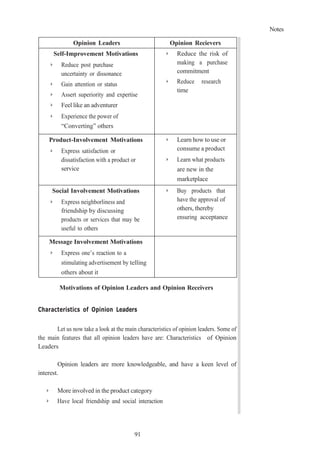
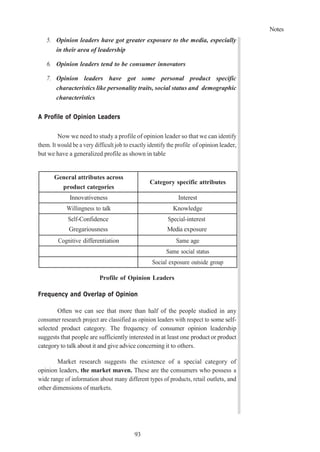
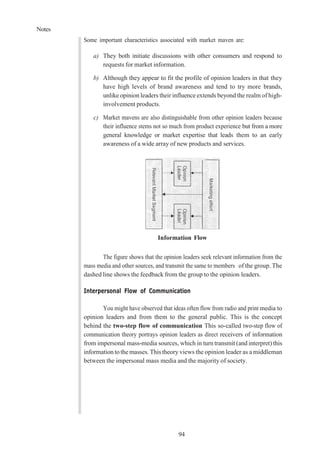
  • 12.
    Notes 10 Types of Involvement Thetwo types of involvement are: A) Situation B) Enduring Situational Involvement `Situational involvement is temporary and refers to emotional feelings of a consumer, experiences in a particular situation when one thinks of a specific product. Enduring Involvement Enduring involvement is persistent over time and refers to feelings experienced toward a product category across different situations. For example, holiday- makers renting a resort for their trip are highly involved in their choice, but their involvement is temporary. Whereas involvement of a person whose hobby is bike racing endures overtime and affects his responses in any situation related to pre-purchase, purchase and post- purchase of sport bikes. It is observed that involvement is triggered by special situation in the case of holiday makers, but in the second case, it comes from, and is a part of the consumer. The contrast between situational and enduring involvement is important. When marketers measure involvement they examine the extent to which it can be induced by the product or selling situation. After noticing the type of involvement they are facing, marketers work to control products or selling situations. Effects of Consumer Involvement Involvement with the product makes consumers process the product- related information more readily. This information is processed thoroughly; hence, it is retained for a longtime. Because of this the consumers become emotionally high and tend to engage in extended problem solving and word- of-mouth communications. These result into three categories: search for information, processing information, and
  • 13.
    Notes 11 information transmission. Customers whoare highly involved tend to search for information and shop around more when compared with low involvement customers. For example, the customer who is highly involved with cars and thinks about buying it is likely to gather information. He sees for alternative models to figure the advantages and disadvantages of each. The more they are involved, the more they learn about the alternatives with in that category. To gather the information they use various sources. One such behavior is to shop around, where they visit various outlets and talk to sales people. The customers of this kind should be encouraged buy retailers to visit the outlets to know, and compare various models to meet information needs. Processing of Information Processing of information means depth of comprehension, extent of cognitive elaboration, and the extent of emotional arousal of information as discussed below. Depth of Comprehension Highly involved customers tend to process product information at deeper levels of understanding than the ones with low involvement. For example educated parents in urban areas are highly involved in baby food purchase decisions than rural uneducated parents. They also retain this information for long time. In this case marketers need to provide information cues to help the consumers to retrieve information from memory. But when thetarget is lowinvolvement consumers,marketers should make the necessary information as accessible as possible at the time of selection and buying of the product. Extent of Cognitive Elaboration Highly involved customers think more about product choices than consumers with low involvement. Their deep understanding involves support arguments and / or counter arguments. That is, highly involved consumers tend to generate cognitive responses either in support of the product information or against the information provided by the marketers.
  • 14.
    Notes 12 If we talkof the previous example, marketing baby food products, the product all though effective may have significant side effects like obesity. Educated parents are likely to give this the great deal of thought before giving it to their children. To ensure that the parents generate positive thoughts, the marketers have to mention a quality argument that the product benefits outweigh its negative effects. If the arguments are less informed and not persuasive, it is likely to produce negative thoughts resulting in an unfavorable attitude towards the product. Level of Emotional Arousal Highly involved consumers are more emotional than less involved consumers. The highly involved consumers react more strongly to the product- related information which may act for or against marketers. This is because the negative interpretation is likely to be exaggerated more number of times causing the customers to reject the product. Information Transmission Transmission of information is the extent to which greatly involved customers send information about the product to others. This is done usually through word-of-mouth communication. The researchers have shown that if consumers are highly involved they talk about the product frequently than others. Satisfied consumers are likely to speak favourable about the product, while unsatisfied speak negatively. Therefore, marketers catering to highly involved consumers should attempt to enhance consumer satisfaction and decrease dissatisfaction. For example, customer happy with ONIDA television communicates the same to others through word- of-mouth. Models of Consumer Involvement There are four prominent models of consumer behavior based on involvement which help marketers in making strategic decision particularly in marketing communication related strategies. The four models are as follows.
  • 15.
    Notes 13 1. Low InvolvementLearning Model 2. Learn-Feel-Do Hierarchy model 3. Level of Message Processing Model 4. Product versus Brand Involvement Model 1. Low Involvement Learning Model Low Involvement products are those which are at low risk, perhaps by virtue of being inexpensive, and repeatedly used by consumers. Marketers try to sell the products without changing the attitudes of consumers. New product beliefs replace old brand perceptions. Marketers achieve low– involvement learning through proper positioning. For example, writing pen with the ‘uninterrupted flow’, and tooth paste with ‘mouth wash’ positioning attracts new consumers. 2. Learn-Feel-Do Hierarchy Model Buying decisions vary according to the way they are taken. Some decisions are taken with lot of thinking others are taken with great feelings. Some are made through force of habit and others are made consciously. The learn-feel-do hierarchy is simple matrix that attributes consumer choice to information (learn), attitude (feel), and behavior (do) issues. The matrix has four quadrants, each specifying a major marketing communication goal to be informative, to be effective, to be habit forming, or promote self-satisfaction. Thinking and feeling are shown as a continuum - some decisions involve one or the other and many involve elements of both. High and low importance is also represented as a continuum. HIGH INVOLVEMENT LOW INVOLVEMENT Thinking Feeling 1. Informative (Thinker) Model: Learn-Feel-Do 2. Affective (Feeler) Model: Feel-Learn-Do 3. Habit Formation (Doer) Model: Do-Learn-Feel 4. Self- Satisfaction Reactor) Model: Do-Feel-Learn
  • 16.
    Notes 14 (I) High Involvement/ High Thinking Purchases in first quadrant require more information, both because of the importance of the product to the consumer and thinking issues related to the purchases. Major purchases such as cars, houses and other expensive and infrequently buying items come under this category. The strategy model is learn- feel-do. Marketers have to furnish full information to get consumer acceptance of the product. (ii) High Involvement / High Feeling The purchase decisions in second quadrant involve less of information than feeling. Typical purchases tied to self-esteem- jewelry, apparel, cosmetics and accessories come under this category. The strategy model is feel-learn-do. To encourage purchases marketers must approach customers with emotion and appeal. (iii) Low Involvement / Low Feeling The purchases in this quadrant are motivated primarily by the need to satisfy personal tastes, many of which are influenced by self-image. Products like news paper, soft drinks, Liquor etc., fall under this category. Group influences often lead to the purchase of these items. The strategy model is do-feel-learn. It helps marketers to promote products through reference groups and other social factors. (iv) Low Involvement / Low Thinking It involves less in thinking and more of habitual buying. Products like stationery, groceries, food etc., fall under this category. Over a period of time any product can fall in this segment. The role of information is to differentiate any ‘point of difference’ from competitors. Brand loyalty may result simply from the habit. The strategy model is do-learn-feel. It suggests thatmarketers induce trial through various sales promotion techniques. 3. Level of Message Processing Model Consumer attention to advertisements or any other marketing communication depends on four levels of consumer involvement: Pre- attention, focal attention, comprehension and elaboration. Each calls
  • 17.
    Notes 15 for different levelof message processing. Pre-attention demands only limited message processing - the consumer only identifies the product. Focal attention involves basic information as product name or usefulness. In comprehension level, the message is analyzed and the content of the message is integrated with other information, through elaboration, which helps to build attitude towards the product. It is suggested that marketers make advertisements which can induce elaboration. 4. Product versus Brand Involvement Model Sometimes consumer is involved with the product category but may not be necessarily involved with the particular brand or vice versa. For example, house wives know more about kitchen ware but may not know the details of various brands. According to the consumer involvement in either product or particular brand, consumer types can be divided into four categories as described below. (i) Brand Loyals: These consumers are highly involved with both the product category and with particular brand. For example, cigarette smokers and paper readers fall in this category. (ii) Information Seekers: These buyers are involved more with product category but may not have preferred brand. They are likely to see information to decide a particular brand. For examples, air- conditioners and washing machine buyers fall under this category. (iii) Routine Brand Buyers: These consumers are not highly involved with the product category but may be involved with the particular brand within that category. They have low emotional attachment with the product category and tied mainly with their brand. For example users of particular brand of soap for years, regular visitors to particular restaurant fall in this category. (iv) Brand Switching: Consumers in this category have no emotional attachment either with product category or any brand within it. They typically respond to price. For example stationery items, fashion products come under this category. ****
  • 18.
    Notes 16 Lesson 1.3 -Consumer Decision Making Process The most important environment in which firms operate is their customer environment because the basic belief of marketing oriented company – that the customer is the centre around which the business revolves. Therefore, marketing people need to understand the processes that their customers go through when making decision. The consumer decision making process involves series of related and sequential stages of activities. The process begins with the discovery and recognition of an unsatisfied need or want. It becomes a drive. Consumer begins search for information. This search gives rise to various alternatives and finally the purchase decision is made. Then buyer evaluates the post purchase behavior to know the level of satisfaction. The process is explained below with the help of diagram. Steps In Decision Making Process Information Search Evaluation of Alternatives Purchase Decision Need Recognition Post-Purchase Behavior
  • 19.
    Notes 17 1. Need Recognition Whena person has an unsatisfied need, the buying process begins to satisfy the needs. The need may be activated by internal or external factors. The intensity of the want will indicate the speed with which a person will move to fulfill the want. On the basis of need and its urgency, the order of priority is decided. Marketers should provide required information of selling points. 2. Information Search Identified needs can be satisfied only when desired product is known and also easily available. Different products are available in the market, but consumer must know which product or brand gives him maximum satisfaction. And the person has to search out for relevant information of the product, brand or location. Consumers can use many sources e.g., neighbors, friends and family. Marketers also provide relevant information through advertisements, retailers, dealers, packaging and sales promotion, and window displaying. Mass media like news papers, radio, and television provide information. Nowadays internet has become an important and reliable source of information. Marketers are expected to provide latest, reliable and adequate information. 3. Evaluation of Alternatives This is a critical stage in the process of buying. Following are important elements in the process of alternatives evaluation a. A product is viewed as a bundle of attributes. These attributes or features are used for evaluating products or brands. For example, in washing machine consumer considers price, capacity, technology, quality, model and size. b. Factors like company, brand image, country, and distribution network and after-sales service also become critical in evaluation. c. Marketers should understand the importance of these factors with regards to the consumers while manufacturing and marketing their products.
  • 20.
    Notes 18 4. Purchase Decision Outcomeof the evaluation develops likes and dislikes about alternative products or brands in consumers. This attitude towards the brand influences a decision as to buy or not to buy. Thus the prospective buyer heads towards final selection. In addition toall theabove factors, situational factors like finance options, dealer terms, falling prices etc., are also considered. 5. Post- Purchase Behavior Post-purchase behavior of consumer is more important as far as marketer is concerned. Consumer gets brand preference only when that brand lives up to his expectation. This brand preference naturally repeats sales of marketer. A satisfied buyer is a silent advertisement. But, if the used brand does not yield desired satisfaction, negative feeling will occur and that will lead to the formation of negative attitude towards brand. This phenomenon is called cognitive dissonance. Marketers try to use this phenomenon to attract users of other brands to their brands. Different promotional-mix elements can help marketers to retain his customers as well as to attract new customers. Consumer Decision Rules These are generally referred to as information processing strategies. These are procedures that help consumers to evaluate various options and reduce the risk of making complex decisions by providing the guidelines. Decision rules have been broadly classified into two categories: 1. Compensatory Decision Rules: Consumers evaluate brand or model in terms of each attribute and computes a weighted score for each brand. The computed score reflects the brand’s relative merit as a potential purchase choice. The assumption is that consumer will select the brand that scores highest among alternative brands. The unique feature of this rule is that it balances the positive evaluation of a brand on one attribute to balance out a negative evaluation on some other attribute. For example, positive attribute like high fuel efficiency is balanced with the negative evaluation of high maintenance cost.
  • 21.
    Notes 19 2. Non-compensatory DecisionRules: In contrast to the above rule non- compensatory rules do not allow consumers to balance positive evaluation of a brand on one attribute against negative evaluation on some other attribute. There are three types of non-compensatory rules. Conjunctive Decision Rule: In conjunctive decision rule the consumer establishes a different, minimally acceptable level as a cut off point for each attribute. In this the option is eliminated for further consideration if a specific brand or model falls below the cutoff point on any attribute. Disjunctive Rule: It is the ‘mirror image’ of conjunctive rule. Here the consumer establishes a separate minimally acceptable cut off level for each attribute. In this case if an option meets or exceeds the cut off established for any one attribute, it is accepted. Lexicographic Decision Rule: In this rule the consumer initially ranks the attributes in terms of perceived relevance or importance. Later he compares different alternatives in terms of the single attribute that is considered most important. On this top ranked alternative, regardless of the score on any other attribute,if one option scores sufficientlyhigh it is selected and the process ends. Levels Of Consumer Decision Making The consumer decision making process is complex with varying degree. All purchase decisions do not require extensive effort. On continuum of effort ranging from very high to very low, it can be distinguished into three specific levels of consumer decision making: 1 Extensive Problem Solving (EPS) 2. Limited Problem Solving (LPS) 3. Routine Problem Solving (RPS) 1. Extensive Problem Solving (EPS): When consumers buy a new or unfamiliar product it usually involves the need to obtain substantial information and a long time to choose. They must form the concept
  • 22.
    Notes 20 of a newproduct category and determine the criteria to be used in choosing the product or brand. 2. Limited Problem Solving (LPS): Sometimes consumers are familiar with both product category and various brands in that category, but they have not fully established brand preferences. They search for additional information which helps them to discriminate among various brands. 3. Routine Problem Solving (RPS): When consumers have already purchased aproductorbrand,theyrequirelittleorno information to choose the product. Consumers involve in habitual and automatic purchases. ****
  • 23.
    Notes 21 Lesson1.4 - ConsumerBehavior and Marketing Implications The basic belief of marketing-oriented company is that the customer is the hub around which the business revolves. Therefore, understanding what makes people in general buy and what makes your customer in particular buy, is a vital part of business success. Market itself means – customer, around whom all marketing strategies are formulated and implemented. In order to meet competition at the market place, the marketing managers are using various methods to add value to the final product which will reach the hands of the consumers. It means in ever changing marketing environment, there is a growing concern or awareness among marketers to go for a careful study of the consumer behavior around which all marketing activities are made. Following are the key marketing implications of consumer behavior. Consumer Behavior and Marketing Strategies Understanding the consumer behavior is the basis for marketing strategy formulation. Consumer’s reaction to strategy determines the organization success or failure. In this competitive environment organizations can survive only by offering more customer value - difference between all the benefits derived from a total product and all the costs of acquiring those benefits - than competitors. Providing superior customer value requires the organization to do a better job of anticipating and reacting to the customer needs than the competitor. Marketing strategy is basically the answer to the question: How will company provide superior customer value to its target market? The answer to this question requires formulation of marketing - mix – product, price, place and promotion - strategies. The right combination of these elements meets customer expectation and provides customer value. For example, marketer of a bike must know the customers performance expectations, desired service, price willing to pay, information he seeks and after-sales service to provide superior customer value.
  • 24.
    Notes 22 Consumer Behavior andMarket Segmentation The most important marketing decision a firm makes is the selection of one or more segments to focus their marketing effort. Marketers do not create segments but they find it in the market place. Market segmentation is the study of market place in order to discover viable group of consumers who are homogeneous in their approach in selecting and using goods or services. Since market segment has unique needs, a firm that develops a product focusing solely on the needs of that segment will be able to meet the target group desire and provides more customer value than competitor. For example, right segment for ‘Femina’ magazine is educated urban women. The success of this magazine depends on their understanding of the urban woman. Consumer Behavior and Product Positioning Product positioning is placing the product, service, company, or shop in the mind of consumer or target group. Through positioning marketers seek the right fit between a product and desired customer benefits. The right positioning means understanding the consumer perception process in general and perception of company’s product in particular. For example, Samsung brand is perceived as premium brand by few customers and value-driven brand by others in the market, but marketer must find out what makes their target market to perceive differently and position it accordingly. Consumer Behavior and Marketing Research Studying consumer behavior enables marketing researchers to predict how consumers will react to promotional messages and to understand why they make the purchase decision they do. Marketers realized that if they know more about the consumer decision making criteria, they can design marketing strategies and promotional messages that will influence consumers more effectively. The importance of consumer behavior made marketers to think of a separate branch in marketing research - Consumer research, to deal exclusively for consumer related issues. The current focus of consumer research is on study of underlying needs and motives in taking purchase decisions, consumer learning process and attitude formation process.
  • 25.
    Notes 23 Consumer Behavior andNon-Profit and Societal Marketing A sound knowledge of consumer behavior can help the organizations that sell ideas and concepts of social relevance. Institutions that promote family planning, AIDS free society, governmental agencies, religion orders and universities also appeal to the public for their support in order to satisfy some want or need in society. The knowledge about potential contributors, what motivate their generosity, how these motives can be effectively appealed is useful for the organizations involved in these activities. Consumer Behavior and Governmental Decision Making Two major areas where consumer behavior study helps government is in policy making on various services, and in designing consumer protection legislation. The knowledge of people’s attitudes, beliefs, perceptions and habits provides adequate understanding of consumers. ****
  • 26.
    Notes 24 Lesson 1.5 -Consumer Behavior Models Economic or Marshallian Model This theory was first advanced by the economists. They gave formal explanation of buyer behavior. According to this theory the consumers are assumed to be rational and conscious about economic calculations. They follow the law of marginal utility. An individual buyer seeks to spend his money on such goods which give maximum satisfaction (utility) according to his interests and at relative cost. The buying behavior is determined by the income – its distribution and level - affects the purchasing power. The economic factors which affect the buyer behavior are: 1. Disposable Personal Income The economists attempted to establish relationship between income and spending. Disposable personal income represents potential purchasing power that a buyer has. The change in income has direct relation on buying habits. Personal consumption spendingtends to both rise and fall at a slower rate than what disposable personal income does. Disposable of personal income depend on various situations such as: 1. Size of family income Size of family and size of family income affect the spending and saving patterns. Usually large families spend more and small families spend less in comparison. 2. Income Expectation The income expected to be got in future has direct relation with the buying behavior. The expectation of higher or lower income has a direct effect on spending plans.
  • 27.
    Notes 25 3. Tendency toSpend and to Save This is related to the habit of buyers to spend or save out of the disposable income. If the buyers give importance to the present needs, they dispose off their income. And buyers spend less if they give importance to future needs. 4. Liquidity of Funds The present buying plans are greatly influenced by liquidity of assets readily convertible into cash. For example, readily marketable shares and bonds, bank balances come into this category. However, this convertible assets influence offer freedom to buyer, who actually buys with current income. 5. Consumer Credit Facility of consumer credit system - hire purchase, installment purchase etc., plays an important role in purchase decision. A buyer can command more purchasing power. ‘Buy now and pay later’ plays its role effectively in the rapid growth of market for car, scooter, washing machine, furniture, television and so on. The economic model of consumer behavior is uni-dimensional. It is based on certain predictions of buying behavior. They are: a. Lower the price of the product, higher the sales b. Lower the size of the substitute product, lower the sale of the product c. Higher the real income, higher the sales of this product d. Higher the promotional expenses, higher are the sales However, ‘lower the price of a product, higher the sales’ may not hold good as buyer may feel that the product is sub-standard one. The behavioral researchers believe that this model ignores all the other aspects such as perception, motivation, learning, attitude and
  • 28.
    Notes 26 personality, and socio-culturalfactors. Further, it is also observed that consumer also gets influenced by other marketing variables such as products, effective distribution network and marketing communication. Hence, it is felt that the economic model is inadequate. It assumes that market is homogeneous where markets are assumed to be heterogeneous. Learning or Pavlovian Model Psychology has contributed lot to the marketers to understand the buyers. It explains how consumers learn about a product and the way they can recall from the memory, and the development of buying habits. All theories of buyer’s behavior have been primarily based on learning, viz., Stimulation-Response or S-R model, this theory of learning is explained as a process of repetition, motivation, conditioning and relationship. Repetition improves learning. For example, when advertisements are repeated, people may be able to understand further about the product. This is aimed at repeated advertisements for drawing the attention and interest of the people. According to stimulus- response theory learning involves the following steps. a. Drive: It is a strong internal stimulus which impels action and when it is directed towards a drive reducing object, it becomes a motive. A drive thus motivates a person for action to satisfy the need. Drives may be primary-thrust, hunger etc., and secondary - desire for money, pride etc. b. Cues: These are weak stimuli. They determine when the buyer will respond. c. Response: Response is the feedback reaction of the buyer. It is an answer given to drive or cue. The individual has to choose some specific response in order to fulfill the drive or the need which was acting as a stimulus. For example, a hunger drive can be satisfied by visiting a shop known through an advertisement and buying the readymade food product. If that experience is satisfactory, this response of satisfaction is strengthened.
  • 29.
    Notes 27 Drives, Cues, andResponses Thus this learning of links which mean stimulus, cue and response results in habits. Along with this, attitudes and beliefs are also learnt. As it becomes a habit, the decision process for the individual becomes routine affair. Thus, learning model has the following prediction: a. Learning refers to change in behavior brought about by practice or experience. Everything one does or thinks is learnt. b. Product features such as price, quality, service, brand, package etc., acts as cues or hints influencing consumer behavior c. Marketing communications such as advertising, sales promotion etc., also act as guides persuading buyer to purchase the product. d. Response is decision to purchase. Drive An activated or Unsatisfied enough to motivate repeated purchase error in a stimulus response situation These are stimuli, coming from the marketing and social environment of
  • 30.
    Notes 28 Psychoanalytical Model Sigmund Freuddeveloped this theory. According to him human personality has three parts: 1. The Id, is the source of all mental energy that drives us to action 2. the super ego, the internal representation of what is social is approved conscience 3. The Ego, the conscious director of id impulses for finding him satisfaction in socially acceptable manner. The buyer behavior depends upon the relative strength of the three elements in the personal ability. Motivational research has been involved in investigating motives of consumer behavior so as to develop suitable marketing implications accordingly. This approach has been used to generate idea for developing- design, features, advertising and other promotional techniques. Sociological Model According to this theory the individual decision and behavior are quite often influenced by the family and the society. He gets influenced by it and in turn also influences it in its path of development. He plays many roles as a part of formal and informal associations or organizations i.e., as a family member, employee of a firm, member of professional forum, and as an active member of an informal cultural organization. Hence he is largely influenced by the group in which he is a member. For example, the decision may be made by one, actual buying may be done by another, and the product is used by yet another member of the family. Here, a mother takes a decision to buy a tiny cycle for her child, the cycle is purchased by the father and the user is the child. Howard - Sheth Model The Howard - Sheth model shows the processes and variables influencing the buyer behavior before and during the purchase. It emphasizes three key variables- perception, learning and attitude formation. It explains the way consumers compare available products in order to choose the best which fits their needs and desires. Consumers
  • 31.
    Notes 29 learn by findingout the relevant information about products through two sources of information: a. Social sources b. Commercial sources The gathered information is used for comparison of alternative brands according to various choice criteria. The basic structure of the model is given below Social Class, Financial Status Exogenous Variable Basic Structure of Buying Behavior The following predictions can be made about the model i. Stimuli or perceived learning occurs and results in output ii. Output occurs on the basis of the perception and learning non- observable variables. iii. Exogenous or outside variables such as social class, financial status etc., are used to predict perception and learning This model describes the buying behavior in various stages Stage 1: Motives are based on needs demanding satisfaction. They lead to goal directed behavior satisfaction. Motives ignite a drive to search and secure information from alternatives. Stimulus- input variables are marketing programme and social environment. Stimuli Outputs Learning Perception Drive
  • 32.
    Notes 30 Input or stimuli: I.Product themselves in the market II. Commercial information on them, say quality, price, availability and distinctiveness III. Product information obtained from friends, acquaintances and reference groups. Thus, a number of products or brands are perceived and considered by the consumers mind. In this manner the resulting perception is selected. Stage 2: While evaluating, many brands are eliminated or left out for further consideration. Now, only few will receive further consideration. Each will have plus / minus points. These choice considerations act as connecting links between motives and selected brands choice consideration which provide a structure to motives and the process of learning and experience. These considerations develop as criteria/rule to decide on the goods that have the prospects of yielding maximum satisfaction. The market must offer a good marketing-mix that is used by the buyer to influence the choice criteria. Stage3: The choice criteria gives rise to predisposition- the relative preference in favour of particular brand. Sudden hindrances may sometimes stop the process. This may be in form of price, inadequate supply of brand, external variables such as financial status, time pressure etc. If they do not occur, the preference results in a response output such as attention, comprehension, attitude, buying intention and preferably actual purchase. Stage 4: Feedback of purchase experience is sent to the buyer which shows if the actual satisfaction was equal to the expected satisfaction. Satisfaction leads to repurchase, and repeat orders indicate brand loyalty. The marketer is interested in this outcome. Buying behavior is influenced by motives (rational / emotional curiosity) attitudes, perception, social factors and personal factors.
  • 33.
    31 Inhibitors Set Selective Commercial Social Choice criteria Brand inthe shop Stimulus variable Predisposition Alternatives Policy Personality Social Class Culture Time Pressure Satis- Motives Response Output variable Purchase Intention Attitude Comprehension of the brand Attention Black Box of Buyer behavior Thus models of buyer behavior are generally based on certain factors internal to the consumer e.g., learning, personality, attitudes and perceptions. The external factors may be in the form of group, cultural and inter-personal influences and effects advertising and communications. The action of individuals is the result ofboth internal / external factors and interactions tothe consumerdecision making processes. The modern concepts of the buying behavior state that the behavior is the result of interaction between people centered factors and situation centered factors.
  • 34.
    32 Nicosia Model The marketeris expected to be aware of the person centered factors such as buyer motivation, learning, perceptions, attitudes, values and beliefs. Similarly, marketers must be aware of social environment and internal personal interactions influencing the buyer behavior. Field 1: From source of a message to consumers attitude MESSAGE ATTITUDE EXPOSURE 2 of means Search Evaluation MOTIVATION 3 Decision (Action) Action Consumption Storage Sub Field: 2 Consumers Attributes Sub Field: 1 Firm’s attributes
  • 35.
    Notes 33 Howard – ShethBrand Buyer Behavior Model Nicosia Model The buyer behavior model is taken from the marketing mans point of view. It is also called systems model as the human is analysed as a system, with stimuli as the input to the system and the human behavior as an output of the system. Francesco Nicosia, an expert in consumer motivation and behavior has developed this in 1966. He tried to explain buyer behavior by establishing a link between the organization and its prospective consumer. Here the messages from the company initially influence the predisposition of the consumer towards the product and service. Based on the situation, the consumer will have a certain attitude towards theproduct.Thismay result in a search for the product or an evaluation of the product attributes by the consumer. If this step satisfies the consumer, it may result in a positive response, with a decision to buy the product or else the reverse may occur. The Nicosia model divides the above activity explanation into four basic areas: Area 1: Field one has two sub areas-the consumer attributes and the firms attributes. The advertising message from the company will reach the consumers attributes. Certain attributes may develop sometimes depending upon the way the message is received by the consumer. The newly developed attribute becomes the input for area 2. Area 2: This area is related to the search and evaluation undertaken by the consumer of the advertised product and also to verify if other alternatives are variable. If the above step motivates to buy the product / service, it becomes the input for the third area. Area 3: This area explains as how the consumer actually buys the product. Area 4: This is related to the uses of the purchase items. This can also be used as an out put to receive feedback on sales results to the firm.
  • 36.
    Notes 34 Summary The heterogeneity amongpeople across the world makes understanding consumer buying behavior an intricate and challenging task. Product motives and patronage motives play a crucial role in consumer purchases. Like individuals organizations also make many buying decisions. The major factors that distinguish it from consumer decision are Market structure and Demand, Buyer characteristics, and Decision process and buying patterns. The degree of involvement has a lot of impact on search of information, Information processing, and Transmission of information. The various models of consumer involvement help marketers to study purchase behavior across product segments. Consumers usually go through five stages in arriving at a purchase decision. In the first stage, the customer identifies an unsatisfied need. In the second stage consumer collect information about the product and brands. In a third stage, the consumer evaluates all the alternatives with the help of available information. Later in stage four, the customer makes a purchase decision. And finally in the fifth stage, consumer experiences post-purchase satisfaction or dissatisfaction. Organizational buyer has different decision making criteria. Decision making rules – Compensatory and Non compensatory – simplify the complex nature of decision making to consumers. Understanding consumer behavior is the basis of the formulation of marketing strategies. Consumer behavior studies help in designing effective marketing strategies like, Marketing-mix Strategy, Market Segmentation Strategy, Product Positioning Strategy, and Marketing Research. As consumer behavior is very complex to understand, consumer models aid marketer to put their effort to understand in right direction. The models – Economic, Learning, Psychoanalytic, Sociological, Howard-Sheth and Nicosia enables marketers to understand and predict consumer behavior in the market place.
  • 37.
    Notes 35 Self Assessment Questions 1.Explain the nature of consumer behavior 2. Justify the statement, “The evaluation of marketing concept from mere selling concept to Consumer-oriented marketing has resulted in buyer behavior becoming an independent discipline.” 3. Compare and contrast the buying behavior of organization market and retail consumers. 4. What is Consumer Involvement? Discuss the factors that affect the Consumer Involvement. 5. How does processing of information affect consumer involvement? 6. Discuss various consumer involvement models and their suitability to different organizations? 7. What essential elements are required to understand consumer decision making? 8. How does decision making change because of change in purchase involvement? 9. How can a consumer arrive at a decision? Explain various stages in it. 10. What is customer value and why is it important to marketers? 11. What are the four major marketing implications to understand consumer Behavior? 12. List the inputs of various decisions making models and discuss their limitations in the market place. 13. How do compensatory and non-compensatory decision rules vary? 14. Define extensive problem solving, limited problem solving and routine problem solving. What are the differences among the three decision- making approaches? What type of decision process would you expect most consumers to follow in their first purchase of a new product or brand in each of the following areas (a) Cosmetics (b) Computer (c) Mobile (d) Edible oil (e) Air-conditioner. Explain your answers.
  • 38.
    Notes 36 Application Activities 1. Conducta focus group interview to discover the buying motives influencing the purchases of following products and brands a) Vacuum cleaner b) Purchases in Hyper-Markets c) LG Refrigerator d) Sun Umbrella 2. Interview 15 students on your campus and determine their internet shopping behaviors. Divide them into appropriate groups such as heavy, moderate, light, and non-shoppers and explain why each group behaves as it does. 3. Develop a short questionnaire designs to measure the information search consumers engage in prior to purchasing an expensive recreational or entertainment item or service. Your questionnaire should include measures of types of information sought, as well as sources that provide this Information. Also include measures of the relevant consumer characteristics that might influence information search, as well as some measure of past experience with the products. Then interview two recent purchasers of each product, using the questionnaire you have developed. Analyze each consumers response and classify each consumer in terms of information search. What are the marketing implications of your results? 5. Develop a short questionnaire to elicit the evaluative criteria consumer might use in selecting the following. Also have each respondent indicate the relative importance he or she attaches to each of the evaluative criteria. Then, working with several other students, combined your information and develop a segmentation strategy based on consumer evaluation criteria and its importance. Finally develop an advertisement for the members of each market segment to indicate that their needs would be served by your brand. a) Shaving cream b) Stationery
  • 39.
    Notes 37 c) Santro Car d)Panasonic Mobile e) Whirlpool Refrigerator f) Durian Furniture Glossary Attitude: A learned predisposition to behave in consistently favorable or unfavorable manner with respect to given object. Behavioral Learning Theories: Theories based on the premise that learning takes place as the result of observable responses to external stimuli. Brand Loyalty: Consumers consistent preference and / or purchase of the same brand in a specific product or service category Cognitive Learning: The acquisition of new knowledge about the world. Compensatory Decision Rule: A type of decision rule in which consumer evaluates each brand in terms of each relevant attribute and then selects the brand with the highest weighted score Conditioned Learning: According to Pavlovian theory conditioned learning results when a stimulus paired with another stimulus that elicits a known response serves to produce the same response by itself Conditioned Stimuli: When new products bear a well known symbol on the belief that it embodies the same attributes with the name it is associated with Conjunctive Decision Rule: Non-compensatory decision rule in which consumers establish a minimally acceptable cut off points for each attribute evaluated. Brands that fall below the cutoff point on any one attribute are eliminated from further consideration Consumer Behavior: The behavior consumers display in searching for, purchasing, using, evaluating and disposing of products, services, and ideas. Consumer decision making: Cognitive and emotional aspects such as impulse, family, friends, advertisers, role models, moods, and situations that influence a purchase
  • 40.
    Notes 38 Consumer Decision Rules:Procedures adopted by consumers to reduce the complexity of making products and brand decisions Consumer Research: Methodology used to study consumer behavior Consumer Socialization: The process, started in childhood by which an individual first learns the skills and attitudes relevant to consumer purchase behavior Cues: Stimuli that give direction to consumer motives (i.e., that suggest a specific way to satisfy a salient motive Customer Life Time Value: Profiles based on the collection and analysis of internal secondary data. Customer Retention: Providing value to customers continuously so that they will stay with the company rather than switch to another firm Customer Satisfaction: An individual’s perception of the performance of the product or service in relation to his or her expectation Customer Value: The ratio between the customers’s perceived benefits and the resources used to obtain those benefits Differentiated Marketing: Targeting a product or service to two or more segments, using specifically tailored product, promotional appeal, price, and/or method of distribution for each Disjunctive Rule: A non-compensatory decision rule in which consumers establish a minimally acceptable cut off point for each relevant product attribute; any brand meeting or surpassing the cut off point for any one attribute is considered an acceptable choice Emotional Motives: The selection of goals according to personal or subjective criteria (e, g., the desire for individuality, pride, fear etc) Evoked Set: The specific brands consumer considers in making a purchase choice in a particular product category Extensive Problem Solving: Decision making efforts by consumers that have no established criteria for evaluating a product category or specific brands in that category or have not narrowed the brands to a manageable subset
  • 41.
    Notes 39 Feed Back: Theresponse given by a receiver to the sender of the message Focus Group: A Qualitative research method in which about eight to ten persons participate in an unstructured group interview focused on a product or service concept Freud Theory: A theory of personality and motivation developed by the psychoanalyst Sigmund Freud Information Processing: A cognitive theory of human learning patterned after computer information processing that focuses on how information is stored in human memory and how it is retrieved Involvement Theory: A theory of consumer learning which postulates that consumers engage in a range of information processing activity from extensive to limited problem solving depending on the relevance of the purchase Lexicographic Decision Rule: A non-compensatory decision rule in which consumers first rank product attributes in terms of their importance then compare brands in terms of the attribute considered most important. If one brand scores higher than the other brands it is selected: if not the process is continued with the second rank attribute, and so on Non-compensatory Decision Rule: A type of consumer decision rule by which positive evaluation of a brand attribute does not compensate for negative evaluation of the same brand on some other attributes Organizational Consumer: A business, government agency, or other Institution that buys the goods, services, and/ or equipment necessary for the organization to function Purchase Behavior. Behavior that involves two types of purchases: trial purchases and repeat purchase Repeat Response Behavior: A habitual purchase response based on predetermined criteria Word-Of-Mouth: Informal conversations concerning products or services ****
  • 42.
  • 43.
    41 Notes UNIT – II LearningObjectives After studying this lesson, you should be able to: ➢ Define and identify the various influences on culture ➢ Know the Environmental variations and cultural values ➢ Explain the cross-cultural influences on consumer behavior ➢ Define Social Class and its impact on consumer decisions. ➢ Emphasize the role of reference groups in influencing consumer behavior. ➢ Discuss Family life cycle and its implications on consumer behavior ➢ Define Family roles and consumption patterns ➢ Understand the concept of diffusion and adoption of new products/ innovation. Lesson Structure Lesson – 2.1: Cultural and Environmental Influences On Consumer Behavior Lesson – 2.2: Groups, Social Class and Reference Groups Lesson – 2.3: Family Influences and Decision Making Lesson – 2.4: Opinion Leadership and Diffusion Of Innovations
  • 44.
    Notes 42 Lesson 2.1 -Cultural and Environmental Influences on Consumer Behavior Introduction Everybody in this world is a consumer. Every day of our life we are buying and consuming an incredible variety of goods and services. However, we all have different tastes, likes and dislikes and adopt different behavior patterns while making purchase decisions. Many factors affect how we, as individuals and as societies, live, buy, and consume. External influences such as culture, ethnicity, and social class influence how individual consumers buy and use products, and help explain how groups of consumers behave. The study of culture encompasses all aspects of a society such as its religion, knowledge, language, laws, customs, traditions, music, art, technology, work patterns, products, etc. Culture is an extremely critical and all pervasive influence in our life. CULTURE - Meaning For the purpose of studying consumer behavior, culture can be defined as the sum total of learned beliefs, values and customs that serve to guide and direct the consumer behavior of all members of that society. Howard and Sheth have defined culture as “A selective, manmade way of responding to experience, a set of behavioral pattern”. Thus, culture consists of traditional ideas and in particular the values, which are attached to these ideas. It includes knowledge, belief, art, morale, law, customs and all other habits acquired by man as a member of society. An accepted concept about culture is that includes a set of learned beliefs, values, attitudes, habits and forms of behavior that are shared by a society and are transmitted from generation to generation within that society. Culture is learned through the following three ways: 1. Formal learning: Parents and elders teach children the proper way to behave. For instance, you have been taught that you need to study to be successful and happy in life. This learning may influence your response both as a student and individual towards education.
  • 45.
    Notes 43 2. Informal learning:We learn by imitating the behavior of our parents, friends, or by watching TV and film actors in action 3. Technical learning: Instructions are given about the specific method by which certain things to done such as painting, dancing, singing etc. Characteristics of Culture ➢ Culture is learned. ➢ Culture regulates society–norms, standards of behavior, rewards and punishments. ➢ Culture makes life more efficient ➢ All members follow same norms. ➢ Culture is adaptive. ➢ Culture is environmental. ➢ Multiple cultures are nested hierarchically. Culture also determines what is acceptable with product advertising. Culture determines what people wear, eat, reside and travel. Cultural values in India are good health, education, respect for age and seniority. But in our culture today, time scarcity is a growing problem, which implies a change in meals. Some changes in our culture: 1. Convenience: As more and more women are joining the work force there is an increasing demand for products that help lighten and relieve the daily household chores, and make life more convenient. This is reflected in the soaring sale of washing machines, microwaves, pressure cookers, mixer-grinders, food processors, frozen food etc. 2. Education: People in our society today wish to acquire relevant education and skills that would help improve their career prospects. This is evident from the fact that so many professional, career oriented educational centers are coming up, and still they cannot seem to meet the demand. As a specific instance count the number of institutions offering courses and training in computers that has opened in your city. 3. Physical appearance: Today, physical fitness, good health and smart appearance are on premium today. Slimming centers and
  • 46.
    Notes 44 beauty parlours aremushrooming in all major cities of the country. Cosmetics for both women and men are being sold in increasing numbers. Even exclusive shops are retailing designer clothes. 4. Materialism: Thereis averydefiniteshift in thepeople’s cultural value from spiritualism towards materialism. We are spending more money than ever before on acquiring products such as air- conditioners, cars CD players etc, which adds to our physical comfort as well as status. Types of Culture ➢ National culture ➢ The culture prevalent in a nation, common to everyone ➢ Popular culture ➢ The culture of the masses with norms of mass appeal ➢ Subculture ➢ The culture of a group within the larger society ➢ Group identification based on nationality of origin, race, region, age, religion, gender, etc. ➢ Corporate culture ➢ The company’s values, rituals, customs, myths and heroes Hoffstede’s Five Dimensions of Culture Culture has a profound impact on the way consumers perceive themselves, products they buy and use, purchasing processes, and the organisations from which they purchase. Marketers, however, are giving more attention to understanding macro cultures and how they affect consumer behavior. Hoffstede found five dimensions of culture that are common among sixty six countries. These dimensions serve as a foundation for characterizing, comparing and contrasting specific national cultures, and they are helpful in identifying environmentally sensitive segments of the market. 1. Individualism versus collectivism (Pursuit of self or group interest) Individualism describes the relationship between an individual and fellow individuals, or the collectivity that prevails in society. Table
  • 47.
    Notes 45 below depicts theattitudinal and behavioral differences associated with individualism and collectivism. 2. Power distance ( Social inequality and submission to authority) Power distance reflects the degree to which a society accepts inequality in power at different levels in organisations and institutions. It can affect preferences for centralization of authority, acceptance of differential rewards, and the ways people of unequal status work together. Individualism (E.g., United States, Australia, Canada Etc) Collectivism (E.g., Hong Kong, Japan, India) Self construal Defined by internal attributes, personal traits Defined by important others, family and friends Role of others Values Self-evaluation e.g., standards of social comparison, sources of appraisal regarding self. Emphasis on separateness, individuality Self-definition e.g., relationships with others define self and affect personal preferences. Emphasis on connectedness, relationships Motivational drives Behavior Focus differentiation, relatively greater need to unique Reflective of personal preferences and needs Focus on similarity, relatively greater need to blend in Influenced by preferences, needs of close others Individualism versus Collectivism 3. Uncertainty avoidance (Tolerance/avoidance of ambiguity) Uncertainty avoidance concerns the different ways in which societies react to the uncertainties and ambiguities inherent in life. Some societies need well-defined rules or rituals to guide behavior, whereas others are tolerant of deviant ideas and behavior. 4. Masculinity/femininity (Segregation of male and female roles in society) This factor determines the extent to which societies hold values traditionally regarded as predominantly masculine or feminine. For instance, assertiveness, respect for achievement, and
  • 48.
    Notes 46 the acquisition ofmoney and material possessions are identified with masculinity; and nurturing, concern for the environment and championing the underdog are associated with a culture’s feminity. 5. Abstract versus associative thinking Creation of value in products based on cause/effect logic or association among events without a logical link Cultural Influences Culture is that complex whole which includes knowledge, belief, art, law, morals, customs and any other capabilities and habits acquired by humans as members of society. Culture influences the pattern of living, of consumption, of decision-making by individuals. Culture is acquired and it can be acquired from the family, from the region or from all that has been around us while we were growing up and learning the ways of the world. Culture forms a boundary within which an individual thinks and acts. When one thinks and acts beyond these boundaries, he is adopting a cross-cultural behavior and there are cross- cultural influences as well. The nature of cultural influences is such that we are seldom aware of them. One feels, behaves, and thinks like the other members of the same culture. It is all pervasive and is present everywhere. Material culture influences technology and how it brings cultural changes like use of telephones, mobile phones, clothing styles and fashions, gives the marketers a chance to improve the product, packing, etc. to meet the needs of the customers. Norms are the boundaries that culture sets on the behavior. Norms are derived from cultural values, which are widely told beliefs that specify what is desirable and what is not. Most individuals obey norms because it is natural to obey them. Culture outlines many business norms, family norms, behavior norms, etc. How we greet people, how close one should stand to others while conducting business, the dress we wear and any other patterns of behavior. Culture keeps changing slowly over time; and is not static. Changes take place due to rapid technologies. In case of emergency, war, or natural calamities, marketers and managers must understand the existing culture as well as the changing culture and culture of the country where the goods are to be marketed. Major companies have adapted themselves to international culture and are accepted globally.
  • 49.
    Notes 47 Coca Cola issold all over the world. Procter & Gamble and other companies give cross-cultural training to their employees. By making cross- cultural mistakes, many companies have difficulty in pushing their products for example, (i) Coca Cola had to withdraw its 2 liters’ bottle from Spain, because it did not fit in the local refrigerator; (ii) Many countries are very traditional and do not like women displayed on the products. This acts as a detriment to business in those countries. Variation in Cultural Values There are three broad forms of cultural values as shown in the following figure. Values Orientation influencing Behavior I. Other Oriented Values This shows the relationship between individuals and the society. The relationship influences marketing practices. If the society values collective activity, decisions will be taken in a group. It gives rise to following questions which affect consumer behavior. Individual/ collective: Whether individual initiation has more value than collective activity? Romantic orientation: This depicts whether the communication is more effective which emphasizes courtship or otherwise. In many countries a romantic theme is more successful. Adult/ child theme: Is family life concentrated round children or adults? What role do children play in decision-making?
  • 50.
    Notes 48 Masculine/ Feminine: Whetherthe society is male dominant or women dominant or balanced. Competitive/ Cooperation: Whether competition leads to success. This is achieved by forming alliances with others. Youth/ age: Are prestige roles assigned to younger or older members of the society. American society is youth oriented and Korean is age oriented. Decisions are taken by mature people in Korea. II. Environment Oriented Values Cleanliness: If a culture lays too much stress on cleanliness. There is scope for the sale of beauty creams, soaps, deodorants, insecticides, washing powder, vacuum cleaner, etc. In western countries, a lot of emphasis is placed on this aspect and perfumes and deodorants are widely used. Performance/ status: A status oriented society cares for higher standards of living, and chooses quality goods and established brand names and high prices items. This is true for the United States, Japan, Singapore, Malaysia, Indonesia, Thailand and most Arabic countries. In performance oriented societies, where rewards and prestige is based on an individual’s performance, less importance is given to brand names. Products whichfunction equallywell andmaynot bebigbrand names are used. Germans do not give the same amount of emphasis to brand names. The marketers adopt strategies accordingly. Tradition/ change: Traditional oriented societies stick to the old product and resist innovation or new techniques. In traditional societies, there is less scope for new products, and old traditional products are in greaterdemand. In somesocieties which areupwardlymobile,consumers are looking for modern methods, new products, new models and new techniques. Risk taking/ security: An individual who is in a secure position and takes a risk can be either considered venturesome or foolhardy. This depends on the culture of the society. For developing new entrepreneurs risk taking is a must. It leads to new product development, new advertising themes and new channels of distribution. Security oriented societies have little chances of development and innovation.
  • 51.
    Notes 49 Problem solving/fatalist: Asociety can be optimistic and have a problem solving attitude or, be inactive and depend on fate. This has marketing implications on the registering of complaints when consumers are dissatisfied with the purchase of the products. Advertising plays an important part and gives guidance to the consumer, and removes these doubts to a great extent. Nature: There are differences in attitude over nature and its preservation. Consumers stress on packing materials that are recyclable and environment friendly. Some countries give great importance to stop environmental pollution and to recycling of products. Companies like P&G, Colgate-Palmolive captured a great extent of the market by offering products which are less harmful to the environment. They also use ingredients in the products which are not harmful in any way. III. Self-Oriented Values Active/passive: Whether a physically active approach to life is valued more highly than a less active orientation. An active approach leads to taking action all the time and not doing anything. In many countries, women are also taking an active part in all activities. This makes the society a highly active one, where everybody is involved in work. Material/ non-material: In many societies money is given more importance, and a lot of emphasis is on being material minded. While in many societies things like comfort, leisure and relationships get precedence over being materialistic. Materialism can be of two types. ➢ Instrumental materialism: which is the acquisition of things to enable one to do something or achieve something. Cars are used for transportation. People like to possess things of material value which would help them to bring efficiency. ➢ Terminal materialism: is the requisition of materialism for the sake of owing it rather than for use-Art is acquired for owing it. Cultural differences play art important role in this type of materialism. Instrumental materialism is common in the United States of America, where as Japanese advertisements are mostly dominating terminal materialism.
  • 52.
    Notes 50 Hard work/leisure: Thishas marketing implications on labor saving products and instant foods. Some societies value hard work and consider it as a fuller life. Others adopt labor saving devices and instant foods to have more leisure time at their disposal. Postponed gratification/ immediate gratification: Should one save for the rainy day or live for the day? Sacrifice the present for the future, or live only for the day? Some countries like The Netherlands and Germany consider buying against credit cards as living beyond one’s means, whereas credit cards are very popular in America and other countries having a different cultural orientation, some prefer cash to debt. Some societies save for tomorrow; others enjoy the present and spend lavishly. Sexual gratification/Abstinence: Some traditional societies curb their desires, food, drinks or sex, beyond a certain requirement. Muslim cultures are very conservative, and do not want their women to be seen in public or be exposed, so the Polaroid camera which gives instant photographs can be purchased and pictures can be taken by the family members without their women being exposed to the developers in a photo lab. Humor/ serious: Should we take life lightly and laugh it off on certain issues or, take everything seriously? This is an- other aspect of culture. Advertising, personnel selling techniques and promotion may revolve around these themes and the way the appeal for a product is to be made in various cultures. Subcultures and Consumer Behavior Culture can be divided into subcultures. A subculture is an identifiable distinct, cultural group, which, while following the dominant cultural values of the overall society also has its own belief, values and customs that set them apart from other members of the same society. Sub-culture categories are: ➢ Nationality: Indian, Sri Lanka, Pakistan ➢ Religion: Hinduism, Islam ➢ Race: Asian, black, white ➢ Age: young, middle aged, elderly
  • 53.
    Notes 51 ➢ Sex: Male,Female ➢ Occupation: Farmer, teacher, business ➢ Social class: upper, middle, lower ➢ Geographic regions: South India, North-eastern India 1. Regional, Ethnic, and Religious Influences on Consumer Behavior The three major aspects of culture that have important effects on consumer behavior are regional, ethnic, and religious differences. Firstly, consumption patterns may differ in various regions of India and the world, and marketing strategy can sometimes be tailored specifically to these regions. Secondly, our country has a number of different ethnic groups, and population trends will dramatically alter the demographic profile of the country in the next 50 years. In spite of its diversity, marketing strategies can be developed for this group. Finally, religious beliefs and values can influence consumer. Many marketers are now becoming multicultural in their marketing activities by trying to appeal to a variety of cultures at the same time. Although the diversity of the Indian melting pot may be unique, there are many important ethnic groups in other areas of the world. 2. Age, Gender, and Household Influences on Consumer Behavior Among the four major age groups, Teens, who need to establish an identity, are the consumers of tomorrow and have an increasing influence on family decisions. The somewhat disillusioned Generation X consists of smart and cynical consumers who can easily see through obvious marketing attempts. Baby boomers grew up in a very dynamic and fast- changing world, and this has affected their values for individualism and freedom. The 50 and older segment can be divided into two groups-the young again and the gray market. Neither group likes to be thought of as old. The affect of gender differences on consumer behavior is examined next. Sex roles are changing. Women are becoming more professional and independent, and men are becoming more sensitive and caring. Also, men and women can differ in terms of traits, information processing, decision styles, and consumption patterns.
  • 54.
    Notes 52 Gender is consistentthroughout lifetime, influencing customer values and preferences. Gender shows different consumption patterns and perceptions of consumption situations. E.g. the wedding ceremony. Households play a key role in consumer behavior. The proportion of non-traditional households has increased due to factors such as (1) later marriages, (2) Cohabitation, (3) Dual-career families, (4) Increased divorce, and (5) Fewer children. Households also exert an important influence on acquisition and consumption patterns. First, household members can play different roles in the decision process (gatekeeper, influencer, decider, buyer, and user). Second, husbands and wives vary in their influence in the decision process, depending on the situation-husband-dominant, wife-dominant, autonomic, or syncretic. 3. Psychographics: Values, Personality, and Lifestyles The roles of psychographics in affecting the consumer behavior are detailed below. Values are enduring beliefs about things that are important. They are learnedthroughtheprocessesofsocializationandacculturation. Our values exist in an organized value system, with some values being viewed as more important than others. Some are regarded as terminal values and reflect desired end states that guide behavior across many different situations. Instrumental values are those needed to achieve these desired end states. Domain-specific values are those that are relevant within a given sphere of activity. Western cultures tend to place a relatively high value on material goods, youth, the home, family and children, work and play, health, hedonism, and technology. Marketers use tools like value segmentation to identify consumer groups with common values. Personality consists of the distinctive patterns of behaviors, tendencies, qualities, and personal dispositions that make people different from one another. Approaches to the study of personality include
  • 55.
    Notes 53 1. The psychoanalyticapproach, which sees personality arising from unconscious internal struggles within the mind at key stages of development; 2. Trait theories, which attempt to identify a set of personality characteristics that describe and differentiate individuals, such as introversion, extroversion, and stability; 3. Phenomenological approaches, which propose that personality is shaped by an individual’s interpretation of life events 4. Social-psychological theories, which focus on how individuals act in social situations (e.g., compliant, detached, or aggressive); and 5. Behavioral approaches, which view an individual’s personality in terms of past rewards and punishments. Marketers also measure lifestyles, which are patterns of behavior (or activities, interests, and opinions). These lifestyles can provide some additional insight into consumers’ consumption patterns. Finally, some marketing researchers use Psychographic techniques that involve all of these factors to predict consumer behavior. One of the most well known Psychographic tools is the Values and Lifestyle Survey (VALS). Cross Cultural Consumer Behavior Cross cultural marketing: Objectives and Policies Cross-cultural marketing is defined as “the effort to determine to what extent the consumers of two or more nations are similar or different. This will facilitate marketers to understand the psychological, social and cultural aspects of foreign consumers they wish to target, so as to design effective marketing strategies for each of the specific national markets involved.” Problems in Cross Cultural marketing 1. Problems related to product selection: The marketer going for cross cultural marketing has to select the customers/ market not on the basis of the superficial similarities of age or income, but by using the real motivating factors that prompt them to accept or reject products.
  • 56.
    Notes 54 2. Problems relatedto promotion/marketing communication: e.g. Ariel in the middle east and also Pepsi 3. Problems related to pricing: the marketer has to adjust his pricing policies according to the local economic conditions and customs. 4. Problems related to selection of distribution channels: in Japan, P & G used this to sell soap Cross-Cultural Consumer Analysis To determine whether and how to enter a foreign market, we need to conduct some form of cross-cultural consumer analysis. Cross-cultural consumer analysis can be defined as the effort to determine to what extent the consumers of two or more nations are similar or different. Such analysis can provide marketers with an understanding of the psychological, social, and cultural characteristics of the foreign consumers they wish to target, so that they can design effective marketing strategies for the specific national markets involved. Japanese Culture Traits American Culture traits ➢ Homogenous ➢ Harmony to be valid and ➢ preserved ➢ Group, not individual, ➢ important ➢ Ambiguous ➢ General ➢ Hold back emotions in public ➢ Process-oriented ➢ Make a long story short ➢ Nonverbal communication ➢ important ➢ Interested in who is speaking ➢ Diverse ➢ Fight for one’s ➢ beliefs/positions ➢ Individualistic ➢ Clear-cut ➢ Specific ➢ Display emotions in public ➢ Result oriented ➢ Make a short story long ➢ Verbal communication ➢ important ➢ Interested in what is spoken Japanese and American cultural traits difference
  • 57.
    Notes 55 Similarities and differencesamong people A major objective of cross-cultural consumer analysis is to determine how consumers in two or more societies are similar and how they are different. Alternative Multinational Strategies Some of us may argue as markets are becoming more and more similar, standardized marketing strategies are becoming more and more feasible. But, some more would argue back that differences between consumers of various nations are far too great to permit a standardized marketing strategy. Whether to use shared needs and values as a segmentation strategy or to use national borders as a segmentation strategy? Shared needs and values would mean to appeal to consumers in different countries in terms of their common needs, values, and goals. Using national borders as a segmentation strategy would mean to use relatively different local or specific marketing strategies for members of distinctive cultures or countries. Product Strategy Standardized Communications Localized Communications Standardized Product Global strategy: Uniform product/ Uniform Message Mixed strategy: Uniform Product/ Customized message Localized Product Mixed Strategy: Customized Product/ Uniform Message Local strategy: Customized Product/ Customized Message Alternative Global Marketing Strategies 1. Favoring a World Brand: A lot of companies have created world brand products that are manufactured, packaged, and positioned in exactly the same way regardless of the country in which they are sold. For instance, Sony sells its Walkman in this fashion. 2. Adaptive Global Marketing: In contrast to the above, some other organizations imbibe a strategy that adapts their advertising messages to the specific values of particular cultures. A very good example here would be that of McDonald’s, which tries to localize its advertising to consumers in each of the cross-cultural markets in which it operates.
  • 58.
    Notes 56 Cultural Variations &Non-Verbal Communication In a culture we have many variations in non-verbal communications. Each culture assigns a meaning to non-verbal signs utilized by it. There are some variables in non-verbal communication. These are: (a) Use of time (b) Use of space (c) Friendship (d) Agreements (e) Things (f) Symbols (g) Etiquette Time Time is a resource which is distributed equally amongst everybody. Every person has the same amount of time at his disposal. What view individuals and societies take of time makes them different. Some can be classified under monochromic culture and others in polychromic culture. Some of the important differences between monochromic a polychromic culture are give in the table below. Monochromic culture Polychromic culture Do one thing at a time. Do many things at once. Concentrate on the job. Highly distractible and subject to interruption. Take deadlines and schedules seriously. Consider deadlines and schedules secondary. Committed to job. Committed to people and relationships. Adhere religiously to plans. Change plan often and easily. Emphasize promptness. Base promptness on relationship. Accustomed to short term relationships. Prefer long term relationships Differences between Monochromic and Polychromic Culture
  • 59.
    Notes 57 The meaning oftime maybe different in different cultures. Some people take time in making decisions according to the importance of decisions. Some insist on coming to the point directly in business transactions and are well prepared. Some keep appointments by the minute; others make people wait for a long time. Space Space may be related to prestige rather than the need. The higher the office, the bigger the office space and so on. Americans have the offices of executives on the top floor and tend to separate the office of subordinates. Japanese have their discount stores on the upper floor. Some cultures and individuals maintain a fair distance while transacting, others co-mingle easily. Americans maintain a fair distance while interacting with associates. Arabs stand very close to each other. Friendship Friendship plays an important role in business transactions. Good personal relationship and feelings matter most in a long term agreement. Social contacts developed by parties gain priority over technical specifications. Americans make friends easily, and drop them easily as well, because of both social and geographical mobility. Some cultures like Indian or Latin Americans have lasting relationships that endure for a long time and so does the business. Personal ties, personal trust leads to cooperation and a lot of transaction can take place between parties. Some want to transact business only with those whom they get along and, making money is secondary. Agreements All business when transacted is done under some agreements. These agreements may be written or just on an understanding between the two parties. Most people enter into an agreement, but friendship and kinship are also given a lot of importance. Verbal commitments are also binding in some cultures, where signing a contract is just a mere formality.
  • 60.
    Notes 58 Things Different cultures attachdifferent meaning to things. Things include products as well as gifts given in certain business and social situations. An appropriate product in the form of a gift is to be carefully chosen. The gifts can be big or small. They can be given openly or presented privately. This depends on the practices followed in that particular country. Some want to make a show of the gift, by giving it in front of others. Others are secretive about it. Symbols and Colours Different countries attach different meanings to symbols, numbers and colours. Symbols can be flowers, triangles, pictures and animals, etc. Some numbers are considered lucky, and others not so lucky, or even unlucky, like 13, 4, etc. Colors have different interpretations. Pink is associated with a female, and blue with the male in the US, whereas it is just the opposite in Holland. A list of colors and their interpretations is given below: White: Symbol of mourning or death in the Far East, happiness, purity and peace in the United States. Purple: Associated with death in many Latin American countries. Blue: Symbolizes feminity in Holland and masculinity in the United States, Sweden, India, etc. Red: Color for brides and children in India. Sign of masculinity in the UK and France, negative in Nigeria, Germany and positive in Denmark, Rumania and Argentina. Yellow: Sign of death in Mexico, infidelity in France, celebrations in many countries including India. White lilies: Suggestion of death in England. Symbol of Numbers 7: Lucky in India, USA, Morocco, Nicaragua and Czechoslovakia. 13: Unlucky in many countries including India. 4: Symbol of death in Japan. Packing in 4s is avoided.
  • 61.
    Notes 59 Triangle: Negative inHong Kong and Taiwan, positive in Columbia. Owl: Wisdom in the United States, bad luck in India. Deer: Speed, grace in the United States; Homosexuality in Brazil. Etiquette These are accepted norms of behavior. Some behavior may be rude or abusive in one culture and quite acceptable in other cultures, e.g. sitting with legs crossed or sitting in a manner that shows the sole of a shoe. In Japan it is considered impolite to say no directly to a business offer. They put it differently, by saying it is very difficult, which means no. The exchange of business cards in Japan is essential, and indicates the level of your status in your business. Similarly, there are many different habits and ways of doing things socially that affect the making of advertisement. Eating with the fork in the right hand and the left hand kept under the table is quite common in America, whereas, in European culture, the fork should be in the left hand and the right hand holding the knife or spoon. These non-verbal communications in different countries or different languages have a direct bearing on the marketing activity and must be taken care of. As people recognize verbal languages, they act accordingly. In a similar manner, non-verbal communication must also be recognized and understood so that there is less misinterpretation. The advertisement of the communication we want to give should be appropriate and match with the culture of the country. ****
  • 62.
    Notes 60 Lesson 2.2 -Groups, Social Class and Reference Groups Introduction With the exception of those very few people who can be classified as hermits, people tend to be involved with others on a rather constant basis. Like almost all behavior, an individual’s social relationships are often motivated by the expectation that they will help in the satisfaction of specific needs. For example, a person might become a volunteer ambulance driver to satisfy a need for community recognition. Another person might join a computer club in an effort to find compatible friends to satisfy social needs. Athirdpersonmight join ahealth foodcooperative to obtain the benefits of group buying power. These are just a few of the almost infinite number of reasons why people involve themselves with others. What Is A Group? A group may be defined as two or more people who interact to accomplish some goals. Within the broad scope of this definition are both an intimate “group” of two neighbors who informally attend a fashion show together and a larger, more formal group, such as a neighborhood. Types of Groups To simplify our discussion, we will consider four different types of group classification: primary versus secondary groups, formal versus informal groups, large versus small groups, and membership versus symbolic groups. 1. Primary versus Secondary Groups If a person interacts on a regular basis with other individuals (with members of his or her family, with neighbors, or with co-workers whose opinions are valued), then these individuals can be considered as a primary group for that person. On the other hand, if a person interacts
  • 63.
    Notes 61 only occasionally withsuch others, or does not consider their opinions to be important, then these others constitute a secondary group for that person. From this definition, it can be seen that the critical distinctions between primary and secondary groups are the frequency with which the individual interacts with them and. the importance of the groups to the individual. 2. Formal versus Informal Groups Another useful way to classify groups is by the extent of their formality; that is, the extent to which the group structure, the members’ roles, and the group’s purpose are clearly defined. If a group has a highly defined structure (e.g., a formal membership list), specific roles and authoritylevels (a president, treasurer, and secretary), and specific goals (to support a political candidate, improve their children’s education, increase theknowledgeorskills of members), then it would be classified as a formal group. The local chapter of the American Red Cross, with elected officers and members who meet regularly to discuss topics of civic interest, would be classified as a formal group. On the other hand, if a group is more loosely defined, if it consists, say, of four women who were in the same college sorority and who meet for dinner once a month, or three co-workers who, with their spouses, see each other frequently then it is considered an informal group. 3. Large versus Small Groups It is often desirable to distinguish between groups in terms of their size or complexity. A large group might be thought of as one in which a single member is not likely to know more than a few of the group’s members personally, or be fully aware of the specific roles or activities of more than a limitednumberofother groupmembers. Examples oflarge groups include such complex organizations as General Motors, with its numerous subordinate divisions, and the American Bar Association, with its many state, county, and city chapters.
  • 64.
    Notes 62 In contrast, membersof a small group are likely to know every member personally and to be aware of every member’s specific role or activities in the group. For example, each staff member of a college newspaper is likely to know all the other members and be aware of their duties and interests within the group. In the realm of consumer behavior, we are principally concerned with the study of small groups, since such groups are more likely to influence the consumption behavior of group members. 4. Membership versus Symbolic Groups Another useful way to classify groups is by membership versus symbolic groups. A membership group is a group to which a person either belongs or would qualify for membership. For example, the group of women with whom a young homemaker plays golf weekly or with whom she hopes to play golf when an opening occurs would be considered, for her, a membership group. In contrast, a group in which an individual is not likely to receive membership, despite acting like a member by adopting the group’s values, attitudes, and behavior, is considered a symbolic group. Clearly, actual membership groups offer a more direct, and thus a more compelling, influence on consumer behavior. In summary, we can say that small, informal, primary membership groups are of the great interest to marketers because they exert the greatest potential influence on consumer purchase decisions. Consumer-Relevant Groups To more fully comprehend the kind of impact that specific groups have on individuals, we will examine six basic consumer-relevant groups: the Family, Friendship groups, Formal social groups, Shopping groups, Consumer action groups and Work groups. The Family An individual’s family is the most important group to influence his or her consumer decisions. The family’s importance in this regard is due to the frequency of contact that the individual has with other family members and that the family has a greater extent of influence on the establishment ofawiderangeofvalues, attitudes, and behavior.
  • 65.
    Notes 63 Friendship Groups Friendship groupsare informal groups because they are, usually unstructured and lack specific authority levels. In terms of relative influence, after an individual’s family, it is friends who are most likely to influence the individual’s purchase decisions. Seeking and maintaining friendships is a basic drive of most people. Friends fulfill a wide range of needs: they provide companionship, security, and opportunities to discuss problems that an individual may be reluctant to discuss with members of his or her own family. Friendships are also a sign of maturity and independence, for they represent a breaking away from the family and the forming of social ties with the outside world. Consumers are more likely to seek information from those friends they feel have values or outlooks similar to their own. Formal Social Groups In contrast to the relative intimacy of friendship groups, formal social groups are more remote and serve a different function for the individual. A person joins a formal social group to fulfill such specific goals as making new friends, meeting “important” people (e.g., for career advancement), or promoting a specific cause. Because members of a formal social group often consume certain products together, such groups are of interest to marketers. For example, the membership list of a men’s club would be of interest to local men, Insurance agents, automobile agents, tax accountants. Membership in a formal social group may influence a consumer’s behavior in several ways. For example, members of such groups have frequent opportunity to informally discuss products, services, or stores. Some members may copy the, consumption behavior of other members whom they admire. Shopping Groups Two or more people who shop together-whether for food, for clothing, or simply to pass the time, can be called a shopping group. Such groups are often offshoots of family or friendship groups. People like to
  • 66.
    Notes 64 shop with otherswho they feel have more experience with or knowledge about a desired product or service. Shopping with others also provides an element of social fun to an often boring but necessary task. In addition, it reduces the risk that a purchase decision will be socially unacceptable. Relatively few marketing or consumer behavior studies have examined the nature of shopping groups. However, one study of the in- store behavior of shoppers revealed some differences between group and individual shopping. The research found that shopping parties of at least three persons deviated more from their original purchase plans (they bought either more or less than originally planned) than did either single shoppers or two-party groups. The study also found that shopping groups tended to cover more territory in the store than individuals shopping alone, and thus had more opportunity to see and examine merchandise and to make unplanned purchases. A special type of shopping group is the in-home shopping group, which typically consists of a group of women who gather together in the home of a friend, to attend a “party” devoted to the marketing of a specific line of products. The in-home party approach provides marketers with an opportunity to demonstrate the features of their products simultaneously to a group of potential customers. The undecided guests often overcome a reluctance to buy when they see their friends make positive purchase decisions. Furthermore, some of the guests may feel obliged to buy because they are guests in the home of the sponsoring hostess. Consumer Action Groups A particular kind of consumer group-a consumer action group- has emerged in response to the consumerist movement. This type of consumer group has become increasingly visible since the 1960s and has been able to influence product design and marketing practices of both manufacturers and retailers. Consumer action groups can be divided into two broad categories: those that organize to correct a specific consumer abuse and then disband, and those that organize to address broader, more pervasive, problem areas and operate over an extended or indefinite period of time. A group of tenants who band together to dramatize their dissatisfaction with the
  • 67.
    Notes 65 quality of serviceprovided by their landlord, or a group of irate community members who unite to block the entrance of a fast-food outlet into their middle-class neighborhood, are examples of temporary, cause-specific consumer action groups. Work Groups The sheer amount of time that people spend at their jobs, frequently more than thirty-five hours per week, provides ample opportunity for work groups to serve as a major influence on the consumption behavior of members. Both the formal work group and the informal friendship/work group have the potential for influencing consumer behavior. The formal work group consists of those individuals who work together as a team. Their direct and sustained work relationship offers substantial opportunity for one or more members to influence the consumer-related attitudes and activities of other team members. Members of informal work groups may influence the consumption behavior of other members during coffee or lunch breaks or after-hours meetings. Social Class Social class is more of a continuum, i.e., a range of social positions, on which each member of society can be place. But, social researchers have divided this continuum into a small number of specific classes. Thus, we go by this framework, social class is used to assign individuals or families to a social-class category. Social class can be defined as ‘The division of members of a society into a hierarchy of distinct status classes, so that members of each class have relatively the same status and the members of all other classes have either more or less status.’ Characteristics of Social Classes The main characteristics of social class 1. Persons within a given social class tend to behave more alike 2. Social class is hierarchical
  • 68.
    Notes 66 3. Social classis not measured by a single variable but is measured as a weighted function of one’s occupation, income, wealth, education, status, prestige, etc. 4. Social class is continuous rather than concrete, with individuals able to move into a higher social class or drop into a lower class. Factors responsible for Social Stratification S. No Status, Value & Prestige enjoyed Social Class Factors affecting Social class 1 Low Lower Class Lower level occupation with no authority, less income, and no education or minimum education, For example, labour class or clerks etc. 2 Medium Middle Class Graduates, or postgraduates, executives’ managers of companies with authority, drawing handsome salary of which certain amount can be saved and invested. For example, executives or middle level managers of companies. 3 High Higher Class Authoritative person, drawing handsome salary, very often professionally qualified, working in a very senior position or a person born into a rich family, with a good background of education. Factors showing social class differences Impact of social class ➢ Provides a sense of identity ➢ Imposes a set of ‘normative’ behavior ➢ Classes share values, possessions, customs and activities ➢ Marketing response to customers of different economic means
  • 69.
    Notes 67 ➢ Marketing tothe low-income consumer ➢ Some marketers ambivalent as not perceived as long-term customers constitutes a substantial group ➢ Target with value-oriented strategies Reference Groups Reference groups are groups that serve as a frame of reference for individuals in their purchase decisions. This basic concept provides a valuable perspective for understanding the impact of other people on an individual’s consumption beliefs, attitudes, and behavior. It also provides some insight into methods that groups can be used to effect desired changes in consumer behavior. What is a Reference Group? A reference group is any person or group that serves as a point of comparison (or reference) for an individual in the formation of either general or specific values, attitudes, or behavior. The usefulness of this concept is enhanced bythe fact that it places no restrictions on group size or membership, nor does it require that consumers identify with a tangible group (i.e., the group can be symbolic: prosperous business people, rock stars, and sports heroes). Reference groups that influence general values or behavior are called normative reference groups. An example of a child’s normative reference group is the immediate family, which is likely to play an important role in molding the child’s general consumer values and behavior (e.g., which foods to select for good nutrition, appropriate ways to dress for specific occasions, how and where to shop, what constitutes “good” value). Reference groups that serve as benchmarks for specific or narrowly defined attitudes or behavior are called comparative reference groups. A comparative reference group might be a neighboring family whose lifestyle appears to be admirable and worthy of imitation (the way they maintain their home, their choice of home furnishings and cars, the number and types of vacations they take).
  • 70.
    Notes 68 Both normative andcomparative reference groups are important. Normative reference groups influence the development of a basic code of behavior; comparative reference groups influence the expression of specific consumer attitudes and behavior. It is likely that the specific influences of comparative reference groups are to some measure dependent upon the basic values and behavior patterns established early in a person’s development by normative reference groups. Broadening the Reference Group Concept Like many other concepts borrowed from the behavioral sciences, the meaning of reference group has changed over the years. As originally employed, reference groups were narrowlydefined to include only those groups with which a person interacted on a direct basis (e.g., family and close friends). However, the concept has gradually broadened to include either direct and indirect individual or group influences. Indirect reference groups consist of those individuals or groups with whom a person does not have direct face-to-face contact, such as movie stars, sports heroes, political leaders, or TV personalities. Referents that a person might use in evaluating his or her own general or specific attitudes or behavior vary from an individual to several family members to a broader kinship, from a voluntary association to a social class, a profession, an ethnic group, a community, or even a nation. Types of Reference Groups Reference groups can be classified in terms of a person’s membership or degree of involvement with the group and in terms of the positive or negative influences they have on his or her values, attitudes, and behavior. Four types of reference groups that emerge from a cross-classification of these factors: 1. A contractual group is a group in which a person holds membership or has regular face-to-face contact and of whose values, attitudes, and standards he or she approves. Thus a contactual group has a positive influence on an individual’s attitudes or behavior. 2. An aspirational group is a group in which a person does not hold membership and does not have face-to-face contact, but wants to
  • 71.
    Notes 69 be a member.Thus it serves as a positive influence on that person’s attitudes or behavior. 3. A disclaimant group is a group in which a person holds membership or has face-to-face contact but disapproves of the group’s values, attitudes, and behavior. Thus the person tends to adopt attitudes and behavior that are in opposition to the norms of the group. 4. An avoidance group is a group in which a person does not hold membership and does not have face-to-face contact and disapproves of the group’s values, attitudes, and behavior. Thus the person tends to adopt attitudes and behavior that are in opposition to those of the group. Consider Ron a senior majoring in advertising at the state university in the southwestern United States. The school’s Advertising Club, of which he is vice-president, serves as one of Ron’s contractual groups. Ron believes that continuing his education to obtain an MBA will enhance his career opportunities. It is clear that individuals who hold the MBA degree serve as an aspirational group for him. Still further, although he enjoys his position as a reporter on the university’s newspaper, the recent editorials (endorsed by most of the staff) urging students to adopt a more conservative political philosophy run counter to his own views. Thus the newspaper staff is currently a disclaimant group. Finally, Ron personally knows a number of students who have quit college during their final year; these former students serve as an avoidance group. Factors that Affect Reference Groups Influence The degree of influence that a reference group exerts on an individual’s behavior usually depends on the nature of the individual and the product and on specificsocial factors. This sectiondiscusses howand whysomeofthese factors operate to influence consumer behavior. 1. Information and Experience An individual who has firsthand experience with a product or service, or can easily obtain full information about it, is less likely to be influenced by the advice or example of others. On the other hand, a person who has little or no firsthand experience with a product or service, and
  • 72.
    Notes 70 does not expectto have access to objective information about it (e.g., a person who believes that relevant, advertising may be misleading or deceptive), is more likely to seek out the advice or example of others. Research on imitative behavior provides some interesting insights on how insufficient experience or information concerning a product makes consumers more susceptible to the influence either positive or negative, of others. For example, if a medical school student wants to impress his new girl-friend, he may take her to a restaurant that he knows from experience to be good or to one that has been highly recommended by the local newspaper’s Dining-Out Guide. If he has neither personal experience nor information he regards as valid, he may seek the advice of friends or imitate the behavior of others by taking her to a restaurant he knows is frequented by physicians whom he admires. 2. Credibility, Attractiveness, and Power of the Reference Group A reference group, which is perceived as credible, attractive, or powerful can induce consumer attitude and behavior change. For example, when consumers are concerned with obtaining accurate information about the performance or quality of a product or service, they are likely to be persuaded by those they consider to be trustworthy and knowledgeable. That is, they are more likely to be persuaded by sources with high credibility. When consumers are primarily concerned with the acceptance or approval of others they like, with whom they identify, or who offer them status or other benefits, they are likely to adopt their product, brand, or other behavioral characteristics. When consumers are primarily concerned with the power that a person or group can exert over them, they might choose products or services that confirm to the norms of that person or group in order to avoid ridicule or punishment. However, unlike other reference groups that consumers follow either because they are credible or because they are attractive, power groups are not likely to cause attitude change. Individuals may conform to the behavior of a powerful person or group but are not likely to experience a change in their own attitudes. Different reference groups may influence the beliefs, attitudes, and behavior of an individual at different points in time or under different circum- stances. For example, the dress habits of a young female attorney
  • 73.
    Notes 71 mayvary, depending onher place and role. She may conform to the dress code of her office by wearing conservative business suits by day and drastically alter her mode of dress after work by wearing more conspicuous, flamboyant styles. 3. Conspicuousness of the Product The potential influence of a reference group varies according to how visually or verbally conspicuous a product is to others. A visually conspicuous product is one that can be seen and identified by others, and that will stand out and be noticed (e.g., a luxury item or novelty product). Even if a product is not visually conspicuous, it may be verbally conspicuous it may be highly interesting or it may be easily described to others. Products that are especially conspicuous and status-revealing (a new automobile, fashion clothing, home furniture) are most likely to be purchased with an eye to the reactions of relevant others. Products that are less conspicuous (canned fruits, laundry soaps) are less likely to be purchased with a reference group in mind. The success of a brand of status running shoes like Reebok is aided by the fact that it is relatively easy to spot a person wearing them-given the distinctive flag symbol on the side of each shoe. 4. Reference Group Impact on Product and Brand Choice In some cases, and for some products, reference groups may influence both a person’s product category and brand (or type) choices. Such products are called pro- duct-plus, brand-plus items. In other cases, reference groups influence only the product category decision. Such products are called product-plus, brand-minus items. In still other cases, reference groups influence the brand (or type) decision. These products are called product-minus, brand-Plus items. Finally, in some cases, reference groups influence neither the product category nor the brand decision; these products are called product-minus, brand-minus items. The idea of classifying products and brands into four groups in terms of the suitability of a reference group appeal was first suggested in the mid-1950s, along with an initial classification of a small number of product categories.
  • 74.
    Notes 72 5. Reference Groupsand Consumer Conformity Marketers are particularly interested in the ability of reference groups to change consumer attitudes and behavior (i.e., to encourage conformity). To be capable of such influence, a reference group must: 1. Inform or make the individual aware of a specific product or brand; 2. Provide the individual with the opportunity to compare his or her own thinking with the attitudes and behavior of the group; 3. Influence the individual to adopt attitudes and behavior that are consistent with the norms of the group; 4. Legitimize an individual’s decision to use the same products as the group. The ability of reference groups to influence consumer conformity is demonstrated by the results of a classic experiment designed to compare the effects. Benefits of the Reference Group Appeal Reference group appeals have two principal benefits for the advertiser: they increase brand awareness and they serve to reduce perceived risk. 1. Increased Brand Awareness Reference group appeals provide the advertiser with the opportunity to gain and retain the attention of prospective consumers with greater ease and effectiveness than is possible with many other types of promotional campaigns. This is particularly true of the celebrity form of reference group appeal, where the personality employed is generally well known to the relevant target segment. Celebrities tend to draw attention to the product through their own popularity. This gives the advertiser a competitive advantage in gaining audience attention, particularly on television where there are so many brief and similar commercial announcements.
  • 75.
    Notes 73 2. Reduced PerceivedRisk The use of one or more reference group appeals may also serve to lower the consumer’s perceived risk in purchasing a specific product. The example set by the endorser or testimonial-giver may demonstrate to the consumer that uncertainty about the product purchase is unwarranted: Following are examples of how reference group appeals serve to lower the consumer’s perceived risk. a. Celebrity: Consumers who admire a particular celebrity often have the following reactions to the celebrity’s endorsement or testimonial. For e.g. “She wouldn’t do a commercial for that product if she didn’t believe it was really good.” b. Expert. When consumers are concerned about the technical aspects of a product, they welcome the comments of an acknowledged or apparent expert. For e.g. “If he says it works, then it really must work.” c. Common Man. When consumers are worried about how a product will affect them personally, they are likely to be influenced by a common man endorsement or testimonial. For eg. “People just like me are using that product,” Type Definition Example Testimonial Based on personal usage, a celebrity attests to the quality of the product or service Sachin and Adidas Endorsement Celebrity lends his name and appears on behalf of a product or service with which he/she may not be an expert Sachin and Boost Actor Celebrity presents a product or service as part of a character endorsement Shahrukh Khan and Santro Spokesperson Celebrity represents the brand or company over an extended period of time Shahrukh Khan and Tag Heur ****
  • 76.
    Notes 74 Lesson 2.3 -Family Influences and Decision Making Introduction The family is a major influence on the consumer behavior of its members. There are many examples of how the family influences the consumption behavior of its members. A child learns how to enjoy candy by observing an older brother or sister; learns the use and value of money by listening to and watching his or her parents. Decisions about a new car, a vacation trip, or whether to go to a local or an out-of-town college are consumption decisions usually made within the context of a family setting. As a major consumption unit, the family is also a prime target for the marketing of many products and services. The Family The importance of the family or household unit in consumer behavior arises for two reasons: 1. Many products are purchased by a family unit. 2. Individuals’ buying decisions may be heavily influenced by other family members. How families or households make purchase decisions depends on the roles of the various family members in the purchase, consumption, and influence of products. Household products like food and soaps may be purchased by a person but consumed by many, whereas personal care items, such as cosmetics or shaving cream, might be purchased by an individual family member for his or her own consumption. Homes and cars, on the other hand, are often purchased by both spouses, perhaps with involvement from children or other member of the extended family. Visits to shopping malls often involve multiple family members buying clothing and accessories, something with a heavy dose of influence
  • 77.
    Notes 75 by family members-childrenmay buy clothing paid for and approved of by parents, whereas teenagers may influence the clothing purchase of a parent. Regardless of how many family members are present when items are being purchased, the other family members play an important role in the purchase. Just because of being mother for two young children, it is her responsibility for buying food for the family and act as an individual in the market. It does not mean that her decisions are not influenced by the preferences and power of other family members. Although marketing communications are usually directed to individuals, marketers should consider the consumption circumstances and the family structure before deciding on specific communication or advertising methods to attract their segment. What is a Family? A family is a group of two or more persons related by blood, marriage, or adoption who reside together. The nuclear family is the immediate group of father, mother, and child(ren) living together. The extended family is the nuclear family, plus other relatives, such as grandparents, uncles and aunts, cousins, and parents-in-law. The family into which one is born is called the family of orientation, whereas the one established by marriage is the family of procreation. In a more dynamic sense, the individuals who constitute a family might be described as members of the most basic social group who live together and interact to satisfy their personal and mutual needs. What is a Household? The term household is used to describe all person, both related and unrelated, who occupy a housing unit. There are significant differences between the terms household and family even though they are sometimes used interchangeably. It is important to distinguish between these terms when examining data. The term household is becoming a more important unit of analysis for marketers because of the rapid growth in nontraditional families and non-family households. Among non-family households, the great majority consist of people living alone. The remaining non-family households
  • 78.
    Notes 76 include those consistingof elderly people living with non-family members. For example, persons of Opposite Sex Sharing Living Quarters, friends living together, and same sex couples. Structural Variables Affecting Families and Households Structural variables include the age of the head of household or family, marital status, presence of children, and employment status. For example, consumer analysts have enormous interest in whether families have children and how many they have. Children increase family demand for clothing, food, furniture, homes, medical care, and education, while they decrease demand for many discretionary items, including travel, higher-riced restaurants, and adult clothing. Other structural changes affect the types of products that are manufactured. For example, in Japan, high-tech companies have formed a consortium to standardize technology that has been developed to monitor and manage households. Sociological Variables Affecting Families and Households Marketers can understand family and household decisions better by examining the sociological dimensions of how families make consumer decisions. Three sociological variables that help explain how family’s function includes cohesion, adaptability, and communication. ➢ Cohesion is the emotional bonding between family members. It measures how close to each other family members feel on an emotional level. Cohesion reflects a sense of connectedness to or separateness from other family members. ➢ Adaptability measures the ability of a family to change its power structure, role relationships, and relationship rules in response to situational and developmental stress. The degree of adaptability shows how well a family can meet the challenges presented by changing situations. ➢ Communication is a facilitating dimension, critical to movement on the other two dimensions. Positive communication skills (such as empathy, reflective listening, and supportive comments) enable family members to share their changing needs as they relate to
  • 79.
    Notes 77 cohesion and adaptability.Negative communication skills (such as double messages, double binds, criticism) minimize the ability to share feelings, thereby restricting movement in the dimensions of cohesion and adaptability. Understanding whether family members are satisfied with family purchase requires communication within the family. To determine how the family makes its purchase decisions and how the family affects the future purchase behavior of its members, it is useful to understand the functions provided and the roles played by family members to fulfill their consumption needs. Functions of The Family Four basic functions provided by the family are particularly relevant to a discussion of consumer behavior. These include (1) Economic well- being, (2) Emotional support, (3) Suitable family lifestyles, and (4) Family- member socialization. (1) Economic Well-Being Providing financial means to its dependents is unquestionably a basic family function. How the family divides its responsibilities for providing economic well-being has changed considerably. The traditional roles of husband as economic provider and wife as homemaker and child rearer are still valid. The economic role of children has changed. Today, even if some teenage children work, they rarely assist the family financially. Their parents are still expected to provide for their needs. But some of them get enough pocket-money to decide their consumption of discretionary items. (2) Emotional Support The provision of emotional nourishment (including love, affection, and intimacy) to its members is an important basic function of the contemporary family. In fulfilling this function, the family provides support and encouragement and assists its members in coping with personal or social problems. To make it easier for working parents to show their love affection and support for their children, greeting-card companies have been marketing cards especially for parent to give to
  • 80.
    Notes 78 their children. Forinstance, in most communities, many educational and psychological centers are available that are designed to assist parents who want to help their children improve their learning and communication skills, or generally, better adjust to their environments. (3) Suitable Family Lifestyles Another important family function in terms of consumer behavior is the establishment of a suitable lifestyle for the family. Family lifestyle commitments, including the allocation of time, greatly influence consumption patterns. For example, the increase in the number of married women working outside the home has reduced the time they have available for household chores, and has created a market for convenience products and fast-food restaurants. Also, with both parents working, an increased emphasis is placed on the notion of “quality time”, rather than the “quan- tity of time” spent with children and other family members. Realizing the scarcityof qualityfamilytime, Hotels feature a variety of weekend packages targeted to couples and their children. (4) Socialization of Children and Other Family Members The socialization of family members, especially young children, is a central family function. In large part, this process consists of imparting to children the basic value and modes of behavior consistent with the culture. These generally include moral and religious principles, interpersonal skills, dress and grooming standard, appropriate manners and speech, and the selection of suitableeducational andoccupationalorcareergoals. Socialization skills (manners, goals, values, and other qualities) are imparted to a child directlythrough instruction and indirectly through observation of the behavior of parents and older siblings. Marketers often target parents looking for assistance in the task of socializing preadolescent children. Family Life Cycles Families pass through a series of stages that change them over time. This process historically has been called the family life cycle (FLC). The concept may need to be changed to household life cycle (HLC) or consumer life cycle (CLC) in the future to reflect changes in society. However, we will use the term FLC to show how the life cycle affects consumer behavior.
  • 81.
    Notes 79 Family Life CycleCharacteristics The traditional FLC describes family patterns as consumers marry, have children, leave home, lose a spouse, and retire. These stages are described in Table along with consumer behaviors associated with each stage. But consumers don’t necessarily have to pass through all these stages-thy can skip multiple stages Stages in Family Life Cycle Economic Circumstances Likely Buying Behavior Bachelorhood (Young, single staying alone) Earning reasonable good salary, no financial burdens Buy, basic kitchen equipment basic furniture, two wheeler, vacation with friends Parenthood (young married just attained parenthood) Better off financially, though home purchases at peak, less liquid assets, not able to save more. Buys baby food, toys, diapers, chest & cough medicines Post parenthood (growing children or grown up children) Financial position improved with wife working, probability of home ownership on the higher side). Concentrates on home improvements. Buy more tasteful furniture, car, home appliances, and magazines. Interested in vacation packages. Dissolution (retired & lone surviving spouse) Income though good, not interested in spending. At times drastic cut in income is likely. Buy more medicinal products ant other products like the retired people. Seeks more of attention, affection and security conscious. Consumer Activities Occurring in Various Life Cycles
  • 82.
    Notes 80 Young Singles Young singlesmay live alone, with their nuclear families, or with friends, or they may co-habitate with partners in this stage. Although earnings tend to be relatively low, these consumers usually don’t have many financial obligations and don’t feel the need to save for their futures or retirement. Many of them find themselves spending as much as they make on cars, furnishings for first residences away from home, fashions, recreation, alcoholic beverages, food away from home, vacations, and other products. Newly Married Couples Newly married couples without children are usually better off financially than they were when they were single, since they often have two incomes available to spend on one household. These families tend to spend a substantial amount of their incomes on cars, clothing, vacations, and other leisure activities. They also have the highest purchase rate and highest average purchases of durable good (particularly furniture and appliances) and appear to be more susceptible to advertising. Full Nest I With the arrival of the first child, parents begin to change their roles in the family, and decide if one parent will stay to care for the child or if they will both work and buy daycare services. In this stage, families are likely to move into their first home; purchases furniture and furnishings for the child; and purchase new items such as baby food, toys, sleds, and skates. These requirements reduce families’ ability to save, and the husband and wife are often dissatisfied with their financial position. Full Nest II In this stage, the youngest child has reached school age, the employed spouse’s income has improved. Consequently, the family’s financial position usually improves, but the family finds itself consuming more and in larger quantities. Consumption patterns continue to be heavily influenced by the children, since the family tends to buy large- sized packages of food and cleaning suppliers, bicycles, music lessons, clothing, sports equipment, and a computer.
  • 83.
    Notes 81 Full Nest III Asthe family grows older and parents enter their min-40s, their financial position usually continues to improve because the primary wage earner’s income rises, the second wage earner is receiving a higher salary, and the children earn from occasional and part-time employment. The family typically replaces some worn pieces of furniture, buys some luxury appliances, and spends money on education. Families also spend more on computers in this stage, buying additional PCs for their older children. Depending on where children go to college and how many are seeking higher education, the financial position of the family may be tighter than other instances. Married, No Kids Couples who marry and do not have children are likely to have more disposable income to spend on charities, travel, and entertainment than others in their age range. Not only do they have fewer expenses, these couples are more likely to be dual-wage earners, making it easier for them to retire earlier if they save appropriately. Older Singles Single, age 40 or older, may be single again (ending married status because of divorce or death of a spouse), or never married (because they prefer to live independently or because they co-habitate with partners), either group of which may or may not have children living in the household. This group now has more available income to spend on travel and leisure but feels the pressure to save for the future, since there is no second income on which to rely as they get older. Empty Nest I At this stage, the family is most satisfied with its financial position. The children have left home and are financially independent allowing the family to save more. In this stage discretionary income is spent on what the couple wants rather than on what the children need. Therefore, they spend on home improvements, luxury items, vacations, sports utility vehicles, food away from home, travel, and product for their grand children.
  • 84.
    Notes 82 Empty Nest II Butthis time, the income earners have retired, usually resulting in a reduction in income and disposable income. Expenditures become health oriented, centering on such items as medical appliances and health, and medicines. But manyof these families continue to be active and in good health, allowing them to spend time traveling, exercising, and volunteering. Many continue working part time to supplement their retirement and keep them socially involved. Solitary Survivor Solitary survivors be either employed or not employed. If the surviving spouse has worked outside the home in the past, he or she usually continues employment or goes back to work to live on earned income (rather than saving) and remain socially active. Expenditures for clothing and food usually decline in this stage, with income spent on health care, sickness care, travel entertainment, and services.. Those who are not employed are often on fixed incomes and may move in with friends to share housing expenses and companionship, and some may choose to remarry. Retired Solitary Survivor Retired solitary survivors follow the same general consumption patterns as solitary survivors; however, their income may not be as high. Depending on how much they have been able to save throughout their lifetimes, they can afford to buy a wide range of products. These individuals have special needs for attention, affection, and security based on their lifestyle choices. Marketers use the descriptions of these FLC stages when analyzing marketing and communication strategies for products and services, but they often add additional information about consumer markets to analyze their needs, identify niches, and develop consumer-specific marketing strategies. Family Decision-Making Families use products even though individuals usually buy them. Determining what products should be bought, which retail outlet to
  • 85.
    Notes 83 use, how andwhen products are used, and who should buy them is a complicated process involving a variety or roles and actors. Role Behavior Families and other groups exhibit what sociologist Talcott Parsons called instrumental and expressive role behaviors. ➢ Instrumental roles, also known as functional or economic roles, involve financial, performance, and other functions performed by group members. ➢ Expressive roles involve supporting other family members in the decision-making process and expressing the family’s aesthetic or emotional needs, including upholding family norms. Individual Roles in Family Purchases Family consumption decisions involve at least five definable roles, which may be assumed by spouses, children, or other members of a household. Both multiple roles and multiple actors are normal. Marketers need to communicate with consumers assuming each of these roles, remembering that different family members will assume different roles depending on the situation and product. Children, for example, are users of cereals, toys, clothing, and many other products but may not be the buyers. One or both of the parents may be the decider and the buyer, although the children may be important as influencers and users. Family Roles For a family to function as a cohesive unit, roles or tasks-such as doing the laundry, preparing meals, setting the dinner table, taking out the garbage, walking the dog must be carried out by one or more family members. In our dynamic society, etc. family-related roles are constantly changing. Key Family Consumption Roles The roles played by the different family members will vary from product to product. While shopping in the market, a housewife comes across a new variety of juice that she buys for the family. Her decision to
  • 86.
    Notes 84 purchase does notdirectly involve the influence of other family members. She is the decider, buyer; but she may or may not be the preparer and is not the only user. In case of products such as television, car, music systems, furniture or any other product which is likely to be used by some or all the family members, the purchase decision is likely to be joint or group decision. There are eight distinct roles in the family decision-making process. A look at these roles provides further insight into how family members act in their various consumption-related roles: 1. Influencers: Those family members who provide information and advice and thus influence the purchase. The housewife tells her family about the new eatery that has opened in the neighborhood and her favorable description about it influences her husband and teenaged children. 2. Gatekeepers: Those family members who control the flow of information about a product/service thus influencing the decisions of other family members. The teenage son, who wants a racing bicycle, may withhold from his father much of the relevant information onall brands except the one that he fancies, thereby influencing his father’s decision in favour of his preferred brand. 3. Deciders: Family members who have the power to unilaterally or jointly decide whether or not to buy a product or service. The husband and wife may jointly decide about the purchase of a new refrigerator. 4. Buyers: Those family members who actually buy a particular product or service. A housewife may be the person who actually buys all the foodstuffs, rations and toiletries, which are consumed by all the family members. 5. Preparers: Those family members who transform or prepare the product into the form in which it is actually consumed. The housewife may prepare the family meal using raw vegetables, lentils, spices, oil and other ingredients. 6. Users: Those family members who use or consume a particular product or service. All family members may use the car, watch the television, and listen to the stereo music system
  • 87.
    Notes 85 7. Maintainers: Familymember(s) who service or repair the product so that it will provide continued satisfaction. 8. Disposers: Family member(s) who initiate or carry out the disposal or discontinuation of a particular product or service. Influencing Spouses and Resolving Consumer Conflicts When making consumer decisions, husbands and wives commonly attempt to influence each other to arrive at what they feel to be the best outcome. Six influence strategies for resolving husband/wife consumption- related conflicts have been identified: ➢ Expert: At attempt by a spouse to use his or her superior information about decision alternatives to influence the other spouse. (Cooking Oil) ➢ Legitimacy:An attempt bya spouse to influence the other spouse on the basis of position in the household.(Buying a house) ➢ Bargaining: An attempt by a spouse to secure influence now that will be exchanged with the other spouse at some future date. (Jewelry) ➢ Reward: An attempt by a spouse to influence the behavior of the other spouse by offering a reward.(FMCG) ➢ Emotional: An attempt by spouse to use an emotion-laden reaction to influence the other spouse’s behavior.(Birth control measures) ➢ Impression: Any persuasive attempts by one spouse to influence the behavior of the other.(Fixated buyer behavior) These influence strategies tend to be used by either husbands or wives when they find themselves in disagreement or in conflict with the other spouse regarding specific consumer decision. For instance, we all have experienced occasions on which different restaurants to visit, see different movies, or go onadifferent typeoffamilyvacation. Theseare only a few examples of the almost endless possibilities of potential family consumption conflicts that might need to be resolved.
  • 88.
    Notes 86 Children As any parentknows, young children attempt to influence family decisions as soon as they possess the basic communication skills needed to interact with other family members (“Buy me a cookie”, “I want a Barbie doll”, “Let’s eat at McDonald’s”.). Older children are likely to participate more directly in family consumption activities. In a study of children aged 6 to 14, more than half indicated that they influenced family purchase decisions, such as choice of vacations, stereo equipment, and home computers. Other research indicates that children play relatively important roles when it comes to initiating interest in a new computer and in the actual purchase decision. The parent-child relationship, as it relates to consumer behavior, can be viewed as an influence versus yield situation. Specifically, children attempt to influence their parents to make a purchase (to yield). In observing shoppers in a supermarket, it is quite evident that children attempt to influence their parents to make purchases of special interest (e.g., laundry detergents) for which they see ads on TV. Teenagers and Post teens A significant number of teenagers have discretionary spending in terms of spending patterns. High school students (those in grades 7 through 12) are most interested in sports and fitness. Boys between the ages of 16 and 19 spend most of their money on movies, dating, entertainment, vehicle expenses, and clothing, while girls of that age spend most of their money on clothing, cosmetics, and fragrances. The teen market can be segmented in terms of lifestyle groups. Figure below presents a four-category segmentation schema of the teenage market. Such segmentation framework has value for marketers who wish to focus their marketing efforts on a particular subgroup of teens. Segment Name Key Characteristics 1. Socially driven. Primarily female; active and extroverted. They are optimistic and plan to attend College.
  • 89.
    Notes 87 Segment Name Key Characteristics 2. Versatile Participant Slightlymore females than males: responsible teens, but less optimistic and less likely to plan to attend college than the Social Driven. They are comfortable in social and solitary situations. 3. Passive Introverts Slightly more males than females: withdrawn, self- conscious, and the least comfortable in social situations. They are less optimistic about, the future, and spend the least. 4. Sports Oriented Primarily males: outgoing, active, and greatly interested in participating in and watching sports. Sports influence their self- image and what they buy. Lifestyle segmentation of the teen market Family marketing Family marketing focuses on the relationships between family members based on the roles they assume, including the relationship between purchaser and family consumer and between purchaser and purchase decision maker. Family marketing identifies scenarios where some purchase might have more than one decision maker, whereas some have more than one consumer. The family marketing model, as see in Figure, represents nine cells describing various purchaser-consumer relationships. Depending on where in the matrix various products fall, marketers can advertise and position products differently according to their purchaser-consumer relationships. The family purchase decision-making process can be complex, but answering the following questions helps identify different purchaser- consumer relationships. 1. Who’s buying for whom? 2. Who are the principal characters? 3. What’s the plot for the purchase? 4. Who wants what and when? 5. What can we assume?
  • 90.
    88 The Family MarketingModel Although these answers may not identify all essential relation- ships marketers should consider, they do identify a family marketing plan, which creates a relationship between individuals and products based on the role each individual has in the influence or purchase of products. In the restaurant industry, the trend has been to focus on marketing to the family as a single unit. Admittedly, the appeal to families arose from the restaurant industry’s desire to grow sales and profits. Influences on the Decision Process How do husbands and wives perceive their relative influence on decision making across the decision stages? And what does this mean for marketers? Joint decisions tend to be made about vacations, televisions, refrigerators, and living room furniture. Autonomic decision-making tends to be present in decisions about categories that include women’s jewelry, men’s leisure clothing, indoor paint and wallpaper, and luggage. By understanding where on this “map” the decisions to buy particular products fall, marketers can try to determine which aspects of specific product to advertise to different household members and which media will reach the influential family member.
  • 91.
    89 Notes Influence by DecisionStage Spouses exert different degrees if influence when passing through the different stages of the decision-making process. This movement from information search to final decision may be minimal in the case of many low- involvement goods but more pronounced for goods that are risky or have high involvement for the family. Movement is most pronounced for refrigerators, family autos, upholstered living room furniture, and carpets or rugs. Vacations are perhaps the most democratic of a family’s purchase decisions. Separate campaigns maybe timed to coincide with specialized interests, especially for products with a long planning cycle. Influence of Employment In the past, marketers were able to refer to the traditional role structure categories to determine which family member was most likely to purchase a specific product. Although traditional buying roles still apply, husbands in dual-income marriages may be willing to stop at the grocery store to pick up a few items, and working wives may drop the family car at the service station for an oil change. However, contemporary couples are not inclined to shift traditional joint buying responsibilities to only one spouse, but they are willing to shop jointly for major items. Influence of Gender As the gender gap narrows, husband and wife decisions are increasingly made jointly. Qualls studied family decisions concerning vacations, automobiles, children’s education, housing, insurance, and savings. Prior studies showed that decisions regarding these products were usually reported as wife or husband dominant. Qualls found overwhelmingly that joint decisions are now the norm for these products, with 80 percent of children’s education and housing decisions made jointly. Increasing resources of women and shift toward egalitarianism are producing more joint decision-making in product and service categories of perceived high risk.
  • 92.
    Notes 90 Lesson 2.4 -Opinion Leadership and Diffusion of Innovations Introduction An issue of considerable importance to consumers and marketers alike- the informal influence that others have on consumers’ behavior and the dynamic processes that impact consumers’ behavior, is the nature and dynamics of the influence that friends, neighbors, and the acquaintances have on our-consumer related decisions. This influence is often called word-of-mouth communications or the opinion leadership process. We also consider the personality and motivations of those who influence, i.e., opinion leaders and those who are influenced, i.e., opinion receivers. What is Opinion Leadership? Opinion Leadership is the process by which one person (opinion leader) informally influences the actions or attitudes of others, who may be opinion seekers or merely opinion recipients. The definition of opinion leadership emphasizes on informal influence. This informal flow of opinion related influence between two or more people is referred to as word-of-mouth communication. The person is the opinion leader and may become an opinion receiver. Individuals who actively seek information and advice about products are often called opinion seekers. These opinion leaders are very often a part of the social groups and also have social communication network. The biggest advantage of the informal word-of-mouth communication is that it is informal and interpersonal in nature and this takes place between people who are not directly associated with the commercial selling source or the firm. Very often, we can see that the formal word-of-mouth communication is more influential than mass advertising in determining which product or brand is bought.
  • 93.
    Notes 91 Opinion Leaders OpinionRecievers Self-Improvement Motivations ➢ Reduce post purchase uncertainty or dissonance ➢ Gain attention or status ➢ Assert superiority and expertise ➢ Feel like an adventurer ➢ Experience the power of “Converting” others ➢ Reduce the risk of making a purchase commitment ➢ Reduce research time Product-Involvement Motivations ➢ Express satisfaction or dissatisfaction with a product or service ➢ Learn how to use or consume a product ➢ Learn what products are new in the marketplace Social Involvement Motivations ➢ Express neighborliness and friendship by discussing products or services that may be useful to others ➢ Buy products that have the approval of others, thereby ensuring acceptance Message Involvement Motivations ➢ Express one’s reaction to a stimulating advertisement by telling others about it Motivations of Opinion Leaders and Opinion Receivers Characteristics of Opinion Leaders Let us now take a look at the main characteristics of opinion leaders. Some of the main features that all opinion leaders have are: Characteristics of Opinion Leaders Opinion leaders are more knowledgeable, and have a keen level of interest. ➢ More involved in the product category ➢ Have local friendship and social interaction
  • 94.
    Notes 92 ➢ Can disseminateinformation ➢ Have high credibility ➢ Have more self-confidence, are more sociable and cosmopolitan, can take risks. Opinion leaders are activated greatly to reduce distance process for the products they have bought; may want to influence neighbors and friends. They involve themselves, to confirm their own judgment. They are younger, have more education, have a higher income, and higher occupational status. They are exposed to media. See more movies and television. Also read information magazines and technical publication devoted to the product category. Having greater knowledge about the product, they can disseminate more and true information about the products and their usage. Opinion leaders are therefore a case of study to marketers and their strategies are evaluated and formed, keeping the opinion leaders and their roles in mind. 1. Opinion leaders are perceived to be highly credible sources of product related information. Opinion leaders are persons who are considered to be knowledgeable. They often voice their opinion based on first hand information. 2. Opinion leaders are gregarious people and also have a lot of experience: Their experience as a shopper and user sets them apart from other people. Since most of their advice is based on firsthand experience, opinion receivers have a lot of confidence in their advice. Besides, because of their gregarious nature, people enjoy interacting with them. 3. Opinion leaders usually provide unbiased information, i.e., they provide both favorable and unfavorable information to the opinion seekers: This adds credibility to them and opinion seekers havefaith that they are receiving correct information. 4. Opinion leaders are both sources of information and advice
  • 95.
    Notes 93 5. Opinion leadershave got greater exposure to the media, especially in their area of leadership 6. Opinion leaders tend to be consumer innovators 7. Opinion leaders have got some personal product specific characteristics like personality traits, social status and demographic characteristics A Profile of Opinion Leaders Now we need to study a profile of opinion leader so that we can identify them. It would be a very difficult job to exactly identify the profile of opinion leader, but we have a generalized profile as shown in table General attributes across product categories Category specific attributes Innovativeness Interest Willingness to talk Knowledge Self-Confidence Gregariousness Special-interest Media exposure Cognitive differentiation Same age Same social status Social exposure outside group Profile of Opinion Leaders Frequency and Overlap of Opinion Often we can see that more than half of the people studied in any consumer research project are classified as opinion leaders with respect to some self- selected product category. The frequency of consumer opinion leadership suggests that people are sufficiently interested in at least one product or product category to talk about it and give advice concerning it to others. Market research suggests the existence of a special category of opinion leaders, the market maven. These are the consumers who possess a wide range of information about many different types of products, retail outlets, and other dimensions of markets.
  • 96.
    Notes 94 Some important characteristicsassociated with market maven are: a) They both initiate discussions with other consumers and respond to requests for market information. b) Although they appear to fit the profile of opinion leaders in that they have high levels of brand awareness and tend to try more brands, unlike opinion leaders their influence extends beyond the realm of high- involvement products. c) Market mavens are also distinguishable from other opinion leaders because their influence stems not so much from product experience but from a more general knowledge or market expertise that leads them to an early awareness of a wide array of new products and services. Information Flow The figure shows that the opinion leaders seek relevant information from the mass media and other sources, and transmit the same to members of the group. The dashed line shows the feedback from the group to the opinion leaders. Interpersonal Flow of Communication You might have observed that ideas often flow from radio and print media to opinion leaders and from them to the general public. This is the concept behind the two-step flow of communication This so-called two-step flow of communication theory portrays opinion leaders as direct receivers of information from impersonal mass-media sources, which in turn transmit (and interpret) this information tothemasses. This theory views the opinion leader as a middleman between the impersonal mass media and the majority of society.
  • 97.
    Notes 95 A more comprehensivemodel of the interpersonal flow of communication depicts the transmission of information from the media as a Multi-step flow. The revised model takes into account the fact that informationand influence often are two-wayprocesses in which opinion leaders both influence and are influenced by opinion receivers. Opinion Leadership and the Firm’s Marketing Strategy Marketers have long been aware of the power that opinion leadership exerts on consumers’ preferences and actual purchase behavior. Many marketers look for an opportunity to encourage word-of-mouth communications and other favorable informal conversations. New product designers take advantage of the effectiveness of word-of-mouth communication by deliberately designing products to have word-of-mouth potential. A new product should give customers something to talk about. Proof of the power of word-of-mouth is the cases in which critics hate a movie and the viewing public like it and tell their friends. In instances where informal word of mouth does not spontaneously emerge from the uniqueness of the product or its marketing strategy, some marketers have deliberately attempted to stimulate or to simulate opinion leadership. There are different opinion leaders for different products. The marketer must determine through research, experience or logic, the role an opinion leader plays in the existing situation for a product or service. Consumers talk to each other about their experiences and performance of the product. If their experiences do not meet expectations then there is cause for concern, and the marketer must take relevant steps to redress their complaints. This can be reduced by utilizing the knowledge of opinion leaders, which are rather difficult to identify. Opinion leaders are gregarious and tend to belong to clubs and associations. Some product categories have professional opinion leaders who are also very influential. Hairstylists serve as, opinion leaders for hair-care products. For healthcare products-pharmacists are important opinion leaders. Computer professionals can give an opinion about the purchase of personal computers. The idea is to identify the opinion leaders, and then undertake a marketing research onthem and formulate a marketing strategy.
  • 98.
    Notes 96 The marketing researchconducted on opinion leaders gives ideas of the likes and dislikes of the product users and their categories. Various tests should include the product use test, the pre-testing of the advertising copy, the media preferred for customers to respond favorably to the firm’s marketing mix. The sampling should be done from amongst the opinion leaders. In retailing and personnel selling various techniques can be adopted to attract customers like, one meal extra for every three meals or, pay for two and take three or, a “fashion advisory board” can be constituted in clothing stores. In advertising, people of prominence and, owners can be used andtheir experiences and satisfaction received can be projected through conversation and, by giving their impression to the general public and non-owners of the product. Opinion leaders can be used effectively in commercials to promote the product to the masses. Diffusion of Innovations We as consumers always find a new innovation-idea or product or even new service attractive. However, for the firm which is trying its hand at the new innovation, there is always a question hanging around ‘How fast will the diffusion of the innovation take place?” This is to say that any innovation has got an element of risk involved. The firm will introduce a new concept or a new product after an intensive research is carried out by it. Thus we see that the process of diffusion of innovation is very critical to a firm. Diffusion Diffusion is a macro process concerned with the spread of a new product is an innovation from its source to the consumers. Adoption is a micro process that focuses on the stages through which an individual consumer passes when deciding to accept or reject a new product. Diffusion of innovations is the process by which acceptance of an innovation (new products or new service or new idea) is spread by communication (mass media, sales people, informal conversation) to members of the target market over a period of time.
  • 99.
    Notes 97 Some new productinnovation, which were easily accepted by customers New Product Benefit Communicated 1. Vacuum cleaner (Eureka Forbes) Compact, easy to use vacuum cleaner to keep home clan and tidy, home delivery after demonstration. 2. Fire extinguisher (Real Value) Portal piece of safety equipment-fire extinguisher. 3. Plastic water tank (Sintex) A convenient low cost alternative to the traditional metal or concrete water tank 4. Utensil cleaner cake (Rin cake) Premixed scouring solution in the form of bar instead of waste prone powder. 5. Mosquito repellent matt (Good Knight) A mosquito repellent-which has no smoke, no fumes, no ash, no cream, no mosquitos 6. Diaper (Huggys) Drier, more comfortable than cloth, disposable diaper for babies. Examples of new products/services easily accepted by consumers The Diffusion Process The diffusion process follows a similar pattern over time, irrespective of the social group or innovation. The typical diffusion process shows a slow growth or adoption. It later rises rapidly, and then a period of slow growth is noticed. In fast diffusion process, the product clicks immediately. The spread of innovation is very quick. People patronize the product immediately, and later on there is again slow diffusion. In slow diffusion process, the product takes a lot of time to diffuse or spread, and the consumer follows a pattern of adoption slowly by getting acquainted with the product. Diffusionis theprocess bywhichtheacceptanceofan innovation (a new product, a new service, new idea or new practice) is spread by communication (mass media, salespeople, or informal conversations) to members of a social system (a target market) over a period of time. The four basic elements of this process are: 1. The Innovation 2. The channels of Communication 3. The Social System 4. Time
  • 100.
    Notes 98 Diffusion Process These studiesshow that the products take a certain amount of time, from when it gets introduced to its saturation. The marketer therefore has to understand what determines the spread of innovation in a given market segment, and how do the early buying consumers differ from those of late purchasers. 1. The Innovation Various approaches which have been taken to define a new product or a new service include a) Firm-oriented definitions: A firm oriented approach treats the newness of a product from the perspective of the company producing or marketing it. When the product is “new” to the firm it is considered to be new. b) Product oriented definitions: Product-oriented approach focuses on the features inherent in the product itself and on the effects these features are likely to have on consumers’ established usage patterns. Three types of product innovations could be: Continuous innovation having the least disruptive influence on established patterns involving the introduction of a modified product, rather than a totally new product. E.g., latest version of Microsoft Office; dynamically continuous innovation which may involve the creation of a new product or the modification of an existing product e.g., disposable diapers, CD players; discontinuous innovations requiring consumers to adopt new behavior patterns e.g., TV, fax machines, Internet
  • 101.
    Notes 99 c) Market orienteddefinitions: Judges the newness of a product in terms of how much exposure consumers have to the new product. The definitions could be: i. A product id considered new if it has been purchased by a relatively small (fixed) percentage of the potential market. ii. A product is considered new if it has been on the market for a relatively short (specified) period of time. d) Consumer oriented definitions: A new product is any product that a potential consumer judges to be new. 2. The channels of Communication How quickly an innovation spreads through a market depends to a great extent on communications between the marketer and consumers, as well as communication among consumers i.e., word-of-mouth communication. Thus this communication will include two types of communication: a. Communication between marketers and consumers b. Communication among consumers i.e., word of mouth. Consumer information sources fall into four categories: Personal sources: Family, friends, neighbors, and acquaintances. Commercial sources: Sales people, advertising, sales promotion techniques. Public sources: Mass media, consumer rating organisations Experimental sources: Demonstration, handling samples. Depending on the innovation or new product, and the prospective customers, the firms try to adopt a cost effective way of communicating with them.
  • 102.
    Notes 100 Adoption and Diffusionof Innovation Process 3. The Social System The diffusion of a new product usually takes place in a social setting frequently referred to as a social system. In our case, the terms market segment and target segment may be more relevant than the term social system used in diffusion research. A social system is a physical, social, or cultural environment to which people belong and within which they function. For example, for new hybrid seed rice, the social system might consist of all farmers in a number of local villages. The key point to remember is that a social system’s orientation is the climate in which marketers must operate to gain acceptance for their new products. For example, in recent years, the World has experienced a decline in the demand for red meat. The growing interest in health and fitness thought the nation has created a climate in which red meat is considered too high in fat and calorie content. At the same time, the consumption of chicken and fish has increased, because these foods satisfy the prevailing nutritional values of a great number of consumers.
  • 103.
    Notes 10 1 4. Time Time pervadesthe study of diffusion in three distinct but interrelated ways: a) The amount of purchase time: Purchase time refers to the amount of time that elapses between consumers’ initial awareness of a new product or service and the point at which they purchase or reject it. For instance, when the concept of “Home Land” super market was introduced by Asha Chavan in Pune, apart from offering a variety of quality products, also give an unconditional guarantee of replacement or refund, home delivery of all, even single item telephonic orders at no extra cost. And beyond business, Homeland also offers free services like phone, electricity, credit card and cell phone bill payments. b) The identification of adopter categories: The concept of adopter categories involves a classification scheme that indicates where a consumer stands in relation to other consumers in terms of time. Five adopter categories are frequently used viz., innovators, early adopters, early majority, late majority, and laggards. Let us discuss about these categories later in the chapter. c) The rate of adoption: The rate of adoption is concerned with how long it takes a new product or service to be adopted by members of a social system i.e., how quickly it takes a new product to be accepted bythose who will ultimately adopt it. Type of Time Meaning Examples Purchase time Time between awareness and purchase If you look at your car’s fuel meter and it reads “Empty” you stop at the next petrol pump you come to. Adopter categories A classification scheme that indicates where a consumer stands, in relation to others, when adopting a new product If you are shopping for your second car, you may take a while to make a purchase, as long as your present car is working fine. Innovators are the first to adopt a new product, and laggards are the last
  • 104.
    Notes 102 Type of Time Meaning Examples Rateof adoption How long it takes a new product or service to be adopted by members of a social system Black-and-white TVs were adopted by consumers much more quickly than their manufacturers had envisioned; in contrast, trash compactors have never been widely adopted Importance of Time in the Diffusion process The marketing objective for launching new products is to gain wide acceptance from the market as quickly as possible. So as to obtain huge market share with the new product, marketers either adopt a Penetrating strategy, i.e., low introductory price to discourage competitors from entering the market or go for a Skimming strategy. Influence of Product Characteristics on diffusion The rate of spread of innovation depends on a number of factors listed below: 1. Type of group: Some groups, who are young, affluent and highly educated, accept changes faster than the old, traditional and poor groups. This shows that the target market is an important determinant of the rate of diffusion. 2. Perceived risk: The more the risk associated with changing to new innovation, the slower is the rate of diffusion. The risk consists of the product not performing as expected, the risk of the consequences of change- over, and the risk of reverting back to the old product, if not satisfied with the innovative product. 3. Type of decision: An individual vs. a collective decision. Individual decisions lead to faster diffusion than collective ones. 4. Marketing effort: This also affects the diffusion process. More aggressive marketing effort, consisting of high and continuous advertising expenditure, diffuses faster than otherwise. 5. Trial: The trial can be taken at low cost and low risk, the diffusion is faster. Some products can be borrowed, rented or, their trial can
  • 105.
    Notes 10 3 be taken atretail outlets. These products like medicines and other low priced items have faster diffusion. These days even car outlets are giving free trials and rides to prospective customers, to make their new models of cars diffuse faster. 6. Fulfillment of felt need: The faster a need is satisfied or fulfilled by a product, the greater is the rate of its diffusion. 7. Compatibility: The more the product is compatible with the beliefs, attitudes and values of the individual or group the faster the diffusion - vegetables soup for vegetarians, ordinary microwave no roasting. 8. Relevant advantage: The advantage could be of price, quality, ease of handling, product quality. To have quick diffusion, the product must offer either a price advantage or a performance advantage. Washing machine is expensive, but a labour saving device. 9. Complexity: If the product is complex (difficult to understand and use) the diffusion is slower. The product may be complex but its use must be easy. Complexity may be because of many attributes (at- tributes complexity which are difficult to under- stand). The other complexity may be trade off complexity. The trade off takes place between cost of purchase and economy. Convenience vs. space or speed of cooking, vs. quality of cooking, as in microwave ovens. 10. Observability: The more easily the positive effects of the products can be observed, the more discussion takes place and faster the diffusion process, e.g. cell phones. Classification of Adopters Adopters can be classified into five groups based on the time when they adopt. Innovators: The first 2.5 per cent to adopt innovation. Early adopters: The next 13.5 per cent to adopt. Early majority: The next 34 per cent to adopt. Late majority: The next 34 per cent to adopt. Laggards: The final 16 per cent to adopt.
  • 106.
    Notes 104 Innovators Innovators are venturesomerisk takers. They are younger, more educated and socially mobile. They have the capacity to absorb risk associated with the new product. They are cosmopolitan in outlook, are aware and make use of commercial media, and are eager to learn about new products, are progressive, ready to use new products. Early adopters They take a calculated risk before investing and using new innovations. Theyare opinion leaders and provide information to groups, but they are also concerned about failure. Therefore, they weigh advantages and disadvantages of the product before plunging in for a purchase. Early majority They tend to be more continuous and use the product after the innovators and early adopters seem to be satisfied with it. They are elders, well educated and less socially mobile. They rely heavily on inter-personal source of in- formation. They constitute 34 per cent of the consumers. Late majority They are doubtful and skeptical about the innovation of new products. They tend to use the product not so much because of innovation, but because of other pressures, non-availability of the product and social pressures. They have less social status, and are less socially mobile than the previous group. Laggards They are more traditional. They possess limited social interaction and are oriented to the past. They adopt the innovations with great reluctance. They constitute a small portion of 16 per cent of the consumers. As depicted in figure below adopter categories are generallydepicted as taking on the characteristics of a normal distribution i.e., a bell-shaped curve that describes the total population that ultimately adopts a product.
  • 107.
    Notes 10 5 Stages of Diffusion Adopter Category Description Relativepercentage within which the population that eventually adopts Innovators Venturesome-very eager to try new ideas; acceptable if risk is daring; more cosmopolite social relationships; communicates with other innovators 2.5% Early Adopters Respect- more integrated into the local social system; the persons to check with before adopting a new idea; category contains greatest number of opinion leaders; are role models 13.5% Early Majority Deliberate-adopt new ideas just prior to the average time; seldom hold leadership positions; deliberate for some time before adopting 34.0%
  • 108.
    Notes 106 Adopter Category Description Relative percentage within whichthe population that eventually adopts Late majority Skeptical-adopt new ideas just after the average time; adopting may be both an economic necessity and a reaction to peer pressures; innovations approached cautiously 34.0% Laggards Traditional-the last people to adopt an innovation; most “localite” in outlook; oriented to the past; suspicious of the new 16.0% Adopter categories Non adopter Categories A classification of the non-adopter categories would include: a. The unaware group: Those consumers who are not aware of the new product b. Symbolic rejecters: Who, though aware of the product, have decided against buying it. c. Symbolic adopters: Who know the product will be useful or them but have not tried it. d. Trial adopters: Who have tried the product and also rejected the same. e. Trial rejecters Role of Personal Influence Personal influence is another important factor, which plays a role in the adoption process of new products. This refers to what effect the statements made abut ‘a new product’ by one person will have on another person’s change in attitude or probability. This means that based on the comments or views expressed by ones personal friend or acquaintance one may change the decision to adopt a new product or innovation. It is
  • 109.
    Notes 10 7 usually observed thatconsumers and especially women prefer to consult one another’s friends and value the opinions expressed by them about new products, the quality differences among the different brands, store at which to purchase to experience shopping and so on. Market strategy Related to Diffusion There are differences in the early purchasers or innovators and late purchasers (Laggards). The strategy for the target market adopted is a “moving target market” approach. First the general target market is selected, and then the focus shifts to innovators, early adopters, early majority, late majority and laggards. This takes place as the product keeps getting acceptance from the consumers. There is then a change in the media and advertising themes for different target groups. Diffusion Enhancement Strategies The idea is to find out the diffusion inhibitors and to eliminate them for the enhancement of diffusion. For this the diffusion determinants are analysed, and diffusion strategies framed, as given in table below. Diffusion Determinant Diffusion inhibitor Diffusion enhancement strategies 1. Type of group Conservative Try other markets modern traditional and consumer 2. Perceived risk High Give guarantees, reduce risk by endorsing with credible sources 3. Type of decision Group Choose media to reach all decisions deciders and provide conflict reduction themes 4. Marketing effort Limited Extensive and aggressive marketing effort 5. Trial Difficult Distribute free samples to early adopters. Use high service outlets 6. Fulfillment of felt need Weak Show importance of benefits use extensive advertising
  • 110.
    Notes 108 Diffusion Determinant Diffusion inhibitor Diffusion enhancement strategies 7. Compatibility ConflictStress attributes consistent with values and norms 8. Relevant advantage Low Lower the price-redesign the product 9. Complexity High Use extensive marketing effort. Use skilled sales force. Use demonstration of product 10. Observability Low Expose the product more through promotion and advertising Diffusion enhancement strategies These diffusion inhibitors have to be analyzed, and strategies formulated accordingly. Self Assessment Questions 1) What do you mean by a family? Explain its functions in marketing. 2) Discuss the variables that affect families and households. 3) Explain Family Life Cycle and its characteristics influencing consumer behavior. 4) Contrast between the family behavior roles and the individual roles on purchase decisions. 5) Describe the distinct roles in the family decision-making process. 6) How do spouse affects family decision making and how their conflicts are resolved? 7) Explain the influence of children and teenagers on family buying behavior. 8) What is family marketing? What are the influences on family purchase? 9) Explain family marketing model with illustration. 10) How does the family influence the consumer socialization of
  • 111.
    Notes 10 9 children? What roledoes television advertising play in consumer socialization? 11) What do you mean by a family? Explain its functions in marketing. 12) Discuss the variables that affect families and households. 13) Explain Family Life Cycle and its characteristics influencing consumer behavior. 14) Contrast between the family behavior roles and the individual roles on purchase decisions. 15) Describe the distinct roles in the family decision-making process. 16) How do spouse affects family decision making and how their conflicts are resolved? 17) Explain the influence of children and teenagers on family buying behavior. 18) What is family marketing? What are the influences on family purchase? 19) Explain family marketing model with illustration. 20) How does the family influence the consumer socialization of children? What role does television advertising play in consumer socialization? 21) Explain Opinion leadership. Distinguish between opinion leaders and opinion receivers. 22) What are the characteristics of an opinion leader? 23) Give an account of the profile of opinion leaders. 24) Why is an opinion leader a more important source of product information than an advertisement for the same product? 25) Describe about the frequency and overlap of opinions in information flow. 26) How opinion leadership does define the marketing strategy of a firm? 27) Explain diffusion of innovations. 28) Describe the various elements in the process of diffusion.
  • 112.
    Notes 110 29) Explain theinfluence of product characteristics on diffusion. 30) Explain the various categories of adopters of products. 31) Discuss the market strategies due to diffusion for consumer behavior. CASE STUDY Family Influences A certain store was keeping a number of brands of washing machines. They had washing machines to cater to the needs of all the segments of the society. They were stocking IFB, Videocon, BPL, National, Godrej, and local made washing machines as well. They had automatic, semi-automatic and manual machines. The automatic machines were bought by the higher income group. The middle income group was content with semi-automatic machines. Manual hand operated machines were for the ‘lower class of clientele, and also those living in the rural areas, where electrification was not complete, or the electricity went off for days together. It was observed that when customers came to buy an automatic machine, they usually came with their spouses and they looked mainly at the colour, style of functioning, electric consumption, care for handling, price factors, etc. Many customers would not buy on their first visit. They would come back after an interval of time, and purchase the machine after careful considerations of the attributes that they were.looking for. Many would lower their choice, and come back to buy semi-automatic, instead of automatic machines. The sale was observed to be highest during marriage seasons and at festival times. There was a great influence of the house-wives in buying these, as they were the ultimate users. With a lot of information imparted by the media, and the children being exposed to it for several hours, in a day, they seemed to have a good knowledge of the attributes, and had a great say in the purchases and their opinions werealso given weightage by the parents.
  • 113.
    Notes 11 1 Since a chainstore is more interested in the sales to materialize, rather than pushing any particular brand, the salesmen are directed to satisfy the customers or the family. This should be their first consideration. Questions for Discussion 1) What should be the role of the marketer in the above case regarding advertisement, promotion, persuasion, and closing the sales? 2) Who others could influence the purchase decisions in a family, in relevance with the above case? 3) Do you feel that group interaction helps the buyer too, in his decision-making process? Elaborate. ****
  • 114.
  • 115.
    113 Notes UNIT – III LearningObjectives After studying this Unit you should be able to: ➢ Define perception and its key elements ➢ Explain the concept of Consumer Learning ➢ Relate the concept of consumer attitudes to purchase behavior ➢ Understand the role of motivation in consumption behavior ➢ Connect individual personality to purchase decisions ➢ Suggest how psycho graphical segmentation can be effectively used in marketing Unit Structure Lesson 3.1 - Consumer Perception Lesson 3.2 - Consumer Learning Lesson 3.3 - Consumer Attitudes Lesson 3.4 - Consumer Motivation Lesson 3.5 - Personality – Psychographics, Values and Lifestyles.
  • 116.
    Notes 114 Lesson 3.1 -Consumer Perceptions Introduction Perception is the process of selecting, organizing and interpreting information inputs to produce meaning. The above definition of perception lays emphasis on certain features: ➢ Perception is a mental process, whereby an individual selects data or information from the environment, organizes it and then draws significance or meaning from it. ➢ Perception is basically a cognitive or thinking process and individual activities; emotions, feelings etc. are based on his or her perceptions of their surroundings or environment. ➢ Perception being an intellectual and cognitive process will be subjective in nature. The Process of Perception has Three Sub Stages 1. Sensation– Attending to an object/event with one of five senses 2. Organization – Categorizing by matching sensed stimulus with similar object in memory, e.g. color 3. Interpretation– Attaching meaning to stimulus, making judgments as to value and liking, e.g. bitter taste People can emerge with different perceptions of the same object because of three perceptual processes: 1. Selective attention 2. Selective distortion and 3. Selective retention
  • 117.
    Notes 115 Selective Attention. Peopleare exposed to a tremendous amount of daily stimuli: the average person may be exposed to over 1500 ads a day. A person cannot possibly attend to all of these; most stimuli will be screened out. Selective attention means that marketers have to work hard to attract consumers’ notice. A stimuli is more likely to be attended to if it is linked to an event, satisfies current needs, intensity of input changes (sharp price drop). Selective Distortion. Stimuli do not always come across in the way the senders intend. Selective distortion is the tendency to twist information into personal meanings and interpret information in a way that will fit our preconceptions. Unfortunately, there is not much that marketers can do about selective distortion. Advertisers that use comparative advertisements (pitching one product against another), have to be very careful that consumers do not distort the facts and perceive that the advertisement was for the competitor. Selective retention. People will forget much that they learn but will tend to retain information that supports their attitudes and beliefs. Because of selective retention, we are likely to remember good points mentioned about competing products. Selective retention explains why marketers use drama and repetition in sendingmessages to their target market. We remember inputs that support our beliefs, forgets those that don’t. Elements of Perception We will examine some of the basic concepts that underlie the perception process. Sensation is the immediate and direct response of the sensory organs to stimuli (an advertisement, a package, and a brand name). A stimulus is any unit of input to any of the senses. Sensory receptors are the human organs (i.e., the eyes, ears, nose, mouth, and skin) that receive sensory inputs, sight, sound, smell, taste, or touch. Human sensitivity refers to the experience of sensation. Sensitivity to stimuli varies with the quality of an individual’s sensory receptors and the amount or intensity of the stimuli to which he/she is exposed.
  • 118.
    Notes 116 Sensation itself dependson energy change, the difference of input. Thus, a constant environment, whether very busy and noisy or relatively quiet, would provide little sensation because of the lack of change, the consistent level of stimulation. As sensory input decreases, the ability to detect changes increases. This ability of the human organism to accommodate itself to varying levels of sensitivity as external conditions vary not only protects us from damaging, disruptive, or irrelevant bombardment when the input level is high but has important implications for marketers. The Absolute Threshold - The lowest level at which an individual can experience a sensation is called the absolute threshold. The point at which a person can detect the difference between “something” and “nothing” is that person’s absolute threshold for the stimulus. Sensory adaptation is a problem that causes many advertisers to change their advertising campaigns regularly. Marketers try to increase sensory input in order to cut through the daily clutter consumers experience in the consumption of advertising. Some increase sensory input in an effort to cut through the advertising “clutter.” Other advertisers try to attract attention by decreasing sensory input. The Differential Threshold The minimal difference that can be detected between two stimuli is called the difference threshold or the JND (just noticeable difference). A 19th century German scientist named Ernst Weber discovered that the JND between two stimuli was not an absolute amount, but an amount relative to the intensity of the first stimulus. Weber’s law states that the stronger the initial stimulus, the greater the additional intensity needed for the second stimulus to be perceived as different. Also, an additional level of stimulus, equivalent to the JND must be added for the majority of people to perceive a difference between the resulting stimulus and the initial stimulus. Weber’s law holds for all senses and almost all levels of intensity. Retailers use the principle in reducing prices. Markdowns must amount to at least twenty percent to be noticed by shoppers. The Nature and Process of Perception Information processing is a series of activities by which stimuli are perceived, transformed into information and stored. There are four major stages in the information-processing model, viz., exposure,
  • 119.
    Notes 117 attention, interpretation andmemory. It is the first three, which constitute the perception process. Exposure occurs when a stimulus such as an advertisement comes within range of a person’s sensoryreceptor nerves- vision. Attention occurs when the receptor nerves pass the sensation on to the brain for processing. Target customer allocates cognitive processing capacity i.e. pays attention to ad. Interpretation is the assignment of meaning to the received sensations. Target customer interprets the message i.e. message sent = message received. Memory is the short-term use of the meaning for the immediate decision-making and the longer-term retention of the meaning. –Target customer stores the advertisement and message in memory so can be accessed when needed. Process of Perception There is normally a linear flow from exposure to memory. Exposure – Attention - Interpretation – Memory Perceptual process As we can see in the perceptual process in figure there is a linear flow from exposure to memory. But, these processes occur virtually simultaneously and are clearly interactive. It implies that our memory influences the information we are exposed to, attend to, and the interpretation we assign. At the same time, memory itself is being shaped by the information it is receiving. Much of the interpreted information will not be available to active memory when the individual needs to make a purchase decision. The perceptual process consists of many sub processes. We can understand this by taking a note of the input-throughput – output approach.Thisapproachisbasedonthefactthatthere is an input, which when processed gives outputs. That is, the perceptual inputs will comprise of stimuli in the environment. Perceptual Processes Perceptual Inputs: The first process in the perceptual processes the presence of stimuli like people, objects, events, information etc. Perceptual mechanism: We will discuss the mechanism of perception in the next section. Perceptual outputs: The perceptual
  • 120.
    Notes 118 outputs will bethe behavior or actions of the individuals, i.e., the resultant opinions, feelings attitudes etc. Biases in the Perceptual Process ➢ Selective exposure- Customers only allow exposure to a small number of the 3000 daily marketing communications e.g. ‘zipping’ and ‘zapping’ TV commercials. ➢ Selective attention - Customers ignore ads that do not relate to their interests e.g. flipping past magazine ads. ➢ Selective interpretation - Customers use perceptual distortion to make information more congruent with existing beliefs e.g. Smoker versus non- smoker interpretations of warnings on cigarette packs. Dynamics of Perception a. Physical stimuli from the outside environment, and internal stimuli based on expectations, motives, and learning is based on previous experiences. Because each person is a unique individual, with unique experiences, needs, wants, desires, and expectations, it follows that each individual’s perceptions are also unique. There are three aspects to perceptions—selection, organization, and interpretation of stimuli. b. Individuals are very selective as to which stimuli they “recognize.” c. They subconsciously organize the stimuli they recognize according to widely held psychological principles. d. And they interpret such stimuli (i.e., they give meaning to them) subjectively in accordance with their needs, expectations, and experiences. Perceptual Selection We as consumers subconsciously exercise selectivity as to the stimuli they perceive. Which stimuli get selected depends on two major factors in addition to the nature of the stimulus itself:
  • 121.
    Notes 119 a. Consumers’ previousexperience as it affects their expectations. b. Their motives at the time (their needs, desires, interests, and so on). Each of these factors can serve to increase or decrease the probability that a stimulus will be perceived. The Nature of the Stimulus Marketing stimulus contains an enormous number of variables. Examples include: a. Nature of the product. b. Its physical attributes. c. The package design. d. The brand name. e. The advertisements and commercials. f. The position of a print ad or commercial. g. The editorial environment. h. Advertisers use extreme attention-getting devices to get maximum contrast and penetrate the consumer’s perceptual screen. i. Advertisers use color contrasts, size, etc., to create stopping power and gain attention. Expectations People see what they expect to see. What they expect to see is usually based on familiarity, previous experience, or preconditioned set of expectations. Stimuli that conflict sharply with expectations often receive more attention than those that conform to expectations. Motives People tend to perceive things they need or want. The stronger the need, the greater the tendency to ignore unrelated stimuli in the environment. An individual’s perceptual process attunes itself more closely to those elements of the environment that are important to that person. Marketing managers recognize the efficiency of targeting their products to the perceived needs of consumers.
  • 122.
    Notes 120 Selective Perception The consumer’s“selection” of stimuli (selective perception) from the environment is based on the interaction of expectations and motives with the stimulus itself. Selective exposure—consumers actively seek out messages they find pleasant or with which they are sympathetic. a. Consumers actively avoid painful or threatening messages. Selective attention—consumers have a heightened awareness of the stimuli that meet their needs or interests. b. Consumers have a lower awareness of stimuli irrelevant to their needs. c. People vary in terms of the kind of information in which they are interested and the form of message and type of medium they prefer. Perceptual defense—Threatening or otherwise damaging stimuli are less likely to be perceived than are neutral stimuli. Individuals unconsciously may distort information that is not consistent with their needs, values, and beliefs. Perceptual blocking— consumers screen out enormous amounts of advertising by simply “tuning out.” Perceptual Organization People do not experience the numerous stimuli they select from the environment as separate and discrete sensations. People tend to organize stimuli into groups and perceive them as unified wholes. Gestalt psychology (Gestalt, in German, means pattern or configuration) is the name of the school of psychology that first developed the basic principles of perceptual organization. Three of the most basic principles of perceptual organization are figure and ground, grouping, and closure. Figure and Ground Stimuli that contrast with their environment are more likelytobe noticed. The simplest example is the contrast between a figure and the ground on which it is placed. The figure is usually perceived clearly. The
  • 123.
    Notes 121 ground is usuallyperceived as indefinite, hazy, and continuous. The figure is more clearly perceived because it appears to be dominant—the ground appears to be subordinate and less important. Advertisers have to plan their advertisements carefully to make sure that the stimulus they want noted is seen as figure and not as ground. Marketers sometimes run advertisements that confuse the consumer because there is no clear indication of which is figure and which is ground. Grouping Individuals tend to group stimuli in “chunks” rather than as discrete bits of information. Grouping can be used advantageously by marketers to imply certain desired meanings in connection with their products. Closure Individuals have a need for closure. a. As a result, people organize a perception so that they see a complete picture. b. If the pattern of stimuli to which they are exposed is incomplete, they tend to perceive it as complete—they fill in the missing pieces. The very act of completion serves to involve the consumer more deeply in the message. Perceptual Interpretation The interpretation of stimuli is uniquely individual because it is based on what individuals expect to see in light of their previous experience. Stimuli are often highly ambiguous. a. When stimuli are highly ambiguous, individuals usually interpret them in such a way that they serve to fulfill personal needs, wishes, and interests. How close a person’s interpretations are to reality depends on the clarity of the stimulus, the past experiences of the perceiver, and his or her motives and interests at the time of perception.
  • 124.
    Notes 122 Perceptual Distortion Withrespecttoperceptual distortion,individuals are subject toa number of influences that tend to distort their perceptions. Physical Appearances— People tend to attribute the qualities they associate with certain people to others who may resemble them. For example attractive models are more persuasive and have a more positive influence on consumer attitudes and behavior than do average-looking models. Stereotypes—Individuals tend to carry “pictures” in their minds of the meaning of various kinds of stimuli. First Impressions—These tend to be lasting but formed while the perceiver does not know which stimuli are relevant, important, or predictive. Jumping to Conclusions—Many people tend to jump to conclusions before examining all the relevant evidence or hearing the beginning of an ad and drawing the incorrect conclusion. Halo Effect—Describes situations where the evaluation of a single object or person on a multitude of dimensions is based on the evaluation of just one or a few dimensions. Consumer imagery - Consumers attempt to preserve or enhance their self-images by buying products they believe agree with that self- image and avoiding products that do not agree. This is called consumer imagery. Consumers tend to shop in stores that have images that agree with their own self-images. Perceptual Mapping Perceptual mapping allows marketers to determine how their products appear to consumers in relation to competitive brands on one or more relevant characteristics. Perceptual mapping enables the marketer to see gaps in the positioning of all brands in the product class and to identify areas in which consumer needs are not being adequately met.
  • 125.
    Notes 123 Marketing Application ofPerception Positioning of Services Compared with manufacturing firms, service marketers face several unique problems in positioning and promoting their offerings. Services are intangible; image becomes a key factor in differentiating a service from its competition. The marketing objective is to enable the consumer to link a specific image with a specific brand name. Many service marketers have developed strategies to provide customers with visual images and tangible reminders of their service offerings. Perceived Price How a consumer perceives a price (perceived price)—as high, as low, as fair—has a strong influence on both purchase intentions and purchase satisfaction. Reference Prices A reference price is any price that a consumer uses as a basis for comparison in judging another price. Reference prices can be external or internal. An advertiser generally uses a higher external reference price (“sold elsewhere at...”) in an ad in which a lower sales price is being offered, to persuade the consumer that the product advertised is a really good buy. Perceived Quality Consumers often judge the quality of a product (perceived quality) on the basis of a variety of informational cues. a) Intrinsic cues are physical characteristics of the product itself, such as size, color, flavor, or aroma. b) Extrinsic cues are such things as price, store image, service environment, brand image, and promotional message.
  • 126.
    Notes 124 Perceived Quality ofProducts Intrinsic cues are concerned with physical characteristics of the product itself, size, color, flavor, etc. a) Consumers like to think that they base quality evaluations on intrinsic cues,butinreality, theyareoftenunabletoidentifythat product in a taste test. b) In the absence of actual experience with a product, consumers often evaluate quality on the basis of extrinsic cues, price, brand image, store image, etc. Many consumers use country-of-origin stereotypes to evaluate products. Perceived Quality of Services It is more difficult for consumers to evaluate the quality of services than the quality of products. Service characteristics include—intangibility, variability, perishability, inseparability, simultaneously produced, and consumed. Consumers are unable to compare services side-by-side as they do products, so consumers rely on surrogate or extrinsic cues when purchasing services. Marketers try to standardize their services in order to provide consistency of quality. Service is consumed as it is being produced. As a result, defective services are difficult to correct. Researchers have concluded that the service quality that a customer perceives is a function of the magnitude and direction of the gap between expected service and the customer’s assessment of the service actually delivered. Price/Quality Relationship Perceived product value has been described as a trade-off between the product’s perceived benefits (or quality) and perceived sacrifice required to acquire it. A number of research studies support the view that consumers rely on price as an indicator of product quality. Other studies suggest consumers are actually relying on a well-known brand name as a quality indicator. Because price is so often considered to be an indicator of quality, some products deliberately emphasize a high price to underscore
  • 127.
    Notes 125 their claims ofquality. Marketers have used the price/quality relationship to position their products as the top-quality offering in their product category. a) There is a positive price/quality relationship. b) Consumers use price as a surrogate indicator of quality if they have little information or little confidence in their ability to make a choice. Retail Store Image Retail stores have their own images that influence the perception of the quality of the products they carry. Studies show consumers perceive stores with small discounts on a large number of products as having lower- priced items than stores that offer large discounts on a small number of products. The width of product assortment also affects retail store image. The type of product the consumer wishes to buy influences his or her selection of retail outlet, conversely, the consumer’s evaluation of a product often is influenced by the knowledge of where it was bought. Manufacturer’s Image Consumer imagery extends beyond perceived price and store image to the producers themselves. Manufacturers who enjoy a favorable image generally find that their new products are accepted more readily than those of manufacturers who have a less favorable or even a “neutral” image. Today, companies are using advertising, exhibits, and sponsorship of community events to enhance their images. ****
  • 128.
    Notes 126 Lesson 3.2 -Consumer Learning Introduction Marketers are concerned with how individuals learn because they want to teach them, in their roles as consumers, about products, product attributes, and potential consumer benefits; about where to buy their products, how to use them, how to maintain them, and even how to dispose off them. Marketing strategies are based on communicating with the consumer. a) Marketers want their communications to be noted, believed, remembered, and recalled. b) For these reasons, they are interested in every aspect of the learn- ing process. There is no single, universal theory of how people learn. There are two major schools of thought concerning the learning process: one consists of Behavioral learning theories, the other of cognitive learning theories. Cognitive theorists view learning as a function of purely mental processes, although behavioral theorists focus almost exclusively on observable behaviors (responses) that occur as the result of exposure to stimuli. Consumer Learning Consumer learning can be thought of as the process by which individuals acquire the purchase and consumption knowledge and experience that they apply to future related behavior. Several points in this definition are worth noting. a) First, consumer learning is a process; that is, it continually evolves and changes as a result of newly acquired knowledge eor from actual experience.
  • 129.
    Notes 127 b) Both newlyacquired knowledge and personal experience serve as feedback to the individual and provide the basis for future behav- ior in similar situations. The role of experience in learning does not mean that all learning is deliberately sought. A great deal of learning is also incidental, acquired by accident or without much effort. The term learning encompasses the total range of learning, from simple, almost reflexive responses to the learning of abstract concepts and complex problem solving. c) Most learning theorists recognize the existence of different types of learning and explain thedifferences throughtheuseofdistinctive models of learning. Despite their different viewpoints, learning theorists in general agree that in order for learning to occur, certain basic elements must be present— motivation, cues, response, and reinforcement. Motivation - Motivation is based on needs and goals. a) The degree of relevance, or involvement, with the goal, is critical as to how motivated the consumer is to search for information about a product. Uncovering consumer motives is one of the prime tasks of marketers, who try to teach consumer segments why their prod- uct will best fulfill their needs. Cues - If motives serve to stimulate learning, cues are the stimuli that give direction to the motives. a) In the marketplace, price, styling, packaging, advertising, and store displays all serve as cues to help consumers fulfill their needs. Cues serve to direct consumer drives when they are consistent with their expectations. Response - How individuals react to a cue—how they behave— constitutes their response. Aresponse is not tied to a need ina one-to-one fashion. A need or motive may evoke a whole variety of responses. The response a consumer makes depends heavily on previous learning; that, in turn, depends on how related responses were reinforced previously. Reinforcement - Reinforcement increases the likelihood that a specific response will occur in the future as the result of particular cues or stimuli.
  • 130.
    Notes 128 Behavioral Learning Theories Behaviorallearning theories are sometimes called stimulus response theories. a) When a person responds in a predictable way to a known stimulus, he or she is said to have “learned.” Behavioral theories are most concerned with the inputs and outcomes of learning, not the process. Two theories relevant to marketing are classical conditioning and instrumental (or operant) conditioning. Classical Conditioning Early classical conditioning theorists regarded all organisms as passive recipients. a) Conditioning involved building automatic responses to stimuli. Ivan Pavlov was the first to describe conditioning and to propose it as a general model of how learning occurs. b) For Pavlov, conditioned learning results when a stimulus that is paired with another stimulus elicits a known response and serves to produce the same response when used alone. c) He used dogs to demonstrate his theories. d) The dogs were hungry and highly motivated to eat. e) Pavlov sounded a bell and then immediately applied a meat paste to the dogs’ tongues, which caused them to salivate. f) After a sufficient number of repetitions of the bell sound, followed almost immediately by the food, the bell alone caused the dogs to salivate. In a consumer behavior context, an unconditioned stimulus might consist of a well-known brand symbol (e.g., the Microsoft “windows” icon) that implies technological superiority and trouble-free operation (the unconditioned response). Conditioned stimuli might consist of new products bearing well- known symbols.
  • 131.
    Notes 129 Cognitive Associative Learning Recentconditioning theory views classical conditioning as the learning of associations among events that allows the organism to anticipate and “represent” its environment. The relationship (i.e., contiguity) between the conditioned stimulus and the unconditioned stimulus (the bell and the meat paste) influenced the dogs’ expectations, which in turn influenced their behavior salivation). Classical conditioning is seen as cognitive associative learning not the acquisition of new reflexes, but the acquisition of new knowledge about the world. Optimal conditioning—that is, the creation of a strong association between the conditioned stimulus (CS) and the unconditioned stimulus (US)— requires forward conditioning; that is, the CS should precede the US, repeated pairings of the CS and the US, a CS and US that logically belong together, a CS that is novel and unfamiliar, and a US that is biologically or symbolically salient. Under Neo-Pavlovian conditioning, the consumer can be viewed as an information seeker who uses logical and perceptual relations among events, along with his or her own preconceptions, to form a sophisticated representation of the world. Strategic Applications of Classical Conditioning Three basic concepts can be derived from classical conditioning: repetitin, stimulus generalization, and stimulus discrimination. 1. Repetition works by increasing the strength of the association and by slowing the process of forgetting. a) After a certain number of repetitions retention declines. b) This effect is known as advertising wear out and can be de- creased by varying the advertising messages. c) Wear out may be avoided by varying the message through cosmetic variation or substantive variation. According to classical conditioning theorists, learning depends not only on repetition, but also on the ability of individuals to generalize.
  • 132.
    Notes 130 2. Stimulus generalizationexplains why imitative “me too” products succeed in the marketplace: consumers confuse them with the original product they have seen advertised. a) It alsoexplainswhymanufacturersofprivatelabelbrandstrytomake their packaging closely resemble the national brand leaders. The principle of stimulus generalization is applied by marketers to product line, form, and category extensions. b) In product line extensions, the marketer adds related products to an already established brand, knowing that the new product is more likely to be adopted when it is associated with a known and trusted brand name. c) Marketers offer product form extensions that include different sizes, different colors, and even different flavors. d) Product category extensions generally target new market seg- ments. Family branding—the practice of marketing a whole line of company products under the same brand name—is another strategy that capitalizes on the consumer’s ability to generalize favorable brand associations from one product to the next. Retail private branding often achieves the same effect as family branding. 3. Stimulus discrimination is the opposite of stimulus generalization and results in the selection of specific stimulus from among similar stimuli. a) The consumer’s ability to discriminate among similar stimuli is the basis of positioning strategy, which seeks to establish a unique image for a brand in the consumer’s mind. The key to stimulus discrimination is effective positioning, a major com- petitive advantage. b) The image, or position, that a product or service has in the mind of the consumer is critical to its success. c) Unlike the imitator who hopes consumers will generalize their perceptions and attribute special characteristics of the market leader’s products to their own products, market leaders want
  • 133.
    Notes 131 the consumer todiscriminate among similar stimuli. Most product differentiation strategies are designed to distinguish a product or brand from that of competitors on the basis of an at- tribute that is relevant, meaningful, and valuable to consumers. It often is quite difficult to unseat a brand leader once stimulus discrimination has occurred. d) In general, the longer the period of learning—of associating a brand name with a specific product—the more likely the con- sumer is to discriminate, and the less likely to generalize the stimulus. The principles of classical conditioning provide the theoretical underpinnings for many marketing applications. e) Repetition, stimulus generalization, and stimulus discrimina- tion are all major applied concepts that help explain consumer behavior. Instrumental Conditioning Like classical conditioning, instrumental conditioning requires a link between a stimulus and a response. a) However, in instrumental conditioning, the stimulus that results in the most satisfactory response is the one that is learned. Instrumental learning theorists believe that learning occurs through a trial-and-error process, with habits formed as a result of rewards received for certain responses or behaviors. b) Although classical conditioning is useful in explaining how consumers learn very simple kinds of behaviors, instrumental conditioning is more helpful in explaining complex, goal-directed activities. According to American psychologist B. F. Skinner, most individual learning occurs in a controlled environment in which individuals are “rewarded” for choosing an appropriate behavior. c) In consumer behavior terms, instrumental conditioning suggests that consumers learn by means of a trial-and error process in which some purchase behaviors result in more favorable outcomes (i.e., rewards) than other purchase behaviors. d) A favorable experience is instrumental in teaching the individual torepeat a specific behavior. Like Pavlov, Skinner developed his model of learning by working with animals. ) In a marketing context, the consumer who tries several brands and styles of jeans before finding a style that fits her figure (positive reinforcement) has engaged in instrumental learning.
  • 134.
    Notes 132 Reinforcement of Behavior Skinnerdistinguished two types of reinforcement (or reward) influence, which provided that the likelihood for a response would be repeated. a) The first type, positive reinforcement, consists of events that strengthen the likelihood of a specific response. b) Negative reinforcement is an unpleasant or negative outcome that also serves to encourage a specific behavior. c) Either positive or negative reinforcement can be used to elicit a desired response. d) Negative reinforcement should not be confused with punishment, which is designed to discourage behavior. Forgetting and extinction when a learned response is no longer reinforced, it diminishes to the point of extinction; that is, to the point at which the link between the stimulus and the expected reward is eliminated. a) Forgetting is often related to the passage of time; this is known as the process of decay. b) Marketers can overcome forgetting through repetition and can combat extinction through the deliberate enhancement of con- sumer satisfaction. Reinforcement schedules—marketers have found that product qualitymust be consistently high and provide customer satisfaction with each use for desired consumer behavior to continue. Marketers have identified three types of reinforcement schedules: Total (or continuous) reinforcement, Systematic (fixed ratio) reinforcement, and Random (variable ratio) reinforcement. Variable ratios tend to engender high rates of desired behavior and are somewhat resistant to extinction— perhaps because, for many consumers, hope springs eternal. Shaping—the reinforcement ofbehaviors that must be performed by consumers before the desired behavior can be performed is called shaping. Shaping increases the probabilities that certain desired consumer behavior will occur.
  • 135.
    Notes 133 Modeling or ObservationalLearning Learning theorists have noted that a considerable amount of learning takes place in the absence of direct reinforcement, either positive or negative, through a process psychologists call modeling or observational learning (also called vicarious learning). They observe how others behave in response to certain situations (stimuli), the ensuing results (reinforcement) that occur, and they imitate (model) the positively reinforced behavior when faced with similar situations. a) Modeling is the process through which individuals learn behavior by observing the behavior of others and the consequences of such behavior. b) Their role models are usually people they admire because of such traits as appearance, accomplishment, skill, and even social class. c) Children learn much of their social behavior and consumer behavior by observing their older siblings or their parents. Advertisers recognize the importance of observational learning in their selection of models, whether celebrities or unknowns. Sometimes ads depict negative consequences for certain types of behavior. d) This is particularly true of public policy ads, which may show the negative consequences of smoking, of driving too fast, or taking drugs Cognitive Learning Theory Not all learning is the result of repeated trials. a) Learning also takes place as the result of consumer thinking and problem solving. Cognitive learning is based on mental activity. Cognitive learning theory holds that the kind of learning most characteristic of human beings is problem solving and it gives some control over their environment. Information Processing The human mind processes the information it receives as input much as a computer does. a) Information processing is related to both the consumer’s cogni- tive ability and the complexity of the information to be processed. Individuals differ in terms of their ability to form mental images and in their ability to recall information. Themore experience a consumer has with a product category, the greater his or her ability to make use of product information.
  • 136.
    Notes 134 How Consumers Store,Retain, and Retrieve Information The structure of memory—because information processing occurs in stages, it is believed that content is stored in the memory in separate storehouses for further processing; a sensory store, a short-term store, and a long-term store. Sensory store—all data comes to us through our senses, however, our senses do not transmit information as whole images. a) The separate pieces of information are synchronized as a single image. b) This sensory store holds the image of a sensory input for just a second or two. c) This suggests that it’s easy for marketers to get information into the consumer’s sensory store, but hard to make a lasting impression. Short-term store—if the data survives the sensory store, it is moved to the short-term store. d) This is our working memory. e) If rehearsal—the silent, mental repetition of material— takes place, then the data is transferred to the long-term store. f) If data is not rehearsed and transferred, it is lost in a few seconds. Long-term store—once data is transferred to the long-term store it can last for days, weeks, or even years. Rehearsal and encoding—the amount of information available for delivery from the short-term store to the long-term store depends on the amount of rehearsal an individual gives to it. g) Encoding is the process by which we select and assign a word or visual image to represent a perceived object. h) Learning visually takes less time than learning verbal information. i) How much consumers encode depends on their cognitive commit- ment to the intake of the information and their gender. Informa- tion overload takes place when the consumer is presented with too much information.
  • 137.
    Notes 135 j) It appearsto be a function of the amount of information and time frame of that information. k) There are contradictory studies on what constitutes overload. l) The difficulty is determining the point of “overload.” Retention— information is constantly organized and reorganized as new links between chunks of information are forged. m) In fact, manyinfor- mation- processing theorists view the long-term store as a network consisting of nodes (i.e., concepts) with links among them. n) As individuals gain more knowledge they expand their network of relationships, and sometimes their search for additional informa- tion. o) This process is known as activation, which involves relating new data to old to make the material more meaningful. p) The total package of associations brought to mind when a cue is activated is called a schema. q) Research has found that older adults appear to be more reliant on schema-based information processing strategies than younger adults. r) Consumers’ information search is often dependent upon how sim- ilar or dissimilar (discrepant) presented products are to product categories already stored in memory. s) Consumers recode what they have already encoded to include larg- er amounts of information (chunking). s) The degree of prior knowledge is an important consideration. t) Knowledgeable consumers can take in more complex chunks of information than those who are less knowledgeable in the product category. u) Information is stored in long-term memory in two ways: episodi- cally (i.e., by the order in which it is acquired) and semantically (according to significant concepts). v) Many learning theorists believe that memories stored semantically are organized into frameworks by which we integrate new data with previous experience. Retrieval is the process by which we re- cover information from long-term storage.
  • 138.
    Notes 136 w) A greatdeal of research is focused on how individuals retrieve information from memory. x) Studies show that consumers tend to remember the product’s ben- efits, rather than its attributes. y) Motivated consumers are likely to spend time interpreting and elaborating on information they find relevant to their needs; and are likely to activate such relevant knowledge from long-term memory. z) Research findings suggest that incongruent (e.g. unexpected) el- ements pierce consumers’ perceptual screens and improve the memorability of an ad when these elements are relevant to the ad- vertising message. a) Incongruent elements that are not relevant to an ad also pierce the consumer’s perceptual screen but provide no memorability for the product. Interference effects are caused by confusion with competing ads and result in a failure to retrieve. b) Advertisements for competing brands or for other products made by the same manufacturer can lower the consumer’s ability to re- memberadvertised brand information.c)There are actually two kinds of interference. i) New learning can interfere with the retrieval of previously stored material. ii) Old learning can interfere with the recall of recently learned material. Limited and Extensive Information Processing For a long time, consumer researchers believed that all consumers passed through a complex series of mental and behavioral stages in arriving at a purchase decision (extensive information processing). These stages ranged from awareness (exposure to information), to evaluation (preference, attitude formation), to behavior (purchase), to final evaluation (adoption or rejection). This same series of stages is oftenpresented as the consumer adoption process. Some theorists began to realize that there were some purchase situations that simply did not call for extensive information processing and evaluation; that sometimes consumers simply went from awareness of a need to a routine purchase,
  • 139.
    Notes 137 without a greatdeal of information search and mental evaluation (limited information processing).Purchases of minimal personal importance were called low involvement purchases, and complex, search-oriented purchases were considered high-involvement purchases. Involvement Theory Involvement theory developed from research into hemispherical lateralization or split-brain theory. a) The premise is that the right and left hemispheres of the brain spe- cialize in the kinds of information they process. b) The left hemisphere is responsible for cognitive activities such as reading, speaking, and attribution information processing. c) The right hemisphere of the brain is concerned with nonverbal, timeless, pictorial, and holistic information. Involvement Theory and Media Strategy Individuals passively process and store right-brain information. a) Because it is largely pictorial, TV viewing is considered a right hemisphere activity. b) Passive learning was thought to occur through repeated exposures to low- involvement information. c) The left hemisphere is associated with high-involvement information. d) Recent research suggests that pictorial cues help recall and familiarity, although verbal cues trigger cognitive functions, encouraging evaluation. e) The right-brain processing theory stresses the importance of the visual component of advertising, including the creative use of symbols. f) Pictorial cues are more effective at generating recall and familiarity with the product, although verbal cues (which trigger left-brain processing) generate cognitive activity that encourages consumers to evaluate the advantages and disadvantages of the product.
  • 140.
    Notes 138 There are limitationsto split-brain theory. Research suggests the spheres of the brain do not always operate independently of each other, but work together to process information. There is evidence that both sides of the brain are capable of low- and high- involvement. It does seem the right side is more cognitively oriented and the left side more affectively oriented. Involvement Theory and Consumer Relevance A consumer’s level of involvement depends on the degree of personal relevance that the product holds for the consumer. a) High-involvement purchases are those that are very important to the consumer in terms of perceived risk. b) Low-involvement purchases are purchases that are no very important to the consumer, hold little relevance, and little perceived risk. Highly involved consumers find fewer brands acceptable (they are called narrow categorizers); uninvolved consumers are likely to be receptive to a greater number of advertising messages regarding the purchase and will consider more brands (they are broad categorizers). Central and Peripheral Routes to Persuasion Central and peripheral routes to persuasion—the central premise is that consumers are more likely to weigh information carefully about a product and to devote considerable cognitive effort to evaluating it when they are highly involved with the product category and vice versa. a) Use of the central route to persuasion is more effective in marketing for high- involvement purchases. b) The peripheral route to persuasion is more effective for low- involvement purchases. The elaboration likelihood model (ELM) suggests that a person’s level of involvement during message processing is the critical factor in determining the most effective route of persuasion.
  • 141.
    Notes 139 c) Thus, wheninvolvement is high, consumers follow the central route and base their attitudes or choices on the message arguments. d) When involvement is low, they follow the peripheral route and rely more heavily on other message elements to form attitudes or make product choices. The marketing implications of the elaboration likelihood model are clear: e) For high-involvement purchases, marketers should use arguments stressing the strong, solid, high-quality attributes of their products—thus using the central (i.e., highly cognitive) route. f) For low-involvement purchases, marketers should use the peripheral route to persuasion, focusing on the method of presentation rather than on the content of the message(e.g., through the use of celebrity spokespersons or highly visual and symbolic advertisements). Measures of Involvement Researchers have defined and conceptualized involvement in a variety of ways including ego involvement, commitment, communication involvement, purchase importance, extent of information search, persons, products situations, and purchase decisions. a) Some studies have tried to differentiate between brand involvement and product involvement. b) Others differentiate between situational, enduring, and response involvement. The lack of a clear definition about the essential components of involvement poses some measurement problems. c) Researchers who regard involvement as a cognitive state are concerned with the measurement of ego involvement, risk perception, and purchase importance. d) Researchers who focus on the behavioral aspects of involvement measure such factors as the search for and evaluation of product information.
  • 142.
    Notes 140 e) Others arguethat involvement should be measured by the degree of importance the product has to the buyer. Because of the many different dimensions and conceptualizations of involvement, it makes sense to develop an involvement profile, rather than to measure a single involvement level. Marketing Applications of Involvement Involvement theory has a number of strategic applications for the marketer. f) The left-brain (cognitive processing)/right-brain (passive processing) paradigm seems to have strong implications for the content, length, and presentation of both print and television advertisements. g) By understanding the nature of low-involvement information processing, marketers can take steps to increase consumer involvement with their ads. Measures of Consumer Learning Market share and the number of brand- loyal consumers are the dual goals of consumer learning. a) Brand-loyal customers provide the basis for a stable and growing market share. b) Brands with larger market shares have proportionately larger groups of loyal buyers. Recognition and Recall Measures Recognition and recall tests are conducted to determine whether consumers remember seeing an ad, the extent to which they have read it or seen it and can recall its content, their resulting attitudes toward the product and the brand, and their purchase intentions. a) Recognition tests are based on aided recall, although recall tests use unaided recall. b) In recognition tests, the consumer is shown an ad and asked whether he or she remembers seeing it and can remember any of its salient points. c) In recall tests, the consumer is asked whether he or she has read a specific magazine or watched a specific television show, and if so, can recall any ads or commercials seen, the product advertised, the brand, and any salient points about the product.
  • 143.
    Notes 141 The Learning ProcessesAmong The Customer Roles Learning Process User Payer Buyer Cognitive learning User learns about the use of products and services by reading about them Payer learns about used car prices from the used car price book Buyers learn about new stores by word of mouth and about brand ratings from choice etc Classical conditioning Food preferences are acquired in early childhood Perceived fairness of price levels is classically conditioned. Buyers are conditioned through patronage of the same vendors. Instrumental conditioning Users adopt new products and services if they find them beneficial. Payers ‘buy cheap’ at first, then experience shoddy performance and learn to ‘invest’ more. Buyers learn they can get better terms by changing vendors Modeling Users model their clothing and car choice after people they admire. Budgeting decisions mirror those of admired companies. Payers learn norms for tipping by observing others. Buyers may switch preferences to stores and vendors that are trendy. Adoption of innovation Users adopt product and service feature innovations Payers adopt financing innovations like credit cards, leasing etc. Buyers adopt purchase procedure innovations like buying through the internet.
  • 144.
    Notes 142 Comparison of LearningTheories Behaviorist Cognitivist Definition of learning Change in behavior based on Experience. Process of gaining or changing insights, outlooks, or through patterns Conditions that Influence learning Environment Needs, interests, feelings, etc. of learner. S-R Learning process Conditioning in small steps. Reinforcement Something must go on inside the learner that can’t be measured, but must be inferred from observed behavior. There is more to learning than just observed behavior Central argument We can’t know students have learned unless we can measure changes in observed behavior. Something must go on inside the learner that can’t be measured, but must be inferred from observed behavior. There is more to learning than just observed behavior ****
  • 145.
    Notes 143 Lesson 3.3 -Consumer Attitudes Introduction An attitude describes a person’s relatively consistent evaluations, feelings, and tendencies towards an object or an idea. Attitudes put people into a frame of mind for liking or disliking things and moving toward or away from them. Companies can benefit by researching attitudes towards their products. Understanding attitudes and beliefs is the first step toward changing or reinforcing them. Attitudes are very difficult to change. A person’s attitudes fit into a pattern, and changing one attitude may require making many difficult adjustments. It is easier for a company to create products that are compatible with existing attitudes than to change the attitudes toward their products. There are exceptions, of course, where the high cost of trying to change attitudes may pay off.. We can now appreciate the many individual characteristics and forces influencing consumer behavior. Consumer choice is the result of a complex interplay of cultural, social, personal, and psychological factors. We as marketers cannot influence many of these; however, they help the marketer to better understand Customer’s reactions and behavior. Attitudes are defined as a mental predisposition to act that is expressed by evaluating a particular entity with some degree of favor or disfavor. The value of attitude in marketing can be explained in terms of its importance in prediction, diagnostic value and also as relatively inexpensive information that is easily obtained. Models of Attitude We will now look at the various models of attitudes. But before looking at these models, we have to understand the fact that many a times our attitudes depend on the situations. Structural models of attitudes: To understand the relationships between attitudes and behavior, psychologists have tried to develop models
  • 146.
    Notes 144 that capture theunderlying dimensions of attitude. To serve this purpose, the focus has been on specifying the composition of an attitude to better explain or predict behavior. Tri-component Attitude Model According to the tri-component attitude model, attitude consists of three major components, viz., a cognitive component, an affective component, and a conative component. a. The cognitive component: The cognitive component consists of a person’s cognitions, i.e., knowledge and perceptions (about an object). This knowledge and resulting perceptions commonly take the form of beliefs, images, and long-term memories. A utility function representing the weighted product of attributes and criteria would be used to develop the final ranking and thus choice. This model represents the process used by individuals with a strong Thinking Cognitive Style. b. The affective component: The affective component of an attitude comprises of the consumers emotions or feelings (toward an object). These emotions or feelings are frequently treated by consumer researchers as primarily evaluative in nature; i.e., they capture an individual’s direct or global assessment of the attitude-object, which might be positive, negative, or mixed reaction consisting of our feelings about an object. Buying of any product or service would be accomplished on the basis of how each product/service makes the decision maker feel. The product that evokes the greatest positive (pleasurable) affective response would thus be ranked first. The affective response may be derived through association (i.e., category attributes) or directly attributed to the interaction between the product or service and the decision maker. It is believed that the manner in which the product/service affirms or disaffirms the self- concept of the decision maker has a strong impact to the decision maker’s affect response to the candidate. This model represents the process used by individuals with a strong Feeling Cognitive Style. Ordering of the three job candidates would be accomplished on the basis of how each candidate makes the decision maker feel. The candidate that evokes the greatest positive (pleasurable) affective response would thus be ranked first. The affective response may
  • 147.
    Notes 145 be derived throughassociation (i.e., category attributes) or directly attributed to the interaction between the candidate and the decision maker. It is believed that the manner in which the candidate affirms or disaffirms the self- concept of the decision maker has a strong impact to the decision maker’s affect response to the candidate. c. The conative component: The conative component is concerned with the likelihood or tendency of certain behavior with regard to the attitude object. It would also mean the predisposition or tendency to act in a certain manner toward an object Multi-attribute Attitude Models Multi-attribute attitude models portray consumers’ attitudes with regard to an attitude “object” as a function of consumers’ perceptions and assessment of the key attributes or beliefs held with regard to the particular attitude “objects”. The three models, which are very popular, are: the attitude-toward-object model, the attitude-toward-behavior model, and the theory of reasoned-action model. 1) Attitude toward object model. The attitude-toward object model is suitable for measuring attitudes towards a product or service category or specific brands. This model says that the consumer’s attitude toward a product or specific brands of a product is a function of the presence or absence and evaluation of certain product-specific beliefs or attributes. In other words, consumers generally have favorable attitudes toward those brands that they believe have an adequate level of attributes that they evaluate as positive, and they have unfavorable attitudes towards those brands they feel do not have an adequate level of desired attributes or have too many negative or undesired attributes. 2) Attitude towards behavior model: This model is the individual’s attitude toward the object itself. The crux of the attitude-towards- behavior model is that it seems to correspond somewhat more closely to actual behavior than does the attitude-toward-object model. So taking on from liking a BMW, we may say you are not ready to buy/drive one because you believe that you are too young/ old to do so
  • 148.
    Notes 146 3) Theory ofreasoned-action-model: This model represents a comprehensive integration of attitude components into a structure that is designed to lead to both better explanations and better predictions of behavior. Similar to the basic tricomponent attitude model, the theory- of-reasoned-action model incorporates a cognitive component, an affective component, and a conative component; however these are arranged in a pattern different from that of the tricomponent model. To understand intention, in accordance with this model, we also need to measure the subjective norms that influence an individual’s intention to act. A subjective norm can be measured directly by assessing a consumer’s feelings as to what relevant others would think of the action being contemplated; i.e., would they look favorably or unfavorably on the anticipated action? Theory of Trying to Consume The theory of trying to consume has been designed to account for the many cases where the action or outcome is not certain, but instead reflects the consumer’s attempts to consume or purchase. In such cases there are often personal impediments and/or environmental impediments that might prevent the desired action or outcome from occurring. Here again, the key point is that in these cases of trying, the outcome is not, and cannot be assumed to be certain. The focus hereis the“trying”orseeking part, rather than the outcome (consumption) Attitude-Towards-the-Ad Models The gist of this model can be explained by the following: 1) Normally, if you like an ad, you are more likely to purchase the advertised brand. 2) For a new product/brand, an ad has a stronger impact on brand attitude and purchase intention. Attitude Formation and Change I. How are attitudes formed? We examine attitude formation by dividing into three areas: how attitudes are learned, the sources of influence on attitude formation, and the impact of personality on attitude formation.
  • 149.
    Notes 147 II. How attitudesare learned: 1) The shift from having no attitude toward a given object to having an attitude is learned. The learning may come from information exposure, consumers’ own cognition (knowledge or belief), or experience. 2) Consumers may form an attitude before or after a purchase. Sources of influence on attitude formation: personal experience, friends and family, direct marketing, or mass media. 3) Personality factors: such as high/low need for cognition (information seeking), and social status consciousness Learning of Attitudes By formation of attitude, we mean a situation, where there is a shift from having no attitude towards a given object to having some attitude toward it. This shift from no attitude to an attitude or the formation of attitude is a result of learning. Attitudes are generally formed through: · Repeated exposure to novel social objects, ➢ Classical conditioning, ➢ Operant conditioning and ➢ Exposure to live and symbolic models. Consumers generally purchase new products that are associated with a favorably viewed brand name. Their favorable attitude toward the brand name is frequently the result of repeated satisfaction with other products produced by the same company. In terms of classical conditioning, an established brand name is an unconditioned stimulus that has resulted in a favorable brand attitude through past positive reinforcement. A new product, which is yet to be linked to the established brand, would be the conditioned impulse. For example, by giving a new anti-wrinkle lotion the benefit of its well-known and respected family name, Johnson & Johnson may be counting on an extension of the favorable attitude already associated with the brand name to the new product. They are counting on stimulus generalization from the brand name to the new product. It has been shown by research that the “fit” between a parent brand like in the case of J&J and a brand extension, for instance, J&J’s anti-wrinkle, is a
  • 150.
    Notes 148 function of twofactors: (1) the similarity between the pre-existing product categories already associated with the parent brand and the new extension, and (2) the “fit” or match between the images of the parent brand and the new extension. At times, attitudes follow the purchase and consumption of a product. For example, a consumer may purchase a brand-name product without having a prior attitude towards it, becauseit is the onlyproduct available like the last bottle of shampoo in a hotel store). Consumers sometimes maketrial purchases ofnewbrands from product categories in which they have little personal involvement. If they find the purchased brand to be satisfactory, then they are likely to develop a favorable attitude toward it. Life is too complicated to predict what attitudes will persist and which will change but early socialization experiences do shape attitudes. Sources of Influence on Attitude Formation The formation of consumer attitudes is strongly influenced by personal experience, the influence of family and friends, direct marketing, and mass media. Attitudes towards goods and services are primarily formed through the consumer’s direct experience Personality Factors We know that the personality of each individual is different and it plays a very crucial role in formation of attitude. Say for example, if you have a high need for cognition, i.e., you crave for information and enjoy thinking. Then you are likely to form a positive attitude in response to ads or direct mail that is rich in product related information. On the other hand, your friend Ravi, who is relatively low in need for cognition, is more likely to form positive attitudes in response to ads that feature an attractive model or well-known celebrity. 1. Attitude Change and Persuasion 2. Strategies of Attitude Change Bringing about a change in the consumer attitudes is a very important strategic consideration for us marketing people. When the product or brand is the market leader, the marketers will work at ensuring that their customers continue to patronize their product with the existing positive attitude. Such firms also have to ensure that their existing loyal customers do not succumb to their competitor’s attitude change ploys. But it is the firm whose is not the brand leader, which tries to adopt marketing
  • 151.
    Notes 149 strategies so asto change the attitudes of the market leaders, customers and win them over. Among the attitude change strategies that are available to them are: 1. Changing the consumer’s basic motivational function 2. Associating the product with an admired group or event 3. Resolving two conflicting attitudes 4. Altering components of the Multi-attribute model, and 5. Changing consumer beliefs about competitor’s brands. Now let us look at each of these strategies in greater details. 1. Changing the basic motivational function This strategy calls for changing consumer attitudes towards a product or brand by making a new need prominent. One such method changing motivation is called the functional approach. As per this approach, attitudes can be classified in terms of four functions, viz: 1. The utilitarian function 2. The ego defensive function 3. The value - expressive function 4. The Knowledge function. The utilitarian function: A consumer develops a brand attitude because of its utility. In other words; we develop a favorable altitude towards a product because of its utility function. So marketers try to change consumer attitudes in favoroftheirproducts orbrandbyhighlightingits utilitarian purpose, which they (the competitors consumers ;) may not have considered. Ego defensive function: Most individuals want to protect their self- image. They want re-assurance about their self-image from inner feelings or doubts. Firms marketing personal care and cosmetics try to appeal to this need and develop a favorable attitude change towards their products or brands by communicating a re-assurance to the consumers self concept The value expressive function: A. consumer develops an attitude based on his general value, life style and outlook. If the target consumers hold a positive attitude towards being fashionable, then they will have a positive attitude towards high fashion clothes
  • 152.
    Notes 150 The knowledge function:Human nature is such that individuals prefer to know and understand the people and things they are in contact. While product positioning, marketers try to do this and improve the consumers attitude towards their product or brand by highlighting its benefits over competing brands. 2. Associating the product with an admired group or event At times attitudes come to be attached to certain groups, social events or causes. So marketers could try strategies whereby their product or service comes to be associated with certain events, social groups or causes. 3. Resolving two conflicting attitudes Marketers also try to take advantage of actual or potential conflict between attitudes. At times firms make consumers see that their attitudes towards a brand is in conflict with another attitude, and then they may be inclined to change their evaluation of the brand. 4. Altering components of the Multi-attribute model In the earlier lesson we discussed a number of Multi-attribute models, which have implication for attitude change strategies. To be more precise, these models provide us with additional insights as to how to bring about attitudinal change: (1) Changing the relative evaluation of attributes (2) Changing brand beliefs (3) Adding an attribute, and (4) Changing the overall brand rating (1) Changing the relative evaluation of attributes Consumer markets can be segmented in the same product category according to brands that offer different features or beliefs.
  • 153.
    Notes 151 (2) Changing brandbeliefs This calls for changing attitudes of consumers by changing beliefs or perceptions about the brand itself. (3) Adding an attribute This means either adding an attitude that p previously has been ignored or one that represents an improvement or technological innovation. (4) Changing the overall brand rating Altering the consumers overall assessment of the brand directly without attempting to improve or change their evaluation of a single brand attribute. Usually this strategy is used by using some form of global statement like “ this is the largest selling brand (5) Changing consumer beliefs about competitor’s brands Usually it is seen that the attitude change agent is a well respected agent authority or peer group. The amount of attitude change is related to the credibility of the source of the message. The major purpose of changing attitudes is to eventually change consumer behavior. Thus an understanding of consumer attitudes towards their product will enable the marketer to adopt suitable strategies and create a positive image or attitude for that matter of their products in the minds of the consumer. Behavior Can Precede or Follow Attitude Formation' Cognitive Dissonance Theory According to cognitive dissonance theory, discomfort or dissonance occurs when a consumer holds confusing thoughts about a belief or an attitude object (either before or after the purchase). Post purchase dissonance occurs after the purchase. The consumer is not happy with the purchase—so they adjust their attitudes to conform to their behavior. Post purchase dissonance is quite normal. Attitude change is frequently an outcome of an action or behavior. Dissonance propels consumers to reduce the unpleasant feelings created by the rival thoughts.
  • 154.
    Notes 152 Tactics that consumerscan use to reduce dissonance include reduction By rationalizing the decision as being wise. By seeking out advertisements that support the original reason for choosing the product. By trying to “sell” friends on the positive features of the brand. By looking to known satisfied owners for reassurance. Marketers can help reduce post purchase uncertainty by aiming specific messages at reinforcing consumer decisions. Beyond these dissonance-reducing tactics, marketers increasingly are developing affinity or relationship programs designed to reward good customers and to build customer loyalty and satisfaction. Attribution Theory What does attribution theory say about attitude? Attribution theory attempts to explain how people assign causality to events on the basis of either their own behavior or the behavior of others. Self-Perception Theory Self-perception theory addresses individuals’ inferences or judgments as to the cause of their own behavior. In terms of consumer behavior, self- perception theory suggests that attitudes develop as consumers look at and make judgments about their own behavior. Internal and external attributions—attitudes develop as consumers look at and make judgments about their own behavior. These judgments can be divided into internal, external, and defensive attributions. Internal attribution—giving yourself credit for the outcomes— your ability, your skill, or your effort. External attribution—the purchase was good because of factors beyond your control—luck, etc. Defensive attribution—consumers are likely to accept credit personally for success, and to credit failure to others or to outside events. For this reason, it is crucial that marketers offer uniformly high quality products that allow consumers to perceive themselves as the reason for the success; that is, “I am competent.” Attributions Toward Others Every time you ask “Why?” about a statement or action of another or “others”—a family member, a friend, a salesperson, a direct marketer, a shipping company— attribution toward others theory is relevant.
  • 155.
    Notes 153 Attributions Toward Things Itis in the area of judging product performance that consumers are most likely to form product attributions toward things. Specifically, they want to find out why a product meets or do not meet their expectations. In this regard, they could attribute the product’s successful performance (or failure) to the product itself, to themselves, to other people or situations, or to some combination of these factors. How we Test our Attributions We as Individuals acquire conviction about particular observations by acting like “naive scientists,” that is, by collecting additional information in an attempt to confirm (or disconfirm) prior inferences. In collecting such information, we often use the following: Distinctiveness—The consumer attributes an action to a particular product or person if the action occurs when the product (or person) is present and does not occur in its absence. Consistency over time—Whenever the person or product is present, the consumer’s inference or reaction must be the same, or nearly so. Consistency over modality—The inference or reaction must be the same, even when the situation in which it occurs varies. Consensus—The action is perceived in the same way by othe consumers. ****
  • 156.
    Notes 154 Lesson 3.4 -Motivation Motivation Motivation is concerned with: ➢ Needs-the most basic human requirement ➢ Drives-tells how these needs translate into behavior ➢ Goals-what these behavior aim to achieve Types of Needs a. Physiological (or primary) needs: Those needs, which are innate, or biogenic needs and sustain life. E.g., food and air b. Psychological needs: Personal competence c. Learned (secondary or cultural) needs: Acquired needs Needs Arousal Needs are aroused by four distinct stimuli: ➢ Physiological ➢ Cognitive ➢ Environmental ➢ Emotional What Determines Customer Needs? 1. Personal characteristics of the individual ➢ Genetics – the branch of science dealing with heredity and chemical/biological characteristics – E.g. food allergies ➢ Biogenics – characteristics that individuals possess at birth – E.g. gender and race
  • 157.
    Notes 155 ➢ Psychogenic –individual states and traits induced by a person’s brain functioning – E.g. moods and emotions. ➢ Physical characteristics of environment - E.g. Climate, including temperature, attitude and rainfall. What Determines Customer Wants? 1. The individual context ➢ Personal worth or the financial resources available to the indi– vidual – E.g. luxury versus budget cars ➢ Institutional context – the groups and organizations that a person belongs – E.g. teen clothing styles ➢ Cultural context – the influence of a customer’s culture and cultural values – E.g. ethnic foods 2. The Environmental Context ➢ Economy ➢ Technology ➢ Public Policy Maslow’s Hierarchy of Needs Abraham Maslow hypothesized that within every human being there exists a hierarchy of five needs: 1. Physiological 2. Safety 3. Social 4. Esteem 5. Self actualization Sheth’s Five Needs Sheth had identified five levels of needs, which we are mentioning below, with some examples:
  • 158.
    Notes 156 ➢ Functional needs–Those needs which satisfy a physical/functional purpose, e.g. soap ➢ Social needs –Needs that allow identification with desired group, e.g. logos ➢ Emotional needs –Those needs which, create appropriate emotions, e.g. joy on getting gift ➢ Epistemic needs –The Need for knowledge/information, e.g. newspaper ➢ Situational needs –The needs, which are contingent on time/place, e.g. emergency repairs McCLELLAND’S Three Needs Theory As we know, having studied this before McClelland had identified three types of needs: Need for achievement, Need for Power, and Need for affiliation 1. Need for achievement: drive to excel: drive to achieve in relation to a set of standards; to strive to succeed. 2. Need for power: the need to make others behave in a way that they would not have behaved otherwise. 3. Need for affiliation: the desire for friendly and close interpersonal relationships. Motives and Motivation Now that we know about needs and wants in details, we need to now move on the motivation. But before going into an in-depth discussion on these, we will first understand the distinct meanings of the three interrelated terms motives, motivating, and motivation. Motives: Motives give direction to human behavior. We can say that a motive is an inner state that energizes, activates, or moves and directs or channels behavior towards the goal. Motivating: This implies an activity engaged into by an individual, by which he or she will channelise the strong motives in a direction that is satisfactory.
  • 159.
    Notes 157 Motivation: Motivating canbe described as the driving force within individuals that impels them into action. For instance, at the basic level, our body has a need (say hunger), which will translate into a drive (here the drive will e to obtain food) and the goal will be to satisfy the need (in this example to fee full in the stomach). Positive or Negative Motivation Motivation can be either positive or negative. A positive motivation happens when an individual experiences a driving force towards an object or person or situation.Thisisalso calledpersonmotivation.Ontheother hand, adriving force compelling the person to move away from someone or something will be known as negative motivation. Consumer Motivation The study of Consumer Motivation essentially addresses the question: “Why do people shop?” The answer, really, is that people shop for a variety of reasons and it is very difficult to make generalizations. Shopping for food can, on one level, is seen as satisfying some basic survival need. The problem with that, however, is that most of us buy far more food than we would actually need for basic subsistence and many of the items we purchase in a supermarket are “luxuries” (relatively speaking). Personal Motives Role Playing – some shopping activities are associated with a particular role in society (housewife, mother, student, etc). Diversion – shopping can be a form or recreation, or an escape from daily routine. Self-Gratification – shopping can be mood-related, for instance where people engage in “retail therapy” to cheer them up or alleviate depression. Learning – shopping is an ideal way to learn about new fashions and trends.
  • 160.
    Notes 158 Physical Activity –for some people, a stroll around the mall can be their main form of exercise. Sensory Stimulation – shoppers often report that they enjoy handling merchandise, the sounds of background music, the scents of perfume counters, etc, and visit stores or malls to indulge in this. Social Motives Social Interaction – people enjoy the opportunities for social interaction with friends, strangers, sales staff, etc. Peer Affiliation – certain shops allow customers mix with key reference groups; e.g. people with shared interests, members of a social category they either belong to or aspire to etc. Status & Authority – shopping experiences are sometimes seen as ways of commanding respect and attention; e.g. during encounters with sales staff. Pleasure of Bargaining – some shoppers love to “haggle”, a way of obtaining goods at a better price or of priding oneself on the ability to make “wise” purchases. The above categories are by no means mutually exclusive. Some 70% of the population visits a shopping mall at least once per week and they are liable to do so for a variety of reasons at any one time. Shopping is certainly far more than merely going to a store to buy a product one needs or wants – people often go to the mall with no intentions of spending any money at all! Customer Moods Moods are emotions felt less intensely and are short-lived. Marketing stimuli can induce positive or negative moods: ➢ Ambience of store or service delivery facility ➢ Demeanor of salesperson ➢ Sensory features of the product ➢ Tone and manner of advertising ➢ Content of message from salesperson or ad
  • 161.
    Notes 159 Hedonic Consumption Hedonic consumptionis use of products/services for intrinsic enjoyment rather than to solve a problem in the physical environment. It creates pleasure through the senses: ➢ Sensory pleasure from a bubble bath ➢ Aesthetic pleasure from an original work of art ➢ Emotional experience from a scary movie ➢ Fun and enjoyment from playing sport. How involved with the product are most prospective buyers in the target market segment? Involvement is used here in a more precise waythan in everydaylanguage and refers to the degree to which people regardtheproduct as important and personally relevant. As indicated in the class, the more involved a person is with a product, the more likely they are to engage all the stages of the PDP and expend time and effort on making a choice. Conversely the less involved they are, the more likely it is that they will do less searching and less evaluationofalternatives. The implications of this are significant. If people will do only a small amount of searching for information you will have an advantage if you provide them with relevant information and make it available to them in an appropriate way and your competitors do not. For instance, it may be highly beneficial to offer inducements to salespeople in retail outlets to provide information about your brand if that information alone is largely all that is going to be used to decide which to purchase. Alternatively one might try to influence the degree of involvement people have with a product. For instance the linkage between toothpaste and “cavity prevention” created through advertising and the advice of dentists is an attempt to increase the importance people attach to using toothpaste. ****
  • 162.
    Notes 160 Lesson 3.5 -Personality Personality The word ‘personality’ derives from the Latin word ‘persona’ which means ‘mask’. The study of personality can be understood as the study of ‘masks’ that people wear. These are the personas that people not only project and display, but also include the inner parts of psychological experience, which we collectively call our ‘self’. The Nature of Personality In our study of personality, three distinct properties are of central importance: a) Personality reflects individual differences. b) Personality is consistent and enduring. c) Personality can change. Personality Reflects Individual Differences 1. An individual’s personality is a unique combination of factors; no two individuals are exactly alike. 2. Personality is a useful concept because it enables us to categorize consumers into different groups on the basis of a single trait or a few traits. Personality is Consistent and Enduring 1. Marketers learn which personality characteristics influence specific consumer responses and attempt to appeal to relevant traits inherent in their target group of consumers. 2. Even though an individual’s personality may be consistent, consumption behavior often varies considerably because of
  • 163.
    Notes 161 psychological, socio-cultural, andenvironmental factors that affect behavior. Personality can Change 1. An individual’s personality may be altered by major life events, such as the birth of a child, the death of a loved one, a divorce, or a major career change. 2. An individual’s personality also changes as part of a gradual maturing process. a) Personality stereotypes may also change over time. b) There is a prediction, for example, that a personality convergence is occurring between men and women. Personality Perspectives The different approaches or perspectives to personality are: ➢ Biological ➢ Psychoanalytic ➢ Dispositional ➢ Learning ➢ Humanistic ➢ Cognitive Theories of Personality There are three major theories of personality we need to discuss in this lesson. They are: a) Freudian theory. b) Neo-Freudian personality theory. c) Trait theory. Freudian Theory Sigmund Freud’s psychoanalytic theory of personality is the cornerstone of modern psychology. This theory was built on the premise that unconscious needs or drives, especially biological and sexual drives, are at the heart of human motivation and personality.
  • 164.
    Notes 162 Id, Superego, andEgo The Id is the “warehouse” of primitive and impulsive drives, such as: thirst, hunger, and sex, for which the individual seeks immediate satisfaction without concern for the specific means of that satisfaction. Superego is the individual’s internal expression of society’s moral and ethical codes of conduct. a) The superego’s role is to see that the individual satisfies needs in a socially acceptable fashion. b) The superego is a kind of “brake” that restrains or inhibits the impulsive forces of the id. Ego is the individual’s conscious control which functions as an internal monitor that attempts to balance the impulsive demands of the id and the socio- cultural constraints of the superego. Freud emphasized that an individual’s personality is formed as he or she passes through a number of distinct stages of infant and childhood development. These distinct stages of infant and childhood development are: oral, anal, phallic, latent, and genital stages. An adult’s personality is determined by how well he or she deals with the crises that are experienced while passing through each of these stages. Structure of Mind: Freud’s Id, Ego, and Superego As mentioned above Freud came to see personality as having three aspects, which work together to produce all of our complex behaviors: the id, the ego and the superego. As you can see, the Ego and Superego play roles in each of the conscious, subconscious, and unconscious parts of the mind. All 3 components need to be well balanced in order to have good amount of psychic energy available and to have reasonable mental health. Freudian Theory and Product Personality Those stressing Freud’s theories see that human drives are largely unconscious, and that consumers are primarily unaware of their true reasons for buying what they buy. These researchers focus on consumer purchases and/or consumption situations, treating them as an extension of the consumer’s personality.
  • 165.
    Notes 163 Neo-Freudian Personality Theory Severalof Freud’s colleagues disagreed with his contention that personality is primarily instinctual and sexual in nature. They argued that social relations are fundamental to personality development. Alfred Adler viewed human beings as seeking to attain various rational goals, which he called style of life, placing emphasis on the individual’s efforts to overcome feelings of inferiority. Harry Stack Sullivan stressed that people continuously attempt to establish significant and rewarding relationships with others, placing emphasis on efforts to reduce tensions. Karen Horney focused on the impact of child-parent relationships, especially the individual’s desire to conquer feelings of anxiety. She proposed three personality groups: compliant, aggressive, and detached. Compliant individuals are those who move toward others—they desire to be loved, wanted, and appreciated. Aggressive individuals move against others—they desire to excel and win admiration. Detached individuals move away from others—they desire independence, self-sufficiency, and freedom from obligations. A personality test based on the above (the CAD) has been developed and tested. It reveals a number of tentative relationships between scores andproduct and brand usage patterns. It is likely that many marketers have used some of these neo- Freudian theories intuitively. Trait Theory Trait theory is a significant departure from the earlier qualitative measures that are typical of Freudian and neo-Freudian theory. It is primarily quantitative or empirical, focusing on the measurement of personality in terms of specific psychological characteristics called traits. A trait is defined as any distinguishing, relatively enduring way in which one individual differs from another. Selected single-trait personality tests increasingly are being developed specifically for use in consumer behavior studies. Types of traits measured include: Consumer innovativeness — how receptive a person is to new experiences. Consumer materialism — the degree of the consumer’s attachment to “worldly possessions.”
  • 166.
    Notes 164 Consumer ethnocentrism —the consumer’s likelihood to accept or reject foreign-made products. Researchers have learned to expect personality to be linked to how consumers make their choices, and to the purchase or consumption of a broad product category rather than a specific brand. Personality & Consumer Diversity Marketers are interested in understanding how personality influences consumption behavior because such knowledge enables them to better understand consumers and to segment and target those consumers who are likely to respond positively to their product or service communications. Consumer Innovativeness and Related Personality Traits Marketing practitioners must learn all they can about consumer innovators—those who are likely to try new products. Those innovators are often crucial to the success of new products. Personality traits have proved useful in differentiating between consumer innovators and non- innovators. Personality traits to be discussed include: ➢ Consumer innovativeness. ➢ Dogmatism. ➢ Social character. ➢ Need for uniqueness. ➢ Optimum stimulation level. ➢ Variety-novelty seeking. Consumer Innovativeness How receptive are consumers to new products, new services, or new practices? Recent consumer research indicates a positive relationship between innovative use of the Internet and buying online.
  • 167.
    Notes 165 Dogmatism Dogmatism is apersonality trait that measures the degree o rigidity an individual displays toward the unfamiliar and toward information that is contrary to their established beliefs. Consumers low in dogmatism are more likely to prefer innovative products to established ones. Consumers high in dogmatism are more accepting of authority- based ads for new products. Social Character Social character is a personality trait that ranges on a continuum from inner-directed to other-directed. Inner-directed consumers tend to rely on their own “inner” values or standards in evaluating new products and are innovators. They also prefer ads stressing product features and personal benefits. Other- directed consumers tend to look to others for direction and are not innovators. They prefer ads that feature social environment and social acceptance. Need for Uniqueness These people avoid conformity are the ones who seek to be unique! Optimum Stimulation Level Some people prefer a simple, uncluttered, and calm existence, although others seem to prefer an environment crammed with novel, complex, and unusual experiences. Persons with optimum stimulation levels (OSL s) are willing to take risks, to try new products, to be innovative, to seek purchase- related information, and to accept new retail facilities. The correspondence between an individual’s OSL and their actual circumstances has a direct relationship to the amount of stimulation individual’s desire. If the two are equivalent, they tend to be satisfied. If bored, they are under stimulated, and vice versa. Variety-Novelty Seeking This is similar to OSL. Primary types are variety or novelty seeking. There appear to be many different types of variety seeking: exploratory
  • 168.
    Notes 166 purchase behavior (e.g.,switching brands to experience new and possibly better alternatives), vicarious exploration (e.g., where the consumer secures information about a new or different alternative and then contemplates or even daydreams about the option), and use innovativeness (e.g., where the consumer uses an already adopted product in a new or novel way). The third form of variety or novelty seeking—use innovativeness— is particularly relevant to technological changes. Consumers with high variety seeking scores might also be attracted to brands that claim to have novel or multiple uses or applications. Marketers, up to a point, benefit from thinking in terms of offering additional options to consumers seeking more product variety. Ultimately, marketers must walk the fine line between offering consumers too little and too much choice. The stream of research examined here indicates that the consumer innovator differs from the non-innovator in terms of personality orientation. Cognitive Personality Factors Market researchers want to understand how cognitive personality influences consumer behavior. Two cognitive personality traits have been useful in understanding selected aspects of consumer behavior. They are: a) Need for cognition. b) Visualizers versus Verbalizers. Need for Cognition This is the measurement of a person’s craving for or enjoyment of thinking. Consumers who are high in NC (need for cognition) are more likely to be responsive to the part of an advertisement that is rich in product-related information of description. They are also more responsive to cool colors. Consumers who are relatively low in NC are more likely to be attracted to the background or peripheral aspects of an ad. They spend more time on print content and have much stronger brand recall. Need for cognition seems to play a role in an individual’s use of the Internet.
  • 169.
    Notes 167 Visualizers versus Verbalizers Visualizersare consumers who prefer visual information and products that stress the visual. Verbalizers are consumers who prefer written or verbal information and products that stress the verbal. This distinction helps marketers know whether to stress visual or written elements in their ads. From Consumer Materialism to Compulsive Consumption Consumer Materialism Materialism is a trait of people who feel their possessions are essential totheir identity. They value acquiring and showing off possessions, they are self centered and selfish, they seek lifestyles full of possessions, and their possessions do not give them greater happiness. Fixated Consumption Behavior Somewhere between being materialistic and being compulsive is being fixated with regard to consuming or possessing. Like materialism, fixated consumption behavior is in the realm of normal and socially acceptable behavior. Fixated consumers’ characteristics include – 1. A deep (possibly: “passionate”) interest in a particular object or product category. 2. A willingness to go to considerable lengths to secure additional examples of the object or product categoryofinterest. 3. The dedication ofaconsiderable amount ofdiscretionary time and money to searching out the object or product. This profile of the fixated consumer describes many collectors or hobbyists (e.g., coin, stamp, antique collectors, vintage wristwatch, or fountain pen collectors). Compulsive Consumption Behavior Compulsive consumption is in the realm of abnormal behavior. Consumers who are compulsive have an addiction; in some respects, they are out of control, and their actions mayhave damaging consequences to them and those around them.
  • 170.
    Notes 168 Brand Personality It appearsthat consumers tend to ascribe various descriptive “personality-like” traits or characteristics—the ingredients of brand personalities—to different brands in a wide variety of product categories. A brand’s personality can either be functional (“provides safety”) or symbolic (“the athlete in all of us”). Brand Personification A brand personification recasts consumers’ perception of the attributes of a product or service into the form of a “humanlike character.” It seems that consumers can express their inner feelings about products or brands in terms of association with a known personality. Identifying consumers’ current brand-personality link or creating one for new products are important marketing tasks. There are five defining dimensions of a brand’s personality (“sincerity,” “excitement,” “competence,” “sophistication,” and “ruggedness”), and fifteen facets of personality that flow out of the five dimensions (e.g., “down-to-earth,” “daring,” “reliable,” “upper class,” and “outdoors”). Personality and Color Consumers also tend to associate personality factors with specific colors. In some cases, various products, even brands, associate a specific color with personality-like connotations. It appears that blue appeals particularly to male consumers. Yellow is associated with “novelty,” and black frequently connotes “sophistication.” Many fast-food restaurants use combinations of bright colors, like red, yellow, and blue, for their roadside signs and interior designs. These colors have come to be associated with fast service and food being inexpensive. In contrast, fine dining restaurants tend to use sophisticated colors like gray, white, shades of tan, or other soft, pale, or muted colors to reflect fine leisurely service. Consumers’ like or dislike for various colors can differ between countries. Self and Self-image Self-images, or “perceptions of self,” are very closely associated with personality in that individuals tend to buy products and services and
  • 171.
    Notes 169 patronize retailers withimages or “personalities” that closely correspond to their own self-images. Such concepts as one or multiple selves, self-image, and the notion of the extended self is explored by consumer behavior researchers. The Makeup of the Self-Image A person has a self-image of him/herself as a certain kind of person. The individual’s self-image is unique, the outgrowth of that person’s background and experience. Products and brands have symbolic value for individuals, who evaluate them on the basis of their consistency with their personal pictures or images of themselves. Products seem to match one or more of individual’s self images; other products seem totally alien. Four aspects of self-image are: 1. Actual self-image—how consumers see themselves. 2. Ideal self-image—how consumers would like to see themselves. 3. Social self-image—how consumers feel others see them. 4. Ideal social self-image—how consumers would like others to see them. Some marketers have identified a fifth and sixth self-image. 5. Expected self-image—how consumers expect to see themselves at some specified future time. “Ought-to” self—traits or characteristics that an individual believes it is his or her duty or obligation to possess. In different contexts consumers might select different self images to guide behavior. The concept of self-image has strategic implications for marketers. Marketers can segment their markets on the basis of relevant consumer self-images and then position their products or stores as symbols for such self- images. The Extended Self Consumers’ possessions can be seen to “confirm” or “extend” their self-images. The above suggests that much of human emotion can be connected to valued possessions. Possessions can extend the self in
  • 172.
    Notes 170 a number ofways: Actually, by allowing the person to do things that otherwise would be very difficult or impossible to accomplish (e.g., problem- solving by using a computer). Symbolically, by making people feel better or “bigger” (e.g., receiving an employee award for excellence). By conferring status or rank (e.g., status among collectors of rare works of art because of the ownership of a particular masterpiece). By bestowing feelings of immortality, by leaving valued possessions to young family members (this also has the potential of extending the recipients’ “selves”). By endowing with magical powers (e.g., a cameo pin inherited from one’s aunt might be perceived as a magic amulet bestowing luck when it is worn). ****
  • 173.
    Notes 171 Lesson 3.6 -Psychographics, Values and Lifestyles Introduction Psychographic segmentation divides the market into groups based on social class, lifestyle and personality characteristics. It is based on the assumption that the types of products and brands an individual purchases will reflect that persons characteristics and patterns of living. The following are examples of psychographic factors used in market segmentation: Social class is the single most used variable for research purposes, and divides the population into groups based on a socio-economic scale. Lifestyle involves classifying people according to their values, beliefs, opinions, and interests. There is no one standardized lifestyle segmentation model, instead market research firms, and advertising agencies are constantly devising new categories, which will best help target possible consumers of their clients products. Personality – The innate characteristics in an individual that make him or her unique. It is a picture of how a person is looked upon by others around him. Psychographic Segmentation ➢ Provides information on – personality, motives, lifestyles, geo- demographics ➢ Groups consumers based on ➢ Activities: work, hobbies, entertainment, shopping ➢ Interests: family, home, community, fashion, media ➢ Opinions: themselves, politics, economics, culture
  • 174.
    Notes 172 What is aConsumer Lifestyle? ➢ It is a constellation of individual characteristics that reflect certain behaviors participation in groups, activities, hobbies, volunteer activities ➢ Commitments to certain behaviors product constellations Lifestyle impacts on Consumer Analysis ➢ What type of buying behavior is preferred? ➢ Foundation of time use and time preferences. ➢ Patterns of consumption are based on lifestyle ➢ People sort themselves into groups based on what they like to do - sports, reading, fishing, music enthusiasts Vals (Value & Lifestyle) Segmentation Based on Value & Lifestyle Orientation ➢ Actualizers - successful, many resources ➢ Fulfillers - career oriented, practical, principles ➢ Achievers - career-oriented, predictability ➢ Experiencers - impulsive, young, action ➢ Believers - strong principles, proven brands ➢ Strivers - like achievers, fewer resources ➢ Makers - action, DIY Strugglers: difficult life Social Class Social Class is the relative standing of members of a society. This means: Higher positions imply higher status. We can say that Social class is more of a continuum, i.e., a range of social positions, on which each member of society can be place. But, social researchers have divided this continuum into a small number of specific classes. Thus, we go by this
  • 175.
    Notes 173 framework, social classis used to assign individuals or families to a social- class category. We can now define social class as the division of members of a society into a hierarchy of distinct status classes, so that members of each class have relativelythe same status and the members of all other classes have either more or less status. Factors Showing Social Class Differences 1. Authority 2. Income 3. Occupations and Achievement 4. Education Characteristics of Social Classes 1. Persons within a given social class tend to behave more alike 2. Social class is hierarchical 3. Social class is not measured by a single variable but is measured as a weighted unction of one’s occupation, income, wealth, education, status, prestige, etc. 4. Social class is continuous rather than concrete, with individuals able to move into a higher social class or drop into a lower class. Prominent Social Classes Upper-Uppers Upper-Uppers are the social elite who live on inherited wealth and have well known families. Theymaintain more than one home and send their children to the best schools. They are in the market for jewelry, antiques, homes, and foreign vacations. While small as group they serve as a reference group to others to the extent that other social classes imitate their consumption decisions.
  • 176.
    Notes 174 Lower Uppers Lower Uppersare persons who have earned high income or wealth through exceptional abilityin their profession or business. They usually come from the middle-class. They tend to be active in social and civic affairs and seek to buy the symbols of social status for themselves and their children, such as expensive cars, homes and schooling. Their ambition is to be accepted n the upper-upper status, a status that is more likely to be achieved by their children than themselves Upper Middles Upper Middles possess neither family status nor unusual wealth. The primarily concerned with “career”. They have attained positions as professionals, independent businesspersons, and corporate managers. They believe in education and want their children to develop professional or administrative skills so that they will not drop into the lower stratum. They are civic minded and are a quality market for good clothes, homes, furniture and appliances. middle class The middle class is average paid white and blue- collar workers who try to do the proper things. Often they will buy products to “keep up with the trends”. The middle class believes in spending more money on “worth-while experiences” for their children and aiming them towards professional colleges. Working class Working class consists of “average pay blue collar workers and those who lead a “working class life- style”, whatever income, school or job they have. The working class depends heavily on relatives for economic and emotional support, for tips on job opportunities, advice on purchase, and for assistance in times of trouble. The working class maintains a sharp sex-role division and stereotyping. They are found to have larger families than the higher classes.
  • 177.
    Notes 175 Upper Lowers Upper Lowersare working, though their living standard isjust abovethepovertyline. Theyperform unskilled work and are poorly paid. Often they are educationally deficient. Although they fall near the poverty line, they manage to maintain some level of cleanliness. Lower Lowers Lower Lowers are visibly poverty-stricken and usually out of work. Some are not interested in finding permanent jobs and most are dependent in charity for income. Their homes and possessions are “dirty, ragged, and broken- down”. Impact of Social Class ➢ Provides a sense of identity ➢ Imposes a set of ‘normative’ behaviors ➢ Classes share values, possessions, customs and activities ➢ Marketing response to customers of different economic means ➢ Marketing to the low-income consumer ➢ Some marketers ambivalent as not perceived as long-term customers ➢ Constitutes a substantial group ➢ Target with value-oriented strategies Self Assessment Questions 1. Marketers don’t create needs, needs pre-exist marketers, discuss the statement. 2. How can marketers use consumer’s failures at achieving goals to develop advertisement for products & services? 3. How would you explain the fact that although no two individuals have identical personalities, personality is sometimes used in consumer research to identify distinct & sizeable market segments 4. Discuss the application of perception management in customer value creation. 5. How is consumer innovation related to personality traits?
  • 178.
    Notes 176 6. Explain howlearning is related to brand loyalty 7. What are the strategies adopted for costumer attitude change 8. How can lifestyle be used effectively as a criterion in international market segmentation? 9. How can Maslow’s theory of motivation be applied to individual consumer behavior? 10. Explain the common perceptual errors. CASE STUDY A well known electronics company is introducing a new smoke detector with a special feature that makes the alarm beep once a minute when the detector’s batteries are weak and need to be replaced. Assume that the company discovers that in many detectors the batteries can be too weak to properly operate the alarm for sometime before the “beep” features is activated. Should the manufacturer: (a) recall and redesign the smoke detector, (b) stop making the alarm with out recall and inform current owners of the problem by mail, or (c) continue marketing the smoke detector while informing buyers of the need of changing batteries regularly? Question How can an understanding of consumer behavior help the company select the most effective strategy to handle this situation? ****
  • 179.
    Notes 177 UNIT – IV LearningObjectives After reading this unit you will be able to: ➢ Understand consumer behavior and its application ➢ Understand the role of marketing communication in consumer behavior ➢ Understand store choice and shopping behavior of consumer ➢ Familiarize with consumerism Unit Structure Lesson 4.1 - Consumer Behavior Application and Consumerism Lesson 4.2 - Marketing Communication Lesson 4.3 - Store Choice and Shopping Behavior Lesson 4.4 - Consumerism
  • 180.
    Notes 178 Lesson 4.1 -Consumer Behavior and Applications As compared to ten or even twenty years ago, today, Consumers have so many choices to make. Today as always, business growth depends heavily on loyal customers who return because they are satisfied with the product and/or service they have received. But first companies have to bring consumers into the stores. The companies bring consumers into the store by marketing their product. Throughout in this book you would realize that Consumer is the end all and by all. He reins the market. It is necessary to discuss strategic market planning and marketing early in the course. A strategic market plan gives direction to a firm’s efforts and better enables it to understand the dimensions of marketing research, consumer analysis, and product, distribution, promotion, and price planning. The basic objectives of this unit are: Strategic Marketing Planning ➢ To understand the meaning of Strategic Marketing Planning and its implications ➢ To have an insight into the various strategies Segmentation, Targeting and Positioning of Products ➢ To understand the importance of market segmentation and the basis on which it is done ➢ To develop a target market strategy ➢ To understand positioning of a product or service and its strategies ➢ Re-positioning Perceptual Mapping ➢ To understand what is perceptual mapping and why is it important? ➢ Marketing Communication ➢ To understand the meaning and importance of communication in marketing.
  • 181.
    Notes 179 ➢ To knowthe Model and Process of marketing communication ➢ Promotion – a vital component in marketing communication ➢ Pricing – status sign Store Choice & Shopping Behavior ➢ Consumer Outlet Selection ➢ Consumer Shopping Behavior ➢ Stages of the Consumer Buying Process ➢ Purchase Timing Behavior In-Store Stimuli, Store Image and Loyalty ➢ In-store stimuli ➢ Behavior Basis ➢ Visual merchandising ➢ Store loyalty Consumerism ➢ The meaning of consumerism ➢ History ➢ Consumerism in India ➢ Consumer Rights ➢ Consumer protection The study of consumers helps firms and organizations improve their marketing strategies by understanding issues such as: ➢ The psychology of consumers as to how they think, feel, reason, and select between different alternatives (e.g., brands, products); ➢ The psychology of consumers as to how they are influenced by their environment (e.g., culture, family, signs, media); ➢ The behavior of consumers while shopping or making other marketing decisions;
  • 182.
    Notes 180 ➢ How limitationsin consumer knowledge or information processing abilities influence decisions and marketing outcome; ➢ How consumer motivation and decision strategies differ between products that differ in their level of importance or interest that they entail for the consumer; and ➢ How marketers can adapt and improve their marketing campaigns and marketing strategies to reach the consumer more effectively. Understanding these issues helps us adapt our strategies by taking the consumer into consideration. For example, by understanding that a number of different messages compete for our potential customers’ attention, we learn that to be effective, advertisements must usually be repeated extensively. We also learn that consumers will sometimes be persuaded more by logical arguments, but at other times will be persuaded more by emotional or symbolic appeals. By understanding the consumer, we will be able to make a more informed decision as to which strategy to employ. There are four main applications of consumer behavior: ➢ The most obvious is for marketing strategy—i.e., for making better marketingcampaigns. Forexample, byunderstandingthat consumers are more receptive to food advertising when they are hungry, we learn to schedule snack advertisements late in the afternoon. By understanding that new products are usually initially adopted byafewconsumers andonly spread later, and then only gradually, to the rest of the population, we learn that (1) companies that introduce new products must be well financed so that they can stay afloat until their products become a commercial success and (2) it is important to please initial customers, since they will in turn influence many subsequent customers’ brand choices. ➢ A second application is public policy. In the 1980s, Acutance, a near miracle cure for acne, was introduced. Unfortunately, Acutance resulted in severe birth defects if taken by pregnant women. To get consumers’ attention, the Federal Drug Administration (FDA) took the stepofrequiringthat verygraphicpictures ofdeformed babies be shown on the medicine containers.
  • 183.
    Notes 181 ➢ Social marketinginvolves getting ideas across to consumers rather than selling something. ➢ As a final benefit, studying consumer behavior should make us better consumers. What is a Market? A market is: “An aggregate of people who, as individuals or organizations, have needs for products in a product class and who have the ability, willingness and authority to purchase such products (conditions needed for an exchange).” Types of markets 1. Consumer Intend to consume or benefit, but not to make a profit. 2. Organizational/Business For: ➢ Resale ➢ Direct use in production ➢ or general daily operations. Market Segmentation To get a product or service to the right customer, a marketer would firstly segment the market, then target a single segment or series of segments, and finally position within the segment’s. Segmentation is essentially the identification of subsets of buyers within a market who share similar needs and who demonstrate similar buyer behavior. The world is made up from billions of buyers with their own sets of needs and behavior. Segmentation aims to match groups of purchasers with the same set of needs and buyer behavior. Such a group is known as a ‘segment’. The requirements for successful segmentation are ➢ Homogeneity within the segment ➢ Heterogeneity between segments ➢ Segments are measurable and identifiable
  • 184.
    Notes 182 ➢ Segments areaccessible and actionable ➢ Segment is large enough to be profitable . . . . . Eg. The market for Laptops can be segmented into – Students, Business Executives, IT professionals – both backend and front end. Criteria Needed for Segmentation are: 1. Segments must have enough profit potential to justify developing and maintaining a Marketing Mix 2. Consumer must have heterogeneous (different) needs for the product. 3. Segmented consumer needs must be homogeneous (similar) 4. Company must be able to reach a segment with a Marketing Mix. Have you seen children making choice for themselves or for the family? How do you think they know what they want? How do marketers reach children? Yes, today they are an important part of our market. They not only make decisions regarding their cloths, theyactually help parents makedecision regarding high priced products and services such as televisions, clubs and hotels, car, shoes etc. The marketers use various tools to reach them- some of the media channels they focus on:- ➢ Cartoons Network ➢ Toon Disney ➢ POGO ➢ Nickelodeon ➢ Cereal boxes ➢ Sports illustrated for kids Look at how media has changed recently due to changing demographics etc. and therefore the need of marketers to reach these groups. Media must respond because they are essentially financed by the marketers or at least heavily subsidized
  • 185.
    Notes 183 Bases for MarketingSegmentation ➢ Geographic variables - dividing the market into zones or geographical regions ➢ Region of the world or country ➢ Country size ➢ Climate ➢ Eg. MTR chilly or any of their items price their products region-wise. Within Karnataka ` 15 /100grams AND Outside Karnataka ` 18/100 grams ➢ Demographic Variables - is a shorthand term for ‘population characteristics’. Demographics include race, age, income, mobility (in terms of travel time to work or number of vehicles available), educational attainment, home ownership, employment status, and even location. Distributions of values within a demographic variable, and across households, are both of interest, as well as trends over time. Demographics are primarily used in economic and marketing research. ➢ age ➢ Gender ➢ Sexual orientation ➢ Family size ➢ Family life cycle ➢ Income ➢ Occupation ➢ Education ➢ Socioeconomic status is the social science of the social and economic impacts of any product or service offering, market intervention or other event on an economy as a whole and on the companies, organizations and factors that influence how an intervention is likely to change a society will be unique to each situation, but generally may include, for example: ➢ Prevailing economic conditions ➢ Race or ethnicity
  • 186.
    Notes 184 ➢ The levelof economic development and the extent of disparities within a society ➢ Political stability and the relationship between government and judiciary ➢ Levels of education, literacy and familiarity with technology ➢ Maturity and openness of markets ➢ Propensity for entrepreneurial activity ➢ Strength of tradition in terms of beliefs and behaviors ➢ Religion ➢ Nationality/race ➢ Eg.Spice Telecom has a special plan for the “Youth segment” called Spice youth, they have special benefits like 100 sms free, zero balance recharge. ➢ Psychographic variables are any attributes relating to personality, values, attitudes, interests, or lifestyles. They are also called IAO variables (Interests, Attitudes, and Opinions). They can be contrasted with demographic variables (such as age and gender), and behavioral variables (such as usage rate or loyalty). When a relatively complete assessment of a person or group’s psychographic make-up is constructed, this is called a psychographic profile. Psychographic profiles are used in market segmentation and advertising. It only relates to one form not two as geodemographic which would relate to the geographical spread of different age groups across the India for example. The variables are- ➢ Personality ➢ Life style ➢ Value ➢ Attitude ➢ Behavioral variables – are any attributes relating to the behavior or pattern of use of a product by the consumers. ➢ Benefit sought ➢ Product usage rate ➢ Brand loyalty
  • 187.
    Notes 185 ➢ Product enduse ➢ Readiness-to-buy stage ➢ Decision making unit When numerous variables are combined to give an in-depth understanding of a segment, this is referred to as depth segmentation. When enough information is combined to create a clear picture of a typical member of a segment, this is referred to as a buyer profile. When the profile is limited to demographic variables it is called a demographic profile (typically shortened to “a demographic”). A statistical technique commonly used in determining a profile is cluster analysis. ➢ Segmentation variables should be related to consumer needs for, and uses of, or behavior toward the product. Eg. Stereo; age not religion. ➢ Segmentation variable must be measurable. No best way to segment the markets. Selecting inappropriate variable limits the chances of success. Developing a Target Market Strategy A Product will not sell by itself; It needs the best of strategies. After drawing a strong strategy plan, we need to develop a target market.Developing a target market strategy has three phases: 1. Analyzing consumer demand 2. Targeting the market(s) ➢ Undifferentiated ➢ Concentrated ➢ Multi-segmented 3. Developing the marketing strategy 1. Selecting Target Markets by Analyzing Demand Demand is the quantity of a good that consumers are not only willing to purchase but also have the capacity to buy at the given price. For example, a consumer may be willing to purchase 2 Kgs of potatoes if the price is ` 3
  • 188.
    Notes 186 per kg. However,the same consumer may be willing to purchase only 1 Kg if the price is ` 5.00 per Kg. A demand schedule can be constructed that shows the quantitydemanded at each givenprice. It can be represented on a graph as aline or curve by plotting the quantity demanded at each price. It can also be described mathematically by a demand equation. The main determinants of the quantity one is willing to purchase will typically be the price of the good, one’s level of income, personal tastes, the price of substitute goods, and the price of complementary goods. The capacitytobuyis sometimes usedtocharacterise demandas being merely an alternate form of supply. As marketers we need to aggregate consumers with similar needs. We need to identify demand patterns. Identification of demand could be done by asking the following questions and analyzing the same. Do all potential customers have similar needs/desires or are there clusters? What are the demand patterns? A marketer can normally identify three demand patterns, they are: ➢ Homogeneous Demand-uniform, everyone demands the product for the same reason(s). eg. A prescribed textbook for a course ➢ Clustered Demand-consumer demand classified in 2 or more identifiable clusters. Eg. Automobiles: ➢ luxury ➢ cheap ➢ Sporty ➢ Spacious ➢ Diffused Demand-Product differentiation more costly and more difficult to communicate E.g. Cosmetic market; need to offer hundreds of shades of lipstick. Firms try to modify consumer demand to develop clusters of at least a moderate size. 2. Targeting the Market After analyzing the demand pattern we as marketers, can identify how the consumers can be targeted. This would include 3 approaches in which a marketer can target its consumers.
  • 189.
    Notes 187 Undifferentiated Approach (TotalMarket Approach) – This approach does not differentiate the market according to any variable. In this case a Single Marketing Mix for the entire market identified is laid out. All consumers have similar needs for a specific kind of product. Homogeneous market,or demand is so diffused it is not worthwhile to differentiate, try to make demand more homogeneous. Eg. Nirma Detergent soap – foranykind of stain, for any kind of person or cloth one soap. Single Marketing Mix consists of: ➢ 1 Pricing strategy ➢ 1 Promotional program aimed at everybody ➢ 1 Type of product with little/no variation ➢ 1 Distribution system aimed at entire market The elements of the marketing mix do not change for different consumers; all elements are developed for all consumers. Examples include Staple foods-sugar and salt and farm produce. This approach is popular when large-scale production began. In today’s competitive market this approach is out-dated and could cause a product to fail, as the competition is very high and the availability of alternatives are very extensive. If this approach is incorporated into an organization it must be able to develop and maintain a single marketing mix. In this case the major objective is to maximize sales. a) Market Segmentation Approach Indians are very price conscious people. They would like the best of products at a very economical price. Well there is another set of people who believe the higher the price better he quality of product. It can be understood that Individuals with diverse product needs have heterogeneous needs. Market segmentation is the process of dividing a total heterogeneous market into market groups consisting of people who have relatively similar product needs, there are clusters of needs. The purpose is to design a Marketing Mix (s) that morepreciselymatchestheneeds ofindividualsin a selected market segment(s).
  • 190.
    Notes 188 A market segmentconsists of individuals, groups or organizations with one or more characteristics that cause them to have relatively similar product needs. There are two Market Segmentation Strategies (remember these are strategies and not the basis of segmentation). b) Concentration Strategy A firm that does targeting of only one segment with a unique marketing mix is referred as concentrated marketing strategy. It the company is small or new to the field, it may decide to go for concentrated strategy. Here the complete market is not considered as one, but instead one homogeneous segment is selected. Eg. RECOVA – a facial cream for women who are in the age of 30 and above. PROS include ➢ It allows a firm to specialize in one product/ one market group ➢ can focus all energies on satisfying one group’s needs ➢ A firm with limited resources can compete with larger organizations. CONS include ➢ Puts all eggs in one basket. ➢ Small shift in the population or consumer tastes can greatly affect the firm. ➢ May have trouble expanding into new markets (especially up- market). In this strategy the objective is not to maximize sales, it is efficiency, attracting a large portion of one section while controlling costs. c) Multi-segment strategy (or also called as differentiated marketing strategy Here targeting is inclusive of many segments using individual marketing mixes is called differentiated marketing strategy. Here two or more segments are sought with a Marketing Mix for each segment,
  • 191.
    Notes 189 different marketing planfor each segment. This approach combines the best attributes of undifferentiated marketing and concentrated marketing. In this strategy, the firm will try to offer a product suitable for every purse, purpose and personality by adoption this strategy, it hopes to strengthen the overall identification of the company with the product category. Example: Titan- watches ranging from ` 250 to more than a lakh, executive watches to sports watches, plastic to the hardest of metal, water proof etc. Marriott International: 1. Marriott Suites ........Permanent vacationers 2. Fairfield Inn........ Economy Lodging 3. Residence Inn........Extended Stay 4. Courtyard By Marriott .......... Business Travelers PROS include ➢ Shift excess production capacity. ➢ Can achieve same market coverage as with mass marketing. ➢ Price differentials among different brands can be maintained Contact Lens!! ➢ Consumers in each segment may be willing to pay a premium for the tailor-made product. ➢ Less risk, as the marketer is not relying on one market. CONS include ➢ Demands a greater number of production processes. ➢ Costs and resources and increased marketing costs through selling through different channels and promoting more brands, using different packaging etc. ➢ Must be careful to maintain the product distinctiveness in each consumer group and guard its overall image
  • 192.
    Notes 190 Positioning In marketing, positioningis the technique by which marketers try to create an image or identity in the minds of their target market for its product, brand, or organization. It is the ‘relative competitive comparison’ their product occupies in a given market as perceived by the target market. Positioning is something (perception) that is done in the minds of the target market. A product’s position is how potential buyers see the product. Positioning is expressed relative to the position of competitors. The term was coined in 1969 byAl Ries and Jack Trout in the paper “Positioning” is a game people play in today’s me-too market place” in the publication Industrial Marketing. Simply, positioning is how your target market defines you in relation to your competitors. A good position is: 1. What makes you unique 2. This is considered a benefit by your target market Both of these conditions are necessary for a good positioning. So what if you are the only red-haired singer who only knows how to play a G minor chord? Does your target market consider this a good thing? Positioning is important because you are competing with all the noise out there competing for your potential fans attention. If you can stand out with a unique benefit, you have a chance at getting their attention. It is important to understand your product from the customer’s point of view relative to the competition. Product Positioning Strategy The ability to spot a positioning opportunity is a sure test of a person’s marketing ability. Successful positioning strategies are usually rooted in a product’s sustainable competitive advantage. A company that is more profitable than its rivals is exploiting some form of competitive
  • 193.
    Notes 191 advantage. The benchmarkfor profitability is the company’s cost of capital. To consistently make profits in excess of its cost of capital - economic rent - the company must possess some form of sustainable competitive advantage (SCA) to derive firm specific distinctive strategic positioning. The most common basis for constructing a product positioning strategy are: ➢ Positioning on specific product features ➢ Positioning on specific benefits, needs, or solutions ➢ Positioning on specific use categories ➢ Positioning on specific usage occasions ➢ Positioning on a reason to choose an offering over the competition ➢ Positioning against another product ➢ Positioning through product class dissociation ➢ Positioning by cultural symbols Product Positioning Process Generally, the product positioning process involves: 1. Defining the market in which the product or brand will compete (who the relevant buyers are) 2. Identifying the attributes (also called dimensions) that define the product ‘space’ 3. Collecting information from a sample of customers about their perceptions of each product on the relevant attributes 4. Determine each products’ share of mind 5. Determine each products’ current location in the product space 6. Determine the target market’s preferred combination of attributes (referred to as an ideal vector) 7. Examine the fit between: ➢ The position of your product ➢ The position of the ideal vector 8. Finally, Position.
  • 194.
    Notes 192 One of themain objectives of advertising and promotion is to establish what is called mind share (or share of mind). When people think of examples of a type or category of product, they think of a limited list (referred to as an evoked set). Any product included in an evoked set has mind share. For example, if you are considering purchasing a college education, you have several thousand colleges to choose from. However your evoked set, those that you will consider, will probably be limited to about ten. Of these ten, the colleges that you are most familiar with will have the greatest proportion of your mind share. Marketers try to maximize their product’s share. Mind share can be established to a greater or lesser degree depending on market segment. A similar concept is top of mind. The more easily you remember a brand, the closer it is to your top of mind. This implies that you have not forgotten or buried the information. The process is similar for positioning your company’s services. Services,however,don’thavethephysicalattributes ofproducts-thatis, we can’t feel them or touch them or show nice product pictures. So you need to ask first your customers and then yourself, what value do clients get from my services? How are they better off from doing business with me? Also ask: is there a characteristic that makes my services different? Write out the value customers derive and the attributes your services offer to create the first draft of your positioning. Test it on people who don’t really know what you do or what you sell, watch their facial expressions and listen for their response. When they want to know more because you’ve piqued their interest and started a conversation, you’ll know you’re on the right track. Six-Step Template For Successful Positioning 1. What position do you currently own? 2. What position do you want to own? 3. Whom you have to defeat to own the position you want. 4. Do you have the resources to do it? 5. Can you persist until you get there? 6. Are your tactics supporting the positioning objective you set?
  • 195.
    Notes 193 Re-positioning involves changingthe identity of a product, relative to the identity of competing products, in the collective minds of the target market. De-positioning involves attempting to change the identity of competing products, relative to the identity of your own product, in the collective minds of the target market. Perceptual Mapping Perceptual mapping is a graphics technique used by marketers that attempts to visually display the perceptions of customers or potential customers. Typically the position of a product, product line, brand, or company is displayed relative to their competition. Perceptual maps canhave anynumberofdimensions but themost common is two dimensions. Any more is a challenge to draw and confusing to interpret. The first perceptual map below shows consumer perceptions of various automobiles on the two dimensions of sportiness/conservative and classy/affordable. This sample of consumers felt Porsche was the sportiest and classiest of the cars in the study (top right corner). They felt Plymouth was most practical and conservative (bottom left corner). Perceptual Map of Competing Products Cars that are positioned close to each other are seen as similar on the relevant dimensions by the consumer. For example consumers see Buick, Chrysler, and Oldsmobile as similar. They are close competitors and form a competitive grouping. A company considering the introduction of a new model will look for an area on the map free from competitors. Some
  • 196.
    Notes 194 perceptual maps usedifferent size circles to indicate the sales volume or market share of the various competing products. Displaying consumers’ perceptions of related products is only half the story. Many perceptual maps also display consumers’ ideal points. These points reflect ideal combinations of the two dimensions as seen by a consumer. Thenextdiagram showsastudyofconsumers’ideal points inthealcohol/spirits product space. Each dot represents one respondents ideal combination of the two dimensions. Areas where there is a cluster of ideal points (such as A) indicates a market segment. Areas without ideal points are sometimes referred to as demand voids. Perceptual Map of Ideal Points and Clusters A company considering introducing a new product will look for areas with a high density of ideal points. They will also look for areas without competitive rivals. This is best done by placing both the ideal points and the competing products on the same map. Some maps plot ideal vectors instead of ideal points. The map below, displays various aspirin products as seen on the dimensions of effectiveness and gentleness. It also shows two ideal vectors. The slope of the ideal vector indicates the preferred ratio of the two dimensions by those consumers within that segment. This study indicates there is one segment that is more concerned with effectiveness than harshness, and another segment that is more interested in gentleness than strength.
  • 197.
    Notes 195 Perceptual maps neednot come from a detailed study. There are also intuitive maps (also called judgmental maps or consensus maps) that are created by marketers based on their understanding of their industry. Management uses its best judgement. It is questionable how valuable this type of map is. Often they just give the appearance of credibility to management’s preconceptions. When detailed marketing research studies are done methodological problems can arise, but at least the information is coming directly from the consumer. Thereis anassortment ofstatistical procedures that canbe usedtoconvert theraw data collected in a survey into a perceptual map. Preference regression, Multi dimensional scaling will produce either ideal points or competitor positions. Factor analysis, discriminant analysis, cluster analysis, and logit analysis can also be used. Some techniques are constructed from perceived differences betweenproducts; others are constructedfrom perceived similarities.Still others are constructed from cross price elasticity of demand1 data from electronic scanners. ****
  • 198.
    Notes 196 Lesson 4.2 -Marketing Communication Introduction To be a manager is to be a communicator – the two are inextricably linked. A great manager needs to communicate upwards, sideways and with his/her team all the time. Employees have a stake in the business, so it is essential that they are kept fully informed regularly and that their views and opinions are sought. Communication is any process in which people share information, ideas, and feelings. It involves not only the spoken and written word, but also body language, personal mannerisms and style, and the physical environment -anything that adds meaning to a message. Diagram from Communicating Effectively by Hybels and Weaver Noise - is the interference that keeps a message from being understood or accurately interpreted. External noise: Comes from environment. i.e. loud music, hot sun, babies...
  • 199.
    Notes 197 Internal noise: Occursin the minds of the sender receiver when their thoughts and feelings are focused on something other than the communication at hand. Semantic: Caused by people’s emotional reaction to words. Simply stated, the communication process involves a sender who transmits a message through a selected channel to the receiver. A simple communication process model is given here A simple communication process model Most problems in business are caused by poor communication. What is more, one of the two most common reasons why employees feel demotivated is that they don’t know what’s going on and no-one’s interested in their views. Good communication can improve the performance of your business, so take time to do it well. We will take you through the following essential pointers to effective communication: Two-Way Communication Ensure it is two-way. Many managers focus only on communications downwards – giving information to their people. However, for communication to be really effective it must be two-way. You need therefore, to give information to others and to gain information from them by asking questions. Encoding Channel to message reception Decoding NOISE Understanding
  • 200.
    Notes 198 What? Decide what tocommunicate. Many managers are far too secretive. If you are keeping something from your team, ask yourself why. There may be a good reason, but most issues relating to the business, its performance and its future plans should be shared. This will create a greater sense of ownership and involvement amongst your team. When? Decide when to communicate. Communication should be timely. Share information as things happen. Avoid the temptation to store up your communication until the next monthly meeting! By then, it may seem like history and you may have lost the opportunity to gain the input of others. Why? Decide why you are communicating. This will influence how best to do it. Is it to share information? Is it to persuade? Influence? Is it to gain feedback? Is it to prompt action? Tailor the Communication Make it relevant to your audience. The art of good communication is to tailor the message to the recipient. Consider, for example: ➢ What is their reaction likely to be? ➢ How much detail do they like to have? ➢ How easily and quickly can they absorb information? ➢ Are they interested in hard facts, data and substantiation? ➢ The best communicators are those who make the effort to get it right for their audience. How? Choose your method. There are lots of ways to communicate. Select the right combination for the right circumstances. Here are a few:
  • 201.
    Notes 199 Method Pros Cons Telephone ➢Quick and easy ➢ Two-way ➢ Usually limited to one-to-one ➢ No body language Meeting ➢ Good way of sharing the same information with many people ➢ Opportunity to explore and discuss ➢ Good for gaining consensus ➢ Good for building teams ➢ Takes time to arrange ➢ Reliant on the skills of the person chairing the meeting ➢ Takes the time of each participant Letter ➢ Provides the writer with the opportunity to draft, re- write and re-write again until it’s right ➢ Allows copies to be taken and kept for the record ➢ Slower than telephone or email ➢ One-way Email ➢ Quick and easy ➢ Information can be kept and stored ➢ Lends itself to communicating the same information to a wide audience ➢ Relies on the technology being available ➢ Can lead to over- communicating eg copying everything to everyone Presentation ➢ Formal ➢ Can have great impact ➢ Communicates a consistent message to a wide audience ➢ Cost ➢ Time ➢ Relies on the skills of the presenter
  • 202.
    Notes 200 Informal chats ➢ Quick andeasy ➢ Timely – you can speak as and when things happen ➢ Requires little preparation ➢ Can be disruptive ➢ Can exclude employees based elsewhere Newsletters / bulletins ➢ Good for business-wide communications ➢ Can mix business and people information ➢ Can engender a feeling of belonging and establish an organisation culture ➢ Cost and time of production Notice board ➢ Immediate ➢ Can have impact ➢ Reaches lots of people, including visitors ➢ Relies on employees taking the time to look at it ➢ Needs regular updating Review Review the effectiveness of each method from time to time, to ensure that you are using the most effective combination. For example, at the end of a team meeting, take five minutes to conduct a review – what went well? What could we do differently next time? And finally ➢ Good communicators make the message interesting by giving a human twist, telling a story, using analogies, giving examples…. etc. ➢ The recall rate of the spoken word improves when supported by good visual aids, but is still only around 30%! Importance of Marketing Communication It is very important to have a communication flow between the firm and the consumer. In the absence of a direct face-to-face contact
  • 203.
    Notes 201 with the consumer,the marketer has to make provisions for developing a communication flow between them and their customers. The Traditional view, the marketer’s held, was that they can enter into a communication with their consumer through the development of a ‘promotion mix’, which includes personal selling, advertising, sales promotion and publicity. However, in the existing competitive scenario, firms have realized that in order to woo and win over consumers, they have to develop a multi dimensional flow of communication network between them on one hand and with the consumers on the other side. While the organization performs its role as an effective communicator, the firm is also a sender of market message and also a receiver of the market response. Marketing Communication Through Products According to Philip Kotler “A product is anything that can be offered to a market for attentions, acquisition, use or consumption that might satisfy a want or need. It includes physical objects, services, persons, places, organizations and ideas. So a product is said to be the carrier of messages through its package, color, size shape physical attributes, label and above all its brand name. The consumer does not consider the product as a non-living thing but instead he would assign meaning and significance to a product because of its brand personality or brand equity or image. E.g. Margo soap – conveys the message of a complete neem diet for the consumer skin and Lux soap – feel like a star. Price – Status Pricing as viewed today is the analysis of the consumer’s perception of “value and sacrifice”. In certain cases the consumer’s view price as a status signs. This is very true in premium or higher priced products. E.g. Onida’s Plasma TV. Promotion – a Vital Component in Marketing Communication By using persuasive communication, the marketer seeks to transfer a set of meanings, feelings and tones about a product to some target audience.
  • 204.
    Notes 202 Such communication willaffect the consumer’s attitudes and motivation levels and can help in formulating conceptions of the advertised brand. Through advertising a marketer reaches the consumers by advocating the use or the usefulness of the product. It attracts consumers, increases their curiosity towards the product or increases the usage level of the product. Effective communication would convert competitor’s consumers and help retain their own consumers. Firms use consumer oriented franchise building promotions because they re-in force the consumer’s brand understanding. Sales promotion tools like coupons, premium, catalog, trade fairs, exhibitions, road shows and hoardings etc., convey a selling message along with the deal. Both publicity and public relation can stimulate and provide support methods to communicate about the company and its products. They also enjoy more credibility with the public than advertising. ****
  • 205.
    Notes 203 Lesson 4.3 -Store Choice and Shopping Behavior Retail Evolution and Consumer Choice For many products, consumers frequently have numerous choices as to where they are going to actually obtain the product. Although we are used to thinking of buying automobiles only from dealerships, for example, it is today possible to buy them through brokers or fleet sales organizations that may both (1) offer a lower price and/or (2) provide the help of a neutral third party which does not have a vested interest in the sales of one make over the other. In general, the evolution of diversity in the retail scene has provided consumers with more choice. In the old days, most consumers had access only to “general” stores for most products. Gradually, in urban environments, specialty and discount stores evolved. Today, a consumer may generally choose to buy most products either at a relatively high price, frequently with a significant amount of service, in a specialty store, or with lower service in a discount store. A special case of the discount store is the category killer--a store that tends to specialize in some limited area (e.g., electronics), lacking the breadth of a traditional discount store often undercutting the traditional discount store on price (which they are able to do because of the bargaining power that results from high buying volumes of a narrow assortment of merchandise from the same manufacturer). “At Home” Shopping and Electronic Commerce During the last several decades, the incidence of “at home” shopping has increased. The growth of catalog sales can be traced to advances in computer technology and subsequent list availability (as we discussed in the section of direct marketing segmentation methods). A more recent development is Internet based marketing. Although sales are modest in this domain at the moment, it is too early to judge the total potential of this medium. Although many of the concerns that consumers hold about
  • 206.
    Notes 204 computer crime tendto be exaggerated and/or largely unwarranted, public fears are a major holdback. Another problem is the demographics of computer and Internet use--the majority of U.S. consumers, and certainly the great majority of residents of even highly industrialized countries, are not regular Internet users. Certain products specifically aimed at heavy Internet users (e.g., records, software) and products/services that require a high level of customization (e.g., airline tickets) may find good opportunities. An interesting problem with Internet commerce, which may well have spillover effects outside the realm of the Net, is the relative ease with which consumers may compare prices of different retailers, resulting in intense price competition. Note that recent legislation has limited taxation of Internet sales in the U.S., in a sense attempting to “jump start” this innovation. Store Positioning Positioning of retail stores is essential. In general, stores which excel on a significant dimension seem to perform better--for example, RPG’s food world excels through its intense customer service, while Big Bazaar excels through its efficiency and low prices. Stores which fall somewhere in between—e.g., Nilgiris - tend to do less well since they get “stuck in the middle” and have to compete against both. Obviously, there is a limit to how strongly you can move toward one extreme. For example, if Food world were to double its prices and even double its service, that position would be untenable, and certain extreme discount stores that offer lower prices than Big Bazaar tend not to be successful because they are ultimately not satisfactory to consumers. A grocery retail chain faces the following consumer behavior issues: 1. Should there be a reduction in number of stock keeping units (SKU) for a particular category? 2. How should the sale of non-promoted categories be looked at in judging promotional effectiveness? 3. Is there a need to classify variety seeking behavior? 4. How should one monitor consumption rates for packaged goods? 5. What are the long term effects of promotion on consumer behavior?
  • 207.
    Notes 205 Consumer Shopping Behavior Definitionof Buying Behavior: Buying Behavior is the decision processes and acts of people involved in buying and using products. As Marketers we need to understand our Consumer for the following reasons: ➢ Why consumers make the purchases that they make? ➢ What factors influence consumer purchases? ➢ The changing factors in our society. Consumer Buying Behavior refers to the buying behavior of the ultimate consumer. A firm needs to analyze buying behavior for: ➢ Buyers reactions to a firms marketing strategy has a great impact on the firm’s success. ➢ The marketing concept stresses that a firm should create a Marketing Mix (MM) that satisfies (gives utility to) customers, therefore need to analyze the what, where, when and how consumers buy. ➢ Marketers can better predict how consumers will respond to marketing strategies. Stages of the Consumer Buying Process There are Six Stages to Consumer Buying Decision Process (For complex decisions). Actual purchasing is only one stage of the process. Not all decision processes lead to a purchase. All consumer decisions do not always include all 6 stages, determined by the degree of complexity. The 6 stages are: 1. Problem Recognition (awareness of need) It is actual difference between the desired state and the actual condition. The stage where marketers help identify the deficit in assortment of products. Simple example Hunger stimulates your need to eat. This can be stimulated by the marketer through product information, in case the consumer did not know he was deficient? Eg. When we see a commercial for a new pair of shoes, It can stimulates your recognition that you need a new pair of shoes.
  • 208.
    Notes 206 2. Information search—canbe both internal and external. ➢ Internal search, search your memory. This basically your experience or things that affect you which is stored in your memory. ➢ External search if you need more information. Friends and relatives (word of mouth), Marketer dominated sources like magazines, catalogue ; comparison shopping; public sources etc. A successful information search leaves a buyer with possible alternatives. Hungry, want to go out and eat, evoked set is ➢ Chinese food ➢ Indian food ➢ McDonalds ➢ Pizza Hut etc 3. EvaluationofAlternatives—This is stagewhen youknowthat you have quite a lot of alternatives and you need to establish criteria for evaluation, features the buyer wants or does not want. We could Rank/weight alternatives or resume search. May decide that you want to eat something spicy, Indian gets highest rank etc. If not satisfied with your choicethenreturns tothesearch phase. Can you think of another restaurant, next time? Look in the yellow pages etc. Information from different sources may be treated differently. Marketers try to influence by “framing” alternatives. 4. Purchase decision—Choose buying alternative, includes product, package, store, method of purchase etc. 5. Purchase—May differ from decision, time lapse between point 4 & 5, product availability. Most of the time the consumers make their purchase decision irrational or emotional. There need not be a rational process all the time. E.g. Ann purchased Levi Jeans just because her neighbor purchased it and she looks good in it. Ann never wears western clothes. In this example you can understand that Ann has been emotional when purchasing the jeans, as she might have assumed that she will also look good or just out of sheer jealously she has done it.
  • 209.
    Notes 207 6. Post-Purchase Evaluation—Inthis stage it is the outcome that is looked into. There are two major outcomes, they are Satisfaction or Dissatisfaction. Have you heard people asking for suggestions after the purchase, True a lot of them need the security of others who would make comments? It is like all human beings to have doubts on the purchase. E.g. A woman buys a pink color sari and comes home, though she likes it she will ask her husband, her friends and every one close to her, their opinion about the sari. This is called Cognitive Dissonance, a inner feeling if she has made the right decision. This can be reduced by warranties, after sales communication etc. Another example is after eating an Indian meal, may think that really you wanted a Chinese meal instead. Purchase Timing Behavior The economic assumption underlying the analysis of brand switching and purchase timing for a single product category is the reparability of consumers’ utilities across the different product categories that constitute the basket of goods purchased by consumers. Most grocers generally store related categories together with the assumption that a household’s choice in one category is not independent of its choice in the other. The decision of when to purchase one product category might depend on the decision for a related category. Such an understanding is useful for the retailer because it helps in getting an idea about what kind of promotions will click with the consumers. A critical issue when studying household purchases of multiple categories is being able to identify the related product categories. This requires a complete characterization of the purchase behavior of households in several different categories. Inter-purchase time also needs to be monitored. There are several sources of the observed correlation in the inter-purchase times across households. One source is related to the nature of the product categories themselves that induce the dependence. Consumers typically consume these products together and therefore purchase them together, for example, dhoop sticks and camphor. Other sources of the estimated correlation across categories are from (1) consumers visiting the store only on few occasions and consequently making purchases in all categories at the same time, like monthly purchase,
  • 210.
    Notes 208 (2)theretailerpromoting‘unrelated’categoriestogether, which resultsinthejoint purchases of products in different categories, for example, a free toothbrush with adeodorant,or(3)thehousehold exhaustsitssupplyof both products at the same time, which prompts joint purchase. Interestingly, purchasetimingmayalso beaffected bythevariety seeking behavior observed in consumers. In-Store Stimuli, Store Image and Loyalty In-store Choice Consumer store choice results from a process whereby information on various alternatives is evaluated by the consumer prior to the selection of one of these alternatives. In the application of store choice models it is often assumed that the information-processing strategy underlying store choice is a simultaneous one in which all possible alternatives are evaluated by an individual. A competing assumption, increasingly recognized in a spatial choice, is that individuals initially evaluate clusters of alternatives and then only evaluate alternatives within a chosen cluster. Fierce competition has always been a hallmark of the retail industry. Inrecent years, it has become even tougher, as innovative new entrants have upset the status quo and existing retailers have become more efficient. Butperhaps the greatest challenge faced by retailers is consumers’ rising expectations. Today’s consumers have evolved into elusive, finicky targets who have many shopping options and are harder to please. Consumers are more highly informed than ever before and more able to compare prices and products with little time, effort or interaction with a retailer. In addition to being more informed, consumers also shop differently than they have before—often using a combination of going to a physical store and shopping online. It is safe to say that never before have consumers expected more from retailers and exhibited so little loyalty to specific brands. “Know your customer” is one of the most widely quoted maxims of business—and for good reason. However, companies often talk about the importance of customer knowledge while failing to put action behind
  • 211.
    Notes 209 their words. Why?Some companies remember the pain involved in failed data warehousing projects or unsuccessful attempts to persuade sales personnel to document customer comments. Other companies engage in modest efforts, such as studying customer profitabilityor implementing limited CRM software, which may provide some efficiency, but yield little in the way of deep customer insight. Behavior Basis Leading retailers, however, recognize that they must go beyond their historical product-focused operations and become more customer focused if they are to remain successful. But what does customer focused mean? First, retailers need to develop an understanding of the customer that is based on customer behavior rather than on geography or demographics. Second, they must learn to usethis information across the entire organization— including the C-suite— and not just in the marketing department. The opportunity for retailers to use customer data and information to build more profitable, lasting customer relationships is tremendous. While gathering data can be fairly easy, making sense of it is an entirely different matter. One of the first steps to mastering multi-channel customers is to have the technology needed to serve them, learn about them and make better decisions about how to reach them. The merchants can no longer be satisfied with simple demographics such as gender or age group. They also cannot be content with a good picture of an in-store shopper or an online shopper. Instead, the merchant has to have information about what price levels a customer group reacts to, how discounts on various items affect the impulse to shop and buy, and how a target shopper reacts to various stimuli in all the channels they use. The insight into how a group of customers react to and use different channels can be the piece of information that allows retailers to generate loyalty, improved margins and profitability. Compiling, organizing, analyzing and using this type of complex data takes powerful technology.
  • 212.
    Notes 210 Tying It Together Evenmore important than computing power, however, is integration. Successful retailers cannot just build better silos of customer information. The greater the number of channels, brands, categories and products involved, the more difficult the task of integrating and analyzing the data. Thus, retailers must create a single view of the customer by combining information from different silos into one complete snapshot of the consumer. Once retailers have the technology to support and propel their efforts, they must adopt an analytical approach to customer insights. Analytics can take customer information and turn it into information retailers can use across all channels to make effective decisions about pricing, merchandising, advertising, promotions and customer service levels. This approach is based on customer behavior and differs significantly from traditional retail CRM methods. Specifically, this analytical approach uses methods and associated tools to analyze customer behavior in three ways: 1. Purchasing history, such as frequency of visits and market basket 2. Promotional response to merchandising and marketing levers, such as changes in pricing, promotion and category locations 3. Store (physical and on-line) behavior, such as the stores at which they shop and the areas of the store in which they shop. These dynamic behavioral insights help retailers identify and predict which merchandising and marketing levers cause each customer group’s behavior in each store and each channel. This approach is very different from the customer research and demographic segmentation approaches many retailers have depended upon in the past. It is different because it is driven by actual customer behavior—not how customers say they will behave—and it predicts the factors that will motivate customers to make future purchases. With this information, retailers are prioritizing customer segments and developing detailed strategies to influence them to buy more products, more often, and in ways that are more profitable to the retailer.
  • 213.
    Notes 211 It is worthnoting, however, that although purchasing and loyalty card data is extremely valuable in the analysis, it is not absolutely essential. In its absence, retailers can still take a much more fact-based approach to developing customer insights through customer segment and attitudinal analysis using existing data and customer observation. With the appropriate technology and analytics working for a retailer, what’s missing in leveraging the multi-channel customer? What will propel the retailer to the top? Customer insight is necessary, location is still important, ease of access is a differentiator, but the new mantra may well beinnovation, innovation, innovation Visual Merchandising (VM) is the art of presentation, which puts the merchandise in focus. It educates the customers, creates desire and finally augments the selling process. This is an area where the Indian textile and clothing industry, particularly, the SMEs lack adequate knowledge and expertise. This inadequacyis best reflected in poor presentation/display and communication in various national and international exhibitions. Organization often tend not to realize that the store image plays a very important role in communication and conveying messages to its customers Marketers are trying to deliver greater value through adopting shelving techniques. They follow FIFO (first in first out) techniques. VM Helps in ➢ educating the customers about the product/service in an effective and creative way. ➢ establishing a creative medium to present merchandise in 3D environment, thereby enabling long lasting impact and recall value. ➢ setting the company apart in an exclusive position. ➢ establishing linkage between fashion, product design and marketing by keeping the product in prime focus. ➢ combining the creative, technical and operational aspects of a product and the business. ➢ drawing the attention of the customer to enable him to take purchase decision within shortest possible time, and thus augmenting the selling process.
  • 214.
    Notes 212 Store Loyalty According toAmerican Marketing Association – Store Loyalty is defined as-In context to Consumer Behavior “ The degree to which a consumer consistently patronizes the same store when shopping for particular types of products.” In context to retailing “ A condition in which a customer regularly patronizes a specific retailer.” ****
  • 215.
    Notes 213 Lesson 4.4 -Consumerism Introduction Personal happiness with purchasing material possessions and consumption is often associated with criticisms of consumption starting with Karl Marx and Thorstein Veblen, but can actually be traced back to the first human civilizations. In economics, consumerism can also refer to economic policies that place an emphasis on consumption, and, in an abstract sense, the belief that the free choice of consumers should dictate the economic structure of a society (cf. Producerism, especially in the British sense of the term). History Although consumerism is commonly associated with capitalism and the Western world, it is multi-cultural and non-geographical, as seen today in Tokyo, Singapore, Hong Kong, Shanghai, Taipei, Tel Aviv and Dubai, for example. Consumerism, as in people purchasing goods or consuming materials in excess of their basic needs, is as old as the first civilizations (Ancient Egypt, Babylon and Ancient Rome, for example). Since consumerism began, various individuals and groups have consciously sought an alternative lifestyle through simple living. While consumerism is not a new phenomenon, it has only become widespread over the 20th century and particularly in recent decades, under the influence of neoliberal capitalism and globalization. Popular media used “Consumerist” as a short-form for “Consumer- Activist”. Webster’s dictionary added “the promotion of the consumer’s interests” alongside “the theory that an increasing consumption of goods is economically desirable” under “Consumerism”. Consumerism in India In India, as a developing economy, it is felt that the plight of the consumers ar not different from that of the counterparts in the rest of the
  • 216.
    Notes 214 world. In spiteof the fact that not all the Indian consumers are well educated and hence, unable to comprehend and understand the complex methods of marketing, theyare also exploited and veryoften become victims of false claims for products, mislead by deceptive advertisements, misled by packaging, poor after sales service and so on. Because of the above felt abuses, there is observed and seen a growing consumer awareness leading to the growth of consumerism and an increasing demand for consumer protection in India. Consumerism can be said to be a still in its infancy stage. But the consumer movement is slowly gaining momentum. Rapid rise in the consumer earnings, fall in the savings rate resulting in generating increasing amounts of disposable income to be spent on consumer products and services. With the advent of the information age bringing with it real time images of the global life style; and thus making high spender and budget shoppers spend lawishly on products and services. Consumer Rights A perfect example that I would like to put forward Manufacturers deliberately set out to fleece consumers by using tactics like misleading or deceptive packaging. Despite the government of India enforcing a law by the name of Standards of Weight and Measures Act, 1977, manufacturers blatantly flout the rules and tampered with the packaging of the products. The Act requires definite and conspicuous declaration of name and address of the commodity inside, the net quantity in standard unit of weight or measure, the date of manufacture and the maximum retail price and the expiry date. It has laid down the standards of weights and measures or the number for different commodities so that the commodities are packaged in a rationalized standard quantity by weight measures or number to facilitate the purchase transaction as also the price comparison. Extensive research in several departments reveals the deception in the diminutive print. Packaging of some products do not carry the
  • 217.
    Notes 215 manufacturing date; somedo not have expiry date on them and some brands do not convey the warning like “best before” or “use by”. For perishable stuff, such declarations should clearly be conveyed to the consumers. In reality, if you ask anyshopkeeper, you get a curt” “It is a fast- moving item. We don’t stock anything stale.” Some manufacturers entertain the buyers by incorporating a treasure hunt for the relevant label. They print the information in colors that merge with the plastics, emboss it so you need to run your fingers on it, or hide it under a decorative flap. The manufacturing date on a toothpaste tube has to be dug out of the crimped tail. As for the expiry date on a battery cell, the number on medium or large ones are visible under a lens, but the script on the seat of a pencil cell is beyond the power of magnifying glass. A well-known manufacturer gets “20% off ” printed in big bold letters and in mini print it says: “On the recommended retail price. Taxes extra as applicable”. Thisisasurreptitiouswaytodupeconsumersinbuyingtheproduct. A large number of unidentified consumers do not get what they pay for. Packaging sizes and container shapes for many products deceive and confuse consumers about the amount of product they contain, and some manufacturers have been increasing package size while decreasing content It’s a common practice for manufacturers to tactically reduce the weight contained in a package while keeping the size of the box, bottle, or container the same, and misrepresent the quantity of good sold. The quantity of the product inside the packet is not consistent with what is specified on it. It is not just a question of grams or a few rupees but an unjust enrichment to manufacturers and a needless loss to consumers. Very few buyers check if the packed commodities weigh less than weight marked on the panel. If they do so, they don’t try to question the malpractice. Shopkeepers often do not have electronic weighing machines that can detect small discrepancies. As a matter of fact, the packet should weigh more than the marked weight, because the given weight is actually the net weight of the product inside, which is its weight before packaging. On the contrary, the weight of product inside the packet and that of the packet itself is less than marked
  • 218.
    Notes 216 weight on thepanel of packet. The net result is that consumers are taken for a ride, with erring shopkeepers going scot-free. What consumer should do to control such malpractices? ➢ If you find the product suspicious in case of anomaly weight, get it weighed at the shop itself. And write a short note in the form of complaint to the manufacturer in corporation with the shopkeeper. ➢ Bring it to the notice of weights and measures department, which is supposed to take the sample and initiate legal proceedings against the manufacturer. ➢ If manufacturer refuses to fall in line, you ca approach the district- or state- level consumer court for redressal. Consumer protection is government regulation to protect the interests of consumers, for example by requiring businesses to disclose detailed information about products, particularly in areas where safety or public health is an issue, such as food. Consumer protection is linked to the idea of consumer rights (that consumers have various rights as consumers), and toconsumerorganizations whichhelp consumers make better choices in the marketplace. Some of the consumer issues that the Consumer law takes action are on ➢ Antitrust ➢ Class action ➢ Competition policy ➢ Competition regulator ➢ Extended warranty ➢ Fairtrade labelling ➢ Food safety ➢ Mandatory labelling ➢ Product recall ➢ Predatory mortgage lending ➢ Transparency (market)
  • 219.
    Notes 217 Summary Let’s just rememberone thing. India has been a poor countryfor a long, long while now. Folks below the poverty line have numbered a strong platoon of people. And despite it all, the population has grown, survived and continues to thrive in its sheer numbers. People have found a way to survive. The fittest havesurvivedonhighvaluebrands,theless fit have thrivedon brands of a lesser caliber in the country. Those even lower in the hierarchy have survived on the fringe of the commodityin everycategoryofwant andneed.Consumption needs have always found answers. Consumption solutions for all! There is therefore a pyramid of consumption that lies all over the slopes of Maslow’s hierarchy of needs. But then, everybody, rich or poor, has fallen within the confines of this pyramid. And just as long as they do, there is indeed potential for a robust market for commodities, quasi- brands, brands, super- brands and of course at the ultimate level of the self-actualizingfolk, no brands at all! Every one of these segments has a value though. And in value rests the potential for the marketer. The one big true-blue competitive advantage for India of the present and India of the future is indeed its large population base articulating every basic need in consumption of products, services and utilities. Time to change the paradigm of India’s population then! Every marketer of whatever origin, be it from within India or outside, will queue up in the consumer markets of the country, trying to woo the wallet of the willing. As traditional source markets reach a plateau in their consumption, nascent markets like the one in India will hold a great deal of allure to the marketing man in his western straitjacket. The competitive advantage of India will rest in both its own shores and in the foreign lands of its source markets. As the WTO regime opens up markets that do not discriminate and markets that don’t raise the usual high tariff walls that have been the distinct characteristic of the past that has gone by, the Indian product and the Indian brand has a challenge to seize and exploit to its advantage.
  • 220.
    Notes 218 Response The market forMS Office is large and it’s a world player, as for you it would be goodif youcould identifyaniche, oranUSP and playNicher. Defender too is a good strategy. As you cannot go aggressive Ms would outright squash you or buy you. You could play defender. 1. List the three stages in the consumption process. Describe the issues that you consider in each of these stages when you made a recent important purchase Response The three stages in the consumption process shown are (1) prepurchase, (2) purchase, and (3) post purchase. The student selected should develop fairly unique sets of issues related to each of these phases based on the different products and purchases situation. 2. Critics of targeted marketing strategies argue that this practice is discriminatory and unfair, especially if such a strategy encourages a group of people to buy a product that may be injurious to them or that they cannot afford. For example, community leaders in largely minority neighborhoods have staged protests against billboards promoting beer or cigarettes in these areas. On the other hand, the Association of National Advertisers argues that banning targeted marketing constitutes censorship and is thus a violation of the First Amendment. What are your views regarding both sides of this issue? Response It is important to guide discussion to the legitimate interests on both sides. However, in this situation the discussion should also examine the legitimacy of each side’s basic point. For what groups should target marketing not be allowed? Or under what specific circumstances should target marketing be allowed? Is the argument that target marketing unduly influences those who cannot resist its appeal reasonable? Is the counter- argument that banishing target marketing amounts to censorship and is unconstitutional equally specious? Discussion should initially focus on the
  • 221.
    Notes 219 validity of eachargument, and then evolve toward a compromise that will protect target marketing efforts while recognizing the needs of society. 3. Can you give an illustration of some product you purchase just for its image? Response Some products purchased for the image (in some cases) Nike – to belong to a particular group. A few decades ago Car was a product purchased for social status. Being seen in a Mercede’s Benz. 4. Explain a product position and why positioning strategy is important Response A product position is the image that the product projects relative to images presented by both competitive products and other products marketed by the same company. Positioning is how you want the customer to view your product compared with competition. Product positioning is the process of identifying the most important beliefs, attitudes, and product-use habits of the customer; assessing how the marketer’s product is perceived relative to these factors; and then placing the product in its most advantageous light. A positioning strategy incorporates what is known about the environment, the target market, and the product differentiation. Before a product position strategy can be determined, the marketer must identify key attitudes and perceptions toward the attributes of a particular product relative to competitors. 5. You company markets microwaveable dinners. Your research suggests that 40 percent of your customers use coupons. What additional information would you need from your research division to determine whether this percentage is a potentially profitable market? Response Is the potential market segmenting the right size and does it have the necessary growth characteristics? Does the segment have sufficient
  • 222.
    Notes 220 long-term profitability? Considerationsinclude: the threat that the segment has too many competitors, the threat of a new competitor, the threat of substitute products, the threat that the power of buyers becomes oppressive, or the threat that the power of suppliers becomes oppressive. 6. Whatis amarket strategyandhowdoes it differ from amarketingstrategy? Response A market strategy is an element of the marketing strategy. Marketing strategyis the process of evaluating the options for achieving the marketing goals. By looking at the options for attaining each objective, the marketing manager can identify the major strategy alternatives. Do it yourself 1. Observe a consumer shopping and attempt to infer the variables involved in the situation. Make a report of the observed behavior and the inferences drawn. 2. Interview a peer about the variables thought to be important influences on consumer behavior in the purchase of a specific product (e.g. car, stereo, house, vacation, camera, etc.). Then to do the same for an older person and compare and contrast the responses. Self-Assessment Questions 1. What marketing strategy would you adopt if you were to introduce a software in competition with Microsoft’s Office package? Why? CASE STUDY Marketing Spotlight—Nike The Nike story begins with its founder, running enthusiast Phil Knight. In 1962, Knight started Blue Ribbon Sports, the precursor to Nike. At the time, the athletic shoe industry was dominated by two German companies, Adidas and Puma. Knight recognized a neglected segment of
  • 223.
    Notes 221 serious athletes whohad specialized needs that were not being addressed. The concept was simple: Provide high-quality running shoes designed especially for athletes by athletes. Knight believed that “high-tech” shoes for runners could be manufactured at competitive prices if imported from abroad. Without much cash to do any advertising for his products, Knight crafted his “grass roots” philosophy of selling athletic shoes: Speaking to athletes in their language and on their level; sharing their true passion for running; and listening to their feedback about his products and the sport. Each weekend Knight would travel from track meet to track meet—both high school and collegiate competitions—talking with athletes and selling Tiger shoes from the trunk of his green Plymouth Valiant. The company’s commitment to designing innovative footwear for serious athletes helped it build a cult following that rapidly reached the American consumer. By 1980, after just under two decades in the business, Nike had become the number one athletic shoe company in the United States. Unfortunately for the company, this wave of success was soon to crest as rival companies positioned themselves to take advantage of the aerobics craze, which Nike largely ignored. Companies like Reebok and L.A. Gear developed fashionable and comfortable products aimed at women fitness enthusiasts that sold remarkably well. Nike refusedtojoinamarket it sawas lowinqualityandheavyon cosmetic properties and continued making durable, performance-oriented products. The company lost millions in sales and allowed Reebok to gain basically uncontested market share points. By 1987, Reebok had nearly doubled Nike’s market share, with 30 percentage points compared to Nike’s 18. Fortunately for Nike, the company chose to fight back with product innovations and persuasive marketing. The company’s “Air” technology revitalized the company with the additional aid of successful advertising campaigns such as the 1987 “Revolution in Motion” spot for the new Air Max shoes and the “Air Jordan” commercials. When Nike unveiled its now-famous “Just Do It” campaign in 1988, just as Reebok developed the “Reeboks Let U.B.U” slogan, the company was on its way to a full recovery. By 1989, Nike had regained the market leader position in America as market share rose three points above Reebok to 25 percent that year. In the 1990s, Nike continued its consumer focus. Nike kept its “finger on the pulse” of the shoe-buying public in part through the use of “EKINs”
  • 224.
    Notes 222 (Nike spelled backwards)– sports-loving employees whose job was to hit the streets todisseminateinformation about Nikeandfind out what was ontheminds of retailers and consumers. Nike’s “Brand Strength Monitor” formally tracked consumer perceptions three times a year to identify marketplace trends. In areas where it felt less knowledgeable, e.g., outside of track and basketball, Nike was more likely to commission customized research studies. Nike’s inventory control system, called “Futures,” also helped it better gauge consumer response and plan production accordingly. Innovative product development had always been a cornerstone of the company. By1998, Nike was unveiling a new shoe style, on average, every day. In 1999, the company put the power to design shoes in the hands of its customers with the NIKEiD project. NIKEiD enabled customers to personalize a pair of selected shoe models using online customization software. The software led consumers through a step-by-step process: customers could choose the size and width of the shoes, pick the color scheme, and affix their own 8-character personal ID to the product. Early reviews of the NIKEiD project were full of criticism of the limited selection and availability, so less than a year after its debut, Nike added additional shoe models and more customization options while increasing site capacity. Though the company had become a household name throughout the world and, more important, achieved the position of global sportswear leader, Nike wasstill$3billionshyofreachingthegoalof$12billionthat PhilKnightinitially intended the company to reach by 2000. In a letter in Nike’s 2000 annual report, Knight addressed the issue of how to jumpstart his company’s slowed growth and offered the following formula: “ we need to expand our connection to new categories and toward new consumers.” This quotation is indicative of Nike’s relentless drive to build its brand with a strong consumer focus. Questions 1. While Nike made significant changes to maintain its global leadership position, there appear to be some problems in maintaining and growing that position. Is Knight correct in his formula for jumpstarting Nike’s growth (last paragraph), or is the matter more complicated?
  • 225.
    Notes 223 2. Develop andevaluate the types of pro and con marketing environmental changes that you see for Nike. Given the options and challenges that Nike faces, how would you proceed with a strategic marketing plan for the firm? Suggested Responses 1. Maintaining growth in their business sector requires more than just focus on customers and positive attitudes toward sports and athletes. It also requires a marketing awareness of where the economy and sports are changing and where the future is going, as dictated by the attitudes and actions of the next/younger generation of “players.” It would appear that Nike allowed the general market to move away from their products, so if they are going to remain in the game they are going to have to target the heavy-hitters in the sports of today and the future. They cannot sell an unlimited number of shoes to serious athletes, so unless they are willing to also sell some other items (equipment), on a global basis, they will find that what made them great (high tech athletic shoes, etc.) has become a commodity, andtheylikely will not have a sustainable competitive advantage for the future. 2. It appears that there is only so much you can do with shoes in a highly competitive environment. Nike is involved in certain high- profile sports (basketball, running, and baseball in particular), but along with the growing diversity of the country (and the world for that matter), there are other sports (and consumers) worth looking at for the future. Knight could be arguing in the last paragraph that they not only need to be more involved in other sports such as hockey, soccer, and even skiing, but they also need to spread the Nike franchise into other equipment for the various sports. Also, they need to move into the sports where there are new consumer and new expenditure opportunities. This could imply golf, hockey, and soccer, and others where there is a significant future. Finally, if a main issue is distribution and the channels, then Nike has to have products that will appeal to new channels and provide new sales profits for those channels that they have not yet fully developed. ****
  • 226.
  • 227.
    225 Notes UNIT – V LearningObjectives ➢ To understand the consumer behavior in the new millennium ➢ To study the influence of internet on consumer behavior ➢ To understand the significance of the consumer perceptions and its influence on the buyer behavior. ➢ To understand the marketers concern related to the consumer perceptions ➢ To understand the significance of research in the direct marketing approach ➢ To understand the future of direct marketing in India and its influence in the Consumer behavior. ➢ To understand the concept of Consumer privacy. Unit Structure Lesson 5.1 - The Global Consumer Behavior and On-Line Buying Behavior Lesson 5.2 - Consumer Buying Habits and Perceptions of Emerging Non – Store Choices Lesson 5.3 - Research and Applications of Responses to Direct Marketing Approaches Lesson 5.4 - Issues of Privacy and Ethics
  • 228.
    Notes 226 Lesson 5.1 -The Global Consumer Behavior and on-Line Buying Behavior Introduction Firms that choose not to understand their customers’ purchasing behavior often lose out. An excellentlyengineered product mayfail just because the customer does not identify himself or herself with it. It is therefore imperative that the firm understands the structural changes taking place in its market and also the long-term impact of these changes on its product and other elements of the marketing mix. The firm must also understand the buyer’s purchasing behavior. Specifically, it must understand how the buyer decides in favor of one brand or product, what motivates him or her to select an alternative, and who influences him or her to buy the brand or product. The marketer needs to focus on the “how” and “why” of the total experience consumers have with products and services. Unfortunately, most marketers tend to look at only a few aspects of experience and build the complete strategy around it. For example, one of the leading electrical appliances company crafted its strategy around customers’ experience at the dealer outlet. Hence the strategy was on developing dealer outlets, enhancing dealer productivity, and loyalty. It failed to understand other dimensions like service, price-performance relationship, and esteem values of the brand which are as important in the consumer’s mental space and hence influences his/her attitude towards the brand. Likewise, one of the dotcom companies failed to understand that the consumer valued security of transactions over all other dimensions of web-based transactions. Hence marketers need to focus on discovering the ‘why’ of an experience. They also need to understand that large samples based survey is no guarantee of having discovered the “truth”. Quantity of data does not guarantee quality. What is needed is a deep understanding of consumer behavior. Without such an understanding, marketers cannot accurately anticipate consumer responses to product designs, features and marketing ideas.
  • 229.
    Notes 227 The Global ConsumerMarket a) Seamless Global Society The internet has today reduced the gap between different societies. This gap, which was on account of physical distance, information and knowledge, has now become redundant. Today we are seeing the emergence of a global society and universal values. One such universal value relates to the concept of time. It is no more perceived as infinite. And hence time is an indicator of opportunity. An organization’s competitiveness is greatly determined by its ability to respond within a given time frame., determined by market forces and not by its own competencies. The Hindu concept of time, which is eternal and continuing, seems to lose its meaning in this era of information superhighways. Another impact of the Net revolution is the new concept of value. More and more customers have and will come to expect global products and services at local prices. In other words organizations cost structures will have to be globally competitive. Only then will customers get their value for money. Thus, the mere fact that an organization is offering a premium quality product will not be a sufficient reason to motivate customers to buy it. Developments in telecommunications will further contribute to the emergence of these universal concepts, which will affect the customer’s definition of time and value. Mobile telephony has altered the concepts of space, time and location. b) Basis for Competitive Advantage The net is also likely to change the concept of nation state. It is not that these states will not exist but their role will change. The governments of these countries will continue to play a role in maintaining their cultural diversity and sovereignty. They will co-operate with other societies like security, taxation, censorship, and ownership. One of the direct outcomes of this seamless global society, therefore, will be the culture of openness and transparency. These technological changes are going to lead to significant shifts in competitive leadership. Future market leaders will use computers to create new businesses, change existing ones and even restructure many of today’s long established marketing practices.
  • 230.
    Notes 228 The basis fortheir sustainable competitive advantage will be knowledge management. In the ongoing war for competitive advantage, information technology has become the ultimate weapon. Hence creation, dissemination and protection of knowledge in the organization is perhaps going to be the most crucial armour for competitive survival. c) Business at the Speed of Thought Today the internet give very little time to individuals and organizations to react and respond. We have to learn to conduct our business operations at the speed of the human mind. It should be possible for us to offer products and services even as these are conceived in the customer’s mind. This obviously means that conventional marketing management will no longer deliver. We are already seeing the emergence of online help, which in many cases, has made conventional forms of service redundant. Interactive technologies are already eliminating several roles in the marketing of products and services. Fro example, it is perceived that there will be no role for a service center of a consumerdurablefirminthe21st Centuryif its competitor markets a totally reliable product and, in the extreme case of failure, provides online assistance through its own website or service portal created by a group of service engineers. The product life cycles will be far shorter. Products are further standardized, and hence, the opportunities to differentiate will also no longer exist. From the conventional generic tangible values of performance and reliability, the marketers focus will have to be on tangible and intangible values. Unfortunately the globalisation of products and markets will provide very little scope for differentiation in regard to these specific product or corporate values. The differentiator, therefore, will be the ability of the marketer to creatively customize them for the buyer. Interactive technologies will come to the marketers rescue. The key issues in these technologies will pertain to continuously updating the customer database and proactively creating research based product solutions and, in turn, moving the customer up the technology path.. The marketing challenge lies in enabling customers overcome their resistance to change. It will be the organisation’s ability to competitively pre-empt others and build volumes that will make it a market leader.
  • 231.
    Notes 229 d) Virtual enterprise Theabove changes, which have already made their presence felt emphatically in the global scene, have led to the creation of virtual enterprises. We have already seen the emergence of an era of Digital Darwinism. Amazon.com, Yahoo! Hotmail and Rediff.com, Indiatimes. com, like many others, are facilitators in the creation of a virtual enterprise. In this era of virtual reality , size and location of an enterprise will have very little or no role to play. e) Customer: Co-producer of products and services Another dimension of the new millennium, which we can see emerging today, is that the customer will be a co- producer of products and services. No longer will it be the responsibility of the manufacturer to produce the product in its finality as the customer may demand. The producer will take the product upto a certain level in the value chain and then leave it for the buyer to customize it to his/ her requirement. A classical case is that of the Asian Paints facility that lets the buyer have his choice of shade customized through the company’ outlets, de-ploying interactive technologies. Similar interactive technologies like the ATM have made the customer a co-producer of products and services. f) Customer: A Warehouse of Information In the internet age, the customer has access to huge bank of information from various national and global resources. The challenge for the marketer will be how to use this information for developing the marketing mix. In business –to-business marketing, the challenge will be one of integrating organizational operations to the customer’s environment.e.g. an engineering company will have to tailor its design, engineering and operations to suit the changing requirements of the customer. Hence the era of standardization is today replaced by mass customization. g) The death of Business and consumer marketing The differentiation between business and consumer marketing, urban and rural marketing, and domestic and global marketing will
  • 232.
    Notes 230 get more blurred.This will also be the case with product and services marketing. The physical differentiation between the product and service will cease to exist mainly because of the standardization in manufacturing technologies. Hence, organizations will havetolearn from themarketing practices of winning organizations, irrespective of the nature of their products and markets. h) The role of Distribution Channels The Conventional dealer and distributor will no longer viable. The intermediary’s role will no more be that of physical delivery, sharing risks and investment in stock movements. Rather, it will be service and customization of the offer that will make an intermediary succeed. i) The poor as a market segment Globalization has widened the gap between the rich and the poor. Today poor nations are making an all out effort to bridge the gap. Not only so, poor people all over the world are now a large segment. No marketer can afford to ignore it. So, whether it is customization of products/ services, or price reduction or enhancing accessibility, firms will have to come out with creative solutions for this segment.Wehave to keep inmindthat the focushereis onthepoor customers who may be located in urban or rural areas. Incidentally, this segment offers a much more attractive opportunity than just the rich. j) Environment Protection The biggest challenge for the new millennium marketer is protection of the environment. So whether it is in product development, use or disposal, the marketer will have to make a conscious effort to protect and maintain the environment. This has led to the development of eco friendly hotels, watches, food products and packaging material, etc., k) Diversity and Convergence Coexist Markets are diverse. This diversity is not just based on the demographic & geographical location of the consumers, but also on their response to changes especially to technological changes. While diverse
  • 233.
    Notes 231 markets are areality, convergence of needs is also a fact. Given the spread ofinternet and satellite television, it is not uncommon to see consumers all over the world demanding same products and services. Thus, the new millennium demands a paradigm shift from marketers to customers who are treated as a resource that has an access to global sources of information and purchase. In this environment, customer’s total experience with the brand and the organization will be the differentiator between winners and losers. This total experience is more than just product related. It is based on the organizations culture and systems and hence reflects organizational quality. Buyer – an Enigma Although it is important for the firm to understand the buyer and accordingly evolve its marketing strategy, the buyer or consumer continues to be an enigma-sometimes responding the way the marketer wants and on other occasions just refusing to buy the product from the same marketer. For this reason, the buyers’ mind has been termed as a black box. The marketer provides stimuli but he is uncertain of the buyer’s response. The stimulus is a combination of product, brand name, color, style, packaging, intangible services, merchandizing, shelf display, advertising, distribution, publicity and so forth. Nothingbetter illustrates this enigmatic buyer than the failure of aherbal anti-cold balm launched byWarner Hindustan some time back. Though the balm market has grown significantlyand Vicks Vaporubhad been dominating the anti- cold rub segment for more than two decades now, Warner failed. Was it is the brand name? Did the customer see no significant difference between Vicks and Warner? This has remained an enigma. Further, today’s customer is being greatly influenced by the media especially electronic. Technological developments in the field of information, biotechnology and genetics, and intensive competitions in all products and services are also impacting consumer choices. Consider, for example, the case of consumers who shop on the Internet for books from US-based Amazon.com, music from Sony, banking from HDFC Bank India, airline services from Jet Airways, or order roses from India to be
  • 234.
    Notes 232 delivered to lovedones in the US on Valentine’s day through 1-800 flowers. com. Clearly the Internet has today impacted the customer learning and shopping behavior. Multiple television channels are also shaping the customer’s values. The customer is aware, more than ever before, of the rights and choices available to him/her. Today the Indian customer is at a crossroad-should he/she enjoy the pleasure (arising out of such an act) of buying a consumer durable, service, a holiday or an automobile or defer the experience? Today the customer is demanding more value for the price that he/she pays. Social structures like family, role models, and peer groups are under pressure largely because of the change created by media, technology and competition. As shown in figure, these change drivers are today impacting the customer’s awareness, values, social structures and even individual customer personality. Internet User Profile Indian consumers also have the opportunity to seek out goods and services beyond their local, regional, and national boundaries. This universal access has had a positive impact on the quality of life of some population segments. Typically, an Indian Internet user is young, educated, generally a professional, urban (mostly metro resident), who accesses the Internet either at office/cyber cafés/educational institution. Males use the Internet more than females. Irrespective of sex, the Internet user generally uses the Net for accessing information. Information products like newspapers and magazines from different countries including India are already on the web. Although most of them are free at the moment, information sellers like the Mumbai-based Centre for Monitoring Indian Economy (CMIE) are running websites which surfers can access for data on the Indian economy. Indian advertising agencies having Websites that open up their detailed information bases and full range of services to paid subscribers are pointing to the future. E-buying is relatively much less. The International Finance Centre (IFC) reported that Indians bought ` 93 million (about $2.2m) worth of goods and services over the Net in 1999. This was one sixth of the value of purchases made over the Net by Chinese Internet Users ($13m) in 1999.
  • 235.
    Notes 233 How the Internetis influencing Consumer Behavior The Net has virtually become a household name in India. This can be attributedtothegrowth oftheprivate ISP market inthecountry, offering the cyber voyage at more and more competitive prices. Internet in India is now one of the most vital mediums for information, entertainment and communication and the sole means for electronic commerce. A closer look at the Internet user profile shows that 41 per cent are large business firms who use the Net for their operations. Corporate India has realized the significance of e-commerce and the Net and has made it a part of its strategic planning exercise. Time and cost savings because of the disintermediation process further motivated large firms to embrace the Internet. SME (Small and Medium firms) accounted for 19 per cent of the user base, while the household segment accounted for 18 per cent. Education/research institutions and the government accounted for 10 per cent and 12 percent respectively. As we had mentioned earlier, access to, rather than ownership of, the communication tool is important. It is not surprising to note that Internet usage is not just restricted to a single individual in a household or business. More than one family member in the Indian house-hold has used the Net for different needs. Research shows that the top Internet user is an adult son/daughter or male head of the family, thus adding up to 42 per cent of Net users in the age group of 15-24 years, 31 per cent in the 25-34 years age group, and the rest above 35 years, with a clear bias in favour of the male bread winner. Cyber cafés are most popular among the younger age groups of 16-20 years. 98 per cent of the times the Net is used for email; 93 per cent users use it for Web browsing, 59 per cent also engage in online chat and 55 per cent use it for information and data transfer. Only 6.5 per cent of net users engage in e-commerce. A direct implication of the above changes in consumer lifestyles has been that customer expectations from suppliers have gone up significantly. Today the customer’s decision-making parameters are significantly different from those in earlier decades. Though an average Indian customer continues to be price sensitive, he is increasingly moving away from just low-priced product to quality products and services at the lowest prices. In other words, the Internet has created awareness among
  • 236.
    Notes 234 the Indian consumersabout global qualityand performance parameters that they can get an affordable price. The fact that an average consumer can buy a newly published book within a week directly from Amazon.com, or a holiday from the best-known tour operator on his (customer’s) term through the Net has put pressure on the Indian industry. Industry had to take another look at its costs, distribution models, and even input-output ratios. Competition further aggravated the scenario for most Indian companies, especially the older generation firms. One of the sectors where this change was visible was the banking sector where new generation banks like HDFC and ICICI snatched the lead from nationalized banks, including the State Bank of India. HDFC Bank’s leadership today is principally because it redefined banking paradigms for Indian consumers. It was the first to offer Net banking and several other services on the Net. This made banking convenient for the customer. The customer did not have to visit the bank but could do his/her transactions on the Net. Likewise there were developments o the industrial products and commodities front. Disintermediation is now emerging fast in the Indian market. Time and location seem to no longer define customer choices, especially in metros and major urban centers. This is increasingly true for the younger customer group, which, as we saw earlier, is the major Internet user. Also, the younger generation of consumers is less brands loyal, they are shopping for value and it is in this context that the Internet has come as a big boon. There is another interesting paradigm that is shaping the Indian market. Increasingly, information and ownership of products and services is no more concentrated at the top end of the Indian market. The Internet has made it possible for all market segments to have access to the same information and provide equal opportunity to all to buy products and services. Facilities like online chats have increasingly created customer communities which have, in a way, become pressure groups. A company can no more hide poor performance or complaints inonemarket from its customers in another. It is in this context that the Internet is a great leveler and facilitator that build relationships between buyers and sellers.
  • 237.
    Notes 235 ACTIVITY – A 1.Based on an understanding of the borderless Consumer Behavior, how do you evolve a marketing strategy for marketing white goods? ****
  • 238.
    Notes 236 Lesson 5.2 -Consumer Buying Habits and Perceptions of Emerging Non – Store Choices Introduction As studied earlier in the chapters perception is the process by which an individual interprets various stimuli received and forms picture of the world. The stimuli are received through the sensory organs namely eyes, ears, nose, mouth and skin and sorted out by the brain and stored as information. While doing so the individuals brain colours and tags the information using its own logic and the previous memory/experience if any. In fact the reality of the world and everything that surrounds is merely the perception of the individual. There is a possibility therefore that different individuals perceive different ‘realities’ of a single event or object. Importance of Consumer Perception Perceptions are being formed by the individual all the time and being stored away for future references. Perceptions so formed will come into play when the individual has to take any consumption decisions. Therefore perceptions about a product or service that are formed in the mind of the consumer are vital factors for the success of the product or service in the market.Astute marketers therefore take extraordinary care to study how perceptions are formed and how they can be changed. Formation of Perceptions Though we have said that the individual constantly receives sensory stimuli throughout his wakeful life, the stimuli do not always register. The stimuli that do get picked up by the sensory organs but do not get registered are in fact the larger portion.
  • 239.
    Notes 237 The first reasonfor non-registration is any monotony and constancy of a given stimulus. As an example we can show that a person may be conscious but not take “notice” of light, sound, touch or movement if any of these stimuli is constant on a time scale and unvaried in strength. The person can notice a light touchon his skinbya featherbut does not noticethat his feet are touched and pressed by the floor all the time. Similarly if a person is driving through a street that has billboards of identical style and positioned all along the road, only the first one may be noticed and later on eve that image may erased as the drive continues. The second reason for non-registration is that even if the stimulus increases or decreases, the change or difference may not be substantial to merit notice. We will examine this phenomenon in a little more detail later in the chapter under the head JND (Just Noticeable Difference). The third reason for non-registration is the “shut-out” or rejection by the individual. This shut out or turn-off occurs automatically in the individual who is exposed to an overdose of any sensation for a length of time. As an example, an individual whois shownaTVcommercial over and overmaymentallyblock it and may not notice it any longer. If such individual is forced to notice it by mere changes in the strengths of stimuli like its sound or light without any change in its content, may even develop an unfavourable perception about it. Marketers can learn important lessons by observing the above phenomenon and avoid counter productive communications and wasted efforts in advertisements. Marketer’s Concern A company marketing its products constantly strives to make the consumers form a positive and favourable perception about the company and its products. For this the stimuli sent out by the company through its messages, the packaging, advertisements and the very products themselves should stand out. They should be designed to be noticeable among the din of other stimuli. Some strategies to make the stimuli stand out are:
  • 240.
    Notes 238 By contrasting Inviting attentionto an advertisement by employing contrast with the surroundings in size, colour, colour-reversal, or style is common. Newer methods of contrasting are being found all the time. A short silence in an audio commercial or a blank space in a closely printed page or a color spot in black and white visual create contrast and can be used with advantage. Printing a message upside down, using different language and symbols, printing a teasing message, etc., are some of the others methods which fall broadlyinthis category. By Projecting the Unexpected Delivering the blow where and when it is least expected is another strategy tograb attention. Advertisements cleverly using phrases such as “DONOT BUY. . . . ” Or “WE ARE SORRY…” “WHY WE CANNOT ” Do grab attention. They succeed in making the target audience read the message fully to solve the intrigue. Stimuli that demolish certain prevailing myths or certain preconceived notions are always better noticed. In fact one would tend to notice a message that contradicts a belief than another message which goes along with the belief. For example, if you notice a commercial that depicts Dubai as a cool and green place or Bangkok as a place for family holiday an religious pilgrimage, you are tempted to read the message fully. By Motivating In the separate chapter on motivation it has been explained how the highlighting of dissatisfaction and projecting of solutions can motivating a person. By a proper design of the messages, the advertiser can grab the attention of the person who are dissatisfied with a particular situation. Their perception of the cause of dissatisfaction can be moulded and a positive perception about the solution created. As an example, we can mention the advertisements for HORLICKS, which points the dissatisfactory condition of a convalescing patient and how the patient can find a solution in HORLICKS. The promotional campaigns for soft drinks in the tropical countries have always
  • 241.
    Notes 239 projected how onegets thirsty and how thirst can be quenched by the soft drink. Consumer Perceptions in Service Sector The understanding and the handling of consumer perception become more complex as one moves from the arena of goods to services. It is universally accepted that consumers have more difficulty in evaluating “quality” when it comes to service. Since services are intangible, perishable, and have no preset physical standards, the customer may form perceptions based on ideal expectations. The supplier too forms a perception of what is adequate. Often there is no meting point even to start with Worse still is the fact that the supplier and the consumer never sat together and created a common agreed perception. The result is that after the service is actually delivered the consumer gets a disappointment or shock – a wholly avoidable thing. As an example we can talk about a package holidaysold bya tour operator to a first time consumer. The supplier did not inform the consumer of certain exclusions and limitations in the specification of the package in the intervening time before the tour commenced. The consumer in the meantime built his own high expectations. He thought that, ➢ Accommodation in hotels was single bedded. ➢ Free bed tea and breakfast were included. ➢ Visa charges and entrance tickets to museums were included in the fare. None of the above was met. By the negation of the above three minor expectations, the entire tour was perceived as lousy and unsatisfactory. Tourists who had earlier experiences along these lines however did not have such expectations and their perceptions were positive. Perceptions and Brand Brand identity helps in making the consumer remember the association of the brand with quality and speeds up the purchase decision. However, the consumer presupposes that brand ensures an earlier perceived
  • 242.
    Notes 240 quality. In factthe expectation in a brand purchase situation is higher and shortcomings are not easily forgiven or forgotten. The golden principle in this for marketers is that they should offer only quality products when a brand is invoked. Consumer Perception of Risks Every consumer perceives some possible risks even with purchase decisions already taken. Apprehensions about these risks are not openly expressed. Even after a transaction is completed without any risks materializing, the consumer may carry the perception that there were risks. These perceived risks are: ➢ Functional risk of the product not performing as expected. ➢ Financial risk of having paid a higher price than necessary. ➢ Risk of effort and time being wasted consequent to a possible product failure. Marketers can do a lot to reassure the consumers post-purchase, on the correctness of the choice. More importantly they should follow up every successful transaction and lay the foundation for repeat purchases and erase perception of risks. Playing Trumps At the store or on the Net or a home, you are bound to find consumers who are having difficulty in making choices due to the risks they perceive. In such cases the sales executive has the duty to guide the consumer. He could: ➢ Ascertain their real needs and suggest products that can meet these needs. ➢ Encourage consumer to rely on the brand. ➢ Give honest brand comparisons. ➢ Explain the scope and limitations of after-sales-service and warranties. ➢ When in doubt, play trumps. Recommend only the best, setting aside the cost factors.
  • 243.
    Notes 241 ACTIVITY – A 1.Explain in detail how the study of the consumer perceptions help in understanding the buying habits of the consumers. How does a marketer frame the strategies accordingly. Narrate with an example. ****
  • 244.
    Notes 242 Lesson 5.3 -Research and Applications of Responses to Direct Marketing Approaches Introduction Research is a key to the evolution of successful marketing strategies and programmes. It is an important tool to study buyer behaviors, changes in consumer lifestyles, consumption patterns, brand loyalty, and also forecast market changes. Research is also used to study competition and analyze the competitor’s product positioning and how to gain competitive advantage. Of late, Marketing Research is also being used to help create and enhance brand equity. This is a new role and decidedly different from the conventional one where it was used for just studying buyer behavior or for conducting feasibility studies. In fact, because of this conventional role, Marketing Research, until the mid 1980s, was considered a luxury, which only multinationals like Lever and Procter & Gamble and their like could afford. However, it is not so now. This is because competition has increased manifold in all sectors since 1985, and especially after 1991. Following liberalization and decontrol, most firms today find that the government does not take strategydecisions forthem anymore. Rather,thearena has now shifted to their boardrooms, and they do not have answers to several questions. More specifically, they do not have the answer to the question: “How togainandretaincompetitiveadvantage?” This is where MR plays an important role. Realizing the contribution that MR makes, more and more companies are now turning towards it. FMCG firms have now realized the futility of product research without understanding the dynamics of customer decision-making. Marketing research has often been delinked from business strategy. When that happens, most research reports become “academic” in nature and are “filed”.
  • 245.
    Notes 243 Many a time,research or respondent bias makes the MR exercise a waste of resources. Often the researcher has the temptation to conclude what the top management may like to hear. For example, most chief executive and marketing chiefs would like to believe that everything about their operations is good. The researcher may find just the opposite. For example, he may find that the firm’s distribution plan and strategyis not competitive and channel members do not have faith in company’s policies. The trade has switched loyalties and the company’s penetration is now reduced to only a few select outlets who are also with the company due to their long-term association only. Should the researcher choose to present these facts? If he or she does the management and, more so, the marketing chief may not appreciate the facts and that may mean an end to any other subsequent assignment or being relegated in the organization, a dilemma that most researchers face. But a good researcher, like a good doctor, knows that it is better to present facts and let the company decide the strategy, rather than hide it, which subsequently may even affect its survival. Therefore to make Research effective, it is important that it has a linkage wit business strategy and should respond to future or emerging scenarios in the market place. To understand the research and applications of responses to direct marketing approaches one has to first understand what direct marketing is? What Is Direct Marketing Direct marketing is an interactive mode of marketing through which the marketer reaches out his target market at any location. The Direct Marketing Association of USA has defined direct marketing as “an interactive system of marketing which uses one or more advertising media to effect a measurable response and/or transaction at any location”. An analysis of this definition brings out three key elements, namely: a. It is an interactive system in the sense that there is a two-way communication between the marketer and his/her target market; the response or non-response of the customer completes the communication loop in the direct marketing programme. For example, when the customer fills in the response cupon in an advertisement or a catalogue and mails it, he/she communicates to the marketer and hence completes the communication loop.
  • 246.
    Notes 244 b. Another elementis measurability of response – a mentioned above the number of coupons received indicates the response rate to the marketer’s communication. c. Direct marketing activities are not location specific; it is not necessary for the customer to physically interact with the marketer; he/she can establish a contact through mail, phone, fax or the internet. As mentioned above, direct marketing is an efficient way to promote and sell products and services in a highly competitive market. The goal of direct marketing is to always get a response from the customer. Direct marketing has also been known by other terms like direct selling, mail order selling or catalogue selling. Today direct marketing uses all these tools and is based on a customer database. In fact, the key to successful direct marketing is the development of this database. Research and Database Development Database marketing is the most effective way to customize the marketing mix to suit target market. This helps not only in customizing the offering but also its delivery. Given the developments in the area of information technology (Softwares like geographical information system – GIS), today it is possible to deliver the right product with the right message, at the right time to the right person. This presupposes the creation of customer’s purchase and other related information. It also includes the development of a database of potential customers. Database marketing, therefore, is an interactive approach to marketing that uses all communication tools and media vehicles through research to reach to the target market. It is also the basis of all relationship marketing efforts of the company. The information stored in the database is used to develop customer loyalty and to identify all potential buyers for any new product or service. It also helps in identifying the most cost effective media and delivery vehicles.
  • 247.
    Notes 245 Characteristics of aGood Database Although each firm may decide to develop its own database, there are certain characteristics that help enrich it. These are: a. Each customer or prospect should be treated as an individual entityand hence a separate record for him/her should exist in the marketing database. Market segments are an agglomeration of such individual customers. b. Each such marketing record should contain all the relevant information and access details like name, address, telephone numbers, frequency of product use, experience with the product, industry and decision making units for organizational customer, response to any earlier direct marketing campaign, and soon. c. This information should be available to all departments and employees of the company involved in the direct marketing programme to enable them to be customer friendly. d. The aim of the organization should be to replace routine usage surveys with this database. e. Information technology tools should be used to strengthen this database and also develop corporate responses to the customer. These tools can also be used to identify opportunities and threats in the customer environment and craft appropriate responses which will help the marketer to exploit opportunities and neutralize threats. The use of these tools should also help in optimum resource utilization. Increasingly, firms are realizing the importance of database in targeting and creating competitive advantage. Today several organizations are also using this database for their customer relationship management programmes. Cross- selling can also be effectively managed through database marketing. This is especially true for firms operating in several products/businesses that require the same database. Citibank, for example, uses its credit card customer’s database to market several other financial products, including banking services.
  • 248.
    Notes 246 Once again, informationtechnology has further augmented these strengths. Database management, therefore, is a key to the development of an effective direct marketing programme. Direct Marketing Mix Marketing mix in the direct marketing mode, by and large, remains the same except for communication programme and customer service, which have acquired a new meaning. For example, if the marketer guarantees delivery of the product within a defined time frame and promises to take it back in case it fails to live up to customer expectations and return his/her money, then the customer service executive cannot refuse a claim. This is opposed to general marketing practices where marketing can put several disclaimer and refuse to without any question may cost the marketer significant losses as he not only loses that customer but subsequent prospects as well. In general marketing the loss can be contained through other elements of the marketing mix. In addition to marketing mix decisions, the direct marketer has to pay special attention to the following factors in decision making. Communication Programme This involves (both) creative and media decisions. The creative decisions centre around the copy platform, graphic design elements, mailers, stickers, and so forth. Consider, for example, the campaigns of Orange (Hutchison Max Telecom), a cellular phone service provider in the country. These were not only crisp but also helped in positioning. Orange as one of the most customer friendly cellular services in India. The communication of its various products like the prepaid Sim card (just talk), roaming facilities and various air time packages shared the same colors and motivate customer to buy the service. The media used by direct marketers are mailers, telephone, television and the Internet. Direct response print and television advertising are particularly effective in generating response to the offer, especially if it is complex to understand. Also,thedirect marketertodayuses various outdoor retail panels (Just Talk and BPL MOTS brands of prepaid Sim card in Mumbai) and even stickers to retain the brand at the top of customer’s mind. These also serve the purpose of a remainder.
  • 249.
    Notes 247 Customer Service As mentionedearlier, customer service is a key input in direct marketing. In direct marketing physical contact with the customer is low and it is the quality of service that facilitates customer decision-making. Service, therefore, is an investment and cannot be ignored. The customer service mix today involves the following: a. Speed and Accuracy of Order fulfillment: This includes the speed at which the customer is able to complete order form and the organization’s ability to acknowledge and execute the order. This involves the development of an appropriate order fulfillment process in which speed and accuracy hold the key to purchase and retention. In online order procurement, the company will have to pay special attention to its bandwidth and server capacity. The same holds true for marketers who use call centres to book, deliver, and service customers’ orders. b. Immediate customer complaint resolution: Today, customers demand on-the-pot resolution of complaints. Given the Internet and call centres, customers look for seamless complaint management. c. Other important elements of customer service: Toll free telephone numbers (1-600), money back guarantee, multiple modes of payment (credit cards, cheque, money order, VPP and so on) are giving customers flexibility. The Jet Airways in-flight shopping mall (now withdrawn) offered all these modes thereby making it easy for customer to buy a product. Dettol, a brand ofReckitt Benckiser of India,ahs launched the‘Healthy Home Careline’. Consumers can reach the companybydialing a toll free number and theirqueries are answered instantly. This, in turn, builds the image of RB as a caring company, increases the company’s interaction with customers, and also gives it access to the name and phone numbers of consumers, thus expanding its consumer database. Timing and Sequencing This factor involves determination of whether the product or service is offered once, as a part of the campaign, or continuously. This
  • 250.
    Notes 248 will obviously involvecampaign decisions like whether to have bursts, pulsing, or a continuous campaign. The Research Process Having known the concept of direct marketing, we also have to scan through the marketing research process itself to know how this research is applied in the direct marketing approach. This process, has seven stages as mentioned below: 1. Problem definition related to direct marketing 2. Defining research objectives 3. Working out a research design 4. Deciding on the sources of data 5. Planning and deciding on data collection techniques and tools 6. Analyzing data 7. Making a report and presenting it to the decision maker/s Direct Marketing Approach Through Marketing Intelligence System The purpose of any marketing research is to provide information at a specific time on customers, trade, competition and future trends in each of these segments. Most of these research exercises help strengthen an enterprise and assist it in strategic decision making. But marketing is a war that requires continuous surveillance of markets (customers), competition, and other structural components like government policy. Based on this continuous surveillance, successful enterprises evolve their tactics to win smaller battles which help it win the war of market shares. The entire concept of market intelligence is similar to military sciences, where it is a known fact that no army can win a war without good, effective and timely information on enemy forces and the terrain on which the war is going to be fought. Components of Intelligence System In marketing the intelligence system has two components: ➢ customer intelligence ➢ competitor intelligence
  • 251.
    Notes 249 Customer Intelligence This providesuseful information on a customer’s business, preferences or loyalties, personal demographic details, and also “whims and fancies”. A good intelligence system will even tell a marketer what to do and not do when he or she is with the customer. Like what words to use and which ones to avoid, the proper dress code, habits or tendencies to watch out for, and so on. This information becomes useful in planning sales calls on customers. It is also useful in evolving advertising and promotion programmes. Most often this data is collected by sales people either as a separate stand-alone exercise or as a part of their regular sales call. Competition Intelligence This gives information on strengths and weaknesses of each competitor in the territory, the strategy and tactics being used by them, and how the customer procures competitor brands. This also provides inputs on the key persons in competitor firms. This information is collected on a regular basis by sales people and I continuously updated. Most marketing researches involve studying consumer’s perceptions, beliefs, preferences, and motivations. Some may involve studying the psychological dimensions of the dealer, retailer, or sales person’s behavior. In a way, most research exercises measure attitudes of individuals. An attitudinal study involves specifying: a. The class of persons, objects, events, or states to be observed. b. The environmental conditions under which the observation takes place. c. The operations to be performed in making the observations. d. The instruments to be used to perform the operations and e. The observations to be made. Extending this concept tomarketing, the attitude ofa consumer towards a particular brand of a product or service can be understood as a function of: a. the number of consumers of that brand. b. at a specific time and in a given geographical area, who are
  • 252.
    Notes 250 c. personally interviewed,using a d. specified attitudinal scale, to obtain e. the response information provided by the attitude scale In other words, consumer attitudes towards a brand, product, or service may be understood as numerical ratings on a like-dislike scale. Scales used to Measure the Attitude of the Customers in the Customer Intelligence System To measure the attitudes of a consumer, a researcher has to understand different scales, situations in which they may be used, or the analytical tools that can be used to analyze the responses. Scales are of four types: (a) nominal, (b) ordinal, (c) interval, and (d) ratio. Nominal Scales These are the least restrictive of all the scales. Here numbers are used for identification purposes only. A typical example of this scale is telephone numbers allotted to subscribers. An other illustration is classification of retail outlets“carryingbrandX”andthose“notcarrying brand X”. These scales permit only the most elementary mathematical analysis. For example, mode is a common statistical tool used here. Let us consider the example of different brands of toilet soaps being marketed in a given area. On the basis of the number of shops keeping different brands of toilet soaps, we can find out the most popular brand of soap in a particular geographical area, or the brand sold by maximum number of shops in that area. Ordinal Scales These are the ranking scales. These scales require the customer’s ability to distinguish between elements according to a single attribute and direction. Consider, for example, a person who may be asked to rank different brands of cars on fuel efficiency. Suppose the response is: Maruti 800 CC - 1 Indica - 2
  • 253.
    Notes 251 Santro - 3 Zen- 3 Esteem - 4 Accent - 5 In this situation an ordinal scale has been used. It may be understood that mere ranking of different brands in a product class (in the above case, car brands) does not permit the researcher to conclude about the differences separating brands on a specific attribute. In the above example, the only conclusion that can be drawn is that Maruti 800 is the most fuel efficient car in this area. But by how much and how different it is from others on fuel efficiency cannot be assessed by this scale. An ordinal scale contains all the information of a nominal scale, as equivalent entities receive the same rank. Ordinal scales lend themselves to statistical analysis like median, quartile, percentile, and other summary statistics. Interval Scales These scales allow an individual to make meaningful statements about differences separating two objects. However, it may be noted that the zero point of this scale is arbitrary. The most common example of this scale is a thermometer measuring temperatures in Fahrenheit and centigrade scales. While an arbitraryzero is assigned to each scale, equal temperature differences are found by ‘scaling’ equal volumes of expansion of mercury. A typical example of interval scale is the preference for a brand of perfume exhibited by a consumer on the following scale a. I like it the most b. I like it c. I neither like nor dislike it d. I dislike it e. I dislike it the most Here, each response refers to specific degree of consumer preference.
  • 254.
    Notes 252 Responses measured onthese scales can be analyzed using statistical tools like mean, standard deviation, and correlation coefficient. Advanced statistical analyses using t-test and f-test can also be done on responses measured on this scale. Ratio Scales These are at the top end of scaling techniques as all arithmetical operations are possible here. A ratio scale possesses a unique zero point. It contains all the information of earlier-mentioned scales. Having considered the choice of scales, the researcher should now understand that all attitude measurement procedures are concerned with having people respond to specific stimuli according to a certain set of instructions. These stimuli may be advertising copy, themes, packaging, shelf display, or even a sales person’s presentation. The response may involve assessing attractiveness of an advertisement, appeal of a package, or credibility of presentation. The respondent’s task is to express his/her response on a scale (could be any, chosen by the researcher). An important point to be considered by the researcher is whether the emphasis in the analysis is to be on the respondents or the stimuli, or both. Suppose the marketing research is on detergent powders (stimuli) and the housewives have been asked to evaluate different brands on one attribute “gentleness on hands”. Now three types of scaling might be identical. (i) Respondent-centered approach: Here the researcher examines systematic variation across respondents. (ii) Response approach: Here the researcher examines both (i) and (ii). Most marketing researches have scales and analysis that measure based on response approach. In measuring attitudes, several scaling techniques are used. Some of these are Thurstones Case V, Osgood’s Semantic Differential, Likert’s Summated Scale, and the Q-Soct. Among these, the most common are the Semantic Differential and Likert’s Summated scales. “The semantic differential is a type of quantitative judgement method that results in (assumed interval) scales that are often further analyzed by such techniques as factor analysis; (the procedure) enables the researcher to probe both the direction and the intensity of respondents’ attitudes towards such
  • 255.
    Notes 253 concepts as corporateimage, advertising image and brand image”. The most common approach is to ask respondents to describe a firm on bipolar adjectives on a seven point scale, as shown in table. Progressive — — — — X — — Traditionalist Reliable — — — — — — X Unreliable Strong — X — — — — — Weak Customer focused — — — — — X — Non-customer focused Responsive — — — — — X — Non-responsive These seven points on the scale represent equal intervals. Each point measures the intensity of the respondent’s perception or feeling and the more the respondent moves towards a particular pole, the more positive or negative he or she feels. Specifically, the two ends of the scale represent strong feelings, while the middle or the 4th point reflects indifference. The scale is quantified as being +3, +2, +1, 0, -1, -2, -3. In this example, the firm is perceived as being traditionalist, highly unreliable, strong but non- customer focused, and non-responsive. Likewise, a firm may measure its competitive image against its major competitors. Figure shows a customer’s perception of firm X vis-à-vis firms Y and Z. Here, we note that customers have a highly negative image of firm X and a highly positive image of firm Y. Today semantic differential scales are being used in image measurement, comparing competitive brands and services, analyzing effectiveness of advertising and other promotional inputs, and to determine the attitudinal characteristics of buyers of a particular product class or brands within a product class. These scales are most popular in marketing research. Interview Schedule At times a questionnaire is not able to give an insight into the rationale ofacustomer’s feeling, orfactors that will lead tothesuccess of anewtechnology like e-mail and voice-mail or new products that a firm
  • 256.
    Notes 254 may consider introducing.It is for these and several similar reasons that an interview schedule is developed. The purpose of this schedule is to study in depth an object, event, or a group of people. Unlike a questionnaire the responses here are unstructured. The limitation of an interview schedule is that it does not lend itself to tabulation and, generally, analysis of responses is difficult. It is for this reason that its use is limited and the sample size, too, is much smaller than the one in a market survey using questionnaires. Association Tests Of late, the researcher’s focus has been on qualitative research, or researching the psychological dimension of consumer behavior. We mentioned earlier that in most direct questioning, using a questionnaire or an interview schedule, the respondent is generally guarded and gives responses morefrom theconscious part of his orher psyche. To get tothe subconscious mind, marketing researchers are using several psychological instruments like association tests, sentence completion tests, and thematic appreciation tests (TAT). These tests are believed to reveal the customer’s perception of a product, brand, or firm’s image. These tests can also give information on the customer’s perception of brand personality as also the personality and lifestyle of the target customer group. Some of the other commonly used tools in qualitative research, aimed at discovering consumers hidden thoughts, are the use of metaphors and stories and even asking them to recall their experiences with a brand or any other event. Memories of experiences are often told through a story. Consumer reconstruct them each time use them to communicate their earlier experiences. But memories are also communicated in a metaphoric manner. The overload of memories, metaphors and storytelling strongly influence consumers’ consumption experience and behaviors. By providing particular metaphors, researchers can guide customers in weaving their stories of past, current and future experiences in the market-place. Consumers, in turn, use their own metaphors to express their thoughts, feelings, and emotions. Stories about brands demonstrate how brands are represented in the consumer’s mind.
  • 257.
    Notes 255 Tools for DataCollection The researcher has to decide on the appropriate tool for data collection. These tools are: Questionnaire – used for the survey method. Interview schedule – used mainly for exploratory research Association tests – primarily used in qualitative research Questionnaire This is the most popular tool for data collection. A questionnaire contains questions that a researcher wishes to ask his respondents. It is im- portant that these questions be put in a language the customer understands and finds easy to answer. As far as possible, all technical terms or words that can have multiple meanings and interpretations should be explained. This is essential so as to have consistency in responses from all sample respondents. For example, words like “regularly”, “frequently”, “occasion- ally”, need to be explained. A question like “How regularly do you buy a de- tergent powder?” and having the choices “always, frequently, occasionally, sometimes, and never”, will not get the desired response if not explained. So the researcher may explain these words in the following manner: Always : every shopping cycle Frequently : every alternate shopping cycle Occasionally : Once in six shopping cycles Sometimes : not very often; once in a while Never : never buy in any of the shopping cycles The shopping cycle means every time you go to buy groceries for your house. This could be weekly, fortnightly, or monthly. Steps in Questionnaire Design It is important that the questions are unloaded, to avoid any researcher bias. It is also important that the information collected must be believable and unbiased. Just as researcher bias has to be avoided, respondent bias must also be avoided.
  • 258.
    Notes 256 Further, there mustbe a flow in a questionnaire. For example, “How many children do you have?” and then asking “your marital status” is improper. The question on marital status should logically precede the one of the number of children. A questionnaire should be pre-tested before final printing. The pre- testing should be for the following: a. Are the questions clear to the respondents? b. Is the researcher getting answers to the questions? Or does the respondent understand questions in the same way as the researcher does? c. Are there any terms or words requiring explanation? d. Arethereanysensitive “spots”or“questions” which respondents would feeluncomfortablewith andwouldnot wantto respondto? Typically, these could be questions relating to respondent’s income, age, or personal particulars. To avoid such drawbacks, put these questions with multiple choices in different ranges. Also, with regard to income, it is best to ask annual family income as it is less threatening. e. What is the time that an average respondent is taking to complete the questionnaire? It is important to remember long questionnaires leadtofatigue and also puts off the respondent. Non-response or inappropriate response is very common in a long questionnaire. So the key is in avoiding respondent fatigue by having a short questionnaire. f. Does the customer feel interested in the research project? Is his/her interest sustained while responding to the questionnaire? g. Is there a logical flow among the questions? h. Are the investigators able to explain the purpose and questions, if required? Thus through questionnaires the data are collected and analysed with the help of the statistical tools and then the interpretations are reported.
  • 259.
    Notes 257 Future of DirectMarketing in India and the Consumer Behavior The future of direct marketing in India is dependent on the following: a. Reaching out to Non-Metro/Non-Urban Markets: As metro and urban markets get saturated by products and services promoted in both general and direct marketing models, the key to any direct marketing campaign lies in expanding its reach to rural and semi- rural markets. Infrastructural constraints have so far come in the way of the direct marketer. But with rural cyber cafes, satellite televison reaching rural areas, telecom booths, and mobile telephony gaining popularity, it should be possible for marketers to reach out to their target market in these areas. Post offices are located in the farthest corner of India and service village with a population as low as 20 households. These offices can be used as an effective medium to communicate, deliver and even service the rural customer. IDBI, ICICI, SBI and other financial institutions are today directly marketing their mutual funds and other financial products through the Indian postal system. Thus, the key to success in the Indian market lies in the firm’s ability to access rural markets. b. Enhancing Credibility of the Offer The Indian customer generally does not buy a product or service until he/she has seen it, touched it, and experienced it. Therefore, these are key ingredients in the customer’s selection process and the direct marketer has to enhance his credibility as he cannot offer these benefits. He thus needs to pay special attention to ensuring that the customer’s experience with the product exceeds his/her expectations. Also, heneeds to focus on service to ensure speedy settlement of any claims. Credibility is the key to success in direct marketing. c. Wider use of Debit and Credit Card Direct marketing’s success in India will be dependent on the wider use of debit and credit cards as mode of payment by both the customer and the marketer. This involves a shift of transactions from cash to non-cash modes and hence a change in the customers’ and sellers’ mindset.
  • 260.
    Notes 258 d. Emergence ofSpecialized Database Firms Another key factor in the success of direct marketing is the evolution of specialized database firms. It is an expensive proposition both in terms of money and time to create customer database. This makes direct marketing feasible only for large firms. A very large component of the Indian economy consists of small- and medium-sized firms who cannot afford to create this database. Hence the emergence and evolution of firms specialized in database management will contribute to the success of direct marketing in India. To conclude, direct marketing has arrived in India, but is still an urban and metro phenomenon. It is gradually widening out to non- urban areas too. It is important to remember that competitive marketing strategies involve using a combination of general and direct marketing approaches. ACTIVITY – A 1 Explainindetail the applicationof theResearch in theDirectmarketing process. ****
  • 261.
    Notes 259 Lesson 5.4 -Issues of Privacy and Ethics Consumer Privacy The word “Consumerism”, has many connotations, depending on who is using the term. Business, government, consumer groups and academic researchers have each developed their own definition of the term. These definitions span the gamut from challenging society’s goals for material goods to reflecting people’s desire for better values. One succinct definition is that “Consumerism is a social movement of citizens and government to enhance the rights and powers of buyers in relation to sellers. One of the consumer rights relates to privacy, information, data banks, and similar emerging issues. Consumer information collected, merged, and exchanged through computer and communication technologies has become the main resource that business and government use to facilitate the millions of daily transactions engaged in by consumers. Timely, accurate, and complete consumer information is needed by a variety of organizations, direct response marketers, advertising agencies, insurance companies, and private utilities. The purposes of consumer information may include such things as approving or denying credit, issuingcredit cards, writinginsurancepolicies,selectingpeople fordirect mail solicitation, preventing fraud, determining eligibility for government aid, investigating and law enforcement purposes and many other activities. To obtain the benefits of technology without losing basic privacy rights, six basic computer –age privacy rules were formulated: 1. Only relevant and socially approved personal information should be collected by private or public organizations to determine people’s access to rights, benefits and opportunities. 2. Individuals should be informed what information about them is to be collected and how it will be used.
  • 262.
    Notes 260 3. Individuals shouldhave practical procedures for inspecting their records and for raising issues as to the accuracy, completeness, and propriety of information used to make evaluative decisions about them. 4. Sensitive personal information should be circulated within the collecting organization only to those with a need to see it for legitimate purposes. 5. Disclosures of identified personal information should not be made by collecting organizations to others outside the original area of activity unless agreed to by the individual or required by legal process. 6. Organisations must create and apply effective data security measures so that they can keep the promises of confidentiality that they have made to individuals whose information they are holding in a trustee relationship. But new consumer privacy issues have surfaced recently. For instance: ➢ Feature stories in magazines, newspapers, and on TV informed the public that information given for one purpose – credit, insurance, employment, organizational memberships, publication subscriptions, charitable donations, etc., - was being widely used for other commercial purposes without the individual’s knowledge or consent. ➢ When the Society of Consumer Affairs Professionals in industry polled ten leading consumer advocacy organizations in 1989 as to the issues theybelieved would be consumer action priorities in the ‘90’s, a majority cited better “ Consumer privacy protection”. A major survey of consumers and industry leaders in the privacy – intensive sector ( eg., banks and thrifts, insurance companies, direct marketers, credit bureaus, etc., ) made the following conclusions regarding consumer privacy in the information age: 1. The general concern over threats to privacy by 79 percent of the public reflects the low trust in institutions that has become a hall mark.
  • 263.
    Notes 261 2. Despite thesehigh general concerns over privacy invasion, the public is prepared to provide personal information for consumer services when convinced that fair information practices are observed. 3. Concern about privacy varies by race, religion, political philosophy, information level, age and computer use. For instance blacks, Jews, liberals and those aged 30 – 49 are most pro-privacy. 4. Lowering general public concern over threats to privacy will not be easy but there Are three important ways to enhance consumer privacy interests: a. Update consumer privacy laws such as the Fair Credit Reporting Act. b. Create new information property rights for consumers wherebytheycould opt in or out of particular consumer- profile information systems and receive some kind of compensation if they participate. c. Develop more proactive consumer privacy protection policies by business and consumer advocacy groups. This topic would be of continuing concern to the marketers because of the potential for a consumer backlash on privacy issues. More education of consumers will be required about why certain information is being collected and about their consumer rights. Ethics in Business and its Relevance to Consumer Behavior Understanding of consumer Behavior gives a clear advantage to the marketer who would know all that is there to know about the target consumers personality and choices. In fact almost all companies producing or marketing continuously gather and update their information about their target consumers and form strategies. In many circles it is felt that in depth understanding about the behavior of the consumers gives scope to the marketer to manipulate the market itself and that strategies are formed without regard to fundamental ethics of being honest, truthful and fare. The principal aim of the strategies is to somehow overcome the resistance of the consumers and sell more. This leads to a situation
  • 264.
    Notes 262 where cleverness inthe market place and selling success become prized qualities of a market man when viewed from the angle of his employer or the company. Unless the company draws the line and encourages the employees to be within certain limits, ethics becomes the first casualty. In thelongrunit does immense damage to the relationship between the company and its customers. Therefore, more than anyone else companies doing marketing have to make ethics their way of life not be compromised even under grave provocation or threat from competition. Without ethics there can be no business. Ethics is not a Matter of Choice It is difficult to precisely define what ethics is. However most people have no difficulty in understanding the spirit of ethics. Most people do not question or argue about the axiom that ethics is not a matter of choice. Just as you do not question the right of other people to live you do not question their right to expect ethical behavior from you. Having said that we must however admit that unethical practices are seen and put up within every area including marketing. In marketing- be it product design, packaging, pricing, promotion, distribution or quality assurance, ethics gets a go-by many times. Seemingly honest business persons educated and respectable sometimes allow unethical practices by the companies to go on. Common explanations that they are caught up in a competitive situation and therefore helpless is not acceptable. The real reason could be that in their quest for commercial superiority they are closing an eye and allowing unethical practices to continue. In short they are subverting what should have been their fundamental principal and philosophy. The society cannot accept such business because it affects the very fabric of life. Ethics Flow From the Top A business place dishonesty or rot has described above could not be taking place without some knowledge of the management. Management are in any case expected to be constantly on the alert to detect and stem any rot at the first instance. They are to educate their employees and pro actively install all policies that would prevent unethical practices. Ethical practices should be instituted by the companies to flow from the top and
  • 265.
    Notes 263 percolating to alllevels below. Including lofty statements about ethics in the company’s vision statement is good but not enough. The corporate management should understand that Junior executives constantly look upward their supervisors and top management for moral guidance. Absence of guidance is taken by the working levels as a signal that the company is not serious about ethics. In such company’s commercial success becomes the paramount policy. All means, fare or foul, that brings success will be viewed as strategies. One company’s unethical practices will induce the other company’s to follow suit in the name of the competition. Using trick for trick, fighting fire with fire, the competitors bring down the general image of the industry. All because few managements did not have the foresight or gutts to stand up and stick to ethics even at the cost of some short term set backs. However history has shown that those company’s stand erect and instill ethics in their employees get notices by consumers and become leaders. Ethics is a Journey Ethics is not a destination. It is a journey. Company’s and persons should continuously practice it, question themselves periodically and take course corrections to travel in correct directions. Induction of the code of ethics and their maintenance should be proactively supervised by the entire organization be it a government, business or a group on a continuous basis. Appreciation and reward for followers of ethical codes is important and so also punishments for breaking these codes. What is Ethical Purchasing? Ethical purchasing put simply is buying things that are made ethically by companies that act ethically. Ethical can be a subjective term both for companies and consumers, but in its truest sense means without harm to or exploitation of humans, animals or the environment . . . Understanding Buying Ethically The ways in which you can act as an ‘ethical consumer’ can take on a number of often subtle forms.
  • 266.
    Notes 264 ➢ Positive buyingis favoring ethical products, be they fair trade, organic or cruelty free. This option is arguably the most important since it directly supports progressive companies. ➢ Negative purchasing means avoiding products you disapprove of such as battery eggs or polluting cars. ➢ Company-based purchasing involves targeting a business as a whole. For example, the Nestlé boycott targets all its brands and subsidiaries in a bid to force the company to change its marketing of baby milk formula in the Third World. ➢ The fully screened approach is a combination of all three and means looking at all the companies and products together and evaluating which brand is the most ethical . . . 10 Shopping Tips for the Ethical Shopper 1. Local shops 2. Health food shops 3. Fair trade 4. Products not tested on animals 5. Vegetarian products 6. Organic produce 7. Non-genetically altered food 8. Ethical money 9. Recycling & second hand 10. Wood Products Deviant Consumer Behavior The deviant consumer behaviors include negligent and fraudulent behaviors. Negligent Consumer Behavior: COMPULSIVE BUYING Most consumers engage in buying as a normal and routine part of their everyday lives. But when the buying becomes compulsive the goal shifts from obtaining utility from the purchased item to achieving
  • 267.
    Notes 265 gratification from thepurchasing process itself. Compulsive buying is chronic. Repetitive purchasing that becomes a primary response to negative events or feelings. It becomes very difficulty to stop and ultimately results in harmful consequences to individuals or others. Compulsive buying is undesirable because it has sever consequences such as amassing huge amounts of debt that are difficult to retire and feelings of remorse, lowered self esteem, and weekend inter personal relationships. Shopaholics are addicted to purchasing and use it as a fix to offset emotional deprivation. And when theyare confronted over their spending habits they will often switch to another type of chronic destructive habits such as over eating, work holism or over exercising. Studies show that as much as 10 percent of the American population can be classified as hard core shoppers who shop for shopping sake rather that to fill real needs. One factor facilitating the process is the easy availability of the credit cards. It is probably no coincidence that there has been a rapid growth in the bank cards issued during the rise in the problem of compulsive consumption. One consumer was even able to obtain 1199 different types of credit cards to win a bet with a friend. The result of easy credit can be staggering debt. Support groups have been established to fight this type of addiction by helping people who are trying to stop their compulsion to spend beyond their means for things they don’t need. Fradulent Consumer Behavior Shop lifting is an example of fraudulent or a criminal type of deviant consumer behavior that involves the theft of retail merchandise during the store hours by someone who is shopping or pretending to shop. Shop lifting rose 35 per cent between the mid – 1980’s – 1990 and equals about two per cent of all retail sales excluding gas and car purchases. Thus, it must be emphasized that consumers, just as business and other organizations, have an obligation to act responsibly in the marketplace in exchange relationships.
  • 268.
    Notes 266 Ethical Shopping andEthical Trade Initiatives Every day we choose between different products. Our purchase decisions do not only affect us ourselves. The way the products have been produced can make a big difference to other people, to nature, the environment and to animals. Ethical purchase behavior is about taking responsibility for the influence which we control ourselves. Ethically Questionable Consumer Behavior The more one equals ethics with moral criticism and moral self- criticism, the more natural it is to start with looking at unethical rather than ethical consumer behavior. In addition to potential theory-traditional reasons, there are good practical and economic reasons for explaining, influencing and prohibiting ethically questionable consumer behavior. A red thread in this consumer ethics research tradition has been it’s the development, validation and frequent replication of the “consumer ethics scale” (often referred to as CES. This CES scale offers a list of more or less ethically questionable consumer activities for a vote. The activities can be grouped into four categories, ranging from clearly questionable to little controversial categories: Actively benefiting from illegal activity 1. Changing price tags on merchandise in a retail store. 2. Drinking a can of soda in a supermarket without paying for it. 3. Reporting a lost item as “stolen” to an insurance company in order to collect the money. 4. Giving misleading price information to a clerk for an un-priced item. 5. Returning damaged merchandise when the damage is your own fault. Passively benefiting at the expense of others 6. Getting too much change and not saying anything. 7. Lying about a child’s age in order to get a lower price. 8. Not saying anything when the server miscalculates the bill in your favor.
  • 269.
    Notes 267 Actively benefiting fromquestionable behavior 9. Breaking a bottle of salad dressing in a supermarket & doing nothing about it. 10. Stretching the truth on an income tax return. 11. Using an expired coupon for merchandise. 12. Using a coupon for merchandise that you did not buy. 13. Not telling the truth when negotiating the price of a new automobile. No harm/no foul 14. Tasting grapes in a supermarket and not buying any. 15. Using computer software or games that you did not buy. 16. Recording an album instead of buying it. 17. Spending over an hour trying on different dresses and not purchasing any. 18. Taping a movie off the television. 19. Returning merchandise after trying it and not liking it. ACTIVITY – A 1. Explain in detail the ways and means of being an ethical shopper?
  • 270.
    Notes 268 Self Assessment Questions 1.Briefly discuss the influences of internet on the consumer Behavior? 2. A Customer is a Co-producer of products and services- Comment. 3. How do buying influences on a public sector firm differ from that of a private sector firm within the same industry, for example, petroleum? 4. What do you mean by a Consumer perception. What are the factors influencing the consumer perception about a particular brand? 5. Enumerate in detail the significance of the Consumer perceptions in the Service sector? 6. Discuss in detail the various types of scales that could be used to measure the attitude of the consumers in the direct marketing process. 7. Briefly discuss the future of Direct marketing in India with relevance to the consumer behavior. 8. You are the marketing manager for a manufacturer of speciality watches designed for runners. Would you sell these items through retail stores or would you trydirect marketing? What research techniques would you adopt to understand your consumer’s behavior? 9. Enumerate the significance of Ethics in the study of Consumer Behavior. 10. Unethical Practices are seen and put up within every area of marketing – Comment. 11. Ethics is not a destination,it is a journey – Comment.
  • 271.
    Notes 269 CASE STUDY Pasteurized Milk UltraHigh Temperature (UHT) treated pasteurized milk is being sold in tetra packs and these packs have a self life of three months without refrigeration. The tetra Brick Aseptic (TBA) with 4.5 tab content costs around ` 20-24 per litre. Tetra Find Aseptic (TFA) packs which could preserve milk for 45 days cost about 40% lower than TBA packs. Vijaya uses TFA and the price per litre is ` 19 inspite of the advantage of these kinds of tetra packs, consumer in India have been used to boil milk for generation and may not appreciate the fact that pasteurized milk need not be boiled (even the pouches which are pasteurized milk and refrigerated). Secondly, there is also the taste factor associated with boiling. Tetra packed milk was introduced as early as 1980 by the manufacturers of Amul (GCMMF) but the product didn’t catch up. But changing life styles and poor costs (required for refrigeration) may encourage consumer to try this product under the present day context. Tetra pacjk India is attempting to create awareness about the benefits of tetra pack milk. The Annual production of milk around 72 billion litres per annum and out of this only about 12 % is packaged. Questions 1. How would you use consumer behavior principles to formulate a communication plan for tetra packed milk? 2. Suggest a suitable strategy for marketing the product.
  • 272.
    Notes 270 REFERENCES 1. Baden-Fuller, C.and Stopford, J. (1992), “THE FIRM MATTERS, NOT THE INDUSTRY”, in de Wit, B. and Meyer, R. (1998), “Strategy: process, content, context”, pp. 610-617. 2. M.S. Raju ,CONSUMER BEHAVIOR- CONCEPTS, APPLICATIONS AND CASES, Dominique Xardel 3. David L.Loudon and Albert J.Della Bitta - CONSUMER BEHAVIOR ( FOURTH EDITION ) 4. Leon Sciffman, Leslie Lazar Kanuk -CONSUMER BEHAVIOR ( 8TH EDITION ) 5. Henry Assal - CONSUMER BEHAVIOR AND MARKETING ACTION ( 6TH EDITION ) 6. PHI – Leon G Shiffman & Leslie Lazar Kanuk, CONSUMER BEHAVIOR, 7TH EDITION, 7. Roger D Blackwell, James F. Engel Paul W. Miniard, CONSUMER BEHAVIOR 8. Day, G. (1980) “STRATEGIC MARKET ANALYSIS: TOP-DOWN AND BOTTOM-UP APPROACHES”, working paper #80-105, Marketing Science Institute, Cambridge, Mass. 1980. 9. http://en.wikipedia.org/wiki/Market_segment 10.http://lynn_meade.tripod.com/id64.htm 11.http://www.etretailbiz.com/apr2003/guest.html 12.http://www.intelliquest.com/resources/technical/Market- SegmentationOverview_MBIQ_June24.pdf 13.McKenna, R. (1988) “MARKETING IN THE AGE OF DIVERSITY”, Harvard Business Review, vol 66, September- October, 1988. 14. McKenna, R. (1988) “MARKETING IN THE AGE OF DIVERSITY”, Harvard Business Review, vol 66, September-October, 1988. 15. Nair Suja, R. (2004) “ CONSUMER BEHAVIOR AND MARKETING RESEARCH”, Himalaya Publishing House, Mumbai, India.