Business Intelligence and
 Corporate Performance
     Management


            Chapter 11
                            1
Concepts and Benefits


 Chapter 11             2
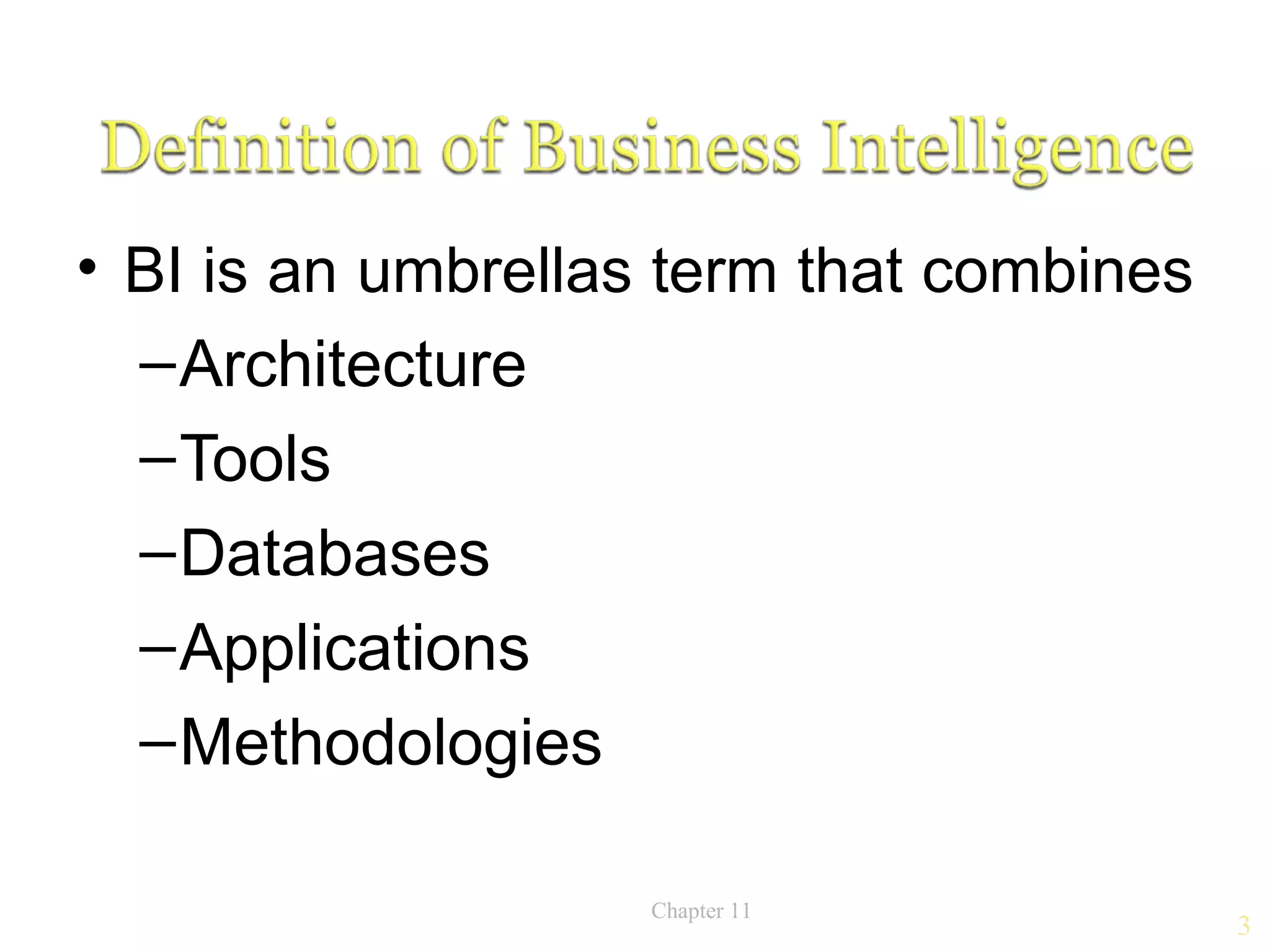
• BI is an umbrellas term that combines
  – Architecture
  – Tools
  – Databases
  – Applications
  – Methodologies

                    Chapter 11
                                          3
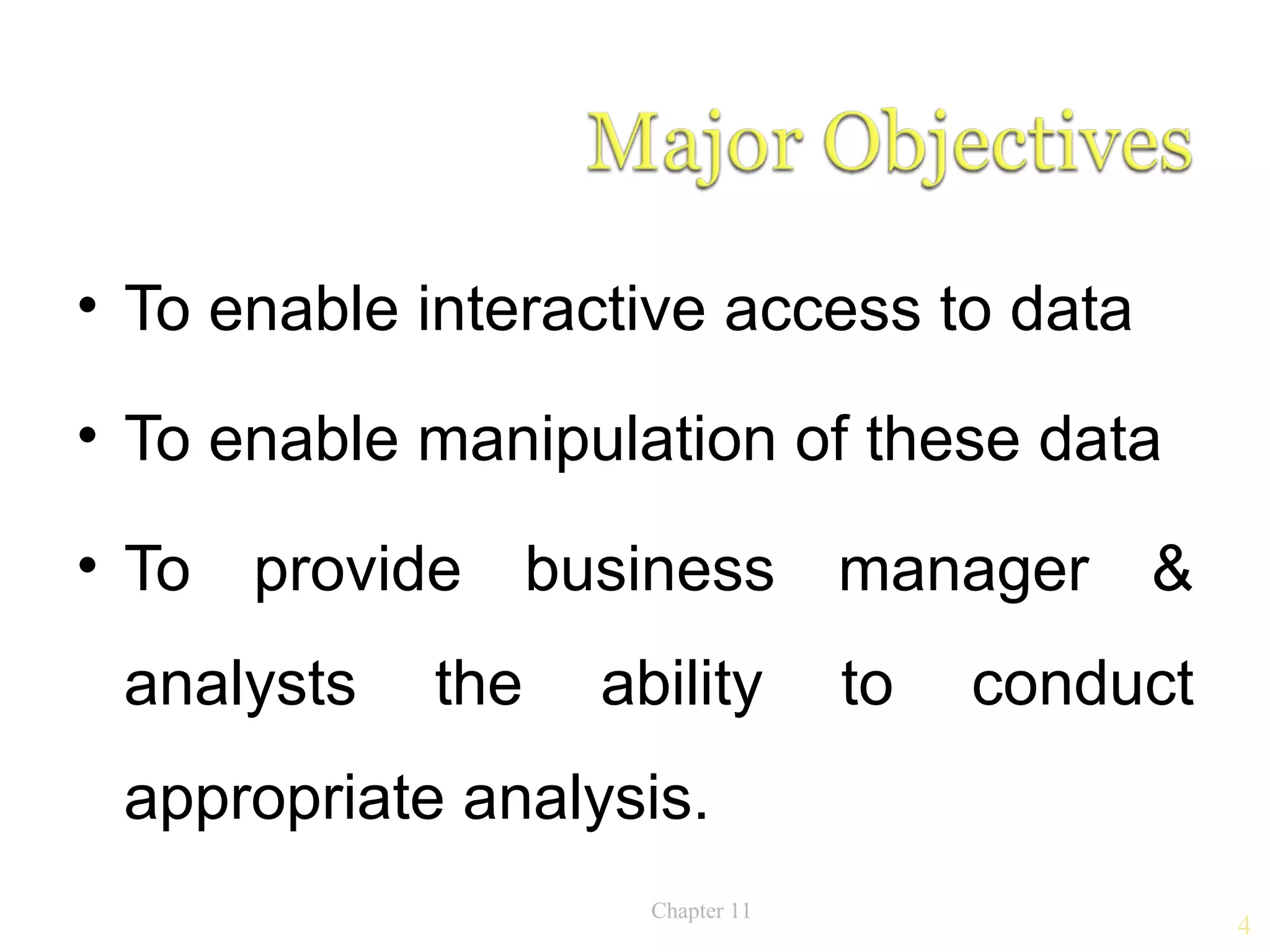
• To enable interactive access to data

• To enable manipulation of these data

• To provide business manager &
 analysts   the   ability        to   conduct
 appropriate analysis.
                    Chapter 11
                                                4
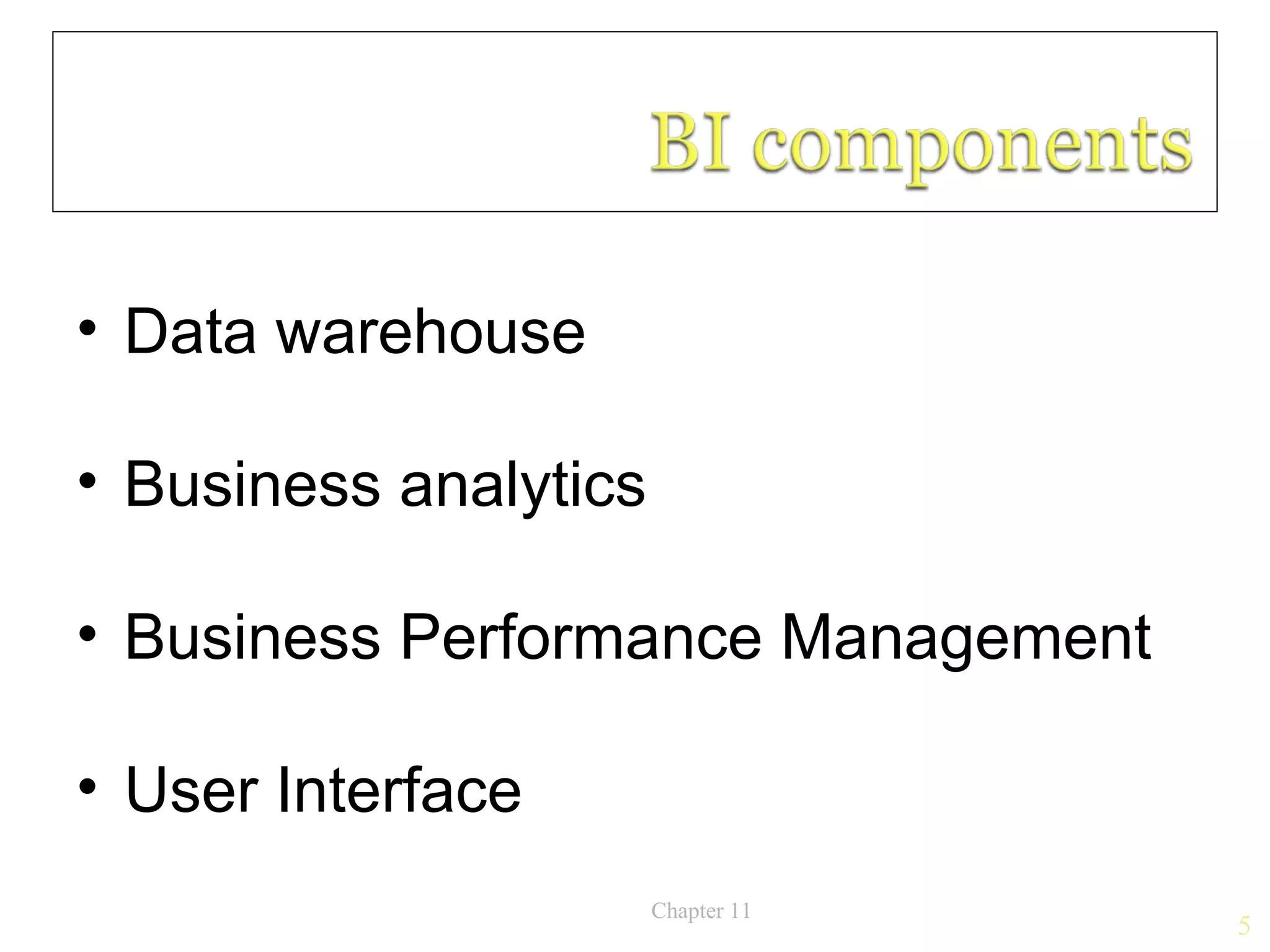
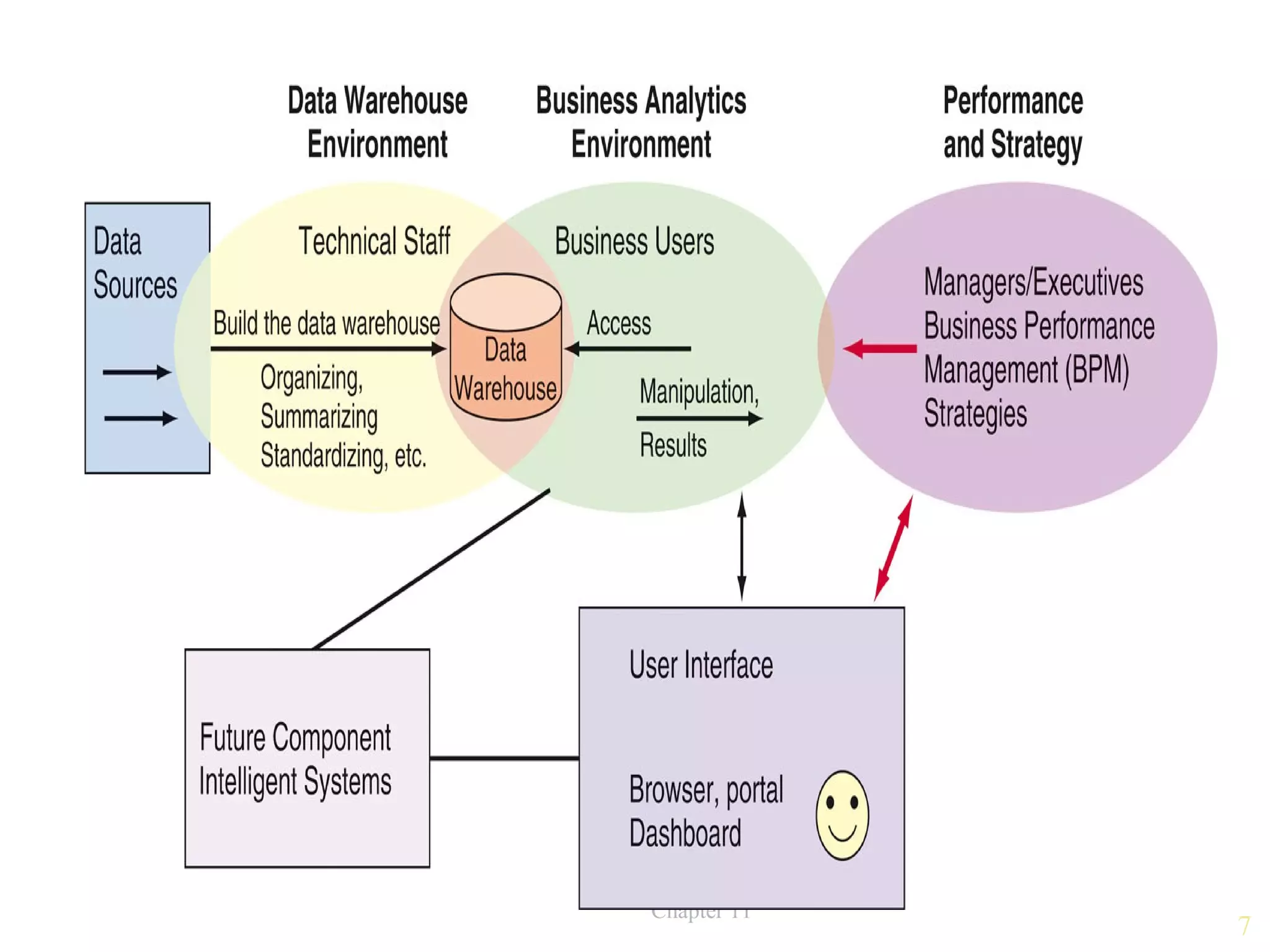
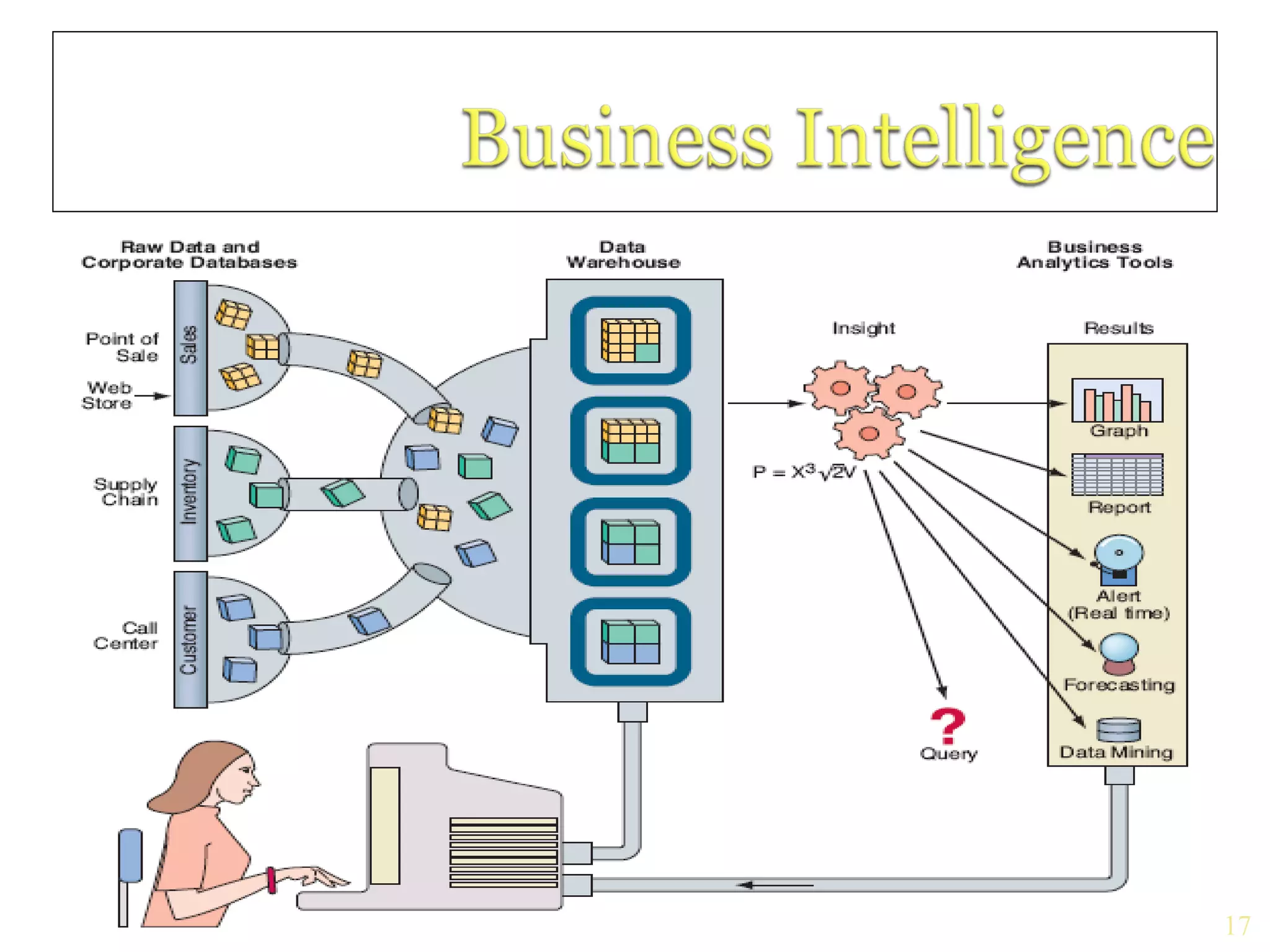
• Data warehouse

• Business analytics

• Business Performance Management

• User Interface
                       Chapter 11
                                    5
Chapter 11   6
Chapter 11
             7
• It is a special database, or repository of
 data, that has been prepared
• To support decision making applications
 ranging from
• Simple   reporting     and        querying   to
 complex optimization
                       Chapter 11
                                                    8
• Constructed with methodologies,
 mainly metadata and ELT.
• It is also based on data marts, which
 are repositories for departments and
 various functions.
                      Chapter 11
                                          9
• Software tools to create on-demand
 reports and queries and analyze data.
• Appears under the name OLAP

• Identify performance trends using
 trend analysis and graphing tools.
                   Chapter 11
                                         10
• Reporting and queries

• Advanced analytics

• Data , text and web mining


                    Chapter 11
                                 11
• Is constructed for monitoring and
  analysis of performance.
• Based on Balanced scorecard :
  framework for defining, implementing
  & managing & enterprise’s business
  strategy by linking objectives with
  factual measures.

                   Chapter 11
                                         12
• Dashboards: organize and present
  information in a way that is easy to
  read.
   – Presents corporate performance
     measures       (KPIs),     trends,
     exceptions.
• Visualization tools: multidimensional
  cube to present virtual reality. GIS
  etc…
                    Chapter 11
                                          13
Chapter 11
             14
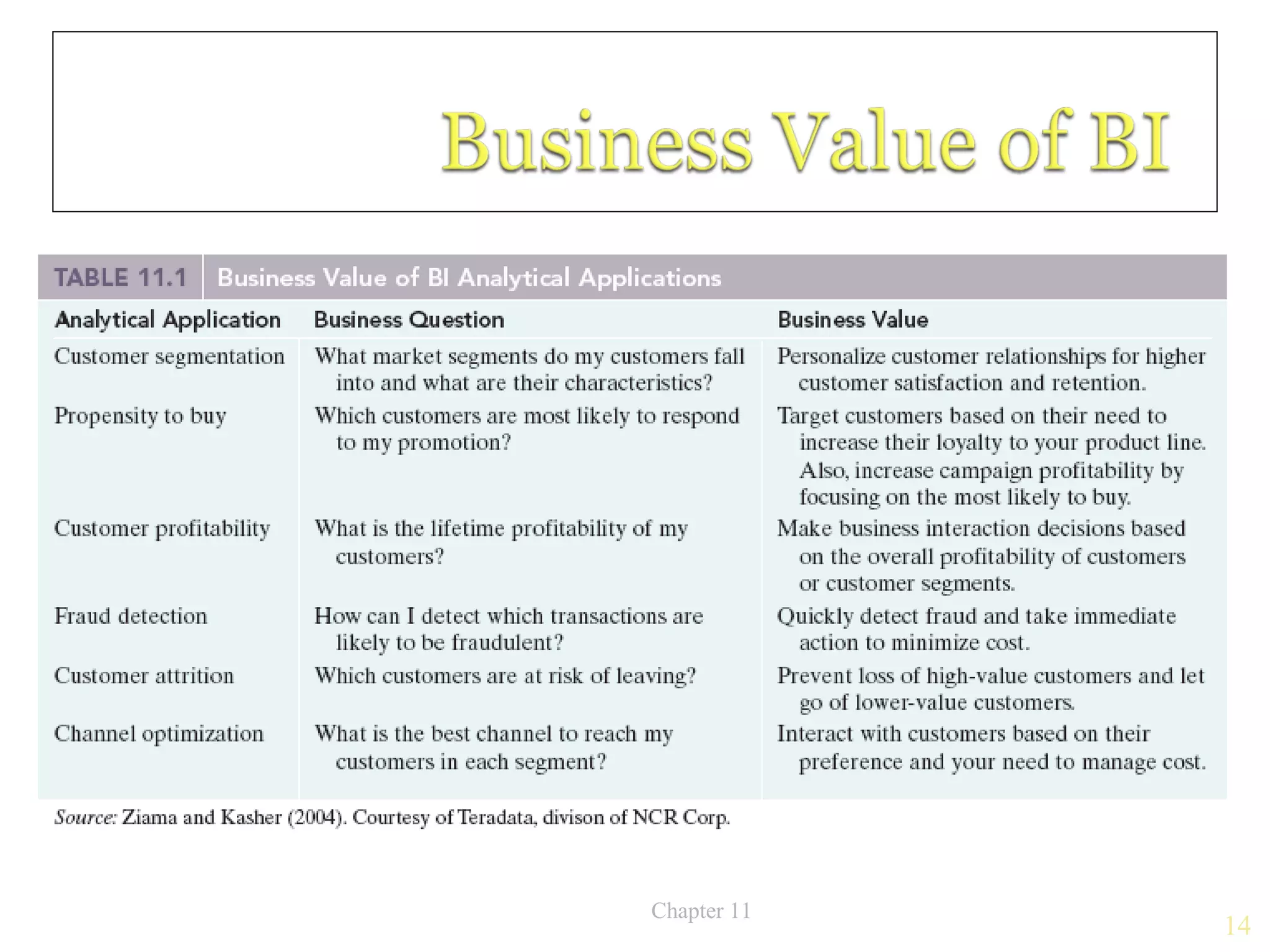
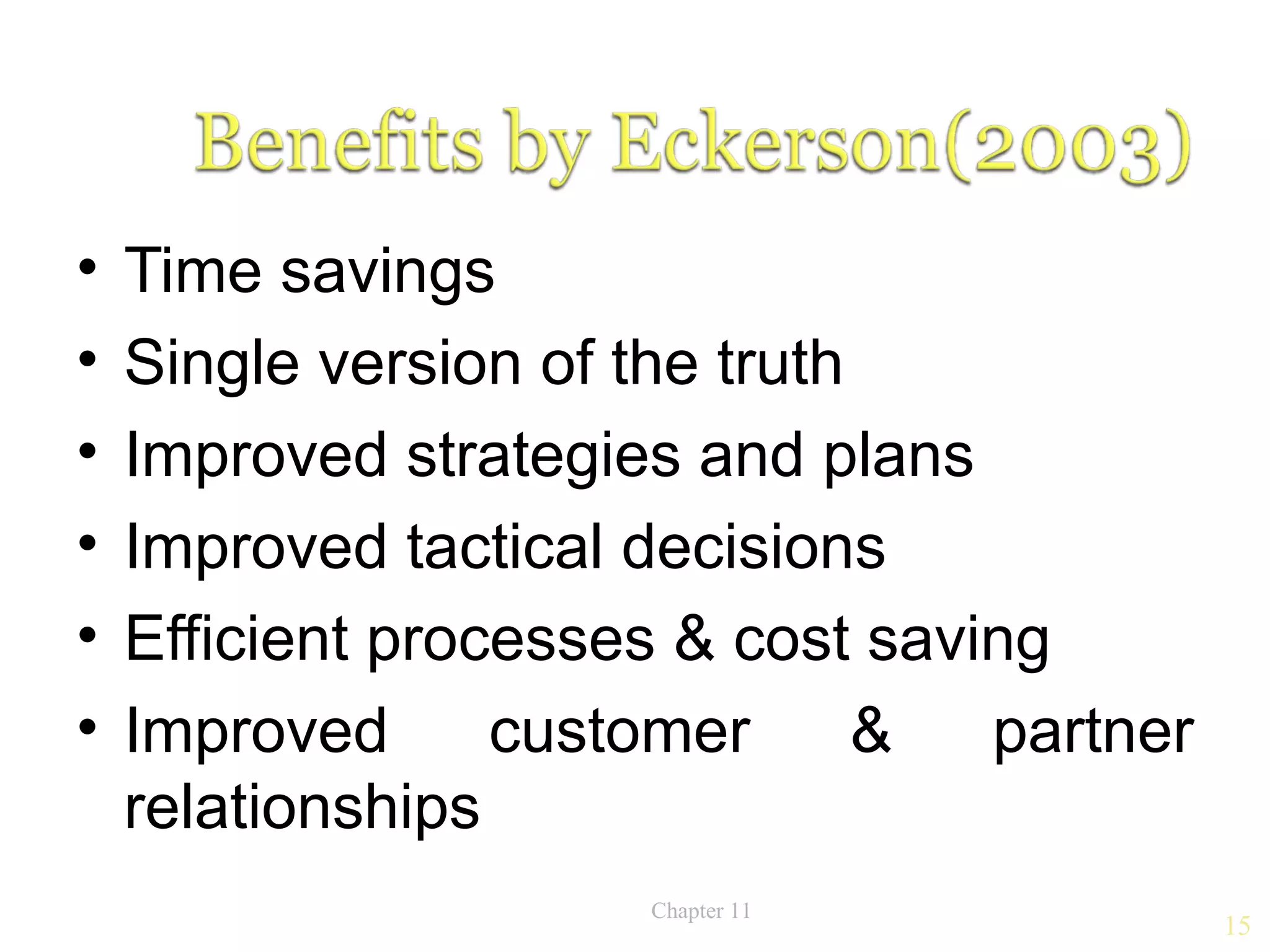
•   Time savings
•   Single version of the truth
•   Improved strategies and plans
•   Improved tactical decisions
•   Efficient processes & cost saving
•   Improved      customer      &  partner
    relationships
                      Chapter 11
                                             15
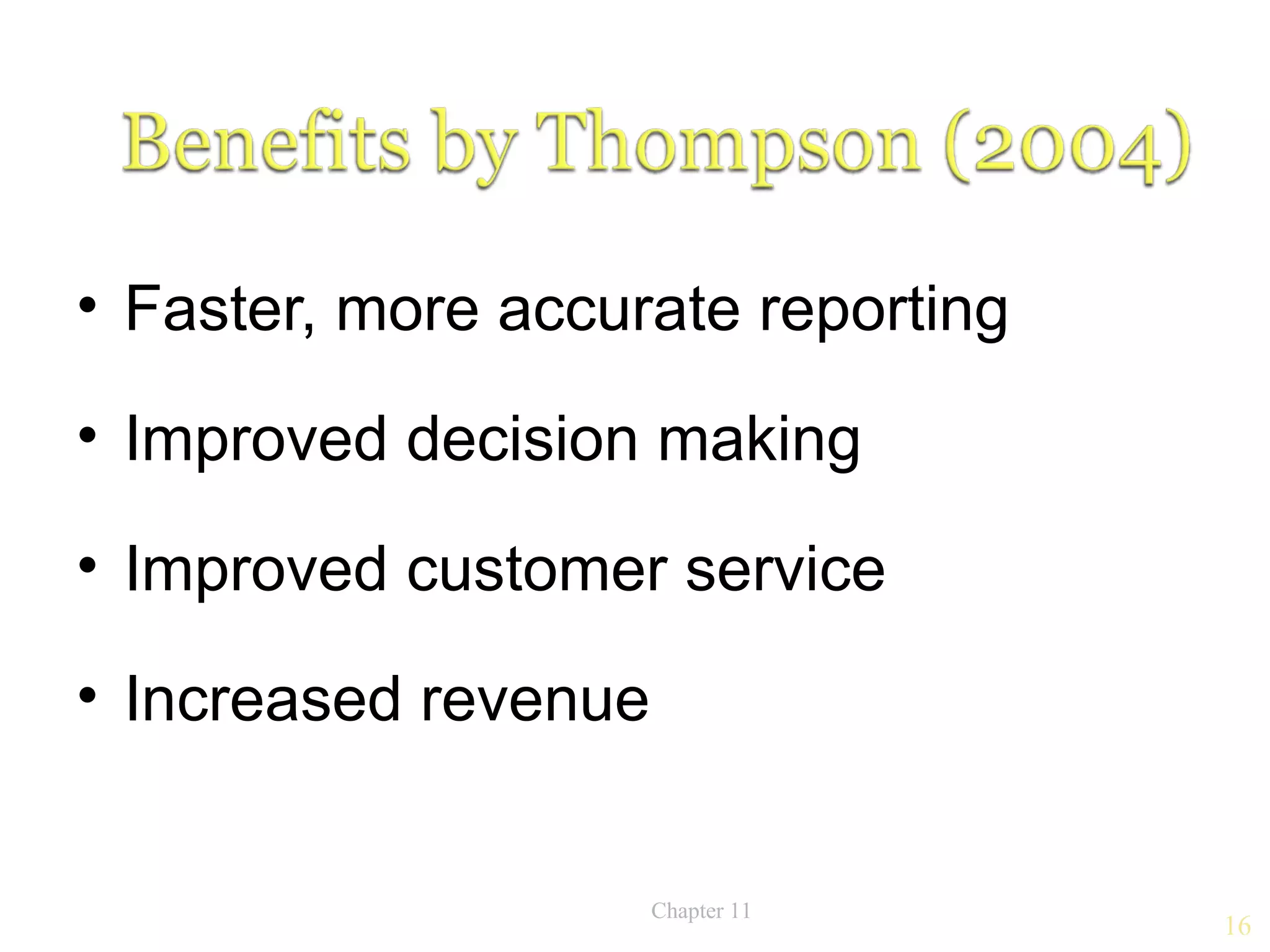
• Faster, more accurate reporting

• Improved decision making

• Improved customer service

• Increased revenue


                      Chapter 11
                                    16
Chapter 11
             17
Online Analytical Processing,
     Reporting and Querying


         Chapter 11             18
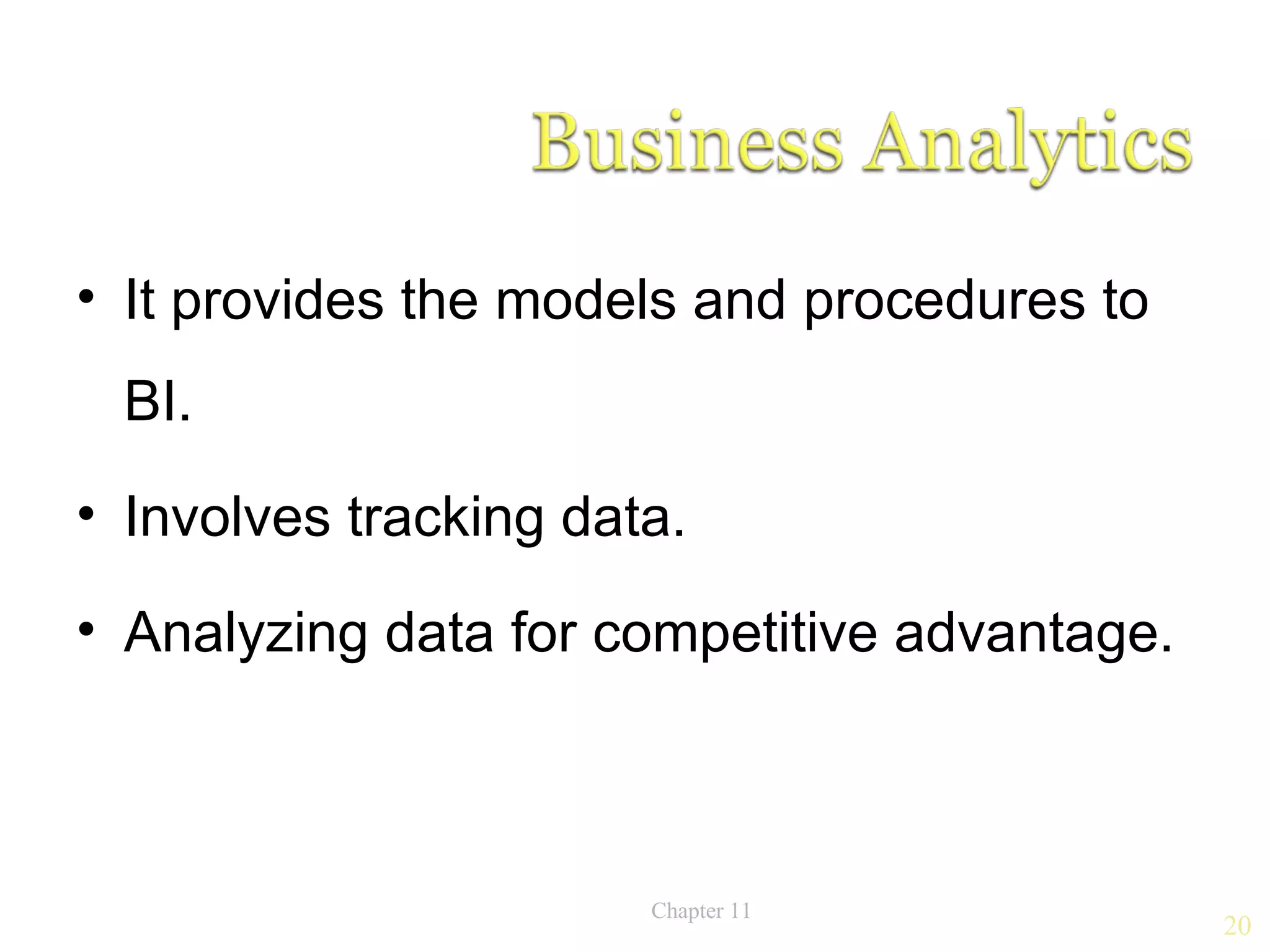
• Is the science of analysis.

• It   refers    to   analysis         of   data   and
  information.


                          Chapter 11
                                                         19
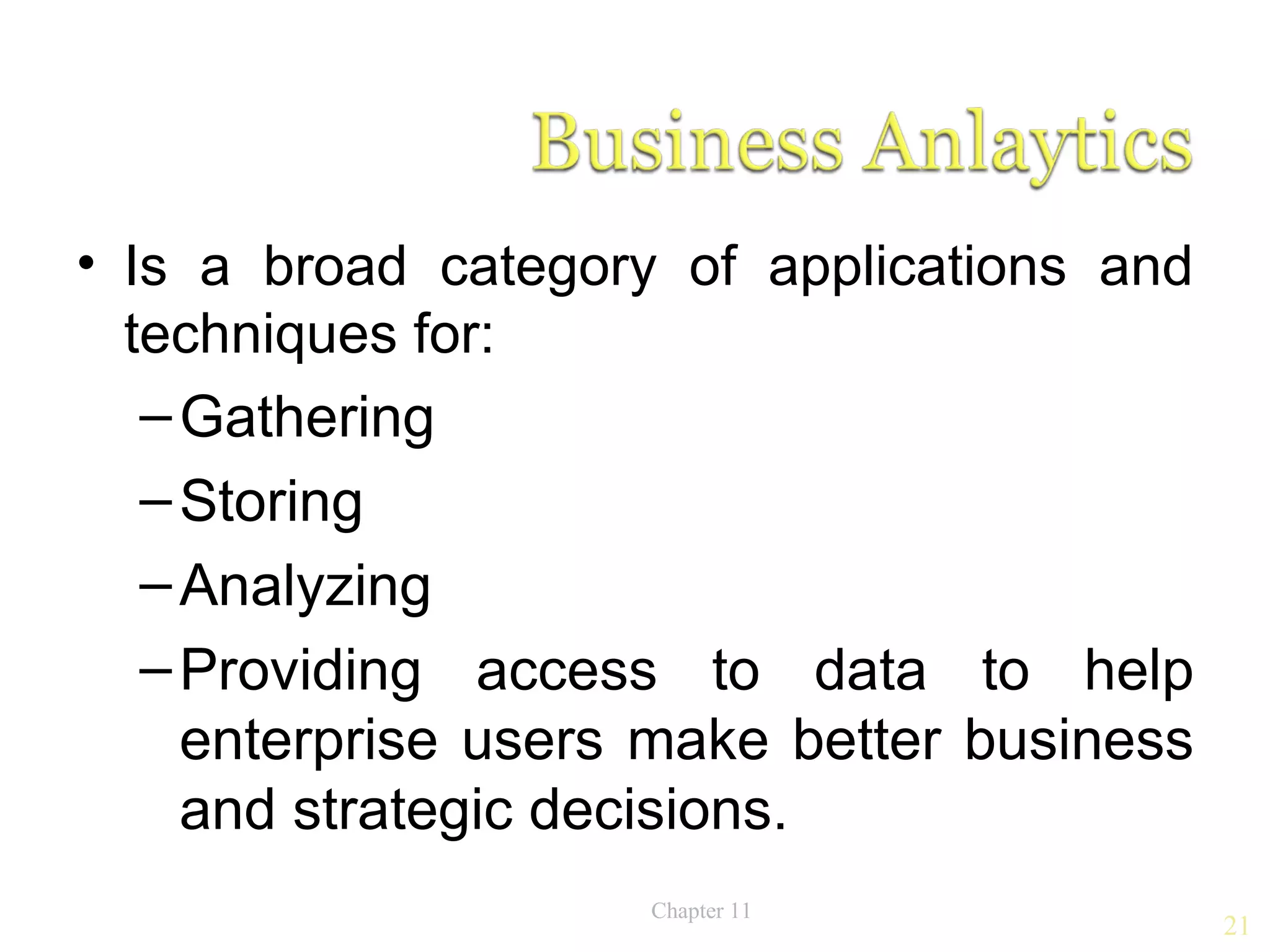
• It provides the models and procedures to
 BI.
• Involves tracking data.

• Analyzing data for competitive advantage.


                       Chapter 11
                                              20
• Is a broad category of applications and
  techniques for:
   – Gathering
   – Storing
   – Analyzing
   – Providing access to data to help
     enterprise users make better business
     and strategic decisions.
                     Chapter 11
                                             21
• It is also known as:

  – Analytical processing

  – Business intelligence tools

  – Business intelligence applications or

  – Business intelligence

                         Chapter 11
                                            22
• Automating the thinking

• Uses complex quantitative techniques


                      Chapter 11
                                         23
• Knowledge discovery: the process of
 extracting useful knowledge from volumes
 of data.


                    Chapter 11
                                            24
• To identify valid, novel, potentially useful
  and understandable patterns in data.
• Supported by:
  – Massive data collection
  – Powerful multiprocessor computers
  – Data mining & algorithms
                         Chapter 11
                                                 25
• OLAP refers to a variety of activities
 performed by end-users in online systems.


                     Chapter 11
                                             26
• Routine:     automatically          generated       and
 distributed     periodically         to   internal    &
 external subscribers on mailing lists.
• Ad-hoc: customized for specific users
 when needed.


                         Chapter 11
                                                            27

Ch11

  • 1.
    Business Intelligence and Corporate Performance Management Chapter 11 1
  • 2.
  • 3.
    • BI isan umbrellas term that combines – Architecture – Tools – Databases – Applications – Methodologies Chapter 11 3
  • 4.
    • To enableinteractive access to data • To enable manipulation of these data • To provide business manager & analysts the ability to conduct appropriate analysis. Chapter 11 4
  • 5.
    • Data warehouse •Business analytics • Business Performance Management • User Interface Chapter 11 5
  • 6.
  • 7.
  • 8.
    • It isa special database, or repository of data, that has been prepared • To support decision making applications ranging from • Simple reporting and querying to complex optimization Chapter 11 8
  • 9.
    • Constructed withmethodologies, mainly metadata and ELT. • It is also based on data marts, which are repositories for departments and various functions. Chapter 11 9
  • 10.
    • Software toolsto create on-demand reports and queries and analyze data. • Appears under the name OLAP • Identify performance trends using trend analysis and graphing tools. Chapter 11 10
  • 11.
    • Reporting andqueries • Advanced analytics • Data , text and web mining Chapter 11 11
  • 12.
    • Is constructedfor monitoring and analysis of performance. • Based on Balanced scorecard : framework for defining, implementing & managing & enterprise’s business strategy by linking objectives with factual measures. Chapter 11 12
  • 13.
    • Dashboards: organizeand present information in a way that is easy to read. – Presents corporate performance measures (KPIs), trends, exceptions. • Visualization tools: multidimensional cube to present virtual reality. GIS etc… Chapter 11 13
  • 14.
  • 15.
    Time savings • Single version of the truth • Improved strategies and plans • Improved tactical decisions • Efficient processes & cost saving • Improved customer & partner relationships Chapter 11 15
  • 16.
    • Faster, moreaccurate reporting • Improved decision making • Improved customer service • Increased revenue Chapter 11 16
  • 17.
  • 18.
    Online Analytical Processing, Reporting and Querying Chapter 11 18
  • 19.
    • Is thescience of analysis. • It refers to analysis of data and information. Chapter 11 19
  • 20.
    • It providesthe models and procedures to BI. • Involves tracking data. • Analyzing data for competitive advantage. Chapter 11 20
  • 21.
    • Is abroad category of applications and techniques for: – Gathering – Storing – Analyzing – Providing access to data to help enterprise users make better business and strategic decisions. Chapter 11 21
  • 22.
    • It isalso known as: – Analytical processing – Business intelligence tools – Business intelligence applications or – Business intelligence Chapter 11 22
  • 23.
    • Automating thethinking • Uses complex quantitative techniques Chapter 11 23
  • 24.
    • Knowledge discovery:the process of extracting useful knowledge from volumes of data. Chapter 11 24
  • 25.
    • To identifyvalid, novel, potentially useful and understandable patterns in data. • Supported by: – Massive data collection – Powerful multiprocessor computers – Data mining & algorithms Chapter 11 25
  • 26.
    • OLAP refersto a variety of activities performed by end-users in online systems. Chapter 11 26
  • 27.
    • Routine: automatically generated and distributed periodically to internal & external subscribers on mailing lists. • Ad-hoc: customized for specific users when needed. Chapter 11 27