Chapter 3


      Data Management: Data,
    Databases and Warehousing


1
Learning Objectives

       Recognize the importance of data, managerial
        issues, and life cycle
       Describe sources of data, collection, and quality
       Describe DMS
       Describe Data Warehousing          and Analytical
        Processing
       Describe DBMS (benefits and issues)

2
Learning Objectives (Continued)

       Understand conceptual, logical, and physical data
       Understand ERD
       The importance of Marketing
       The Internet and Data Management


3
Introduction
     Corporate data are key strategic assets.
     Managing data quality is vital to the organizations.
     Dirty data results in:
       Poor business decisions
       Poor customer service
       Inadequate product design


4
Goal of data management
     The goal of DM is provide the infrastructure to
       transform raw data into corporate information of
       the highest quality.


5   Chapter 3
Building Blocks of DM
     Data profiling:
         Understanding the data
     Data quality management:
         Improving the quality of data
     Data integration:
         Combining similar data from multiple sources
     Data augmentation:
         Improving the value of the data


6   Chapter 3
Data Problems and Difficulties
     Exponential increase in the data volume with
      time.
     Scattered data across organization collected and
      stored through various methods and devices.
     Consideration of external data for decision
      making
     Data security, quality and integrity.


7
-cont…
     Selection of data management tools.
     Validity of the data.
     Maintenance of data to eradicate redundancy and
      obsolete.


8
Solution to Managing Data
     Organizing data in a hierarchical format in one
      location.
     Supports secured and efficient high-volume
      processing.
     RDBMS add to facilitate end-user computing and
      decision support.
     Data-warehousing.


9
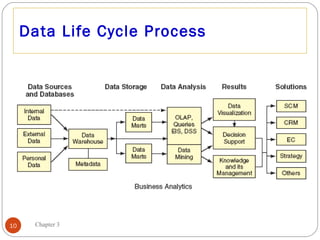
Data Life Cycle Process


10    Chapter 3
Transactional vs.
 Analytical Data Processing
          Transactional processing takes place in
 operational systems (TPS) that provide the organization
 with the capability to perform business transactions and
 produce transaction reports.
    The data are organized mainly in a hierarchical
    structure and are centrally processed.
     This is done primarily for fast and efficient
    processing of routine, repetitive data.


11   Chapter 3
-cont…
      Supplementary activity to transaction processing is
       called analytical processing, which involves the
       analysis of accumulated data.
      Analytical processing, sometimes referred to as
       business intelligence, includes data mining, decision
       support systems (DSS), querying, and other
       analysis activities.
      These analyses place strategic information in the
       hands of decision makers to enhance productivity
       and make better decisions, leading to greater
       competitive advantage.

12
Data Sources
      Organizational Data: Organizational internal data
       about people, products, services, processes,
       equipment, machinery etc.
      End User Data: Data created by the IS users or
       other corporate employees. They may include
       facts, concepts, thoughts and opinions.
      External Data: Commercial databases, sensors,
       satellites, government reports, secondary storage
       devices, internet servers, etc..

13
Methods for Collecting Raw Data
      Manually
        Surveys, observations, contributions from experts..
      Electronically
        H/W and S/W for data storage, communication,
         transmission and presentation.
        Online surveys, online polls, data warehousing,
         website profiling, data that is scanned/transmitted.
          CLICKSTREAM DATA: Data that can be collected
           automatically using special software from the company’s web
           site.


14
Data Quality
      Data quality determines the data’s usefulness as
       well as the quality of the decisions based on the
       data.
      Data quality dimensions:
        Accuracy
        Accessibility
        Relevance
        Timeliness
        Completeness

15
Categories of Data Quality
      Standardization (for consistency)
      Matching (of data if stored in different places)
      Verification (against the source)
      Enhancement (adding of data to increase its
      usefulness)


16
3-Step Method for DM
      Analyzing the actual organizational processes
      Moving on to analyzing the entities that these
       elements comprise
      Finish by analyzing the relationship between the
       data in the business processes that the data must
       support.


17
??? To Understand Business Flow
      What information is input to the process?
      What information is changed or created during
       the process?
      What happens to the information once the
       process is complete?
      What value-added information does the process
       produce?


18
Data Privacy, Cost and Ethics
      Collecting data raises the concern about privacy
       protection.
      Data collected is about:
        Employees
        Customers
        Other people
      Accessible to authorized people only.
      Reasonable costs for collection, storage and use


19
Document Management
      DM is the automated control of
        electronic documents,
        page images,
        spreadsheets,
        voice word processing documents, and
        other complex documents through their entire life
        cycle within an organization.


20
Benefits of DM
      Allows organization to exert greater control over
        production, storage and distribution of documents,
        yielding greater efficiency in the reuse of information ,
        the control of a documents through a workflow
         process and
        the reduction of product cycle times.
      Deals with knowledge,data and information.


21
Major Tools for DM
      Workflow software
      Authoring tools
      Scanners
      Databases


22
DMSs
      Document Management Systems:
       provide decision makers with information in an
        electronic format and usually include computerized
        imaging systems that can result in substantial savings.


23
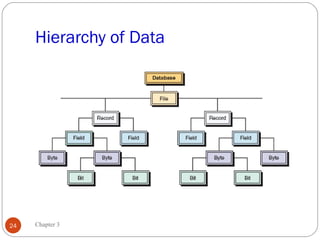
Hierarchy of Data


24   Chapter 3
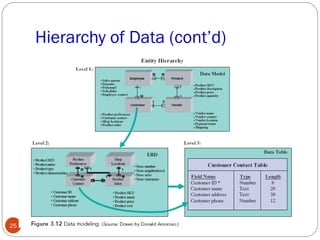
Hierarchy of Data (cont’d)


25   Chapter 3
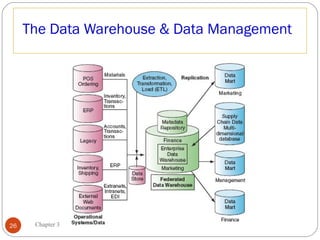
The Data Warehouse & Data Management


26    Chapter 3
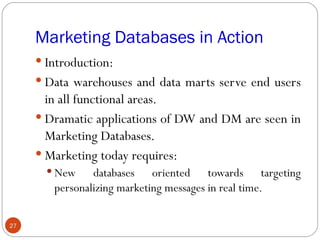
Marketing Databases in Action
      Introduction:
      Data warehouses and data marts serve end users
       in all functional areas.
      Dramatic applications of DW and DM are seen in
       Marketing Databases.
      Marketing today requires:
        New    databases oriented towards targeting
        personalizing marketing messages in real time.

27
Marketing Transaction Databases
      MD provides effective means of capturing
       information on customer preferences and needs.
      Enterprises, use this knowledge to create new
       and/or personalized products and services.
      Combines many of the characteristics of current
       databases and marketing data sources into a new
       database that allows marketers to engage in real-
       time personalization and target every interaction
       with customers.
28
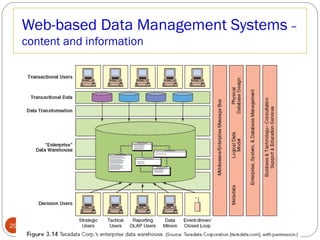
Web-based Data Management Systems –
     content and information


29     Chapter 3
Managerial Issues

 Cost-benefit issues and justification

 Where to store data physically

 Legal issues

 Internal or external?

 Data Delivery

30    Chapter 3
Managerial Issues (Continued)
     Disaster recovery

     Data security and ethics

     Ethics: Paying for use of data

     Privacy

     Legacy Data


31      Chapter 3

3 data mgmt

  • 1.
    Chapter 3 Data Management: Data, Databases and Warehousing 1
  • 2.
    Learning Objectives  Recognize the importance of data, managerial issues, and life cycle  Describe sources of data, collection, and quality  Describe DMS  Describe Data Warehousing and Analytical Processing  Describe DBMS (benefits and issues) 2
  • 3.
    Learning Objectives (Continued)  Understand conceptual, logical, and physical data  Understand ERD  The importance of Marketing  The Internet and Data Management 3
  • 4.
    Introduction  Corporate data are key strategic assets.  Managing data quality is vital to the organizations.  Dirty data results in:  Poor business decisions  Poor customer service  Inadequate product design 4
  • 5.
    Goal of datamanagement  The goal of DM is provide the infrastructure to transform raw data into corporate information of the highest quality. 5 Chapter 3
  • 6.
    Building Blocks ofDM  Data profiling:  Understanding the data  Data quality management:  Improving the quality of data  Data integration:  Combining similar data from multiple sources  Data augmentation:  Improving the value of the data 6 Chapter 3
  • 7.
    Data Problems andDifficulties  Exponential increase in the data volume with time.  Scattered data across organization collected and stored through various methods and devices.  Consideration of external data for decision making  Data security, quality and integrity. 7
  • 8.
    -cont…  Selection of data management tools.  Validity of the data.  Maintenance of data to eradicate redundancy and obsolete. 8
  • 9.
    Solution to ManagingData  Organizing data in a hierarchical format in one location.  Supports secured and efficient high-volume processing.  RDBMS add to facilitate end-user computing and decision support.  Data-warehousing. 9
  • 10.
    Data Life CycleProcess 10 Chapter 3
  • 11.
    Transactional vs. AnalyticalData Processing  Transactional processing takes place in operational systems (TPS) that provide the organization with the capability to perform business transactions and produce transaction reports. The data are organized mainly in a hierarchical structure and are centrally processed.  This is done primarily for fast and efficient processing of routine, repetitive data. 11 Chapter 3
  • 12.
    -cont…  Supplementary activity to transaction processing is called analytical processing, which involves the analysis of accumulated data.  Analytical processing, sometimes referred to as business intelligence, includes data mining, decision support systems (DSS), querying, and other analysis activities.  These analyses place strategic information in the hands of decision makers to enhance productivity and make better decisions, leading to greater competitive advantage. 12
  • 13.
    Data Sources  Organizational Data: Organizational internal data about people, products, services, processes, equipment, machinery etc.  End User Data: Data created by the IS users or other corporate employees. They may include facts, concepts, thoughts and opinions.  External Data: Commercial databases, sensors, satellites, government reports, secondary storage devices, internet servers, etc.. 13
  • 14.
    Methods for CollectingRaw Data  Manually  Surveys, observations, contributions from experts..  Electronically  H/W and S/W for data storage, communication, transmission and presentation.  Online surveys, online polls, data warehousing, website profiling, data that is scanned/transmitted.  CLICKSTREAM DATA: Data that can be collected automatically using special software from the company’s web site. 14
  • 15.
    Data Quality  Data quality determines the data’s usefulness as well as the quality of the decisions based on the data.  Data quality dimensions:  Accuracy  Accessibility  Relevance  Timeliness  Completeness 15
  • 16.
    Categories of DataQuality  Standardization (for consistency)  Matching (of data if stored in different places)  Verification (against the source)  Enhancement (adding of data to increase its usefulness) 16
  • 17.
    3-Step Method forDM  Analyzing the actual organizational processes  Moving on to analyzing the entities that these elements comprise  Finish by analyzing the relationship between the data in the business processes that the data must support. 17
  • 18.
    ??? To UnderstandBusiness Flow  What information is input to the process?  What information is changed or created during the process?  What happens to the information once the process is complete?  What value-added information does the process produce? 18
  • 19.
    Data Privacy, Costand Ethics  Collecting data raises the concern about privacy protection.  Data collected is about:  Employees  Customers  Other people  Accessible to authorized people only.  Reasonable costs for collection, storage and use 19
  • 20.
    Document Management  DM is the automated control of  electronic documents,  page images,  spreadsheets,  voice word processing documents, and  other complex documents through their entire life cycle within an organization. 20
  • 21.
    Benefits of DM  Allows organization to exert greater control over  production, storage and distribution of documents,  yielding greater efficiency in the reuse of information ,  the control of a documents through a workflow process and  the reduction of product cycle times.  Deals with knowledge,data and information. 21
  • 22.
    Major Tools forDM  Workflow software  Authoring tools  Scanners  Databases 22
  • 23.
    DMSs  Document Management Systems:  provide decision makers with information in an electronic format and usually include computerized imaging systems that can result in substantial savings. 23
  • 24.
  • 25.
    Hierarchy of Data(cont’d) 25 Chapter 3
  • 26.
    The Data Warehouse& Data Management 26 Chapter 3
  • 27.
    Marketing Databases inAction  Introduction:  Data warehouses and data marts serve end users in all functional areas.  Dramatic applications of DW and DM are seen in Marketing Databases.  Marketing today requires:  New databases oriented towards targeting personalizing marketing messages in real time. 27
  • 28.
    Marketing Transaction Databases  MD provides effective means of capturing information on customer preferences and needs.  Enterprises, use this knowledge to create new and/or personalized products and services.  Combines many of the characteristics of current databases and marketing data sources into a new database that allows marketers to engage in real- time personalization and target every interaction with customers. 28
  • 29.
    Web-based Data ManagementSystems – content and information 29 Chapter 3
  • 30.
    Managerial Issues Cost-benefitissues and justification Where to store data physically Legal issues Internal or external? Data Delivery 30 Chapter 3
  • 31.
    Managerial Issues (Continued) Disaster recovery Data security and ethics Ethics: Paying for use of data Privacy Legacy Data 31 Chapter 3