The Fall of Rome
After  1000 years  of civilization, Rome is eroded by the  Germanic  tribes that migrated into the empire.
During the late 300’s and early 400’s (AD), many groups invaded Roman territory: Visigoths, Vandals, Franks, Saxons, Angles, and Ostrogoths . The Visigoth chief  Alaric  led his people into Rome itself.
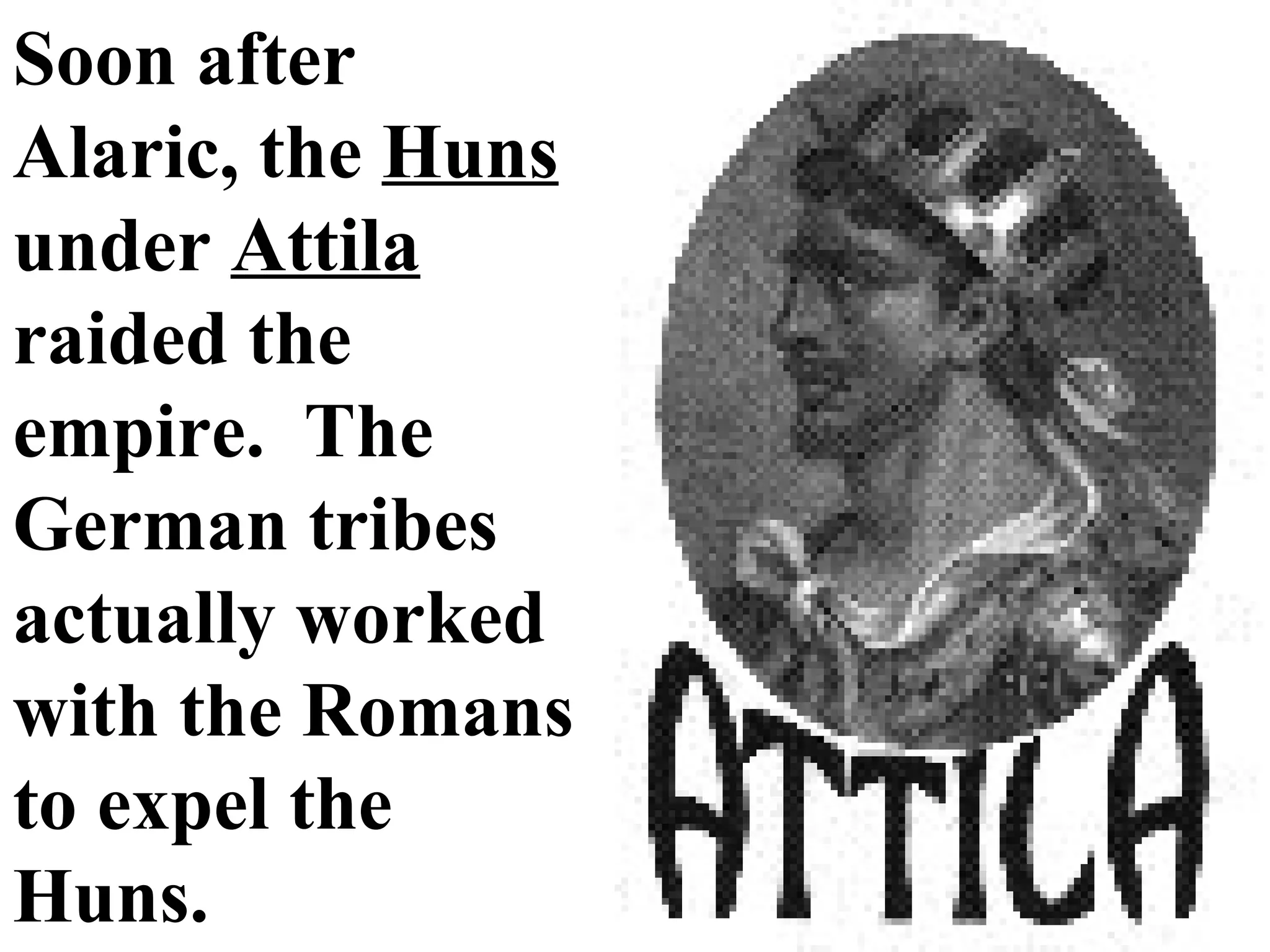
Soon after Alaric, the  Huns  under  Attila  raided the empire.  The German tribes actually worked with the Romans to expel the Huns.
When the Huns were gone, the Germans attacked the Romans again and the empire was officially gone. Death Certificate Rome
In 476 AD, a German soldier-turned-General named  Odoacer  captured Rome and 1000 years of progress came to an end. No more Rome?!
The Fall of Rome precipitated an economic, political, and social crisis that turned into the  Medieval Period  (Middle Ages).
The Fall of Rome is a process, not an event.  It took hundreds of years for Rome to fall, and the roots of the fall were set in motion over 400 years before the end.
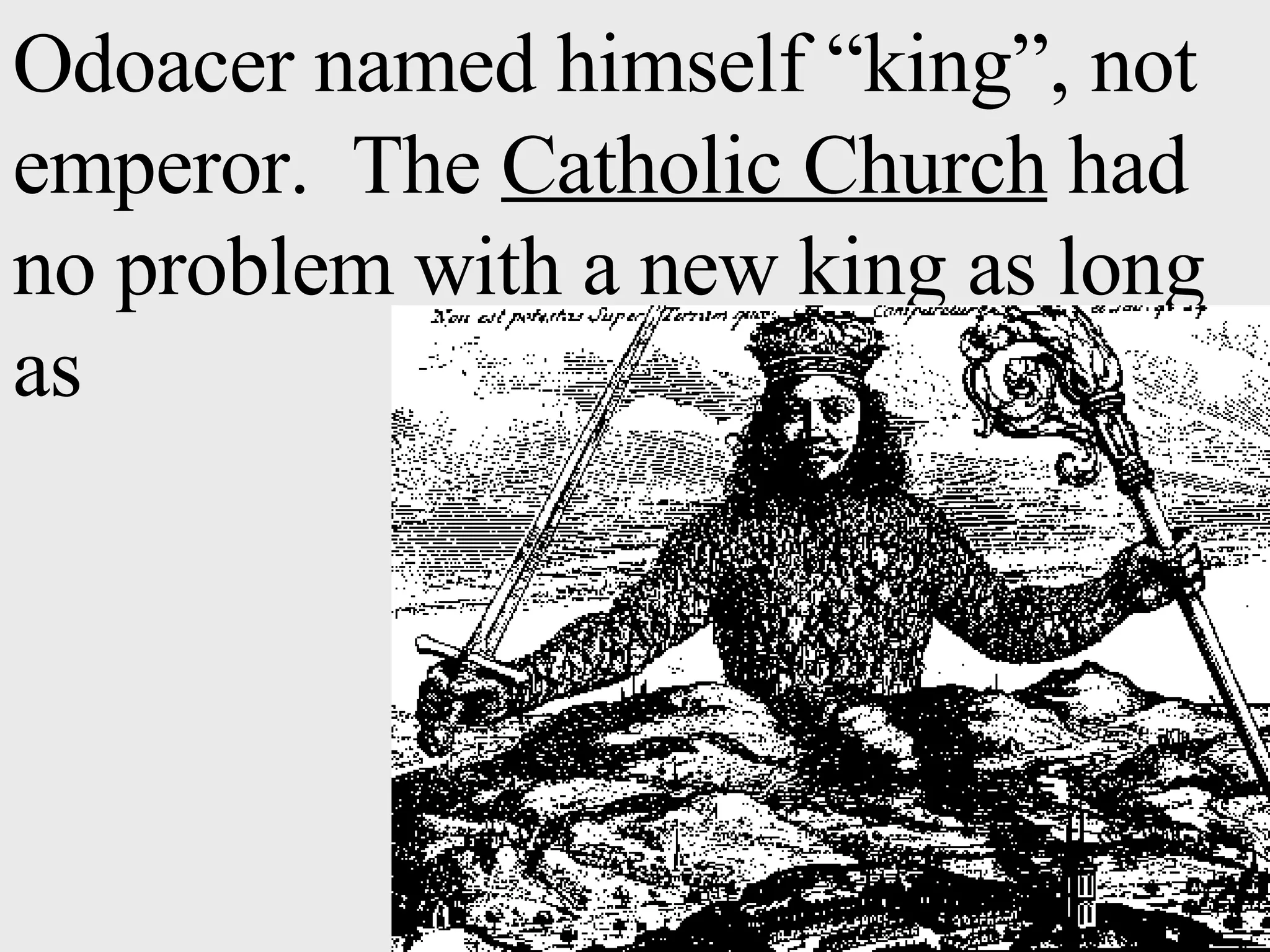
Odoacer named himself “king”, not emperor.  The  Catholic Church  had no problem with a new king as long as    they were    left alone.
Why is the Catholic Church’s opinion important?   They are the only medieval institution that is in every European country and knows how to write!!  Their diplomacy and unified beliefs will be the only source of  stability  in Europe for the next 1000 years.
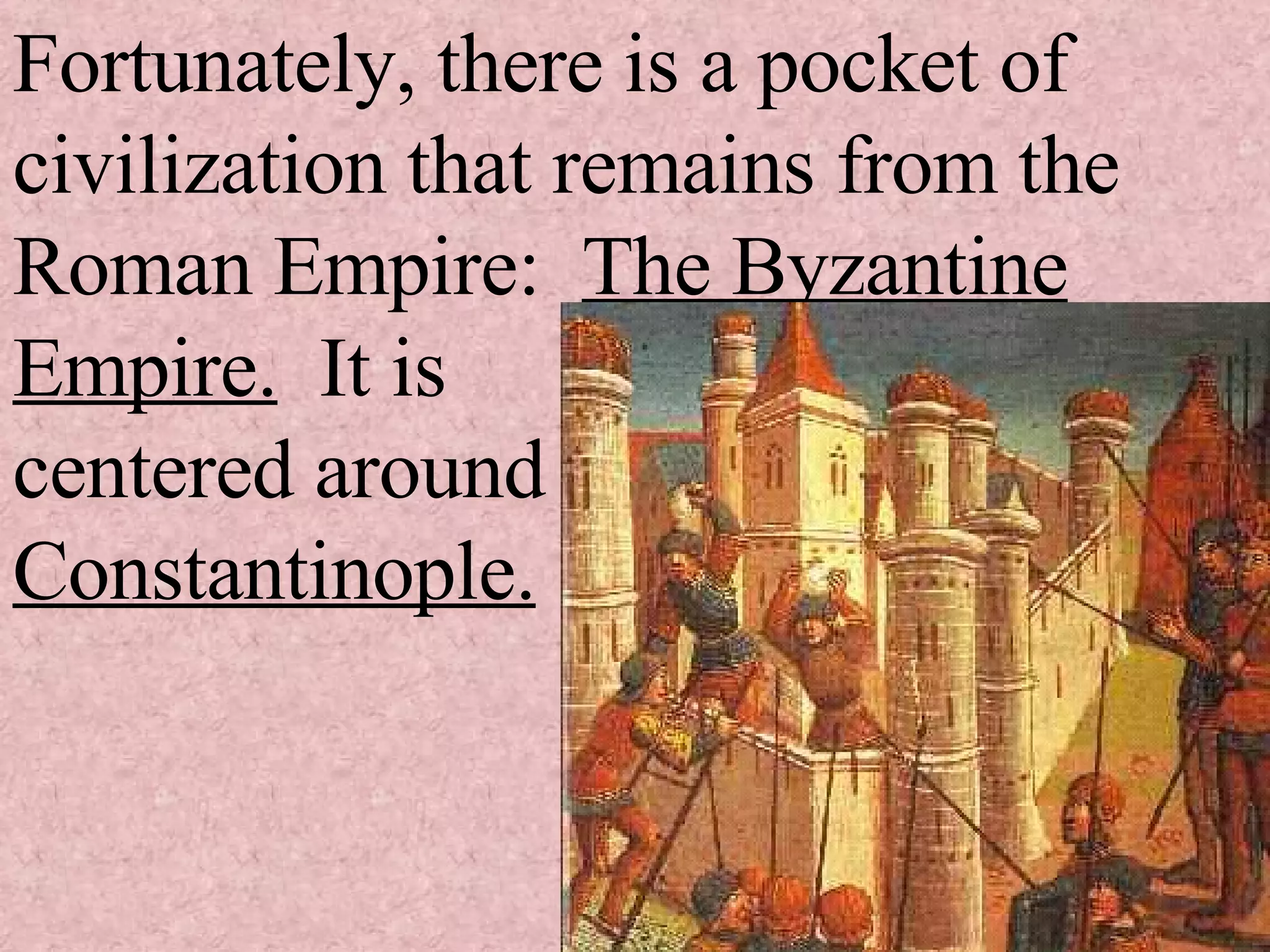
Fortunately, there is a pocket of civilization that remains from the Roman Empire:  The Byzantine Empire.   It is    centered around    Constantinople.
The Fall of Rome precipitates the advent of the Middle Ages. The Medieval Period is generally assumed to be  400-1450 AD (CE).
The legacy of the Romans (for us): 1.  Christian church.   2.  Cultural diffusion.   3.  Byzantine Empire & Roman law. 4.  Literature and letters. We are cultural descendants of the Romans and the Greeks.

6iv Fall Of Rome

  • 1.
  • 2.
    After 1000years of civilization, Rome is eroded by the Germanic tribes that migrated into the empire.
  • 3.
    During the late300’s and early 400’s (AD), many groups invaded Roman territory: Visigoths, Vandals, Franks, Saxons, Angles, and Ostrogoths . The Visigoth chief Alaric led his people into Rome itself.
  • 4.
    Soon after Alaric,the Huns under Attila raided the empire. The German tribes actually worked with the Romans to expel the Huns.
  • 5.
    When the Hunswere gone, the Germans attacked the Romans again and the empire was officially gone. Death Certificate Rome
  • 6.
    In 476 AD,a German soldier-turned-General named Odoacer captured Rome and 1000 years of progress came to an end. No more Rome?!
  • 7.
    The Fall ofRome precipitated an economic, political, and social crisis that turned into the Medieval Period (Middle Ages).
  • 8.
    The Fall ofRome is a process, not an event. It took hundreds of years for Rome to fall, and the roots of the fall were set in motion over 400 years before the end.
  • 9.
    Odoacer named himself“king”, not emperor. The Catholic Church had no problem with a new king as long as they were left alone.
  • 10.
    Why is theCatholic Church’s opinion important? They are the only medieval institution that is in every European country and knows how to write!! Their diplomacy and unified beliefs will be the only source of stability in Europe for the next 1000 years.
  • 11.
    Fortunately, there isa pocket of civilization that remains from the Roman Empire: The Byzantine Empire. It is centered around Constantinople.
  • 12.
    The Fall ofRome precipitates the advent of the Middle Ages. The Medieval Period is generally assumed to be 400-1450 AD (CE).
  • 13.
    The legacy ofthe Romans (for us): 1. Christian church. 2. Cultural diffusion. 3. Byzantine Empire & Roman law. 4. Literature and letters. We are cultural descendants of the Romans and the Greeks.