Amity Institute of Education
EXPOSITORY
WRITING
Submitted by:
Prachi Chaudhary
Amity Institute of Education
EXPOSITORY WRITING
2
• Exposition is a type of oral or written discourse that is
used to explain, describe, give information or inform.
• The expository essay is genre of essay that requires the
student to investigate an idea, evaluate evidence,
expound on the idea, and set forth an argument
concerning that idea in clear and concise manner.
• The creator of expository text can not assume that
reader or listener has prior knowledge or prior
understanding of the topic that is being discussed.
Amity Institute of Education
EXPOSITORY WRITING
3
One important point to keep in mind for the
author is to try to use words that clearly show
what they are talking about rather then blatantly
telling the reader what is being discussed.
Amity Institute of Education
The Five-Paragraph Essay
4
A common method for writing an expository essay
is the five-paragraph approach. This is, however,
by no means the only formula for writing such
essays. If it sounds straightforward, that is
because it is, in fact, the method consist of:
An introductory paragraph
Three evidentiary body paragraphs
A conclusion
Amity Institute of Education
Structuring the Expository Essay
1. Introductory Paragraph- Begin with a “grabber” - a
technique used to grab the reader’s attention. Effective
grabber techniques include:
• Quotations
• Definitions
• Facts
The introduction ends with an affirmative sentence that
expresses the main idea of the essay.
Amity Institute of Education
2. Body Paragraphs- The second, third and
fourth paragraphs make up the body of the
essay. The first sentence of each of the three
body paragraphs, also called the topic sentence,
must be backed up with some form of evidence.
Three types of evidence:
• Statistics
• Expert Opinion
• Example
Amity Institute of Education
3. Conclusion- The fifth paragraph is called
the conclusion. The conclusion begins
with a transition term (In summary, To
conclude) and a summary in which the
thesis and the three arguments are
restated.
Amity Institute of Education
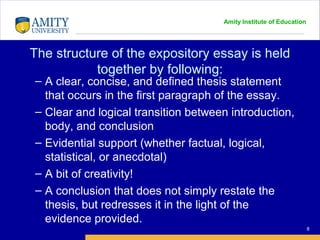
The structure of the expository essay is held
together by following:
8
– A clear, concise, and defined thesis statement
that occurs in the first paragraph of the essay.
– Clear and logical transition between introduction,
body, and conclusion
– Evidential support (whether factual, logical,
statistical, or anecdotal)
– A bit of creativity!
– A conclusion that does not simply restate the
thesis, but redresses it in the light of the
evidence provided.
Amity Institute of Education
Some Expository Organizational Patterns
9
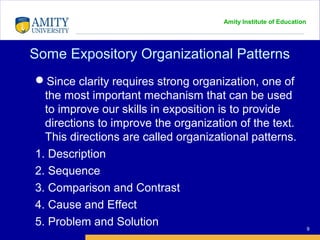
Since clarity requires strong organization, one of
the most important mechanism that can be used
to improve our skills in exposition is to provide
directions to improve the organization of the text.
This directions are called organizational patterns.
1. Description
2. Sequence
3. Comparison and Contrast
4. Cause and Effect
5. Problem and Solution
Amity Institute of Education
A. Description
10
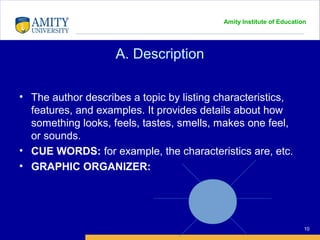
• The author describes a topic by listing characteristics,
features, and examples. It provides details about how
something looks, feels, tastes, smells, makes one feel,
or sounds.
• CUE WORDS: for example, the characteristics are, etc.
• GRAPHIC ORGANIZER:
Amity Institute of Education
B. Sequence
11
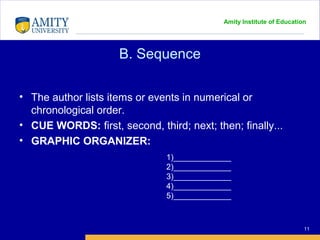
• The author lists items or events in numerical or
chronological order.
• CUE WORDS: first, second, third; next; then; finally...
• GRAPHIC ORGANIZER:
1)_____________
2)_____________
3)_____________
4)_____________
5)_____________
Amity Institute of Education
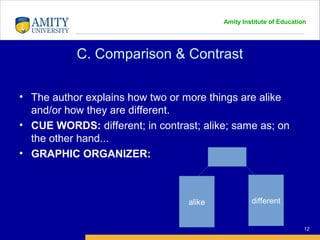
C. Comparison & Contrast
12
• The author explains how two or more things are alike
and/or how they are different.
• CUE WORDS: different; in contrast; alike; same as; on
the other hand...
• GRAPHIC ORGANIZER:
alike different
Amity Institute of Education
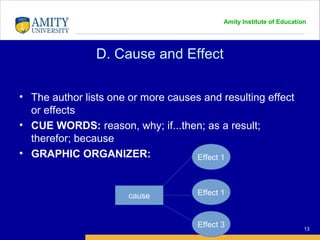
D. Cause and Effect
13
• The author lists one or more causes and resulting effect
or effects
• CUE WORDS: reason, why; if...then; as a result;
therefor; because
• GRAPHIC ORGANIZER:
cause
Effect 1
Effect 2
Effect 3
Effect 1
Amity Institute of Education
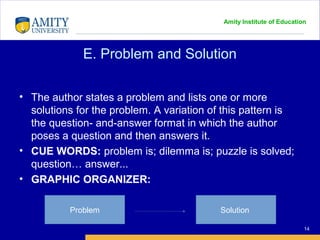
E. Problem and Solution
14
• The author states a problem and lists one or more
solutions for the problem. A variation of this pattern is
the question- and-answer format in which the author
poses a question and then answers it.
• CUE WORDS: problem is; dilemma is; puzzle is solved;
question… answer...
• GRAPHIC ORGANIZER:
Problem Solution
Amity Institute of Education

Expository writing

  • 1.
    Amity Institute ofEducation EXPOSITORY WRITING Submitted by: Prachi Chaudhary
  • 2.
    Amity Institute ofEducation EXPOSITORY WRITING 2 • Exposition is a type of oral or written discourse that is used to explain, describe, give information or inform. • The expository essay is genre of essay that requires the student to investigate an idea, evaluate evidence, expound on the idea, and set forth an argument concerning that idea in clear and concise manner. • The creator of expository text can not assume that reader or listener has prior knowledge or prior understanding of the topic that is being discussed.
  • 3.
    Amity Institute ofEducation EXPOSITORY WRITING 3 One important point to keep in mind for the author is to try to use words that clearly show what they are talking about rather then blatantly telling the reader what is being discussed.
  • 4.
    Amity Institute ofEducation The Five-Paragraph Essay 4 A common method for writing an expository essay is the five-paragraph approach. This is, however, by no means the only formula for writing such essays. If it sounds straightforward, that is because it is, in fact, the method consist of: An introductory paragraph Three evidentiary body paragraphs A conclusion
  • 5.
    Amity Institute ofEducation Structuring the Expository Essay 1. Introductory Paragraph- Begin with a “grabber” - a technique used to grab the reader’s attention. Effective grabber techniques include: • Quotations • Definitions • Facts The introduction ends with an affirmative sentence that expresses the main idea of the essay.
  • 6.
    Amity Institute ofEducation 2. Body Paragraphs- The second, third and fourth paragraphs make up the body of the essay. The first sentence of each of the three body paragraphs, also called the topic sentence, must be backed up with some form of evidence. Three types of evidence: • Statistics • Expert Opinion • Example
  • 7.
    Amity Institute ofEducation 3. Conclusion- The fifth paragraph is called the conclusion. The conclusion begins with a transition term (In summary, To conclude) and a summary in which the thesis and the three arguments are restated.
  • 8.
    Amity Institute ofEducation The structure of the expository essay is held together by following: 8 – A clear, concise, and defined thesis statement that occurs in the first paragraph of the essay. – Clear and logical transition between introduction, body, and conclusion – Evidential support (whether factual, logical, statistical, or anecdotal) – A bit of creativity! – A conclusion that does not simply restate the thesis, but redresses it in the light of the evidence provided.
  • 9.
    Amity Institute ofEducation Some Expository Organizational Patterns 9 Since clarity requires strong organization, one of the most important mechanism that can be used to improve our skills in exposition is to provide directions to improve the organization of the text. This directions are called organizational patterns. 1. Description 2. Sequence 3. Comparison and Contrast 4. Cause and Effect 5. Problem and Solution
  • 10.
    Amity Institute ofEducation A. Description 10 • The author describes a topic by listing characteristics, features, and examples. It provides details about how something looks, feels, tastes, smells, makes one feel, or sounds. • CUE WORDS: for example, the characteristics are, etc. • GRAPHIC ORGANIZER:
  • 11.
    Amity Institute ofEducation B. Sequence 11 • The author lists items or events in numerical or chronological order. • CUE WORDS: first, second, third; next; then; finally... • GRAPHIC ORGANIZER: 1)_____________ 2)_____________ 3)_____________ 4)_____________ 5)_____________
  • 12.
    Amity Institute ofEducation C. Comparison & Contrast 12 • The author explains how two or more things are alike and/or how they are different. • CUE WORDS: different; in contrast; alike; same as; on the other hand... • GRAPHIC ORGANIZER: alike different
  • 13.
    Amity Institute ofEducation D. Cause and Effect 13 • The author lists one or more causes and resulting effect or effects • CUE WORDS: reason, why; if...then; as a result; therefor; because • GRAPHIC ORGANIZER: cause Effect 1 Effect 2 Effect 3 Effect 1
  • 14.
    Amity Institute ofEducation E. Problem and Solution 14 • The author states a problem and lists one or more solutions for the problem. A variation of this pattern is the question- and-answer format in which the author poses a question and then answers it. • CUE WORDS: problem is; dilemma is; puzzle is solved; question… answer... • GRAPHIC ORGANIZER: Problem Solution
  • 15.