
www.dunya.edu.af
Dunya Institute for Higher
Education
www.dunya.edu.af
The Writing Process
www.dunya.edu.af
Stages of the Writing Process
There are several stages to the Writing
Process. Each stage is essential.
Prewriting
Writing (Drafting)
Revising
Editing
www.dunya.edu.af
I. Prewriting
Choose/narrow your topic
Determine your
Audience
Purpose
Tone
Point-of-view
Tense
Explore your topic
Make a plan
www.dunya.edu.af
Choose/Narrow Your Topic
 Your topic should pass the 3-question test:
1. Does it interest me?
2. Do I have something to say about it?
3. Is it specific?
www.dunya.edu.af
Determine Your Audience
Your Audience is composed of those who
will read your writing.
Ask yourself:
Who are my readers?
What do my readers know about my topic?
What do my readers need to know about my
topic?
How do my readers feel about my topic?
www.dunya.edu.af
Audience continued. . .
What do my readers expect?
Standard Written English
Correct grammar and spelling
Accurate information
Logical presentation of ideas
Followed directions of the assignment!!!
 What are my length requirements?
 What is my time limit?
 What does the assignment consist of?
 Is research required?
 What format should be used?
www.dunya.edu.af
Determine Your Purpose
 Purpose is the reason you are writing.
 Whenever you write, you always have a purpose.
Most writing fits into one of 3 categories:
 Expressive Writing
 Informative Writing
 Persuasive Writing
 More than one of these may be used, but one will be
primary.
www.dunya.edu.af
Determine Tone
Tone is the mood or attitude you adopt as you
write.
Serious or frivolous/humorous?
Intimate or detached?
www.dunya.edu.af
Determine Point-of-View
Point-of-view is the perspective from which
you write an essay.
There are 3 points-of-view:
First person—”I, we”
Second person—”you”
Third person—”he, she, they”
One of the most common errors in writing
occurs when the writer shifts point-of-view
unnecessarily!
www.dunya.edu.af
Determine Tense
Tense is the voice you use to designate
the time of the action or state of
being.
Present tense
Past tense
Future tense
www.dunya.edu.af
Explore Your Topic
 Pre-writing Techniques:
 Brainstorming/Listing
 Freewriting
 Clustering/Mapping
 Questioning
 Discussing
 Outlining
www.dunya.edu.af
Make a Plan
Before you begin drafting your
essay, you should make a plan (a
roadmap).
Review, evaluate, and organize ideas
written in your pre-writing; then
make a plan for your essay’s
Thesis statement
Support
Order
Structure
www.dunya.edu.af
Thesis Statement
The thesis statement expresses the
MAIN IDEA of your essay, the
central point that your essay
develops/supports.
www.dunya.edu.af
Thesis continued. . .
Your thesis SHOULD:
Accurately predict your essay’s direction,
emphasis, and scope
Make no promises that the essay will not fulfill
Be direct and straightforward
NOT be an announcement, statement of
opinion, or statement of fact.
www.dunya.edu.af
Thesis continued. . .
• Analytical Paper:
– It breaks down an issue or an idea into its component
parts, evaluate the issue or idea and presents the
breakdown.
• Explanatory Paper:
– It explains something to the audience.
• Argumentative Paper:
– It makes a claim about a topic and justifies this claim with
specific evidence. The goal is to convince the audience.
www.dunya.edu.af
Thesis continued. . .
• Example of analytical thesis statement:
– An analysis of the college admission process
reveals one challenge facing counselors: accepting
students with high test scores or students with
strong extracurricular backgrounds.
• The paper that follows should:
– Explain the analysis of the college admission process.
– Explain the challenge facing admissions counselors.
www.dunya.edu.af
Thesis continued. . .
• Example of an explanatory thesis statement:
– The life of the typical college student is
characterized by time spent studying, attending
class, and socializing peers.
• The paper that follows should:
– Explain how students spend their time studying,
attending class, and socializing with peers
www.dunya.edu.af
Thesis continued. . .
• Example of an argumentative thesis statement:
– High school graduates should be required to take a
year off to pursue community service projects before
entering college in order to increase their maturity
and global awareness.
• The paper that follows should:
– Present an argument and give evidence to support
the claim that students should pursue community
projects before entering college.
www.dunya.edu.af
Support
Be sure to evaluate the information
in your prewriting carefully in order
to choose the best support for your
topic.
Primary Support—major ideas or
examples that back up your main
points
Secondary Support—details which
further explain your primary support
www.dunya.edu.af
Support continued. . .
Basics of good support
Relates to main point
Considers readers, i.e. provides
enough information
Is detailed and specific
www.dunya.edu.af
Order
The Order is the sequence in which you
present your ideas.
There are 3 types of order:
Time (chronological) order
Space order
Emphatic order (order of importance: least-to-
most, most-to-least)
www.dunya.edu.af
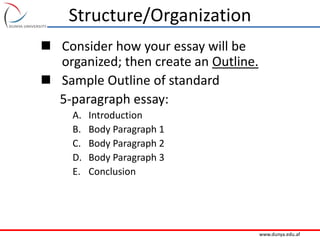
Structure/Organization
 Consider how your essay will be
organized; then create an Outline.
 Sample Outline of standard
5-paragraph essay:
A. Introduction
B. Body Paragraph 1
C. Body Paragraph 2
D. Body Paragraph 3
E. Conclusion
www.dunya.edu.af
II. Writing
During the Writing Stage, you should
Create your essay’s Title
Compose a draft
A Draft is the first whole version of all your ideas
put together; it’s a “dress rehearsal.”
You should plan to revise your Draft several times
throughout the writing process.
www.dunya.edu.af
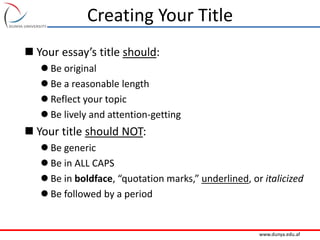
Creating Your Title
 Your essay’s title should:
 Be original
 Be a reasonable length
 Reflect your topic
 Be lively and attention-getting
 Your title should NOT:
 Be generic
 Be in ALL CAPS
 Be in boldface, “quotation marks,” underlined, or italicized
 Be followed by a period
www.dunya.edu.af
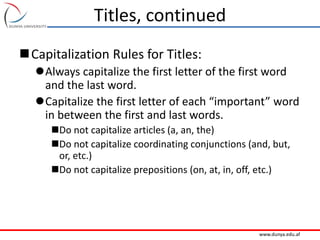
Titles, continued
Capitalization Rules for Titles:
Always capitalize the first letter of the first word
and the last word.
Capitalize the first letter of each “important” word
in between the first and last words.
Do not capitalize articles (a, an, the)
Do not capitalize coordinating conjunctions (and, but,
or, etc.)
Do not capitalize prepositions (on, at, in, off, etc.)
www.dunya.edu.af
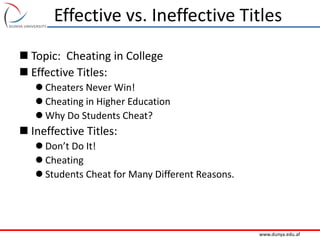
Effective vs. Ineffective Titles
 Topic: Cheating in College
 Effective Titles:
 Cheaters Never Win!
 Cheating in Higher Education
 Why Do Students Cheat?
 Ineffective Titles:
 Don’t Do It!
 Cheating
 Students Cheat for Many Different Reasons.
www.dunya.edu.af
Writing a Draft
Basics of a good draft:
Has a fully developed introduction and
conclusion
Has fully developed body paragraphs, each
containing a topic sentence, at least two
examples, and detailed support
Follows standard structure and uses complete
sentences
www.dunya.edu.af
Write Your Introduction
Your introductory paragraph should do the
following:
Be a minimum of 4-6 sentences
Tell the audience what to expect from your
discussion (thesis)
Move from general to specific, with the thesis as
the last sentence in the intro
Get the reader’s attention
Set the tone for the rest of the essay
www.dunya.edu.af
Introduction, continued
Strategies for developing an Introduction
include
Providing background information
Telling a personal anecdote
Beginning with a quotation
Asking a question
www.dunya.edu.af
Write Your Body Paragraphs
Each body paragraph should develop one of
the specific points mentioned in the thesis.
Each BP should contain:
Topic Sentence—main idea of BP
Primary Support—examples
Secondary Support—details
www.dunya.edu.af
Body Paragraphs: Topic Sentence
 A Topic Sentence expresses the main idea of the
body paragraph.
 Begin each body paragraph with a Topic Sentence
that
 Narrows the focus of the paragraph
 Accurately predicts the direction of the paragraph
 Refers back to the Thesis statement
www.dunya.edu.af
Body Paragraphs continued
Body paragraphs must have
Unity—everything refers back to main point
Support—examples and details
Coherence—all points connect to form a whole;
one point leads to another
www.dunya.edu.af
Body Paragraphs: Unity
Unity is achieved when everything refers back
to the main point
ALL SENTENCES SHOULD RELATE BACK TO TOPIC
SENTENCE & THESIS.
Do not include any ideas that are irrelevant or off-
topic.
www.dunya.edu.af
Body Paragraphs: Support
 Support is achieved through adequate examples and
details.
 Each body paragraph should include at least two
examples to support the main idea of the paragraph.
 Each example should include at least one specific
detail that further illustrates the point.
www.dunya.edu.af
Body Paragraphs: Coherence
Coherence is achieved when all points
connect to form a whole; one point leads to
another.
Coherence is mainly achieved through the use
of transitions.
Transitions—words & phrases which connect your
sentences so that your writing flows smoothly.
www.dunya.edu.af
Write Your Conclusion
The concluding paragraph should
Contain a minimum of 4 sentences
Refer back to the main point, but not simply
repeat the thesis
Make an observation on what is written
NOT introduce any new ideas
Create a sense of closure
www.dunya.edu.af
III. Revising
 Revising is finding & correcting problems with
content; changing the ideas in your writing to make
them clearer, stronger, and more convincing.
 Revising looks at the “Big Picture”—the Idea level.
www.dunya.edu.af
Revision Strategies
 Look for
 Unity
 Does everything refer back to main point?
 Does each topic sentence refer to the thesis?
 Does each sentence in each BP refer back to the topic sentence?
 Detail and support
 Does each BP contain at least two examples?
 Is each example followed by at least one supporting detail?
 Coherence
 Are all points connect to form a whole?
 Are transitions used to move from one idea to the next?
www.dunya.edu.af
Revision Tips
Take a break from your draft before attempting
to revise.
Read your draft out loud and listen to your
words.
Imagine yourself as your reader.
Look for consistent problem areas.
Get feedback from peers.
Get help from a tutor!
www.dunya.edu.af
IV. Editing
Editing is finding and correcting problems
with grammar, style, word choice & usage,
and punctuation.
Editing focuses on the “Little Picture”—Word
level.
www.dunya.edu.af
Editing Strategies
Keep an Error Log to help you identify your
problem areas and improve your writing.
When editing, review your paper for one type
of error at a time; don’t try to read through
looking for everything at once.
www.dunya.edu.af
Editing Tips
Work with a clean printed copy, double-
spaced to allow room to mark corrections.
Read your essay backwards.
Be cautious of spell-check and grammar-
check.
Read your essay out loud.
Get feedback from peers.
Work with a tutor!
www.dunya.edu.af
Self-Review
 You should never move to peer review without first
completing a self-review (revising & editing); you
want your peer to look for mistakes that you were
unable to catch yourself!
 After you have reviewed your own work, make the
necessary corrections and print a clean, revised copy
before moving on to peer review.
www.dunya.edu.af
Peer-Review
 It is important to make the peer review process
useful.
 Basics of useful feedback:
 It is given in a positive way
 It is specific
 It offers suggestions
 It is given both verbally and in writing
www.dunya.edu.af
Summary
Clarity: make it easy to understand
Precision: say what you mean
Conciseness: don’t waste words
Good writing is appropriate to context
Good writing is easy to understand

The writing process

  • 1.
  • 2.
  • 3.
    www.dunya.edu.af Stages of theWriting Process There are several stages to the Writing Process. Each stage is essential. Prewriting Writing (Drafting) Revising Editing
  • 4.
    www.dunya.edu.af I. Prewriting Choose/narrow yourtopic Determine your Audience Purpose Tone Point-of-view Tense Explore your topic Make a plan
  • 5.
    www.dunya.edu.af Choose/Narrow Your Topic Your topic should pass the 3-question test: 1. Does it interest me? 2. Do I have something to say about it? 3. Is it specific?
  • 6.
    www.dunya.edu.af Determine Your Audience YourAudience is composed of those who will read your writing. Ask yourself: Who are my readers? What do my readers know about my topic? What do my readers need to know about my topic? How do my readers feel about my topic?
  • 7.
    www.dunya.edu.af Audience continued. .. What do my readers expect? Standard Written English Correct grammar and spelling Accurate information Logical presentation of ideas Followed directions of the assignment!!!  What are my length requirements?  What is my time limit?  What does the assignment consist of?  Is research required?  What format should be used?
  • 8.
    www.dunya.edu.af Determine Your Purpose Purpose is the reason you are writing.  Whenever you write, you always have a purpose. Most writing fits into one of 3 categories:  Expressive Writing  Informative Writing  Persuasive Writing  More than one of these may be used, but one will be primary.
  • 9.
    www.dunya.edu.af Determine Tone Tone isthe mood or attitude you adopt as you write. Serious or frivolous/humorous? Intimate or detached?
  • 10.
    www.dunya.edu.af Determine Point-of-View Point-of-view isthe perspective from which you write an essay. There are 3 points-of-view: First person—”I, we” Second person—”you” Third person—”he, she, they” One of the most common errors in writing occurs when the writer shifts point-of-view unnecessarily!
  • 11.
    www.dunya.edu.af Determine Tense Tense isthe voice you use to designate the time of the action or state of being. Present tense Past tense Future tense
  • 12.
    www.dunya.edu.af Explore Your Topic Pre-writing Techniques:  Brainstorming/Listing  Freewriting  Clustering/Mapping  Questioning  Discussing  Outlining
  • 13.
    www.dunya.edu.af Make a Plan Beforeyou begin drafting your essay, you should make a plan (a roadmap). Review, evaluate, and organize ideas written in your pre-writing; then make a plan for your essay’s Thesis statement Support Order Structure
  • 14.
    www.dunya.edu.af Thesis Statement The thesisstatement expresses the MAIN IDEA of your essay, the central point that your essay develops/supports.
  • 15.
    www.dunya.edu.af Thesis continued. .. Your thesis SHOULD: Accurately predict your essay’s direction, emphasis, and scope Make no promises that the essay will not fulfill Be direct and straightforward NOT be an announcement, statement of opinion, or statement of fact.
  • 16.
    www.dunya.edu.af Thesis continued. .. • Analytical Paper: – It breaks down an issue or an idea into its component parts, evaluate the issue or idea and presents the breakdown. • Explanatory Paper: – It explains something to the audience. • Argumentative Paper: – It makes a claim about a topic and justifies this claim with specific evidence. The goal is to convince the audience.
  • 17.
    www.dunya.edu.af Thesis continued. .. • Example of analytical thesis statement: – An analysis of the college admission process reveals one challenge facing counselors: accepting students with high test scores or students with strong extracurricular backgrounds. • The paper that follows should: – Explain the analysis of the college admission process. – Explain the challenge facing admissions counselors.
  • 18.
    www.dunya.edu.af Thesis continued. .. • Example of an explanatory thesis statement: – The life of the typical college student is characterized by time spent studying, attending class, and socializing peers. • The paper that follows should: – Explain how students spend their time studying, attending class, and socializing with peers
  • 19.
    www.dunya.edu.af Thesis continued. .. • Example of an argumentative thesis statement: – High school graduates should be required to take a year off to pursue community service projects before entering college in order to increase their maturity and global awareness. • The paper that follows should: – Present an argument and give evidence to support the claim that students should pursue community projects before entering college.
  • 20.
    www.dunya.edu.af Support Be sure toevaluate the information in your prewriting carefully in order to choose the best support for your topic. Primary Support—major ideas or examples that back up your main points Secondary Support—details which further explain your primary support
  • 21.
    www.dunya.edu.af Support continued. .. Basics of good support Relates to main point Considers readers, i.e. provides enough information Is detailed and specific
  • 22.
    www.dunya.edu.af Order The Order isthe sequence in which you present your ideas. There are 3 types of order: Time (chronological) order Space order Emphatic order (order of importance: least-to- most, most-to-least)
  • 23.
    www.dunya.edu.af Structure/Organization  Consider howyour essay will be organized; then create an Outline.  Sample Outline of standard 5-paragraph essay: A. Introduction B. Body Paragraph 1 C. Body Paragraph 2 D. Body Paragraph 3 E. Conclusion
  • 24.
    www.dunya.edu.af II. Writing During theWriting Stage, you should Create your essay’s Title Compose a draft A Draft is the first whole version of all your ideas put together; it’s a “dress rehearsal.” You should plan to revise your Draft several times throughout the writing process.
  • 25.
    www.dunya.edu.af Creating Your Title Your essay’s title should:  Be original  Be a reasonable length  Reflect your topic  Be lively and attention-getting  Your title should NOT:  Be generic  Be in ALL CAPS  Be in boldface, “quotation marks,” underlined, or italicized  Be followed by a period
  • 26.
    www.dunya.edu.af Titles, continued Capitalization Rulesfor Titles: Always capitalize the first letter of the first word and the last word. Capitalize the first letter of each “important” word in between the first and last words. Do not capitalize articles (a, an, the) Do not capitalize coordinating conjunctions (and, but, or, etc.) Do not capitalize prepositions (on, at, in, off, etc.)
  • 27.
    www.dunya.edu.af Effective vs. IneffectiveTitles  Topic: Cheating in College  Effective Titles:  Cheaters Never Win!  Cheating in Higher Education  Why Do Students Cheat?  Ineffective Titles:  Don’t Do It!  Cheating  Students Cheat for Many Different Reasons.
  • 28.
    www.dunya.edu.af Writing a Draft Basicsof a good draft: Has a fully developed introduction and conclusion Has fully developed body paragraphs, each containing a topic sentence, at least two examples, and detailed support Follows standard structure and uses complete sentences
  • 29.
    www.dunya.edu.af Write Your Introduction Yourintroductory paragraph should do the following: Be a minimum of 4-6 sentences Tell the audience what to expect from your discussion (thesis) Move from general to specific, with the thesis as the last sentence in the intro Get the reader’s attention Set the tone for the rest of the essay
  • 30.
    www.dunya.edu.af Introduction, continued Strategies fordeveloping an Introduction include Providing background information Telling a personal anecdote Beginning with a quotation Asking a question
  • 31.
    www.dunya.edu.af Write Your BodyParagraphs Each body paragraph should develop one of the specific points mentioned in the thesis. Each BP should contain: Topic Sentence—main idea of BP Primary Support—examples Secondary Support—details
  • 32.
    www.dunya.edu.af Body Paragraphs: TopicSentence  A Topic Sentence expresses the main idea of the body paragraph.  Begin each body paragraph with a Topic Sentence that  Narrows the focus of the paragraph  Accurately predicts the direction of the paragraph  Refers back to the Thesis statement
  • 33.
    www.dunya.edu.af Body Paragraphs continued Bodyparagraphs must have Unity—everything refers back to main point Support—examples and details Coherence—all points connect to form a whole; one point leads to another
  • 34.
    www.dunya.edu.af Body Paragraphs: Unity Unityis achieved when everything refers back to the main point ALL SENTENCES SHOULD RELATE BACK TO TOPIC SENTENCE & THESIS. Do not include any ideas that are irrelevant or off- topic.
  • 35.
    www.dunya.edu.af Body Paragraphs: Support Support is achieved through adequate examples and details.  Each body paragraph should include at least two examples to support the main idea of the paragraph.  Each example should include at least one specific detail that further illustrates the point.
  • 36.
    www.dunya.edu.af Body Paragraphs: Coherence Coherenceis achieved when all points connect to form a whole; one point leads to another. Coherence is mainly achieved through the use of transitions. Transitions—words & phrases which connect your sentences so that your writing flows smoothly.
  • 37.
    www.dunya.edu.af Write Your Conclusion Theconcluding paragraph should Contain a minimum of 4 sentences Refer back to the main point, but not simply repeat the thesis Make an observation on what is written NOT introduce any new ideas Create a sense of closure
  • 38.
    www.dunya.edu.af III. Revising  Revisingis finding & correcting problems with content; changing the ideas in your writing to make them clearer, stronger, and more convincing.  Revising looks at the “Big Picture”—the Idea level.
  • 39.
    www.dunya.edu.af Revision Strategies  Lookfor  Unity  Does everything refer back to main point?  Does each topic sentence refer to the thesis?  Does each sentence in each BP refer back to the topic sentence?  Detail and support  Does each BP contain at least two examples?  Is each example followed by at least one supporting detail?  Coherence  Are all points connect to form a whole?  Are transitions used to move from one idea to the next?
  • 40.
    www.dunya.edu.af Revision Tips Take abreak from your draft before attempting to revise. Read your draft out loud and listen to your words. Imagine yourself as your reader. Look for consistent problem areas. Get feedback from peers. Get help from a tutor!
  • 41.
    www.dunya.edu.af IV. Editing Editing isfinding and correcting problems with grammar, style, word choice & usage, and punctuation. Editing focuses on the “Little Picture”—Word level.
  • 42.
    www.dunya.edu.af Editing Strategies Keep anError Log to help you identify your problem areas and improve your writing. When editing, review your paper for one type of error at a time; don’t try to read through looking for everything at once.
  • 43.
    www.dunya.edu.af Editing Tips Work witha clean printed copy, double- spaced to allow room to mark corrections. Read your essay backwards. Be cautious of spell-check and grammar- check. Read your essay out loud. Get feedback from peers. Work with a tutor!
  • 44.
    www.dunya.edu.af Self-Review  You shouldnever move to peer review without first completing a self-review (revising & editing); you want your peer to look for mistakes that you were unable to catch yourself!  After you have reviewed your own work, make the necessary corrections and print a clean, revised copy before moving on to peer review.
  • 45.
    www.dunya.edu.af Peer-Review  It isimportant to make the peer review process useful.  Basics of useful feedback:  It is given in a positive way  It is specific  It offers suggestions  It is given both verbally and in writing
  • 46.
    www.dunya.edu.af Summary Clarity: make iteasy to understand Precision: say what you mean Conciseness: don’t waste words Good writing is appropriate to context Good writing is easy to understand