MA Education
Semester four
A process is a series of actions or steps taken in order
achieve a particular end.
A technical writer may use a description of a process to inform
an audience that has little knowledge or experience with that
technical expertise.
The process of technical report writing involves following
steps:
1. Preparation:
I. Establish your primary purpose.
II. Assessing your audience and context
IV. Determining the Purpose
V. Selecting the Medium
2. Research
I. Methods of research
3. Sources of information
4. Organization
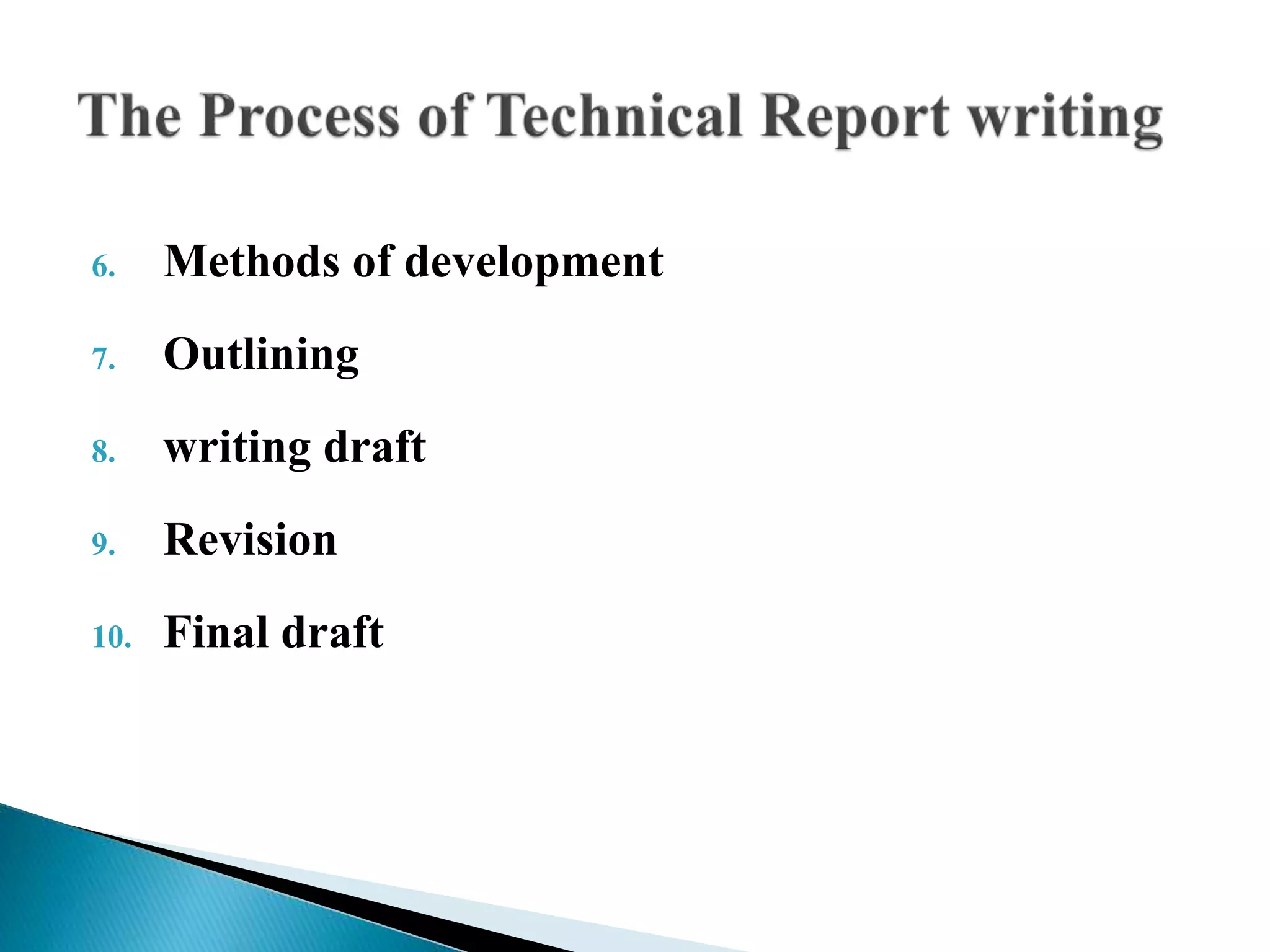
6. Methods of development
7. Outlining
8. writing draft
9. Revision
10. Final draft
1. Preparation
Technical report writing requires an adequate
preparation. In preparation for writing, your goal is to
accomplish the following four major tasks:
I. Establish your primary purpose.
II. Assess your audience (or readers) and the context.
III. Determine the purpose of your report.
IV. Select the appropriate medium.
I. Establish your primary purpose.
To establish your primary purpose simply ask yourself
what do you want your readers to know, believe or be
able to do after reading this report. State your purpose
precisely .
Establish your primary purpose
For example:
 A purpose is to write a “Report on possible location for new
research facility”. It is too general.
 In order to specify the purpose we can write,
“ To compare the relative advantages of Lahore, Faisalabad
and Peshawar as possible locations for new research facility
so that top management can choose the best location”.
II. Assessing your audience and context:
The next task is to assess your audience. Again, be
precise and ask yourself following questions:
 Who is your reader?
 Do you have multiple readers?
 What are your readers’ needs in relation to your subject?
 What are their attitudes about the subject?
II. To determine the effect of context
 Have they already seen other reports on subject?
 What is the corporate culture in which your readers work, and what
are its key values?
 Is this the company’s first new facility, or has the company chosen
locations for new facilities before?
 Have the readers visited all three cities?
 What specific factors, such as competition, finance, and regulation,
are recognized as important within the organization?
III. Determining the Purpose
Determining your purpose and assessing your readers
and context will help you decide what to include and
what not to include in your writing.
IV. Selecting the Medium:
Select appropriate medium for communicating your message to
audience such as:
 E mail.
 Fax.
 Voice mail.
 Videoconferencing.
 Telephone calls.
 Face-to-face meetings.
Careful study that is done to find and report new
knowledge about something.
Conduct adequate research by using different tools of research,
such as:
 Interviewing
 Library
 Internet research
 Careful note taking
 Your own knowledge.
 The knowledge of people outside your workplace.
 Internet sources.
 Library resources.
 Printed and electronic sources in the workplace.
 Interview Subject matter expert.
 The information should be organize coherently.
 To organize information effectively, you need to
determine the best way to structure your ideas.
Choose the appropriate method that best suits your
subject, readers’ needs and your purpose.
For example:
If you are writing instructions for assembling office
equipment. Use sequential method of development to
present the steps of the process in the order that readers
can understand and perform them.
 If you are writing about the history of an
organization, use the chronological method of
development.(go from the beginning to the present)
 A well developed outline ensures that your document
is complete and logically organized. Outlining breaks
large or complex subjects into manageable parts. It
also enables you to emphasize key points by placing
them in the positions of greatest importance.
 Expand your outline into paragraphs and prepare
rough draft.
 Opening of report should announce the subject and
give readers essential background information.
 Introduction should serve as a frame into which
readers can fit the detailed information that follows.
 Read and evaluate the draft.
 Check your draft for accuracy, completeness and
effectiveness.
 Remove extra information.
 Read your rough draft several times.
 Concentrate on coherence, spelling and punctuation.
Final draft of the document is formed after revision
and editing. The final draft should be complete in
every aspect and free from errors.
The process of technical writing is a systematic
procedure which involves different steps to write a
technical report. In this process writer produce a
complete and effective report after analyzing the
audience’ needs and context.

The process of technical writing

  • 1.
  • 2.
    A process isa series of actions or steps taken in order achieve a particular end.
  • 3.
    A technical writermay use a description of a process to inform an audience that has little knowledge or experience with that technical expertise. The process of technical report writing involves following steps: 1. Preparation: I. Establish your primary purpose. II. Assessing your audience and context
  • 4.
    IV. Determining thePurpose V. Selecting the Medium 2. Research I. Methods of research 3. Sources of information 4. Organization
  • 5.
    6. Methods ofdevelopment 7. Outlining 8. writing draft 9. Revision 10. Final draft
  • 6.
    1. Preparation Technical reportwriting requires an adequate preparation. In preparation for writing, your goal is to accomplish the following four major tasks:
  • 7.
    I. Establish yourprimary purpose. II. Assess your audience (or readers) and the context. III. Determine the purpose of your report. IV. Select the appropriate medium.
  • 8.
    I. Establish yourprimary purpose. To establish your primary purpose simply ask yourself what do you want your readers to know, believe or be able to do after reading this report. State your purpose precisely .
  • 9.
    Establish your primarypurpose For example:  A purpose is to write a “Report on possible location for new research facility”. It is too general.  In order to specify the purpose we can write, “ To compare the relative advantages of Lahore, Faisalabad and Peshawar as possible locations for new research facility so that top management can choose the best location”.
  • 10.
    II. Assessing youraudience and context: The next task is to assess your audience. Again, be precise and ask yourself following questions:  Who is your reader?  Do you have multiple readers?  What are your readers’ needs in relation to your subject?  What are their attitudes about the subject?
  • 11.
    II. To determinethe effect of context  Have they already seen other reports on subject?  What is the corporate culture in which your readers work, and what are its key values?  Is this the company’s first new facility, or has the company chosen locations for new facilities before?  Have the readers visited all three cities?  What specific factors, such as competition, finance, and regulation, are recognized as important within the organization?
  • 12.
    III. Determining thePurpose Determining your purpose and assessing your readers and context will help you decide what to include and what not to include in your writing.
  • 13.
    IV. Selecting theMedium: Select appropriate medium for communicating your message to audience such as:  E mail.  Fax.  Voice mail.  Videoconferencing.  Telephone calls.  Face-to-face meetings.
  • 14.
    Careful study thatis done to find and report new knowledge about something.
  • 15.
    Conduct adequate researchby using different tools of research, such as:  Interviewing  Library  Internet research  Careful note taking
  • 16.
     Your ownknowledge.  The knowledge of people outside your workplace.  Internet sources.  Library resources.  Printed and electronic sources in the workplace.  Interview Subject matter expert.
  • 17.
     The informationshould be organize coherently.  To organize information effectively, you need to determine the best way to structure your ideas.
  • 18.
    Choose the appropriatemethod that best suits your subject, readers’ needs and your purpose. For example: If you are writing instructions for assembling office equipment. Use sequential method of development to present the steps of the process in the order that readers can understand and perform them.
  • 19.
     If youare writing about the history of an organization, use the chronological method of development.(go from the beginning to the present)
  • 20.
     A welldeveloped outline ensures that your document is complete and logically organized. Outlining breaks large or complex subjects into manageable parts. It also enables you to emphasize key points by placing them in the positions of greatest importance.
  • 21.
     Expand youroutline into paragraphs and prepare rough draft.  Opening of report should announce the subject and give readers essential background information.  Introduction should serve as a frame into which readers can fit the detailed information that follows.
  • 22.
     Read andevaluate the draft.  Check your draft for accuracy, completeness and effectiveness.  Remove extra information.  Read your rough draft several times.  Concentrate on coherence, spelling and punctuation.
  • 23.
    Final draft ofthe document is formed after revision and editing. The final draft should be complete in every aspect and free from errors.
  • 24.
    The process oftechnical writing is a systematic procedure which involves different steps to write a technical report. In this process writer produce a complete and effective report after analyzing the audience’ needs and context.