Typhoons: Nature's
Powerful Storms
Learning Points
Explain how
landmasses
and bodies of
water affect
typhoons.
Explain how
typhoons
develop.
QUESTIONS TO PONDER?
• What is a typhoon?
• What is the Philippine Area of Responsibility?
Take a moment to think about these questions as we
explore typhoon development.
Word bank
• WEATHER- is the day to day condition of the atmosphere at a particular time
and place.
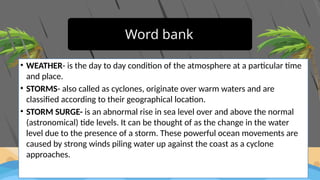
• STORMS- also called as cyclones, originate over warm waters and are
classified according to their geographical location.
• STORM SURGE- is an abnormal rise in sea level over and above the normal
(astronomical) tide levels. It can be thought of as the change in the water
level due to the presence of a storm. These powerful ocean movements are
caused by strong winds piling water up against the coast as a cyclone
approaches.
Introduction to Typhoons
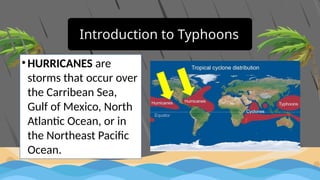
• HURRICANES are
storms that occur over
the Carribean Sea,
Gulf of Mexico, North
Atlantic Ocean, or in
the Northeast Pacific
Ocean.
Introduction to Typhoons
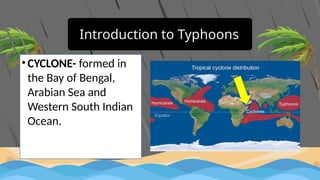
• CYCLONE- formed in
the Bay of Bengal,
Arabian Sea and
Western South Indian
Ocean.
Introduction to Typhoons
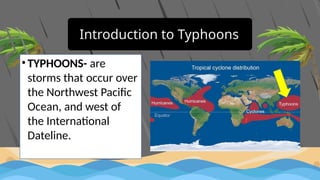
• TYPHOONS- are
storms that occur over
the Northwest Pacific
Ocean, and west of
the International
Dateline.
Introduction to Typhoons
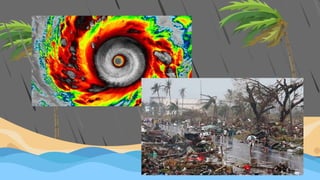
• Typhoons are intense tropical cyclones that
form in Typhoons can cause devastating winds,
heavy rainfall, and storm surges
• Understanding their development is crucial for
preparedness and safety
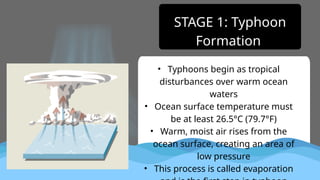
STAGE 1: Typhoon
Formation
• Typhoons begin as tropical
disturbances over warm ocean
waters
• Ocean surface temperature must
be at least 26.5°C (79.7°F)
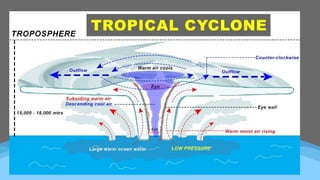
• Warm, moist air rises from the
ocean surface, creating an area of
low pressure
• This process is called evaporation
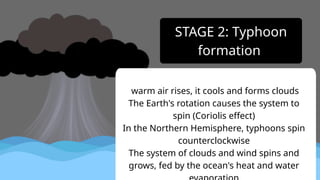
warm air rises, it cools and forms clouds
The Earth's rotation causes the system to
spin (Coriolis effect)
In the Northern Hemisphere, typhoons spin
counterclockwise
The system of clouds and wind spins and
grows, fed by the ocean's heat and water
STAGE 2: Typhoon
formation
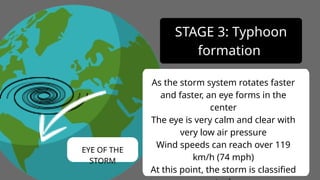
As the storm system rotates faster
and faster, an eye forms in the
center
The eye is very calm and clear with
very low air pressure
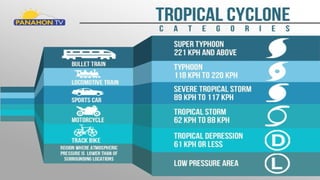
Wind speeds can reach over 119
km/h (74 mph)
At this point, the storm is classified
STAGE 3: Typhoon
formation
EYE OF THE
STORM
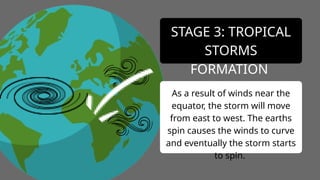
As a result of winds near the
equator, the storm will move
from east to west. The earths
spin causes the winds to curve
and eventually the storm starts
to spin.
STAGE 3: TROPICAL
STORMS
FORMATION
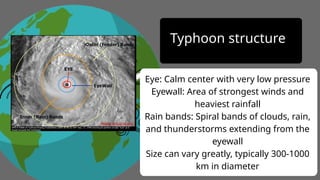
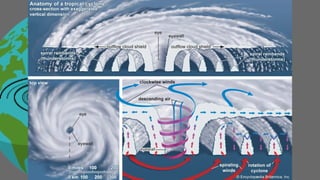
Eye: Calm center with very low pressure
Eyewall: Area of strongest winds and
heaviest rainfall
Rain bands: Spiral bands of clouds, rain,
and thunderstorms extending from the
eyewall
Size can vary greatly, typically 300-1000
km in diameter
Typhoon structure
Typhoon structure
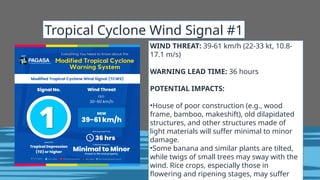
WIND THREAT: 39-61 km/h (22-33 kt, 10.8-
17.1 m/s)
WARNING LEAD TIME: 36 hours
POTENTIAL IMPACTS:
•House of poor construction (e.g., wood
frame, bamboo, makeshift), old dilapidated
structures, and other structures made of
light materials will suffer minimal to minor
damage.
•Some banana and similar plants are tilted,
while twigs of small trees may sway with the
wind. Rice crops, especially those in
flowering and ripening stages, may suffer
Tropical Cyclone Wind Signal #1
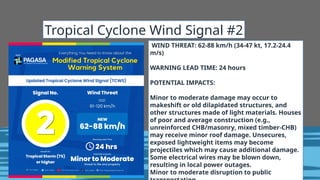
WIND THREAT: 62-88 km/h (34-47 kt, 17.2-24.4
m/s)
WARNING LEAD TIME: 24 hours
POTENTIAL IMPACTS:
Minor to moderate damage may occur to
makeshift or old dilapidated structures, and
other structures made of light materials. Houses
of poor and average construction (e.g.,
unreinforced CHB/masonry, mixed timber-CHB)
may receive minor roof damage. Unsecures,
exposed lightweight items may become
projectiles which may cause additional damage.
Some electrical wires may be blown down,
resulting in local power outages.
Minor to moderate disruption to public
Tropical Cyclone Wind Signal #2
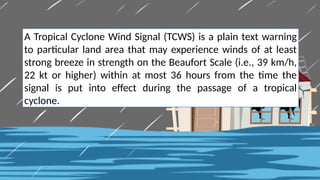
A Tropical Cyclone Wind Signal (TCWS) is a plain text warning
to particular land area that may experience winds of at least
strong breeze in strength on the Beaufort Scale (i.e., 39 km/h,
22 kt or higher) within at most 36 hours from the time the
signal is put into effect during the passage of a tropical
cyclone.
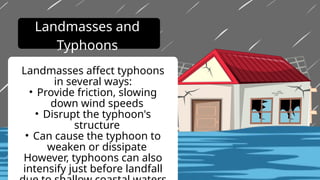
Landmasses affect typhoons
in several ways:
• Provide friction, slowing
down wind speeds
• Disrupt the typhoon's
structure
• Can cause the typhoon to
weaken or dissipate
However, typhoons can also
intensify just before landfall
Landmasses and
Typhoons
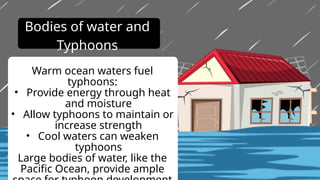
Warm ocean waters fuel
typhoons:
• Provide energy through heat
and moisture
• Allow typhoons to maintain or
increase strength
• Cool waters can weaken
typhoons
Large bodies of water, like the
Pacific Ocean, provide ample
Bodies of water and
Typhoons
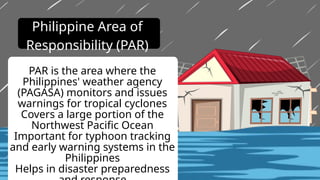
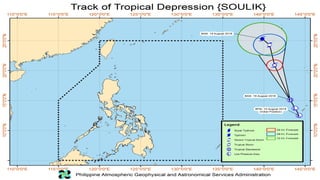
PAR is the area where the
Philippines' weather agency
(PAGASA) monitors and issues
warnings for tropical cyclones
Covers a large portion of the
Northwest Pacific Ocean
Important for typhoon tracking
and early warning systems in the
Philippines
Helps in disaster preparedness
Philippine Area of
Responsibility (PAR)
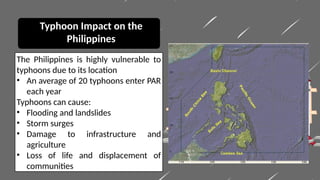
Typhoon Impact on the
Philippines
The Philippines is highly vulnerable to
typhoons due to its location
• An average of 20 typhoons enter PAR
each year
Typhoons can cause:
• Flooding and landslides
• Storm surges
• Damage to infrastructure and
agriculture
• Loss of life and displacement of
communities
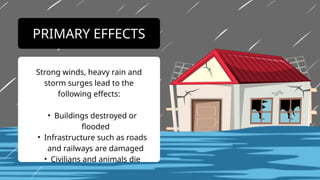
Strong winds, heavy rain and
storm surges lead to the
following effects:
• Buildings destroyed or
flooded
• Infrastructure such as roads
and railways are damaged
• Civilians and animals die
PRIMARY EFFECTS
Secondary effects are the result of
the primary effects:
• Shortage of food and clean
water
• Job losses
• Costs to the economy
• Landslides
SECONDARY
EFFECTS
Secondary effects are the result of
the primary effects:
• Shortage of food and clean
water
• Job losses
• Costs to the economy
• Landslides
SECONDARY
EFFECTS
Stay informed about weather
updates and warnings
Prepare an emergency kit with
food, water, and first aid supplies
Know your evacuation routes and
safe shelters
Secure loose objects and reinforce
your home if possible
Follow instructions from local
authorities
Typhoon
Preparedness
Climate Change and Typhoons
Scientists are studying how climate change might affect
typhoons
Potential impacts include:
More intense storms due to warmer ocean temperatures
Changes in typhoon frequency or paths
Increased rainfall during typhoons
Ongoing research is crucial for future preparedness
Review Quiz
1. What minimum ocean temperature is needed for typhoon
formation?
2. In which direction do typhoons spin in the Northern
Hemisphere?
3. What is the calmest part of a typhoon called?
4. How many typhoons on average enter the Philippine Area
of Responsibility each year?
5. Name two ways landmasses affect typhoons
TRACKING
WEATHER
PAGASA, (Philippine Atmospheric, Geophysical and
Astronomical Services Administration )one of the attached
agencies of the Department of Science and Technology
(DOST) under its Scientific and Technical Services Institutes, is
mandated to “provide protection against natural calamities
and utilize scientific knowledge as an effective instrument to
insure the safety, well being and economic security of all the
people, and for the promotion of national progress.” (Section
2, Statement of Policy, Presidential Decree No. 78; December
1972 as amended by Presidential Decree No. 1149; August
1977)
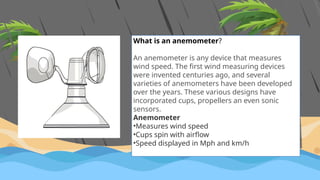
What is an anemometer?
An anemometer is any device that measures
wind speed. The first wind measuring devices
were invented centuries ago, and several
varieties of anemometers have been developed
over the years. These various designs have
incorporated cups, propellers an even sonic
sensors.
Anemometer
•Measures wind speed
•Cups spin with airflow
•Speed displayed in Mph and km/h
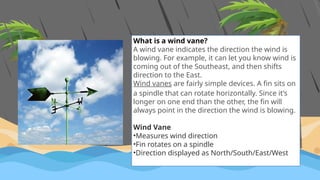
What is a wind vane?
A wind vane indicates the direction the wind is
blowing. For example, it can let you know wind is
coming out of the Southeast, and then shifts
direction to the East.
Wind vanes are fairly simple devices. A fin sits on
a spindle that can rotate horizontally. Since it’s
longer on one end than the other, the fin will
always point in the direction the wind is blowing.
Wind Vane
•Measures wind direction
•Fin rotates on a spindle
•Direction displayed as North/South/East/West
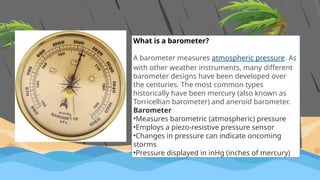
What is a barometer?
A barometer measures atmospheric pressure. As
with other weather instruments, many different
barometer designs have been developed over
the centuries. The most common types
historically have been mercury (also known as
Torricellian barometer) and aneroid barometer.
Barometer
•Measures barometric (atmospheric) pressure
•Employs a piezo-resistive pressure sensor
•Changes in pressure can indicate oncoming
storms
•Pressure displayed in inHg (inches of mercury)
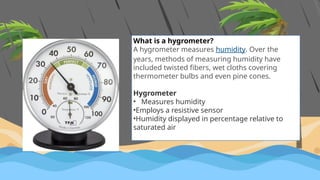
What is a hygrometer?
A hygrometer measures humidity. Over the
years, methods of measuring humidity have
included twisted fibers, wet cloths covering
thermometer bulbs and even pine cones.
Hygrometer
• Measures humidity
•Employs a resistive sensor
•Humidity displayed in percentage relative to
saturated air
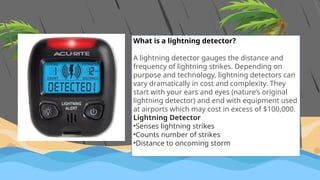
What is a lightning detector?
A lightning detector gauges the distance and
frequency of lightning strikes. Depending on
purpose and technology, lightning detectors can
vary dramatically in cost and complexity. They
start with your ears and eyes (nature’s original
lightning detector) and end with equipment used
at airports which may cost in excess of $100,000.
Lightning Detector
•Senses lightning strikes
•Counts number of strikes
•Distance to oncoming storm
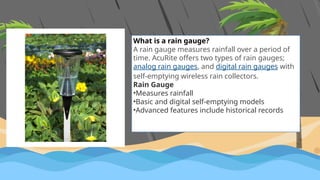
What is a rain gauge?
A rain gauge measures rainfall over a period of
time. AcuRite offers two types of rain gauges;
analog rain gauges, and digital rain gauges with
self-emptying wireless rain collectors.
Rain Gauge
•Measures rainfall
•Basic and digital self-emptying models
•Advanced features include historical records
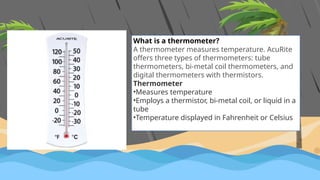
What is a thermometer?
A thermometer measures temperature. AcuRite
offers three types of thermometers: tube
thermometers, bi-metal coil thermometers, and
digital thermometers with thermistors.
Thermometer
•Measures temperature
•Employs a thermistor, bi-metal coil, or liquid in a
tube
•Temperature displayed in Fahrenheit or Celsius
The practice of giving storms personal names appears to
have originated with Clement Wragge, an Australian
meteorologist who in the 1890s entertained himself by
naming storms after women, mythical figures, and
politicians that he didn’t like. The modern system of
using personal names developed during World War II,
when meteorologists began using women’s names—
often those of wives or girlfriends—instead of
cumbersome designations based on latitude and
longitude. Short and quickly understood, names were
easier to transmit over the radio and easier to keep
straight if there was more than one storm in a given
area. The system was formalized in 1953 when the
National Weather Service put together an alphabetical
list of female names to be used for storms in the Atlantic
basin. Male names were added to the list in 1979 when
women’s groups pointed out the sexism of using only
Clement Lindley Wragge (1852-1922)
was a British meteorologist who
travelled widely and coined the term
PAGASA's System for Naming
Typhoons in the Philippines
PAGASA has been giving local names to storms that enter the PAR since 1963. The meaning of
PAR is Philippine Area of Responsibility, which is one of the three domains that weather
forecasters use to monitor, analyze, and forecast tropical cyclones in the Philippines.[1]
But it wasn't until 1998 that the public was involved in naming typhoons in the Philippines. That
year, PAGASA held a “Name a Bagyo” contest that had Filipinos sending their proposed local
names for typhoons. From the nominations, a committee chose 140 Philippine typhoon names.
Some of the handpicked 140 names now make up PAGASA's list of names for tropical cyclones.
[2] The list was divided into four sets of 25 typhoon names (each starting with A to Z) with
additional 10 auxiliary names (each starting with A to J).
PAGASA's list is a mix of male and female names, as well as gender-neutral names like Kabayan,
Tamaraw, and Zigzag.
The average number of typhoons in the Philippines is 20 per year.[3] Each set of 25 typhoon
names is usually enough for one year.
Set 1 Set 2 Set 3 Set 4
2021, 2025, 2029, 2033 2022, 2026, 2030, 2034 2023, 2027, 2031, 2035 2024, 2028, 2032, 2036
Auring Ada Amang Aghon
Bising Basyang Betty Butchoy
Crising Caloy Chedeng Carina
Dante Domeng Dodong Dindo
Emong Ester Egay Enteng
Fabian Francisco Falcon Ferdie
Gorio Gardo Goring Gener
Huaning Henry Hanna Helen
Isang Inday Ineng Igme
Jacinto Josie Jenny Julian
Kiko Kiyapo Kabayan Kristine
Lannie Luis Liwayway Leon
Maring Maymay Marilyn Marce
Nando Neneng Nimfa Nika
Opong Obet Onyok Ofel
Paolo Pilandok Perla Pepito
Quedan Queenie Quiel Querubin
Ramil Rosal Ramon Romina
Salome Samuel Sarah Siony
Tino Tomas Tamaraw Tonyo
Uwan Umberto Ugong Upang
Verbena Venus Viring Vicky
Wilma Waldo Weng Warren
Yasmin Yayang Yoyoy Yoyong
Zoraida Zeny Zigzag Zosimo
Recycling Philippine Typhoon Names
PAGASA uses each set of typhoon names in rotation every four years. For example, the set of
names for 2023 (Amang, Betty, Chedeng, and so on) will also be used in 2027, 2031, and 2035.
The state weather bureau assigns each Philippine typhoon name alphabetically to determine the
number of typhoons that enter PAR every year. The first typhoon to enter in any year starts with
A, the second one starts with B, and so on.
In case there are more than 25 tropical cyclones in the Philippines this year and all the typhoon
names for 2023 are used up, PAGASA will use the auxiliary names.

UNDERSTANDING TYPHOON and how it is formed.pptx

  • 2.
  • 3.
    Learning Points Explain how landmasses andbodies of water affect typhoons. Explain how typhoons develop.
  • 4.
    QUESTIONS TO PONDER? •What is a typhoon? • What is the Philippine Area of Responsibility? Take a moment to think about these questions as we explore typhoon development.
  • 5.
    Word bank • WEATHER-is the day to day condition of the atmosphere at a particular time and place. • STORMS- also called as cyclones, originate over warm waters and are classified according to their geographical location. • STORM SURGE- is an abnormal rise in sea level over and above the normal (astronomical) tide levels. It can be thought of as the change in the water level due to the presence of a storm. These powerful ocean movements are caused by strong winds piling water up against the coast as a cyclone approaches.
  • 6.
    Introduction to Typhoons •HURRICANES are storms that occur over the Carribean Sea, Gulf of Mexico, North Atlantic Ocean, or in the Northeast Pacific Ocean.
  • 7.
    Introduction to Typhoons •CYCLONE- formed in the Bay of Bengal, Arabian Sea and Western South Indian Ocean.
  • 8.
    Introduction to Typhoons •TYPHOONS- are storms that occur over the Northwest Pacific Ocean, and west of the International Dateline.
  • 9.
    Introduction to Typhoons •Typhoons are intense tropical cyclones that form in Typhoons can cause devastating winds, heavy rainfall, and storm surges • Understanding their development is crucial for preparedness and safety
  • 10.
    STAGE 1: Typhoon Formation •Typhoons begin as tropical disturbances over warm ocean waters • Ocean surface temperature must be at least 26.5°C (79.7°F) • Warm, moist air rises from the ocean surface, creating an area of low pressure • This process is called evaporation
  • 11.
    warm air rises,it cools and forms clouds The Earth's rotation causes the system to spin (Coriolis effect) In the Northern Hemisphere, typhoons spin counterclockwise The system of clouds and wind spins and grows, fed by the ocean's heat and water STAGE 2: Typhoon formation
  • 12.
    As the stormsystem rotates faster and faster, an eye forms in the center The eye is very calm and clear with very low air pressure Wind speeds can reach over 119 km/h (74 mph) At this point, the storm is classified STAGE 3: Typhoon formation EYE OF THE STORM
  • 13.
    As a resultof winds near the equator, the storm will move from east to west. The earths spin causes the winds to curve and eventually the storm starts to spin. STAGE 3: TROPICAL STORMS FORMATION
  • 14.
    Eye: Calm centerwith very low pressure Eyewall: Area of strongest winds and heaviest rainfall Rain bands: Spiral bands of clouds, rain, and thunderstorms extending from the eyewall Size can vary greatly, typically 300-1000 km in diameter Typhoon structure
  • 15.
  • 18.
    WIND THREAT: 39-61km/h (22-33 kt, 10.8- 17.1 m/s) WARNING LEAD TIME: 36 hours POTENTIAL IMPACTS: •House of poor construction (e.g., wood frame, bamboo, makeshift), old dilapidated structures, and other structures made of light materials will suffer minimal to minor damage. •Some banana and similar plants are tilted, while twigs of small trees may sway with the wind. Rice crops, especially those in flowering and ripening stages, may suffer Tropical Cyclone Wind Signal #1
  • 19.
    WIND THREAT: 62-88km/h (34-47 kt, 17.2-24.4 m/s) WARNING LEAD TIME: 24 hours POTENTIAL IMPACTS: Minor to moderate damage may occur to makeshift or old dilapidated structures, and other structures made of light materials. Houses of poor and average construction (e.g., unreinforced CHB/masonry, mixed timber-CHB) may receive minor roof damage. Unsecures, exposed lightweight items may become projectiles which may cause additional damage. Some electrical wires may be blown down, resulting in local power outages. Minor to moderate disruption to public Tropical Cyclone Wind Signal #2
  • 20.
    A Tropical CycloneWind Signal (TCWS) is a plain text warning to particular land area that may experience winds of at least strong breeze in strength on the Beaufort Scale (i.e., 39 km/h, 22 kt or higher) within at most 36 hours from the time the signal is put into effect during the passage of a tropical cyclone.
  • 22.
    Landmasses affect typhoons inseveral ways: • Provide friction, slowing down wind speeds • Disrupt the typhoon's structure • Can cause the typhoon to weaken or dissipate However, typhoons can also intensify just before landfall Landmasses and Typhoons
  • 23.
    Warm ocean watersfuel typhoons: • Provide energy through heat and moisture • Allow typhoons to maintain or increase strength • Cool waters can weaken typhoons Large bodies of water, like the Pacific Ocean, provide ample Bodies of water and Typhoons
  • 24.
    PAR is thearea where the Philippines' weather agency (PAGASA) monitors and issues warnings for tropical cyclones Covers a large portion of the Northwest Pacific Ocean Important for typhoon tracking and early warning systems in the Philippines Helps in disaster preparedness Philippine Area of Responsibility (PAR)
  • 26.
    Typhoon Impact onthe Philippines The Philippines is highly vulnerable to typhoons due to its location • An average of 20 typhoons enter PAR each year Typhoons can cause: • Flooding and landslides • Storm surges • Damage to infrastructure and agriculture • Loss of life and displacement of communities
  • 27.
    Strong winds, heavyrain and storm surges lead to the following effects: • Buildings destroyed or flooded • Infrastructure such as roads and railways are damaged • Civilians and animals die PRIMARY EFFECTS
  • 28.
    Secondary effects arethe result of the primary effects: • Shortage of food and clean water • Job losses • Costs to the economy • Landslides SECONDARY EFFECTS
  • 29.
    Secondary effects arethe result of the primary effects: • Shortage of food and clean water • Job losses • Costs to the economy • Landslides SECONDARY EFFECTS
  • 30.
    Stay informed aboutweather updates and warnings Prepare an emergency kit with food, water, and first aid supplies Know your evacuation routes and safe shelters Secure loose objects and reinforce your home if possible Follow instructions from local authorities Typhoon Preparedness
  • 31.
    Climate Change andTyphoons Scientists are studying how climate change might affect typhoons Potential impacts include: More intense storms due to warmer ocean temperatures Changes in typhoon frequency or paths Increased rainfall during typhoons Ongoing research is crucial for future preparedness
  • 32.
    Review Quiz 1. Whatminimum ocean temperature is needed for typhoon formation? 2. In which direction do typhoons spin in the Northern Hemisphere? 3. What is the calmest part of a typhoon called? 4. How many typhoons on average enter the Philippine Area of Responsibility each year? 5. Name two ways landmasses affect typhoons
  • 33.
  • 34.
    PAGASA, (Philippine Atmospheric,Geophysical and Astronomical Services Administration )one of the attached agencies of the Department of Science and Technology (DOST) under its Scientific and Technical Services Institutes, is mandated to “provide protection against natural calamities and utilize scientific knowledge as an effective instrument to insure the safety, well being and economic security of all the people, and for the promotion of national progress.” (Section 2, Statement of Policy, Presidential Decree No. 78; December 1972 as amended by Presidential Decree No. 1149; August 1977)
  • 35.
    What is ananemometer? An anemometer is any device that measures wind speed. The first wind measuring devices were invented centuries ago, and several varieties of anemometers have been developed over the years. These various designs have incorporated cups, propellers an even sonic sensors. Anemometer •Measures wind speed •Cups spin with airflow •Speed displayed in Mph and km/h
  • 36.
    What is awind vane? A wind vane indicates the direction the wind is blowing. For example, it can let you know wind is coming out of the Southeast, and then shifts direction to the East. Wind vanes are fairly simple devices. A fin sits on a spindle that can rotate horizontally. Since it’s longer on one end than the other, the fin will always point in the direction the wind is blowing. Wind Vane •Measures wind direction •Fin rotates on a spindle •Direction displayed as North/South/East/West
  • 37.
    What is abarometer? A barometer measures atmospheric pressure. As with other weather instruments, many different barometer designs have been developed over the centuries. The most common types historically have been mercury (also known as Torricellian barometer) and aneroid barometer. Barometer •Measures barometric (atmospheric) pressure •Employs a piezo-resistive pressure sensor •Changes in pressure can indicate oncoming storms •Pressure displayed in inHg (inches of mercury)
  • 38.
    What is ahygrometer? A hygrometer measures humidity. Over the years, methods of measuring humidity have included twisted fibers, wet cloths covering thermometer bulbs and even pine cones. Hygrometer • Measures humidity •Employs a resistive sensor •Humidity displayed in percentage relative to saturated air
  • 39.
    What is alightning detector? A lightning detector gauges the distance and frequency of lightning strikes. Depending on purpose and technology, lightning detectors can vary dramatically in cost and complexity. They start with your ears and eyes (nature’s original lightning detector) and end with equipment used at airports which may cost in excess of $100,000. Lightning Detector •Senses lightning strikes •Counts number of strikes •Distance to oncoming storm
  • 40.
    What is arain gauge? A rain gauge measures rainfall over a period of time. AcuRite offers two types of rain gauges; analog rain gauges, and digital rain gauges with self-emptying wireless rain collectors. Rain Gauge •Measures rainfall •Basic and digital self-emptying models •Advanced features include historical records
  • 41.
    What is athermometer? A thermometer measures temperature. AcuRite offers three types of thermometers: tube thermometers, bi-metal coil thermometers, and digital thermometers with thermistors. Thermometer •Measures temperature •Employs a thermistor, bi-metal coil, or liquid in a tube •Temperature displayed in Fahrenheit or Celsius
  • 42.
    The practice ofgiving storms personal names appears to have originated with Clement Wragge, an Australian meteorologist who in the 1890s entertained himself by naming storms after women, mythical figures, and politicians that he didn’t like. The modern system of using personal names developed during World War II, when meteorologists began using women’s names— often those of wives or girlfriends—instead of cumbersome designations based on latitude and longitude. Short and quickly understood, names were easier to transmit over the radio and easier to keep straight if there was more than one storm in a given area. The system was formalized in 1953 when the National Weather Service put together an alphabetical list of female names to be used for storms in the Atlantic basin. Male names were added to the list in 1979 when women’s groups pointed out the sexism of using only Clement Lindley Wragge (1852-1922) was a British meteorologist who travelled widely and coined the term
  • 43.
    PAGASA's System forNaming Typhoons in the Philippines
  • 44.
    PAGASA has beengiving local names to storms that enter the PAR since 1963. The meaning of PAR is Philippine Area of Responsibility, which is one of the three domains that weather forecasters use to monitor, analyze, and forecast tropical cyclones in the Philippines.[1] But it wasn't until 1998 that the public was involved in naming typhoons in the Philippines. That year, PAGASA held a “Name a Bagyo” contest that had Filipinos sending their proposed local names for typhoons. From the nominations, a committee chose 140 Philippine typhoon names.
  • 45.
    Some of thehandpicked 140 names now make up PAGASA's list of names for tropical cyclones. [2] The list was divided into four sets of 25 typhoon names (each starting with A to Z) with additional 10 auxiliary names (each starting with A to J). PAGASA's list is a mix of male and female names, as well as gender-neutral names like Kabayan, Tamaraw, and Zigzag. The average number of typhoons in the Philippines is 20 per year.[3] Each set of 25 typhoon names is usually enough for one year.
  • 46.
    Set 1 Set2 Set 3 Set 4 2021, 2025, 2029, 2033 2022, 2026, 2030, 2034 2023, 2027, 2031, 2035 2024, 2028, 2032, 2036 Auring Ada Amang Aghon Bising Basyang Betty Butchoy Crising Caloy Chedeng Carina Dante Domeng Dodong Dindo Emong Ester Egay Enteng Fabian Francisco Falcon Ferdie Gorio Gardo Goring Gener Huaning Henry Hanna Helen Isang Inday Ineng Igme Jacinto Josie Jenny Julian Kiko Kiyapo Kabayan Kristine Lannie Luis Liwayway Leon Maring Maymay Marilyn Marce Nando Neneng Nimfa Nika Opong Obet Onyok Ofel Paolo Pilandok Perla Pepito Quedan Queenie Quiel Querubin Ramil Rosal Ramon Romina Salome Samuel Sarah Siony Tino Tomas Tamaraw Tonyo Uwan Umberto Ugong Upang Verbena Venus Viring Vicky Wilma Waldo Weng Warren Yasmin Yayang Yoyoy Yoyong Zoraida Zeny Zigzag Zosimo
  • 47.
    Recycling Philippine TyphoonNames PAGASA uses each set of typhoon names in rotation every four years. For example, the set of names for 2023 (Amang, Betty, Chedeng, and so on) will also be used in 2027, 2031, and 2035. The state weather bureau assigns each Philippine typhoon name alphabetically to determine the number of typhoons that enter PAR every year. The first typhoon to enter in any year starts with A, the second one starts with B, and so on. In case there are more than 25 tropical cyclones in the Philippines this year and all the typhoon names for 2023 are used up, PAGASA will use the auxiliary names.

Editor's Notes

  • #6 Storm surge is an abnormal rise in sea level over and above the normal (astronomical) tide levels. It can be thought of as the change in the water level due to the presence of a storm. These powerful ocean movements are caused by strong winds piling water up against the coast as a cyclone approaches.
  • #7 Storm surge is an abnormal rise in sea level over and above the normal (astronomical) tide levels. It can be thought of as the change in the water level due to the presence of a storm. These powerful ocean movements are caused by strong winds piling water up against the coast as a cyclone approaches.
  • #8 Storm surge is an abnormal rise in sea level over and above the normal (astronomical) tide levels. It can be thought of as the change in the water level due to the presence of a storm. These powerful ocean movements are caused by strong winds piling water up against the coast as a cyclone approaches.
  • #9 Storm surge is an abnormal rise in sea level over and above the normal (astronomical) tide levels. It can be thought of as the change in the water level due to the presence of a storm. These powerful ocean movements are caused by strong winds piling water up against the coast as a cyclone approaches.