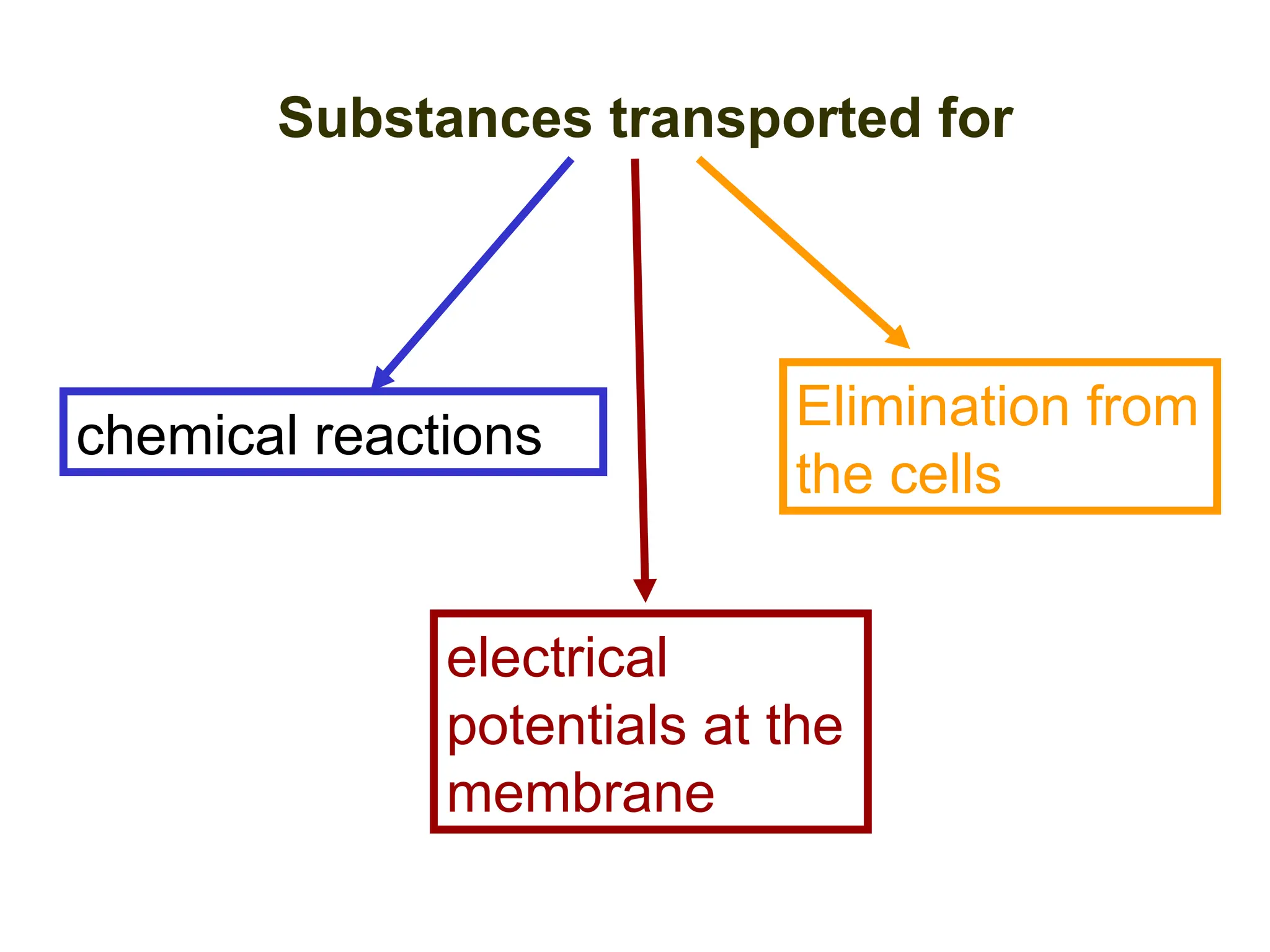
Substances transported for
chemical reactions
electrical
potentials at the
membrane
Elimination from
the cells
Cell Membrane
• surrounds entire cell and cell organelles
• Fluid in nature – movement of molecules
• Phospholipid bilayer – head – polar/hydrophilic
tail – nonpolar/hydrophobic
• Proteins
Integral –carrier & channel
Peripheral-receptors & antigen
Peripheral protein
(ankyrin)
Intrigal protein
Band 3
cytoskelatal protein
spectrin
Tail
(hydrophobic)
ECF
ICF
Glycolipid
Glycoprotein
Integral proteins
Intrinsic protein
Extrinsic protein
Lipid
bilayer
Head
(hydrophilic)
cholesterol
Functions of cell membrane
 Acts as semi permeable barrier –(selective)
oMaintains difference in composition of
ICF & ECF & fluid in various organelles
oProtects cell from toxic substances
oExcretion of waste products
oTransport of nutrients
 Receives signals from the outside
Chemical signals
Electrical signals
Site for attachment to the neighboring cells
Transport across cell membrane
Transport Mechanisms
Passive Active
Simple diffusion
Facilitated diffusion
Filtration
Osmosis
dialysis
Primary active transport
Secondary active transport
Endo/Exocytosis
Methods of transport
Passive Active
Lipid bilayer
Protein
channels
Leaky channels
Gated channels
Diffusion
Simple facilitated
Osmosis Filtration
voltage gated
Ligand gated
Dialysis
Simple diffusion -
Movement of molecules from higher
concentration to lower
concentration till equilibrium is reached
.Diffusion can takes place through:
a) Lipid bilayer
i) Lipid soluble substances-
O2,Co2,alcohol, steriods etc
ii) Lipid insoluble – water (through
spaces bet lipid mol) urea, sugar
(less or no
permeability)
iii) Electrolytes – impermeable
– charge on fatty acid chain
.
b) Protein Channels Open/leaky – Na+ channels,
K+ channels
Gated –channels open under specific conditions
Ligand gated
Na+
K+
Voltage gated
Na+,
K+
Ca++,
Mutation of ionic channels produce channelopathies –affecting
muscle and brain – paralysis or convulsions
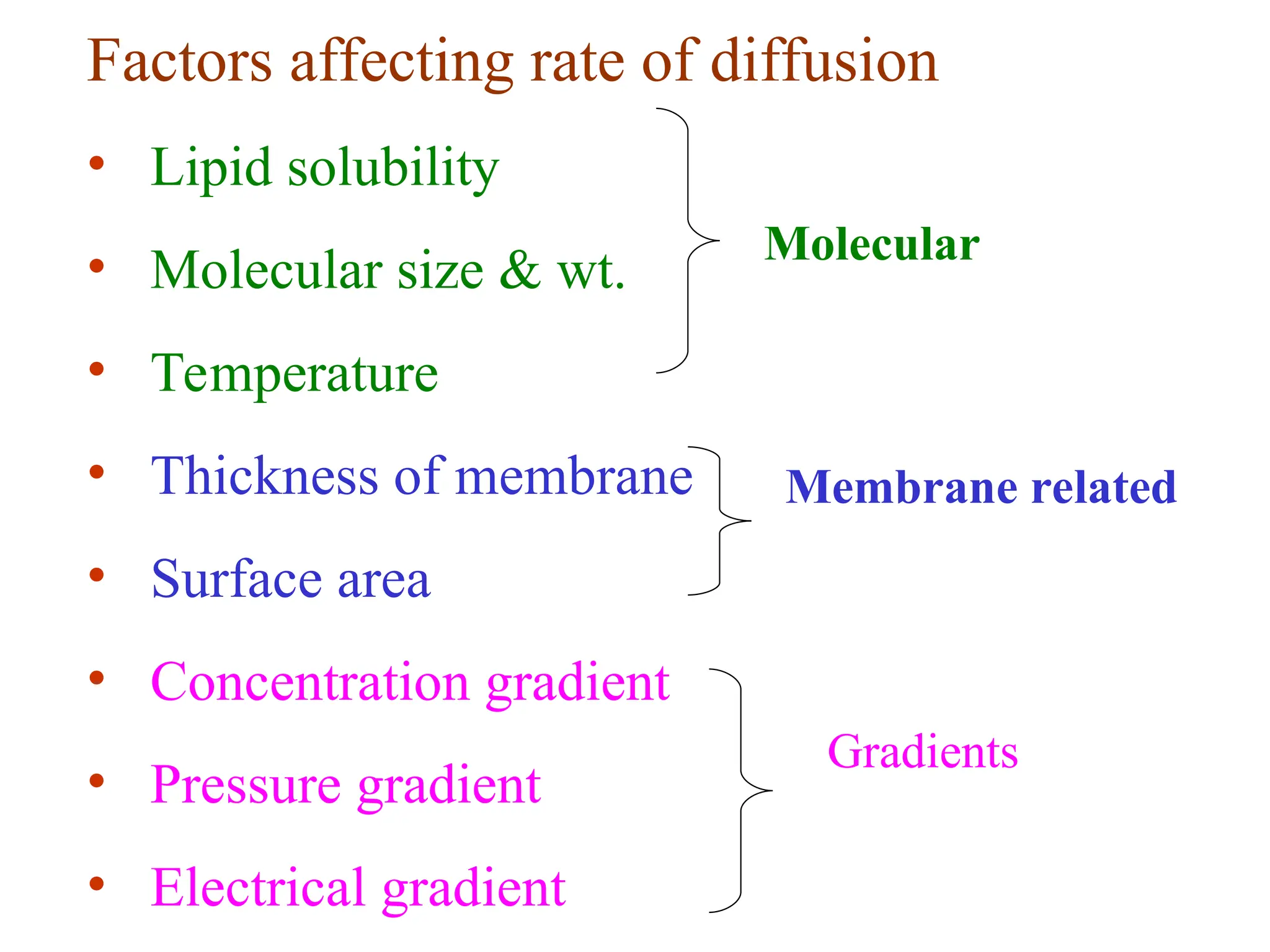
Factors affecting rate of diffusion
• Lipid solubility
• Molecular size & wt.
• Temperature
• Thickness of membrane
• Surface area
• Concentration gradient
• Pressure gradient
• Electrical gradient
Molecular
Membrane related
Gradients
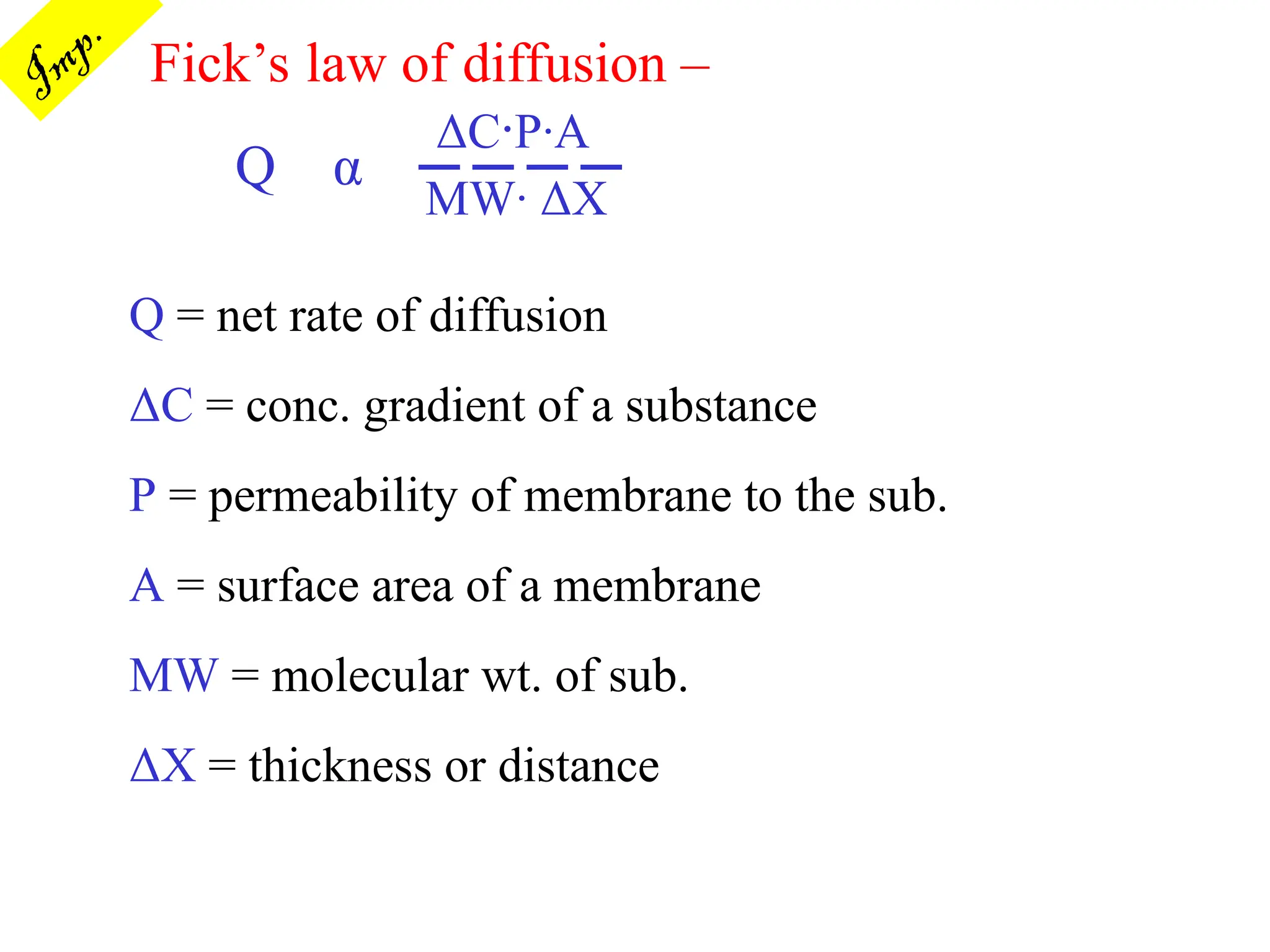
Fick’s law of diffusion –
Q α ─ ─ ─ ─
ΔC∙P∙A
MW∙ ΔX
Q = net rate of diffusion
ΔC = conc. gradient of a substance
P = permeability of membrane to the sub.
A = surface area of a membrane
MW = molecular wt. of sub.
ΔX = thickness or distance
Imp.
II. Facilitated diffusion :
- for larger water soluble mols.
- type of passive transport
- along the conc. Gradient
- carrier mediated transport
- receptor site on one side
Mechanism
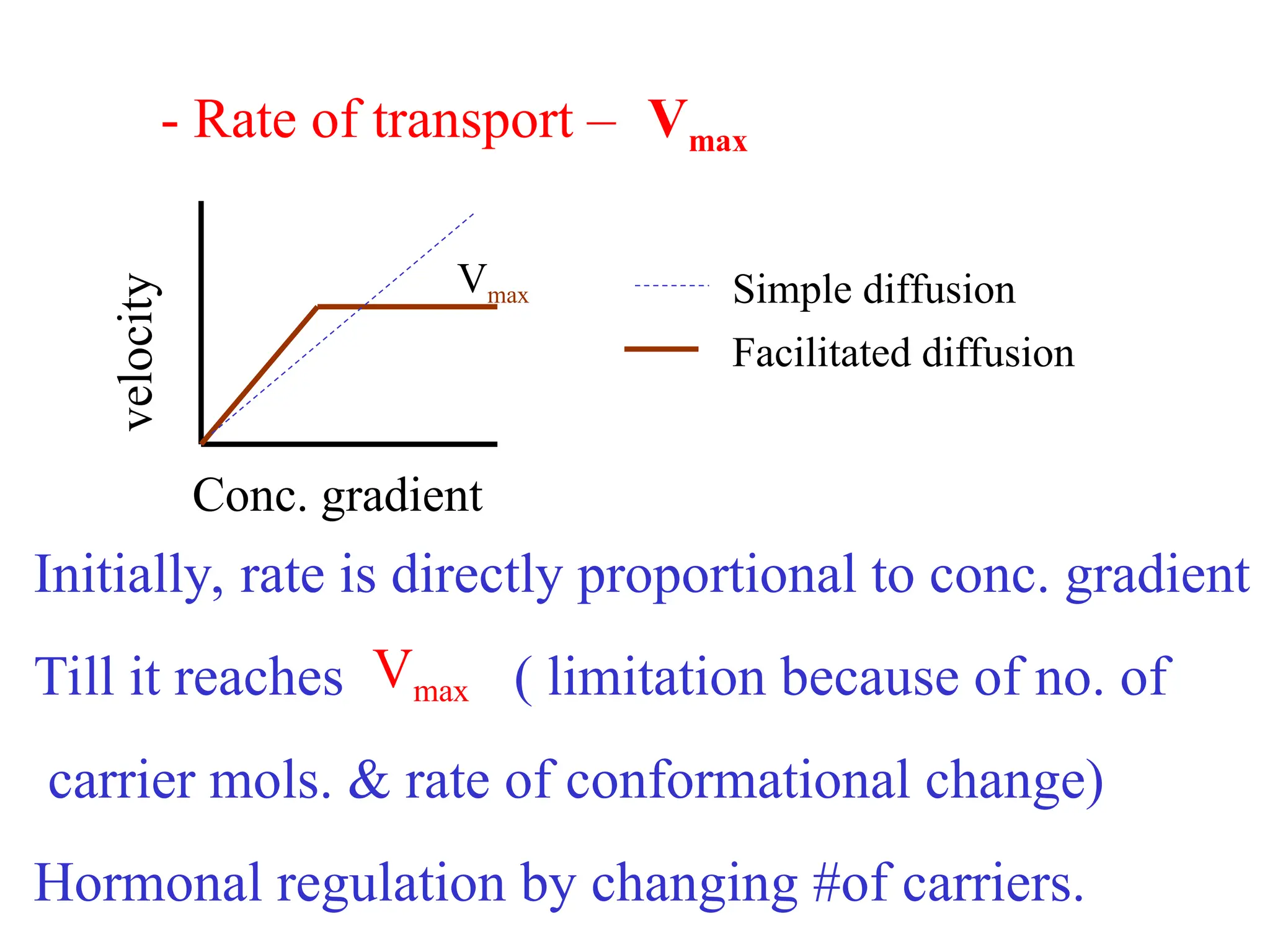
- Rate of transport –
Conc. gradient
velocity
Simple diffusion
Facilitated diffusion
Initially, rate is directly proportional to conc. gradient
Till it reaches ( limitation because of no. of
carrier mols. & rate of conformational change)
Hormonal regulation by changing #of carriers.
Vmax
Vmax
Vmax
- Peculiarities of carrier mediated transport –
 specificity,
 competitive or noncompetitive inhibition –
phloridzin for glucose
 saturation,
 blocking of receptor

Vmax
-Examples – transport of glucose, amino acids,
galactose, etc. in the peripheral cells or counter
transport of Ci and HCO3 in renal tubules
III. Osmosis & osmotic pressure–
when two solutions of different concentrations are
separated by a semi permeable membrane
( impermeable to solute and permeable to water )
water mols. diffuse from solution having less conc. To
the sol. having higher conc.
Osmotic pressure is the minimum pressure
applied on the solution with high conc. which
prevents osmosis.
- depends upon total no. of particles of dissolved
solutes rather than type of the particles
Osmols or mOsmols – expresses conc. of
osmotically active particles
1 osmol = total no. of particles in gram molecular
wt. of non diffusible substance per kg. of water
Isotonic, hypotonic & hypertonic solutions
Isotonic solution – fluids having osmolarity
same as that of plasma ( 290 mOsmols ) . Red
cells suspended in such solution do not shrink
or swell. ( 0.9 % NaCl, 5% glucose )
In Hypotonic soln. RBCs swell and hemolysis
may occur.
In hypertonic solution RBCs shrink because
water moves out.
Applied -
Gibbs – Donnan Equilibrium
Explains difference in the conc. of
diffusible ions in two compartments separated by
semi permeable membrane, when one
compartment contains non diffusible ions
Na +
Cl -
Pr -
A B
Na +
Cl -
Proteins are non
diffusible anions in A
Conc. Of Na +
is more
in A as compared to B
Na+
30
Pr - 30
Na+
30
Cl
-
30
Na+
30
Pr - 30
Na+
30
Cl
-
15
Cl
-
15
Na+
45
Pr - 30
Na+
15
Cl
-
15
Cl
-
15
A B
Na+
40
Pr - 30
Na+
20
Cl -
20
Cl -
10
conc. Gradient for Cl -
electrical gradient
Conc. gradient
electrical gradient
More –vity in A
Explaination –
1) All the solutions are electrically neutral.
( total no. of anions = total no. of cations )
2) Product of diffusible cations and an
anions in both the compartment is equal.
( Na+
A x Cl-
A = Na+
B x Cl-
B )
Applied –
In ICF conc. of diffusible K+
is more because of
presence of non diffusible Pr -
and PO4
-
Diffusion potential or Equilibrium potential - E
Potential generated across the cell membrane in
the presence of non diffusible ions in one
compartment.
Magnitude of potential developed can be
calculated by Nernst equation.
Equilibrium potential or diffusion potential (E)
= + 61 log ------------
Conc. inside
Conc. outside
EK = - 94 mV
ENa = + 61 mV
ECl = - 90 mV
Goldmann-Hodgkin’s equation =
- 61 log --------------------------------------
CNai.PNa + CKi.PNa + CClo.PClo
CNao.PNa + CKo.PNa + CClo.PCli
Nernst equation -
IV. Filtration
Filtration is a process in which fluid along
with solutes passes through a membrane due to
difference in pressures on both sides.
e.g. Filtration at capillary
Capillary hydrostatic pressure – 28mm Hg
Interstitial fluid hydrostatic pressure - -2mm Hg
Colloidal osmotic pressure - 25mm Hg
Net Filtration pressure = 28 - (- 2 + 25) = 5 mm Hg
V. Dialysis –
separation of larger dissolved particles from
smaller particles
It is used for elimination of waste products in the
blood in case of renal failure.
Active transport
 Primary active transport
 Secondary active transport
 Endocytosis
 Pinocytosis
 Phagocytosis
 Exocytosis
Peculiarities of active transport
1) Carrier mediated transport
2) Rapid rate of transport
3) Transport takes place against electrochemical
gradient ( uphill )
4) Expenditure of energy by transport protein
which incorporates ATPase activity
5) Carrier protein shows specificity, saturation
competitive inhibition, blocking
6) Substances transported – Na+
, K+
, H+
, Cl -,
I -
,
Glucose, Amino acids
I. Primary active transport –
Examples - Na+
- K+
pump, Ca++
pump
H+
-K+
pump
- Inner surface of carrier mol. has ATPase
which is activated by attachment of specific
ions and causes hydrolysis of ATP molecule
- Energy released from ATP causes
conformational change in the carrier which
transports ions to the opposite side.
a) Na+
-K +
pump- electrogenic pump
- Attachment of 2K+
on outer side & 3 Na+
on inner side
Activation of ATPase
Conformational change
Efflux of 3 Na+
& influx of 2K+
Creates high K+
conc. & - vity inside the cell
Helps in maintaining cell volume
3Na+
2K+
ATP
aes
Na-K pump is one of the major energy using
process in the body & accounts for a large part
of basal metabolism.
Regulators of Na-K pump –
- Incraesed amount of cellular Na conc.
- Thyroid hormones increase pump activity by more # of Na-K
ATPase mol
- Aldosterone also increases # of pumps
- DOPamine inhibits pump
- Insulin increases pump activity
- Oubain or Digitalis inhibits ATPase (used when weakness of
cardiac muscle –maintains Ca conc. In ICF of cardiac muscle
- Ca++ pump –
present in the membrane of ER,
mitochondria and cell membrane
- involves uniport carrier
- helps to maintain low Ca++conc. in ICF
II. Secondary active transport
Active transport depending upon conc.
gradient of Na+ from ECF to ICF created by
utilization of energy
_ carrier does not have ATPase activity
Substance is transported along with Na+
(Na increases affinity of carrier for gl.)
Na+ is transported only when glucose mol. is
attached
Examples – a) Reabsorption of glucose & amino
acids in PCT & Intestinal mucosa – Co-transport
mechanism
b) H+ secretion by tubular epithelium
– counter transport mechanism
c)In heart Na-K ATPase indirectly affects Ca transport. –antiport
in the membrane of cardiac muscle exchanges intracellular Ca for
extracellular Na
Na+
K+
Glucose
lumen
basal
 Na + – K + pump on basal side
 Electrochemical gradient for Na + on luminal side
 Carrier mediated transport (SGLT-1)of Na+ along
with glucose ( or amino acid ) through the apical
membrane
 Transport of glucose by facilitated diffusion
( GLUT-2 ) through basal side
Types of transporters
Uniport Synport Antiport
Extracellular material to be tackled by
lysosomes is brought into the cell by
endocytosis
3 types
pinocytosis
Receptor
mediated
endocytosis
phagocytosis
Specialised
cells
All cells
Requires ATPase, Ca, microfilaments
dynamin
Membrane deforming
coat protein
Endocytic
vesicle
ECF
Pinocytosis
ECF
B. Receptor mediated endocytosis – highly
selective process to import imp. specific large
molecules. Requires energy & Ca++.
Coated pit
Clathrin, actin,
myosin
e.g. endocytosis of low density
lipoproteins
e.g. endocytosis of viruses such as
hepatitis, AIDS viruses & excess iron
C. Phagocytosis
• Internalization of large multimolecular
particles, bacteria, dead tissues by
specialized cells e.g. certain types of
w.b.c.s ( Professional phagocytes)
• The material makes contact with the
cell membrane which then invaginates.
Pseudopodia
internalization
Fusion
digestion
absorption
Residual
body
Phagoso-
some
Phagocytosis
bacterium
Passive transport Active transport
• No expenditure of
energy molecules
• Takes place along
conc., electrical, &
pressure gradient
• Carrier may or may
not be required
• Rate is proportional to
conc. difference
• Expenditure of energy
mol. ( ATP )
• Can take place against
conc. Gradient
• Carrier is always
required
• Rate is proportional to
availability of carrier
& energy. (Vmax)
Simple Diffusion Facilitated Diffusion
• Passive transport
• For small molecules
• No carrier required
• Rate of transport is
directly proportional to
conc. gradient
• Examples –
Lipid soluble –
O2, CO2, alcohol
Lipid insoluble –
urea, Na+, K+
• Passive transport
• For large molecules
• Carrier mediated
• Initially rate is
proportional to conc.
gradient till Vmax
( saturation of carriers)
• Examples –
glucose, amino acids

membrane_transport general biology 1.ppt

  • 1.
    Substances transported for chemicalreactions electrical potentials at the membrane Elimination from the cells
  • 2.
    Cell Membrane • surroundsentire cell and cell organelles • Fluid in nature – movement of molecules • Phospholipid bilayer – head – polar/hydrophilic tail – nonpolar/hydrophobic • Proteins Integral –carrier & channel Peripheral-receptors & antigen
  • 3.
  • 4.
  • 5.
    Functions of cellmembrane  Acts as semi permeable barrier –(selective) oMaintains difference in composition of ICF & ECF & fluid in various organelles oProtects cell from toxic substances oExcretion of waste products oTransport of nutrients  Receives signals from the outside Chemical signals Electrical signals Site for attachment to the neighboring cells
  • 6.
    Transport across cellmembrane Transport Mechanisms Passive Active Simple diffusion Facilitated diffusion Filtration Osmosis dialysis Primary active transport Secondary active transport Endo/Exocytosis
  • 7.
    Methods of transport PassiveActive Lipid bilayer Protein channels Leaky channels Gated channels Diffusion Simple facilitated Osmosis Filtration voltage gated Ligand gated Dialysis
  • 8.
    Simple diffusion - Movementof molecules from higher concentration to lower concentration till equilibrium is reached
  • 9.
    .Diffusion can takesplace through: a) Lipid bilayer i) Lipid soluble substances- O2,Co2,alcohol, steriods etc ii) Lipid insoluble – water (through spaces bet lipid mol) urea, sugar (less or no permeability) iii) Electrolytes – impermeable – charge on fatty acid chain
  • 10.
    . b) Protein ChannelsOpen/leaky – Na+ channels, K+ channels Gated –channels open under specific conditions Ligand gated Na+ K+ Voltage gated Na+, K+ Ca++, Mutation of ionic channels produce channelopathies –affecting muscle and brain – paralysis or convulsions
  • 11.
    Factors affecting rateof diffusion • Lipid solubility • Molecular size & wt. • Temperature • Thickness of membrane • Surface area • Concentration gradient • Pressure gradient • Electrical gradient Molecular Membrane related Gradients
  • 12.
    Fick’s law ofdiffusion – Q α ─ ─ ─ ─ ΔC∙P∙A MW∙ ΔX Q = net rate of diffusion ΔC = conc. gradient of a substance P = permeability of membrane to the sub. A = surface area of a membrane MW = molecular wt. of sub. ΔX = thickness or distance Imp.
  • 13.
    II. Facilitated diffusion: - for larger water soluble mols. - type of passive transport - along the conc. Gradient - carrier mediated transport - receptor site on one side Mechanism
  • 14.
    - Rate oftransport – Conc. gradient velocity Simple diffusion Facilitated diffusion Initially, rate is directly proportional to conc. gradient Till it reaches ( limitation because of no. of carrier mols. & rate of conformational change) Hormonal regulation by changing #of carriers. Vmax Vmax Vmax
  • 16.
    - Peculiarities ofcarrier mediated transport –  specificity,  competitive or noncompetitive inhibition – phloridzin for glucose  saturation,  blocking of receptor  Vmax -Examples – transport of glucose, amino acids, galactose, etc. in the peripheral cells or counter transport of Ci and HCO3 in renal tubules
  • 17.
    III. Osmosis &osmotic pressure– when two solutions of different concentrations are separated by a semi permeable membrane ( impermeable to solute and permeable to water ) water mols. diffuse from solution having less conc. To the sol. having higher conc.
  • 18.
    Osmotic pressure isthe minimum pressure applied on the solution with high conc. which prevents osmosis. - depends upon total no. of particles of dissolved solutes rather than type of the particles Osmols or mOsmols – expresses conc. of osmotically active particles 1 osmol = total no. of particles in gram molecular wt. of non diffusible substance per kg. of water
  • 19.
    Isotonic, hypotonic &hypertonic solutions Isotonic solution – fluids having osmolarity same as that of plasma ( 290 mOsmols ) . Red cells suspended in such solution do not shrink or swell. ( 0.9 % NaCl, 5% glucose ) In Hypotonic soln. RBCs swell and hemolysis may occur. In hypertonic solution RBCs shrink because water moves out. Applied -
  • 20.
    Gibbs – DonnanEquilibrium Explains difference in the conc. of diffusible ions in two compartments separated by semi permeable membrane, when one compartment contains non diffusible ions Na + Cl - Pr - A B Na + Cl - Proteins are non diffusible anions in A Conc. Of Na + is more in A as compared to B
  • 21.
    Na+ 30 Pr - 30 Na+ 30 Cl - 30 Na+ 30 Pr- 30 Na+ 30 Cl - 15 Cl - 15 Na+ 45 Pr - 30 Na+ 15 Cl - 15 Cl - 15 A B Na+ 40 Pr - 30 Na+ 20 Cl - 20 Cl - 10 conc. Gradient for Cl - electrical gradient Conc. gradient electrical gradient More –vity in A
  • 22.
    Explaination – 1) Allthe solutions are electrically neutral. ( total no. of anions = total no. of cations ) 2) Product of diffusible cations and an anions in both the compartment is equal. ( Na+ A x Cl- A = Na+ B x Cl- B ) Applied – In ICF conc. of diffusible K+ is more because of presence of non diffusible Pr - and PO4 -
  • 23.
    Diffusion potential orEquilibrium potential - E Potential generated across the cell membrane in the presence of non diffusible ions in one compartment. Magnitude of potential developed can be calculated by Nernst equation.
  • 24.
    Equilibrium potential ordiffusion potential (E) = + 61 log ------------ Conc. inside Conc. outside EK = - 94 mV ENa = + 61 mV ECl = - 90 mV Goldmann-Hodgkin’s equation = - 61 log -------------------------------------- CNai.PNa + CKi.PNa + CClo.PClo CNao.PNa + CKo.PNa + CClo.PCli Nernst equation -
  • 25.
    IV. Filtration Filtration isa process in which fluid along with solutes passes through a membrane due to difference in pressures on both sides. e.g. Filtration at capillary Capillary hydrostatic pressure – 28mm Hg Interstitial fluid hydrostatic pressure - -2mm Hg Colloidal osmotic pressure - 25mm Hg Net Filtration pressure = 28 - (- 2 + 25) = 5 mm Hg
  • 26.
    V. Dialysis – separationof larger dissolved particles from smaller particles It is used for elimination of waste products in the blood in case of renal failure.
  • 27.
    Active transport  Primaryactive transport  Secondary active transport  Endocytosis  Pinocytosis  Phagocytosis  Exocytosis
  • 28.
    Peculiarities of activetransport 1) Carrier mediated transport 2) Rapid rate of transport 3) Transport takes place against electrochemical gradient ( uphill ) 4) Expenditure of energy by transport protein which incorporates ATPase activity
  • 29.
    5) Carrier proteinshows specificity, saturation competitive inhibition, blocking 6) Substances transported – Na+ , K+ , H+ , Cl -, I - , Glucose, Amino acids
  • 30.
    I. Primary activetransport – Examples - Na+ - K+ pump, Ca++ pump H+ -K+ pump - Inner surface of carrier mol. has ATPase which is activated by attachment of specific ions and causes hydrolysis of ATP molecule - Energy released from ATP causes conformational change in the carrier which transports ions to the opposite side.
  • 31.
    a) Na+ -K + pump-electrogenic pump - Attachment of 2K+ on outer side & 3 Na+ on inner side Activation of ATPase Conformational change Efflux of 3 Na+ & influx of 2K+ Creates high K+ conc. & - vity inside the cell Helps in maintaining cell volume 3Na+ 2K+ ATP aes
  • 32.
    Na-K pump isone of the major energy using process in the body & accounts for a large part of basal metabolism. Regulators of Na-K pump – - Incraesed amount of cellular Na conc. - Thyroid hormones increase pump activity by more # of Na-K ATPase mol - Aldosterone also increases # of pumps - DOPamine inhibits pump - Insulin increases pump activity - Oubain or Digitalis inhibits ATPase (used when weakness of cardiac muscle –maintains Ca conc. In ICF of cardiac muscle
  • 33.
    - Ca++ pump– present in the membrane of ER, mitochondria and cell membrane - involves uniport carrier - helps to maintain low Ca++conc. in ICF
  • 34.
    II. Secondary activetransport Active transport depending upon conc. gradient of Na+ from ECF to ICF created by utilization of energy _ carrier does not have ATPase activity Substance is transported along with Na+ (Na increases affinity of carrier for gl.) Na+ is transported only when glucose mol. is attached
  • 35.
    Examples – a)Reabsorption of glucose & amino acids in PCT & Intestinal mucosa – Co-transport mechanism b) H+ secretion by tubular epithelium – counter transport mechanism c)In heart Na-K ATPase indirectly affects Ca transport. –antiport in the membrane of cardiac muscle exchanges intracellular Ca for extracellular Na
  • 36.
    Na+ K+ Glucose lumen basal  Na +– K + pump on basal side  Electrochemical gradient for Na + on luminal side  Carrier mediated transport (SGLT-1)of Na+ along with glucose ( or amino acid ) through the apical membrane  Transport of glucose by facilitated diffusion ( GLUT-2 ) through basal side
  • 37.
  • 38.
    Extracellular material tobe tackled by lysosomes is brought into the cell by endocytosis 3 types pinocytosis Receptor mediated endocytosis phagocytosis Specialised cells All cells Requires ATPase, Ca, microfilaments
  • 39.
  • 40.
    B. Receptor mediatedendocytosis – highly selective process to import imp. specific large molecules. Requires energy & Ca++. Coated pit Clathrin, actin, myosin e.g. endocytosis of low density lipoproteins e.g. endocytosis of viruses such as hepatitis, AIDS viruses & excess iron
  • 41.
    C. Phagocytosis • Internalizationof large multimolecular particles, bacteria, dead tissues by specialized cells e.g. certain types of w.b.c.s ( Professional phagocytes) • The material makes contact with the cell membrane which then invaginates.
  • 42.
  • 43.
    Passive transport Activetransport • No expenditure of energy molecules • Takes place along conc., electrical, & pressure gradient • Carrier may or may not be required • Rate is proportional to conc. difference • Expenditure of energy mol. ( ATP ) • Can take place against conc. Gradient • Carrier is always required • Rate is proportional to availability of carrier & energy. (Vmax)
  • 44.
    Simple Diffusion FacilitatedDiffusion • Passive transport • For small molecules • No carrier required • Rate of transport is directly proportional to conc. gradient • Examples – Lipid soluble – O2, CO2, alcohol Lipid insoluble – urea, Na+, K+ • Passive transport • For large molecules • Carrier mediated • Initially rate is proportional to conc. gradient till Vmax ( saturation of carriers) • Examples – glucose, amino acids

Editor's Notes

  • #1 Cell membrane – complex structure –lipids, proteins, carbo. Pr :lipids = 50:50 by mass but 1:50 by # of mol.– varies with function of cell e.g. schwann’s cell 75% lipids and mitochon. 75% proteins Functions of proteins - en
  • #2 Pr.-enzymes,transport,structural,antigens9for histocompatibility),receptors Lipid bilayer – amphipathic Integral pr run through the thickness of membrane may be several times –channels for ions, carrier,pumps,receptors,enzymes Peripheral proteins- cell adhesion mol.(CAMs),cytoskeleton – e.g. Ankyrin on inner side of RBC binds spectrinefilament with Band3 protein in membrane –biconcave Fluid mosiac – for Membrane transport & enzyme action – effect of temp.,density of pr,
  • #4 Fluid masiac – membrane proteins like iceberg in sea –floating in sea of phospholipids which also moves Translational diffusion –rate many micrometrs/sec. Long chain & saturated fatty acids mke membrane stiff. More kinks in unsaturated f atty acids-more fluidity Cholesterol helps to maintain fluidity over widrange of temp. Regional assymetry of membrane Transverse assymetry
  • #5 Membrane disorders – 1) mutation of receptors e.g. herditory spherocytosis –gene coding spectin is affected Myashenia gravis – antibody against receptor Ischaemia of ionic channels Increase fragility – pr:cholesterol
  • #39 Jlkfjglfgk;fdlgkd;glk