Alumni Association, Department of English
organizes
NET/SET Coaching Programme
22N D
SEPT. 2025
Logical reasoning
MS. JHEEL D. BARAD
A S S I S TA N T P R O F E S S O R
S I L V E R O A K C O L L E G E O F C O M P U T E R A P P L I C AT I O N ,
S I L V E R O A K U N I V E R S I T Y, A H M E D A B A D
Syllabus
Understanding the structure of arguments: argument forms, structure of categorical propositions,
Mood and Figure, Formal and Informal fallacies, Uses of language, Connotations and denotations of
terms, Classical square of opposition.
Evaluating and distinguishing deductive and inductive reasoning.
Analogies.
Venn diagram: Simple and multiple use for establishing validity of arguments.
Indian Logic: Means of knowledge.
Pramanas: Pratyaksha (Perception), Anumana (Inference), Upamana (Comparison), Shabda (Verbal
testimony), Arthapatti (Implication) and Anupalabddhi (Non-apprehension).
Structure and kinds of Anumana (inference), Vyapti (invariable relation), Hetvabhasas (fallacies of
inference).
Introduction
Logic: Applying Principles to obtain inferences
Analytical Reasoning (Subjective)
Logical Reasoning (Rational/ Objective)
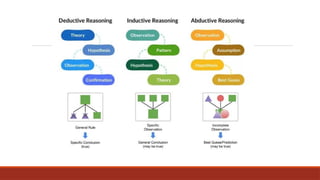
◦ Deductive reasoning [Top- down approach]: Provides certainty
◦ Inductive Reasoning [Bottom- Up approach] : Probabilistic
◦ Abductive Reasoning [Educational Guess]
D
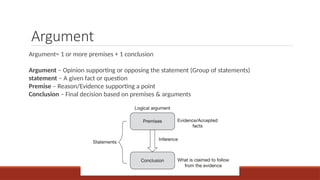
Argument
Argument= 1 or more premises + 1 conclusion
Argument – Opinion supporting or opposing the statement (Group of statements)
statement – A given fact or question
Premise – Reason/Evidence supporting a point
Conclusion – Final decision based on premises & arguments
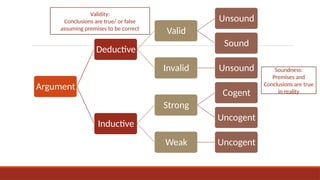
Argument
Deductive
Valid
Unsound
Sound
Invalid Unsound
Inductive
Strong
Cogent
Uncogent
Weak Uncogent
Validity:
Conclusions are true/ or false
assuming premises to be correct
Soundness:
Premises and
Conclusions are true
in reality
D
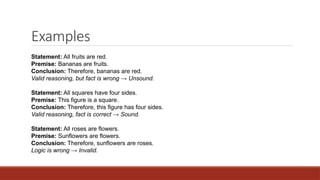
Examples
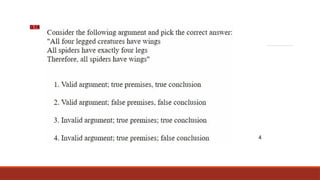
Statement: All fruits are red.
Premise: Bananas are fruits.
Conclusion: Therefore, bananas are red.
Valid reasoning, but fact is wrong → Unsound.
Statement: All squares have four sides.
Premise: This figure is a square.
Conclusion: Therefore, this figure has four sides.
Valid reasoning, fact is correct → Sound.
Statement: All roses are flowers.
Premise: Sunflowers are flowers.
Conclusion: Therefore, sunflowers are roses.
Logic is wrong → Invalid.
4
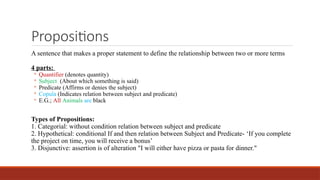
Propositions
A sentence that makes a proper statement to define the relationship between two or more terms
4 parts:
◦ Quantifier (denotes quantity)
◦ Subject (About which something is said)
◦ Predicate (Affirms or denies the subject)
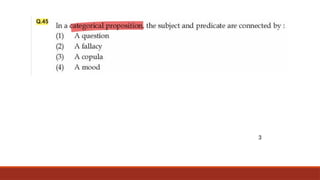
◦ Copula (Indicates relation between subject and predicate)
◦ E.G.; All Animals are black
Types of Propositions:
1. Categorial: without condition relation between subject and predicate
2. Hypothetical: conditional If and then relation between Subject and Predicate- ‘If you complete
the project on time, you will receive a bonus’
3. Disjunctive: assertion is of alteration "I will either have pizza or pasta for dinner."
3
Categorial Propositions
Form
Type Meaning Hidden propositions Quantity Quality Example
A All S is/are P Each, Every, Any, Only Universal Affirmative All dogs are loyal.
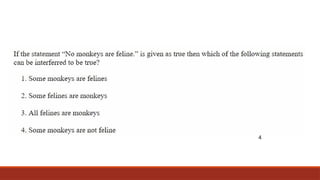
E No S is/are P No, Never, None Universal Negative No dogs are reptiles
I Some S is/are P Positive (I type): Most, a
few, mostly, generally,
almost: Negative (O Type)
Negative (I type): seldom,
Scarcely, Rarely, few,
hardly, little: Positive (O
Type)
Particular Affirmative Some dogs are friendly
O Some S is/are not P Particular Negative Some dogs are not friendly
Parts of categorial proposition
Major Premise: Predicate of conclusion [Major term]; Premise containing major term
Minor Premise: Subject of Conclusion [Minor term}; Premise containing minor term
Middle term: Term common in both premise and not a part of conclusion
Conclusion: Subject is subject of 1st
proposition; Predicate in Predicate of 2nd
Proposition
Premise 1: All humans are
mortal.
Premise 2: Socrates is a human.
Conclusion: Therefore, Socrates
is mortal.
4
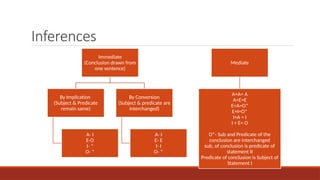
Inferences
Immediate
(Conclusion drawn from
one sentence)
By Implication
(Subject & Predicate
remain same)
A- I
E-O
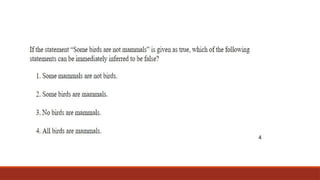
I- *
O- *
By Conversion
(Subject & predicate are
interchanged)
A- I
E- E
I- I
O- *
Mediate
A+A= A
A+E=E
E+A=O*
E+I=O*
I+A = I
I + E= O
O*- Sub and Predicate of the
conclusion are interchanged
sub, of conclusion is predicate of
statement II
Predicate of conclusion is Subject of
Statement I
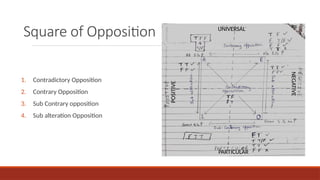
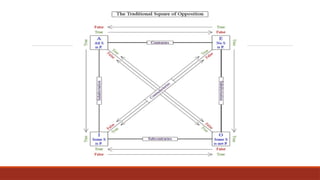
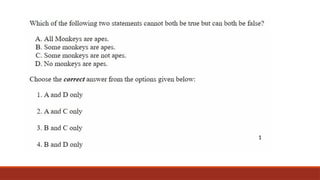
Square of Opposition
1. Contradictory Opposition
2. Contrary Opposition
3. Sub Contrary opposition
4. Sub alteration Opposition
UNIVERSAL
PARTICULAR
POSITIVE
NEGATIVE
1
4
4
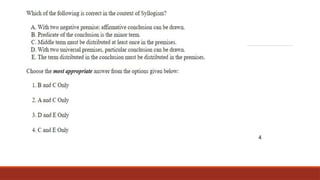
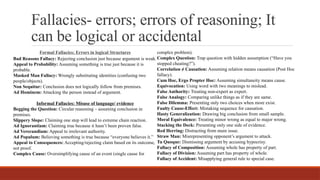
Fallacies- errors; errors of reasoning; It
can be logical or accidental
Formal Fallacies: Errors in logical Structures
Bad Reasons Fallacy: Rejecting conclusion just because argument is weak.
Appeal to Probability: Assuming something is true just because it is
probable.
Masked Man Fallacy: Wrongly substituting identities (confusing two
people/objects).
Non Sequitur: Conclusion does not logically follow from premises.
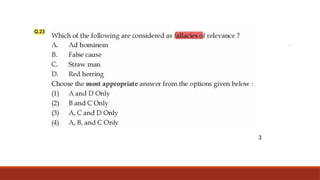
Ad Hominem: Attacking the person instead of argument.
Informal Fallacies: Misuse of language/ evidence
Begging the Question: Circular reasoning – assuming conclusion in
premises.
Slippery Slope: Claiming one step will lead to extreme chain reaction.
Ad Ignorantiam: Claiming true because it hasn’t been proven false.
Ad Verecundiam: Appeal to irrelevant authority.
Ad Populum: Believing something is true because “everyone believes it.”
Appeal to Consequences: Accepting/rejecting claim based on its outcome,
not proof.
Complex Cause: Oversimplifying cause of an event (single cause for
complex problem).
Complex Question: Trap question with hidden assumption (“Have you
stopped cheating?”).
Correlation ≠ Causation: Assuming relation means causation (Post Hoc
fallacy).
Cum Hoc, Ergo Propter Hoc: Assuming simultaneity means cause.
Equivocation: Using word with two meanings to mislead.
False Authority: Treating non-expert as expert.
False Analogy: Comparing unlike things as if they are same.
False Dilemma: Presenting only two choices when more exist.
Faulty Cause-Effect: Mistaking sequence for causation.
Hasty Generalization: Drawing big conclusion from small sample.
Moral Equivalence: Treating minor wrong as equal to major wrong.
Stacking the Deck: Presenting only one side of evidence.
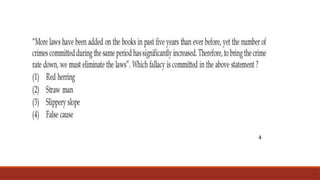
Red Herring: Distracting from main issue.
Straw Man: Misrepresenting opponent’s argument to attack.
Tu Quoque: Dismissing argument by accusing hypocrisy.
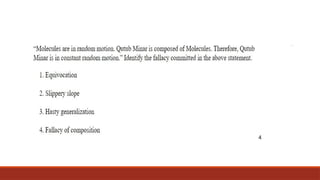
Fallacy of Composition: Assuming whole has property of part.
Fallacy of Division: Assuming part has property of whole.
Fallacy of Accident: Misapplying general rule to special case.
4
4
3
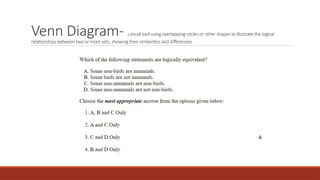
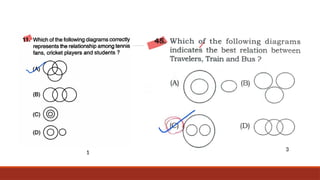
Venn Diagram- a visual tool using overlapping circles or other shapes to illustrate the logical
relationships between two or more sets, showing their similarities and differences.
4
1
3
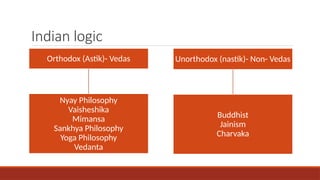
Indian logic
Orthodox (Astik)- Vedas
Nyay Philosophy
Vaisheshika
Mimansa
Sankhya Philosophy
Yoga Philosophy
Vedanta
Unorthodox (nastik)- Non- Vedas
Buddhist
Jainism
Charvaka
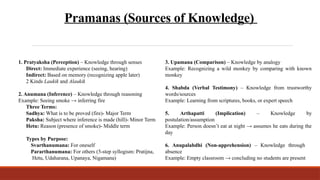
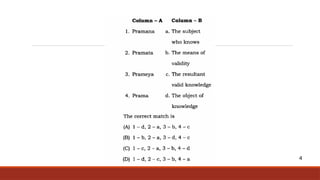
Pramanas (Sources of Knowledge)
1. Pratyaksha (Perception) – Knowledge through senses
Direct: Immediate experience (seeing, hearing)
Indirect: Based on memory (recognizing apple later)
2 Kinds Laukik and Alaukik
2. Anumana (Inference) – Knowledge through reasoning
Example: Seeing smoke → inferring fire
Three Terms:
Sadhya: What is to be proved (fire)- Major Term
Paksha: Subject where inference is made (hill)- Minor Term
Hetu: Reason (presence of smoke)- Middle term
Types by Purpose:
Svarthanumana: For oneself
Pararthanumana: For others (5-step syllogism: Pratijna,
Hetu, Udaharana, Upanaya, Nigamana)
3. Upamana (Comparison) – Knowledge by analogy
Example: Recognizing a wild monkey by comparing with known
monkey
4. Shabda (Verbal Testimony) – Knowledge from trustworthy
words/sources
Example: Learning from scriptures, books, or expert speech
5. Arthapatti (Implication) – Knowledge by
postulation/assumption
Example: Person doesn’t eat at night → assumes he eats during the
day
6. Anupalabdhi (Non-apprehension) – Knowledge through
absence
Example: Empty classroom → concluding no students are present
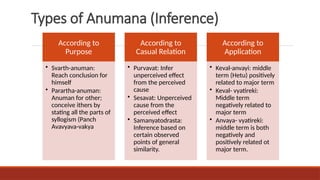
Types of Anumana (Inference)
According to
Purpose
• Svarth-anuman:
Reach conclusion for
himself
• Parartha-anuman:
Anuman for other;
conceive ithers by
stating all the parts of
syllogism (Panch
Avavyava-vakya
According to
Casual Relation
• Purvavat: Infer
unperceived effect
from the perceived
cause
• Sesavat: Unperceived
cause from the
perceived effect
• Samanyatodrasta:
Inference based on
certain observed
points of general
similarity.
According to
Application
• Keval-anvayi: middle
term (Hetu) positively
related to major term
• Keval- vyatireki:
Middle term
negatively related to
major term
• Anvaya- vyatireki:
middle term is both
negatively and
positively related ot
major term.
1
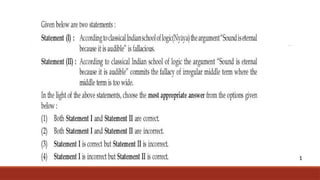
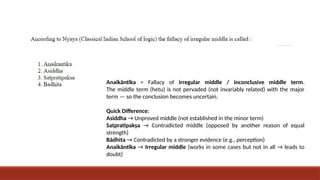
Anaikāntika = Fallacy of irregular middle / inconclusive middle term.
The middle term (hetu) is not pervaded (not invariably related) with the major
term — so the conclusion becomes uncertain.
Quick Difference:
Asiddha → Unproved middle (not established in the minor term)
Satpratipakṣa → Contradicted middle (opposed by another reason of equal
strength)
Bādhita → Contradicted by a stronger evidence (e.g., perception)
Anaikāntika → Irregular middle (works in some cases but not in all → leads to
doubt)
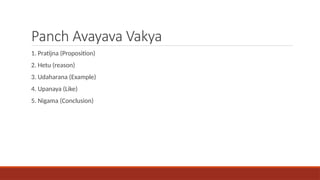
Panch Avayava Vakya
1. Pratijna (Proposition)
2. Hetu (reason)
3. Udaharana (Example)
4. Upanaya (Like)
5. Nigama (Conclusion)
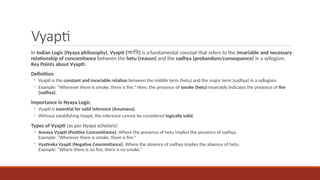
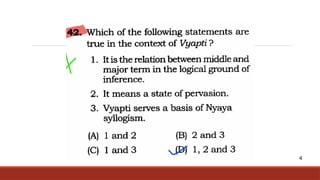
Vyapti
In Indian Logic (Nyaya philosophy), Vyapti (व्याप्ति) is a fundamental concept that refers to the invariable and necessary
relationship of concomitance between the hetu (reason) and the sadhya (probandum/consequence) in a syllogism.
Key Points about Vyapti:
Definition:
◦ Vyapti is the constant and invariable relation between the middle term (hetu) and the major term (sadhya) in a syllogism.
◦ Example: “Wherever there is smoke, there is fire.” Here, the presence of smoke (hetu) invariably indicates the presence of fire
(sadhya).
Importance in Nyaya Logic:
◦ Vyapti is essential for valid inference (Anumana).
◦ Without establishing Vyapti, the inference cannot be considered logically valid.
Types of Vyapti (as per Nyaya scholars):
◦ Anvaya Vyapti (Positive Concomitance): Where the presence of hetu implies the presence of sadhya.
Example: “Wherever there is smoke, there is fire.”
◦ Vyatireka Vyapti (Negative Concomitance): Where the absence of sadhya implies the absence of hetu.
Example: “Where there is no fire, there is no smoke.”
4
4
SCAN
FOR
THE
QUIZ

Logical Reasoning (NET- SET) | Paper 1| PYQS

  • 1.
    Alumni Association, Departmentof English organizes NET/SET Coaching Programme 22N D SEPT. 2025 Logical reasoning MS. JHEEL D. BARAD A S S I S TA N T P R O F E S S O R S I L V E R O A K C O L L E G E O F C O M P U T E R A P P L I C AT I O N , S I L V E R O A K U N I V E R S I T Y, A H M E D A B A D
  • 2.
    Syllabus Understanding the structureof arguments: argument forms, structure of categorical propositions, Mood and Figure, Formal and Informal fallacies, Uses of language, Connotations and denotations of terms, Classical square of opposition. Evaluating and distinguishing deductive and inductive reasoning. Analogies. Venn diagram: Simple and multiple use for establishing validity of arguments. Indian Logic: Means of knowledge. Pramanas: Pratyaksha (Perception), Anumana (Inference), Upamana (Comparison), Shabda (Verbal testimony), Arthapatti (Implication) and Anupalabddhi (Non-apprehension). Structure and kinds of Anumana (inference), Vyapti (invariable relation), Hetvabhasas (fallacies of inference).
  • 3.
    Introduction Logic: Applying Principlesto obtain inferences Analytical Reasoning (Subjective) Logical Reasoning (Rational/ Objective) ◦ Deductive reasoning [Top- down approach]: Provides certainty ◦ Inductive Reasoning [Bottom- Up approach] : Probabilistic ◦ Abductive Reasoning [Educational Guess]
  • 5.
  • 6.
    Argument Argument= 1 ormore premises + 1 conclusion Argument – Opinion supporting or opposing the statement (Group of statements) statement – A given fact or question Premise – Reason/Evidence supporting a point Conclusion – Final decision based on premises & arguments
  • 7.
    Argument Deductive Valid Unsound Sound Invalid Unsound Inductive Strong Cogent Uncogent Weak Uncogent Validity: Conclusionsare true/ or false assuming premises to be correct Soundness: Premises and Conclusions are true in reality
  • 8.
  • 9.
    Examples Statement: All fruitsare red. Premise: Bananas are fruits. Conclusion: Therefore, bananas are red. Valid reasoning, but fact is wrong → Unsound. Statement: All squares have four sides. Premise: This figure is a square. Conclusion: Therefore, this figure has four sides. Valid reasoning, fact is correct → Sound. Statement: All roses are flowers. Premise: Sunflowers are flowers. Conclusion: Therefore, sunflowers are roses. Logic is wrong → Invalid.
  • 10.
  • 11.
    Propositions A sentence thatmakes a proper statement to define the relationship between two or more terms 4 parts: ◦ Quantifier (denotes quantity) ◦ Subject (About which something is said) ◦ Predicate (Affirms or denies the subject) ◦ Copula (Indicates relation between subject and predicate) ◦ E.G.; All Animals are black Types of Propositions: 1. Categorial: without condition relation between subject and predicate 2. Hypothetical: conditional If and then relation between Subject and Predicate- ‘If you complete the project on time, you will receive a bonus’ 3. Disjunctive: assertion is of alteration "I will either have pizza or pasta for dinner."
  • 12.
  • 13.
    Categorial Propositions Form Type MeaningHidden propositions Quantity Quality Example A All S is/are P Each, Every, Any, Only Universal Affirmative All dogs are loyal. E No S is/are P No, Never, None Universal Negative No dogs are reptiles I Some S is/are P Positive (I type): Most, a few, mostly, generally, almost: Negative (O Type) Negative (I type): seldom, Scarcely, Rarely, few, hardly, little: Positive (O Type) Particular Affirmative Some dogs are friendly O Some S is/are not P Particular Negative Some dogs are not friendly Parts of categorial proposition Major Premise: Predicate of conclusion [Major term]; Premise containing major term Minor Premise: Subject of Conclusion [Minor term}; Premise containing minor term Middle term: Term common in both premise and not a part of conclusion Conclusion: Subject is subject of 1st proposition; Predicate in Predicate of 2nd Proposition Premise 1: All humans are mortal. Premise 2: Socrates is a human. Conclusion: Therefore, Socrates is mortal.
  • 14.
  • 15.
    Inferences Immediate (Conclusion drawn from onesentence) By Implication (Subject & Predicate remain same) A- I E-O I- * O- * By Conversion (Subject & predicate are interchanged) A- I E- E I- I O- * Mediate A+A= A A+E=E E+A=O* E+I=O* I+A = I I + E= O O*- Sub and Predicate of the conclusion are interchanged sub, of conclusion is predicate of statement II Predicate of conclusion is Subject of Statement I
  • 16.
    Square of Opposition 1.Contradictory Opposition 2. Contrary Opposition 3. Sub Contrary opposition 4. Sub alteration Opposition UNIVERSAL PARTICULAR POSITIVE NEGATIVE
  • 18.
  • 19.
  • 20.
  • 21.
    Fallacies- errors; errorsof reasoning; It can be logical or accidental Formal Fallacies: Errors in logical Structures Bad Reasons Fallacy: Rejecting conclusion just because argument is weak. Appeal to Probability: Assuming something is true just because it is probable. Masked Man Fallacy: Wrongly substituting identities (confusing two people/objects). Non Sequitur: Conclusion does not logically follow from premises. Ad Hominem: Attacking the person instead of argument. Informal Fallacies: Misuse of language/ evidence Begging the Question: Circular reasoning – assuming conclusion in premises. Slippery Slope: Claiming one step will lead to extreme chain reaction. Ad Ignorantiam: Claiming true because it hasn’t been proven false. Ad Verecundiam: Appeal to irrelevant authority. Ad Populum: Believing something is true because “everyone believes it.” Appeal to Consequences: Accepting/rejecting claim based on its outcome, not proof. Complex Cause: Oversimplifying cause of an event (single cause for complex problem). Complex Question: Trap question with hidden assumption (“Have you stopped cheating?”). Correlation ≠ Causation: Assuming relation means causation (Post Hoc fallacy). Cum Hoc, Ergo Propter Hoc: Assuming simultaneity means cause. Equivocation: Using word with two meanings to mislead. False Authority: Treating non-expert as expert. False Analogy: Comparing unlike things as if they are same. False Dilemma: Presenting only two choices when more exist. Faulty Cause-Effect: Mistaking sequence for causation. Hasty Generalization: Drawing big conclusion from small sample. Moral Equivalence: Treating minor wrong as equal to major wrong. Stacking the Deck: Presenting only one side of evidence. Red Herring: Distracting from main issue. Straw Man: Misrepresenting opponent’s argument to attack. Tu Quoque: Dismissing argument by accusing hypocrisy. Fallacy of Composition: Assuming whole has property of part. Fallacy of Division: Assuming part has property of whole. Fallacy of Accident: Misapplying general rule to special case.
  • 22.
  • 23.
  • 24.
  • 25.
    Venn Diagram- avisual tool using overlapping circles or other shapes to illustrate the logical relationships between two or more sets, showing their similarities and differences. 4
  • 26.
  • 27.
    Indian logic Orthodox (Astik)-Vedas Nyay Philosophy Vaisheshika Mimansa Sankhya Philosophy Yoga Philosophy Vedanta Unorthodox (nastik)- Non- Vedas Buddhist Jainism Charvaka
  • 28.
    Pramanas (Sources ofKnowledge) 1. Pratyaksha (Perception) – Knowledge through senses Direct: Immediate experience (seeing, hearing) Indirect: Based on memory (recognizing apple later) 2 Kinds Laukik and Alaukik 2. Anumana (Inference) – Knowledge through reasoning Example: Seeing smoke → inferring fire Three Terms: Sadhya: What is to be proved (fire)- Major Term Paksha: Subject where inference is made (hill)- Minor Term Hetu: Reason (presence of smoke)- Middle term Types by Purpose: Svarthanumana: For oneself Pararthanumana: For others (5-step syllogism: Pratijna, Hetu, Udaharana, Upanaya, Nigamana) 3. Upamana (Comparison) – Knowledge by analogy Example: Recognizing a wild monkey by comparing with known monkey 4. Shabda (Verbal Testimony) – Knowledge from trustworthy words/sources Example: Learning from scriptures, books, or expert speech 5. Arthapatti (Implication) – Knowledge by postulation/assumption Example: Person doesn’t eat at night → assumes he eats during the day 6. Anupalabdhi (Non-apprehension) – Knowledge through absence Example: Empty classroom → concluding no students are present
  • 29.
    Types of Anumana(Inference) According to Purpose • Svarth-anuman: Reach conclusion for himself • Parartha-anuman: Anuman for other; conceive ithers by stating all the parts of syllogism (Panch Avavyava-vakya According to Casual Relation • Purvavat: Infer unperceived effect from the perceived cause • Sesavat: Unperceived cause from the perceived effect • Samanyatodrasta: Inference based on certain observed points of general similarity. According to Application • Keval-anvayi: middle term (Hetu) positively related to major term • Keval- vyatireki: Middle term negatively related to major term • Anvaya- vyatireki: middle term is both negatively and positively related ot major term.
  • 30.
  • 31.
    Anaikāntika = Fallacyof irregular middle / inconclusive middle term. The middle term (hetu) is not pervaded (not invariably related) with the major term — so the conclusion becomes uncertain. Quick Difference: Asiddha → Unproved middle (not established in the minor term) Satpratipakṣa → Contradicted middle (opposed by another reason of equal strength) Bādhita → Contradicted by a stronger evidence (e.g., perception) Anaikāntika → Irregular middle (works in some cases but not in all → leads to doubt)
  • 32.
    Panch Avayava Vakya 1.Pratijna (Proposition) 2. Hetu (reason) 3. Udaharana (Example) 4. Upanaya (Like) 5. Nigama (Conclusion)
  • 33.
    Vyapti In Indian Logic(Nyaya philosophy), Vyapti (व्याप्ति) is a fundamental concept that refers to the invariable and necessary relationship of concomitance between the hetu (reason) and the sadhya (probandum/consequence) in a syllogism. Key Points about Vyapti: Definition: ◦ Vyapti is the constant and invariable relation between the middle term (hetu) and the major term (sadhya) in a syllogism. ◦ Example: “Wherever there is smoke, there is fire.” Here, the presence of smoke (hetu) invariably indicates the presence of fire (sadhya). Importance in Nyaya Logic: ◦ Vyapti is essential for valid inference (Anumana). ◦ Without establishing Vyapti, the inference cannot be considered logically valid. Types of Vyapti (as per Nyaya scholars): ◦ Anvaya Vyapti (Positive Concomitance): Where the presence of hetu implies the presence of sadhya. Example: “Wherever there is smoke, there is fire.” ◦ Vyatireka Vyapti (Negative Concomitance): Where the absence of sadhya implies the absence of hetu. Example: “Where there is no fire, there is no smoke.”
  • 34.
  • 35.
  • 36.