Q1) IUCN' stands for
Options:
A) International Unity on Community and Nationality
B) Inter-state Unity of Culture Nature
C) Indian Union Congress Nation
D) International Union for the Conservation of Nature and Natural Resources
Q2) Zone of atmosphere near the ground is
Options:
A) Stratosphere B) Mesosphere C) Troposphere D) Homosphere
Q3) Approximately how many people are alive today?
Options:
A) 1 billion B) 2 billion C) 4 billion D) More than 6 billion
Q4) Which of the following is the transition layer between stratosphere and the
mesosphere?
Options:
A) Stratopause B) Tropopause C) Mesopause D) Thermopause
Q5) Emphysema disease is caused by
Options:
A) Carbon dioxide
C) Mercury
B) Sulphur dioxide
D) Photochemical smog
Q6) Submerged hydrophytes have commonly dissected leaves for
Options:
A) Increasing number of stomata
B) Decreasing surface area
C) Reducing effect of water currents
D) Increasing surface area
Website:
www.diwakareducationhub.com
ONLINE BATCH FOR MANAGEMENT, COMMERCE
AND PAPER-1 FOR JUNE/JULY 2019
REGISTRATION HAS BEEN START FOR MORE
DETAILS CLICK ON LINK - CLICK HERE OR CALL
7310762592 – DIWAKAR EDUCATION HUB
UGC NET
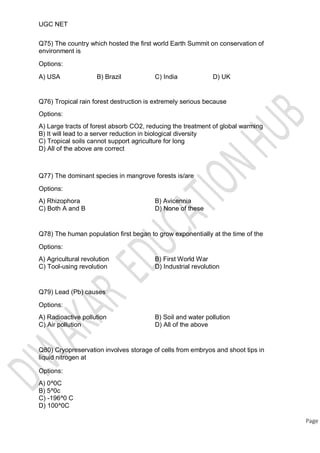
Q7) Ozone layer depletion or hole in ozone layer is being chiefly found in
Options:
A) Russia B) South pole C) North pole D) None of these
Q8) Biosphere Reserves are also notified as
Options:
A) Ecosystems B) Woodlands C) National Parks D) Conservation
Q9) Who developed the 'hot spots concept' in 1988?
Options:
A) M.S.Swaminathan
C) Norman Myers
B) P.K.Iyengar
D) George Bush
Q10) On the basis of the type of environment being polluted, we may recognize
Options:
A) Air pollution B) Soil pollution C) Water pollution D) All of these
Q11) Biodiversity is an abbreviation of
Options:
A) Biological rhythm
C) Biotic factor
B) Abiotic factor
D) Biological diversity
Q12) An ecological community is an assemblage of
Options:
A) Food webs
C) Family units
B) Closely related species
D) Interacting populations
Q13) Humans interfere with the natural phosphorus cycle by
Options:
A) Causing erosion of land
B) Adding phosphate fertilizers to agricultural soils
C) Dumping sewage into rivers and lakes
D) All of the above
Website:
www.diwakareducationhub.c
om
Page
1345
UGC NET
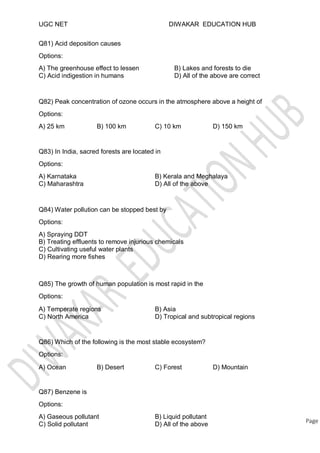
Q14) The carrying capacity of a population is determined by its
Options:
A) Birth rate
C) Limiting resource
B) Death rate
D) Population growth rate
Q15) Exponential growth occurs when there is
Options:
A) Sexual reproduction only
C) Asexual reproduction only
B) No inhibition from crowding
D) A fixed carrying capacity
Q16) Pollutants like PAN and O3 (Photochemical smog) cause
Options:
A) Irritation of eye
C) Respiratory distress
B) Irritation nose and eye
D) All of the above
Q17) Greenpeace is
Options:
A) NGOB) An inhibitory process
C) Government policy for speciation D) All of the above
Q18) The wet forests of Amazon basin are known as which one of the following?
Options:
A) Pampas B) Selvas C) Campos D) Lianos
Q19) Fluorides enter plant leaves through
Options:
A) Leaf base B) Root C) Stomata D) Stem
Q20) The geographic limits within which a population exists is its
Options:
A) Range
B) Habitat
C) Niche
D) Territory
Website:
www.diwakareducationhub.com
Page
UGC NET Teaching & Research Aptitude
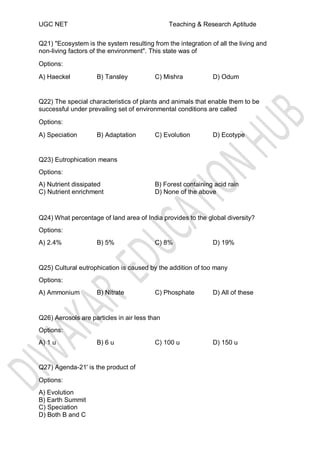
Q21) "Ecosystem is the system resulting from the integration of all the living and
non-living factors of the environment". This state was of
Options:
A) Haeckel B) Tansley C) Mishra D) Odum
Q22) The special characteristics of plants and animals that enable them to be
successful under prevailing set of environmental conditions are called
Options:
A) Speciation B) Adaptation C) Evolution D) Ecotype
Q23) Eutrophication means
Options:
A) Nutrient dissipated
C) Nutrient enrichment
B) Forest containing acid rain
D) None of the above
Q24) What percentage of land area of India provides to the global diversity?
Options:
A) 2.4% B) 5% C) 8% D) 19%
Q25) Cultural eutrophication is caused by the addition of too many
Options:
A) Ammonium B) Nitrate C) Phosphate D) All of these
Q26) Aerosols are particles in air less than
Options:
A) 1 u B) 6 u C) 100 u D) 150 u
Q27) Agenda-21' is the product of
Options:
A) Evolution
B) Earth Summit
C) Speciation
D) Both B and C
UGC NET
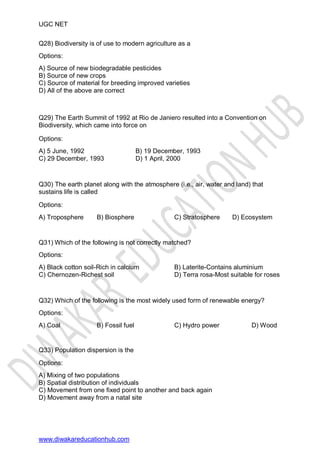
Q28) Biodiversity is of use to modern agriculture as a
Options:
A) Source of new biodegradable pesticides
B) Source of new crops
C) Source of material for breeding improved varieties
D) All of the above are correct
Q29) The Earth Summit of 1992 at Rio de Janiero resulted into a Convention on
Biodiversity, which came into force on
Options:
A) 5 June, 1992
C) 29 December, 1993
B) 19 December, 1993
D) 1 April, 2000
Q30) The earth planet along with the atmosphere (i.e., air, water and land) that
sustains life is called
Options:
A) Troposphere B) Biosphere C) Stratosphere D) Ecosystem
Q31) Which of the following is not correctly matched?
Options:
A) Black cotton soil-Rich in calcium
C) Chernozen-Richest soil
B) Laterite-Contains aluminium
D) Terra rosa-Most suitable for roses
Q32) Which of the following is the most widely used form of renewable energy?
Options:
A) Coal B) Fossil fuel C) Hydro power D) Wood
Q33) Population dispersion is the
Options:
A) Mixing of two populations
B) Spatial distribution of individuals
C) Movement from one fixed point to another and back again
D) Movement away from a natal site
www.diwakareducationhub.com
UGC NET CONTACT - 7310762592
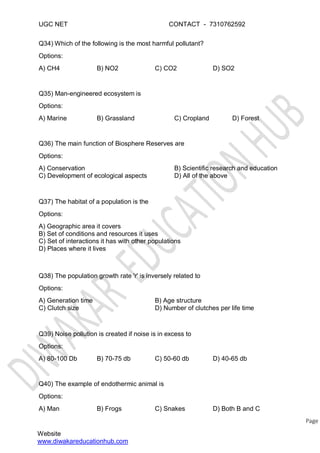
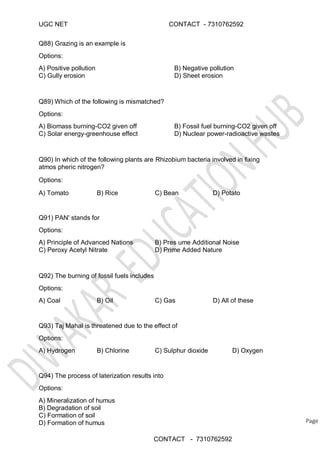
Q34) Which of the following is the most harmful pollutant?
Options:
A) CH4 B) NO2 C) CO2 D) SO2
Q35) Man-engineered ecosystem is
Options:
A) Marine B) Grassland C) Cropland D) Forest
Q36) The main function of Biosphere Reserves are
Options:
A) Conservation
C) Development of ecological aspects
B) Scientific research and education
D) All of the above
Q37) The habitat of a population is the
Options:
A) Geographic area it covers
B) Set of conditions and resources it uses
C) Set of interactions it has with other populations
D) Places where it lives
Q38) The population growth rate 'r' is inversely related to
Options:
A) Generation time
C) Clutch size
B) Age structure
D) Number of clutches per life time
Q39) Noise pollution is created if noise is in excess to
Options:
A) 80-100 Db B) 70-75 db C) 50-60 db D) 40-65 db
Q40) The example of endothermic animal is
A) Man B) Frogs C) Snakes D) Both B and C
Website
www.diwakareducationhub.com
Page
Options:
UGC NET
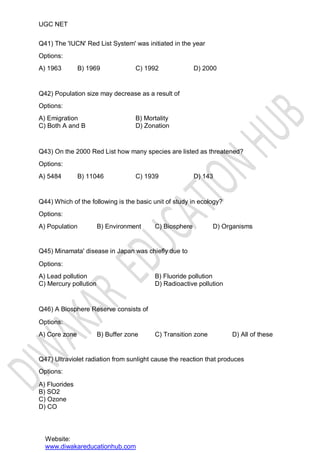
Q41) The 'IUCN' Red List System' was initiated in the year
Options:
A) 1963 B) 1969 C) 1992 D) 2000
Q42) Population size may decrease as a result of
Options:
A) Emigration
C) Both A and B
B) Mortality
D) Zonation
Q43) On the 2000 Red List how many species are listed as threatened?
Options:
A) 5484 B) 11046 C) 1939 D) 143
Q44) Which of the following is the basic unit of study in ecology?
Options:
A) Population B) Environment C) Biosphere D) Organisms
Q45) Minamata' disease in Japan was chiefly due to
Options:
A) Lead pollution
C) Mercury pollution
B) Fluoride pollution
D) Radioactive pollution
Q46) A Biosphere Reserve consists of
Options:
A) Core zone B) Buffer zone C) Transition zone D) All of these
Q47) Ultraviolet radiation from sunlight cause the reaction that produces
Options:
A) Fluorides
B) SO2
C) Ozone
D) CO
Website:
www.diwakareducationhub.com
UGC NET CONTACT - 7310762592
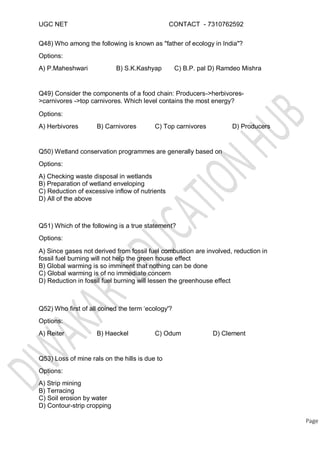
Q48) Who among the following is known as "father of ecology in India"?
Options:
A) P.Maheshwari B) S.K.Kashyap C) B.P. pal D) Ramdeo Mishra
Q49) Consider the components of a food chain: Producers->herbivores-
>carnivores ->top carnivores. Which level contains the most energy?
Options:
A) Herbivores B) Carnivores C) Top carnivores D) Producers
Q50) Wetland conservation programmes are generally based on
Options:
A) Checking waste disposal in wetlands
B) Preparation of wetland enveloping
C) Reduction of excessive inflow of nutrients
D) All of the above
Q51) Which of the following is a true statement?
Options:
A) Since gases not derived from fossil fuel combustion are involved, reduction in
fossil fuel burning will not help the green house effect
B) Global warming is so imminent that nothing can be done
C) Global warming is of no immediate concern
D) Reduction in fossil fuel burning will lessen the greenhouse effect
Q52) Who first of all coined the term ‘ecology'?
Options:
A) Reiter B) Haeckel C) Odum D) Clement
Q53) Loss of mine rals on the hills is due to
Options:
A) Strip mining
B) Terracing
C) Soil erosion by water
D) Contour-strip cropping
Page
UGC NET CONTACT - 7310762592
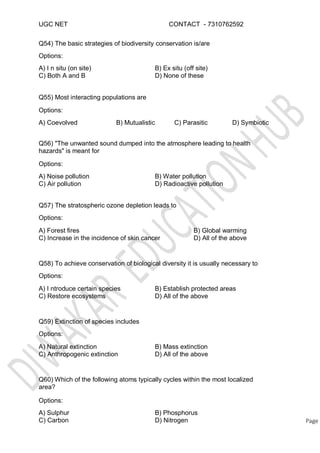
Q54) The basic strategies of biodiversity conservation is/are
Options:
A) I n situ (on site)
C) Both A and B
B) Ex situ (off site)
D) None of these
Q55) Most interacting populations are
Options:
A) Coevolved B) Mutualistic C) Parasitic D) Symbiotic
Q56) "The unwanted sound dumped into the atmosphere leading to health
hazards" is meant for
Options:
A) Noise pollution
C) Air pollution
B) Water pollution
D) Radioactive pollution
Q57) The stratospheric ozone depletion leads to
Options:
A) Forest fires
C) Increase in the incidence of skin cancer
B) Global warming
D) All of the above
Q58) To achieve conservation of biological diversity it is usually necessary to
Options:
A) I ntroduce certain species
C) Restore ecosystems
B) Establish protected areas
D) All of the above
Q59) Extinction of species includes
Options:
A) Natural extinction
C) Anthropogenic extinction
B) Mass extinction
D) All of the above
Q60) Which of the following atoms typically cycles within the most localized
area?
Options:
A) Sulphur
C) Carbon Page
B) Phosphorus
D) Nitrogen
UGC NET CONTACT - 7310762592
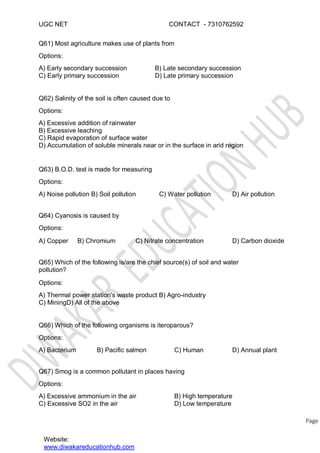
Q61) Most agriculture makes use of plants from
Options:
A) Early secondary succession
C) Early primary succession
B) Late secondary succession
D) Late primary succession
Q62) Salinity of the soil is often caused due to
Options:
A) Excessive addition of rainwater
B) Excessive leaching
C) Rapid evaporation of surface water
D) Accumulation of soluble minerals near or in the surface in arid region
Q63) B.O.D. test is made for measuring
Options:
A) Noise pollution B) Soil pollution
Q64) Cyanosis is caused by
Options:
A) Copper B) Chromium C) Nitrate concentration D) Carbon dioxide
C) Water pollution D) Air pollution
Q65) Which of the following is/are the chief source(s) of soil and water
pollution?
Options:
A) Thermal power station's waste product B) Agro-industry
C) MiningD) All of the above
Q66) Which of the following organisms is iteroparous?
Options:
A) Bacterium B) Pacific salmon C) Human D) Annual plant
Q67) Smog is a common pollutant in places having
Options:
Website:
www.diwakareducationhub.com
Page
A) Excessive ammonium in the air
C) Excessive SO2 in the air
B) High temperature
D) Low temperature
UGC NET CONTACT - 7310762592
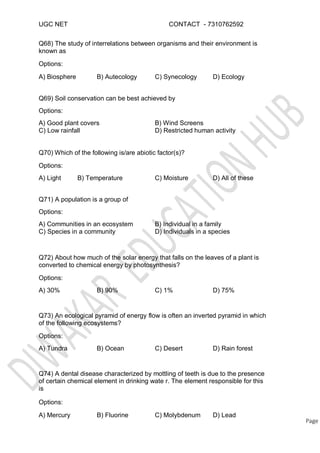
Q68) The study of interrelations between organisms and their environment is
known as
Options:
A) Biosphere B) Autecology C) Synecology D) Ecology
Q69) Soil conservation can be best achieved by
Options:
A) Good plant covers
C) Low rainfall
B) Wind Screens
D) Restricted human activity
Q70) Which of the following is/are abiotic factor(s)?
Options:
A) Light B) Temperature C) Moisture D) All of these
Q71) A population is a group of
Options:
A) Communities in an ecosystem
C) Species in a community
B) Individual in a family
D) Individuals in a species
Q72) About how much of the solar energy that falls on the leaves of a plant is
converted to chemical energy by photosynthesis?
Options:
A) 30% B) 90% C) 1% D) 75%
Q73) An ecological pyramid of energy flow is often an inverted pyramid in which
of the following ecosystems?
Options:
A) Tundra B) Ocean C) Desert D) Rain forest
Q74) A dental disease characterized by mottling of teeth is due to the presence
of certain chemical element in drinking wate r. The element responsible for this
is
Options:
A) Mercury B) Fluorine C) Molybdenum D) Lead
Page
UGC NET
Q75) The country which hosted the first world Earth Summit on conservation of
environment is
Options:
A) USA B) Brazil C) India D) UK
Q76) Tropical rain forest destruction is extremely serious because
Options:
A) Large tracts of forest absorb CO2, reducing the treatment of global warming
B) It will lead to a server reduction in biological diversity
C) Tropical soils cannot support agriculture for long
D) All of the above are correct
Q77) The dominant species in mangrove forests is/are
Options:
A) Rhizophora
C) Both A and B
B) Avicennia
D) None of these
Q78) The human population first began to grow exponentially at the time of the
Options:
A) Agricultural revolution
C) Tool-using revolution
B) First World War
D) Industrial revolution
Q79) Lead (Pb) causes
Options:
A) Radioactive pollution
C) Air pollution
B) Soil and water pollution
D) All of the above
Q80) Cryopreservation involves storage of cells from embryos and shoot tips in
liquid nitrogen at
Options:
A) 0^0C
B) 5^0c
C) -196^0 C
D) 100^0C
Page
UGC NET
Q81) Acid deposition causes
Options:
A) The greenhouse effect to lessen
C) Acid indigestion in humans
DIWAKAR EDUCATION HUB
B) Lakes and forests to die
D) All of the above are correct
Q82) Peak concentration of ozone occurs in the atmosphere above a height of
Options:
A) 25 km B) 100 km C) 10 km D) 150 km
Q83) In India, sacred forests are located in
Options:
A) Karnataka
C) Maharashtra
B) Kerala and Meghalaya
D) All of the above
Q84) Water pollution can be stopped best by
Options:
A) Spraying DDT
B) Treating effluents to remove injurious chemicals
C) Cultivating useful water plants
D) Rearing more fishes
Q85) The growth of human population is most rapid in the
Options:
A) Temperate regions
C) North America
B) Asia
D) Tropical and subtropical regions
Q86) Which of the following is the most stable ecosystem?
Options:
A) Ocean B) Desert C) Forest D) Mountain
Options:
A) Gaseous pollutant
C) Solid pollutant
Page
B) Liquid pollutant
D) All of the above
Q87) Benzene is
UGC NET
Q88) Grazing is an example is
Options:
A) Positive pollution
C) Gully erosion
CONTACT - 7310762592
B) Negative pollution
D) Sheet erosion
Q89) Which of the following is mismatched?
Options:
A) Biomass burning-CO2 given off
C) Solar energy-greenhouse effect
B) Fossil fuel burning-CO2 given off
D) Nuclear power-radioactive wastes
Q90) In which of the following plants are Rhizobium bacteria involved in fixing
atmos pheric nitrogen?
Options:
A) Tomato B) Rice C) Bean D) Potato
Q91) PAN' stands for
Options:
A) Principle of Advanced Nations
C) Peroxy Acetyl Nitrate
B) Pres ume Additional Noise
D) Prime Added Nature
Q92) The burning of fossil fuels includes
Options:
A) Coal B) Oil C) Gas D) All of these
Q93) Taj Mahal is threatened due to the effect of
Options:
A) Hydrogen B) Chlorine C) Sulphur dioxide D) Oxygen
Q94) The process of laterization results into
Options:
A) Mineralization of humus
B) Degradation of soil
C) Formation of soil
D) Formation of humus
CONTACT - 7310762592
Page
UGC NET
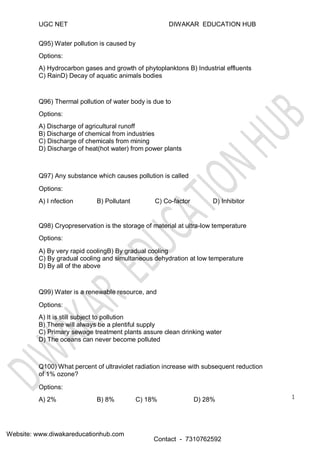
Q95) Water pollution is caused by
Options:
DIWAKAR EDUCATION HUB
A) Hydrocarbon gases and growth of phytoplanktons B) Industrial effluents
C) RainD) Decay of aquatic animals bodies
Q96) Thermal pollution of water body is due to
Options:
A) Discharge of agricultural runoff
B) Discharge of chemical from industries
C) Discharge of chemicals from mining
D) Discharge of heat(hot water) from power plants
Q97) Any substance which causes pollution is called
Options:
A) I nfection B) Pollutant C) Co-factor D) Inhibitor
Q98) Cryopreservation is the storage of material at ultra-low temperature
Options:
A) By very rapid coolingB) By gradual cooling
C) By gradual cooling and simultaneous dehydration at low temperature
D) By all of the above
Q99) Water is a renewable resource, and
Options:
A) It is still subject to pollution
B) There will always be a plentiful supply
C) Primary sewage treatment plants assure clean drinking water
D) The oceans can never become polluted
Q100) What percent of ultraviolet radiation increase with subsequent reduction
of 1% ozone?
Options:
A) 2% B) 8% C) 18% D) 28%
Website: www.diwakareducationhub.com
Contact - 7310762592
1
UGC NET DIWAKAR EDUCATION HUB
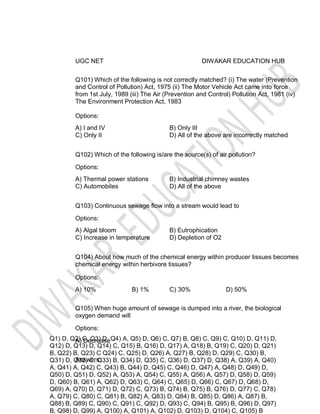
Q101) Which of the following is not correctly matched? (i) The water (Prevention
and Control of Pollution) Act, 1975 (ii) The Motor Vehicle Act came into force
from 1st July, 1989 (iii) The Air (Prevention and Control) Pollution Act, 1981 (iv)
The Environment Protection Act, 1983
Options:
A) I and IV
C) Only II
B) Only III
D) All of the above are incorrectly matched
Q102) Which of the following is/are the source(s) of air pollution?
Options:
A) Thermal power stations
C) Automobiles
B) Industrial chimney wastes
D) All of the above
Q103) Continuous sewage flow into a stream would lead to
Options:
A) Algal bloom
C) Increase in temperature
B) Eutrophication
D) Depletion of O2
Q104) About how much of the chemical energy within producer tissues becomes
chemical energy within herbivore tissues?
Options:
A) 10% B) 1% C) 30% D) 50%
Q105) When huge amount of sewage is dumped into a river, the biological
oxygen demand will
Options:
A) Decrease
Answers:
Q1) D, Q2) C, Q3) D, Q4) A, Q5) D, Q6) C, Q7) B, Q8) C, Q9) C, Q10) D, Q11) D,
Q12) D, Q13) D, Q14) C, Q15) B, Q16) D, Q17) A, Q18) B, Q19) C, Q20) D, Q21)
B, Q22) B, Q23) C Q24) C, Q25) D, Q26) A, Q27) B, Q28) D, Q29) C, Q30) B,
Q31) D, Q32) C, Q33) B, Q34) D, Q35) C, Q36) D, Q37) D, Q38) A, Q39) A, Q40)
A, Q41) A, Q42) C, Q43) B, Q44) D, Q45) C, Q46) D, Q47) A, Q48) D, Q49) D,
Q50) D, Q51) D, Q52) A, Q53) A, Q54) C, Q55) A, Q56) A, Q57) D, Q58) D, Q59)
D, Q60) B, Q61) A, Q62) D, Q63) C, Q64) C, Q65) D, Q66) C, Q67) D, Q68) D,
Q69) A, Q70) D, Q71) D, Q72) C, Q73) B, Q74) B, Q75) B, Q76) D, Q77) C, Q78)
A, Q79) C, Q80) C, Q81) B, Q82) A, Q83) D, Q84) B, Q85) D, Q86) A, Q87) B,
Q88) B, Q89) C, Q90) C, Q91) C, Q92) D, Q93) C, Q94) B, Q95) B, Q96) D, Q97)
B, Q98) D, Q99) A, Q100) A, Q101) A, Q102) D, Q103) D, Q104) C, Q105) B

PEOPLE & ENVIRONMENT MCQ FOR UGC-NET PAPER-1

  • 1.
    Q1) IUCN' standsfor Options: A) International Unity on Community and Nationality B) Inter-state Unity of Culture Nature C) Indian Union Congress Nation D) International Union for the Conservation of Nature and Natural Resources Q2) Zone of atmosphere near the ground is Options: A) Stratosphere B) Mesosphere C) Troposphere D) Homosphere Q3) Approximately how many people are alive today? Options: A) 1 billion B) 2 billion C) 4 billion D) More than 6 billion Q4) Which of the following is the transition layer between stratosphere and the mesosphere? Options: A) Stratopause B) Tropopause C) Mesopause D) Thermopause Q5) Emphysema disease is caused by Options: A) Carbon dioxide C) Mercury B) Sulphur dioxide D) Photochemical smog Q6) Submerged hydrophytes have commonly dissected leaves for Options: A) Increasing number of stomata B) Decreasing surface area C) Reducing effect of water currents D) Increasing surface area Website: www.diwakareducationhub.com ONLINE BATCH FOR MANAGEMENT, COMMERCE AND PAPER-1 FOR JUNE/JULY 2019 REGISTRATION HAS BEEN START FOR MORE DETAILS CLICK ON LINK - CLICK HERE OR CALL 7310762592 – DIWAKAR EDUCATION HUB
  • 2.
    UGC NET Q7) Ozonelayer depletion or hole in ozone layer is being chiefly found in Options: A) Russia B) South pole C) North pole D) None of these Q8) Biosphere Reserves are also notified as Options: A) Ecosystems B) Woodlands C) National Parks D) Conservation Q9) Who developed the 'hot spots concept' in 1988? Options: A) M.S.Swaminathan C) Norman Myers B) P.K.Iyengar D) George Bush Q10) On the basis of the type of environment being polluted, we may recognize Options: A) Air pollution B) Soil pollution C) Water pollution D) All of these Q11) Biodiversity is an abbreviation of Options: A) Biological rhythm C) Biotic factor B) Abiotic factor D) Biological diversity Q12) An ecological community is an assemblage of Options: A) Food webs C) Family units B) Closely related species D) Interacting populations Q13) Humans interfere with the natural phosphorus cycle by Options: A) Causing erosion of land B) Adding phosphate fertilizers to agricultural soils C) Dumping sewage into rivers and lakes D) All of the above Website: www.diwakareducationhub.c om Page 1345
  • 3.
    UGC NET Q14) Thecarrying capacity of a population is determined by its Options: A) Birth rate C) Limiting resource B) Death rate D) Population growth rate Q15) Exponential growth occurs when there is Options: A) Sexual reproduction only C) Asexual reproduction only B) No inhibition from crowding D) A fixed carrying capacity Q16) Pollutants like PAN and O3 (Photochemical smog) cause Options: A) Irritation of eye C) Respiratory distress B) Irritation nose and eye D) All of the above Q17) Greenpeace is Options: A) NGOB) An inhibitory process C) Government policy for speciation D) All of the above Q18) The wet forests of Amazon basin are known as which one of the following? Options: A) Pampas B) Selvas C) Campos D) Lianos Q19) Fluorides enter plant leaves through Options: A) Leaf base B) Root C) Stomata D) Stem Q20) The geographic limits within which a population exists is its Options: A) Range B) Habitat C) Niche D) Territory Website: www.diwakareducationhub.com Page
  • 4.
    UGC NET Teaching& Research Aptitude Q21) "Ecosystem is the system resulting from the integration of all the living and non-living factors of the environment". This state was of Options: A) Haeckel B) Tansley C) Mishra D) Odum Q22) The special characteristics of plants and animals that enable them to be successful under prevailing set of environmental conditions are called Options: A) Speciation B) Adaptation C) Evolution D) Ecotype Q23) Eutrophication means Options: A) Nutrient dissipated C) Nutrient enrichment B) Forest containing acid rain D) None of the above Q24) What percentage of land area of India provides to the global diversity? Options: A) 2.4% B) 5% C) 8% D) 19% Q25) Cultural eutrophication is caused by the addition of too many Options: A) Ammonium B) Nitrate C) Phosphate D) All of these Q26) Aerosols are particles in air less than Options: A) 1 u B) 6 u C) 100 u D) 150 u Q27) Agenda-21' is the product of Options: A) Evolution B) Earth Summit C) Speciation D) Both B and C
  • 5.
    UGC NET Q28) Biodiversityis of use to modern agriculture as a Options: A) Source of new biodegradable pesticides B) Source of new crops C) Source of material for breeding improved varieties D) All of the above are correct Q29) The Earth Summit of 1992 at Rio de Janiero resulted into a Convention on Biodiversity, which came into force on Options: A) 5 June, 1992 C) 29 December, 1993 B) 19 December, 1993 D) 1 April, 2000 Q30) The earth planet along with the atmosphere (i.e., air, water and land) that sustains life is called Options: A) Troposphere B) Biosphere C) Stratosphere D) Ecosystem Q31) Which of the following is not correctly matched? Options: A) Black cotton soil-Rich in calcium C) Chernozen-Richest soil B) Laterite-Contains aluminium D) Terra rosa-Most suitable for roses Q32) Which of the following is the most widely used form of renewable energy? Options: A) Coal B) Fossil fuel C) Hydro power D) Wood Q33) Population dispersion is the Options: A) Mixing of two populations B) Spatial distribution of individuals C) Movement from one fixed point to another and back again D) Movement away from a natal site www.diwakareducationhub.com
  • 6.
    UGC NET CONTACT- 7310762592 Q34) Which of the following is the most harmful pollutant? Options: A) CH4 B) NO2 C) CO2 D) SO2 Q35) Man-engineered ecosystem is Options: A) Marine B) Grassland C) Cropland D) Forest Q36) The main function of Biosphere Reserves are Options: A) Conservation C) Development of ecological aspects B) Scientific research and education D) All of the above Q37) The habitat of a population is the Options: A) Geographic area it covers B) Set of conditions and resources it uses C) Set of interactions it has with other populations D) Places where it lives Q38) The population growth rate 'r' is inversely related to Options: A) Generation time C) Clutch size B) Age structure D) Number of clutches per life time Q39) Noise pollution is created if noise is in excess to Options: A) 80-100 Db B) 70-75 db C) 50-60 db D) 40-65 db Q40) The example of endothermic animal is A) Man B) Frogs C) Snakes D) Both B and C Website www.diwakareducationhub.com Page Options:
  • 7.
    UGC NET Q41) The'IUCN' Red List System' was initiated in the year Options: A) 1963 B) 1969 C) 1992 D) 2000 Q42) Population size may decrease as a result of Options: A) Emigration C) Both A and B B) Mortality D) Zonation Q43) On the 2000 Red List how many species are listed as threatened? Options: A) 5484 B) 11046 C) 1939 D) 143 Q44) Which of the following is the basic unit of study in ecology? Options: A) Population B) Environment C) Biosphere D) Organisms Q45) Minamata' disease in Japan was chiefly due to Options: A) Lead pollution C) Mercury pollution B) Fluoride pollution D) Radioactive pollution Q46) A Biosphere Reserve consists of Options: A) Core zone B) Buffer zone C) Transition zone D) All of these Q47) Ultraviolet radiation from sunlight cause the reaction that produces Options: A) Fluorides B) SO2 C) Ozone D) CO Website: www.diwakareducationhub.com
  • 8.
    UGC NET CONTACT- 7310762592 Q48) Who among the following is known as "father of ecology in India"? Options: A) P.Maheshwari B) S.K.Kashyap C) B.P. pal D) Ramdeo Mishra Q49) Consider the components of a food chain: Producers->herbivores- >carnivores ->top carnivores. Which level contains the most energy? Options: A) Herbivores B) Carnivores C) Top carnivores D) Producers Q50) Wetland conservation programmes are generally based on Options: A) Checking waste disposal in wetlands B) Preparation of wetland enveloping C) Reduction of excessive inflow of nutrients D) All of the above Q51) Which of the following is a true statement? Options: A) Since gases not derived from fossil fuel combustion are involved, reduction in fossil fuel burning will not help the green house effect B) Global warming is so imminent that nothing can be done C) Global warming is of no immediate concern D) Reduction in fossil fuel burning will lessen the greenhouse effect Q52) Who first of all coined the term ‘ecology'? Options: A) Reiter B) Haeckel C) Odum D) Clement Q53) Loss of mine rals on the hills is due to Options: A) Strip mining B) Terracing C) Soil erosion by water D) Contour-strip cropping Page
  • 9.
    UGC NET CONTACT- 7310762592 Q54) The basic strategies of biodiversity conservation is/are Options: A) I n situ (on site) C) Both A and B B) Ex situ (off site) D) None of these Q55) Most interacting populations are Options: A) Coevolved B) Mutualistic C) Parasitic D) Symbiotic Q56) "The unwanted sound dumped into the atmosphere leading to health hazards" is meant for Options: A) Noise pollution C) Air pollution B) Water pollution D) Radioactive pollution Q57) The stratospheric ozone depletion leads to Options: A) Forest fires C) Increase in the incidence of skin cancer B) Global warming D) All of the above Q58) To achieve conservation of biological diversity it is usually necessary to Options: A) I ntroduce certain species C) Restore ecosystems B) Establish protected areas D) All of the above Q59) Extinction of species includes Options: A) Natural extinction C) Anthropogenic extinction B) Mass extinction D) All of the above Q60) Which of the following atoms typically cycles within the most localized area? Options: A) Sulphur C) Carbon Page B) Phosphorus D) Nitrogen
  • 10.
    UGC NET CONTACT- 7310762592 Q61) Most agriculture makes use of plants from Options: A) Early secondary succession C) Early primary succession B) Late secondary succession D) Late primary succession Q62) Salinity of the soil is often caused due to Options: A) Excessive addition of rainwater B) Excessive leaching C) Rapid evaporation of surface water D) Accumulation of soluble minerals near or in the surface in arid region Q63) B.O.D. test is made for measuring Options: A) Noise pollution B) Soil pollution Q64) Cyanosis is caused by Options: A) Copper B) Chromium C) Nitrate concentration D) Carbon dioxide C) Water pollution D) Air pollution Q65) Which of the following is/are the chief source(s) of soil and water pollution? Options: A) Thermal power station's waste product B) Agro-industry C) MiningD) All of the above Q66) Which of the following organisms is iteroparous? Options: A) Bacterium B) Pacific salmon C) Human D) Annual plant Q67) Smog is a common pollutant in places having Options: Website: www.diwakareducationhub.com Page A) Excessive ammonium in the air C) Excessive SO2 in the air B) High temperature D) Low temperature
  • 11.
    UGC NET CONTACT- 7310762592 Q68) The study of interrelations between organisms and their environment is known as Options: A) Biosphere B) Autecology C) Synecology D) Ecology Q69) Soil conservation can be best achieved by Options: A) Good plant covers C) Low rainfall B) Wind Screens D) Restricted human activity Q70) Which of the following is/are abiotic factor(s)? Options: A) Light B) Temperature C) Moisture D) All of these Q71) A population is a group of Options: A) Communities in an ecosystem C) Species in a community B) Individual in a family D) Individuals in a species Q72) About how much of the solar energy that falls on the leaves of a plant is converted to chemical energy by photosynthesis? Options: A) 30% B) 90% C) 1% D) 75% Q73) An ecological pyramid of energy flow is often an inverted pyramid in which of the following ecosystems? Options: A) Tundra B) Ocean C) Desert D) Rain forest Q74) A dental disease characterized by mottling of teeth is due to the presence of certain chemical element in drinking wate r. The element responsible for this is Options: A) Mercury B) Fluorine C) Molybdenum D) Lead Page
  • 12.
    UGC NET Q75) Thecountry which hosted the first world Earth Summit on conservation of environment is Options: A) USA B) Brazil C) India D) UK Q76) Tropical rain forest destruction is extremely serious because Options: A) Large tracts of forest absorb CO2, reducing the treatment of global warming B) It will lead to a server reduction in biological diversity C) Tropical soils cannot support agriculture for long D) All of the above are correct Q77) The dominant species in mangrove forests is/are Options: A) Rhizophora C) Both A and B B) Avicennia D) None of these Q78) The human population first began to grow exponentially at the time of the Options: A) Agricultural revolution C) Tool-using revolution B) First World War D) Industrial revolution Q79) Lead (Pb) causes Options: A) Radioactive pollution C) Air pollution B) Soil and water pollution D) All of the above Q80) Cryopreservation involves storage of cells from embryos and shoot tips in liquid nitrogen at Options: A) 0^0C B) 5^0c C) -196^0 C D) 100^0C Page
  • 13.
    UGC NET Q81) Aciddeposition causes Options: A) The greenhouse effect to lessen C) Acid indigestion in humans DIWAKAR EDUCATION HUB B) Lakes and forests to die D) All of the above are correct Q82) Peak concentration of ozone occurs in the atmosphere above a height of Options: A) 25 km B) 100 km C) 10 km D) 150 km Q83) In India, sacred forests are located in Options: A) Karnataka C) Maharashtra B) Kerala and Meghalaya D) All of the above Q84) Water pollution can be stopped best by Options: A) Spraying DDT B) Treating effluents to remove injurious chemicals C) Cultivating useful water plants D) Rearing more fishes Q85) The growth of human population is most rapid in the Options: A) Temperate regions C) North America B) Asia D) Tropical and subtropical regions Q86) Which of the following is the most stable ecosystem? Options: A) Ocean B) Desert C) Forest D) Mountain Options: A) Gaseous pollutant C) Solid pollutant Page B) Liquid pollutant D) All of the above Q87) Benzene is
  • 14.
    UGC NET Q88) Grazingis an example is Options: A) Positive pollution C) Gully erosion CONTACT - 7310762592 B) Negative pollution D) Sheet erosion Q89) Which of the following is mismatched? Options: A) Biomass burning-CO2 given off C) Solar energy-greenhouse effect B) Fossil fuel burning-CO2 given off D) Nuclear power-radioactive wastes Q90) In which of the following plants are Rhizobium bacteria involved in fixing atmos pheric nitrogen? Options: A) Tomato B) Rice C) Bean D) Potato Q91) PAN' stands for Options: A) Principle of Advanced Nations C) Peroxy Acetyl Nitrate B) Pres ume Additional Noise D) Prime Added Nature Q92) The burning of fossil fuels includes Options: A) Coal B) Oil C) Gas D) All of these Q93) Taj Mahal is threatened due to the effect of Options: A) Hydrogen B) Chlorine C) Sulphur dioxide D) Oxygen Q94) The process of laterization results into Options: A) Mineralization of humus B) Degradation of soil C) Formation of soil D) Formation of humus CONTACT - 7310762592 Page
  • 15.
    UGC NET Q95) Waterpollution is caused by Options: DIWAKAR EDUCATION HUB A) Hydrocarbon gases and growth of phytoplanktons B) Industrial effluents C) RainD) Decay of aquatic animals bodies Q96) Thermal pollution of water body is due to Options: A) Discharge of agricultural runoff B) Discharge of chemical from industries C) Discharge of chemicals from mining D) Discharge of heat(hot water) from power plants Q97) Any substance which causes pollution is called Options: A) I nfection B) Pollutant C) Co-factor D) Inhibitor Q98) Cryopreservation is the storage of material at ultra-low temperature Options: A) By very rapid coolingB) By gradual cooling C) By gradual cooling and simultaneous dehydration at low temperature D) By all of the above Q99) Water is a renewable resource, and Options: A) It is still subject to pollution B) There will always be a plentiful supply C) Primary sewage treatment plants assure clean drinking water D) The oceans can never become polluted Q100) What percent of ultraviolet radiation increase with subsequent reduction of 1% ozone? Options: A) 2% B) 8% C) 18% D) 28% Website: www.diwakareducationhub.com Contact - 7310762592 1
  • 16.
    UGC NET DIWAKAREDUCATION HUB Q101) Which of the following is not correctly matched? (i) The water (Prevention and Control of Pollution) Act, 1975 (ii) The Motor Vehicle Act came into force from 1st July, 1989 (iii) The Air (Prevention and Control) Pollution Act, 1981 (iv) The Environment Protection Act, 1983 Options: A) I and IV C) Only II B) Only III D) All of the above are incorrectly matched Q102) Which of the following is/are the source(s) of air pollution? Options: A) Thermal power stations C) Automobiles B) Industrial chimney wastes D) All of the above Q103) Continuous sewage flow into a stream would lead to Options: A) Algal bloom C) Increase in temperature B) Eutrophication D) Depletion of O2 Q104) About how much of the chemical energy within producer tissues becomes chemical energy within herbivore tissues? Options: A) 10% B) 1% C) 30% D) 50% Q105) When huge amount of sewage is dumped into a river, the biological oxygen demand will Options: A) Decrease Answers: Q1) D, Q2) C, Q3) D, Q4) A, Q5) D, Q6) C, Q7) B, Q8) C, Q9) C, Q10) D, Q11) D, Q12) D, Q13) D, Q14) C, Q15) B, Q16) D, Q17) A, Q18) B, Q19) C, Q20) D, Q21) B, Q22) B, Q23) C Q24) C, Q25) D, Q26) A, Q27) B, Q28) D, Q29) C, Q30) B, Q31) D, Q32) C, Q33) B, Q34) D, Q35) C, Q36) D, Q37) D, Q38) A, Q39) A, Q40) A, Q41) A, Q42) C, Q43) B, Q44) D, Q45) C, Q46) D, Q47) A, Q48) D, Q49) D, Q50) D, Q51) D, Q52) A, Q53) A, Q54) C, Q55) A, Q56) A, Q57) D, Q58) D, Q59) D, Q60) B, Q61) A, Q62) D, Q63) C, Q64) C, Q65) D, Q66) C, Q67) D, Q68) D, Q69) A, Q70) D, Q71) D, Q72) C, Q73) B, Q74) B, Q75) B, Q76) D, Q77) C, Q78) A, Q79) C, Q80) C, Q81) B, Q82) A, Q83) D, Q84) B, Q85) D, Q86) A, Q87) B, Q88) B, Q89) C, Q90) C, Q91) C, Q92) D, Q93) C, Q94) B, Q95) B, Q96) D, Q97) B, Q98) D, Q99) A, Q100) A, Q101) A, Q102) D, Q103) D, Q104) C, Q105) B