1.Explain the role of Philosophy in Understanding the self.
2. Discuss the different concepts of the self from the philosophical
perspective.
3. Develop your own philosophy of the self.
LEARNING OBJECTIVES
ASK YOURSELF
1.How would you characterize your self?
2.What makes you stand out from the rest? What makes your self special?
3. How has your self transformed itself?
4. How is your self connected to your body?
5. How is your self related to other selves?
What is Philosophy?
It is the study of fundamental questions about existence, knowledge, values,
reason, mind, and language. It comes from the Greek word philosophia,
meaning "love of wisdom."
At its core, philosophy involves critical thinking, logical reasoning, and the
pursuit of truth through argument and reflection.
Philosophers don’t just ask what things are, but also why they are that way,
and how we know they are.
Ancient Greek
Philosophers
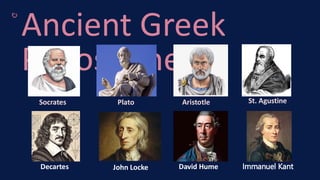
Socrates Plato Aristotle St. Agustine
Decartes John Locke David Hume Immanuel Kant
Ancient Greek
Philosophers
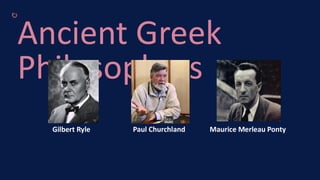
Gilbert Ryle Paul Churchland Maurice Merleau Ponty
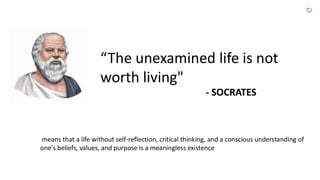
“The unexamined life is not
worth living"
- SOCRATES
means that a life without self-reflection, critical thinking, and a conscious understanding of
one's beliefs, values, and purpose is a meaningless existence
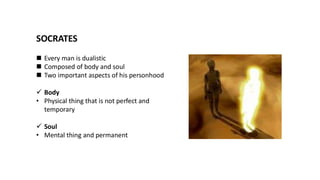
SOCRATES
◼ Every man is dualistic
◼ Composed of body and soul
◼ Two important aspects of his personhood
✓ Body
• Physical thing that is not perfect and
temporary
✓ Soul
• Mental thing and permanent
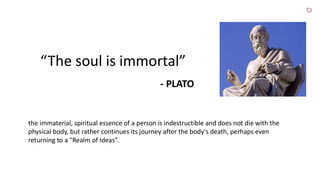
“The soul is immortal”
- PLATO
the immaterial, spiritual essence of a person is indestructible and does not die with the
physical body, but rather continues its journey after the body's death, perhaps even
returning to a "Realm of Ideas”.
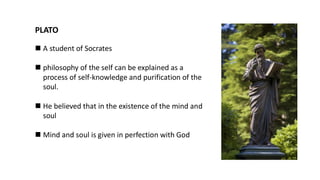
◼ A student of Socrates
◼ philosophy of the self can be explained as a
process of self-knowledge and purification of the
soul.
◼ He believed that in the existence of the mind and
soul
◼ Mind and soul is given in perfection with God
PLATO
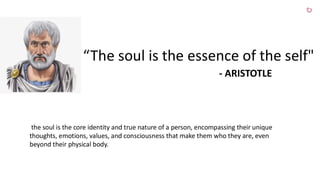
“The soul is the essence of the self"
- ARISTOTLE
the soul is the core identity and true nature of a person, encompassing their unique
thoughts, emotions, values, and consciousness that make them who they are, even
beyond their physical body.
◼ Soul and body, I suggest react sympathetically upon each other.
◼ A change in the state of the soul produces a change in the shape of the
body and conversely, a change in the shape of the body produces a change
in the state of the soul.
◼ Aristotle suggested that anything with life has soul.
◼ His discussion about the self centers on the kinds of soul possessed by a
man.
◼ He introduced the three kinds of soul.
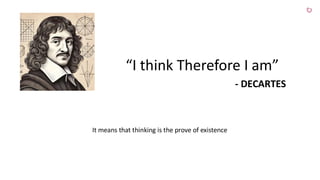
“I think Therefore I am”
- DECARTES
It means that thinking is the prove of existence
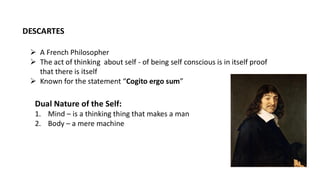
➢ A French Philosopher
➢ The act of thinking about self - of being self conscious is in itself proof
that there is itself
➢ Known for the statement “Cogito ergo sum”
DESCARTES
Dual Nature of the Self:
1. Mind – is a thinking thing that makes a man
2. Body – a mere machine
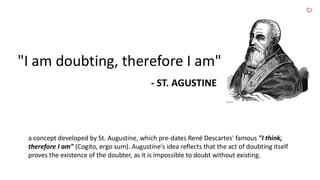
"I am doubting, therefore I am"
- ST. AGUSTINE
a concept developed by St. Augustine, which pre-dates René Descartes' famous "I think,
therefore I am" (Cogito, ergo sum). Augustine's idea reflects that the act of doubting itself
proves the existence of the doubter, as it is impossible to doubt without existing.
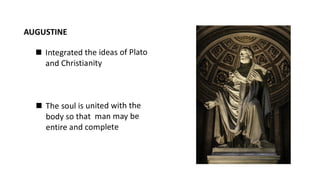
AUGUSTINE
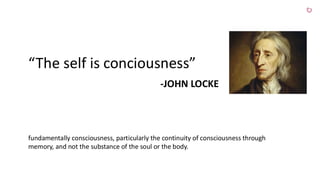
“The self is conciousness”
-JOHN LOCKE
fundamentally consciousness, particularly the continuity of consciousness through
memory, and not the substance of the soul or the body.
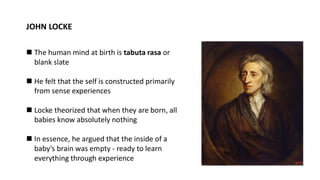
JOHN LOCKE
◼ The human mind at birth is tabuta rasa or
blank slate
◼ He felt that the self is constructed primarily
from sense experiences
◼ Locke theorized that when they are born, all
babies know absolutely nothing
◼ In essence, he argued that the inside of a
baby's brain was empty - ready to learn
everything through experience
“There is no self”
- DAVID HUME
There is no single, unchanging "self" but rather a "bundle of perceptions" that are in
constant flux
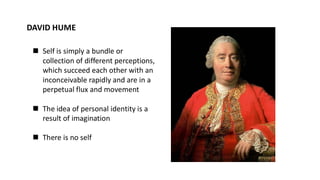
DAVID HUME
◼ Self is simply a bundle or
collection of different perceptions,
which succeed each other with an
inconceivable rapidly and are in a
perpetual flux and movement
◼ The idea of personal identity is a
result of imagination
◼ There is no self
“We construct the self”
- IMMANUEL KANT
he self isn't simply a passive receiver of experience but an active constructor of
reality. Through the mind's inherent rational capacities and transcendental categories like
space, time, and causality, the self organizes and synthesizes raw sensory data into an
intelligible, unified world
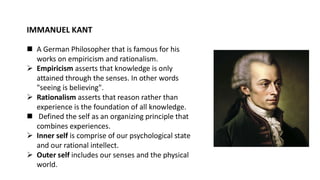
IMMANUEL KANT
◼ A German Philosopher that is famous for his
works on empiricism and rationalism.
➢ Empiricism asserts that knowledge is only
attained through the senses. In other words
"seeing is believing".
➢ Rationalism asserts that reason rather than
experience is the foundation of all knowledge.
◼ Defined the self as an organizing principle that
combines experiences.
➢ Inner self is comprise of our psychological state
and our rational intellect.
➢ Outer self includes our senses and the physical
world.
“The self is the way people have”
- GILBERT RYLE
meant that the "self" isn't a hidden, ghostly entity controlling the body, but rather a collection
of an individual's physical behaviors and dispositions to act in certain ways. In his view, to
understand a person's self, one should observe their actions, as these behaviors reveal their
intelligence, personality, and character, rather than looking for some non-physical "mind"
within the body.
GILBERT RYLE
◼ Self is not an entity one can locate
and analyze but simply the
convenient name that people use
to refer to all the behaviors that
people make
◼ "I act therefore I am", in short, the
self is the same as bodily behavior
◼ The self is the way people behave
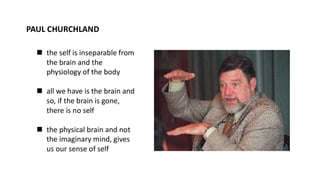
“The self is the brain”
- PAUL CHURCHLAND
our sense of self, our consciousness, and all our mental experiences arise from the
physical processes and electrochemical signals within the brain.
PAUL CHURCHLAND
◼ the self is inseparable from
the brain and the
physiology of the body
◼ all we have is the brain and
so, if the brain is gone,
there is no self
◼ the physical brain and not
the imaginary mind, gives
us our sense of self
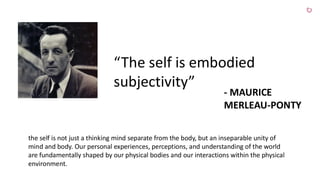
“The self is embodied
subjectivity”
- MAURICE
MERLEAU-PONTY
the self is not just a thinking mind separate from the body, but an inseparable unity of
mind and body. Our personal experiences, perceptions, and understanding of the world
are fundamentally shaped by our physical bodies and our interactions within the physical
environment.
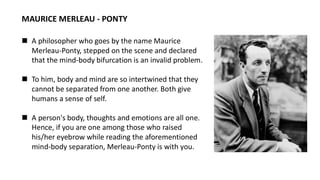
MAURICE MERLEAU - PONTY
◼ A philosopher who goes by the name Maurice
Merleau-Ponty, stepped on the scene and declared
that the mind-body bifurcation is an invalid problem.
◼ To him, body and mind are so intertwined that they
cannot be separated from one another. Both give
humans a sense of self.
◼ A person's body, thoughts and emotions are all one.
Hence, if you are one among those who raised
his/her eyebrow while reading the aforementioned
mind-body separation, Merleau-Ponty is with you.
THANK YOU!

UNDERSTANDING-THE-SELF-3.pdf BSED 1A LAG

  • 2.
    1.Explain the roleof Philosophy in Understanding the self. 2. Discuss the different concepts of the self from the philosophical perspective. 3. Develop your own philosophy of the self. LEARNING OBJECTIVES
  • 3.
    ASK YOURSELF 1.How wouldyou characterize your self? 2.What makes you stand out from the rest? What makes your self special? 3. How has your self transformed itself? 4. How is your self connected to your body? 5. How is your self related to other selves?
  • 4.
    What is Philosophy? Itis the study of fundamental questions about existence, knowledge, values, reason, mind, and language. It comes from the Greek word philosophia, meaning "love of wisdom." At its core, philosophy involves critical thinking, logical reasoning, and the pursuit of truth through argument and reflection. Philosophers don’t just ask what things are, but also why they are that way, and how we know they are.
  • 5.
    Ancient Greek Philosophers Socrates PlatoAristotle St. Agustine Decartes John Locke David Hume Immanuel Kant
  • 6.
    Ancient Greek Philosophers Gilbert RylePaul Churchland Maurice Merleau Ponty
  • 7.
    “The unexamined lifeis not worth living" - SOCRATES means that a life without self-reflection, critical thinking, and a conscious understanding of one's beliefs, values, and purpose is a meaningless existence
  • 8.
    SOCRATES ◼ Every manis dualistic ◼ Composed of body and soul ◼ Two important aspects of his personhood ✓ Body • Physical thing that is not perfect and temporary ✓ Soul • Mental thing and permanent
  • 9.
    “The soul isimmortal” - PLATO the immaterial, spiritual essence of a person is indestructible and does not die with the physical body, but rather continues its journey after the body's death, perhaps even returning to a "Realm of Ideas”.
  • 10.
    ◼ A studentof Socrates ◼ philosophy of the self can be explained as a process of self-knowledge and purification of the soul. ◼ He believed that in the existence of the mind and soul ◼ Mind and soul is given in perfection with God PLATO
  • 11.
    “The soul isthe essence of the self" - ARISTOTLE the soul is the core identity and true nature of a person, encompassing their unique thoughts, emotions, values, and consciousness that make them who they are, even beyond their physical body.
  • 12.
    ◼ Soul andbody, I suggest react sympathetically upon each other. ◼ A change in the state of the soul produces a change in the shape of the body and conversely, a change in the shape of the body produces a change in the state of the soul. ◼ Aristotle suggested that anything with life has soul. ◼ His discussion about the self centers on the kinds of soul possessed by a man. ◼ He introduced the three kinds of soul.
  • 13.
    “I think ThereforeI am” - DECARTES It means that thinking is the prove of existence
  • 14.
    ➢ A FrenchPhilosopher ➢ The act of thinking about self - of being self conscious is in itself proof that there is itself ➢ Known for the statement “Cogito ergo sum” DESCARTES Dual Nature of the Self: 1. Mind – is a thinking thing that makes a man 2. Body – a mere machine
  • 15.
    "I am doubting,therefore I am" - ST. AGUSTINE a concept developed by St. Augustine, which pre-dates René Descartes' famous "I think, therefore I am" (Cogito, ergo sum). Augustine's idea reflects that the act of doubting itself proves the existence of the doubter, as it is impossible to doubt without existing.
  • 16.
  • 17.
    “The self isconciousness” -JOHN LOCKE fundamentally consciousness, particularly the continuity of consciousness through memory, and not the substance of the soul or the body.
  • 18.
    JOHN LOCKE ◼ Thehuman mind at birth is tabuta rasa or blank slate ◼ He felt that the self is constructed primarily from sense experiences ◼ Locke theorized that when they are born, all babies know absolutely nothing ◼ In essence, he argued that the inside of a baby's brain was empty - ready to learn everything through experience
  • 19.
    “There is noself” - DAVID HUME There is no single, unchanging "self" but rather a "bundle of perceptions" that are in constant flux
  • 20.
    DAVID HUME ◼ Selfis simply a bundle or collection of different perceptions, which succeed each other with an inconceivable rapidly and are in a perpetual flux and movement ◼ The idea of personal identity is a result of imagination ◼ There is no self
  • 21.
    “We construct theself” - IMMANUEL KANT he self isn't simply a passive receiver of experience but an active constructor of reality. Through the mind's inherent rational capacities and transcendental categories like space, time, and causality, the self organizes and synthesizes raw sensory data into an intelligible, unified world
  • 22.
    IMMANUEL KANT ◼ AGerman Philosopher that is famous for his works on empiricism and rationalism. ➢ Empiricism asserts that knowledge is only attained through the senses. In other words "seeing is believing". ➢ Rationalism asserts that reason rather than experience is the foundation of all knowledge. ◼ Defined the self as an organizing principle that combines experiences. ➢ Inner self is comprise of our psychological state and our rational intellect. ➢ Outer self includes our senses and the physical world.
  • 23.
    “The self isthe way people have” - GILBERT RYLE meant that the "self" isn't a hidden, ghostly entity controlling the body, but rather a collection of an individual's physical behaviors and dispositions to act in certain ways. In his view, to understand a person's self, one should observe their actions, as these behaviors reveal their intelligence, personality, and character, rather than looking for some non-physical "mind" within the body.
  • 24.
    GILBERT RYLE ◼ Selfis not an entity one can locate and analyze but simply the convenient name that people use to refer to all the behaviors that people make ◼ "I act therefore I am", in short, the self is the same as bodily behavior ◼ The self is the way people behave
  • 25.
    “The self isthe brain” - PAUL CHURCHLAND our sense of self, our consciousness, and all our mental experiences arise from the physical processes and electrochemical signals within the brain.
  • 26.
    PAUL CHURCHLAND ◼ theself is inseparable from the brain and the physiology of the body ◼ all we have is the brain and so, if the brain is gone, there is no self ◼ the physical brain and not the imaginary mind, gives us our sense of self
  • 27.
    “The self isembodied subjectivity” - MAURICE MERLEAU-PONTY the self is not just a thinking mind separate from the body, but an inseparable unity of mind and body. Our personal experiences, perceptions, and understanding of the world are fundamentally shaped by our physical bodies and our interactions within the physical environment.
  • 28.
    MAURICE MERLEAU -PONTY ◼ A philosopher who goes by the name Maurice Merleau-Ponty, stepped on the scene and declared that the mind-body bifurcation is an invalid problem. ◼ To him, body and mind are so intertwined that they cannot be separated from one another. Both give humans a sense of self. ◼ A person's body, thoughts and emotions are all one. Hence, if you are one among those who raised his/her eyebrow while reading the aforementioned mind-body separation, Merleau-Ponty is with you.
  • 29.