

The document discusses systems thinking, emphasizing the interconnection of elements within a system and the impact of human involvement on its predictability. It covers tools and models for analyzing and improving systems, including feedback loops and the importance of understanding information flows and user engagement. Additionally, it highlights the need for skills such as abductive reasoning and synthesis in the design process to effectively address complex situations.
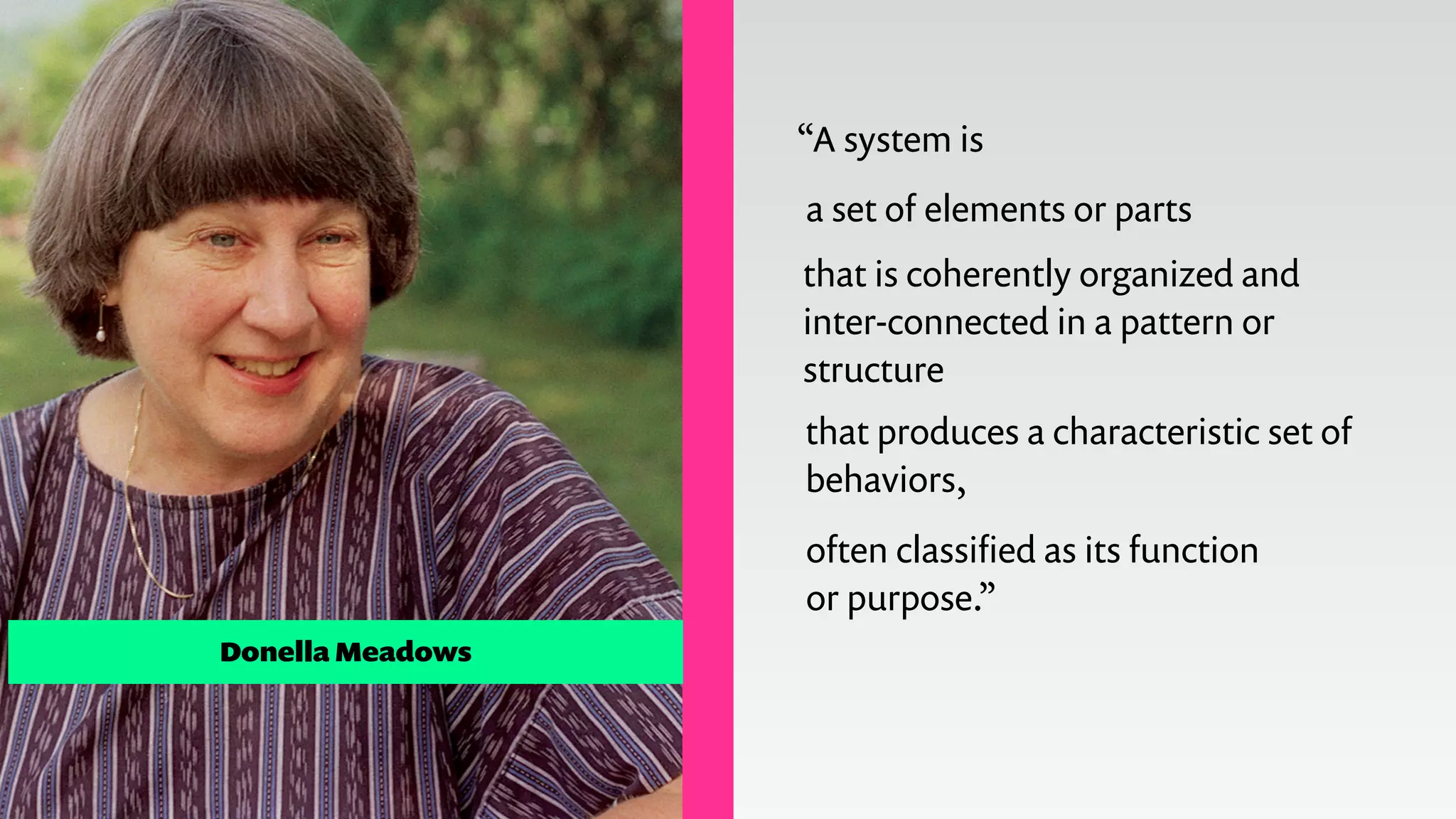
“A system is
aset of elements or parts
often classified as its function
or purpose.”
that is coherently organized and
inter-connected in a pattern or
structure
that produces a characteristic set of
behaviors,
Donella Meadows
3.
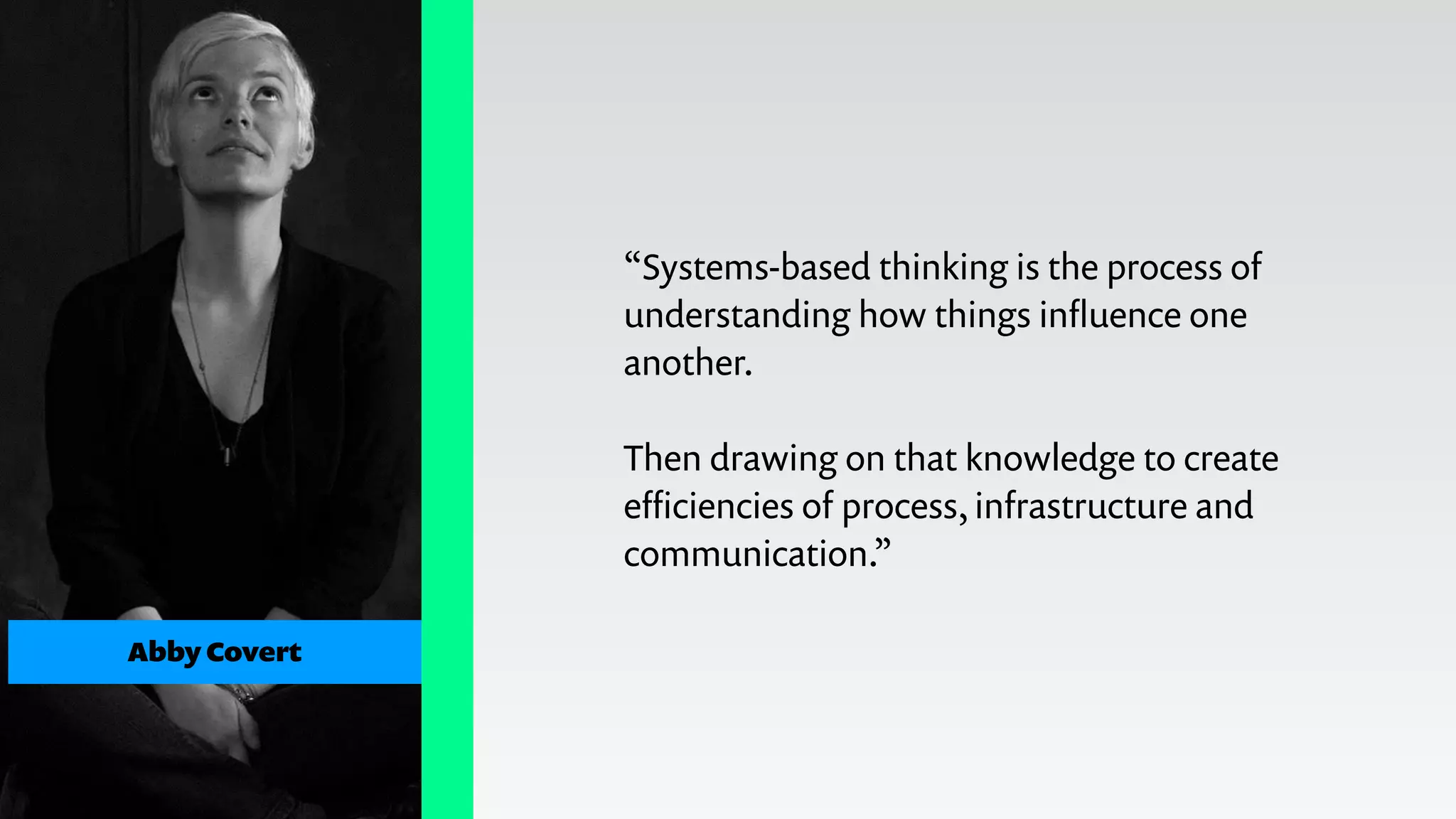
“Systems-based thinking isthe process of
understanding how things influence one
another.
!
Then drawing on that knowledge to create
efficiencies of process, infrastructure and
communication.”
Abby Covert
4.
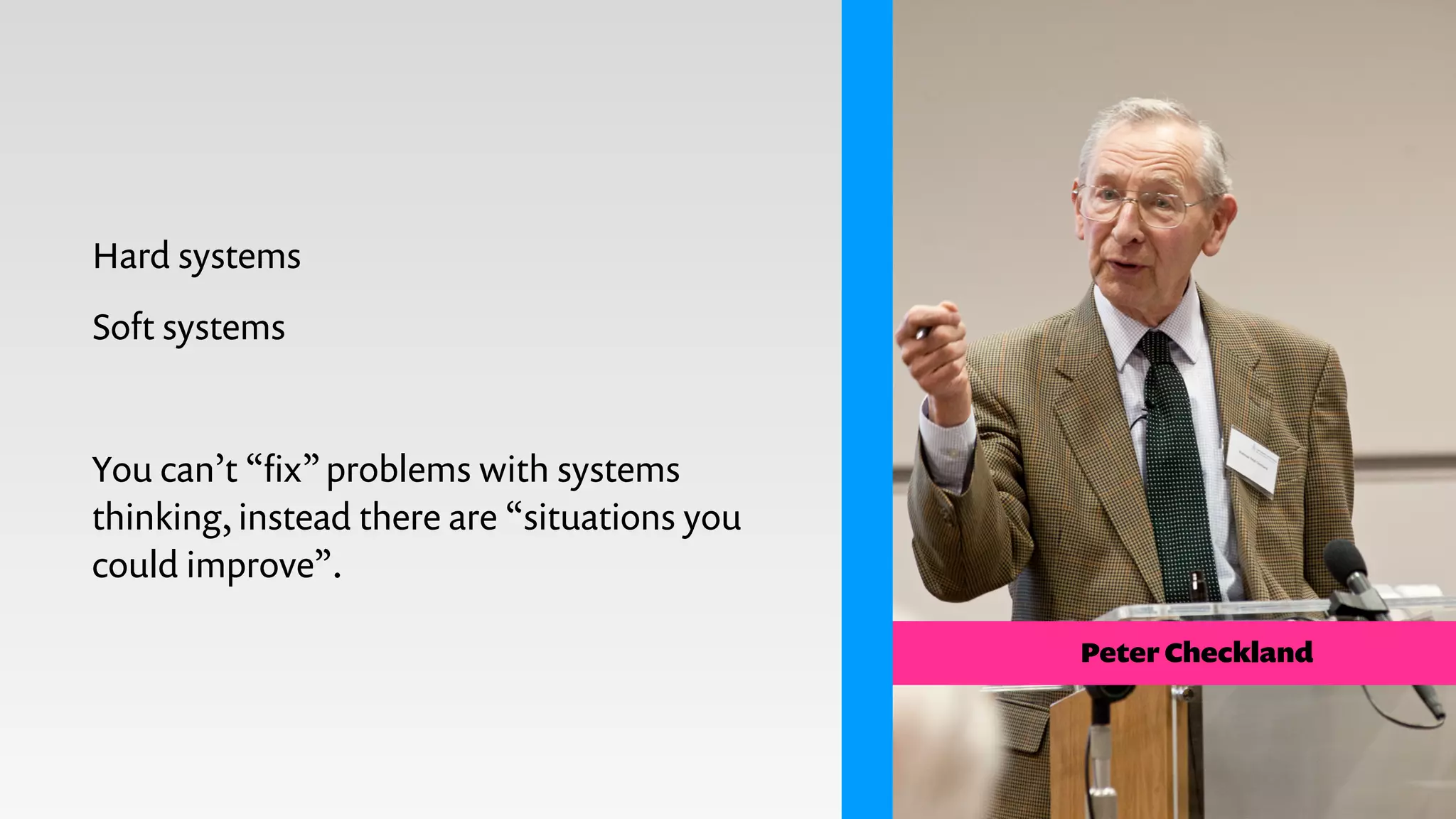
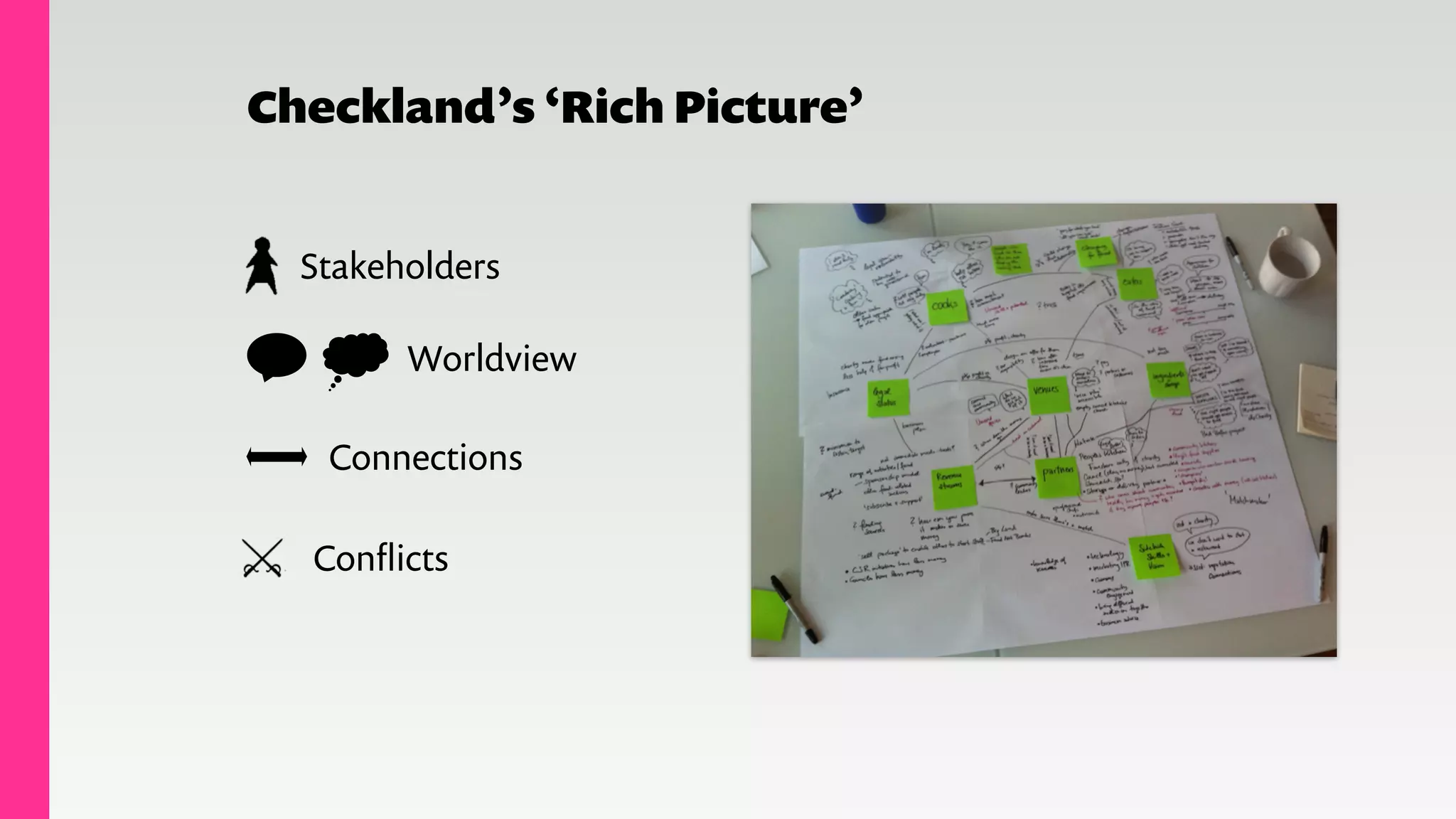
Hard systems
Soft systems
!
Youcan’t “fix”problems with systems
thinking, instead there are “situations you
could improve”.
Peter Checkland
5.
Systems exhibit purposefulbehaviour over time.
Systems get ‘soft’, unpredictable once humans
are involved.
Models are thestarting point to look at
the situation, and see what change should
be introduced, and how.
10.
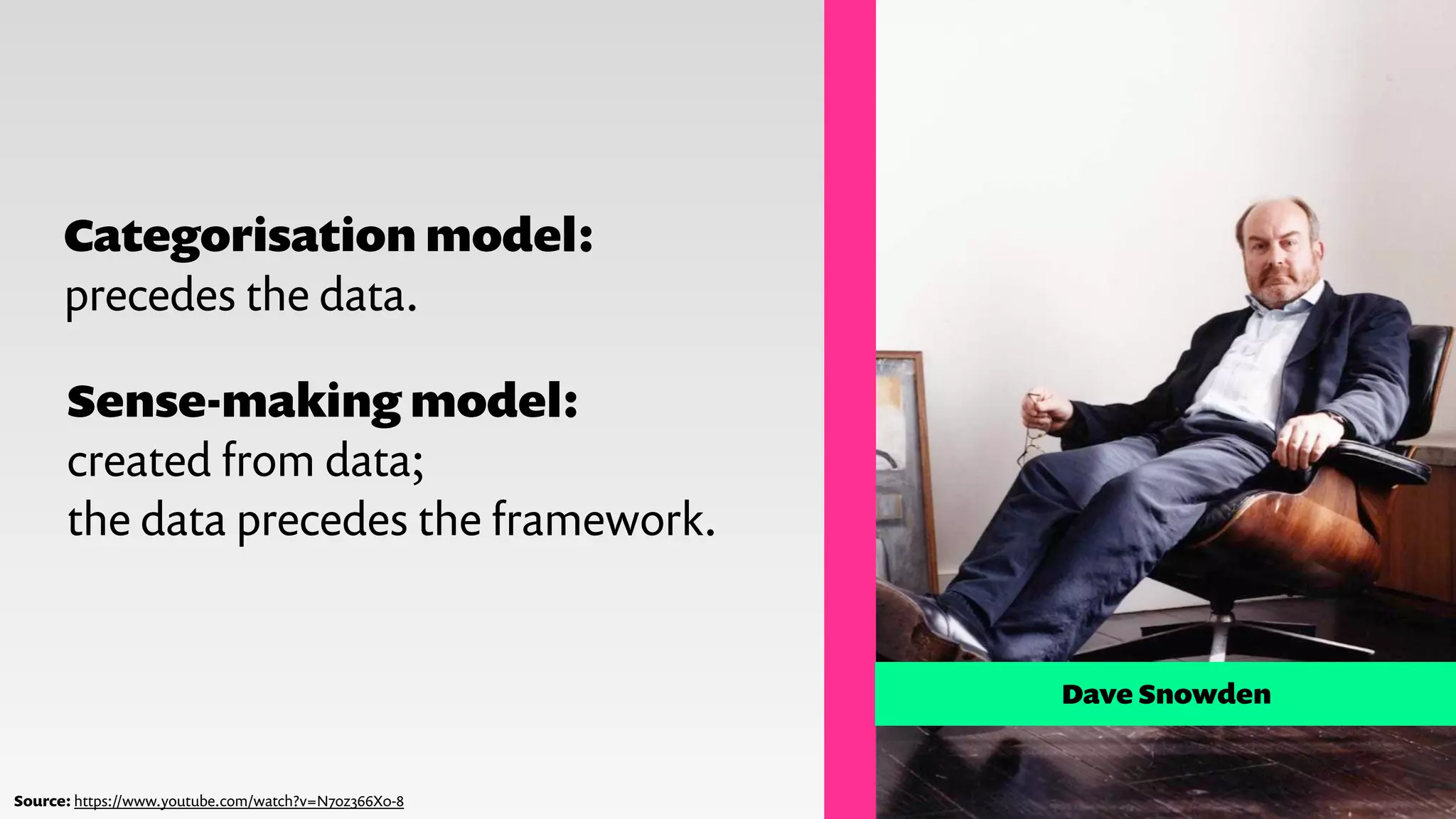
Categorisation model:
precedes thedata.
Sense-making model:
created from data;
the data precedes the framework.
Dave Snowden
Source: https://www.youtube.com/watch?v=N7oz366X0-8
Eric Ries
!
“Only bybuilding a model of customer
behaviour
and then showing our ability to use our
product or service to change it over time
can we establish real facts about the
validity of our vision.”
16.
Measuring tools
Custom analysisbased on raw data
Logging tools
Dashboard
Content marketing tools
(combined with qualitative research!)
17.
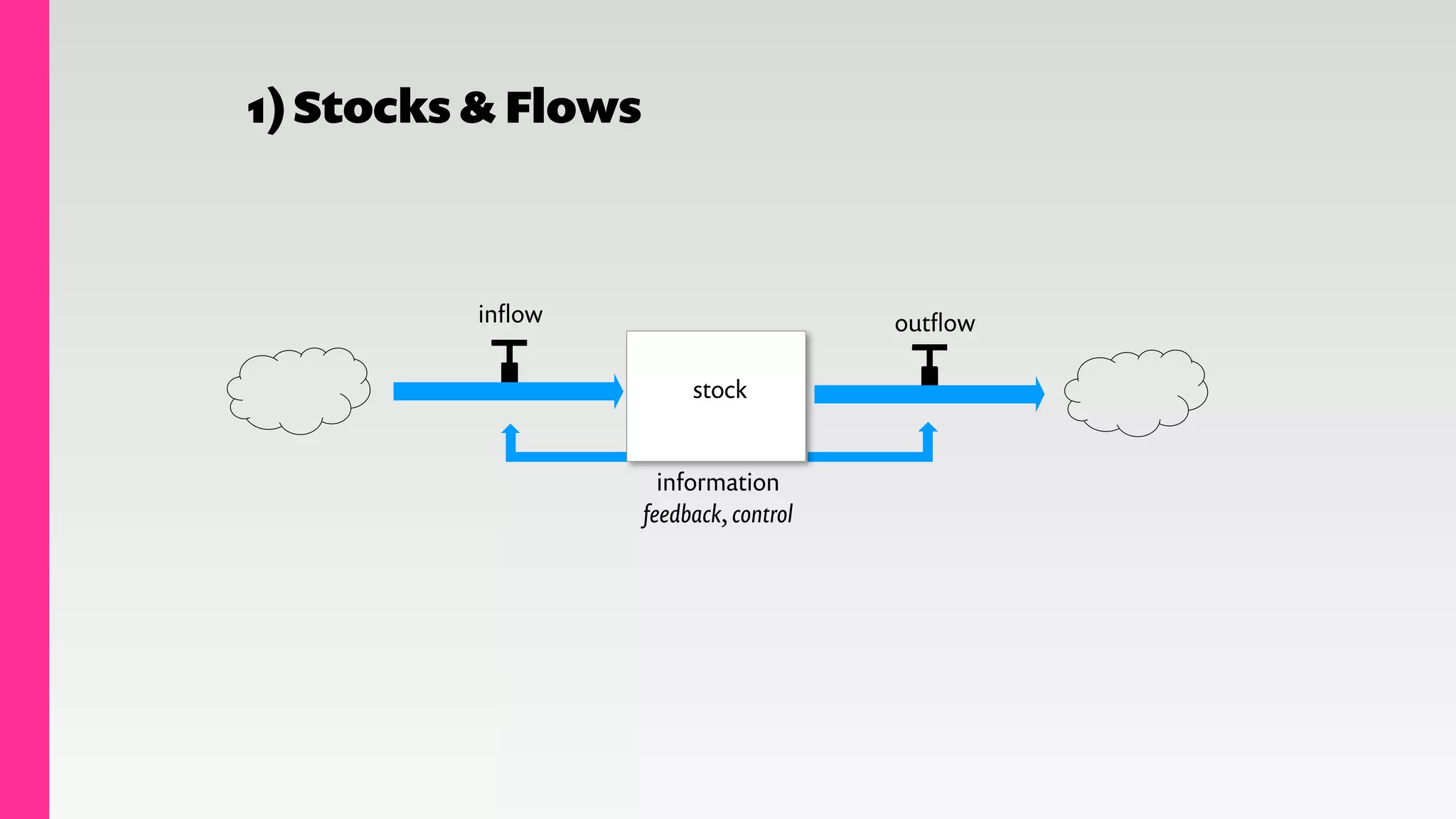
3 things topay attention to in a system:
1) Stocks & Flows
2) Feedback loops
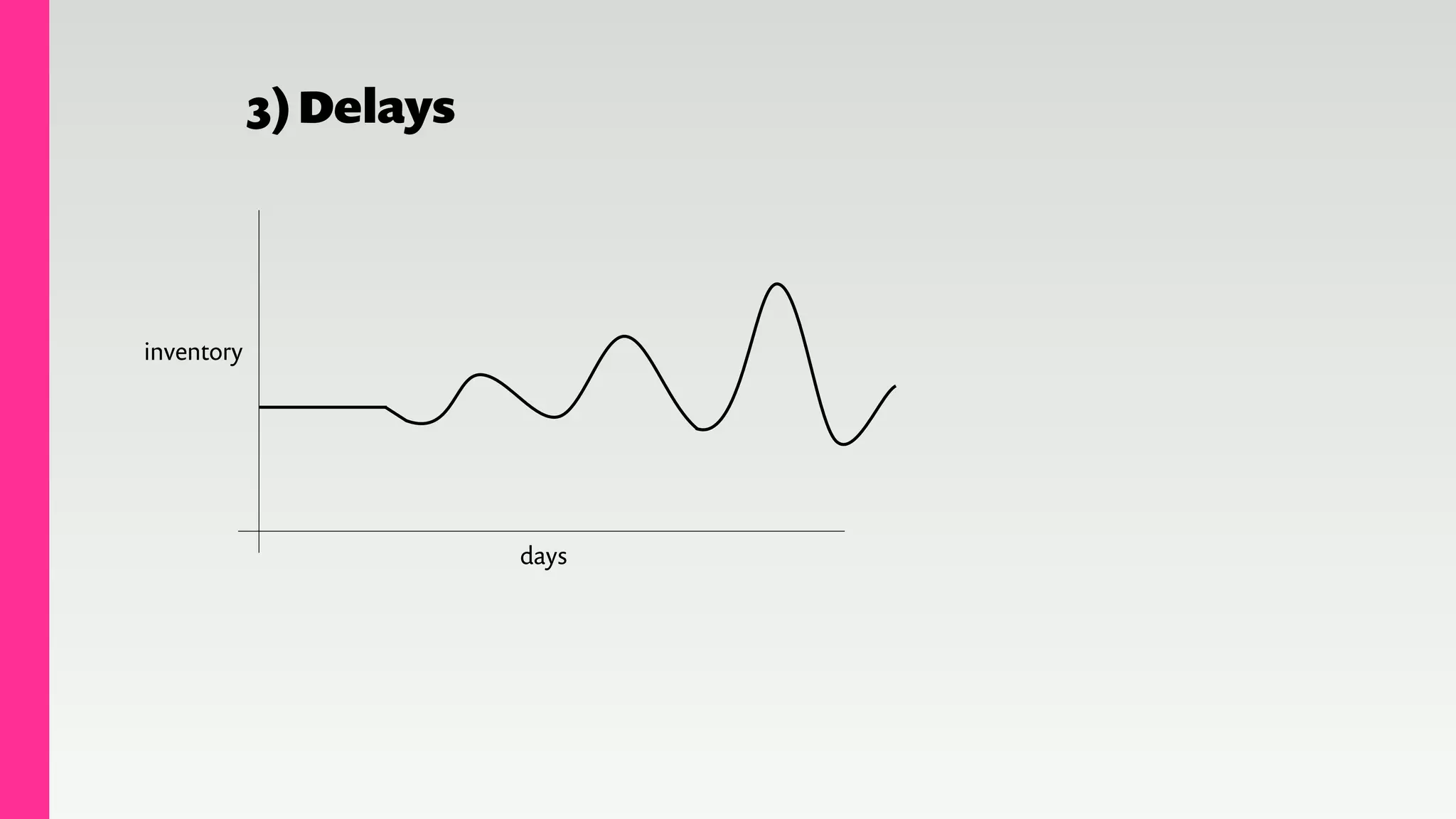
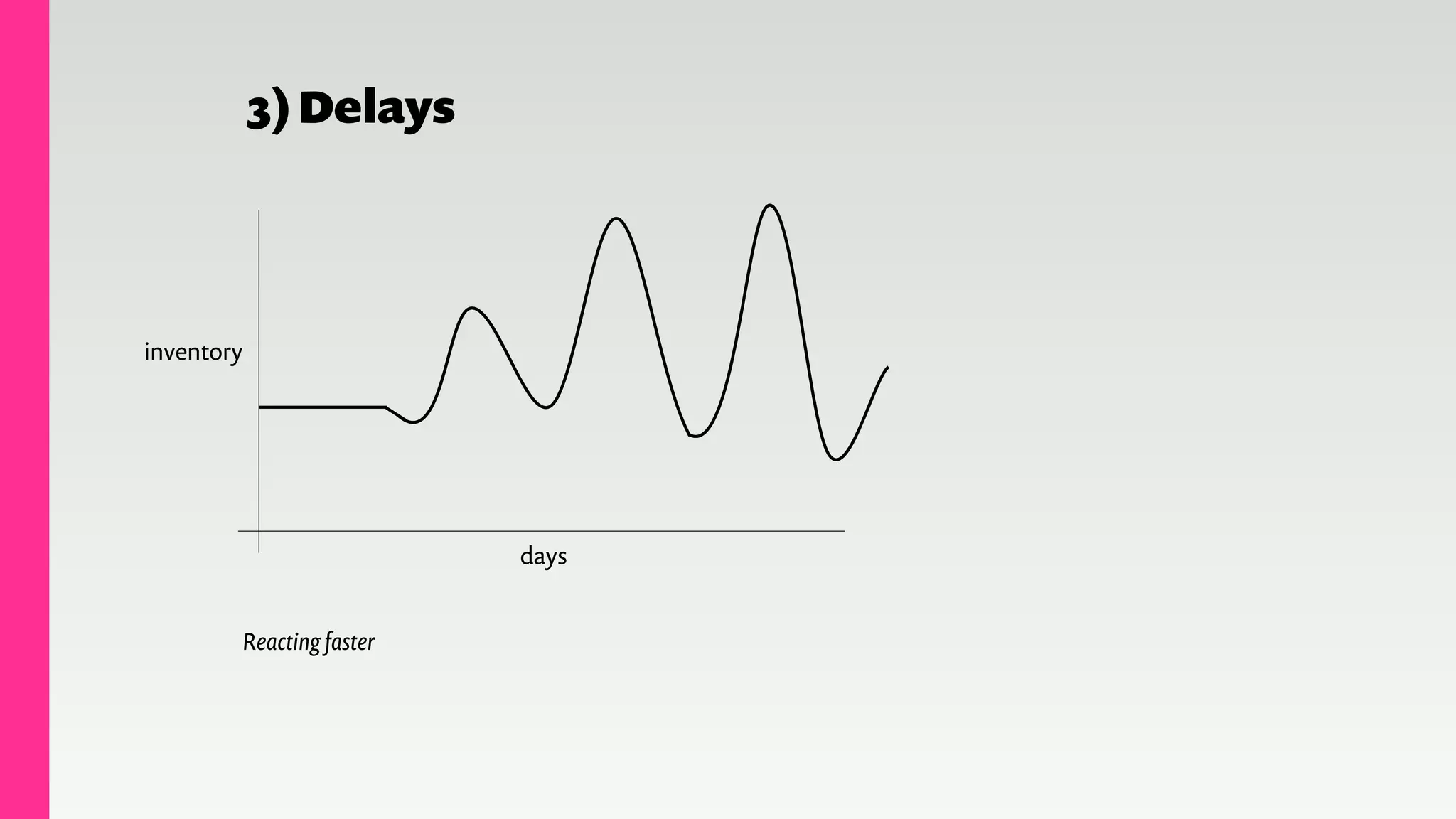
3) Delays
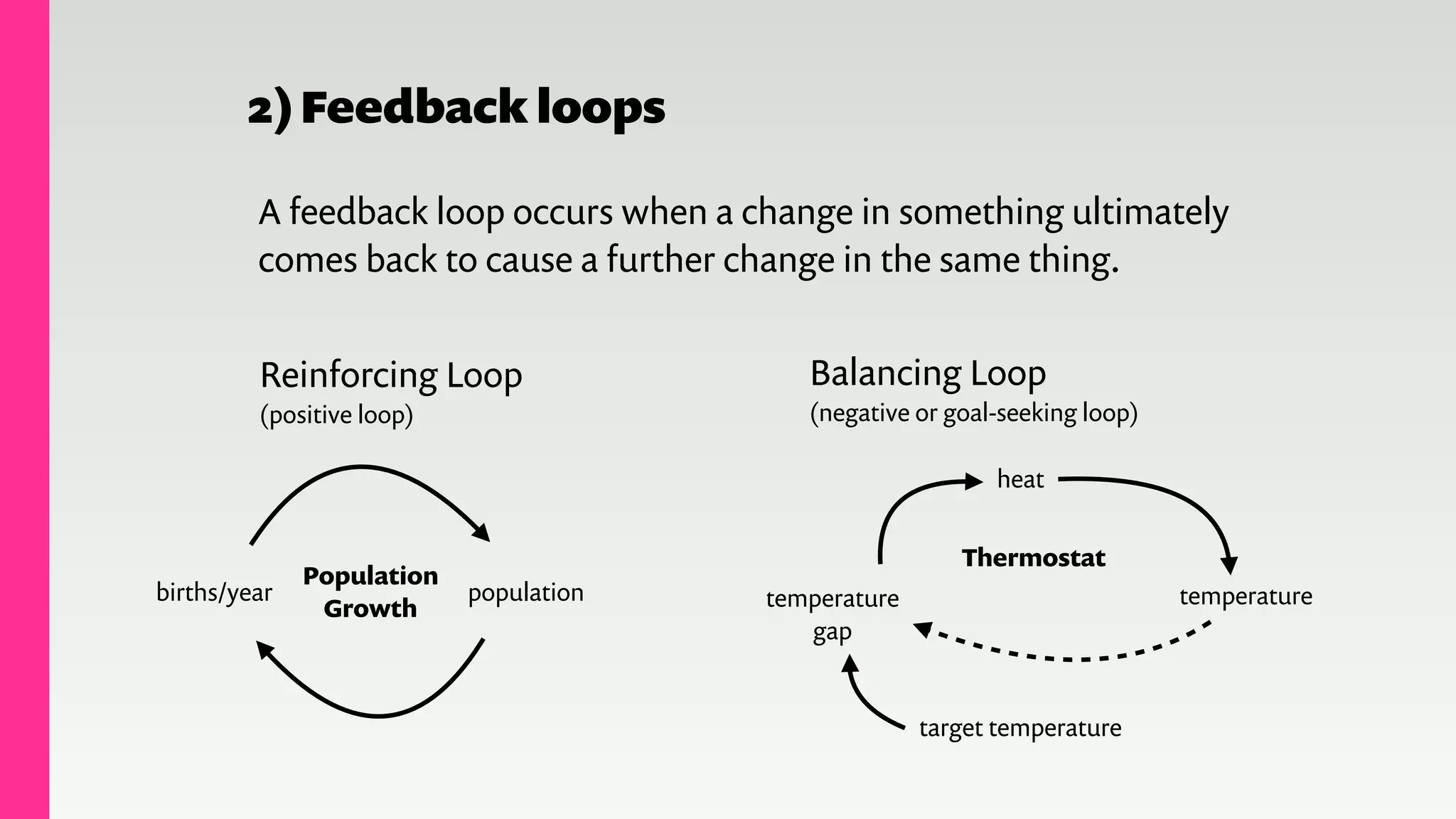
2)Feedback loops
A feedbackloop occurs when a change in something ultimately
comes back to cause a further change in the same thing.
Reinforcing Loop
(positive loop)
births/year population
Population
Growth
Balancing Loop
(negative or goal-seeking loop)
heat
Thermostat
temperature
target temperature
temperature
gap
We are notonly explaining a system and
making it easy to use:
we are also shaping the role of the human
actors in the system.
28.
For reference: DonellaMeadows, http://donellameadows.org/archives/leverage-points-places-to-intervene-in-a-system/
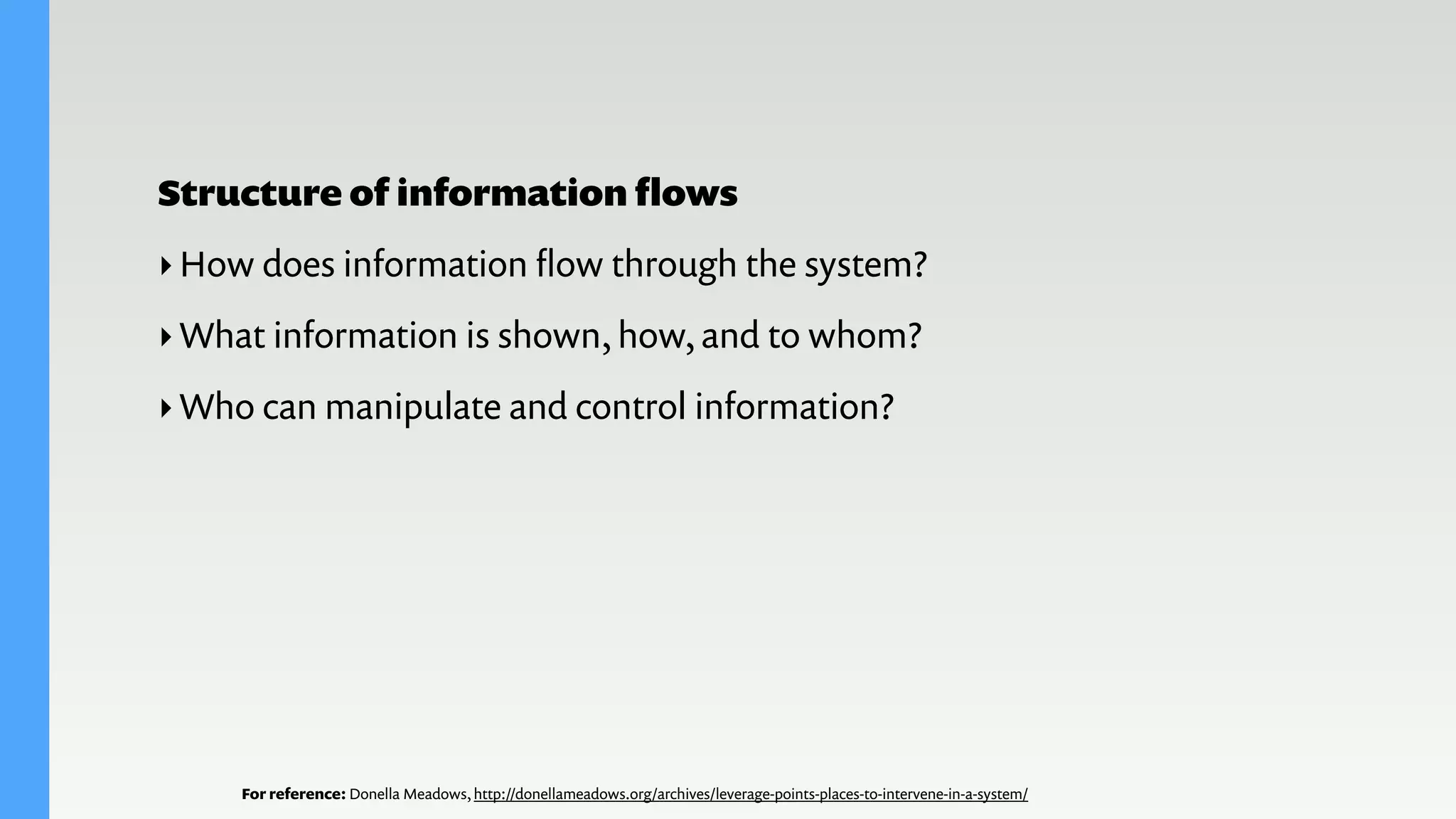
Structure of information flows
‣How does information flow through the system?
‣What information is shown, how, and to whom?
‣Who can manipulate and control information?
29.
For reference: DonellaMeadows, http://donellameadows.org/archives/leverage-points-places-to-intervene-in-a-system/
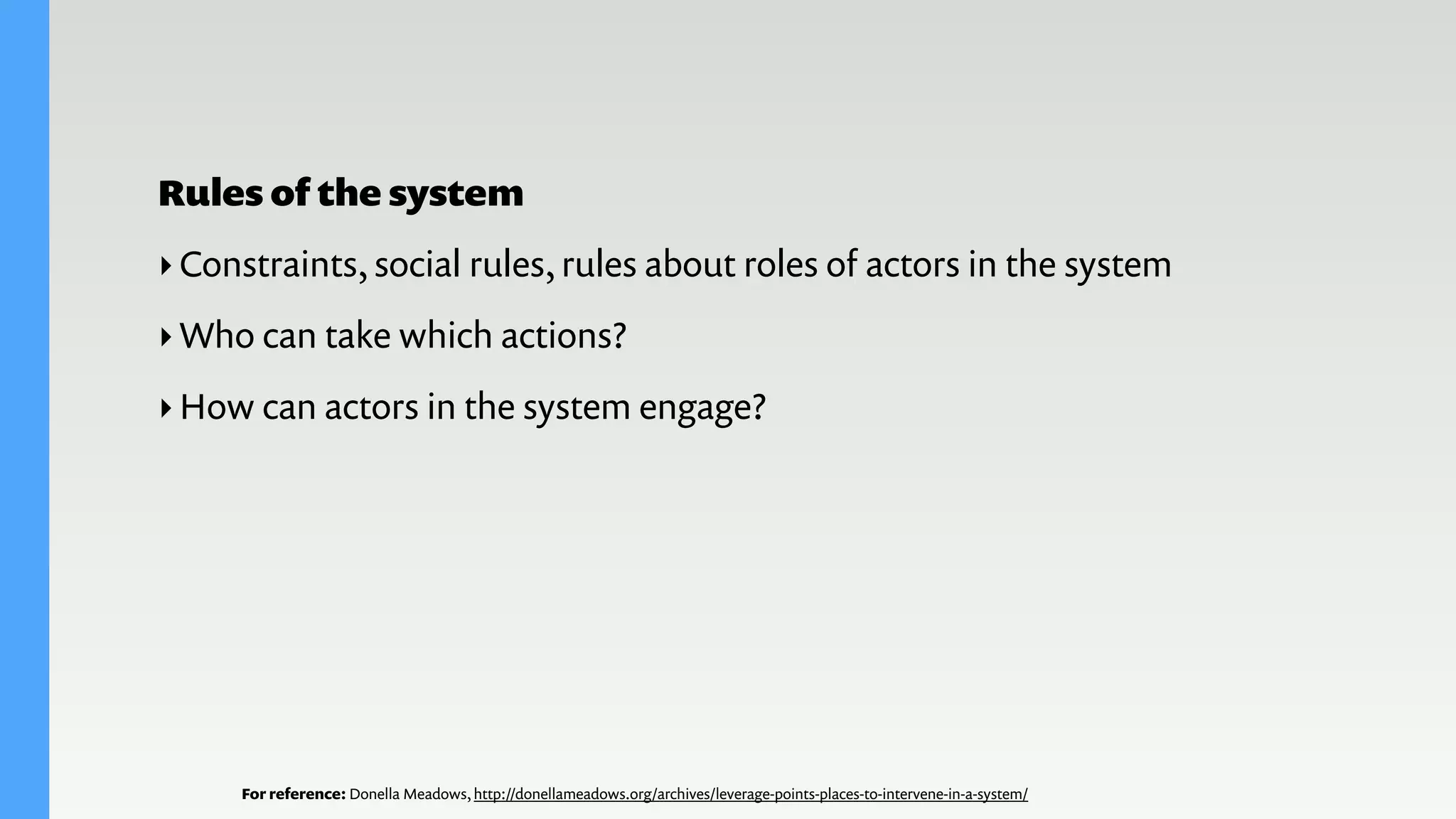
Rules of the system
‣Constraints, social rules, rules about roles of actors in the system
‣Who can take which actions?
‣How can actors in the system engage?
30.
For reference: DonellaMeadows, http://donellameadows.org/archives/leverage-points-places-to-intervene-in-a-system/
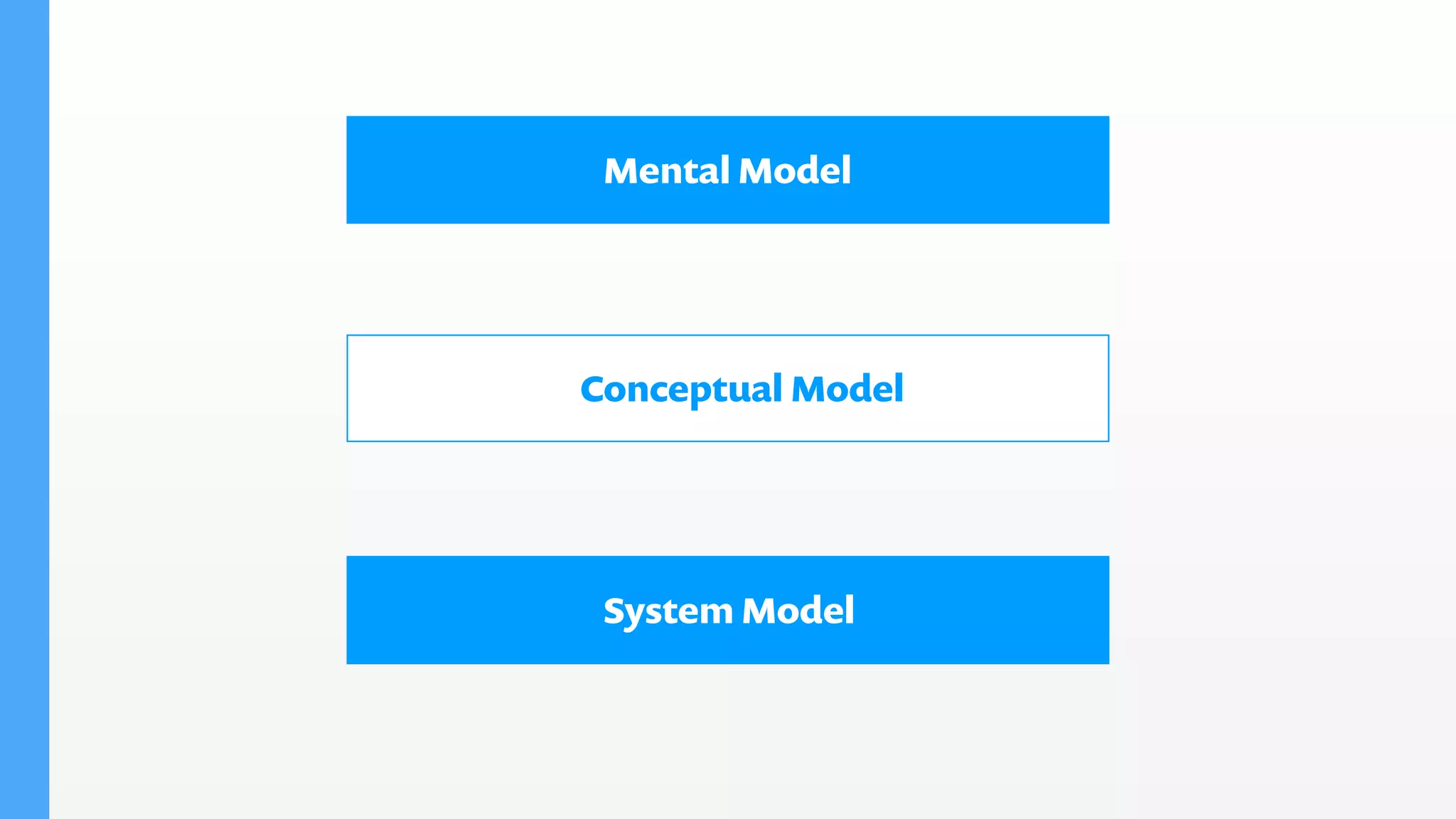
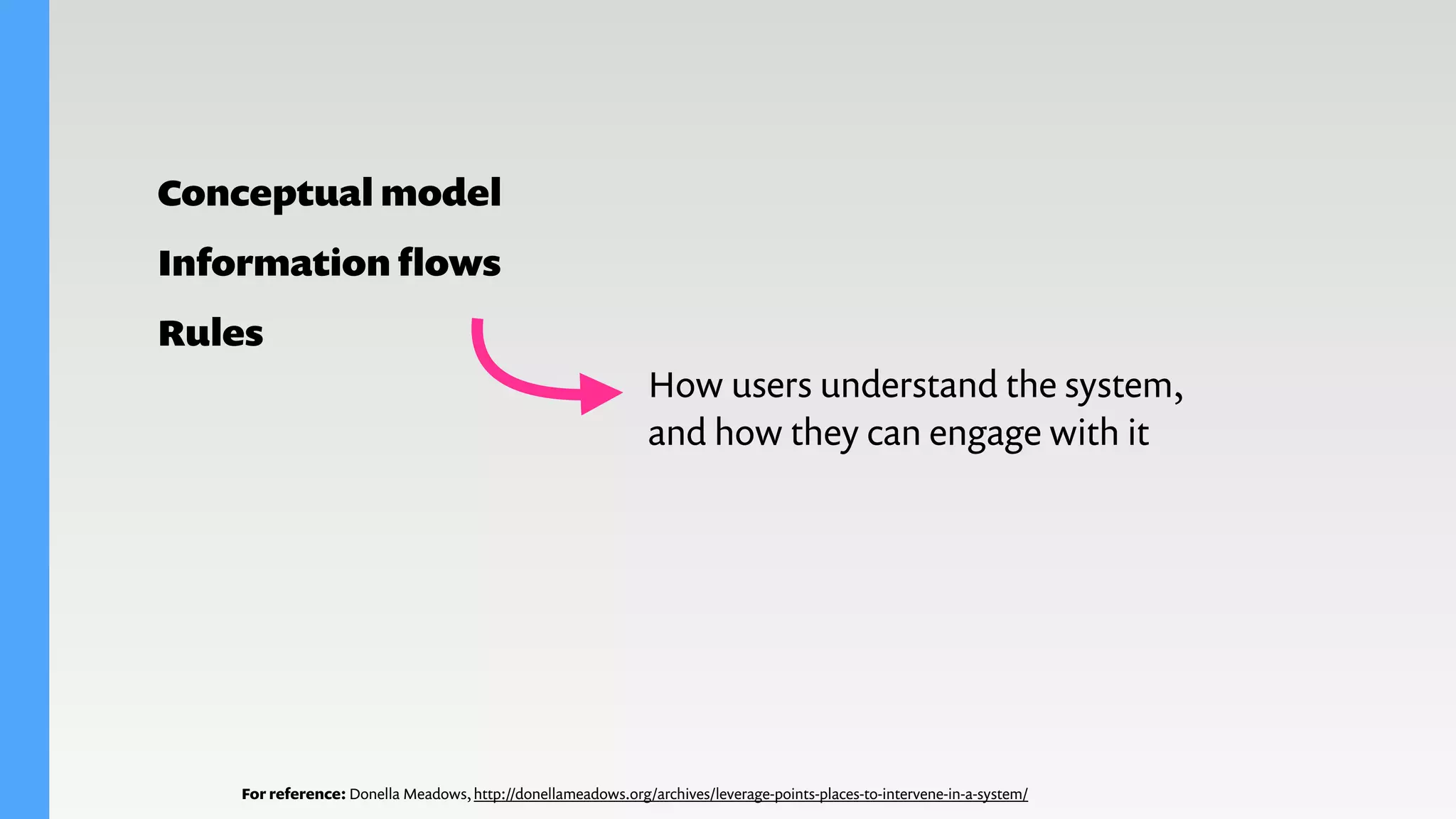
Conceptual model
Information flows
Rules
How users understand the system,
and how they can engage with it
31.
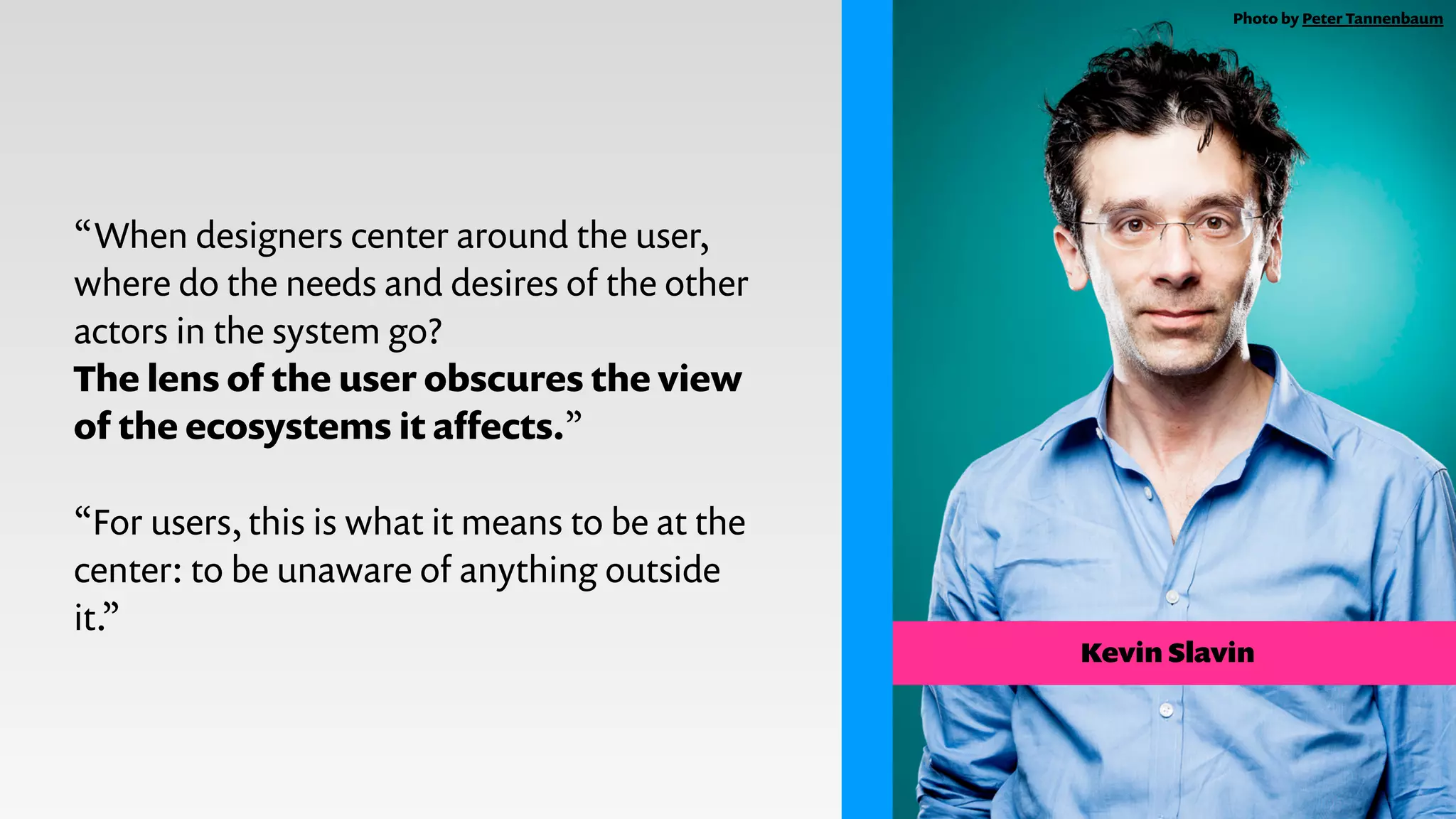
“When designers centeraround the user,
where do the needs and desires of the other
actors in the system go?
The lens of the user obscures the view
of the ecosystems it affects.”
!
“For users, this is what it means to be at the
center: to be unaware of anything outside
it.”
Kevin Slavin
Photo by Peter Tannenbaum
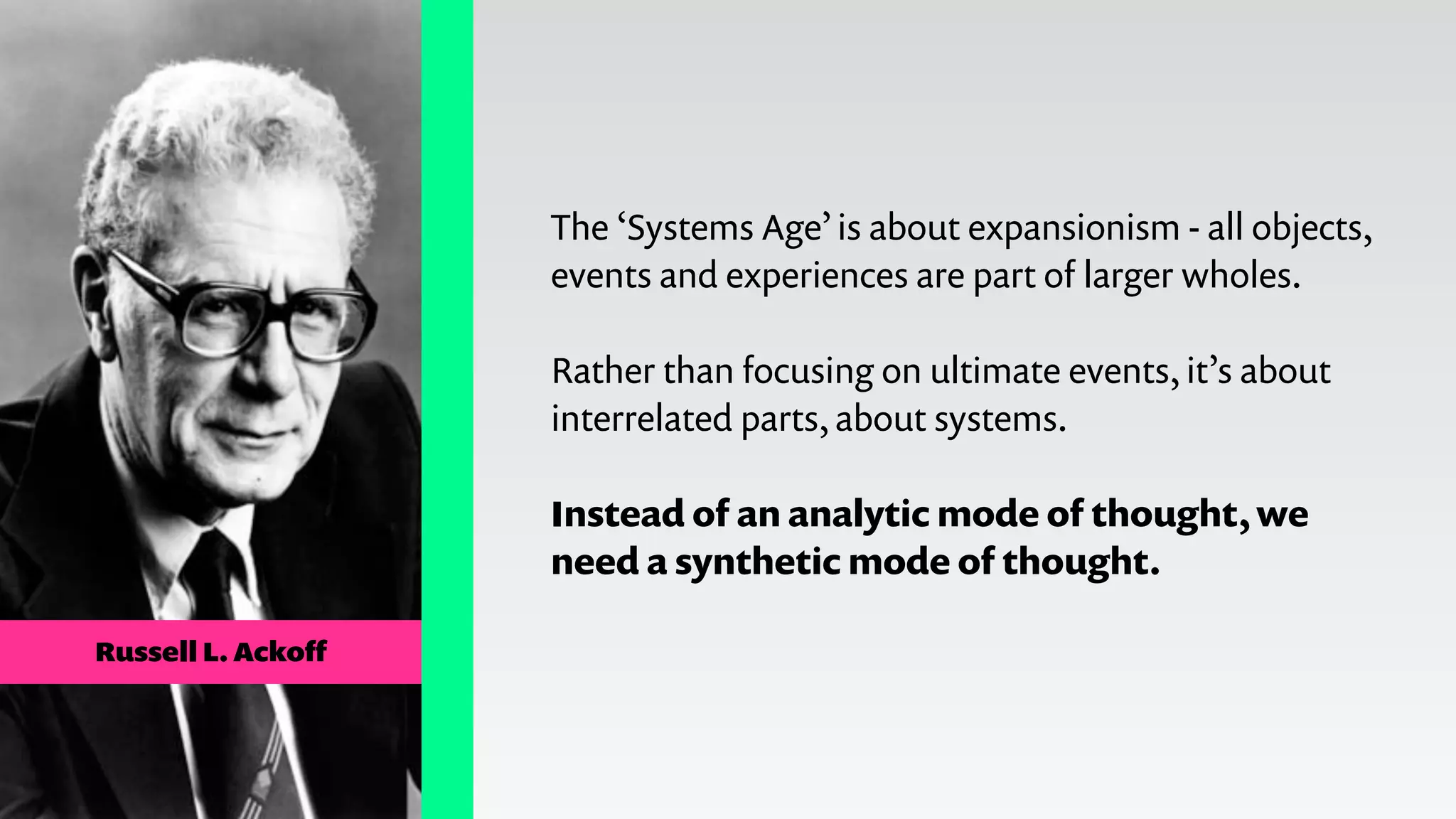
Russell L. Ackoff
The‘Systems Age’ is about expansionism - all objects,
events and experiences are part of larger wholes.
!
Rather than focusing on ultimate events, it’s about
interrelated parts, about systems.
!
Instead of an analytic mode of thought, we
need a synthetic mode of thought.
34.
Skills for thesystems age:
1) The ability to think abductively.
2) The ability to synthesise information.
3) The ability to choose the right level of abstraction.
35.
Abductive reasoning
Abductive logicallows for the creation of new knowledge and insight.
The conclusions from an abductive argument might turn out to be false, even if the
premises are true.
You make inferences (or educated guesses)based on an incomplete
set of information in order to come up with the most likely solution.
Sources: Jon Kolko, http://www.jonkolko.com/writingAbductiveThinking.php; Andy Budd, http://www.andybudd.com/archives/2016/04/what_the_hell_is_design_thinking_anyway/
36.
Ability to synthesiseinformation
The process of drawing together concepts, ideas, objects and other qualitative data in
new configurations, or to create something entirely new.
!
Synthesis
‣typically deals with non-numeric data.
‣often undertaken towards the end of an analytic process as the reverse
of deconstruction.
‣can also form part of an exploration
Source: Steve Baty, http://johnnyholland.org/2009/02/deconstructing-analysis-techniques/
37.
Ability to choosethe right level of abstraction
Models make complexity visible, tell a story, and allow us to create shared
understanding. Successful modeling requires abstraction.
!
‣define the boundaries
‣abstract with a purpose in mind
‣it’s about the process - not about deliverables
‣steward the process of abstraction
38.
Skills for thesystems age:
1) The ability to think abductively.
2) The ability to synthesise information.
3) The ability to choose the right level of abstraction.
39.
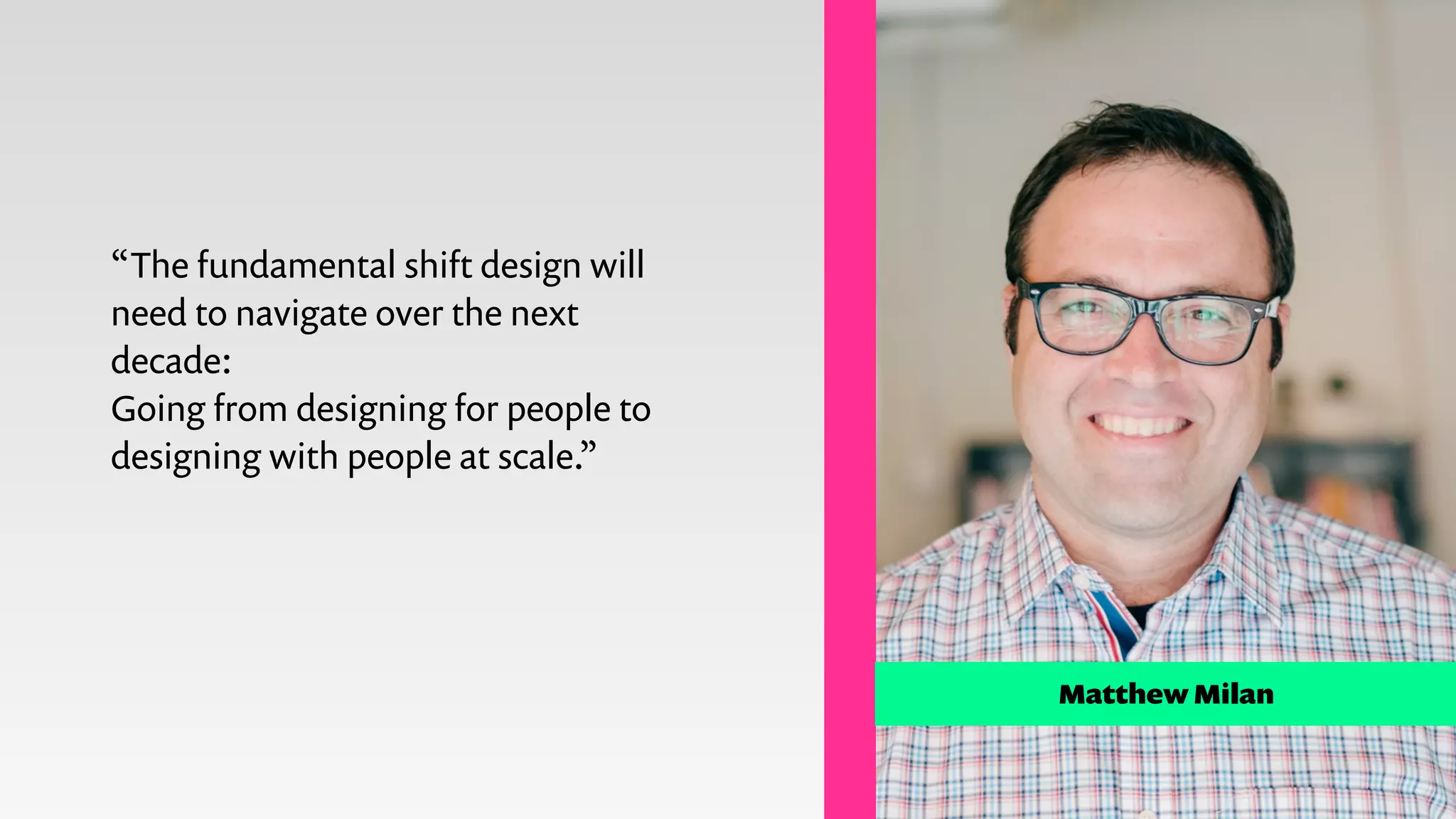
Matthew Milan
“The fundamentalshift design will
need to navigate over the next
decade:
Going from designing for people to
designing with people at scale.”
Use this toolto
help you think
more systemically!
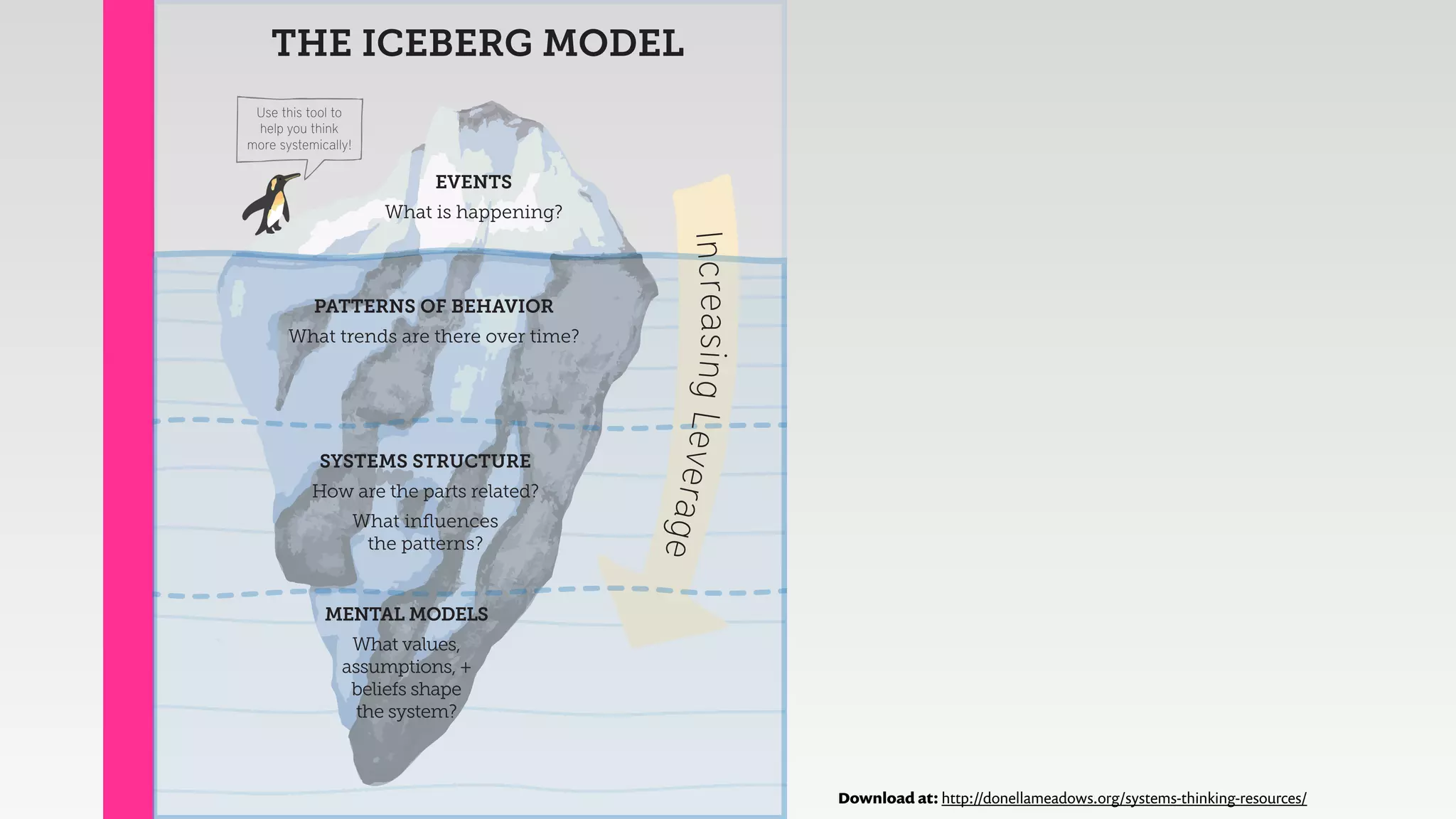
THE ICEBERG MODEL
EVENTS
What is happening?
PATTERNS OF BEHAVIOR
What trends are there over time?
SYSTEMS STRUCTURE
How are the parts related?
What influences
the patterns?
MENTAL MODELS
What values,
assumptions, +
beliefs shape
the system?
IncreasingLeverage
Download at: http://donellameadows.org/systems-thinking-resources/
42.
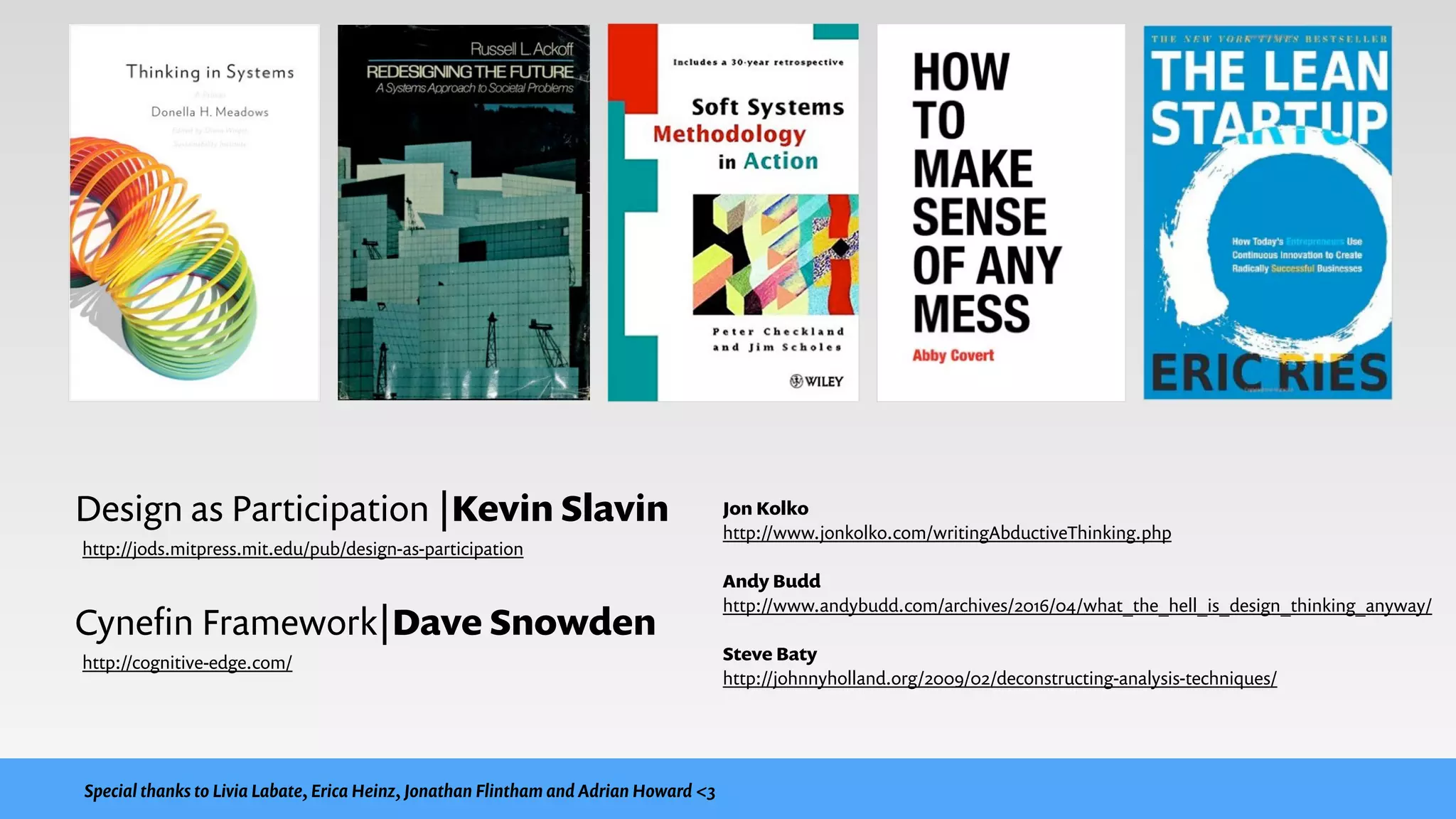
Design as Participation|Kevin Slavin
http://jods.mitpress.mit.edu/pub/design-as-participation
Cynefin Framework|Dave Snowden
http://cognitive-edge.com/
Jon Kolko
http://www.jonkolko.com/writingAbductiveThinking.php
!
Andy Budd
http://www.andybudd.com/archives/2016/04/what_the_hell_is_design_thinking_anyway/
!
Steve Baty
http://johnnyholland.org/2009/02/deconstructing-analysis-techniques/
Special thanks to Livia Labate, Erica Heinz, Jonathan Flintham and Adrian Howard <3