SCIENTOMETRIC ANALYSIS OF RESEARCH
COMPETITIVENESS OF COUNTRIES,
INSTITUTIONS AND SUBJECTS
Supervised By
Dr Vivek Kumar Singh
Assistant Professor
Department of Computer Science
South Asian University
Presented By :
Khushboo Singhal Sumit Kumar Banshal
Roll No. SAU/CS(M)/2013/005 Roll No. SAU/CS(M)/2013/018
Department of Computer Science Department of Computer Science
South Asian University South Asian University
5/17/2015
Outline
 Introduction
 Questions we Aimed to Answer
 Country/Region Level Analysis
 Institution Level Analysis
 Fine Grained Research Theme based Analysis
 Scientometric & Indicators
 Derived Indicators
 Bibliographic Databases
 Our Work
 Regional Analysis
 Institution Level Analysis
 Fine Grained Research Theme based Analysis
 Challenges
 Publication Out of this Work
 Selected Bibliography
Introduction
 Scientometric Assessment of Research Competitiveness is
distributed in three different aspects:
 Country/Region Level Analysis
 South Asia
 Bangladesh
 India
 Institution Level Analysis
 Top 100 world institutes
 Central Universities (CU)
 Indian Institute of Technology (IIT)
 Fine Grained Research Theme based Analysis
 Big Data
Questions we Aimed to Answer
 Can IT infrastructure be mapped with CS research output
from South Asian countries?
 Can we analyze the CS research output stand of
Bangladesh?
 Can we visualize the CS research output stand of India?
 Can we characterize the leading World Institutes ?
 Can we map the proportionate contribution of CU in India
and rank CU accordingly?
 Can we rank IIT based on research output & characterize
the research ?
 Can this methodology be characterized in narrow research
theme?
Country/Region Level Analysis
 South Asia (SA)
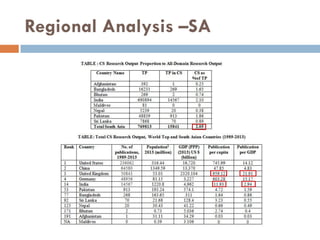
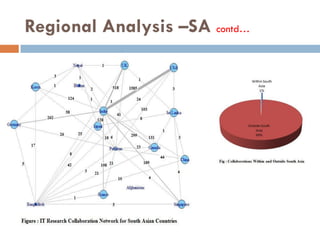
 Mapping IT infrastructure with CS Research Output
 Bibliographic data from Web of Science for SA
Countries
 Afghanistan, Bangladesh, Bhutan, India, Maldives, Nepal,
Pakistan, Sri Lanka
 For the period 1989-2013
 Standings of SA Countries in IT
 Total 15,841 records (15,810 unique)
Country/Region Level Analysis contd…
 Bangladesh
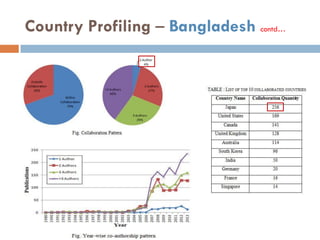
 Insight look on Country’s Research Output
 Trends, Author Ship Patterns, Top Contributors
 Bibliographic data from Scopus
 For the period 1989-2013
 Total 3200 records (3193 unique)
Country/Region Level Analysis contd…
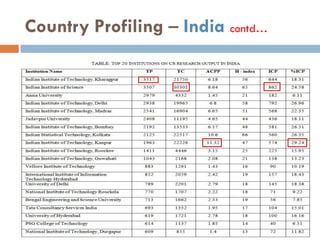
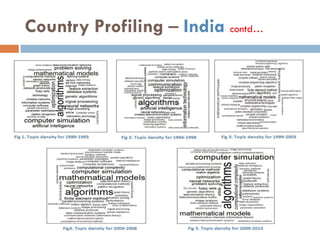
 India
 Insight look on Country’s Research Output
 Trends, Author Ship Patterns, Top Contributors
 Bibliographic data from Scopus
 For the period 1989-2013
 Total 84385 records
 100 institutions
 61502 records (72% of Total Data)
 59682 unique records
Institution Level Analysis
 Top 100 CS Research Producing Institutes of the
World (W-100)
 Measuring Research Competitiveness of W-100
 Characterizing Research Trends
 Implementing Composite Rank
 Bibliographic data from Web of Science
 For the period 1999-2013
 Total 261,154 records
 251,312 unique records
Institution Level Analysis contd…
 Central Universities in India (CU)
 39 Central Universities (http://mhrd.gov.in/)
 Measuring Contribution to Indian Research
 Rank Institute based on Research Strengths
 Identifying Trends & Themes in Research
 For the period 1990-2014
 Total 64302 records
 63776 unique records
 Each record comprises of 60 attributes
Institution Level Analysis contd…
 Indian Institutes of Technology (IIT)
 16 IIT (https://www.iitsystem.ac.in/IITCouncil.jsp)
 Measuring Contribution to Indian Research
 Rank IIT based on Research Strengths
 Identifying Trends & Themes in IIT Research
 For the period 1990-2014
 Total 81588 records
 80991 unique records
 Each record comprises of 60 attributes
 Big Data
 Characterizing Research Output from Narrow Discipline
 Fine-Grained Research Theme Mapped into Scientometric
Methodology
 Emerging Topic since 2005s
 Collected Data from Scopus & WOS
 For the Period 2010-2014
 Total Records
 WOS:- 1415 (60 Fields)
 Scopus:- 6810 (41 Fields)
Fine Grained Research Theme based
Analysis
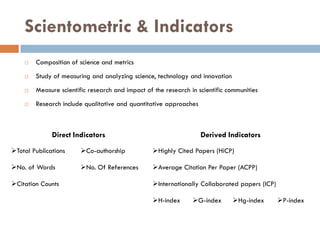
Scientometric & Indicators
 Composition of science and metrics
 Study of measuring and analyzing science, technology and innovation
 Measure scientific research and impact of the research in scientific communities
 Research include qualitative and quantitative approaches
Direct Indicators Derived Indicators
Total Publications Co-authorship Highly Cited Papers (HiCP)
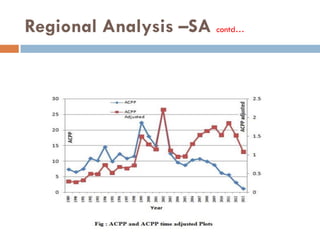
No. of Words No. Of References Average Citation Per Paper (ACPP)
Citation Counts Internationally Collaborated papers (ICP)
H-index G-index Hg-index P-index
Derived Indicators
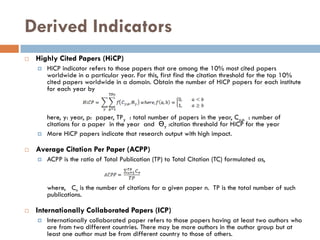
 Highly Cited Papers (HiCP)
 HiCP indicator refers to those papers that are among the 10% most cited papers
worldwide in a particular year. For this, first find the citation threshold for the top 10%
cited papers worldwide in a domain. Obtain the number of HiCP papers for each institute
for each year by
here, y: year, p: paper, TPy : total number of papers in the year, Cy,p : number of
citations for a paper in the year and Ɵy :citation threshold for HiCP for the year
 More HiCP papers indicate that research output with high impact.
 Average Citation Per Paper (ACPP)
 ACPP is the ratio of Total Publication (TP) to Total Citation (TC) formulated as,
where, Cn is the number of citations for a given paper n. TP is the total number of such
publications.
 Internationally Collaborated Papers (ICP)
 Internationally collaborated paper refers to those papers having at least two authors who
are from two different countries. There may be more authors in the author group but at
least one author must be from different country to those of others.
Derived Indicators
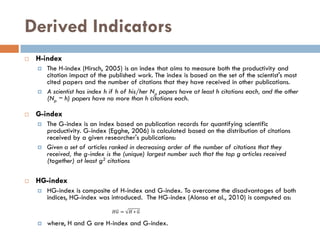
 H-index
 The H-index (Hirsch, 2005) is an index that aims to measure both the productivity and
citation impact of the published work. The index is based on the set of the scientist's most
cited papers and the number of citations that they have received in other publications.
 A scientist has index h if h of his/her Np papers have at least h citations each, and the other
(Np − h) papers have no more than h citations each.
 G-index
 The G-index is an index based on publication records for quantifying scientific
productivity. G-index (Egghe, 2006) is calculated based on the distribution of citations
received by a given researcher's publications:
 Given a set of articles ranked in decreasing order of the number of citations that they
received, the g-index is the (unique) largest number such that the top g articles received
(together) at least g2 citations
 HG-index
 HG-index is composite of H-index and G-index. To overcome the disadvantages of both
indices, HG-index was introduced. The HG-index (Alonso et al., 2010) is computed as:
 where, H and G are H-index and G-index.
Derived Indicators
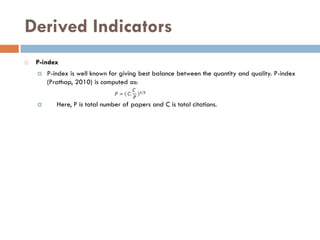
 P-index
 P-index is well known for giving best balance between the quantity and quality. P-index
(Prathap, 2010) is computed as:
 Here, P is total number of papers and C is total citations.
Bibliographic Databases
 There are many well known databases:
 Scopus  Web of Science  MEDLINE
 Google Scholar  Info Track  Biomedical Databases
 Compendex  GENESIS  OAIster
 Inspec
 BASE
 IEEE Xplore
 PASCAL
 TreeBASE
 POPLINE
 Trove  DOGE  Embase
 ACM Portal  DBLP  PubMed
Selected Databases
 WOS
 Depth of Coverage (90 million records of 250+ disciplines)
 12,000 journals proceedings
 160,000 conference proceedings
 Specific Criteria to Select Journal
 Indexing Service
 Attributes in tag format (all tags)
 Sample Data
 Scopus
 50 million records
 Easy to navigate
 Widely Acclaimed Indexing Service as well as publishing house
 Sample data
Regional Analysis –SA
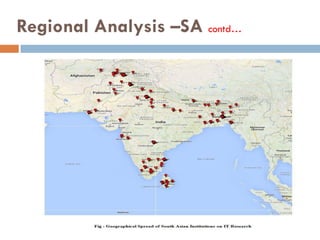
Regional Analysis –SA contd…
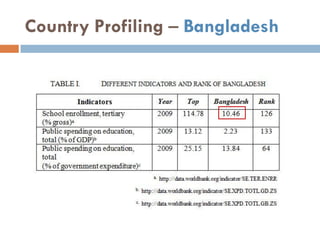
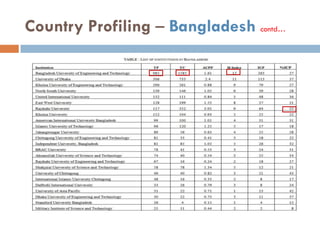
Country Profiling – Bangladesh
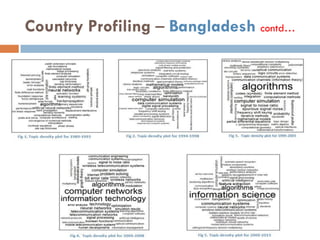
Country Profiling – Bangladesh contd…
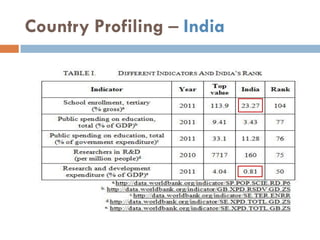
Country Profiling – India
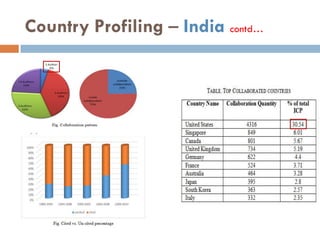
Country Profiling – India contd…
Institution Level Analysis- W100
 Measuring Research Competitiveness
 Identify Thematic Trends
 Rank Institution Based on Composite Indicators
 Rank Institution Based on Thematic Strength
 Based on Research Strength & Trends
 Based on both Qualitative & Quantitative Indicators
 One part based on Scientometrics
 Other part merged Text with Scientometrics
Institution Level Analysis- W100 contd…
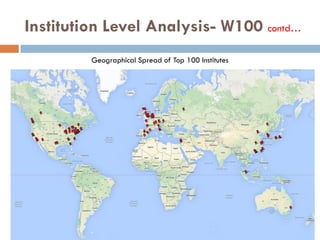
Geographical Spread of Top 100 Institutes
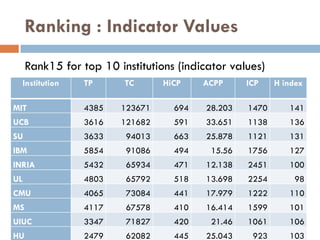
Ranking : Indicator Values
Rank15 for top 10 institutions (indicator values)
Institution TP TC HiCP ACPP ICP H index
MIT 4385 123671 694 28.203 1470 141
UCB 3616 121682 591 33.651 1138 136
SU 3633 94013 663 25.878 1121 131
IBM 5854 91086 494 15.56 1756 127
INRIA 5432 65934 471 12.138 2451 100
UL 4803 65792 518 13.698 2254 98
CMU 4065 73084 441 17.979 1222 110
MS 4117 67578 410 16.414 1599 101
UIUC 3347 71827 420 21.46 1061 106
HU 2479 62082 445 25.043 923 103
Institution Level Analysis- W100 contd…
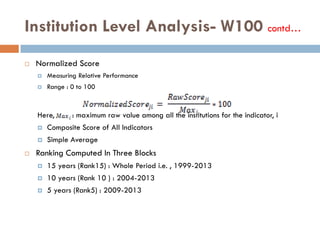
 Normalized Score
 Measuring Relative Performance
 Range : 0 to 100
Here, : maximum raw value among all the institutions for the indicator, i
 Composite Score of All Indicators
 Simple Average
 Ranking Computed In Three Blocks
 15 years (Rank15) : Whole Period i.e. , 1999-2013
 10 years (Rank 10 ) : 2004-2013
 5 years (Rank5) : 2009-2013
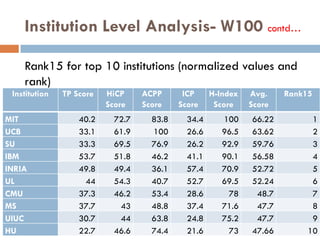
Institution Level Analysis- W100 contd…
Rank15 for top 10 institutions (normalized values and
rank)
Institution TP Score HiCP
Score
ACPP
Score
ICP
Score
H-Index
Score
Avg.
Score
Rank15
MIT 40.2 72.7 83.8 34.4 100 66.22 1
UCB 33.1 61.9 100 26.6 96.5 63.62 2
SU 33.3 69.5 76.9 26.2 92.9 59.76 3
IBM 53.7 51.8 46.2 41.1 90.1 56.58 4
INRIA 49.8 49.4 36.1 57.4 70.9 52.72 5
UL 44 54.3 40.7 52.7 69.5 52.24 6
CMU 37.3 46.2 53.4 28.6 78 48.7 7
MS 37.7 43 48.8 37.4 71.6 47.7 8
UIUC 30.7 44 63.8 24.8 75.2 47.7 9
HU 22.7 46.6 74.4 21.6 73 47.66 10
Institution Level Analysis- W100 contd…
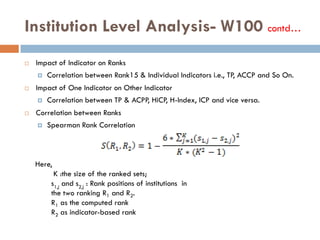
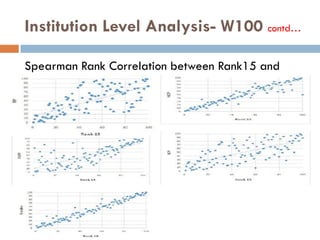
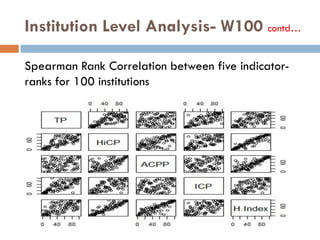
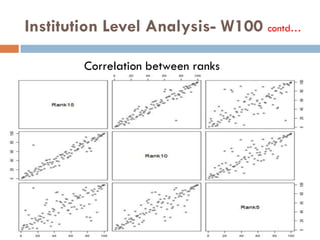
 Impact of Indicator on Ranks
 Correlation between Rank15 & Individual Indicators i.e., TP, ACCP and So On.
 Impact of One Indicator on Other Indicator
 Correlation between TP & ACPP, HiCP, H-Index, ICP and vice versa.
 Correlation between Ranks
 Spearman Rank Correlation
Here,
K :the size of the ranked sets;
s1,j
and s2,j
: Rank positions of institutions in
the two ranking R1 and R2.
R1 as the computed rank
R2 as indicator-based rank
Institution Level Analysis- W100 contd…
Spearman Rank Correlation between Rank15 and
individual indicators
Institution Level Analysis- W100 contd…
Spearman Rank Correlation between five indicator-
ranks for 100 institutions
Institution Level Analysis- W100 contd…
Correlation between ranks
Institution Level Analysis- W100 contd…
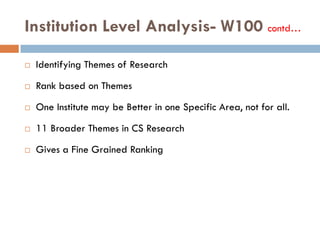
 Identifying Themes of Research
 Rank based on Themes
 One Institute may be Better in one Specific Area, not for all.
 11 Broader Themes in CS Research
 Gives a Fine Grained Ranking
Institution Level Analysis- W100 contd…
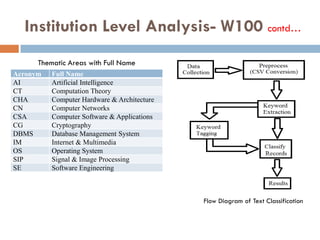
Flow Diagram of Text Classification
Acronym Full Name
AI Artificial Intelligence
CT Computation Theory
CHA Computer Hardware & Architecture
CN Computer Networks
CSA Computer Software & Applications
CG Cryptography
DBMS Database Management System
IM Internet & Multimedia
OS Operating System
SIP Signal & Image Processing
SE Software Engineering
Thematic Areas with Full Name
Institution Level Analysis- W100 contd…
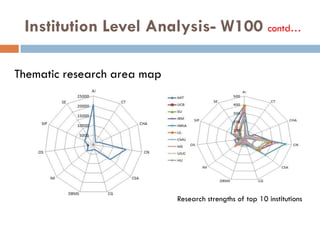
Thematic research area map
Research strengths of top 10 institutions
Institution Level Analysis- W100 contd…
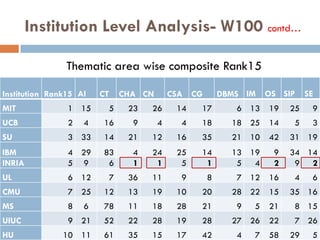
Thematic area wise composite Rank15
Institution Rank15 AI CT CHA CN CSA CG DBMS IM OS SIP SE
MIT 1 15 5 23 26 14 17 6 13 19 25 9
UCB 2 4 16 9 4 4 18 18 25 14 5 3
SU 3 33 14 21 12 16 35 21 10 42 31 19
IBM 4 29 83 4 24 25 14 13 19 9 34 14
INRIA 5 9 6 1 1 5 1 5 4 2 9 2
UL 6 12 7 36 11 9 8 7 12 16 4 6
CMU 7 25 12 13 19 10 20 28 22 15 35 16
MS 8 6 78 11 18 28 21 9 5 21 8 15
UIUC 9 21 52 22 28 19 28 27 26 22 7 26
HU 10 11 61 35 15 17 42 4 7 58 29 5
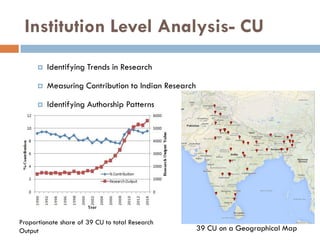
 Identifying Trends in Research
 Measuring Contribution to Indian Research
 Identifying Authorship Patterns
Institution Level Analysis- CU
39 CU on a Geographical Map
Proportionate share of 39 CU to total Research
Output
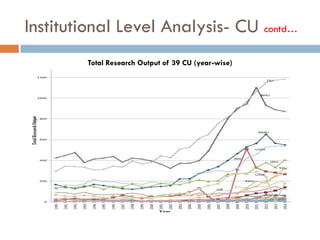
Institutional Level Analysis- CU contd…
Total Research Output of 39 CU (year-wise)
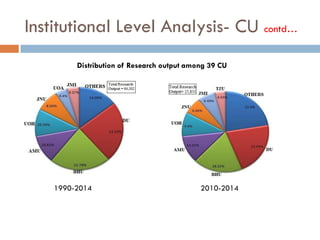
Institutional Level Analysis- CU contd…
Distribution of Research output among 39 CU
1990-2014 2010-2014
Institutional Level Analysis- CU contd…
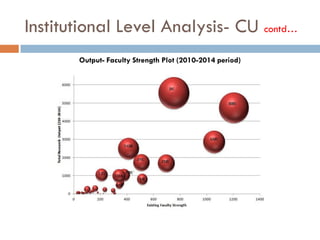
Output- Faculty Strength Plot (2010-2014 period)
Institutional Level Analysis- CU contd…
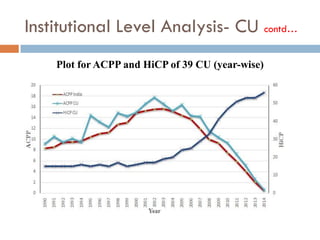
Plot for ACPP and HiCP of 39 CU (year-wise)
Institutional Level Analysis- CU contd…
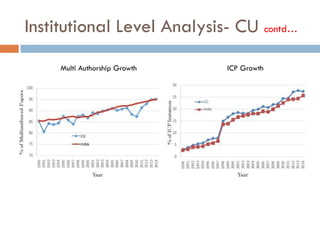
Multi Authorship Growth ICP Growth
Institutional Level Analysis- CU contd…
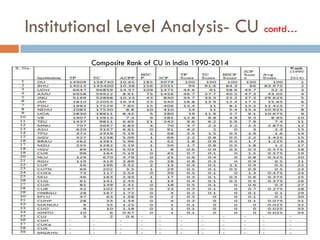
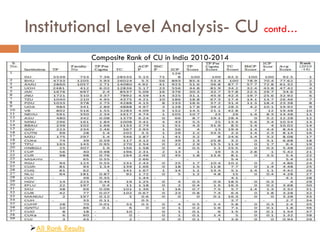
Composite Rank of CU in India 1990-2014
Composite Rank of CU in India 2010-2014
Institutional Level Analysis- CU contd…
All Rank Results
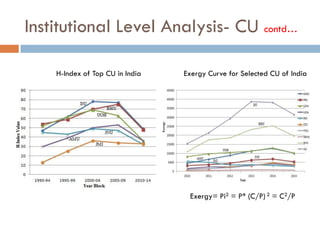
H-Index of Top CU in India Exergy Curve for Selected CU of India
Institutional Level Analysis- CU contd…
Exergy= Pi2 = P* (C/P) 2 = C2/P
Institutional Level Analysis- CU contd…
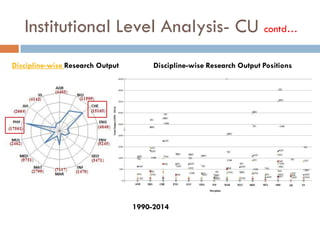
Discipline-wise Research Output Positions
1990-2014
Discipline-wise Research Output
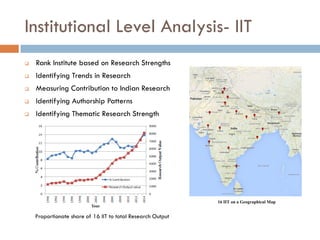
Institutional Level Analysis- IIT
 Rank Institute based on Research Strengths
 Identifying Trends in Research
 Measuring Contribution to Indian Research
 Identifying Authorship Patterns
 Identifying Thematic Research Strength
16 IIT on a Geographical Map
Proportionate share of 16 IIT to total Research Output
Institutional Level Analysis- IIT contd…
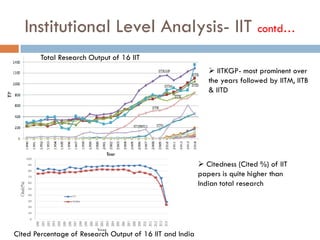
Total Research Output of 16 IIT
Cited Percentage of Research Output of 16 IIT and India
 IITKGP- most prominent over
the years followed by IITM, IITB
& IITD
 Citedness (Cited %) of IIT
papers is quite higher than
Indian total research
Institutional Level Analysis- IIT contd…
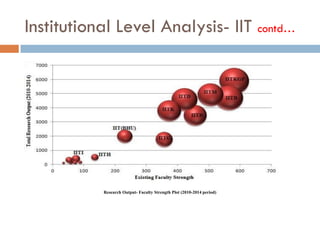
Research Output- Faculty Strength Plot (2010-2014 period)
Institutional Level Analysis- IIT contd…
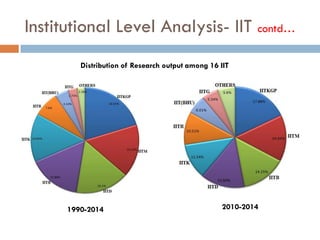
Distribution of Research output among 16 IIT
1990-2014 2010-2014
Institutional Level Analysis- IIT contd…
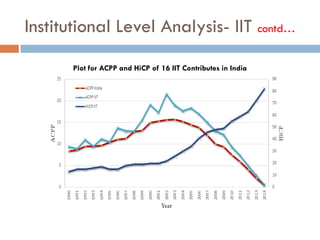
Plot for ACPP and HiCP of 16 IIT Contributes in India
Institutional Level Analysis- IIT contd…
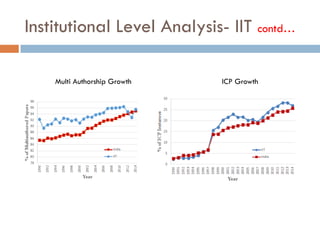
Multi Authorship Growth ICP Growth
Institutional Level Analysis- IIT contd…
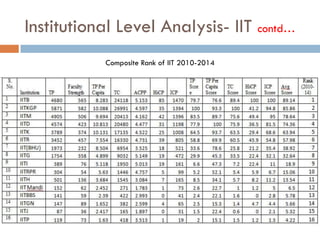
Composite Rank of IIT 2010-2014
Institutional Level Analysis- IIT contd…
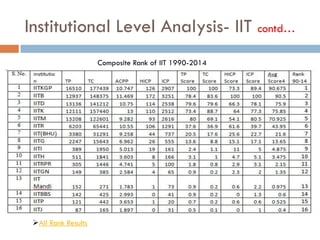
Composite Rank of IIT 1990-2014
All Rank Results
Institutional Level Analysis- IIT contd…
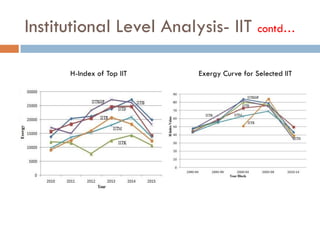
H-Index of Top IIT Exergy Curve for Selected IIT
Institutional Level Analysis- IIT contd…
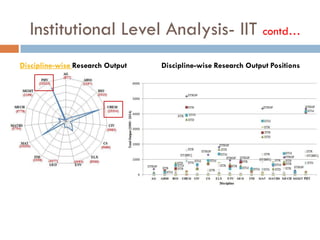
Discipline-wise Research Output PositionsDiscipline-wise Research Output
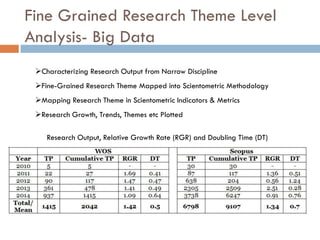
Fine Grained Research Theme Level
Analysis- Big Data
Research Output, Relative Growth Rate (RGR) and Doubling Time (DT)
Characterizing Research Output from Narrow Discipline
Fine-Grained Research Theme Mapped into Scientometric Methodology
Mapping Research Theme in Scientometric Indicators & Metrics
Research Growth, Trends, Themes etc Plotted
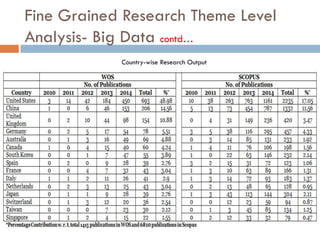
Fine Grained Research Theme Level
Analysis- Big Data contd…
Country-wise Research Output
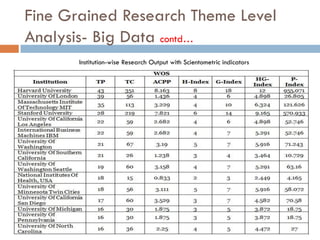
Fine Grained Research Theme Level
Analysis- Big Data contd…
Institution-wise Research Output with Scientometric indicators
Fine Grained Research Theme Level
Analysis- Big Data contd…
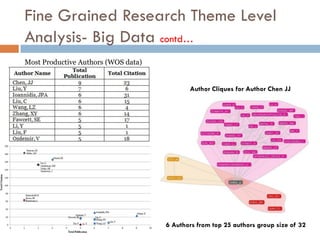
Most Productive Authors (WOS data)
Author Cliques for Author Chen JJ
6 Authors from top 25 authors group size of 32
Fine Grained Research Theme Level
Analysis- Big Data contd…
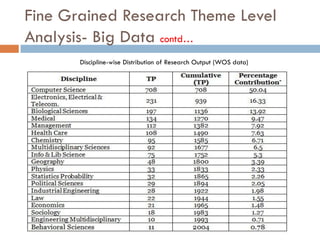
Discipline-wise Distribution of Research Output (WOS data)
Fine Grained Research Theme Level
Analysis- Big Data contd…
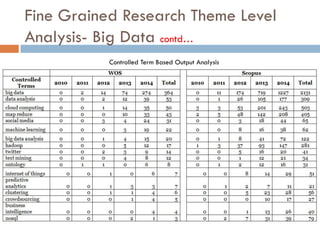
Controlled Term Based Output Analysis
Fine Grained Research Theme Level
Analysis- Big Data contd…
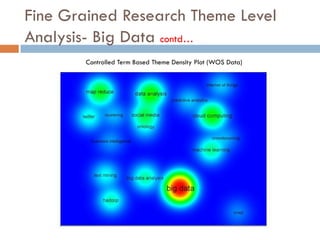
Controlled Term Based Theme Density Plot (WOS Data)
Challenges
 No Standard Datasets
 Semi Structured Data
 Regular Updates in Databases
 High Subscription Rate of Indexing Services
 Switching Affiliations
 Affiliations not in Identical Format
 Data Format Varies in Databases
Publications Out of this Work
 Published:
 Singhal, K., Banshal, S. K., Uddin, A., & Singh, V. K. (2014). The information technology knowledge
infrastructure and research in South Asia. Journal of Scientometric Research, 3(3), 134.
http://www.jscires.org/text.asp?2014/3/3/134/153578
 Banshal, S. K., Singhal, K., Uddin, A., & Singh, V. K. (2014). Mapping Computer Science research in
Bangladesh. In Proceedings of 8th International Conference on Software, Knowledge, Information
Management and Applications (SKIMA), Dhaka, Bangladesh, IEEE XPLORE (pp. 1-
7)http://ieeexplore.ieee.org/xpls/abs_all.jsp?arnumber=7083526.
 Banshal, S. K, Uddin, A. and Singh, V. K. (2015), Identifying Themes and Trends in CS Research Output from
India, In Proceedings of International Conference on Cognitive Computing and Information Processing
(CCIP), Noida, India, IEEE XPLORE (pp. 1-6)
http://ieeexplore.ieee.org/stamp/stamp.jsp?tp=&arnumber=7100742.

 Accepted/Submitted:
 Singh, V. K., Banshal, S. K., Singhal, K. & Uddin, A., A Sciento-Text Framework for Fine-grained
Characterization of the Leading World Institutions in Computer Science Research, Accepted to appear in
15th International Conference on Scientometrics and Informetrics (ISSI), Istanbul, Turkey, 29th June-3rd July,
2015.
 Singh, V. K., Banshal, S. K., Singhal, K. & Uddin, A., Identifying Area Specific Strong Research Centers in the
Leading World Institutions in Computer Science Research, Submitted to Atlanta Conference On Science and
Innovation Policy, Atlanta, USA, 17th Sept. - 19th Sept., 2015.
 Banshal, S. K., Singhal, K., Uddin, A., & Singh, V. K, Scientometric Mapping of Research on ‘Big Data’,
Submitted to Journal of Scientometrics ISSN: 0138-9130 (Print) 1588-2861 (Online); Impact Factor (2013) :
2.274.
Selected Bibliography
 Geraci, M., & Degli Esposti, M. (2011). Where do Italian universities stand? An in-depth statistical analysis of national and international rankings.
Scientometrics, 87(3), 667-681.
 Hirsch, J. (2005). An index to quantify an individual's scientific research output. Proceedings of the National academy of Sciences of the United States of
America, 102, 16569-16572.
 Uddin, A., & Singh, V. K. (2014). Mapping the Computer Science Research in SAARC Countries. IETE Technical Review, 31, 287-296.
 Uddin, A. & Singh, V.K. (2015). A Quantity-Quality Composite Ranking of Indian Institutions in Computer Science Research. IETE Technical Review
(forthcoming) DOI: http://dx.doi.org/10.1080/02564602.2015.1010614
 Singhal K, Banshal SK, Uddin A, Singh VK. The information technology knowledge infrastructure and research in South Asia. J Sci Res 2014;3:134-42
 Banshal SK, Singhal K, Uddin A, Singh VK. & Sharmin MF. Mapping the Computer Science Research in Bangladesh. Proceedings of the 8 th International
Conference on Software, Knowledge, Information Management and Applications, Dhaka, Bangladesh, IEEE Xplore; Dec, 2014
 Liu, N. & Liu, L. (2005). University rankings in China. Higher Education in Europe, 30, 217-227.
 Ma, R., Ni, C. & Qiu, J. (2008). Scientific research competitiveness of world universities in computer science. Scientometrics, 76, 245-260.
 Uddin, A. & Singh, V.K. (2014) Measuring research output and collaboration in South Asian countries. Current Science 107, 1.
 Prathap, G. (2010). The 100 most prolific economists using the p-index. Scientometrics, 84(1), 167-172.
 Egghe, L. (2006). An improvement of the h-index: The g-index. ISSI newsletter, 2(1), 8-9.
 Alonso, S., Cabrerizo, F. J., Herrera-Viedma, E. and Herrera, F. (2010). hg-index: A new index to characterize the scientific output of researchers
based on the h-and g-indices. Scientometrics, 82(2), 391-400.
 Karpagam, R., Gopalakrishnan, S., Babu, B.R. and Natarajan, M. (2012). Scientometric Analysis of Stem cell Research: A comparative study of
India and other countries. Collnet Journal of Scientometrics and Information Management, 6(2), 229-252.
 Karpagam, R., Gopalakrishnan, S., Natarajan, M., and Babu, B.R. (2011). Mapping of nanoscience and nanotechnology research in India: a
scientometric analysis, 1990–2009. Scientometrics, 89(2), 501-522.
Scientometric Analysis

Scientometric Analysis

  • 1.
    SCIENTOMETRIC ANALYSIS OFRESEARCH COMPETITIVENESS OF COUNTRIES, INSTITUTIONS AND SUBJECTS Supervised By Dr Vivek Kumar Singh Assistant Professor Department of Computer Science South Asian University Presented By : Khushboo Singhal Sumit Kumar Banshal Roll No. SAU/CS(M)/2013/005 Roll No. SAU/CS(M)/2013/018 Department of Computer Science Department of Computer Science South Asian University South Asian University 5/17/2015
  • 2.
    Outline  Introduction  Questionswe Aimed to Answer  Country/Region Level Analysis  Institution Level Analysis  Fine Grained Research Theme based Analysis  Scientometric & Indicators  Derived Indicators  Bibliographic Databases  Our Work  Regional Analysis  Institution Level Analysis  Fine Grained Research Theme based Analysis  Challenges  Publication Out of this Work  Selected Bibliography
  • 3.
    Introduction  Scientometric Assessmentof Research Competitiveness is distributed in three different aspects:  Country/Region Level Analysis  South Asia  Bangladesh  India  Institution Level Analysis  Top 100 world institutes  Central Universities (CU)  Indian Institute of Technology (IIT)  Fine Grained Research Theme based Analysis  Big Data
  • 4.
    Questions we Aimedto Answer  Can IT infrastructure be mapped with CS research output from South Asian countries?  Can we analyze the CS research output stand of Bangladesh?  Can we visualize the CS research output stand of India?  Can we characterize the leading World Institutes ?  Can we map the proportionate contribution of CU in India and rank CU accordingly?  Can we rank IIT based on research output & characterize the research ?  Can this methodology be characterized in narrow research theme?
  • 5.
    Country/Region Level Analysis South Asia (SA)  Mapping IT infrastructure with CS Research Output  Bibliographic data from Web of Science for SA Countries  Afghanistan, Bangladesh, Bhutan, India, Maldives, Nepal, Pakistan, Sri Lanka  For the period 1989-2013  Standings of SA Countries in IT  Total 15,841 records (15,810 unique)
  • 6.
    Country/Region Level Analysiscontd…  Bangladesh  Insight look on Country’s Research Output  Trends, Author Ship Patterns, Top Contributors  Bibliographic data from Scopus  For the period 1989-2013  Total 3200 records (3193 unique)
  • 7.
    Country/Region Level Analysiscontd…  India  Insight look on Country’s Research Output  Trends, Author Ship Patterns, Top Contributors  Bibliographic data from Scopus  For the period 1989-2013  Total 84385 records  100 institutions  61502 records (72% of Total Data)  59682 unique records
  • 8.
    Institution Level Analysis Top 100 CS Research Producing Institutes of the World (W-100)  Measuring Research Competitiveness of W-100  Characterizing Research Trends  Implementing Composite Rank  Bibliographic data from Web of Science  For the period 1999-2013  Total 261,154 records  251,312 unique records
  • 9.
    Institution Level Analysiscontd…  Central Universities in India (CU)  39 Central Universities (http://mhrd.gov.in/)  Measuring Contribution to Indian Research  Rank Institute based on Research Strengths  Identifying Trends & Themes in Research  For the period 1990-2014  Total 64302 records  63776 unique records  Each record comprises of 60 attributes
  • 10.
    Institution Level Analysiscontd…  Indian Institutes of Technology (IIT)  16 IIT (https://www.iitsystem.ac.in/IITCouncil.jsp)  Measuring Contribution to Indian Research  Rank IIT based on Research Strengths  Identifying Trends & Themes in IIT Research  For the period 1990-2014  Total 81588 records  80991 unique records  Each record comprises of 60 attributes
  • 11.
     Big Data Characterizing Research Output from Narrow Discipline  Fine-Grained Research Theme Mapped into Scientometric Methodology  Emerging Topic since 2005s  Collected Data from Scopus & WOS  For the Period 2010-2014  Total Records  WOS:- 1415 (60 Fields)  Scopus:- 6810 (41 Fields) Fine Grained Research Theme based Analysis
  • 12.
    Scientometric & Indicators Composition of science and metrics  Study of measuring and analyzing science, technology and innovation  Measure scientific research and impact of the research in scientific communities  Research include qualitative and quantitative approaches Direct Indicators Derived Indicators Total Publications Co-authorship Highly Cited Papers (HiCP) No. of Words No. Of References Average Citation Per Paper (ACPP) Citation Counts Internationally Collaborated papers (ICP) H-index G-index Hg-index P-index
  • 13.
    Derived Indicators  HighlyCited Papers (HiCP)  HiCP indicator refers to those papers that are among the 10% most cited papers worldwide in a particular year. For this, first find the citation threshold for the top 10% cited papers worldwide in a domain. Obtain the number of HiCP papers for each institute for each year by here, y: year, p: paper, TPy : total number of papers in the year, Cy,p : number of citations for a paper in the year and Ɵy :citation threshold for HiCP for the year  More HiCP papers indicate that research output with high impact.  Average Citation Per Paper (ACPP)  ACPP is the ratio of Total Publication (TP) to Total Citation (TC) formulated as, where, Cn is the number of citations for a given paper n. TP is the total number of such publications.  Internationally Collaborated Papers (ICP)  Internationally collaborated paper refers to those papers having at least two authors who are from two different countries. There may be more authors in the author group but at least one author must be from different country to those of others.
  • 14.
    Derived Indicators  H-index The H-index (Hirsch, 2005) is an index that aims to measure both the productivity and citation impact of the published work. The index is based on the set of the scientist's most cited papers and the number of citations that they have received in other publications.  A scientist has index h if h of his/her Np papers have at least h citations each, and the other (Np − h) papers have no more than h citations each.  G-index  The G-index is an index based on publication records for quantifying scientific productivity. G-index (Egghe, 2006) is calculated based on the distribution of citations received by a given researcher's publications:  Given a set of articles ranked in decreasing order of the number of citations that they received, the g-index is the (unique) largest number such that the top g articles received (together) at least g2 citations  HG-index  HG-index is composite of H-index and G-index. To overcome the disadvantages of both indices, HG-index was introduced. The HG-index (Alonso et al., 2010) is computed as:  where, H and G are H-index and G-index.
  • 15.
    Derived Indicators  P-index P-index is well known for giving best balance between the quantity and quality. P-index (Prathap, 2010) is computed as:  Here, P is total number of papers and C is total citations.
  • 16.
    Bibliographic Databases  Thereare many well known databases:  Scopus  Web of Science  MEDLINE  Google Scholar  Info Track  Biomedical Databases  Compendex  GENESIS  OAIster  Inspec  BASE  IEEE Xplore  PASCAL  TreeBASE  POPLINE  Trove  DOGE  Embase  ACM Portal  DBLP  PubMed
  • 17.
    Selected Databases  WOS Depth of Coverage (90 million records of 250+ disciplines)  12,000 journals proceedings  160,000 conference proceedings  Specific Criteria to Select Journal  Indexing Service  Attributes in tag format (all tags)  Sample Data  Scopus  50 million records  Easy to navigate  Widely Acclaimed Indexing Service as well as publishing house  Sample data
  • 18.
  • 19.
  • 20.
  • 21.
  • 22.
  • 23.
    Country Profiling –Bangladesh contd…
  • 24.
    Country Profiling –Bangladesh contd…
  • 25.
    Country Profiling –Bangladesh contd…
  • 26.
  • 27.
    Country Profiling –India contd…
  • 28.
    Country Profiling –India contd…
  • 29.
    Country Profiling –India contd…
  • 30.
    Institution Level Analysis-W100  Measuring Research Competitiveness  Identify Thematic Trends  Rank Institution Based on Composite Indicators  Rank Institution Based on Thematic Strength  Based on Research Strength & Trends  Based on both Qualitative & Quantitative Indicators  One part based on Scientometrics  Other part merged Text with Scientometrics
  • 31.
    Institution Level Analysis-W100 contd… Geographical Spread of Top 100 Institutes
  • 32.
    Ranking : IndicatorValues Rank15 for top 10 institutions (indicator values) Institution TP TC HiCP ACPP ICP H index MIT 4385 123671 694 28.203 1470 141 UCB 3616 121682 591 33.651 1138 136 SU 3633 94013 663 25.878 1121 131 IBM 5854 91086 494 15.56 1756 127 INRIA 5432 65934 471 12.138 2451 100 UL 4803 65792 518 13.698 2254 98 CMU 4065 73084 441 17.979 1222 110 MS 4117 67578 410 16.414 1599 101 UIUC 3347 71827 420 21.46 1061 106 HU 2479 62082 445 25.043 923 103
  • 33.
    Institution Level Analysis-W100 contd…  Normalized Score  Measuring Relative Performance  Range : 0 to 100 Here, : maximum raw value among all the institutions for the indicator, i  Composite Score of All Indicators  Simple Average  Ranking Computed In Three Blocks  15 years (Rank15) : Whole Period i.e. , 1999-2013  10 years (Rank 10 ) : 2004-2013  5 years (Rank5) : 2009-2013
  • 34.
    Institution Level Analysis-W100 contd… Rank15 for top 10 institutions (normalized values and rank) Institution TP Score HiCP Score ACPP Score ICP Score H-Index Score Avg. Score Rank15 MIT 40.2 72.7 83.8 34.4 100 66.22 1 UCB 33.1 61.9 100 26.6 96.5 63.62 2 SU 33.3 69.5 76.9 26.2 92.9 59.76 3 IBM 53.7 51.8 46.2 41.1 90.1 56.58 4 INRIA 49.8 49.4 36.1 57.4 70.9 52.72 5 UL 44 54.3 40.7 52.7 69.5 52.24 6 CMU 37.3 46.2 53.4 28.6 78 48.7 7 MS 37.7 43 48.8 37.4 71.6 47.7 8 UIUC 30.7 44 63.8 24.8 75.2 47.7 9 HU 22.7 46.6 74.4 21.6 73 47.66 10
  • 35.
    Institution Level Analysis-W100 contd…  Impact of Indicator on Ranks  Correlation between Rank15 & Individual Indicators i.e., TP, ACCP and So On.  Impact of One Indicator on Other Indicator  Correlation between TP & ACPP, HiCP, H-Index, ICP and vice versa.  Correlation between Ranks  Spearman Rank Correlation Here, K :the size of the ranked sets; s1,j and s2,j : Rank positions of institutions in the two ranking R1 and R2. R1 as the computed rank R2 as indicator-based rank
  • 36.
    Institution Level Analysis-W100 contd… Spearman Rank Correlation between Rank15 and individual indicators
  • 37.
    Institution Level Analysis-W100 contd… Spearman Rank Correlation between five indicator- ranks for 100 institutions
  • 38.
    Institution Level Analysis-W100 contd… Correlation between ranks
  • 39.
    Institution Level Analysis-W100 contd…  Identifying Themes of Research  Rank based on Themes  One Institute may be Better in one Specific Area, not for all.  11 Broader Themes in CS Research  Gives a Fine Grained Ranking
  • 40.
    Institution Level Analysis-W100 contd… Flow Diagram of Text Classification Acronym Full Name AI Artificial Intelligence CT Computation Theory CHA Computer Hardware & Architecture CN Computer Networks CSA Computer Software & Applications CG Cryptography DBMS Database Management System IM Internet & Multimedia OS Operating System SIP Signal & Image Processing SE Software Engineering Thematic Areas with Full Name
  • 41.
    Institution Level Analysis-W100 contd… Thematic research area map Research strengths of top 10 institutions
  • 42.
    Institution Level Analysis-W100 contd… Thematic area wise composite Rank15 Institution Rank15 AI CT CHA CN CSA CG DBMS IM OS SIP SE MIT 1 15 5 23 26 14 17 6 13 19 25 9 UCB 2 4 16 9 4 4 18 18 25 14 5 3 SU 3 33 14 21 12 16 35 21 10 42 31 19 IBM 4 29 83 4 24 25 14 13 19 9 34 14 INRIA 5 9 6 1 1 5 1 5 4 2 9 2 UL 6 12 7 36 11 9 8 7 12 16 4 6 CMU 7 25 12 13 19 10 20 28 22 15 35 16 MS 8 6 78 11 18 28 21 9 5 21 8 15 UIUC 9 21 52 22 28 19 28 27 26 22 7 26 HU 10 11 61 35 15 17 42 4 7 58 29 5
  • 43.
     Identifying Trendsin Research  Measuring Contribution to Indian Research  Identifying Authorship Patterns Institution Level Analysis- CU 39 CU on a Geographical Map Proportionate share of 39 CU to total Research Output
  • 44.
    Institutional Level Analysis-CU contd… Total Research Output of 39 CU (year-wise)
  • 45.
    Institutional Level Analysis-CU contd… Distribution of Research output among 39 CU 1990-2014 2010-2014
  • 46.
    Institutional Level Analysis-CU contd… Output- Faculty Strength Plot (2010-2014 period)
  • 47.
    Institutional Level Analysis-CU contd… Plot for ACPP and HiCP of 39 CU (year-wise)
  • 48.
    Institutional Level Analysis-CU contd… Multi Authorship Growth ICP Growth
  • 49.
    Institutional Level Analysis-CU contd… Composite Rank of CU in India 1990-2014
  • 50.
    Composite Rank ofCU in India 2010-2014 Institutional Level Analysis- CU contd… All Rank Results
  • 51.
    H-Index of TopCU in India Exergy Curve for Selected CU of India Institutional Level Analysis- CU contd… Exergy= Pi2 = P* (C/P) 2 = C2/P
  • 52.
    Institutional Level Analysis-CU contd… Discipline-wise Research Output Positions 1990-2014 Discipline-wise Research Output
  • 53.
    Institutional Level Analysis-IIT  Rank Institute based on Research Strengths  Identifying Trends in Research  Measuring Contribution to Indian Research  Identifying Authorship Patterns  Identifying Thematic Research Strength 16 IIT on a Geographical Map Proportionate share of 16 IIT to total Research Output
  • 54.
    Institutional Level Analysis-IIT contd… Total Research Output of 16 IIT Cited Percentage of Research Output of 16 IIT and India  IITKGP- most prominent over the years followed by IITM, IITB & IITD  Citedness (Cited %) of IIT papers is quite higher than Indian total research
  • 55.
    Institutional Level Analysis-IIT contd… Research Output- Faculty Strength Plot (2010-2014 period)
  • 56.
    Institutional Level Analysis-IIT contd… Distribution of Research output among 16 IIT 1990-2014 2010-2014
  • 57.
    Institutional Level Analysis-IIT contd… Plot for ACPP and HiCP of 16 IIT Contributes in India
  • 58.
    Institutional Level Analysis-IIT contd… Multi Authorship Growth ICP Growth
  • 59.
    Institutional Level Analysis-IIT contd… Composite Rank of IIT 2010-2014
  • 60.
    Institutional Level Analysis-IIT contd… Composite Rank of IIT 1990-2014 All Rank Results
  • 61.
    Institutional Level Analysis-IIT contd… H-Index of Top IIT Exergy Curve for Selected IIT
  • 62.
    Institutional Level Analysis-IIT contd… Discipline-wise Research Output PositionsDiscipline-wise Research Output
  • 63.
    Fine Grained ResearchTheme Level Analysis- Big Data Research Output, Relative Growth Rate (RGR) and Doubling Time (DT) Characterizing Research Output from Narrow Discipline Fine-Grained Research Theme Mapped into Scientometric Methodology Mapping Research Theme in Scientometric Indicators & Metrics Research Growth, Trends, Themes etc Plotted
  • 64.
    Fine Grained ResearchTheme Level Analysis- Big Data contd… Country-wise Research Output
  • 65.
    Fine Grained ResearchTheme Level Analysis- Big Data contd… Institution-wise Research Output with Scientometric indicators
  • 66.
    Fine Grained ResearchTheme Level Analysis- Big Data contd… Most Productive Authors (WOS data) Author Cliques for Author Chen JJ 6 Authors from top 25 authors group size of 32
  • 67.
    Fine Grained ResearchTheme Level Analysis- Big Data contd… Discipline-wise Distribution of Research Output (WOS data)
  • 68.
    Fine Grained ResearchTheme Level Analysis- Big Data contd… Controlled Term Based Output Analysis
  • 69.
    Fine Grained ResearchTheme Level Analysis- Big Data contd… Controlled Term Based Theme Density Plot (WOS Data)
  • 70.
    Challenges  No StandardDatasets  Semi Structured Data  Regular Updates in Databases  High Subscription Rate of Indexing Services  Switching Affiliations  Affiliations not in Identical Format  Data Format Varies in Databases
  • 71.
    Publications Out ofthis Work  Published:  Singhal, K., Banshal, S. K., Uddin, A., & Singh, V. K. (2014). The information technology knowledge infrastructure and research in South Asia. Journal of Scientometric Research, 3(3), 134. http://www.jscires.org/text.asp?2014/3/3/134/153578  Banshal, S. K., Singhal, K., Uddin, A., & Singh, V. K. (2014). Mapping Computer Science research in Bangladesh. In Proceedings of 8th International Conference on Software, Knowledge, Information Management and Applications (SKIMA), Dhaka, Bangladesh, IEEE XPLORE (pp. 1- 7)http://ieeexplore.ieee.org/xpls/abs_all.jsp?arnumber=7083526.  Banshal, S. K, Uddin, A. and Singh, V. K. (2015), Identifying Themes and Trends in CS Research Output from India, In Proceedings of International Conference on Cognitive Computing and Information Processing (CCIP), Noida, India, IEEE XPLORE (pp. 1-6) http://ieeexplore.ieee.org/stamp/stamp.jsp?tp=&arnumber=7100742.   Accepted/Submitted:  Singh, V. K., Banshal, S. K., Singhal, K. & Uddin, A., A Sciento-Text Framework for Fine-grained Characterization of the Leading World Institutions in Computer Science Research, Accepted to appear in 15th International Conference on Scientometrics and Informetrics (ISSI), Istanbul, Turkey, 29th June-3rd July, 2015.  Singh, V. K., Banshal, S. K., Singhal, K. & Uddin, A., Identifying Area Specific Strong Research Centers in the Leading World Institutions in Computer Science Research, Submitted to Atlanta Conference On Science and Innovation Policy, Atlanta, USA, 17th Sept. - 19th Sept., 2015.  Banshal, S. K., Singhal, K., Uddin, A., & Singh, V. K, Scientometric Mapping of Research on ‘Big Data’, Submitted to Journal of Scientometrics ISSN: 0138-9130 (Print) 1588-2861 (Online); Impact Factor (2013) : 2.274.
  • 72.
    Selected Bibliography  Geraci,M., & Degli Esposti, M. (2011). Where do Italian universities stand? An in-depth statistical analysis of national and international rankings. Scientometrics, 87(3), 667-681.  Hirsch, J. (2005). An index to quantify an individual's scientific research output. Proceedings of the National academy of Sciences of the United States of America, 102, 16569-16572.  Uddin, A., & Singh, V. K. (2014). Mapping the Computer Science Research in SAARC Countries. IETE Technical Review, 31, 287-296.  Uddin, A. & Singh, V.K. (2015). A Quantity-Quality Composite Ranking of Indian Institutions in Computer Science Research. IETE Technical Review (forthcoming) DOI: http://dx.doi.org/10.1080/02564602.2015.1010614  Singhal K, Banshal SK, Uddin A, Singh VK. The information technology knowledge infrastructure and research in South Asia. J Sci Res 2014;3:134-42  Banshal SK, Singhal K, Uddin A, Singh VK. & Sharmin MF. Mapping the Computer Science Research in Bangladesh. Proceedings of the 8 th International Conference on Software, Knowledge, Information Management and Applications, Dhaka, Bangladesh, IEEE Xplore; Dec, 2014  Liu, N. & Liu, L. (2005). University rankings in China. Higher Education in Europe, 30, 217-227.  Ma, R., Ni, C. & Qiu, J. (2008). Scientific research competitiveness of world universities in computer science. Scientometrics, 76, 245-260.  Uddin, A. & Singh, V.K. (2014) Measuring research output and collaboration in South Asian countries. Current Science 107, 1.  Prathap, G. (2010). The 100 most prolific economists using the p-index. Scientometrics, 84(1), 167-172.  Egghe, L. (2006). An improvement of the h-index: The g-index. ISSI newsletter, 2(1), 8-9.  Alonso, S., Cabrerizo, F. J., Herrera-Viedma, E. and Herrera, F. (2010). hg-index: A new index to characterize the scientific output of researchers based on the h-and g-indices. Scientometrics, 82(2), 391-400.  Karpagam, R., Gopalakrishnan, S., Babu, B.R. and Natarajan, M. (2012). Scientometric Analysis of Stem cell Research: A comparative study of India and other countries. Collnet Journal of Scientometrics and Information Management, 6(2), 229-252.  Karpagam, R., Gopalakrishnan, S., Natarajan, M., and Babu, B.R. (2011). Mapping of nanoscience and nanotechnology research in India: a scientometric analysis, 1990–2009. Scientometrics, 89(2), 501-522.