the
Systems Thinking
for Product Managers
Johanna Kollmann | @johannakoll | MTP Engage 2017
“A system is
a set of elements or parts
often classified as its function
or purpose.”
that is coherently organized and
inter-connected in a pattern or
structure
that produces a characteristic set of
behaviors,
Donella Meadows
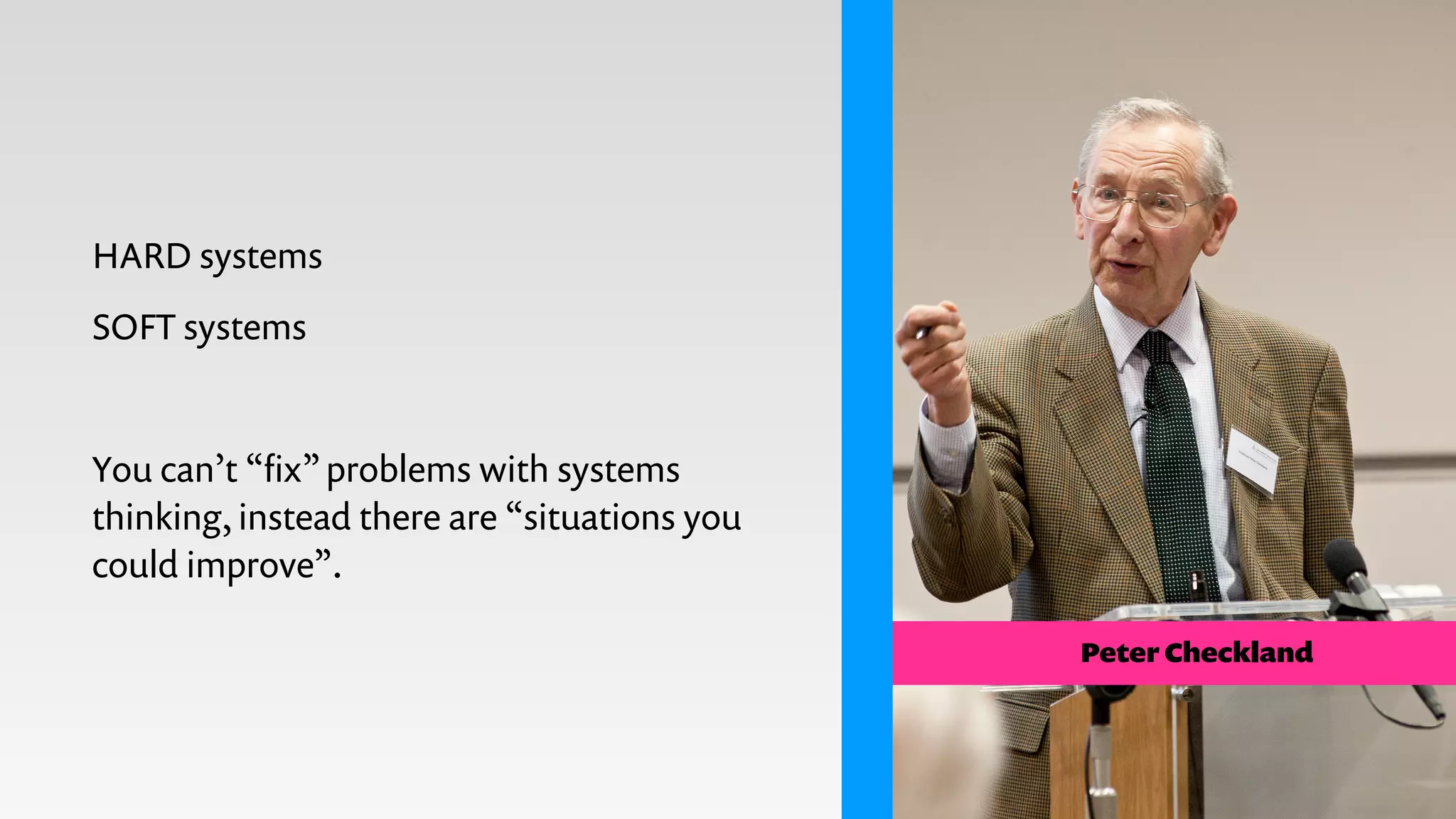
HARD systems
SOFT systems
!
You can’t “fix”problems with systems
thinking, instead there are “situations you
could improve”.
Peter Checkland
Systems exhibit purposeful behaviour over time.
Systems get ‘soft’, unpredictable once humans
are involved.
“Systems-based thinking is the process of
understanding how things influence one
another. 
!
Then drawing on that knowledge to create
efficiencies of process, infrastructure and
communication.”
Abby Covert
UNDERSTANDING
CHANGING
UNDERSTANDING THE SYSTEM
Use this tool to
help you think
more systemically!
THE ICEBERG MODEL
EVENTS
What is happening?
PATTERNS OF BEHAVIOR
What trends are there over time?
SYSTEMS STRUCTURE
How are the parts related?
What influences
the patterns?
MENTAL MODELS
What values,
assumptions, +
beliefs shape
the system?
IncreasingLeverage
Download at: http://donellameadows.org/systems-thinking-resources/
Checkland’s ‘Rich Picture’
1. Construction of the Humber Bridge (adapted from Stewart and
Fortune, 1994)© The Open University
2. Distance Learning Situation © Wood-Harper et al, Information Systems
Definition: The Multiview Approach, Blackwell Scientific Publications 1985
Checkland’s ‘Rich Picture’
Stakeholders
Worldview
Connections
Conflicts
Facilitate a shared understanding:
collaborate on mapping the system.
Customer journey maps
Service blueprints
System relationship maps
Models are the starting point to look at
the situation, and see what change should
be introduced, and how.
Use this tool to
help you think
more systemically!
THE ICEBERG MODEL
EVENTS
What is happening?
PATTERNS OF BEHAVIOR
What trends are there over time?
SYSTEMS STRUCTURE
How are the parts related?
What influences
the patterns?
MENTAL MODELS
What values,
assumptions, +
beliefs shape
the system?
IncreasingLeverage
Download at: http://donellameadows.org/systems-thinking-resources/
Measuring tools
Custom analysis based on raw data
Logging tools
Dashboard
(combined with qualitative research!)
2 things to pay attention to in a system:
1) Stocks & Flows
2) Feedback loops
1)Stocks & Flows
inflow outflow
information
feedback, control
stock
Conversion, churn rates
2)Feedback loops
A feedback loop occurs when a change in something ultimately
comes back to cause a further change in the same thing.
Reinforcing Loop
(positive loop)
births/year population
Population
Growth
Balancing Loop
(negative or goal-seeking loop)
heat
Thermostat
temperature
target temperature
temperature
gap
Viral engines of growth
By the time you see what is going on in a
system, it has already happened - and you
are already a step behind.
Look at systems behaviour over time, rather than
focusing on single events.
!
Spot trends, and ask:
‣What came before?
‣What might happen next?
Model systems through a collaborative process.
Make changes in system behaviour visible.
Look for trends, rather than focusing on single
events.
CHANGING THE SYSTEM
Use this tool to
help you think
more systemically!
THE ICEBERG MODEL
EVENTS
What is happening?
PATTERNS OF BEHAVIOR
What trends are there over time?
SYSTEMS STRUCTURE
How are the parts related?
What influences
the patterns?
MENTAL MODELS
What values,
assumptions, +
beliefs shape
the system?
IncreasingLeverage
Download at: http://donellameadows.org/systems-thinking-resources/
Structure of information flows
‣How does information flow through the system?
‣What information is shown, how, and to whom?
‣Who can manipulate and control information?
For reference: Donella Meadows, http://donellameadows.org/archives/leverage-points-places-to-intervene-in-a-system/
Rules of the system
‣Constraints, social rules, rules about roles of actors in the system
‣Who can take which actions?
‣How can actors in the system engage?
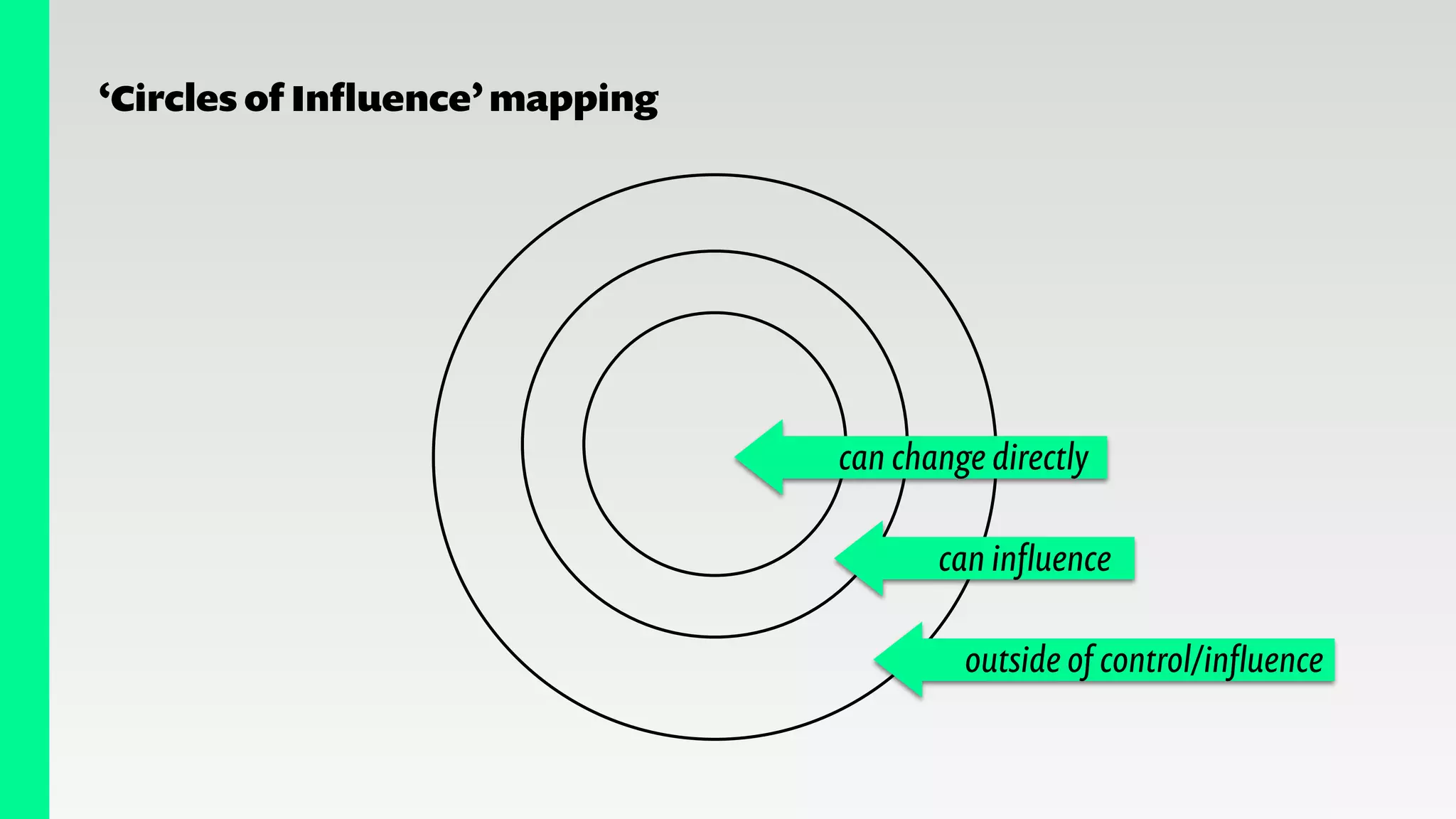
‘Circles of Influence’mapping
can change directly
can influence
outside of control/influence
Use this tool to
help you think
more systemically!
THE ICEBERG MODEL
EVENTS
What is happening?
PATTERNS OF BEHAVIOR
What trends are there over time?
SYSTEMS STRUCTURE
How are the parts related?
What influences
the patterns?
MENTAL MODELS
What values,
assumptions, +
beliefs shape
the system?
IncreasingLeverage
Download at: http://donellameadows.org/systems-thinking-resources/
Information flows are effective leverage points.
Rules can facilitate and prevent change.
Goals drive systems behaviour.
UNDERSTANDING
CHANGING
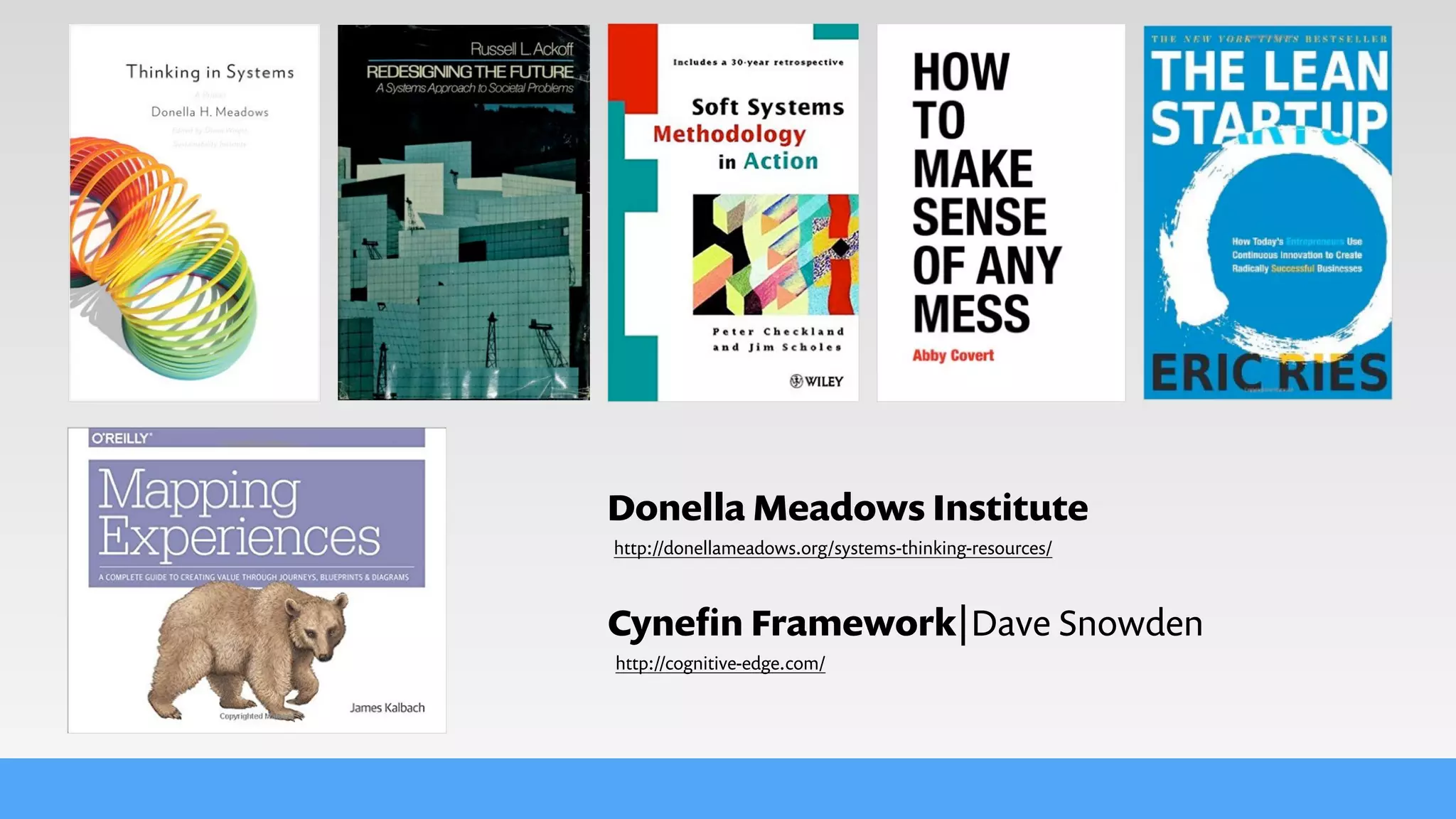
Cynefin Framework|Dave Snowden
http://cognitive-edge.com/
Donella Meadows Institute
http://donellameadows.org/systems-thinking-resources/
say hi: @johannakoll
THANKS
MERCI
DANKE

Systems Thinking for Product Managers

  • 1.
    the Systems Thinking for ProductManagers Johanna Kollmann | @johannakoll | MTP Engage 2017
  • 3.
    “A system is aset of elements or parts often classified as its function or purpose.” that is coherently organized and inter-connected in a pattern or structure that produces a characteristic set of behaviors, Donella Meadows
  • 4.
    HARD systems SOFT systems ! Youcan’t “fix”problems with systems thinking, instead there are “situations you could improve”. Peter Checkland
  • 5.
    Systems exhibit purposefulbehaviour over time. Systems get ‘soft’, unpredictable once humans are involved.
  • 6.
    “Systems-based thinking isthe process of understanding how things influence one another.  ! Then drawing on that knowledge to create efficiencies of process, infrastructure and communication.” Abby Covert
  • 7.
  • 8.
  • 9.
    Use this toolto help you think more systemically! THE ICEBERG MODEL EVENTS What is happening? PATTERNS OF BEHAVIOR What trends are there over time? SYSTEMS STRUCTURE How are the parts related? What influences the patterns? MENTAL MODELS What values, assumptions, + beliefs shape the system? IncreasingLeverage Download at: http://donellameadows.org/systems-thinking-resources/
  • 10.
    Checkland’s ‘Rich Picture’ 1.Construction of the Humber Bridge (adapted from Stewart and Fortune, 1994)© The Open University 2. Distance Learning Situation © Wood-Harper et al, Information Systems Definition: The Multiview Approach, Blackwell Scientific Publications 1985
  • 11.
  • 12.
    Facilitate a sharedunderstanding: collaborate on mapping the system.
  • 13.
    Customer journey maps Serviceblueprints System relationship maps
  • 14.
    Models are thestarting point to look at the situation, and see what change should be introduced, and how.
  • 15.
    Use this toolto help you think more systemically! THE ICEBERG MODEL EVENTS What is happening? PATTERNS OF BEHAVIOR What trends are there over time? SYSTEMS STRUCTURE How are the parts related? What influences the patterns? MENTAL MODELS What values, assumptions, + beliefs shape the system? IncreasingLeverage Download at: http://donellameadows.org/systems-thinking-resources/
  • 16.
    Measuring tools Custom analysisbased on raw data Logging tools Dashboard (combined with qualitative research!)
  • 17.
    2 things topay attention to in a system: 1) Stocks & Flows 2) Feedback loops
  • 18.
    1)Stocks & Flows inflowoutflow information feedback, control stock Conversion, churn rates
  • 19.
    2)Feedback loops A feedbackloop occurs when a change in something ultimately comes back to cause a further change in the same thing. Reinforcing Loop (positive loop) births/year population Population Growth Balancing Loop (negative or goal-seeking loop) heat Thermostat temperature target temperature temperature gap Viral engines of growth
  • 20.
    By the timeyou see what is going on in a system, it has already happened - and you are already a step behind.
  • 21.
    Look at systemsbehaviour over time, rather than focusing on single events. ! Spot trends, and ask: ‣What came before? ‣What might happen next?
  • 22.
    Model systems througha collaborative process. Make changes in system behaviour visible. Look for trends, rather than focusing on single events.
  • 23.
  • 24.
    Use this toolto help you think more systemically! THE ICEBERG MODEL EVENTS What is happening? PATTERNS OF BEHAVIOR What trends are there over time? SYSTEMS STRUCTURE How are the parts related? What influences the patterns? MENTAL MODELS What values, assumptions, + beliefs shape the system? IncreasingLeverage Download at: http://donellameadows.org/systems-thinking-resources/
  • 25.
    Structure of informationflows ‣How does information flow through the system? ‣What information is shown, how, and to whom? ‣Who can manipulate and control information? For reference: Donella Meadows, http://donellameadows.org/archives/leverage-points-places-to-intervene-in-a-system/
  • 26.
    For reference: DonellaMeadows, http://donellameadows.org/archives/leverage-points-places-to-intervene-in-a-system/ Rules of the system ‣Constraints, social rules, rules about roles of actors in the system ‣Who can take which actions? ‣How can actors in the system engage?
  • 27.
    ‘Circles of Influence’mapping canchange directly can influence outside of control/influence
  • 28.
    Use this toolto help you think more systemically! THE ICEBERG MODEL EVENTS What is happening? PATTERNS OF BEHAVIOR What trends are there over time? SYSTEMS STRUCTURE How are the parts related? What influences the patterns? MENTAL MODELS What values, assumptions, + beliefs shape the system? IncreasingLeverage Download at: http://donellameadows.org/systems-thinking-resources/
  • 29.
    Information flows areeffective leverage points. Rules can facilitate and prevent change. Goals drive systems behaviour.
  • 30.
  • 31.
    Cynefin Framework|Dave Snowden http://cognitive-edge.com/ DonellaMeadows Institute http://donellameadows.org/systems-thinking-resources/
  • 32.