Tense
Simple
GROUP 1
https://primkara.ac.id
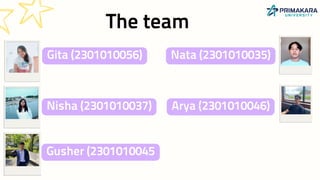
The team
Gita (2301010056)
Nisha (2301010037)
Nata (2301010035)
Gusher (2301010045
Arya (2301010046)
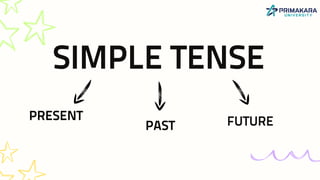
SIMPLE TENSE
PRESENT FUTURE
PAST
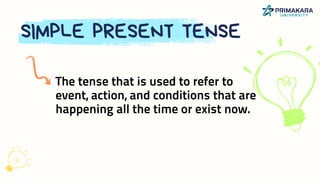
SIMPLE PRESENT TENSE
The tense that is used to refer to
event, action, and conditions that are
happening all the time or exist now.
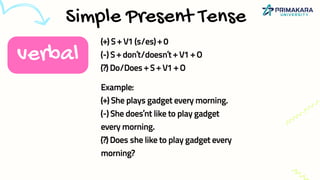
Simple Present Tense
Example:
(+) She plays gadget every morning.
(-) She does’nt like to play gadget
every morning.
(?) Does she like to play gadget every
morning?
verbal
(+) S + V1 (s/es) + 0
(-) S + don’t/doesn’t + V1 + O
(?) Do/Does + S + V1 + O
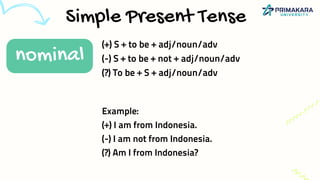
Simple Present Tense
(+) S + to be + adj/noun/adv
(-) S + to be + not + adj/noun/adv
(?) To be + S + adj/noun/adv
nominal
Example:
(+) I am from Indonesia.
(-) I am not from Indonesia.
(?) Am I from Indonesia?
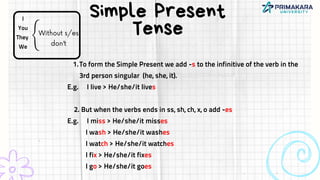
I
You
They
We
Simple Present
Tense
Without s/es
don’t
To form the Simple Present we add -s to the infinitive of the verb in the
3rd person singular (he, she, it).
1.
E.g. I live > He/she/it lives
2. But when the verbs ends in ss, sh, ch, x, o add -es
E.g. I miss > He/she/it misses
I wash > He/she/it washes
I watch > He/she/it watches
I fix > He/she/it fixes
I go > He/she/it goes
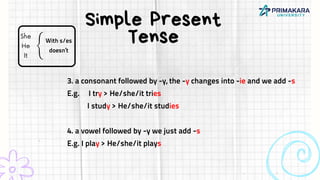
3. a consonant followed by -y, the -y changes into -ie and we add -s
E.g. I try > He/she/it tries
I study > He/she/it studies
4. a vowel followed by -y we just add -s
E.g. I play > He/she/it plays
Simple Present
Tense
She
He
It
With s/es
doesn’t
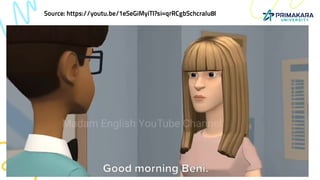
Source: https://youtu.be/1eSeGiMyiTI?si=qrRCgbSchcralu8I
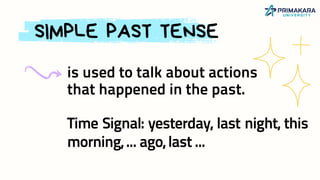
SIMPLE PAST TENSE
is used to talk about actions
that happened in the past.
Time Signal: yesterday, last night, this
morning, ... ago, last ...
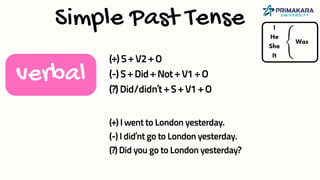
Simple Past Tense
(+) I went to London yesterday.
(-) I did’nt go to London yesterday.
(?) Did you go to London yesterday?
verbal
(+) S + V2 + O
(-) S + Did + Not + V1 + O
(?) Did/didn’t + S + V1 + O
I
He
She
It
Was
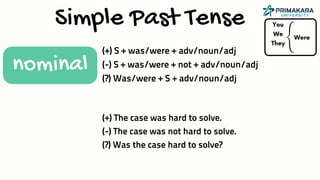
Simple Past Tense
(+) S + was/were + adv/noun/adj
(-) S + was/were + not + adv/noun/adj
(?) Was/were + S + adv/noun/adj
nominal
(+) The case was hard to solve.
(-) The case was not hard to solve.
(?) Was the case hard to solve?
You
We
They
Were
Source: https://youtu.be/ypq7nDhVrT8?si=23r0Cx95Ew12Zhe6
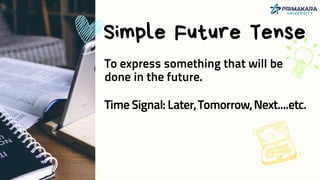
Simple Future Tense
To express something that will be
done in the future.
Time Signal: Later, Tomorrow, Next....etc.
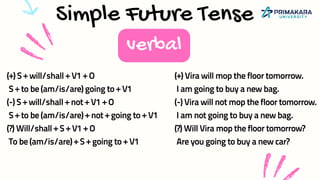
Simple Future Tense
(+) Vira will mop the floor tomorrow.
I am going to buy a new bag.
(-) Vira will not mop the floor tomorrow.
I am not going to buy a new bag.
(?) Will Vira mop the floor tomorrow?
Are you going to buy a new car?
verbal
(+) S + will/shall + V1 + O
S + to be (am/is/are) going to + V1
(-) S + will/shall + not + V1 + O
S + to be (am/is/are) + not + going to + V1
(?) Will/shall + S + V1 + O
To be (am/is/are) + S + going to + V1
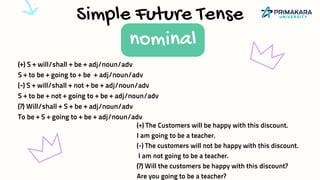
Simple Future Tense
(+) S + will/shall + be + adj/noun/adv
S + to be + going to + be + adj/noun/adv
(-) S + will/shall + not + be + adj/noun/adv
S + to be + not + going to + be + adj/noun/adv
(?) Will/shall + S + be + adj/noun/adv
To be + S + going to + be + adj/noun/adv
nominal
(+) The Customers will be happy with this discount.
I am going to be a teacher.
(-) The customers will not be happy with this discount.
I am not going to be a teacher.
(?) Will the customers be happy with this discount?
Are you going to be a teacher?
Source: https://youtu.be/QZpl168DFWI?si=yosNCzk3KXA0Ijmz
THANK
YOU
https://primkara.ac.id

Understanding Simple Tense

  • 1.
  • 2.
    The team Gita (2301010056) Nisha(2301010037) Nata (2301010035) Gusher (2301010045 Arya (2301010046)
  • 3.
  • 4.
    SIMPLE PRESENT TENSE Thetense that is used to refer to event, action, and conditions that are happening all the time or exist now.
  • 5.
    Simple Present Tense Example: (+)She plays gadget every morning. (-) She does’nt like to play gadget every morning. (?) Does she like to play gadget every morning? verbal (+) S + V1 (s/es) + 0 (-) S + don’t/doesn’t + V1 + O (?) Do/Does + S + V1 + O
  • 6.
    Simple Present Tense (+)S + to be + adj/noun/adv (-) S + to be + not + adj/noun/adv (?) To be + S + adj/noun/adv nominal Example: (+) I am from Indonesia. (-) I am not from Indonesia. (?) Am I from Indonesia?
  • 7.
    I You They We Simple Present Tense Without s/es don’t Toform the Simple Present we add -s to the infinitive of the verb in the 3rd person singular (he, she, it). 1. E.g. I live > He/she/it lives 2. But when the verbs ends in ss, sh, ch, x, o add -es E.g. I miss > He/she/it misses I wash > He/she/it washes I watch > He/she/it watches I fix > He/she/it fixes I go > He/she/it goes
  • 8.
    3. a consonantfollowed by -y, the -y changes into -ie and we add -s E.g. I try > He/she/it tries I study > He/she/it studies 4. a vowel followed by -y we just add -s E.g. I play > He/she/it plays Simple Present Tense She He It With s/es doesn’t
  • 9.
  • 10.
    SIMPLE PAST TENSE isused to talk about actions that happened in the past. Time Signal: yesterday, last night, this morning, ... ago, last ...
  • 11.
    Simple Past Tense (+)I went to London yesterday. (-) I did’nt go to London yesterday. (?) Did you go to London yesterday? verbal (+) S + V2 + O (-) S + Did + Not + V1 + O (?) Did/didn’t + S + V1 + O I He She It Was
  • 12.
    Simple Past Tense (+)S + was/were + adv/noun/adj (-) S + was/were + not + adv/noun/adj (?) Was/were + S + adv/noun/adj nominal (+) The case was hard to solve. (-) The case was not hard to solve. (?) Was the case hard to solve? You We They Were
  • 13.
  • 14.
    Simple Future Tense Toexpress something that will be done in the future. Time Signal: Later, Tomorrow, Next....etc.
  • 15.
    Simple Future Tense (+)Vira will mop the floor tomorrow. I am going to buy a new bag. (-) Vira will not mop the floor tomorrow. I am not going to buy a new bag. (?) Will Vira mop the floor tomorrow? Are you going to buy a new car? verbal (+) S + will/shall + V1 + O S + to be (am/is/are) going to + V1 (-) S + will/shall + not + V1 + O S + to be (am/is/are) + not + going to + V1 (?) Will/shall + S + V1 + O To be (am/is/are) + S + going to + V1
  • 16.
    Simple Future Tense (+)S + will/shall + be + adj/noun/adv S + to be + going to + be + adj/noun/adv (-) S + will/shall + not + be + adj/noun/adv S + to be + not + going to + be + adj/noun/adv (?) Will/shall + S + be + adj/noun/adv To be + S + going to + be + adj/noun/adv nominal (+) The Customers will be happy with this discount. I am going to be a teacher. (-) The customers will not be happy with this discount. I am not going to be a teacher. (?) Will the customers be happy with this discount? Are you going to be a teacher?
  • 17.
  • 18.