ENGLISH GRAMMAR-
TENSES
BY:-
K.RAHUL RAJ
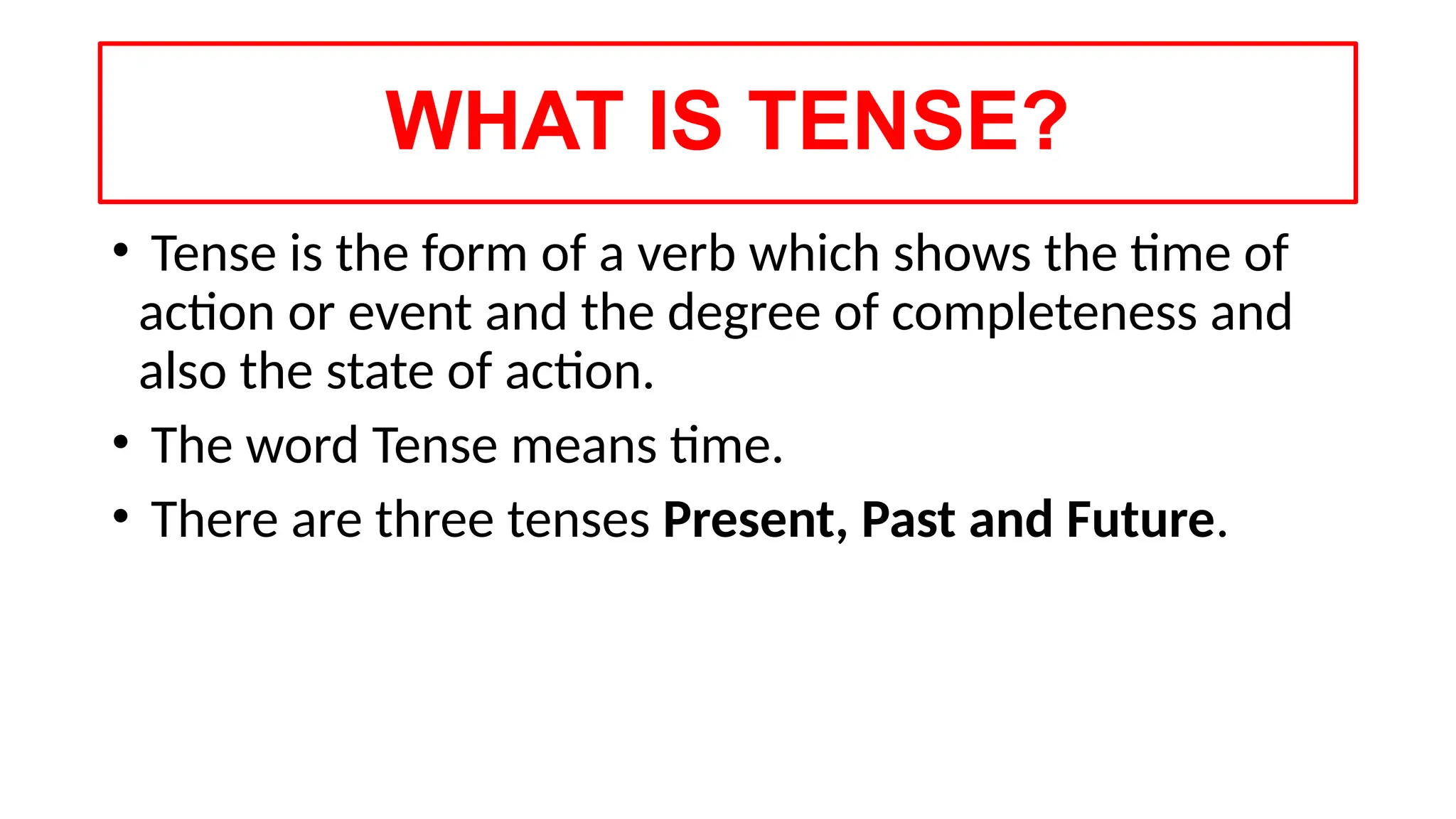
WHAT IS TENSE?
• Tense is the form of a verb which shows the time of
action or event and the degree of completeness and
also the state of action.
• The word Tense means time.
• There are three tenses Present, Past and Future.
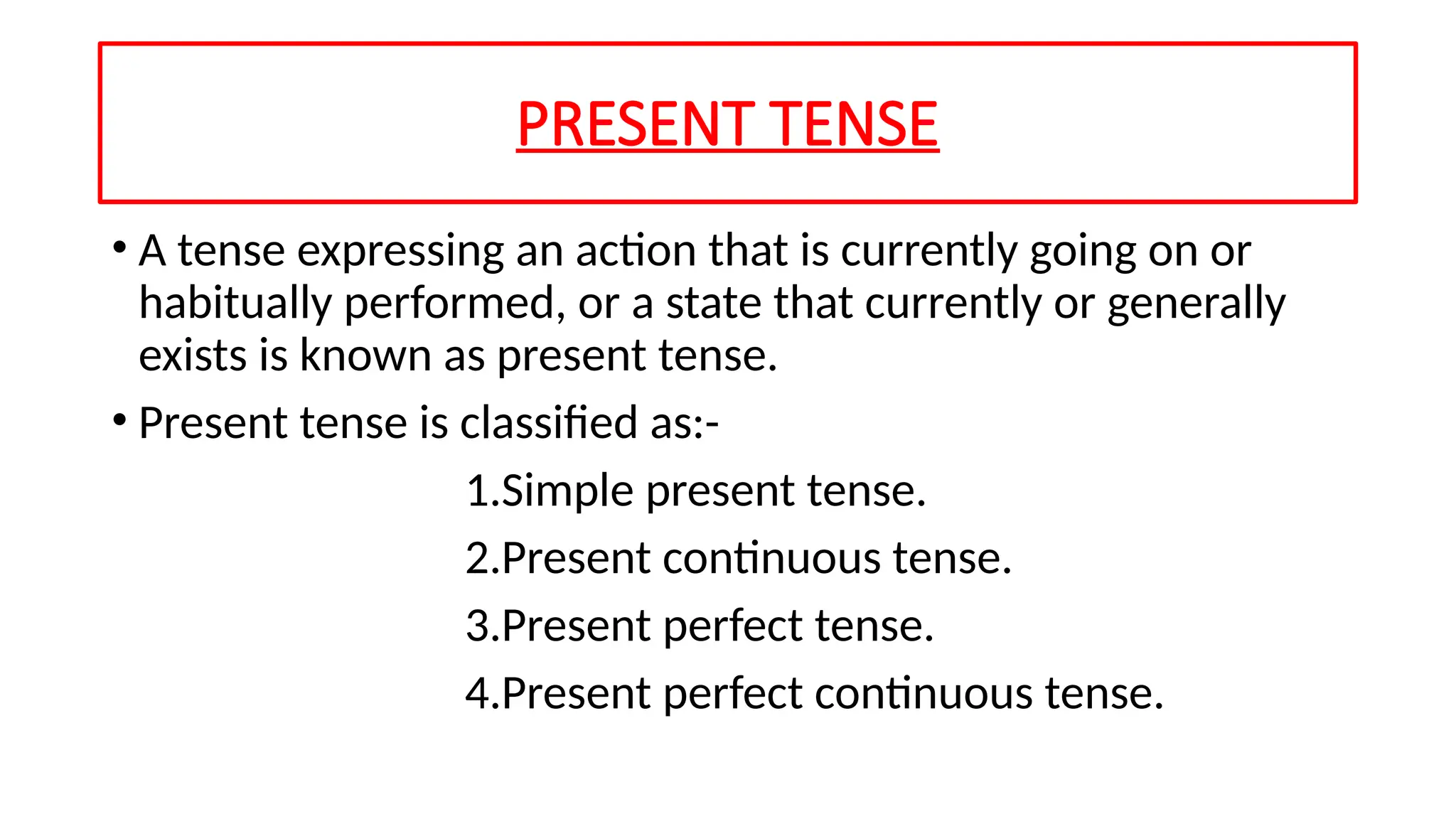
PRESENT TENSE
• A tense expressing an action that is currently going on or
habitually performed, or a state that currently or generally
exists is known as present tense.
• Present tense is classified as:-
1.Simple present tense.
2.Present continuous tense.
3.Present perfect tense.
4.Present perfect continuous tense.
PAST TENSE
• A tense expressing an action that has happened or a state
that previously existed.
• Past tense is classified as:-
1.Simple past tense.
2.Past continuous tense.
3.Past perfect tense.
4.Past perfect continuous tense.
FUTURE TENSE
• A tense expressing an action that has not yet happened, but
expected to happen in the future.
• Future tense is classified as:-
1.Simple future tense.
2.Future continuous tense.
3.Future perfect tense.
4.Future perfect continuous tense.
Simple Present Tense
• We use the simple present tense when an action is happening right
now, or when it happens regularly.
• Depending on the person, the simple present tense is formed by using
the root form or by adding s or es to the end.
‑ ‑
• Formula: Subject + Verb1 + Object.
• Example:
1.Sun shines everyday.
2.John plays football.
PRESENT CONTINUOUS TENSE
• The present continuous tense indicates that an action or condition is
happening now, frequently, and may continue into the future.
• Present Continuous tense is formed by adding -ing to the base verb.
• Formula: Subject + am/is/are + Verb1 + ing + Object.
• Example:
1.Ram is singing a song
2.They are watching a movie
PRESENT PERFECT TENSE
• The present perfect tense is a tense used in present to indicate the
action that has taken place at some specific time.
• It uses auxiliary verb and past participle for the main verb.
• Formula: Subject + have/has + Verb3 + Object.
• Note:
I/We/You/They= have + Verb3
He/She/It= has + Verb3
• Example:
1.I have learnt dancing today.
2. He has completed his homework.
PRESENT PERFECT CONTINUOUS TENSE
• The present perfect continuous tense (also known as the present
perfect progressive tense) shows that something started in the past
and is continuing at the present time.
• Formula: Subject + have/has + been + Verb1 + ing + Object
• Note:
I/We/You/They= have been + Verb1
He/She/It= has been + Verb1
• Example:
1.I have been drawing a picture.
2.He has been teaching a lesson
SIMPLE PAST TENSE
• The simple past is a verb tense that is used to talk about things that
happened or existed before now.
• The simple past tense shows that you are talking about something
that has already happened.
• Formula: Subject + Verb2 + Object.
• Note:
I/We/You/He/She/It/They + Verb2
• Example:
1.I sang(sang=did+sing)a song.
2.You kicked(did+kick)a ball.
PAST CONTINUOUS TENSE
• Past Continuous Tense is a tense which is used to indicate a
continuing action or event that was happening at some point in time
in the past.
• Formula: Subject + was/were + Verb1 + ing + Object.
• Note:
We/You/They= were + Verb1
I/He/She/It= was + Verb1
• Example:
1.I was teaching a lesson.
2.We were watching television.
PAST PERFECT TENSE
• The past perfect tense is a verb tense used to express actions that
occurred in the past that finished before another action in the past
started.
• Formula: Subject + had + Verb3 + Object
• Note:
I/We/You/He/She/It/They = had + Verb3
• Example:
1.I had learnt dancing today.
2.You had written your homework.
PAST PERFECT CONTINUOUS TENSE
• The past perfect continuous tense denotes an action that started in
the past, continued in the past, and also ended at a certain point in
the past.
• Formula: Subject + had + been + Verb1 + ing + Object
• Note:
I/We/You/He/She/It/They = had been + Verb1 + ing
• Example:
1.I had been drawing a picture.
2.You had been doing a project.
SIMPLE FUTURE TENSE
• The simple future is a verb tense that's used to talk about things that
haven't happened yet.
• We use the simple future to talk about an action or condition that will begin
and end in the future.
• Formula: Subject + will/shall + Verb1 + Object
• Note:
I/We = shall + Verb1
You/He/She/It/They = will + Verb1
• Example:
1.I shall sing a song.
2.He will go to school.
FUTURE CONTINUOUS TENSE
• A tense that indicates that something will occur in the future and
continue for an expected length of time.
• Formula: Subject + will/shall + be + Verb1 + ing + Object
• Note:
I/We = shall be + Verb1 + ing
You/He/She/It/They = will be + Verb1 + ing
• Example:
1.I shall be teaching a lesson.
2.You will be walking on the road.
FUTURE PERFECT TENSE
• The future perfect tense is used to indicate a future event that has a
definitive end date.
• Formula: Subject + will/shall + have + Verb3 + Object
• Note:
I/We = shall have + Verb3
You/He/She/It/They = will have + Verb3
• Example:
1.I shall have learnt dancing today.
2.You will have written your homework.
FUTURE PERFECT CONTINUOUS TENSE
• A verb tense that describes actions that will continue up until a point
in the future.
• Formula: Subject + will/shall + have + been + Verb1 + ing + Object
• Note:
I/We = shall have been + Verb1 + ing
You/He/She/It/They = will have been + Verb1 + ing
• Example:
1.We shall have been drawing a picture.
2.You will have been doing a project.
Basic Grammar Seminar English - Tenses.pptx

Basic Grammar Seminar English - Tenses.pptx

  • 1.
  • 2.
    WHAT IS TENSE? •Tense is the form of a verb which shows the time of action or event and the degree of completeness and also the state of action. • The word Tense means time. • There are three tenses Present, Past and Future.
  • 3.
    PRESENT TENSE • Atense expressing an action that is currently going on or habitually performed, or a state that currently or generally exists is known as present tense. • Present tense is classified as:- 1.Simple present tense. 2.Present continuous tense. 3.Present perfect tense. 4.Present perfect continuous tense.
  • 4.
    PAST TENSE • Atense expressing an action that has happened or a state that previously existed. • Past tense is classified as:- 1.Simple past tense. 2.Past continuous tense. 3.Past perfect tense. 4.Past perfect continuous tense.
  • 5.
    FUTURE TENSE • Atense expressing an action that has not yet happened, but expected to happen in the future. • Future tense is classified as:- 1.Simple future tense. 2.Future continuous tense. 3.Future perfect tense. 4.Future perfect continuous tense.
  • 6.
    Simple Present Tense •We use the simple present tense when an action is happening right now, or when it happens regularly. • Depending on the person, the simple present tense is formed by using the root form or by adding s or es to the end. ‑ ‑ • Formula: Subject + Verb1 + Object. • Example: 1.Sun shines everyday. 2.John plays football.
  • 7.
    PRESENT CONTINUOUS TENSE •The present continuous tense indicates that an action or condition is happening now, frequently, and may continue into the future. • Present Continuous tense is formed by adding -ing to the base verb. • Formula: Subject + am/is/are + Verb1 + ing + Object. • Example: 1.Ram is singing a song 2.They are watching a movie
  • 8.
    PRESENT PERFECT TENSE •The present perfect tense is a tense used in present to indicate the action that has taken place at some specific time. • It uses auxiliary verb and past participle for the main verb. • Formula: Subject + have/has + Verb3 + Object. • Note: I/We/You/They= have + Verb3 He/She/It= has + Verb3 • Example: 1.I have learnt dancing today. 2. He has completed his homework.
  • 9.
    PRESENT PERFECT CONTINUOUSTENSE • The present perfect continuous tense (also known as the present perfect progressive tense) shows that something started in the past and is continuing at the present time. • Formula: Subject + have/has + been + Verb1 + ing + Object • Note: I/We/You/They= have been + Verb1 He/She/It= has been + Verb1 • Example: 1.I have been drawing a picture. 2.He has been teaching a lesson
  • 10.
    SIMPLE PAST TENSE •The simple past is a verb tense that is used to talk about things that happened or existed before now. • The simple past tense shows that you are talking about something that has already happened. • Formula: Subject + Verb2 + Object. • Note: I/We/You/He/She/It/They + Verb2 • Example: 1.I sang(sang=did+sing)a song. 2.You kicked(did+kick)a ball.
  • 11.
    PAST CONTINUOUS TENSE •Past Continuous Tense is a tense which is used to indicate a continuing action or event that was happening at some point in time in the past. • Formula: Subject + was/were + Verb1 + ing + Object. • Note: We/You/They= were + Verb1 I/He/She/It= was + Verb1 • Example: 1.I was teaching a lesson. 2.We were watching television.
  • 12.
    PAST PERFECT TENSE •The past perfect tense is a verb tense used to express actions that occurred in the past that finished before another action in the past started. • Formula: Subject + had + Verb3 + Object • Note: I/We/You/He/She/It/They = had + Verb3 • Example: 1.I had learnt dancing today. 2.You had written your homework.
  • 13.
    PAST PERFECT CONTINUOUSTENSE • The past perfect continuous tense denotes an action that started in the past, continued in the past, and also ended at a certain point in the past. • Formula: Subject + had + been + Verb1 + ing + Object • Note: I/We/You/He/She/It/They = had been + Verb1 + ing • Example: 1.I had been drawing a picture. 2.You had been doing a project.
  • 14.
    SIMPLE FUTURE TENSE •The simple future is a verb tense that's used to talk about things that haven't happened yet. • We use the simple future to talk about an action or condition that will begin and end in the future. • Formula: Subject + will/shall + Verb1 + Object • Note: I/We = shall + Verb1 You/He/She/It/They = will + Verb1 • Example: 1.I shall sing a song. 2.He will go to school.
  • 15.
    FUTURE CONTINUOUS TENSE •A tense that indicates that something will occur in the future and continue for an expected length of time. • Formula: Subject + will/shall + be + Verb1 + ing + Object • Note: I/We = shall be + Verb1 + ing You/He/She/It/They = will be + Verb1 + ing • Example: 1.I shall be teaching a lesson. 2.You will be walking on the road.
  • 16.
    FUTURE PERFECT TENSE •The future perfect tense is used to indicate a future event that has a definitive end date. • Formula: Subject + will/shall + have + Verb3 + Object • Note: I/We = shall have + Verb3 You/He/She/It/They = will have + Verb3 • Example: 1.I shall have learnt dancing today. 2.You will have written your homework.
  • 17.
    FUTURE PERFECT CONTINUOUSTENSE • A verb tense that describes actions that will continue up until a point in the future. • Formula: Subject + will/shall + have + been + Verb1 + ing + Object • Note: I/We = shall have been + Verb1 + ing You/He/She/It/They = will have been + Verb1 + ing • Example: 1.We shall have been drawing a picture. 2.You will have been doing a project.