
Understanding, predicting and optimizing
learning with Learning Analytics
Jingyan Lu, The University of Hong Kong
July 5th, LASI-Hong Kong
7/6/2013Jingyan Lu@hku
1
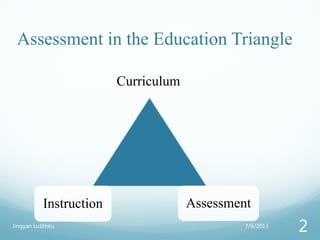
Assessment in the Education Triangle
Instruction Assessment
Curriculum
7/6/2013Jingyan Lu@hku
2
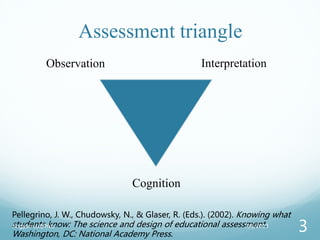
Assessment triangle
Observation Interpretation
Cognition
Pellegrino, J. W., Chudowsky, N., & Glaser, R. (Eds.). (2002). Knowing what
students know: The science and design of educational assessment.
Washington, DC: National Academy Press.
7/6/2013Jingyan Lu@hku
3
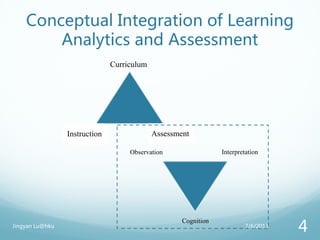
Conceptual Integration of Learning
Analytics and Assessment
Instruction Assessment
Curriculum
Observation Interpretation
Cognition
7/6/2013Jingyan Lu@hku
4
Contribution of measurement
and statistical modeling in
Assessment
7/6/2013Jingyan Lu@hku
5
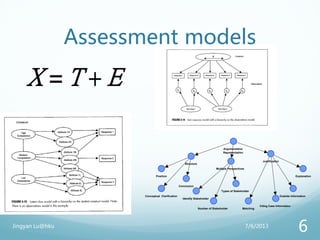
Assessment models
X = T + E
Argumentative
Representation
Structure
Justification
Position
Conceptual Clarification
Conclusion
Multiple Perspectives
Identify Stakeholder
Number of Stakeholder
Types of Stakeholder
Matching
Citing Case Information
Outside Information
Explanation
7/6/2013Jingyan Lu@hku
6
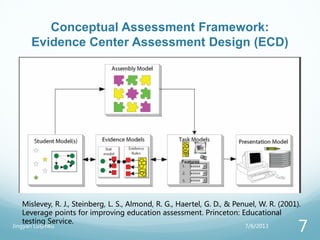
Conceptual Assessment Framework:
Evidence Center Assessment Design (ECD)
Mislevey, R. J., Steinberg, L. S., Almond, R. G., Haertel, G. D., & Penuel, W. R. (2001).
Leverage points for improving education assessment. Princeton: Educational
testing Service.
7/6/2013Jingyan Lu@hku
7
Assessment in the 21st Century
Classroom
 “This evidence-based approach (Mislevy et al,
2003) is particularly relevant in the 21st century
technology rich classroom where student’s
use of technology tools for learning create a
multitude of data (e.g., artefacts, log data)
which can be mined, assessed, and presented in
ways that students and teachers can interpret it
to support learning.”
 Hansen & Wasson (forthcoming)
Hansen, C. & Wasson, B. (forthcoming). Formaive e-assessment in the 21st century
Classroom. NEAR, Iceland, March 7/6/2013Jingyan Lu@hku
8
Applications--Where
 Online Learning Systems - online courses or
learning software or interactive environments that
use intelligent tutoring systems, virtual labs, or
simulations, such as Moodle.
 Why: Big data
7/6/2013Jingyan Lu@hku
9
Application of LA—Predictive
Models in Instructional System
 When are students ready to move onto the next topic?
 When are students falling behind in a course?
 When is a student at risk for not completing a course?
 What grade is a student likely to get without
intervention?
 What is the best next course for a given student?
 Should a student be referred to a counselor for help?
7/6/2013Jingyan Lu@hku
10
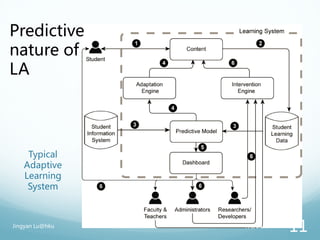
Typical
Adaptive
Learning
System
Predictive
nature of
LA
7/6/2013Jingyan Lu@hku
11
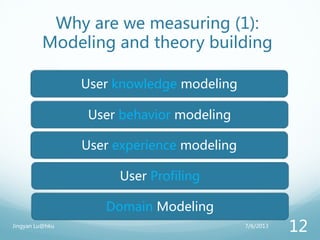
Why are we measuring (1):
Modeling and theory building
User knowledge modeling
User behavior modeling
User experience modeling
User Profiling
Domain Modeling
7/6/2013Jingyan Lu@hku
12
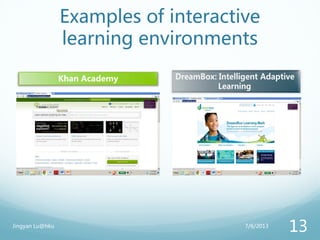
Examples of interactive
learning environments
Khan Academy
7/6/2013Jingyan Lu@hku
13
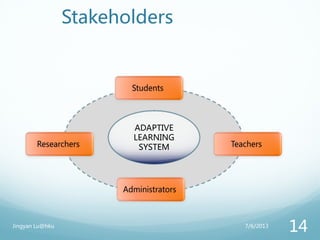
Stakeholders
ADAPTIVE
LEARNING
SYSTEM
7/6/2013Jingyan Lu@hku
14
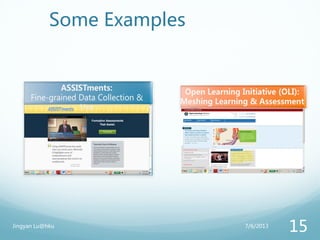
Some Examples
7/6/2013Jingyan Lu@hku
15
Examples (1): Online
learning behavior
7/6/2013Jingyan Lu@hku
16
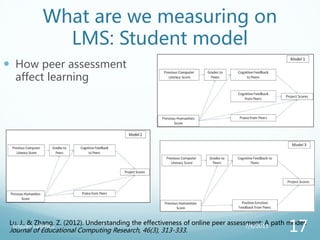
What are we measuring on
LMS: Student model
 How peer assessment
affect learning
Lu, J., & Zhang, Z. (2012). Understanding the effectiveness of online peer assessment: A path model.
Journal of Educational Computing Research, 46(3), 313-333.
7/6/2013Jingyan Lu@hku
17
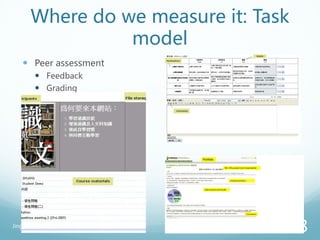
Where do we measure it: Task
model
 Peer assessment
 Feedback
 Grading
7/6/2013Jingyan Lu@hku
18
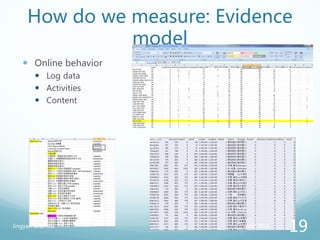
How do we measure: Evidence
model
 Online behavior
 Log data
 Activities
 Content
7/6/2013Jingyan Lu@hku
19
Example 2: Modeling online
critical reading
7/6/2013Jingyan Lu@hku
20
Student Model
 Critical reading behavior
 Critical reading and writing argument
7/6/2013Jingyan Lu@hku
21
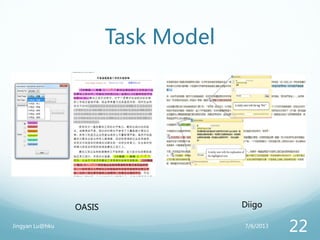
Task Model
DiigoOASIS
7/6/2013Jingyan Lu@hku
22
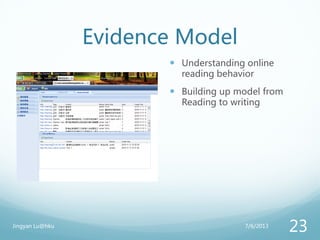
Evidence Model
 Understanding online
reading behavior
 Building up model from
Reading to writing
7/6/2013Jingyan Lu@hku
23
Thank You
jingyan@hku.hk
7/6/2013Jingyan Lu@hku
24

Understanding, predicting and optimizing learning with Learning Analytics

  • 1.
    Understanding, predicting andoptimizing learning with Learning Analytics Jingyan Lu, The University of Hong Kong July 5th, LASI-Hong Kong 7/6/2013Jingyan Lu@hku 1
  • 2.
    Assessment in theEducation Triangle Instruction Assessment Curriculum 7/6/2013Jingyan Lu@hku 2
  • 3.
    Assessment triangle Observation Interpretation Cognition Pellegrino,J. W., Chudowsky, N., & Glaser, R. (Eds.). (2002). Knowing what students know: The science and design of educational assessment. Washington, DC: National Academy Press. 7/6/2013Jingyan Lu@hku 3
  • 4.
    Conceptual Integration ofLearning Analytics and Assessment Instruction Assessment Curriculum Observation Interpretation Cognition 7/6/2013Jingyan Lu@hku 4
  • 5.
    Contribution of measurement andstatistical modeling in Assessment 7/6/2013Jingyan Lu@hku 5
  • 6.
    Assessment models X =T + E Argumentative Representation Structure Justification Position Conceptual Clarification Conclusion Multiple Perspectives Identify Stakeholder Number of Stakeholder Types of Stakeholder Matching Citing Case Information Outside Information Explanation 7/6/2013Jingyan Lu@hku 6
  • 7.
    Conceptual Assessment Framework: EvidenceCenter Assessment Design (ECD) Mislevey, R. J., Steinberg, L. S., Almond, R. G., Haertel, G. D., & Penuel, W. R. (2001). Leverage points for improving education assessment. Princeton: Educational testing Service. 7/6/2013Jingyan Lu@hku 7
  • 8.
    Assessment in the21st Century Classroom  “This evidence-based approach (Mislevy et al, 2003) is particularly relevant in the 21st century technology rich classroom where student’s use of technology tools for learning create a multitude of data (e.g., artefacts, log data) which can be mined, assessed, and presented in ways that students and teachers can interpret it to support learning.”  Hansen & Wasson (forthcoming) Hansen, C. & Wasson, B. (forthcoming). Formaive e-assessment in the 21st century Classroom. NEAR, Iceland, March 7/6/2013Jingyan Lu@hku 8
  • 9.
    Applications--Where  Online LearningSystems - online courses or learning software or interactive environments that use intelligent tutoring systems, virtual labs, or simulations, such as Moodle.  Why: Big data 7/6/2013Jingyan Lu@hku 9
  • 10.
    Application of LA—Predictive Modelsin Instructional System  When are students ready to move onto the next topic?  When are students falling behind in a course?  When is a student at risk for not completing a course?  What grade is a student likely to get without intervention?  What is the best next course for a given student?  Should a student be referred to a counselor for help? 7/6/2013Jingyan Lu@hku 10
  • 11.
  • 12.
    Why are wemeasuring (1): Modeling and theory building User knowledge modeling User behavior modeling User experience modeling User Profiling Domain Modeling 7/6/2013Jingyan Lu@hku 12
  • 13.
    Examples of interactive learningenvironments Khan Academy 7/6/2013Jingyan Lu@hku 13
  • 14.
  • 15.
  • 16.
    Examples (1): Online learningbehavior 7/6/2013Jingyan Lu@hku 16
  • 17.
    What are wemeasuring on LMS: Student model  How peer assessment affect learning Lu, J., & Zhang, Z. (2012). Understanding the effectiveness of online peer assessment: A path model. Journal of Educational Computing Research, 46(3), 313-333. 7/6/2013Jingyan Lu@hku 17
  • 18.
    Where do wemeasure it: Task model  Peer assessment  Feedback  Grading 7/6/2013Jingyan Lu@hku 18
  • 19.
    How do wemeasure: Evidence model  Online behavior  Log data  Activities  Content 7/6/2013Jingyan Lu@hku 19
  • 20.
    Example 2: Modelingonline critical reading 7/6/2013Jingyan Lu@hku 20
  • 21.
    Student Model  Criticalreading behavior  Critical reading and writing argument 7/6/2013Jingyan Lu@hku 21
  • 22.
  • 23.
    Evidence Model  Understandingonline reading behavior  Building up model from Reading to writing 7/6/2013Jingyan Lu@hku 23
  • 24.