Searching for EVIDENCE
Saurab Sharma, MPT
Lecturer, KUSMS
EBPP
Lecturer 5
Objectives
• At the end of the class, students should be
able to:
– Understand basic principles of effective
searching
– Search an article from Pubmed
2Saurab S, KUSMS 14'
Different search engines/
databases
• Pubmed/medline
• CINAHL
• OVID
• Cochrane
• PEDro
• Scopus
• ScienceDirect
• Proquest
• Google Scholar
3Saurab S, KUSMS 14'
Basics of searching
1. Carefully define your clinical question
2. Choose your search terms
3. Broaden your search if necessary (with
synonyms, truncation and/or wildcards
4. Use Boolean Operators
4Saurab S, KUSMS 14'
1. Carefully define your clinical question
• PICO
5Saurab S, KUSMS 14'
2. Choose your search terms
• PICO
6Saurab S, KUSMS 14'
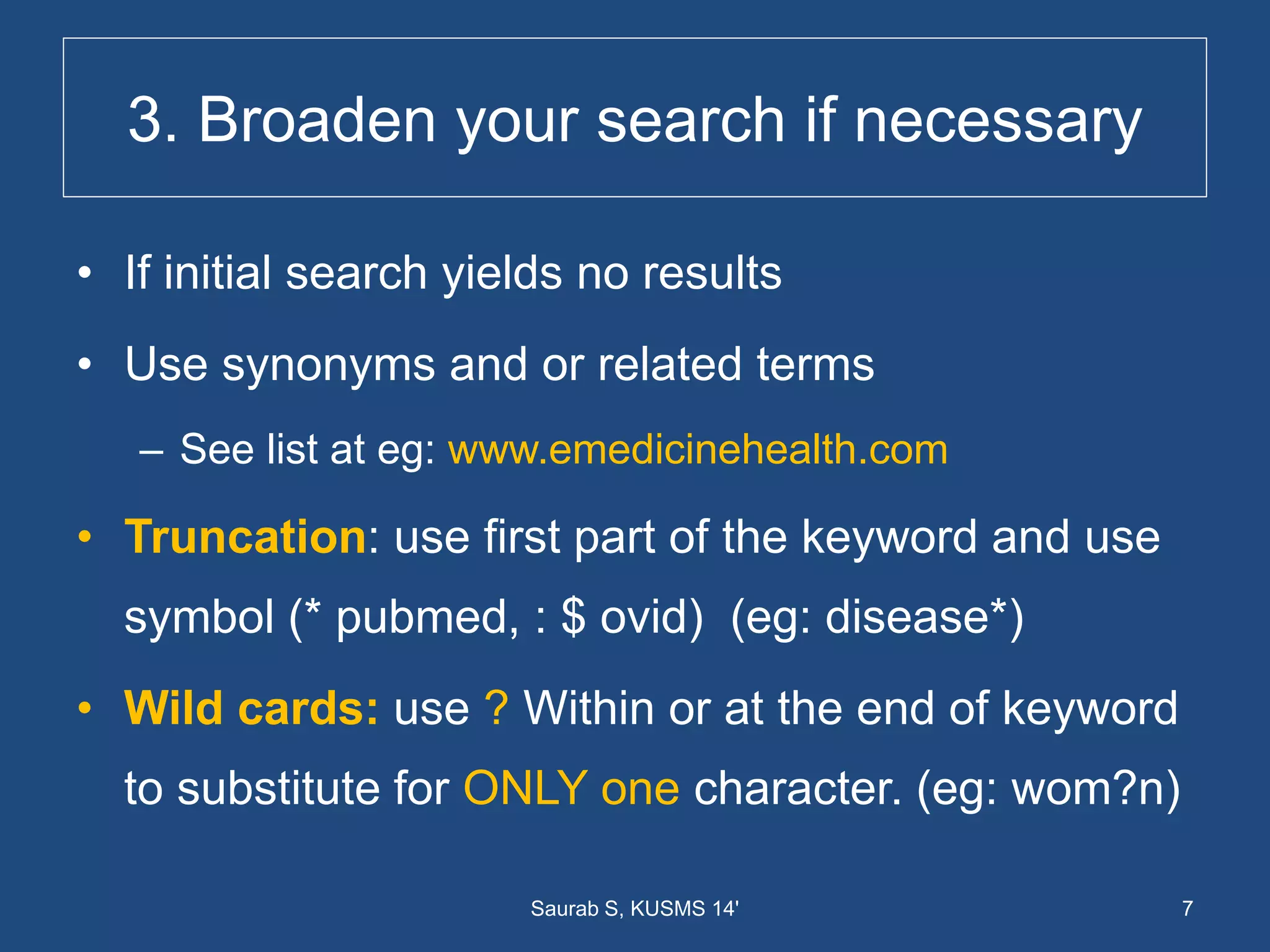
3. Broaden your search if necessary
• If initial search yields no results
• Use synonyms and or related terms
– See list at eg: www.emedicinehealth.com
• Truncation: use first part of the keyword and use
symbol (* pubmed, : $ ovid) (eg: disease*)
• Wild cards: use ? Within or at the end of keyword
to substitute for ONLY one character. (eg: wom?n)
7Saurab S, KUSMS 14'
4. Use Boolean Operators
1. AND
2. OR
3. NOT
8Saurab S, KUSMS 14'
4. Use Boolean Operators
1. AND
2. OR
3. NOT
9Saurab S, KUSMS 14'
Elaborated steps
1. Identify components of question PICO
2. Compose your clinical question
3. Construct the final clinical question
4. Record keywords and phrases
5. Identify synonyms and variant words
6. Use truncation, wild cards and Boolean terms
where appropriate
7. Decide the online resource(s) to search
10Saurab S, KUSMS 14'
Index term
1. MeSH terms (Pubmed)
2. Emtree (EMBASE)
3. CINAHL subject headings (CINAHL)
• Organized hierarchically using tree structure
• Broader terms higher in the tree
• Used to broaden or narrow the search
• Eg: stroke
11Saurab S, KUSMS 14'
References
• Hoffmann T, Bennett S, Del Mar C. Evidence-based
Practice across the health professionals. Churchill
Livingstone. Elsevier Australia. 2010
12Saurab S, KUSMS 14'

5. searching for evidence

  • 1.
    Searching for EVIDENCE SaurabSharma, MPT Lecturer, KUSMS EBPP Lecturer 5
  • 2.
    Objectives • At theend of the class, students should be able to: – Understand basic principles of effective searching – Search an article from Pubmed 2Saurab S, KUSMS 14'
  • 3.
    Different search engines/ databases •Pubmed/medline • CINAHL • OVID • Cochrane • PEDro • Scopus • ScienceDirect • Proquest • Google Scholar 3Saurab S, KUSMS 14'
  • 4.
    Basics of searching 1.Carefully define your clinical question 2. Choose your search terms 3. Broaden your search if necessary (with synonyms, truncation and/or wildcards 4. Use Boolean Operators 4Saurab S, KUSMS 14'
  • 5.
    1. Carefully defineyour clinical question • PICO 5Saurab S, KUSMS 14'
  • 6.
    2. Choose yoursearch terms • PICO 6Saurab S, KUSMS 14'
  • 7.
    3. Broaden yoursearch if necessary • If initial search yields no results • Use synonyms and or related terms – See list at eg: www.emedicinehealth.com • Truncation: use first part of the keyword and use symbol (* pubmed, : $ ovid) (eg: disease*) • Wild cards: use ? Within or at the end of keyword to substitute for ONLY one character. (eg: wom?n) 7Saurab S, KUSMS 14'
  • 8.
    4. Use BooleanOperators 1. AND 2. OR 3. NOT 8Saurab S, KUSMS 14'
  • 9.
    4. Use BooleanOperators 1. AND 2. OR 3. NOT 9Saurab S, KUSMS 14'
  • 10.
    Elaborated steps 1. Identifycomponents of question PICO 2. Compose your clinical question 3. Construct the final clinical question 4. Record keywords and phrases 5. Identify synonyms and variant words 6. Use truncation, wild cards and Boolean terms where appropriate 7. Decide the online resource(s) to search 10Saurab S, KUSMS 14'
  • 11.
    Index term 1. MeSHterms (Pubmed) 2. Emtree (EMBASE) 3. CINAHL subject headings (CINAHL) • Organized hierarchically using tree structure • Broader terms higher in the tree • Used to broaden or narrow the search • Eg: stroke 11Saurab S, KUSMS 14'
  • 12.
    References • Hoffmann T,Bennett S, Del Mar C. Evidence-based Practice across the health professionals. Churchill Livingstone. Elsevier Australia. 2010 12Saurab S, KUSMS 14'

Editor's Notes

  • #8 RA, rheumatic diasease for rheumatic arthritis